
Min Jung
Kim‡
a,
Doo Jin
Lee‡
a,
Jae Ryoun
Youn
*a and
Young Seok
Song
*b
aResearch Institute of Advanced Materials (RIAM), Department of Materials Science and Engineering, Seoul National University, Seoul 08826, Republic of Korea. E-mail: jaeryoun@snu.ac.kr
bDepartment of Fiber System Engineering, Dankook University, Gyeonggi Do 16890, Republic of Korea. E-mail: ysong@dankook.ac.kr
First published on 17th March 2016
This study focuses on the separation of different sized particles and cells by employing a facile two step label free separation technique which consists of elasto-inertial particle focusing and magnetophoretic particle repulsion. The elasto-inertial force makes the objects migrate toward the centerline at the first stage, and the magnetophoretic repulsion force makes them migrate to the lateral direction depending upon their particle size at the second stage in the microchannel. An analytical calculation is carried out to predict the trajectories of different sized particles by considering hydrodynamic viscous drag and magnetophoretic repulsion forces, and this is compared to the experimental results. Numerical analyses are performed to understand the physics underlying the elasto-inertial particle focusing and the magnetophoretic particle migration.
Recently, new separation techniques based on microfluidic systems have been developed to separate target cells or particles, showing the potential for a point-of-care (POC) diagnostic platform with advantages such as cost effectiveness, high throughput, high purity, and high sensitivity.11–15 Since label free separation techniques take advantage of hydrodynamics of particle-laden fluids, hydrodynamic forces acting on the particles such as inertial, drag, and elastic forces become important as well as particle size, particle density, and adhesion to a channel wall.16–18 It is also found that the combination of different types of forces, e.g., inertial/magnetic, inertial/acoustic, inertial/Dean, elastic/inertial forces, could enhance the separation efficiency and purity.6,12,19–22
It has been reported that diamagnetic particles suspended in a paramagnetic fluid show negative magnetophoresis under the magnetic field, which causes particle migration towards the direction of weaker magnetic field in the magnetic domain.23 The magnetophoretic repulsion and hydrodynamic viscous drag forces are more dominant than other forces such as dipole–dipole interactions, gravitational, buoyancy, and diffusion forces.24–27 These magnetophoretic repulsion and hydrodynamic viscous drag forces were harnessed for various applications, such as particle trapping, particle separation, and particle focusing.9,28–31
In recent years, the elasto-inertial focusing of particles mediated by fluid elasticity and inertia has been known to be an efficient technique to focus particles in a microchannel by adding only a small amount of long-chain molecules such as polymers and DNA into Newtonian solutions.32–36 Yang et al.35 firstly named the ‘elasto-inertial particle focusing’ in their work, where the particle focusing could be characterized by the elasticity number defined as the ratio of the Weissenberg number to the Reynolds number. The elasticity number depends on the rheological properties of the fluid and the characteristic length scale of the channel. Our previous study showed that the combination of the elastic force and Dean drag force yielded a multiplex particle focusing phenomenon induced by the nature of a viscoelastic medium and curved channel geometry.37 Indeed, the particle focusing and separation could be achieved by tuning the rheological properties of the fluids without any external forces and complicated configuration of the devices.
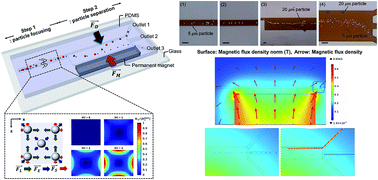
In this study, we investigated the focusing and subsequent particle migration behaviours by using the combination of the elastic and magnetorheological properties of fluids to achieve high separation efficiency of different sized particles. To be more specific, a two-step label free particle separation technique was proposed with the application of two main forces, the elastic force and the magnetophoretic repulsion force. An analytical calculation and numerical simulation were carried out to reveal the mechanism of two step lateral particle migration in the microfluidic channel.
, where Vp is the volume of the non-magnetic particle, μ0 is the permeability of free space,
is the magnetization of magnetic fluid, and
is the magnetic field at the center of non-magnetic particles. The magnetophoretic repulsion force acting on the microparticles counteracts the hydrodynamic viscous drag force defined as
, where η is the viscosity of surrounding fluid,
is velocity of fluid,
is the velocity of particles, and fD is the drag coefficient. The competition between the magnetophoretic repulsion and hydrodynamic viscous drag forces determines the lateral movement of the particles, yielding different particle migration depending on their particle sizes. Since the magnetophoretic repulsion force
is more dominant than the hydrodynamic viscous drag force
with respect to the particle size, large particles can migrate toward an upper channel wall at the second stage while small particles are less affected by the magnetophoretic repulsion force.
The separation efficiency depends on flow rates in the microchannel since the Weissenberg number (Wi = λ
c) and the Reynolds number (Re = ρUDh/η0) are affected by flow rates. Here, λ is the relaxation time,
c is the shear rate of fluid in the channel, ρ is the density of fluid, U is the average velocity, Dh is the hydraulic diameter of channel, and η0 is the zero-shear viscosity. The separation efficiency can also be determined by the concentration of ferrofluid since the amount of ferrofluid in the solution alters the overall magnetization of the fluid
as well as the rheological properties of the solution (Fig. S2†).
It is noted that the particles were not focused at the first stage when a Newtonian fluid was used, showing random distribution along the narrow channel (Fig. S1†). For the Newtonian medium, when the magnetic field was imposed at the second stage, size dependent particle separation did not occur since the particles were not positioned along the centerline at the first stage. In this case, both of 20 μm and 5 μm particles were randomly distributed at the second stage, and 5 μm particles were prone to migrate toward the outlet 1 along with 20 μm particles, which was undesirable for the efficient particle separation. This implies that one-step particle manipulation without particle focusing prior to magnetophoretic particle migration cannot lead to successful particle separation in a microfluidic device.
As the fluid elasticity exists in the solution (meaning, the Weissenberg number, Wi ≠ 0), a single-line particle focusing is observed in the first stage of the microchannel (Fig. 2a). It is shown that the particle focusing was successfully achieved as the particles went through the narrow microchannel from the inlet. Both 5 μm and 20 μm particles were focused along the centerline in the first stage when the flow rate was in the range of 5 to 200 μl h−1. The particle focusing was disturbed as the flow rate exceeded 200 μl h−1 due to the high inertial effect. It has been reported by Lim et al.34 that the particle focusing could be achieved when Wi ≫ 0 and Re ≫ 0. The blockage ratio (Dp/Dh) is also an important factor for the preferential particle focusing since lift forces are dependent on the ratio of particle diameter to channel ratio, and dominate in the case of Dp/Dh ≥ 0.07, causing particles to move toward equilibrium positions.6,8,38 It is clearly seen that the separation efficiency for both of 5 μm and 20 μm particles was high, and all 20 μm particles were collected at the outlet 1 while 5 μm particles showed 0.22%, 0.27%, and 99.51% separation efficiencies at the outlet 1, 2, and 3, respectively (Fig. 2b). It was also found that the particle separation efficiency showed a maximum value as the flow rate was 50 μl h−1 (Fig. 3) both 5 μm and 20 μm particles were collected at the outlet 1 when the flow rate was 5 μl h−1 due to the fact that the magnetophoretic repulsion force was much greater than the inertial force. On the other hand, the inertial force becomes greater than the magnetophoretic repulsion force as the flow rate becomes high, which deteriorates the particle separation efficiency at high flow rates. Therefore, it is advantageous to use the two step label free technique by the combination of the elastic and magnetic forces if high separation efficiency is required. For the small blockage ratio, e.g. Dp/Dh = 0.02, particle focusing in the viscoelastic medium was not achievable (Fig. S4†). The effect of the magnetophoretic repulsion force was also not significant due to their small particle sizes.
![]() | ||
| Fig. 3 Particle separation efficiency with different flow rates ranging from 5 to 200 μl h−1 for (a) 20 μm diameter and (b) 5 μm diameter particles. | ||
The trajectories of two different size particles were calculated analytically to estimate the particle migration by applying the equation of motion which was given by the balance among the acceleration, hydrodynamic viscous drag and magnetophoretic repulsion forces (Fig. 4). We obtained the trajectories of the particles for the suspension with the concentration of 0.4 wt% PEO and 10 wt% ferrofluid. Both 5 μm and 20 μm particles were initially located at the same streamline before they encountered the expanded channel. 5 μm particles showed little lateral migration as they traveled downstream since they were hardly affected by the magnetic force due to the small particle sizes. On the other hand, 20 μm particles showed a linear lateral migration. The analytical results were in good agreement with the experimental observations. At the second stage of the microchannel, the elastic force,
, can be negligible in comparison with the elastic force at the first stage in which
played a major role for the particle focusing since the elasticity number (El) at the second stage were 8 times smaller than that at the first stage (Fig. S3†). In this sense,
and
were dominant factors to determine the position of the particles at the second stage.
Since the elastic and magnetophoretic repulsion forces are associated with the concentrations of PEO and ferrofluid in the solution, the particle separation efficiency can be determined by the concentrations (Fig. 5). At lower PEO and ferrofluid concentration (PEO < 0.15 wt% and ferrofluid < 10 wt%), particles did not migrate to the center, showing random distribution at the first stage of the microchannel (Fig. 5a). When the concentration of PEO is in the range of 0.15 to 0.3 wt%, the particles tend to migrate to the center and four corners of the channel (Fig. 5c). As the concentration of ferrofluid increased to 10 wt%, the particles moved toward the upper wall, representing the lateral migration criterion by the magnetophoresis. In particular, the number of particle focusing regions was reduced to one, i.e., the centerline when the concentration of PEO increased to 0.4 wt% due to enough elasticity that pushed the particles to the center (Fig. 5e). It is found that the particles became off-centered by the magnetophoretic repulsion force that leads the particles to move toward the upper wall of the channel over the entire range of PEO concentrations (Fig. 5f). That is, the combination of the elastic and magnetophoretic repulsion forces can generate highly efficient particle separation at certain flow conditions. Through systematic experiments, we found that the particles were focused at the center during the first stage and then separated into different outlets during the second stage when the concentrations of ferrofluid and PEO exceed 10 wt% and 0.4 wt%, respectively.
A finite element simulation was carried out to understand physics underlying the viscoelastic particle focusing and magnetophoretic particle migration (Fig. 6 and 7). The first normal stress difference, N1, is an indicator for the elastic force,
, which is defined as
.34 The normalized value (N1/|Nmax1|) increased with an increase of Wi (Fig. 6). When Wi is zero, N1/|Nmax1| is zero at the cross-section since the fluid is purely viscous. As Wi increased, the elasticity of the fluid also increased, causing high N1/|Nmax1| at the cross-section. In particular, the minimum values were shown at four corners and the center as Wi increased, which drove the particles to move towards the center and four corners. Yang et al.35 demonstrated that a single-line particle focusing at the center occurs when the fluid inertia (Re > 0) and the elasticity (Wi > 0) compete each other. We also observed the single-line particle focusing as Re > 0.0321 and Wi > 1.59.
Once the particles are focused at the center during the first stage, they flow along the streamline unless there are external forces. The fluid elasticity becomes much smaller as the particles pass through the second stage with a high channel aspect ratio since the elasticity number becomes almost a tenth of the values at the first stage (Fig. S3†). Therefore, the effect of the elasticity can be neglected in the expanded channel. On the other hand, the magnetophoretic repulsion force is determined by the magnetization of the solution and the external magnetic force. While the particles pass through the expanded channel, they undergo lateral migration due to the magnetophoretic repulsion force,
, and the hydrodynamic viscous drag force,
. We performed numerical simulations to investigate the effect of the magnetic force and the magnetization on the particle migration and separation (Fig. 7). The strength of the magnetic field is proportional to the magnetic force generated by the magnet at the bottom of the channel, and an asymmetric magnetic field is generated to cause the lateral migration of the particles (Fig. 7a). It is clearly seen that different sized particles could be collected at different outlets. Since 5 μm particles were less influenced by the magnetophoretic repulsion force in comparison with 20 μm particles, they were collected at the outlet 2 (Fig. 7b). However, 20 μm particles were prone to move toward the upper wall of the channel and collected at the outlet 1 (Fig. 7c). The simulation results demonstrate that the combination of
and
is essential for an efficient label free particle separation through a two-step microfluidic platform by utilizing the elasto-inertial focusing and negative magnetophoresis.
Further experiments were carried out with two different sized biological cells (Chlorella vulgaris and Synechococcus sp.) since the isolation and separation of rare cells are of importance for a variety of biological applications. The average diameters of Chlorella vulgaris and Synechococcus sp. are found to be 5.26 μm and 2.51 μm, respectively (Fig. S5a and b†). It is shown that Chlorella vulgaris cells are focused at the center of the microchannel by the elastic force and migrate toward an upper wall due to the external magnetic force (Fig. S5c and e†). Therefore, Chlorella vulgaris cells are collected at an outlet 1. On the other hand, Synechococcus sp. cells are affected by neither the elastic force nor the magnetic force, showing random distribution as flowing downstream in the channel since the sizes of the cells are relatively smaller than the channel width, and the blockage ratio is only 0.05, which is insufficient to generate the viscoelastic particle focusing (Fig. S5d and f†). Our ongoing effort is to optimize cell separating conditions by considering the deformation of cells and their viscoelasticity.
:
1 mixing ratio (Sylgard 184, Dow Corning) was poured onto the SU-8 photoresist mold, degassed in a vacuum chamber, and cured in an oven at 70 °C for 6 h. The devices were cut from the mold, and punched with a sharpened flat-tip needle to make inlets and outlets. The PDMS replica was bonded onto the slide glass after oxygen plasma treatment. Then, the devices were placed on a hotplate at 120 °C for 20 min to increase bonding strength. A NdFeB permanent magnet was positioned by the side of the microchannel as shown in Fig. 1. The magnetic flux density of the magnet was measured to be 0.198 Tesla by using a Tesla meter (TM-701, KANETEC).
000
000, Sigma Aldrich) was diluted in 22 wt% aqueous glycerol solution. A water based ferrofluid (EMG 408, Ferrotec Corp.) was mixed with the fluids. A small amount of surfactant (Tween 20, Sigma-Aldrich) was added to both of solutions to prevent particle aggregation. Two different sized biological cells (Chlorella vulgaris and Synechococcus sp.) were cultured with BG11 medium (C3061, Sigma Aldrich) for 14 days before usage. Particles and cells were extracted from the medium after experiments by a magnet (Fig. S6†). To investigate the viability of cells, 1% Evans blue dye (EBD) in phosphate-buffered saline (PBS, pH 7.5) was used. For testing the viability of Chlorella vulgaris cells with EBD, Chlorella vulgaris cells were incubated in the dye prior to introducing the cell solution into a microchannel. Then, the cell solution was collected from the outlet after an experiment to investigate the viability. Dead cells are distinguished by a dark-blue color, whereas viable cells are not stained by EBD, which gives different light intensity peaks (Fig. S7a and b†). It is shown that the viability of the cells decays slowly with respect to time, but more than 60% Chlorella vulgaris cells are still viable after a day in the PEO/ferrofluid solution (Fig. S7c†).
exp(−t/λc), where R1 is the initial radius of the filament.38 The viscosity of each fluid was measured by using a strain controlled rheometer (AR G2, TA Instruments) with 60 mm diameter parallel plates over the shear rate of 1 ≤
≤ 1000 s−1 (Fig. S2†). The measured data were fitted with the Carreau model to estimate the zero shear rate and infinite shear rate viscosities, which is expressed by (η − η∞)/(η0 − η∞) = 1/(1 + (λ
)2)n/2 where n is the power index, λ is the relaxation time, and the values are listed in Table S2.†
![]() | (1) |
![]() | (2) |
All the parameters involved in the modeling are listed in Table S1.† It is assumed that the fluid velocity along the x-direction (vf,x) is equal to the particle velocity (vp,x). The entrance length correlates with the Reynolds number for a laminar flow, which can be expressed as Le ≈ 0.06Re. Therefore, a fully developed laminar flow is assumed in this condition. Thus, the velocity profile for the fully developed laminar flow is given by
![]() | (3) |
In which Q is volumetric flow rate, wc is the width, and hc is the height of the microchannel, respectively. The equation of motion of particles under the Stokes flow is
. This equation is modified as
by considering the magnetophoretic repulsion force acting on the particle along the y-direction. Here, FM,y is defined as FM,y = −2πμ0ϕap3MdL(α)∇H2/3H, in which ϕ is the volume fraction of magnetic nanoparticles, Md is the saturation magnetization of the ferrofluid, L(α) is the Langevin function, and H is the magnitude of the magnetic field, μ0 is the permeability of free space, and ap is radius of the spherical diamagnetic particle. By assuming the fluid flow is laminar in the x-direction, vf,y is neglected. Thus, FD,y is reduced to FD,y = −3πηDpvp,yfD. The magnetophoretic repulsion force is proportional to the volume of the particle, and the hydrodynamic viscous drag force is proportional to the diameter of the particle. We obtain the particle velocity in the y-direction (vp,y) as below.
![]() | (4) |
The trajectories of the particles with different sizes can be determined by substituting eqn (3) and (4) into eqn (1).
c, which helps understand the particle focusing behavior with enhanced fluid elasticity at the first stage of the microchannel. For the simulation, governing equations are non-dimensionalized by using Re and Wi. For a steady state, the momentum equation is expressed as Re(u·∇)u = ∇·(−pI + (ηs/η)[(∇u) + (∇u)T] + T) and the extra stress contribution becomes
, where
is the upper convected derivative operator expressed as
, λ is the characteristic relaxation time, ηp is the relative polymer viscosity, ηs is the relative solvent viscosity, and the total viscosity is η = ηs + ηp. The relative solvent and polymer viscosities are set to 0.6 and 0.4, respectively. Wi is varied to observe the effect of N1. Once particles are aligned along the centerline due to the fluid elasticity, they flow along their streamlines to downstream. The Carreau model as a non-Newtonian viscosity model is used to model the particle migration in a fluid in the entire microchannel, whose parameters are set to λ = 0.00634, η0 = 9.08 × 10⁻³ Pa s, η∞ = 7.21 × 10⁻⁷ Pa s, and n = 0.1056 according to the rheological properties of the fluids (Fig. S2†). In this magnetostatic problem, where no electric current is present, ∇ × H = 0, which implies the magnetic scalar potential is given by H = −∇ψ. By adding the constitutive relation of B = μ0(H + M) into ∇·B = 0, the equation becomes ∇·(μ0∇ψ − μ0M) = 0, where μ0 is the permeability of a vacuum and M is the magnetization of a permanent magnet. The lifting force (FL) acting on the particle is determined by d(mpV)/dt = FL, which is the combination of the hydrodynamic viscous drag force (FD) and the magnetophoretic repulsion force (FM). The two forces are expressed as FD = 18mpη(U − Vp)/4ρpap2 and FM = 2πap3μ0μr,fK∇H2, where mp is the density of particle, η is the fluid dynamic viscosity, U is the fluid velocity, Vp is the particle velocity, ρp is the particle density, ap is the particle radius, μr,f is the fluid relative permeability, μr,p is the particle relative permeability, and K is defined as (μr,p − μr,f)/(μr,p + 2μr,f). Overall, the momentum equation, magnetic field, and particle tracing are consecutively solved to obtain the lateral migration of the particles depending on their sizes.
Footnotes |
| † Electronic supplementary information (ESI) available. See DOI: 10.1039/c6ra03146c |
| ‡ These authors contributed equally to this work. |
| This journal is © The Royal Society of Chemistry 2016 |