Fei-Fei Zhangab,
Chun-Li Wang
ab,
Gang Huangab,
Dong-Ming Yinab and
Li-Min Wang*a
aState Key Laboratory of Rare Earth Resource Utilization, Changchun Institute of Applied Chemistry, CAS, Changchun, 130022, China. E-mail: lmwang@ciac.ac.cn; Fax: +86 431 85262836; Tel: +86 431 85262447
bUniversity of Chinese Academy of Sciences, Beijing, 100049, China
First published on 2nd March 2016
Three-dimensional interconnected porous nitrogen-doped graphene/carbonized polypyrrole nanotube (N-GP/CPN) materials have been fabricated via carbonization and chemical activation of polypyrrole-functionalized graphene nanosheets with KOH. The obtained N-GP/CPN with high surface, abundant nanopores and nitrogen doping can serve as conductive substrates for hosting a high content of sulfur and can effectively impede the dissolution of polysulfides. The N-GP/CPN-S composite exhibits excellent electrochemical performance as the cathode material for lithium–sulfur (Li–S) batteries, including a high initial discharge capacity of 1128 mA h g−1 at 0.5C, a notable cycling stability with a high stable capacity of 726 mA h g−1 and an ultraslow decay rate of 0.07% per cycle as long as 500 cycles. Moreover, the N-GP/CPN-S cathode also exhibits good rate capacity, showing a high reversible stable capacity of 687 mA h g−1 at 4C.
One of the most effective way is coupling sulfur with electrically conducting agents to partly overcome the demerits of sulfur cathode. The conductive polymers12–16 have been reported as sulfur hosts due to the good compatibility with sulfur and electrolytes.17 Polypyrrole (PPy) with hollow sphere16,18 or tubular type,19 which have good absorbing ability to the sulfur and polysulfides, exhibited improved cyclability of Li–S batteries. However, the electrochemical performance is still unsatisfactory because of the low pore volume and electrical conductivity of PPy. Carbon materials, such as porous carbon,20,21 carbon nanotubes/fibers,22 and graphene,23 have been engineered to form a conductive network for storing the active material, trapping the dissolved polysulfides, then much improved the discharge capacity and the cycle life of Li–S batteries. Among these carbon materials, two-dimensional (2D) graphene with high specific surface area, excellent mechanical flexibility and stability, has been extensively studied and used in Li–S batteries. However, the simplex 2D structured nanomaterials are not effective to contain high content of sulfur and confine the lithium polysulfides from dissolving out of the composites. Recently, three-dimensional (3D) nanostructured graphene have been emerged as efficient host to encapsulate sulfur as cathode material for Li–S batteries due to its unique structure and properties, achieving significantly enhanced reversible capacity, cycling stability and rate capability.24,25 The 3D conductive network can efficiently enhance the interaction between the active materials electrolytes, shorten diffusion paths for charge transport, and reduce electron transfer resistant.6,26 Furthermore, the porous structure within framework are favored for high sulfur loading and retarding polysulfides dissolution. In addition of the structure modification of graphene, the optimization by tailoring functional sites can also manipulate its chemical reactivity and electronic property. A particularly interesting example is nitrogen-doping which induces a large number of active defects at the edges of graphene. It exhibits more effectively chemical adsorption of sulfur and lithium polysulfides on the high-surface-area graphene nanolayers and leads to much better electrochemical performances for Li–S batteries.27,28
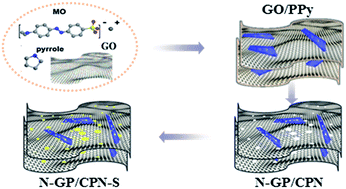
Herein, a novel 3D interconnected porous graphene/carbonized PPy nanotube materials with nitrogen-doping were prepared by facile in situ polymerization, carbonization and chemical activation. N-GP/CPN-S composites were further synthesized through melt diffusion method and used as cathode materials for Li–S batteries, as shown in Scheme 1. The N-GP/CPN with high conductivity and abundant nanopores not only serve as conductive substrates for electrons transport, but favored for firmly depositing sulfur. Meanwhile, the nitrogen doping elevates adsorption of sulfur on nitrogen-containing functional groups and effectively impede the dissolution of polysulfides in the carbon framework. As a result, the as-prepared N-GP/CPN-S composite exhibits superior rate capability and excellent cycle life.
:
1 in ethanol/water co-solvent was stirred for 2 h. After evaporation of the solvents, the mixture was transferred into a tube furnace and heat-treated at 800 °C for 2 h under N2 flow at a heating rate of 2 °C min−1. The obtained product was thoroughly washed with HCl solution (1 M), filtered and then freeze dried to generate porous N-GP/CPN.
The N-GP/CPN-S composite was further synthesized using the mixture of N-GP/CPN composite and sulfur with mixed a mass ratio 1
:
4 and heated at 155 °C for 12 h under N2 flow with a heating rate of 0.5 °C min−1. The GO/PPy-S composite was synthesized using the same method.
:
1, including 0.1 M LiNO3 as an electrolyte additive. The cells were charged and discharged at different current rates between 1.8 and 2.7 V (vs. Li/Li+) using LAND CT2001A multi-channel battery testing system at room temperature. The electrochemical impedance spectroscopy (EIS) measurements and cyclic voltammetry (CV) measurements were carried out with a BioLogic VMP3 station. EIS measurements were performed over frequency ranges from 700 kHz to 100 mHz in automatic sweep mode. CV experiment was performed in the range of 1.8–2.7 V at a sweep rate of 0.05 mV s−1. In this context, 1C corresponds to a current density value of 1675 mA g−1, the specific capacity was calculated on the basis of sulfur mass.
![]() | ||
| Fig. 1 SEM images of (a) GO/PPy and (b) N-GP/CPN composites, (c) low and (d) high resolution TEM images of N-GP/CPN composite. | ||
Fig. 2a shows the Raman spectra for the as-prepared samples. The G band as a characteristic feature of regular graphene structure is usually attributed to the in-plane vibrations of the sp2 carbon atom.29 The D band is associated with the disordered carbon or defective graphitic structures. The intensity ratio of the D and G bands (ID/IG) indicates the disorder in the graphene materials, which is 1.16 for N-GP/CPN (0.88 for GO/PPy). The high value could be attributed to the breakdown and modification of N atoms at the edge of graphene sheets.32 Furthermore, the elemental composition and the bonding configurations of nitrogen functionalities after carbonization processes are investigated by XPS. The XPS survey spectra of GO/PPy and N-GP/CPN in Fig. 2b both show the presence of the C 1s at 285 eV, N 1s peak at 400 eV and O 1s peak at 532 eV.29 Fig. 2c discerns the high-resolution C 1s spectrum of GO/PPy composite which combines the characteristics of both GO and PPy, and divided into four peaks with binding energies at about 284.5, 285, 286.3 and 288.8 eV, corresponding to sp2 graphitic carbon, C 1s, C–N/C–O and –COO–.33 Meanwhile, as shown in Fig. 2d, the peaks in the C 1s spectrum of N-GP/CPN composite exhibit a little difference. The presence of the C
N/C
O peak at 288.3 eV and the disappearance of the –COO– peak suggest the bonding formation of nitrogen atoms to be sp3 carbon and the carbonization of GO, respectively.34 Fig. 2e shows the deconvoluted N 1s spectrum of the GO/PPy composite. The peak at 399.7 eV corresponds to the neutral amine nitrogen (C–N), two major peaks at 397.7 and 400.5 eV are assigned to the imine nitrogen (–N
) and the positively charged nitrogen (–N+),33 respectively, both of which are changed in the N 1s spectrum of the N-GP/CPN composite. The N 1s peak (Fig. 2f) could be deconvoluted into three different peaks with binding energies at about 398.5, 399.6, and 401.2 eV, consistent with pyridinic-N, pyrrolic-N, and graphitic-N,29 separately. Obviously, doping nitrogen atoms into graphene sheets can converts nitrogen atoms within the pentagonal ring of polypyrrole into three types of N-configurations: pyridine-like, pyrrole-like, graphite-like, (Fig. 2g) and induces more defects, which can provide more active sites to chemical adsorb sulfur on the high-surface-area graphene nanosheets.
The pore structure and BET surface area of N-GP/CPN are characterized by N2 adsorption–desorption measurement. The nitrogen sorption isotherms and the corresponding pore size curves of GO/PPy and N-GP/CPN are compared in Fig. 3a and b, respectively. The N-GP/CPN exhibits a typical type IV isotherm with a hysteresis loop in the relative pressure range p/p0 of 0.4–1.0, suggesting the presence of mesoporous structure. Accordingly, the specific surface area of N-GP/CPN is calculated as high as 1178.4 m2 g−1, which is much higher than that of GO/PPy (183.5 m2 g−1). And the pore size distribution of N-GP/CPN displays a large total pore volume of 1.523 cm3 g−1 (p/p0 = 0.9705), which can hosts as much as 75.9 wt% sulfur (ρs = 2.07 g cm−3) according to the theoretical analysis. Compared to the low surface area and pore volume (Fig. 3b, inset) of 0.274 cm3 g−1 (p/p0 = 0.9712) for GO/PPy, it is undoubted that the chemical activation with KOH is not merely digesting the carbon to produce more pores but also dramatically restructuring it, thus yielding continuous 3D interconnected porous N-GP/CPN materials with high BET surface area and pore volume. Notably, the large surface area and porous structure is beneficial for improving the high load of sulfur, confining sulfur and polysulfides effectively, and providing channels for the ions diffusion/transportation.
![]() | ||
| Fig. 3 (a) Nitrogen adsorption–desorption isotherms and (b) pore size distribution of GO/PPy and N-GP/CPN composites. | ||
Since both sulfur and pyrolytic carbon are polar materials, it is easy for N-GP/CPN frameworks to absorb sulfur molecules within these porous channels. Then the N-GP/CPN-S composite with high content of sulfur is synthesized. The GO/PPy-S composite with same ratio is also obtained for comparison. The exact sulfur mass loadings are determined by TGA. As shown in Fig. 4, the weight loss before 300 °C is considered to be the evaporation of sulfur. The sulfur mass loadings of N-GP/CPN-S and GO/PPy-S composites could calculate as approximately 76 wt% and 72 wt%, respectively.
SEM and TEM are performed to observe the morphologies of N-GP/CPN-S and GO/PPy-S composites (Fig. 5). The architectures of N-GP/CPN-S stacked by well-exfoliated thin laminar graphene sheets are clearly observed in the SEM image (Fig. 5a), and no agglomerated sulfur particles are found on the surface of graphene nanosheets. Meanwhile, large sulfur particles and aggregated sheets in GO/PPy-S composite are obviously observed in Fig. 5b. The sulfur particles can be easily discerned in the EDS elemental mapping of GO/PPy-S (Fig. S1†). As shown in Fig. 5c, EDS elemental mapping from the N-GP/CPN-S composite suggests that C, N and S are homogeneously spread among the whole hybrid samples. Both C and S maps are found to have similar intensity across the composite, indicating that sulfur is homogeneously impregnated into the small pores of the N-GP/CPN. TEM images also confirm the highly homogeneous dispersion of nanoscopic sulfur on the surface of the N-GP/CPN-S composite without any agglomerated or bulk sulfur (Fig. 5d and e). XRD patterns of N-GP/CPN, N-GP/CPN-S, and GO/PPy-S composites are shown in Fig. 6. The broad peak at around 24° of N-GP/CPN assigns to the amorphous nature for the carbon. The pattern of GO/PPy-S exhibits sharp diffraction peaks from elemental sulfur (JCPDS: 08-0247). Meanwhile, the peak intensity of sulfur in the N-GP/CPN-S composite is largely reduced, and indexed to another orthorhombic crystalline structure (JCPDS: 42-1278), implying the even re-dispersion of sulfur within the porous nanostructures, which is consistent with the SEM and TEM analyses.
![]() | ||
| Fig. 5 SEM images of (a) N-GP/CPN-S and (b) GO/PPy-S composites, (c) SEM image of N-GP/CPN-S composite and corresponding EDS elemental mapping images, (d and e) TEM images of N-GP/CPN composite. | ||
To evaluate the advantageous electrochemical lithium storage capabilities, systematical electrochemical measurements are made by using N-GP/CPN-S as the cathode active material within CR2025 coin cells. Bare GO/PPy-S composite is also assembled as cathode active material in coin cells for comparison. CV is firstly employed to reveal the electrochemical reaction mechanism and kinetic process of the N-GP/CPN-S and GO/PPy-S electrodes measured between 1.8 and 2.7 V at a scan rate of 0.05 mV s−1, as shown in Fig. 7a. There are two cathodic peaks in the first scan of N-GP/CPN-S electrode due to the multiple reductions of sulfur.35 The peak at 2.36 V is associated with the reduction of sulfur (S8) to higher-order polysulfides (Li2Sx, 4 ≤ x ≤ 8), while the intense peak at 2.03 V is related to further reduction of these soluble polysulfides to insoluble lower-order Li2S2/Li2S.21 Two oxidation reaction peaks are observed in the subsequent anodic scan. The first peak at 2.30 V is associated with the formation of Li2Sn (2 ≤ n ≤ 8), and the second peak at 2.41 V corresponds to the formation of elemental sulfur.36,37 All the corresponding peaks are observed in the CV curve of GO/PPy-S electrode, but with low intensities and delayed reactions (larger polarization), which reveal a higher kinetic barrier for the direct reduction in charge–discharge processes.37
Fig. 7b shows the typical charge–discharge voltage profiles of the N-GP/CPN-S and GO/PPy-S electrodes at 0.2C in the voltage range of 1.8–2.7 V. Consistent with the CV analysis, they display a two-plateau behavior corresponding to the formation of higher-order polysulfides at about 2.38 V and lower-order Li2S2/Li2S at about 2.05 V. The initial discharge and charge capacities of GO/PPy-S electrode are 1131 and 1175 mA h g−1, respectively, with a little overcharge. On the contrary, a high initial discharge capacity of 1205 mA h g−1 and a reversible charge capacity of 1210 mA h g−1 are delivered in N-GP/CPN-S electrode, revealing the facile electronic/ionic transport and improved reaction kinetics enabled by the N-doping porous 3D framework including the 1D carbonized PPy nanotubes and 2D reduced graphene sheets. As shown in Fig. 7c, in the subsequent charge/discharge cycles, the N-GP/CPN-S electrode shows excellent stability with a reversible capacity of 926 mA h g−1 after 100 cycles, as well as exhibits a coulombic efficiency almost 100% for each cycle. In contrast, the GO/PPy-S electrode suffers from steady capacity fading, showing a discharge capacity of 532 mA h g−1 by the 100th cycle, which is due to the rapid dissolution of polysulfide into the electrolyte.
Furthermore, N-GP/CPN-S electrode also shows greatly improved rate performance with continuously increased current rates (Fig. 7d). At high current rates of 0.5, 1, 2, and 4C, the electrode delivers the discharge capacities of 981, 887, 778, and 687 mA h g−1, respectively. More importantly, a stable high capacity of 814 mA h g−1 can still be returned after abruptly switching the current rate back to 1C, indicating outstanding stability and robustness of the electrode. For the GO/PPy-S electrode, it exhibits much lower capacities of 701, 563, 406, and 283 mA h g−1 at the current rates of 0.5, 1, 2, and 4C. Long-term cycling test of the N-GP/CPN-S electrode is carried out at a current rate of 0.5C (Fig. 7e). It exhibits an initial discharge capacity of 1128 mA h g−1 and a notable cycling stability with high stable capacity of 726 mA h g−1 as long as 500 cycles, ultraslow decay rate of 0.07% and per cycle good coulombic efficiency of almost 100%. Therefore, the improved rate performance and cycling stability with high sulfur loading are ascribed to the accommodation of the volume changes provided by the electrode material designs and physical trapping of polysulfide with the interconnected porous nanolayers and nanotubes. In addition, the trapped polysulfides can further efficiently immobilized within the porous structure by chemical adsorption between the N-containing functionalities, such as pyridinic-N, pyrrolic-N, and the discharged polar lithium polysulfide intermediates.
The EIS results of the N-GP/CPN-S and GO/PPy-S electrodes before cycling and after 100 cycles at 0.2C are shown in Fig. 8. The spectra are composed of a semicircle in the high frequency region and a straight line in the low frequency region, which are corresponded to the interfacial charge-transfer resistance (Rct) and Warburg resistance.38,39 It is seen that N-GP/CPN-S electrode has a much smaller Rct than that of GO/PPy-S electrode, indicating the enhanced conductivity of N-GP/CPN-S. After cycling for 100 cycles, both of Rct decreases remarkably when compared with that before cycling, derived from the adequate infiltration of electrolyte, as well as the dissolution and re-distribution of the active materials.40 The charge-transfer resistance of the GO/PPy-S electrode is still larger than that of the N-GP/CPN-S electrode after the 100th discharge, due to the irregular agglomeration of insulating Li2S on the surface of electrode. However, the N-GP/CPN with high surface and abundant nanopores can stably trap lithium polysulfides during the cycling process, thereby restraining the redistribution and agglomeration of Li2S. In addition, the higher conductivity, inter-connected structures and nitrogen doping are also benefit for the enhancement of the electron and ion transfer.
![]() | ||
| Fig. 8 Nyquist plots of the N-GP/CPN-S and GO/PPy-S electrodes (a) before cycling and (b) after 100 cycles. | ||
Footnote |
| † Electronic supplementary information (ESI) available. See DOI: 10.1039/c6ra02667b |
| This journal is © The Royal Society of Chemistry 2016 |