
G. Rajasekaran and
Avinash Parashar*
Department of Mechanical and Industrial Engineering, Indian Institute of Technology, Roorkee – 247667, India. E-mail: drap1fme@iitr.ac.in; rajasekaran.ed@gmail.com; Tel: +91-1332-284801
First published on 4th March 2016
A one atom-thick sheet of carbon exhibits outstanding elastic moduli and tensile strength in its pristine form but structural defects which are inevitable in graphene due to its production techniques can alter its structural properties. These defects in graphene are introduced either during the production process or deliberately by us to tailor its properties. This article discusses the performance enhancement of graphene by introducing pentagon–heptagon–heptagon–pentagon (5–7–7–5) defects. The effect of geometrical parameters such as the nearest neighbour distance and angular orientation between 5–7–7–5 defects on the mechanical properties and failure morphology of graphene was investigated in the frame of molecular dynamics. The mechanical properties and failure morphology of graphene was predicted to be the function of geometrical parameters between 5–7–7–5 defects. It has been predicted from the current study that the brittle behaviour of graphene can be modified to ductile with well controlled distribution of 5–7–7–5 defects. Also it has been predicted that the mechanical properties of graphene can be altered by proper distribution of 5–7–7–5 defects.
Variety of techniques are available for the production of graphene, which also helps in maintaining flexibility with respect to quality, production cost, size and volume of production.1 Even though, different production techniques are existing, it is very hypothetical state to produce pristine graphene sheets. Following possible defects have been observed in graphene sheet such as vacancies (e.g. mono-vacancy, di-vacancy, and multi-vacancy),1 Stone–Thrower–Wales (STW) defects (also known as 5–7–7–5 defects),1 5–7 defects,23–26 pentagon–octagon–pentagon (5–8–5) defects,27 adatoms and substitution atoms, impurities28 and so on. In addition to the defects that are associated with the production technique, defects can also be generated deliberately29–32 for enhancing functionality of graphene in terms of ideal shape, structure and orientation for desired properties.33–35
Mechanical and fracture properties of graphene are susceptible to lattice imperfections. Wang et al.2 investigated the influence of point defects such as STW and vacancies on the fracture strength of graphene. Their numerical model predicted that the fracture strength of graphene is affected by temperature as well as by chirality. Jing et al.19 analyzed the effect of vacancies and STW defects on Young's modulus of graphene sheets and concluded an overall reduction in the Young's modulus with an increase in the number of STW defects. Lu et al.36 employed atomistic simulations to investigate the effect of randomly dispersed Stone–Wales defects on the mechanical properties of carbon nanotubes. Meanwhile, the thermophysical properties of graphene has been studied by Zhang et al.37 In their investigation they studied the dynamic thermal conductivity of varies length of graphene nano ribbons (GNRs). Recently Zhang et al.38 reviewed the important thermal properties of graphene like anisotropic thermal conductivity, thermal rectification, tunable interfacial thermal conductance and decoupled phonon thermal transport. In addition to the above study Ng et al.39–41 investigated the thermal conductivity of GNR containing dispersed STW defects, their results indicate that the presence of STW defects can resulted in the decrease of thermal conductivity by more than 50%. Ng et al.39–41 also concluded that the reduction of thermal conductivity is more significant in zig-zag direction as compared to arm chair, and the trend was independent to the defect densities. Wong et al.42 investigated the effects of chirality, geometrical parameters and vacancy defects on the mechanical properties of graphene subjected to tensile loading. Deformation behavior of graphene containing Stone–Wales defects was studied by Sun et al.43 to understand the structural and thermal misfits between the graphene and heterogeneous substrates. Recently in 2014, He et al.44 also investigated the effect of STW defects on mechanical properties of graphene by means of molecular dynamics. Some recent work on 5–7 defects25,26,45 has predicted that higher percentage of grain boundary (GB) defects could intuitively give rise to higher strength in tilt GBs. On the other hand, Wei et al.46 concluded in their research that GB strength can either increase or decrease with tilt angle. In addition to numerical simulations, the fundamental importance of the effect of above discussed defects on the mechanical properties of graphene has also been studied by means of experimental methods.47,48
It has also been established that interfacial bonding in graphene based nanocomposites preferably takes place at these defected regions based on energy considerations.49 An another area in which the STW defects offers some advantages is the effective storage of hydrogen for possible use in fuel cells. In this case, the propensity for hydrogen penetrating the defected region is higher than in the regular region.49 Xu et al.50 predicted a reduction in strength of graphene with the increase in concentration of STW and vacancy defects. Recently in 2014, He et al.44 studied the effect of angular orientation of STW1 defect on the mechanical strength of graphene in zig-zag direction. In addition to mechanical properties, it was also predicted that electrical and electronic properties of graphene is dependent on defects and its mechanical deformation.51,52 In this article, molecular dynamics based simulations has been performed to study the effect of geometrical parameters such as nearest neighbour distance and angular orientation of pentagon–heptagon–heptagon–pentagon (5–7–7–5) defects on the mechanical properties and failure morphology of graphene in arm chair direction. It has been predicted by Xu et al.50 that the failure mechanism of graphene can be modified from brittle to ductile with the help of defects. But such transition from brittle to ductile was only observed at higher concentration of vacancy and STW defects. Transition in the failure morphology at higher concentration of defects also deteriorates the overall strength of graphene. Aim of this research article is to elucidate the influence of 5–7–7–5 defects in conjunction with geometrical parameters on the mechanical properties and failure morphology of graphene. It is proposed that failure morphology of graphene can also be modified by controlling the distribution of 5–7–7–5 defects, which also helps in retaining the overall strength of graphene.
In all the simulations performed either with pristine and defective graphene, the dimensions of the graphene sheet were 9 nm in length and 9 nm in width which contains 3024 carbon atoms. All the simulations were performed at 300 K with an integration time step of 0.5 fs. Periodic boundary conditions (PBCs) were applied in all three dimensions. In order to ensure that only single sheet of graphene will be generated the unit lattice vector in the direction of thickness was kept very high, hence whatever be the size of simulation box, second sheet will not appear in the simulation box. The out of plane boundaries are fixed in such a way that in any case, graphene sheet in the simulation box will not experience any van der Waals interaction between the graphene and its periodic image. Fig. 1a and b shows the system potential energy and temperature respectively during relaxation of the system. Initially relaxation was carried out for 100 ps and the results are plotted in Fig. 1. It can be inferred from Fig. 1a and b that the system is adequately relaxed even at 15 ps, hence to reduce the computational time we stopped relaxation at 15 ps which is shown by the red dotted line in Fig. 1. After finishing relaxation of atoms for a sufficiently long period of time (15 ps), tensile strain was applied by pulling the sheet along x-direction (zigzag) or along y-direction (armchair) at a strain rate of 0.001 per ps, while in the directions perpendicular to the loading direction, the traction force is free. To maintain the desired boundary conditions, isothermal–isobaric ensemble was enforced along all directions. Stress in the graphene sheet was computed by averaging over 100 time-steps of all the carbon atoms in the model. Stress in molecular dynamics was calculated by using virial stress,1,57,58 which is defined as
![]() | (1) |
![]() | ||
| Fig. 1 MD system responses during relaxation. (a) Plot of potential energy with respect to relaxation time. (b) Plot of system temperature with respect to relaxation time. | ||
![]() | ||
| Fig. 2 STW defects are generated by 90° rotation of bond about the midpoint. (a) Blue C–C bond rotates by 90° to form STW1 defect. (b) Blue C–C bond rotates by 90° to form STW2 defect. | ||
Initially, simulations were performed with single STW (STW1 or STW2) defect lying in graphene sheet along the armchair and zigzag directions. Stress–strain response obtained with STW1 and STW2 defects with respect to direction of tensile loading is plotted in Fig. 3. It can be inferred from the stress–strain response plotted in Fig. 3a and b that STW1 and STW2 defects are important to alter mechanical properties and also to modify the failure morphology in zigzag and armchair directions respectively. On the other hand, STW1 and STW2 are considered highly detrimental for the graphene sheet along the armchair and zigzag directions respectively. Catastrophic brittle failure in armchair direction has been observed while performing simulations with pristine graphene (to avoid repetition of figures and content, author has discussed this phenomena in the ensuing subsection with the help of Fig. 7). In order to enhance the effectiveness of graphene as a nanofiller in nanocomposites, its brittle catastrophic behaviour needs to be diluted or transform at-least to mild ductile behaviour. This transition from brittle to ductile failure can be feasible with the help of point defects such as vacancy and STW, aligned or distributed in graphene.59 Author has attempted to dilute the brittle catastrophic behaviour of graphene in armchair direction by introducing STW defects with varying geometrical parameters. Hence, this numerical simulations are focused only on the armchair direction under the influence of STW2 defects.
![]() | ||
| Fig. 3 Stress–strain response of graphene containing STW defects. (a) Along zig-zag direction. (b) Along armchair direction. | ||
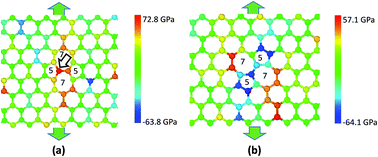
Higher strength shown by graphene in armchair direction with STW2 defect as compared to STW1 defect can be further explained with the help of Fig. 4. Coloured atoms shown in Fig. 4 refers to the different level of stress per atom values, while the graphene sheet was subjected to 1% tensile strain along the armchair direction. It can be seen that initial atomic stress concentration induced by STW1 defect for the armchair direction was in the bond shared by pentagon–heptagon rings (shown by arrow in STW1), whereas with STW2 defect bond shared by the heptagon–hexagon rings was experiencing higher stress per atom level. In case of STW1 defect the stress per atom is more concentrated around single atom and reached a maximum value of 72.8 GPa, whereas with STW-2 defect the stress per atom values are more distributed around the defect and reached a maximum value of 57.1 GPa, which is lower as compared to STW1 defect. This concentration of stress around a single atom in STW1 defect leads to a lower strength of graphene in armchair direction as compared to STW2 defect. It can be concluded upto this point of analysis that STW2 defects can be used to alter mechanical properties and failure morphology of graphene in armchair direction. Further, investigation of failure mechanism in graphene with STW2 (unless otherwise stated STW2 defects will be termed as 5–7–7–5 defects for the ensuing sections of this article) defect along the armchair direction was carried out with the help of bond strain and bond angle analysis in the ensuing sub-section.
Mechanical strength of graphene is governed by the strength of interatomic bonds. In order to get a better insight of failure morphology in and around the 5–7–7–5 defect in graphene, the bond strain and bond angles were further examined. The bond angle and bond strain were calculated using the position co-ordinate obtained with the help of post processing software called the open visualization tool (OVITO). OVITO was used to estimate the bond angle and bond strain at the desired integration time step. In order to perform this study, atoms before and after the bond rotation were designated with an alphabet and bond angle with α and β as indicated in Fig. 5.
![]() | ||
| Fig. 5 Atomic configuration of graphene in armchair direction. (a) Before transformation. (b) After transformation to 5–7–7–5 defect. | ||
It can be inferred from the stress distribution over the atoms in Fig. 4b in conjunction with Fig. 5 that the load carried by longitudinal bonds (AD and BE in Fig. 5a) and diagonal bonds (AC and BF in Fig. 5a) in pristine graphene, is mostly carried by the longitudinal bonds G′I′ and K′L′ and only a small contribution is made by A′B′ bond (shown in Fig. 5b) in graphene with STW-2 defect. This stress distribution or the load sharing by the longitudinal bonds (G′I′ and K′L′) in 5–7–7–5 defects ultimately leads to bond failure. In addition to this analysis, bond strain and bond angles were estimated at different strain level in armchair direction of graphene with 5–7–7–5 defect and results are plotted in Fig. 6.
![]() | ||
| Fig. 6 (a) Variation in bond angles α and β as a function of applied axial strain. (b) Variation in bond strain as a function of applied axial strain. | ||
It can be inferred from Fig. 6a that angles α1 and α2 (shown in Fig. 5b) increased, whereas angles β1 and β2 (shown in Fig. 5b) shows a decreasing trend with increase in applied axial strain. Similarly, in defective graphene with 5–7–7–5 defect, longitudinal bonds G′I′ and L′K′ sustains higher strain values as compared to I′H′ and L′J′. Decrease in bond strain for the longitudinal bond shown in Fig. 6b after reaching the maximum bond strain of 7.5% can be attributed to the change in alignment of the bond due to variation in angles α and β. Effect of bond angle α and β is further illustrated with the help of snapshot of simulation box at the time of failure with pristine as well as defective graphene sheet.
Due to increasing amount of strain in bonds G′I′ and L′K′ and increasing angle α1 and α2, the failure initiates with a blunt crack tips as shown in Fig. 7b, but eventually terminates in a brittle fracture, which is in good agreement with the results provided by Xu et al.50 On the other hand, pristine graphene breaks by a catastrophic brittle fracture with a sharp crack tip as shown in Fig. 7a. In summary, this clearly shows the tendency of graphene sheet to be brittle or ductile which depends strongly on two factors, one is the underlying graphene structure and the second one is the response of the graphene structure to the applied load. It can be concluded from this subsection that point defects such as 5–7–7–5 in armchair direction can help in modifying the failure morphology of graphene.
In order to understand the load distribution in and around the 5–7–7–5 defects, an analysis was performed in conjunction with nearest neighbour distance ‘x’ and position of carbon atoms. Bonds and their respective alignment in 5–7–7–5 defects are shown in Fig. 9a. Average bond (s) lengths and average bond angles (α and β) with respect to nearest neighbour distance ‘x’ are shown in Fig. 9b and c for an angular orientation of 60°. In this particular analysis six different types of 5–7–7–5 bonds (referred as d1–d6 in Fig. 9a) are taken into account. It can be seen in Fig. 9b that the variation of bond length with respect to the nearest neighbour distance, for instant, at x equal to 10 Å, d3 = 1.453 Å > d5 = 1.441 Å > d2 = 1.418 Å > d4 = 1.403 Å > d1 = 1.375 Å > d6 = 1.340 Å, and at x equal to 32 Å, d5 = 1.443 Å > d3 = 1.424 Å > d2 = 1.419 Å > d4 = 1.415 Å > d1 = 1.381 Å > d6 = 1.321 Å. As the distance x starts increasing, bond length d6 decreases, and d5 shows a random variation (unstable nature), while remaining bond lengths such as d1, d2, d3 and d4 are not sensitive to nearest neighbour distance ‘x’. Fig. 9c shows the variation of average bond angle α and β with respect to the nearest neighbour distance ‘x’. It can be inferred from Fig. 9c that the bond angles α and β are behaving opposite to each other, for instant, the bond angle α decreases with increase in ‘x’ upto the distance of 22 Å, while bond angle β increases in the same span. On the other hand, after 22 Å, bond angle α starts increasing while bond angle β starts decreasing. This process clearly shows the influence of nearest neighbour distance ‘x’ on the critical bonds d5 and d6 (which are considered as a maximum load carrying bonds) and on the critical bond angles α and β.
Results obtained with the pair of 5–7–7–5 defects in conjunction with varying geometric parameters such as nearest neighbour distance ‘x’ and angular orientation ‘θ’ are summarised in Fig. 10. It can be observed from Fig. 10a and b that at an angular orientation of θ = 60°, fracture strength and strain increased from 55 GPa to 71 GPa and 0.062 to 0.088 respectively with the increase in nearest neighbour distance ‘x’ from 10 Å to 30 Å. Fracture strength and strain increases rapidly at lower values of ‘x’, but becomes almost constant after 30 Å. Similarly, fracture strength and strain increases from 65 GPa to 72 GPa and 0.078 to 0.089 respectively with increase in the value of ‘x’ at an angular orientation of θ = 30°. On the other hand, negligible amount of variation in fracture strength and strain was observed with angular orientations of ‘θ = 90°’ and ‘θ = 0°’. Fracture strength and strain for graphene containing pair of 5–7–7–5 defects was predicted to be high as compare to graphene with single 5–7–7–5 defect (referred by dashed line in Fig. 10). It can also be inferred from the Fig. 10c that stiffness of graphene sheet containing two 5–7–7–5 defects is lower than the stiffness of graphene with single 5–7–7–5 defect. The variation in fracture strength and strain at lower values ‘x’ can be attributed to the interaction of stress field between 5–7–7–5 defects and also the bond alignment that helps in maintaining the higher strength values as compared to single 5–7–7–5 defect in graphene. On the other hand at higher values of ‘x > 35 Å’, these pair of defects start behaving as single 5–7–7–5 defects, hence have the strength coinciding with the graphene sheet containing single 5–7–7–5 defect.
In order to get a better insight of failure mechanism with respect to varying geometrical parameters (‘x’ and ‘θ’), snapshots were taken from the simulation box at x ≈ 10 Å and 30 Å and are shown in Fig. 11 and 12 respectively. Snapshots were taken particularly at x ≈ 10 Å and x ≈ 30 Å because maximum variation in fracture strength, strain and Young's modulus has been observed between these values of nearest neighbour distance. Snapshots in Fig. 11 and 12 represents the stress distribution over the atoms with pair of 5–7–7–5 defects in graphene after relaxation. For the graphene sheet, the defect-induced stress field is believed to be the basin of the mutual interaction between two nearby defects60,61 and the stress field and elastic field basin will start vanishing within a range of 7 Å to 15 Å.61 It can be observed in Fig. 11 that the interaction of defect induced stress field resulted in a tensile stress field in the area nearby hexagon–heptagon rings while modelling pair of 5–7–7–5 defects at θ = 30° (Fig. 11b) and θ = 60° (Fig. 11c), whereas compressive stress field is generated in pentagon–pentagon rings while modelling pair of 5–7–7–5 defects at an angular orientation of θ = 0° (Fig. 11a) and θ = 90° (Fig. 11d). Due to bond alignment and interaction of stress field between the defects, bonds connecting the 5–7–7–5 defects in θ = 30° and θ = 60° was experiencing concentrated tensile stresses, which ultimately lead to an early failure as indicated in Fig. 10a and b. On the other hand, connecting bonds between 5–7–7–5 defects with angular orientation of θ = 0° and θ = 90°, were experiencing compressive stress values which is not as detrimental to the bond breaking, hence resulted in a higher values of fracture strength and strain in graphene.
Similar to the snapshots of Fig. 11, stress per atom distribution in graphene with pair of 5–7–7–5 defects at higher value of nearest neighbour distance x ≈ 30 Å is shown in Fig. 12. It can be inferred from the images taken at different angular orientations that stresses are uniformly distributed over the graphene sheet and no stress concentration is observed in the connecting bonds between the 5–7–7–5 defects. This clearly indicates that the stress field and elastic field basin will vanish around 30 Å, this results is in good agreement with the results obtained by Ma et al.61 When the nearest neighbour distance is above 30 Å, Young's modulus starts increasing irrespective of the angular orientation (θ). This phenomenon clearly indicating that a different behaviour is expected when two defects are approaching each other by mutually offering similar/opposite (tensile/compressive) stress fields along the approaching direction. In summary, the properly arranged pair of 5–7–7–5 defects can enhance the strength as well as can modify the failure mechanism of graphene sheet. In the simulations performed with pair of 5–7–7–5 defects, an overall increase of 8% and 11% in fracture strength and strain was observed respectively as compared to the strength of graphene with single 5–7–7–5 defect.
Stress–strain response of graphene with pair of 5–7–7–5 defects at x ≈ 10 Å for different angular orientations ‘θ’ is shown in Fig. 13. A mild ductile response in stress–strain curve can be observed for θ = 60°. A similar behaviour with a lesser fraction of perfect plasticity in stress–strain curve is observed for θ = 30°. On the other hand, no ductility or plasticity is observed in stress–strain response for 5–7–7–5 defects at an angular orientations of 0° and 90°. Ensuing section will provide a better insight of failure behaviour of graphene with pair of 5–7–7–5 defects.
In addition to stress distribution over the atoms, snapshots of simulation box were also taken at the time of initiation of failure as provided in Fig. 14 and 15. The snapshots in Fig. 14 and 15 at the time of initiation of failure helps in understating the variation in failure morphology with the distance ‘x’ and angle ‘θ’. As the maximum variation in fracture strength and strain was observed at ‘x ≈ 10 Å’, hence these snapshots in Fig. 14 and 15 was taken with this particular nearest neighbour distance. A brittle nature of failure was observed in Fig. 14, which referred to angular orientation of θ = 0° (Fig. 14a and c) and θ = 90° (Fig. 14b and d), whereas the crack opening with blunting crack tips and nanochain formation at θ = 30° (Fig. 15a and c) and θ = 60° (Fig. 15b and d) indicated a ductile failure for graphene with pair of 5–7–7–5 defects. As shown in Fig. 13, the percentage of perfect plasticity is high for the angular orientation 60° due to multiple nanochain formation between the separated graphene sheets (shown in Fig. 15d), whereas the percentage of perfect plasticity is low for the angular orientation 30° due to lesser number of nanochain formation as compared to the angular orientation of 60° between 5–7–7–5 defects (shown in Fig. 15c). It can also be observed that graphene with pair of 5–7–7–5 defects at an angular orientation of 60° (Fig. 15d) the failure initiates simultaneously from both the 5–7–7–5 defects, triggering of failure from two different location helps in distributing the overall energy at the crack tip which will helps in modifying the failure morphology as well as strength of graphene. It can be concluded from the analysis that the first bond breakage might always takes place at the longitudinal bonds shared by hexagon–heptagon rings for all the angular orientations. It can also be observed from the analysis that the stress and elastic fields developed by the 5–7–7–5 defects is not only affecting the mechanical properties, it also affects the failure morphology of the graphene as well.
| This journal is © The Royal Society of Chemistry 2016 |