A. Demchenkoa,
Y. Changb,
E. Chikoidzeb,
B. Berinib,
C. Lefèvrea,
F. Roullanda,
C. Ulhaq-Bouilleta,
G. Versinia,
S. Barrea,
C. Leuvreya,
V. Favre-Nicolincd,
N. Boudetce,
S. Zafeiratosf,
Y. Dumontb and
N. Viart*a
aInstitut de Physique et Chimie des Matériaux de Strasbourg and Labex NIE, Université de Strasbourg – CNRS UMR 7504, 67034 Strasbourg Cedex 2, France. E-mail: viart@unistra.fr
bGroupe d’Etude de la Matière Condensée (GEMaC), Université de Versailles St Quentin en Y. – CNRS, Université Paris-Saclay, 45 avenue des Etats Unis, 78035 Versailles, France
cUniversité Grenoble Alpes, 38000 Grenoble, France
dCEA, INAC-SP2M, 38000 Grenoble, France
eCNRS – Institut Néel, 38042 Grenoble, France
fInstitut de Chimie et Procédés pour l’Energie, l’Environnement et la Santé (ICPEES), Université de Strasbourg, CNRS UMR 7515, 25 rue Becquerel, 67087 Strasbourg Cedex 02, France
First published on 4th March 2016
Ni-Doped thin films of the room temperature ferrimagnetic oxide Ga0.6Fe1.4O3 were deposited by pulsed laser deposition and their electronic transport and structural and magnetic properties were studied. The actual insertion of the Ni cations within the Ga0.6Fe1.4O3 structure has been checked by resonant X-ray scattering. A clear extremum is noticed for all properties for the 2% Ni doping: extrema in the crystallographic cell parameters of the films, maximum in the Curie temperature, and maximum in the electric resistivity. We also observed a change of conductivity type for this dopant concentration, from n-type for Ni contents below 2% to p-type for Ni contents above 2%. We explain this behavior by the existence of oxygen vacancies in the pulsed laser deposited Ga0.6Fe1.4O3 thin films, which results in the reduction of some of the Fe3+ into Fe2+ cations, and n-type conduction via a hopping mechanism. The insertion of Ni2+ cations first deals with the presence of oxygen vacancies and reduces the number of n-type carriers in the films, in a compensation-like mechanism. When the number of introduced Ni2+ cations dominates the number of oxygen vacancies, conductivity becomes p-type and starts to increase again. We believe that the tunability of the conduction type and magnitude in thin films of a room temperature ferrimagnetic material paves the way towards new all oxide electronic devices.
Conductivity is usually attributed to the presence of oxygen vacancies in the thin films. The major options chosen to reduce the leakage currents in BFO have been annealing in oxygen7 or doping with various cations such as Ti,8 La9 or Cr.10 The number of oxygen vacancies can also be reduced by implantation11 but this requires technological equipment which is not always available and might hinder the crystallographic quality of the films.
Here, we wish to present a room temperature multiferroic/magnetoelectric material which constitutes a possible alternative to BFO, the gallium ferrite Ga2−xFexO3 (0.8 ≤ x ≤ 1.4) (GFO), and to address, first, the issue of the reduction of the leakage currents in thin films of this material, and second, the possibility to tune its conductivity type at will, with a view to applications.
GFO was first described as a polar, magnetoelectric ferrimagnetic material in the 60s.12–15 It has received a considerable renewal of interest the last 10 years after Arima et al. revisited its potential as a room temperature magnetoelectric compound for x > 1.3, with a Curie temperature of 370 K for x = 1.4.16 GFO does not have a perovskite derived structure as most of the promising multiferroic materials. It crystallizes in the orthorhombic space group Pc21n (33) for x between 0.8 and 1.4, the material adopting the β-Ga2O3 and α-Fe2O3 structures for x below 0.8 and above 1.4, respectively. The Pc21n structure of GFO is isostructural to ε-Fe2O3 and is the most interesting on the magnetic point of view. It is based on a double hexagonal compact ABAC oxygens stacking forming four types of cationic sites: a tetrahedral Ga1, and three octahedral Ga2, Fe1 and Fe2 sites (Fig. 1). The ferrimagnetic properties of GFO are due to the uncompensated antiferromagnetic ordering of cations in sites Ga1 and Fe1 with cations in sites Ga2 and Fe2, through superexchange interactions through the oxygens. Thanks to a cationic sites disorder, there is a resulting magnetization even for the x = 1.0 composition. However, both the magnetic ordering temperature and the resulting magnetization are maximum for the highest Fe content, i.e. for x = 1.4 (GFO1.4). We will therefore focus our study on GFO1.4 derived compounds, for their Curie temperature is well above room temperature. GFO1.4 lattice constants are a = 0.8765 ± 0.0002, b = 0.9422 ± 0.0002, and c = 0.5086 ± 0.0002 nm.17
![]() | ||
| Fig. 1 Projection of the crystal structure of Ga2−xFexO3 along the c axis (space group Pc21n). The image has been produced using the VESTA18 crystallographic software. | ||
The polarization of GFO has been difficult to prove and quantify in thin films because of important leakage currents. We successfully decreased the conduction of GFO thin films through doping the films with bivalent cations such as Mg2+ or Co2+.19,20 In those works, we focussed on the efficiency of the doping in reducing the leakage currents. We tentatively explained the phenomenon by hypothesizing that the conduction was due to a hopping mechanism between Fe2+ and Fe3+, the Fe2+ ions originating from an oxygen substoichiometry in the pulsed laser deposited thin films. The mechanism we suggested to explain this behaviour could be described using the Kröger–Vink notation. During the growth process, some oxygen vacancies are produced in Ga0.6Fe1.4O3 according to
![]() | (1) |
is a vacancy in the oxygen site with a double positive charge. The consequence of the existence of such oxygen vacancies is the reduction of Fe3+ into Fe2+| 2δe− + 2δFe×Fe → 2δFe′Fe. | (2) |
The simultaneous presence of Fe2+ and Fe3+ allows electrical conduction through a hopping process. We therefore suggested that doping with a bivalent cation would allow satisfying the charge unbalance due to the presence of oxygen vacancies without any reduction of Fe3+ into Fe2+. This would annihilate conduction through hopping and therefore strongly reduce the leakage currents. We have shown a proof of concept of this idea in a previous work in which we doped GFO with Mg2+.19 We indeed observed a reduction of the leakage currents with the Mg2+ content in the GFO cell up to 2%. Above this content, the leakage currents started increasing again. We attributed this increase to the introduction of an excess of charges related to an excess of bivalent cations with respect to the existing oxygen vacancies. Our model predicted an n- to p-type conduction change upon increasing the Mg2+ content. We however could not show a proof of this hypothesis. This is the subject of the present work. The introduction of Mg2+ into the GFO lattice led to a decrease of the ordering temperature and saturation magnetization. The introduction of magnetic Co2+ cations allowed the same efficiency in the decrease of the leakage currents, but without any decrease of the ordering temperature. This Co2+ doping still caused a decrease in the saturation magnetization though.20 We therefore decided to study the effect of doping GFO thin films with other magnetic bivalent ions, the Ni2+ ions. Those cations are similar to the Fe3+ cations in size (Table 1), and possess a spin moment of 2 μB, while Fe2+ and Fe3+ have spin moments of 4 μB and 5 μB, respectively. Because of the ferrimagnetic nature of the compound, it is impossible to predict if the insertion of a cation bearing a lower moment will lead to a decrease or an increase of the total magnetization; it will depend upon the cationic distribution. Ni2+ ions are very unlikely to occupy the tetrahedral sites, for a d8 ion is stabilized in an octahedral site, but they may occupy any of the three available octahedral sites. We present here a study of the structural, magnetic, and electrical properties of the Ni-doped GFO1.4 pulsed laser deposited films.
| Coordination VI | Coordination IV | |
|---|---|---|
| Ga3+ | 62 | 47 |
| Fe3+ | 64 (high spin) | 49 |
| Fe2+ | 78 (high spin) | 63 |
| Ni2+ | 69 | 55 |
(1% mismatch), on the other hand.24 The angle between cGa0.6Fe1.4O3 and the diagonal of the ac plane is
, which explains the existence of six GFO variants located every 30°.21 The cell parameters were calculated from the θ–2θ measurement of the (040) and reciprocal space mappings of the (062) and (570) reflections. While the in-plane a and c parameters are lower than observed for the same Fe/Ga ratio in bulk,17 the out-of-plane b parameter is higher (Fig. 3). The mismatch between YSZ(100) and GFO(010) along the YSZ[010]//GFO[001] direction cannot account for the low c parameters observed. Indeed aYSZ = 5.139 Å is higher than 5.086(2) Å, observed for c in bulk Ga0.6Fe1.4O3 and this would therefore impose a tensile stress rather than a compressive one. The different thermal expansion coefficients between the substrate and the layer cannot account for the smaller in-plane parameters observed for GFO thin films either. The samples are deposited at 800 °C and then cooled down to room temperature. One could therefore expect a matching of cGFO onto aYSZ at 800 °C. The thermal expansion coefficient of YSZ being αYSZ = 9 × 10⁻⁶ K−1,25 its cell parameter at 800 °C is 5.151 Å. Assuming aGFO adopts this value when deposited, upon cooling, considering a thermal volume expansion coefficient of αGFO = 2.6 × 10⁻⁵ K−1,26 it would become, if one considers that this thermal coefficient is isotropic,
This value is higher than the experimentally observed one, even for undoped samples. The elongation of the GFO cell along its b axis is therefore more likely to be related to the existence of oxygen vacancies within the material. Some increases in the cell parameters have already been observed in materials like perovskites and explained by the oxygen vacancies resulting in the partial reduction of some of the cations, which having more electrons in their reduced form, have a bigger radius.27–29 The cell parameters which are the closest to those observed for the bulk are obtained for the 2% Ni doping.
The insertion of the Ni atoms within the crystallographic structure of GFO was checked by means of resonant diffraction at the Ni K edge. Three independent Bragg reflections of the GFO structure, (110), (211), and (510), were scanned. Anomalous diffraction could be observed in all cases (Fig. 4), after subtracting the fluorescence. It originates from a modification of the diffracted intensity due to resonant elastic X-ray scattering processes involving interactions between the X-ray beam and the Ni atoms in the sample and is a proof that Ni atoms contribute to the structure factor for this crystallographic reflection. This is therefore an unequivocal proof of the insertion of the Ni atoms within the GFO crystallographic structure.
The homogeneity of the Ni-content over the entire thickness of the films was checked using EDX coupled with TEM. The thin films were observed in cross views in the STEM HAADF mode (Fig. 5). No accumulation of Ni at the surface or at the interface between the substrate and the films was observed. The value of the Ni content was confirmed for all compositions, within the error bar of EDX (3%).
![]() | ||
| Fig. 5 Cross view composition of the 2% Ni-doped GFO thin film determined from EDX analysis in STEM HAADF mode (C indicates a carbon layer deposited during the FIB preparation of the sample). | ||
High resolution cross view TEM images show a columnar growth of the films with ca. 10–20 nm wide crystallites (Fig. 6). They confirm the Pc21n crystallographic structure of the samples and allowed observation of the contrast from the different variants.
The Ni 2p3/2 XPS peak (Fig. 7) shows a well-resolved two peak structure with a main peak at 855.2 eV and a satellite structure shifted 6.5 eV at the high binding energy side, which are characteristic of Ni in the +2 valence state.30,31 In addition the Auger parameter (α) calculated using the peak maxima of the Ni 2p3/2 photoelectron and L3M45M45 Auger peaks is found to be 1698.0 ± 0.2 eV, within the range previously proposed for Ni2+.32 Overall, XPS results provide strong evidence that nickel cations are in the +2 valence state.
![]() | ||
| Fig. 7 XPS Ni 2p3/2 spectrum for the 5% Ni-doped GFO thin film. The Auger parameter, (α), calculated by the Ni 2p3/2 and Ni LMM peak maximum positions is included in the graph. | ||
The Curie temperature of the GFO films was measured as the inflexion point of the field-cooled magnetization curve measured in a 50 Oe magnetic field (see ESI† for field-cooled magnetization curves of all the samples, measured in a 50 Oe magnetic field applied parallel to the films). It presents a maximum for the 2% Ni content (Fig. 8). The magnetic properties in GFO are governed by the superexchange interactions between neighbouring magnetic ions.33 They will therefore be strongly affected by the M–O–M bond angles, where M is a magnetic cation, hence by the cationic ordering. In addition to the cationic site distribution, the distortion of the polyhedra also plays an important role. The 2% Ni-doped sample is the one for which the cell is the less distorted when compared to bulk (Fig. 3). The maximum in the Curie temperature is therefore probably due to a maximum in the orbitals overlapping. For lower doping, the cell is distorted by the presence of oxygen vacancies inducing the presence of Fe2+. One can assume that for the 2% Ni doping, all Fe2+ are replaced with Ni2+. This configuration is the closest to bulk GFO, which is free of oxygen vacancies. For higher doping, additional Ni2+ cations are introduced and replace Fe3+, which leads to another distortion of the cell.
Hysteresis loops measured at 300 K (Fig. 9 and ESI†) indicate that the samples are more easily magnetized within the plane of the films (ac plane) than out of plane (b direction). This is consistent with the easy and hard magnetization axes observed in bulk: c is the easy axis while b is the hard axis.16 Because of the existence of 6 in-plane variants, the distinction between the different easy directions in plane, located every 30°, is not possible in the SQUID, in which such a precision in the positioning of the sample is not achievable. The room temperature saturation magnetization increases with the Ni content from 67 to 90 emu cm−3, for non-doped and 5% Ni-doped GFO, respectively (Fig. 10). Magnetization in GFO results from the uncompensated antiparallel ordering of two sublattices constituted by the Ga1 and Fe1 sites, on the one hand, and Ga2 and Fe2, on the other hand. It strongly depends upon the cation distribution on the four different sites.34 The cations contributing to the samples magnetization are Fe3+ (5 μB), Fe2+ (4 μB), and Ni2+ (2 μB) – assuming a quenching of the orbital moment.
![]() | ||
| Fig. 9 Hysteresis loops of the undoped GFO thin film, as representative of all samples (see ESI† for a comprehensive presentation of the measurements), measured at 300 K in parallel (black filled squares) and perpendicular (red hollow squares) (enlargement in inset). | ||
![]() | ||
| Fig. 10 Evolution of the room temperature saturation magnetization of the Ni-doped GFO films with the Ni content. | ||
The total moment for pure GFO1.4 can be evaluated assuming a cationic distribution similar to the bulk one, without considering any oxygen vacancy. In that case, one expects 0.33, 0.79, 0.97, and 0.82 Fe cations in the Ga1, Ga2, Fe1, and Fe2 sites, respectively.35 The sites Ga1 + Fe1 would therefore bear (0.33 + 0.97) × 5 = 6.5 μB, while the Ga2 + Fe2 sites represent (0.79 + 0.82) × 5 = 8.05 μB, yielding a total of 1.55 μB for 2 formula units. The Ni cations only bear 2 μB when compared to Fe cations which have 4 (Fe2+) or 5 μB (Fe3+). The increase in the saturation magnetization observed for increasing Ni content can therefore be explained by the positioning of these cations in the Fe1 or Ga1 sites. Ni2+, being a d8 cation, is strongly stabilized in octahedral sites. They will therefore most probably be located in the Fe1 sites.
Fig. 11 shows the temperature dependence of resistivity ρ(T) for Ni-doped GFO thin films in the 300–500 K temperature range. The measurement temperature was limited to 500 K, to avoid compositional transformation of the samples at higher temperatures. The resistivity of the films increases with decreasing temperature, indicating a semiconducting behaviour of the conductivity. Room temperature resistivity (ρ) values for different levels of Ni content are summarized in Table 2. Room temperature resistivity values vary between 5.5 × 10³ and 7.1 × 10⁴ Ω cm. The maximum value is obtained for the 2% Ni-doping.
| Resistivity (ρ, Ω cm) | ||
|---|---|---|
| 300 K | 500 K | |
| Undoped GFO | 5.0 × 10⁴ | 2.8 × 10³ |
| Ni: 0.5% | 3.2 × 10⁴ | 4.8 × 10³ |
| Ni: 2% | 7.1 × 10⁴ | 1.3 × 10⁴ |
| Ni: 5% | 5.5 × 10³ | 1.4 × 10² |
For the samples with 0–2% Ni the resistivity temperature dependence exhibits hopping conduction mechanism (resistivity does not changes significantly versus temperature) up to around 450 °C. Above 450 °C, the ρ(T) slope changes, which can be an indication of a band activation conduction mechanism. For the 5% Ni doped sample, resistivity is strongly temperature dependent, and an 0.24 eV activation energy of conductivity σ(T) can be estimated from the ln(1/σ) = ln(ρ) versus 1/T slope. Such behaviour for resistivity versus temperature can be explained by the substitution of a hopping conduction mechanism with a delocalized hole conduction.
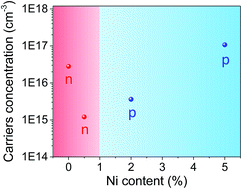
Moreover, Seebeck and Hall effects measurements (Hall effect has been performed at 1.2 T when the magnetization of the samples is saturated) allowing unambiguous determination of the nature of the carriers, and of their concentration (Table 3). The nature of the carriers varies with the Ni content: for doping contents below 2%, the majority of carriers are electrons, while for those with Ni content higher than 2%, they are holes. The number of carriers is a minimum for samples with Ni content between 0.5 and 2% (Fig. 12). This confirms our assumption concerning the mechanism responsible for conduction in the films. The Hall mobilities are less than 1 cm V−1 s−1 for all samples, due to strong carrier localization. The highest resistivity observed for the 2% Ni doped sample, which has a higher carrier concentration then the 0.5% Ni doped sample, is explained by its lower mobility.
| Sample | Carriers concentration (cm−3), (p): holes, (n): electrons | |
|---|---|---|
| 300 K | 500 K | |
| Undoped GFO | N/A | (n) 2.80 × 10¹⁶ |
| Ni: 0.5% | N/A | (n) 1.20 × 10¹⁵ |
| Ni: 2% | N/A | (p) 3.60 × 10¹⁵ |
| Ni: 5% | (p) 1.2 × 10¹⁵ | (p) 1.04 × 10¹⁷ |
![]() | ||
| Fig. 12 Evolution of the carriers’ type and concentration with the Ni content in GFO thin films at 500 K. | ||
At room temperature, the Hall effect is only valid for the 5% Ni doped sample, when hopping conduction gives way to band conduction. The substitution of Fe with Ni indeed leads to the creation of holes according to
![]() | (3) |
| e− + h˙ → 0. | (4) |
The substitution of Fe with Ni therefore first leads to a decrease of the leakage currents thanks to the electrons–holes recombination mechanism. When the substituted Ni content m is too high compared to the number of oxygen vacancies δ, with Ni actively playing the role of acceptor, supernumerary holes are eventually created and the material becomes a p-type conductor. Since each oxygen vacancy generates 2 electrons (see eqn (1)), this is the case when m > 2δ.
Footnote |
| † Electronic supplementary information (ESI) available: Compositions of the Ni-doped films determined by ICP-AES, field-cooled magnetization curves and hysteresis curves of all films, XPS survey scan spectrum of the 5% Ni-doped GFO film together with the deduced stoichiometry. See DOI: 10.1039/c6ra01540a |
| This journal is © The Royal Society of Chemistry 2016 |