Yinan Wanga,
Min Zhaoa,
Yongbo Yua,
Miao Wang*b and
Chunjie Zhao*a
aSchool of Pharmacy, Shenyang Pharmaceutical University, Wenhua Road 103, Shenyang, Liaoning Province, China. E-mail: lab433@163.com; Fax: +86-24-23986299
bSchool of Life Science and Biopharmaceutics, Shenyang Pharmaceutical University, Wenhua Road 103, Shenyang, Liaoning Province, China
First published on 13th April 2016
Cortex Fraxini is a widely used traditional Chinese medicine (TCM) used for the treatment of gout or hyperuricemia. In this study, a reliable and sensitive ultra-high performance liquid chromatography coupled with Fourier transform ion cyclotron resonance mass spectrometry (UHPLC-FT-ICR-MS) method was developed for systematical screen and identification of the metabolic profile in rats after oral administration of Cortex Fraxini. The chromatographic separation was performed on a Universil XB C18 column (150 mm × 2.1 mm, 1.8 μm; Kromat, USA) and eluted by a gradient program. The identification was achieved on a Bruker high resolution spectrometer in positive ion mode. According to the result, a total of 81 constituents, including 29 prototype compounds and 52 metabolites were tentatively identified and validated by MS data and fragment ions from MS/MS spectra. The parents of all identified metabolites were assigned, and the metabolites were mainly coumarin derivatives. In conclusion, the newly established UHPLC-FT-ICR-MS method with high resolution and sensitivity was an effective approach for the identification of prototypes and metabolites of Cortex Fraxini in vivo. These results provided significant information about the metabolic profile of Cortex Fraxini in vivo and also laid a solid foundation for further pharmacokinetic and pharmacological research of this TCM.
Cortex Fraxini (named “Qin Pi” in China) is the dry bark of Oleaceae plant Fraxinus chinensis Roxb., Fraxinus rhynchophylla Hance., Fraxinus stylosa Lingelsh. and Fraxinus szaboana Lingelsh. Cortex Fraxini is a well-known TCM to treat gout, hyperuricemia and arthritis in clinic.1,2 Cortex Fraxini mainly contains coumarins, iridoids, phenylpropanols and phenolic compounds,3–5 which have various bioactivities such as anti-oxidant, anti-inflammation and so on.6–9 Coumarins are the major bioactive constituents in Cortex Fraxini and can be used to treat gout with renal dysfunction in clinic.10 Among these coumarins, aesculin is the most abundant constitute of coumarins. However, there has been no holistic research on the absorbed constituents and metabolic profile of Cortex Fraxini in vivo.
Metabolism research plays an important role in the development process of drugs, such as the assessment of action mechanism. Drugs can produce new active or toxic species via metabolism, so it is necessary for the evaluation of efficacy and safety of a drug.11 Nowadays, metabolism studies are designed to suggest new active constitutes and support further toxicology researches.12 To obtain enough metabolic information from complex biological samples, it is essential to establish a sensitive and reliable analytical method. Till now, liquid chromatography combined with mass spectrometry (LC-MS) has been widely utilized as an efficient tool to detect and identify metabolites in complex matrixes due to its high sensitivity and selectivity.13–16 Fourier transform ion cyclotron resonance mass spectrometry (FT-ICR-MS) with high mass accuracy and high resolution is the most powerful tool for the various analyses.17–20 FT-ICR-MS is specialized in the determination of elemental composition and can be used to identify metabolites.21,22
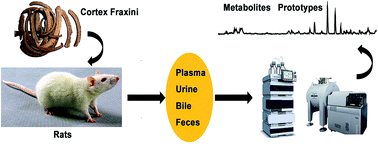
In this present study, an ultra high performance liquid chromatography equipped with Fourier transform ion cyclotron resonance mass spectrometry (UHPLC-FT-ICR-MS) method was established for systematical characterization of metabolic profile in plasma, urine, bile and feces from rats after oral administration of Cortex Fraxini. The metabolic profile of Cortex Fraxini in vivo was revealed for the first time. The results of this study may provide significant information for further research on Cortex Fraxini, such as the relationship between pharmacological activities and chemical constituents in Cortex Fraxini.
The rats were divided into group I and group II randomly with six rats in each group. The rats were fasted for a night with water available before administration. The prepared Cortex Fraxini powder was administrated to rats at the dose of 1.7 g kg−1 body weight (about aesculin 100 mg kg−1)23 by intragastric gavage, and it was suspended in 0.5% carboxymethyl cellulose sodium salt (CMC-Na) before administration. Rats in group I were put into metabolic cages for 24 h to collect urine and feces. Blood from group I were collected at 0.5, 1, 3, 6, 12 and 24 h after dosing, and were obtained via retro-orbital bleeding into heparinized haemospasia tubes. About 0.5 mL blood was collected at each time point, and then centrifuged at 13
000 rpm for 10 min immediately. After administration, rats in group II were anaesthetized and cannulated in bile duct. Afterwards, bile samples were collected for 12 h. Blank samples of plasma, urine bile and feces were also collected from rats without dosing. All biological samples were stored at −80 °C before analysis.
000 rpm for 10 min. Subsequently, the organic layer was transferred and then dried under nitrogen stream at 35 °C. Residues were reconstituted in 200 μL water–methanol (80
:
20, v/v) for UHPLC-FT-ICR-MS analysis. Feces samples were dried in shade and then grind into powder. The powder of feces samples (0.5 g) was extracted by methanol (3 mL) in an ultrasonic water bath for 30 min and then centrifuged at 13
000 rpm for 10 min. All samples were filtered through a 0.22 μm membrane, and the resulting filtrate was transferred into vials of autosampler.
The mass spectra instrument consisted of a Bruker Solarix 7.0 T FT-ICR-MS system (Bruker, Germany) and a Bruker Compass-Hystar workstation (Bruker, Germany). Ionization was performed with positive electrospray ionization (ESI) mode, and the main parameters were set as follows: capillary voltage, 4.5 kV; dry gas flow, 8 L min−1; dry gas temperature, 200 °C; nebulizer gas pressure, 4 bar. Full-scan mass spectrum data was recorded from m/z 100 to 1000 amu, and the collision energy was ranged from 10 eV to 30 eV for MS/MS experiments.
The element compositions of each constitute were deduced by Bruker workstation, and the mass error values between experimental and theoretical below 3.0 ppm were acceptable. The chemical structure were proposed by scrutinizing the retention time, deduced molecular formula, and then further confirmed by MS/MS data and published literatures.23–26 As a result, a total of 81 constitutes were found and identified, including 29 prototype components (P1–P29) and 52 biotransformed metabolites (M1–M52). The results of prototype components are shown in Table 1 and the results of metabolites are presented in Table 2. The tables included the information of formula, retention time, MS data, calculated m/z, error, ion mode and MS/MS data.
| No. | Rt (min) | Identification | Formula | Molecular weight | Ion mode | MS (m/z) | ppm | MS/MS (m/z) | Source |
|---|---|---|---|---|---|---|---|---|---|
| a P, U, B and F represented rat plasma, urine, bile and feces samples respectively. | |||||||||
| P1 | 2.73 | Sinapaldehyde glucoside | C17H22O9 | 370.1263 | [M + Na]+ | 393.11593 | −0.83 | 209.07832, 166.06245, 138.03178 | B |
| P2 | 3.72 | Aesculin | C15H16O9 | 340.0794 | [M + H]+ | 341.08672 | −0.03 | 179.03455, 151.04002, 133.02970 | P, U, B, F |
| P3 | 4.03 | Osmanthuside H | C19H28O11 | 432.1631 | [M + Na]+ | 455.15240 | −0.03 | 301.12958, 151.06155, 139.07636 | P, U, B, F |
| P4 | 4.61 | Syringin | C17H24O9 | 372.1420 | [M + H]+ | 373.14954 | −0.61 | 364.06355, 232.23347, 185.01094 | P, U, B |
| P5 | 5.12 | Fraxin | C16H18O10 | 370.0900 | [M + H]+ | 371.09721 | 0.18 | 209.02670, 194.02135, 181.03957 | P, U, B |
| P6 | 5.21 | Fraxetin diglucoside | C22H28O15 | 532.1428 | [M + Na]+ | 555.13204 | −0.03 | 369.07688, 207.02612, 192.00275 | P, U, B |
| P7 | 5.52 | Scopolin | C16H18O9 | 354.0950 | [M + Na]+ | 377.08437 | −0.18 | 324.08195, 192.03785, 15104688 | U, B |
| P8 | 6.17 | Aesculetin | C9H6O4 | 178.0266 | [M + H]+ | 179.03386 | 0.12 | 151.03953, 133.29895, 123.04881 | P, U, B, F |
| P9 | 6.24 | 6,7-Dimethoxy-coumarin | C11H10O4 | 206.0579 | [M + H]+ | 207.06521 | −0.11 | 174.96985, 143.01934, 132.96804 | U, B |
| P10 | 6.71 | 6-Hydroxy-7,8-dimethoxy-coumarin | C11H10O5 | 222.0528 | [M + H]+ | 223.06012 | 0.13 | 208.03751, 190.02652, 162.03250 | P, U, B, F |
| P11 | 7.34 | Oleoside-11-methylester | C17H24O11 | 404.1318 | [M + Na]+ | 427.12142 | −0.78 | 265.06851, 206.05722 | U, B |
| P12 | 8.42 | Fraxetin | C10H8O5 | 208.0372 | [M + H]+ | 209.04436 | 0.42 | 194.02248, 181.05052, 163.03901 | P, U, B, F |
| P13 | 9.08 | Pinoresinol diglucoside | C32H42O16 | 682.2472 | [M + Na]+ | 705.23729 | −1.1 | 521.19882, 359.12826, 235.12854 | U, B, F |
| P14 | 9.82 | Umbelliferone glucoside | C15H16O8 | 324.0845 | [M + H]+ | 325.09206 | −0.83 | 307.08361, 181.05062, 135.04462 | U |
| P15 | 10.42 | Sopoletin | C10H8O4 | 192.0423 | [M + H]+ | 193.04957 | −0.17 | 178.01950, 150.03186, 133.04562 | P, U, B, F |
| P16 | 11.92 | Isoscopoletin | C10H8O4 | 192.0423 | [M + H]+ | 193.04952 | 0.12 | 178.02604, 133.02886, 122.03788 | P, U, B, F |
| P17 | 12.98 | Pinoresinol-β-D-glucopyraside | C26H32O11 | 520.1944 | [M + H]+ | 521.20232 | −1.12 | 381.12628, 359.12647, 235.17894 | P, U, B, F |
| P18 | 13.49 | Isofraxidin | C11H10O5 | 222.0528 | [M + H]+ | 223.05998 | 0.52 | 208.03711, 190.02651, 162.03226 | P, U, B, F |
| P19 | 16.11 | 8-Hydroxy-6,7-dimethoxy-coumarin | C11H10O5 | 222.0528 | [M + H]+ | 223.06010 | 0.36 | 208.03718, 190.02624, 162.03228 | P, U, B, F |
| P20 | 16.62 | Umbelliferone | C9H6O3 | 162.0317 | [M + H]+ | 163.03899 | 0.86 | 145.02928, 135.04429, 117.03427 | P, U |
| P21 | 16.79 | Calceolariolside A | C23H26O11 | 478.1475 | [M + H]+ | 479.15552 | −1.53 | 461.02145, 317.12146, 181.04331 | P, U, B, F |
| P22 | 18.38 | Plantainoside B | C23H26O11 | 478.1475 | [M + H]+ | 479.15238 | 0.01 | 461.01027, 317.11240, 181.04161 | P, U, B, F |
| P23 | 19.22 | Calceolariolside B | C23H26O11 | 478.1475 | [M + H]+ | 479.15533 | −1.13 | 461.02164, 317.12183, 181.04396 | P, U, B, F |
| P24 | 19.97 | Plantainoside A | C23H26O11 | 478.1475 | [M + H]+ | 479.15552 | −0.76 | 461.00157, 317.12163, 181.04481 | P, U, B, F |
| P25 | 20.34 | Fraxidin-8-glucoside | C17H20O10 | 384.1056 | [M + H]+ | 385.11302 | −0.24 | 208.03748, 190.03861, 163.03907 | P, B |
| P26 | 20.36 | Pinoresinol | C20H22O6 | 358.1416 | [M + H]+ | 359.14910 | −0.51 | 341.13855, 235.12579, 217.25750 | U, B, F |
| P27 | 22.24 | Hydroxyframoside B | C32H38O14 | 646.2261 | [M + Na]+ | 669.21479 | 0.87 | 485.16585, 155.05429, 139.06012 | U, B, F |
| P28 | 22.72 | Framoside | C32H38O13 | 630.2312 | [M + Na]+ | 653.22121 | −1.14 | 491.17348, 161.06314 | U, B, F |
| P29 | 23.64 | Ligustroside | C25H32O12 | 524.1839 | [M + Na]+ | 547.17860 | 0.05 | 385.14471, 315.07982 | P, B |
| No. | Formula | Molecular weight | Rt (min) | MS (m/z) | ppm | Ion mode | Source | MS/MS | Metabolite description | Presumed parent |
|---|---|---|---|---|---|---|---|---|---|---|
| a P, U, B and F represented rat plasma, urine, bile and feces samples respectively. | ||||||||||
| M1 | C15H18O11 | 374.0849 | 3.52 | 397.07442 | −0.73 | [M + Na]+ | U, B | 213.03245, 168.03583, 142.01927 | Hydrolysis, hydroxylation | Aesculin |
| M2 | C15H16O13S | 436.0312 | 3.18 | 437.04086 | −3.00 | [M + H]+ | U | 357.08262, 195.03421, 149.16774 | Hydroxylation, sulfation | Aesculin |
| M3 | C15H16O11 | 372.0693 | 2.72 | 373.06822 | −2.32 | [M + H]+ | P | 211.01657, 183.03941, 165.29849 | Hydroxylation | Aesculin |
| M4 | C15H16O10 | 356.0743 | 4.66 | 357.08178 | −0.43 | [M + H]+ | U | 195.03478, 167.04072, 149.16678 | Oxidation | Aesculin |
| M5 | C15H16O10 | 356.0743 | 5.94 | 357.08176 | −0.44 | [M + H]+ | P | 195.02147, 177.01417, 167.01265 | Hydroxylation | Aesculin |
| M6 | C15H18O10 | 358.0900 | 3.59 | 381.07925 | −0.08 | [M + Na]+ | U, B, F | 197.03733, 179.12461, 127.03518 | Hydrolysis | Aesculin |
| M7 | C16H18O10 | 370.0900 | 3.04 | 371.09755 | −0.75 | [M + H]+ | U, B, F | 231.02660, 216.02145, 185.03948 | Hydroxylation, methylation | Aesculin |
| M8 | C16H18O10 | 370.0900 | 4.14 | 371.09747 | −0.52 | [M + H]+ | P, U, B, F | 231.02678, 216.02182, 185.03957 | Hydroxylation, methylation | Aesculin |
| M9 | C16H20O10 | 372.1056 | 5.69 | 373.11315 | −0.60 | [M + H]+ | U, B, F | 359.11255, 197.04023, 179.10544 | Hydrolysis, methylation | Aesculin |
| M10 | C17H21NO11 | 415.1115 | 5.61 | 416.11893 | −0.46 | [M + H]+ | P, U, F | 254.06213, 236.07512, 127.04587 | Hydrolysis, glycine conjugation | Aesculin |
| M11 | C15H14O12S | 418.0206 | 4.79 | 419.04671 | −0.87 | [M + H]+ | U | 339.09046, 179.03387, 133.02884 | Oxidation, sulfation | Aesculin |
| M12 | C15H18O13S | 438.0468 | 4.42 | 439.05646 | −2.91 | [M + H]+ | U | 359.12516, 197.03753, 179.18248 | Hydrolysis, sulfation | Aesculin |
| M13 | C21H26O16 | 534.1221 | 12.32 | 535.12466 | 2.17 | [M + H]+ | P, U, B | 359.10428, 197.02656, 127.03268 | Hydrolysis, glucuronidation | Aesculin |
| M14 | C15H14O9 | 338.0638 | 4.07 | 339.07287 | −2.10 | [M + H]+ | U | 177.09012, 137.06004, 133.02895 | Dehydrogenation | Aesculin |
| M15 | C21H22O16 | 530.0907 | 2.80 | 553.08029 | −0.51 | [M + Na]+ | U, B | 355.07767, 179.03454, 123.04387 | Deglycosylation, glucuronidation | Aesculin |
| M16 | C21H24O15 | 516.1115 | 2.98 | 539.10048 | −0.47 | [M + Na]+ | P, B | 341.08676, 179.03458, 133.02977 | Glucuronidation | Aesculin |
| M17 | C11H10O6 | 238.0477 | 5.84 | 239.05509 | −0.31 | [M + H]+ | U | 225.03274, 209.04452, 177.19018 | Hydroxylation, methylation | Fraxetin |
| M18 | C11H12O6 | 240.0634 | 12.64 | 263.05255 | 0.21 | [M + Na]+ | P, U, B | 227.03998, 211.05458, 179.21458 | Hydrolysis, methylation | Fraxetin |
| M19 | C11H10O8S | 302.0096 | 7.49 | 303.01707 | −0.52 | [M + H]+ | P, U, B | 223.05987, 208.03715, 190.02658 | Methylation, sulfation | Fraxetin |
| M20 | C16H16O11 | 384.0693 | 3.29 | 385.07652 | 0.05 | [M + H]+ | U, B, F | 209.04438, 194.02249, 181.05074 | Glucuronidation | Fraxetin |
| M21 | C16H16O11 | 384.0693 | 4.96 | 385.07660 | −0.16 | [M + H]+ | P, U, B, F | 209.04447, 193.02248, 179.03425 | Glucuronidation | Fraxetin |
| M22 | C10H10O6 | 226.0477 | 3.40 | 227.05509 | −0.32 | [M + H]+ | B | 213.03241, 195.01254, 143.02648 | Hydrolysis | Fraxetin |
| M23 | C16H20O11 | 388.1006 | 10.33 | 411.08995 | −0.40 | [M + Na]+ | U, B | 227.04654, 213.03217, 143.05621 | Hydrolysis, glucuronidation | Fraxetin |
| M24 | C10H8O8S | 287.9940 | 6.95 | 289.00119 | 0.26 | [M + H]+ | P, B | 209.04434, 194.02244, 181.05058 | Sulfation | Fraxetin |
| M25 | C9H10O6 | 214.0477 | 7.65 | 237.03705 | −0.37 | [M + Na]+ | U, B | 196.04657, 127.03584 | Hydrolysis, hydroxylation | Aesculetin |
| M26 | C16H16O10 | 368.0743 | 4.37 | 369.08153 | 0.26 | [M + H]+ | P, U, B, F | 193.04952, 178.01958, 150.03184 | Glucuronidation, methylation | Aesculetin |
| M27 | C16H16O10 | 368.0743 | 5.76 | 369.08180 | −0.48 | [M + H]+ | B | 193.04945, 178.02605, 133.02885 | Glucuronidation, methylation | Aesculetin |
| M28 | C15H14O13S | 434.0155 | 2.86 | 457.00491 | −0.38 | [M + Na]+ | B | 355.05844, 259.12541, 151.07592 | Glucuronidation, sulfation | Aesculetin |
| M29 | C9H8O5 | 196.0372 | 1.86 | 219.02672 | −1.50 | [M + Na]+ | P, U, B | 179.06145, 153.04582 | Hydrolysis | Aesculetin |
| M30 | C9H6O7S | 257.9834 | 6.23 | 280.97272 | −0.29 | [M + Na]+ | P, U | 151.03911, 133.29805, 123.04871 | Sulfation | Aesculetin |
| M31 | C10H8O5 | 208.0372 | 5.03 | 209.04452 | −0.35 | [M + H]+ | U, B, F | 195.04255, 133.29811, 123.04882 | Hydroxylation, sulfation | Aesculetin |
| M32 | C10H8O5 | 208.0372 | 5.90 | 209.04446 | −0.05 | [M + H]+ | U, B | 195.04270, 133.29827, 123.04885 | Hydroxylation, sulfation | Aesculetin |
| M33 | C10H8O5 | 208.0372 | 7.45 | 209.04440 | 0.25 | [M + H]+ | P, B, F | 195.04252, 133.29830, 123.04877 | Hydroxylation, sulfation | Aesculetin |
| M34 | C15H14O10 | 354.0587 | 3.78 | 355.06582 | 0.42 | [M + H]+ | P, U, B, F | 179.03384, 151.03952, 133.29899 | Glucuronidation | Aesculetin |
| M35 | C15H14O10 | 354.0587 | 4.73 | 355.06582 | 0.42 | [M + H]+ | U | 179.03384, 151.03952, 133.29887 | Glucuronidation | Aesculetin |
| M36 | C11H12O5 | 224.0685 | 5.64 | 225.07579 | −0.18 | [M + H]+ | U, B | 211.05284, 197.03554 | Hydrolysis, methylation | Aesculetin |
| M37 | C11H12O5 | 224.0685 | 6.56 | 225.07576 | −0.04 | [M + H]+ | U, B, F | 211.05271, 197.03549 | Hydrolysis, methylation | Aesculetin |
| M38 | C10H12O6 | 228.0634 | 12.83 | 251.05250 | 0.42 | [M + Na]+ | U | 211.04851, 215.04781, 127.03695 | Hydrolysis, hydroxylation | Sopoletin |
| M39 | C16H18O11 | 386.0849 | 5.11 | 387.08495 | 0.16 | [M + H]+ | U, B | 211.05426, 197.12514, 127.08415 | Hydrolysis, glucuronidation | Sopoletin |
| M40 | C17H20O11 | 400.1006 | 4.70 | 423.09010 | −0.75 | [M + Na]+ | P, B | 239.04547, 225.04587, 221.04574 | Hydroxylation, methylation | Fraxin |
| M41 | C17H20O11 | 400.1006 | 5.58 | 423.08973 | 0.13 | [M + Na]+ | P, U, B, F | 239.04505, 225.04675, 221.04607 | Hydroxylation, methylation | Fraxin |
| M42 | C17H22O11 | 402.1162 | 2.57 | 425.10596 | −1.24 | [M + Na]+ | P, U, B, F | 241.06457, 227.04587, 171.05742 | Hydrolysis, methylation | Fraxin |
| M43 | C16H20O14S | 468.0574 | 19.98 | 469.06565 | −2.13 | [M + H]+ | B | 389.10087, 307.01285, 226.04791 | Hydrolysis, sulfation | Fraxin |
| M44 | C22H26O10 | 546.1221 | 3.46 | 547.13058 | −2.22 | [M + H]+ | B | 371.09717, 231.02658, 216.02134 | Glucuronidation | Fraxin |
| M45 | C10H8O7S | 271.9991 | 8.13 | 273.00631 | 0.14 | [M + H]+ | P, U, B | 193.04964, 178.01962, 150.03178 | Sulfation | Sopoletin |
| M46 | C10H8O7S | 271.9991 | 9.46 | 273.00624 | 0.14 | [M + H]+ | P | 193.04948, 178.02609, 133.02878 | Sulfation | Isoscopoletin |
| M47 | C32H38O17S | 726.1830 | 18.21 | 727.19193 | −2.32 | [M + H]+ | B | 647.22619, 485.16587, 155.05434 | Sulfation | Hydroxyframoside B |
| M48 | C17H18O11 | 398.0849 | 6.98 | 399.09219 | 0.28 | [M + H]+ | P, U | 223.06027, 208.03764, 162.03267 | Glucuronidation | 6-Hydroxy-7,8-dimethoxy-coumarin |
| M49 | C17H18O11 | 398.0849 | 10.41 | 399.09199 | 0.49 | [M + H]+ | P, F | 223.06024, 208.03724, 162.03264 | Glucuronidation | Isofraxidin |
| M50 | C17H18O11 | 398.0849 | 10.88 | 399.09202 | 0.40 | [M + H]+ | P, B, U | 223.06042, 208.03787, 162.03242 | Glucuronidation | 8-Hydroxy-6,7-dimethoxy-coumarin |
| M51 | C26H30O12 | 534.1737 | 17.62 | 535.18127 | −0.49 | [M + H]+ | U, B | 359.14941, 341.13867, 235.12564 | Glucuronidation | Pinoresinol |
| M52 | C38H46O20 | 822.2582 | 19.56 | 823.26451 | 1.23 | [M + H]+ | F | 647.22651, 485.16558, 155.05474 | Glucuronidation | Hydroxyframoside B |
According to the results, some prototype compounds were found in all biological sources (urine, plasma, bile and feces samples), including aesculin (P2), osmanthuside H (P3), eesculetin (P8), 6-hydroxy-7,8-dimethoxy-coumarin (P10), fraxetin (P12), sopoletin (P15), isoscopoletin (P16), pinoresinol-β-D-glucopyraside (P17), isofraxidin (P18), 8-hydroxy-6,7-dimethoxy-coumarin (P19), calceolariolside A (P21), plantainoside B (P22), calceolariolside B (P23) and plantainoside A (P24). While sinapaldehyde glucoside (P1) and umbelliferone glucoside (P14) were found only in bile and urine samples respectively. Other prototype compounds could be found in different biological sources. As for the metabolites, M8, M21, M26, M34, M41 and M42 were found in urine, plasma, bile and feces samples. Notably, M2, M4, M11, M12, M14, M17, M35 and M38 were only found in urine samples.
![]() | ||
| Fig. 3 Extracted ion chromatograms (EICs) for prototype compounds of Cortex Fraxini in plasma samples. | ||
Coumarins are the major compounds in Cortex Fraxini, and 15 coumarin prototypes were identified in this study, including aesculin, fraxin, fraxetin diglucoside, scopolin, aesculetin, 6,7-dimethoxy-coumarin, 6-hydroxy-7,8-dimethoxy-coumarin, fraxetin, umbelliferone glucoside, sopoletin, isoscopoletin, isofraxidin, 8-hydroxy-6,7-dimethoxy-coumarin, umbelliferone and fraxidin-8-glucoside. Other types of prototype are listed as follows: 4 iridoid glycosides including oleoside-11-methylester, hydroxyframoside B, framoside and ligustroside; 5 phenylethanoid glycosides containing osmanthuside H, calceolariolside A, calceolariolside B, plantainoside A and plantainoside B; 3 lignans including pinoresinol diglucoside, pinoresinol-β-D-glucopyraside and pinoresinol; 2 phenylpropanoids containing sinapaldehyde glucoside and syringin.
Among these prototypes, 20 prototype components (P2–P6, P8, P10, P12, P15–P25, P29) were observed in plasma samples; 26 components (P2–P24, P26–P28) were detected in urine samples; 27 components (P1–P13, P15–P19, P21–P29) were identified in bile samples; 18 components (P2–P4, P10, P12, P13, P15, P16, P18, P19, P21–P24, P26–P28) were acquired in feces samples.
Among them, 23 metabolites (M3, M5, M8, M10, M13, M16, M18, M19, M21, M24, M26, M29, M30, M33, M34, M40–M42, M45, M46, M48–M50) were observed in plasma samples; 38 metabolites (M1, M2, M4–M15, M17–M21, M23, M25, M26, M29–M32, M34–M39, M41, M42, M45, M48, M50, M51) were identified in urine samples; 36 metabolites (M1, M6–M9, M13, M15, M16, M18–M29, M31–M34, M36, M37, M39–M45, M47, M49, M51) were detected in bile samples; 17 metabolites (M6–M10, M20, M21, M26, M31–M34, M37, M40, M42, M49, M52) were acquired in feces samples.
The parent of all identified metabolites were assigned as follows: aesculin, fraxetin, aesculetin, sopoletin, fraxin and others. M1–M16 were supposed to be metabolized from aesculin. M3, M4 and M5 belonged to the hydroxylated metabolites. M2 and M8 were the sulfated and methylated products of M5, respectively, and M7 was the isomer of M8. M4 and M14 belonged to the oxidation metabolites. M6 was the hydrolyzed metabolite, and M6 could be further metabolized to M1 (hydroxylation), M9 (methylation), M10 (glycine conjugation), M12 (sulfation) and M13 (glucuronidation). In addition, aesculin could conjugate with glucuronic acid to generate M16.
M17–M24 were supposed to be metabolized from fraxetin. Fraxetin could be hydroxylated and methylated to M17. M22 was the hydrolyzed metabolite of fraxetin, and M22 could be further metabolized to M18 (methylation) and M23 (glucuronidation). M20 and M21 were the glucuronide conjugated metabolites, and M24 was the sulfated product of fraxetin. M25–M37 were supposed to be metabolized from aesculetin. M29 was the ring-opening metabolite of aesculetin, and M29 could be further metabolized to M25 (hydroxylation), M36 (glucuronidation) and M37 (methylation). M30 was the sulfated product of fraxetin and it could further conjugated with glucuronic acid to produce M28. While M31, M32 and M33 were isomers and they belonged to the hydroxylated and methylated metabolites. M34 and M35 were the glucuronide conjugated metabolites, and they could be further methylated to M26 and M27, respectively.
M38, M39 and M45 were supposed to be metabolized from sopoletin. The hydrolyzed metabolite of sopoletin could be further metabolized to M38 (hydroxylation) and M39 (glucuronidation). M45 was the sulfated product of sopoletin. M40–M44 were supposed to be metabolized from fraxin. Fraxin could be hydroxylated and methylated to generate M40 and M41. The hydrolyzed metabolite of fraxin could be further metabolized to M42 (methylation) and M43 (sulfation). M44 was the glucuronide conjugated product of fraxin. M46 was supposed to be the sulfated metabolite of isoscopoletin and M47–M52 belonged to the glucuronide conjugated or sulfated products of other prototype compound.
According to the results, phase II metabolism including O-sulphate conjugation and O-glucuronide conjugation were the major metabolic pathways of Cortex Fraxini in vivo after administrated to rats. Meanwhile, the general role of phase II metabolism is to reduce toxicity or biological activity by conjugating with endogenous substances, producing conjugations with greater water solubility.
| TCM | Traditional Chinese medicine |
| FT-ICR | Fourier transform ion cyclotron resonance |
| UHPLC | Ultra-high performance liquid chromatography |
Footnote |
| † Electronic supplementary information (ESI) available. See DOI: 10.1039/c6ra01428c |
| This journal is © The Royal Society of Chemistry 2016 |