
Activity and kinetics of ruthenium supported catalysts for sodium borohydride hydrolysis to hydrogen

Yunhua Li*a, Xing Zhanga, Qi Zhanga, JinBao Zhenga, NuoWei Zhanga, Bing H. Chena and K. J. Smithb
aDepartment of Chemical and Biochemical Engineering, College of Chemistry and Chemical Engineering, National Engineering Laboratory for Green Chemical Productions of Alcohols-Ethers-Esters, Xiamen University, Xiamen 361005, PR China. E-mail: yunhuali@xmu.edu.cn
bDepartment of Chemical and Biological Engineering, University of British Columbia, 2360 East Mall, Vancouver, BC, V6T 1Z3 Canada

Received 10th January 2016 , Accepted 12th March 2016

First published on 16th March 2016


Abstract

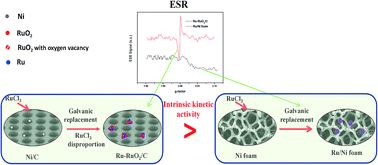
Ru–RuO2/C prepared by galvanic replacement has high catalytic activity for sodium borohydride hydrolysis. In the present study, a series of Ru–RuO2/C catalysts, Ru–RuO2/C reduced, RuO2/C and Ru supported on Ni foam (Ru/Ni foam) are prepared and characterized. Results show that RuO2 on Ru–RuO2/C is formed from both the consumption of the parent Ni and NiO nanoparticles and the disproportionation of RuCl3 with epitaxial growth of Ru species. The quantity of RuO2 with oxygen vacancies in Ru–RuO2/C determines the hydrolysis activity for sodium borohydride. In contrast to Ru–RuO2/C, Ru/Ni foam without oxygen vacancies has the lower hydrolysis activity. Results of kinetics calculation further confirm that without mass transfer limitation, Ru–RuO2/C has lower intrinsic activation energy and correspondingly higher catalytic activity due to existence of oxygen vacancies than those from Ru–RuO2/C reduced, RuO2/C, Ru/Ni foam and catalysts from the literature.

1. Introduction

Hydrogen is a clean, available alternative energy. Hydrolysis of alkaline sodium borohydride (NaBH4) to produce hydrogen has been proposed for hydrogen delivery in portable applications due to the theoretically high hydrogen storage capacity (10.8 wt%). Active catalysts for hydride hydrolysis have included Co, Ni, Co and Ni borides,1,2 Ru,3 Pt,4 CoO and Cu2O.5,6

Recently, a large number of bimetallic catalysts, such as Pd–Cu/C, Pd–Ni/Ni foam,7 Ag–Pd8 and Au–Ag9 have been prepared by galvanic replacement, in which a non-noble metal with a lower potential is replaced by a noble metal to form the bimetallic material. In addition, the existence of the reduced surface can induce the generation of oxygen vacancies10 while the presence of oxygen vacancies in the catalysts can facilitate many redox reactions due to the decrease in work function of the materials.11,12 To our knowledge little has been reported on the synthesis of hydrolysis catalyst with oxygen defects using a reductive base metal as the precursor for galvanic replacement.

Kinetics study on NaBH4 hydrolysis to produce hydrogen has extensively focused on the calculation and comparison of activation energies over catalysts.13,14 Catalytic activity of catalysts, however, is influenced by internal and external diffusion as well as catalytic capacity of active site. In this case, their results for NaBH4 hydrolysis may be more reasonable if the effect of mass transfer limitation in the solution is considered to determine real catalytic properties of catalysts.

In our previous study,15 we reported on the catalytic activity and stability of a Ru–RuO2/C catalyst with oxygen vacancies for sodium borohydride hydrolysis. Although the catalyst showed promising activity, the source of the high catalytic activity and intrinsic activity capacity of Ru–RuO2/C remained unclear. In the present study a series of Ru–RuO2/C catalysts were prepared by galvanic replacement and characterized to investigate the formation of RuO2 with the oxygen vacancies as well as Ru–RuO2/C reduced, RuO2/C and Ru supported on Ni foam (Ru/Ni foam). Under the conditions that the effect of mass transfer was eliminated, intrinsic activation energies of these catalysts were also calculated to compare real catalytic activity of Ru supported catalysts. This work is of great importance for the controllable preparation and reliable comparison of hydrolysis activity of heterogeneous catalysts.

2. Material and methods

2.1 Preparation, characterization and evaluation of catalytic materials

Ru–RuO2/C was prepared by the method described previously.15 In a typical synthesis, the precursor Ni/C was prepared by hydrothermal synthesis (see ESI). The as-prepared sample was dried in vacuum at 333 K for 5 h. Prior to characterization of the Ni/C, the dried sample was calcined at 573 K for 3 h. To obtain the RuO2-based catalyst, the uncalcined Ni/C (0.3 g) was impregnated in an aqueous solution of RuCl3 (25 mL, 9.64 mmol L−1) at 323 K, filtered, dried and calcined 653 K for 3 h. If no specification is made, Ru–RuO2/C denotes the sample treated for 18 h by the galvanic replacement reaction. For comparison, RuO2/C and Ru/Ni foam (Ni foam was from Changsha Lyrun New Material Co. Ltd.) were also prepared from directly impregnating carbon and Ni foam support,7 respectively, as well as Ru–RuO2/C reduced in H2 atmosphere.

X-ray diffraction (XRD) of the catalysts was performed on a Rigaku Ultima-IV diffractometer equipped with a Cu Kα radiation. X-ray photoelectron spectroscopy (XPS) tests were measured with the PHI Quantum 2000 Scanning ESCA Microprobe equipment. Temperature-programmed reduction (TPR) was performed using a conventional TPR apparatus. Electron spin resonance (ESR) was carried out using a Bruker EMX-10/12 Spectrometer at 90 K. Scanning electron microscope (SEM) images of original Ni foam and Ru/Ni from were acquired with a Hitachi S-4800 FE-SEM. The elemental analysis of the samples was conducted on inductive couple plasma (ICP). The surface area of catalysts was determined via the N2 adsorption–desorption isotherm method at 77 K using a Micromeritics TriStar II 3020 and the BET (Brunauer–Emmett–Teller) method. The pore size was calculated using the BJH (Barrett–Joyner–Halenda) method. Prior to the analyses, the samples were outgassed at 523 K for 3 h to eliminate volatile adsorbates on the surface.

In a typical procedure for sodium borohydride hydrolysis, 0.01 g Ru–RuO2/C (0.05 g Ru/Ni foam used because of lower reaction activity) was added into a 25 mL flask and then 5 mL alkaline NaBH4 aqueous solution was introduced into this flask. Hydrogen generated during reaction process was collected into a gas collecting bottle (1 L), which has a minimum scale of 25 mL and an error of 5.0%.

2.2 Mass transfer calculations

Internal diffusion rate might directly affect catalytic performances for NaBH4 hydrolysis reaction. Herein, the Wheeler–Weisz group was used to investigate the influence of internal mass transfer and defined as follows.16–19
 
image file: c6ra00747c-t1.tif(1)
where R is the diameter of pellet catalysts used in hydrolysis reaction process, which was detected through OMEC LS-908 type Laser Particle Size Analyzer. A general relationship between the effective diffusivity (Deff,i) and the pore diffusivity (Dp) is determined by parallel pore model.16,18,20
 
image file: c6ra00747c-t2.tif(2)
ε is the porosity, which can be measured by BET method. τ is the tortuosity factors, which is influenced by temperature, adsorbate density and the diffusion mode and so on.21 A tortuosity factor for typical porous catalysts, 2, was used in this work. The diffusion coefficient, Dp, in the pores was calculated according to a combination of the Knudsen diffusion coefficient (Dk) and the bulk diffusion coefficient (Db,i). As for equimolar counter diffusion, Dp is defined according to the literature (eqn (3)).22
 
image file: c6ra00747c-t3.tif(3)

Among them, Dk can be calculated from eqn (4)

 
image file: c6ra00747c-t4.tif(4)

On the other hand, Majumder et al.23 studied mass transport through carbon nanotube membranes with ∼7 nm pore diameter and found that ionic diffusion through the carbon nanotube (CNT) membranes is close to bulk diffusion expectations and electrostatically influenced by a charged carboxyl functionality at the CNT entrance. In our work, Ru–RuO2/C treated in RuCl3 solution was functionalized by a large number of hydrophilic groups. This implied that reactant ion, BH4, diffusion in Ru–RuO2/C is similar to that in the literature. Therefore, the Knudsen diffusion coefficient of NaBH4 in the pore of Ru–RuO2/C can be obtained with two methods: (1) the conventional calculation for the gas phase according to eqn (4); (2) the Knudsen diffusion coefficient was regarded as the bulk diffusion23 to simplify calculation. Eqn (3) was changed into eqn (5).

 
image file: c6ra00747c-t5.tif(5)

The bulk diffusion coefficient, Db,i, was 3.63 × 10⁻⁵ cm2 s−1 estimated from experimental result in alkaline NaBH4 solution.24 Thus, the diffusion coefficient Dp in the pores of catalysts can be calculated according to eqn (3) or (5), respectively.

3. Results and discussion

3.1 Catalytic hydrolysis reaction of sodium borohydride

The catalytic activity of the catalysts prepared by galvanic replacement was determined for the hydrolysis of NaBH4 and further was normalized by the metal amount in the catalysts (Fig. 1). As shown in Fig. 1, hydrogen generation rates of the catalysts increased with increased galvanic replacement time, i.e. in the order of Ni/C precursor < Ru–RuO2/C treated for 2 h < that treated for 10 h < that treated for 18 h. In comparison with Ru–RuO2/C, Ru–RuO2/C reduced, RuO2/C and Ru/Ni foam present the lower hydrolysis activity (Fig. 2). To understand the change of catalytic activity of catalysts, a series of characterizations were conducted.
image file: c6ra00747c-f1.tif
Fig. 1 Hydrolysis activity of NaBH4 on Ru–RuO2/C at different treatment time.

image file: c6ra00747c-f2.tif
Fig. 2 Hydrolysis activity of NaBH4 on different catalysts.

3.2 Characterization of catalysts

Ru/Ni foam. Table 1 demonstrated the textural characteristics of the materials. During impregnating and reducing process, the pore size and surface area of a series of Ru supported carbon change slightly except for Ru/Ni foam. Fig. 3 showed XRD patterns of Ni foam and Ru supported on Ni foam. Only diffraction peaks of Ni metal were found on Ni foam. After impregnating ruthenium precursor solution, NiO (101) is generated because of the dissolution of partial Ni foam and re-deposition. At the same time, a distinct peak was observed between Ru (002) and Ni (111) during the impregnation process, indicating the formation of a composite composed of metal Ru and Ni. XPS results (Fig. 4 and S1) showed that Ru/Ni foam has the lower binding energy of Ru 3p than Ru–RuO2/C catalysts. This further indicated that more Ru metal exists over Ru/Ni foam. In addition, H2-TPR result showed that a few Ru oxide species are reduced as well as a large amount of Ni oxide species over Ru/Ni foam. And the addition of Ru contributes to the reduction of NiO over Ru/Ni foam compared with Ni foam (Fig. 5). Combining with SEM micrographs and EDX analysis of Ni foam and Ru/Ni foam (Fig. 6), we believe that most of surface Ni and Ru oxide species interact with a composite consisting of Ru and Ni and exist in the form of a large number of nanoplates on Ni foam support.
Table 1 The physiochemical structure of the materials
Catalyst BET surface area (m2 g−1) Pore size (nm)
Ru–RuO2/C for 0 h (Ni/C) 1315.02 4.25
Ru–RuO2/C for 2 h 1442.80 3.94
Ru–RuO2/C for 10 h 1476.14 3.90
Ru–RuO2/C for 18 h 1155.69 4.28
Ru–RuO2/C reduced 1182.82 3.84
RuO2/C 1429.32 4.11
Ru/Ni foam 13.79 23.09


image file: c6ra00747c-f3.tif
Fig. 3 XRD patterns of Ni foam and Ru/Ni foam.

image file: c6ra00747c-f4.tif
Fig. 4 XPS spectra of Ru 3p for different catalysts.

image file: c6ra00747c-f5.tif
Fig. 5 H2-TPR of Ni foam and Ru/Ni foam.

image file: c6ra00747c-f6.tif
Fig. 6 SEM micrograph and EDX analysis of Ni foam and Ru/Ni foam. (a) Ni foam, (b) Ru/Ni foam and (c) EDX of Ru/Ni foam.
Ru–RuO2/C catalysts. Ni species in the form of Ni and NiO were highly dispersed over Ni/C (Fig. 7 and S1). During the subsequent galvanic replacement process, the adsorbed precursor RuCl3, with higher potential than the Ni species, reacts with the nano-particle nickel because nickel has a higher reduction ability than the carbon support. The evolution of the adsorbed RuCl3 into ruthenium oxide with oxygen vacancies was investigated by changing the galvanic replacement time.

In the XRD patterns of Fig. 7, diffraction peaks at 23.7° and 43.9° are attributed to reflections from carbon (JCPDS: 46-0945). The characteristic peaks at 28.0°, 35.1° and 54.3° correspond to (110), (101) and (211) reflections from rutile RuO2 (JCPDS: 40-1290) while the diffraction peaks at 44.5° and 44.0° are attributed to Ni (111) and Ru (101), respectively. As shown in Fig. 7, diffraction peak of Ni (111) over Ni/C (0 h for Ru–RuO2/C) is observed in comparison with carbon by hydrothermal treatment. XPS spectrum (Fig. S1) of Ni/C showed that NiO appears in accompany with Ni metal. The negligible diffraction peak in XRD pattern is due to the high dispersion of NiO on Ni/C. The nickel (111) disappears while RuO2 is formed (Fig. 7) after galvanic replacement. With increased galvanic replacement time, diffraction peak of RuO2 over Ru–RuO2/C is also gradually prominent, indicating the RuO2 increases with increased treatment time.


image file: c6ra00747c-f7.tif
Fig. 7 XRD patterns of C and Ru–RuO2/C at different galvanic replacement time.

In comparison with Ni/C, the appearance of a Ru 3p signal from the XPS spectra (Fig. 4) was accompanied by the disappearance of the Ni 2p spectrum after galvanic replacement for 2 h. In addition, Fig. 8 showed the H2-TPR results of Ru–RuO2/C at different galvanic replacement time. As shown in Fig. 8, Ru–RuO2/C has no obvious reduction peak for Ni oxide species after galvanic replacement for 2 h. These results indicate that the formation of RuO2 is at the expense of both Ni metal and NiO in the initial stage of galvanic replacement. Since the standard reduction potential of Ni2+/Ni pair (−0.25 V, vs. standard hydrogen electrode, SHE) is lower than that of the RuCl3/Ru pair (0.68 V, vs. SHE), RuCl3 can be reduced to Ru by Ni under certain conditions. The produced Ru might be further oxidized in the solution.25 We also impregnated commercial NiO powder with the RuCl3 solution at 323 K. RuO2 was observed by XRD (data not shown) and by XPS (Fig. S2). Therefore, we conclude that Ru and RuO2 on the Ru–RuO2/C catalyst come from the reactions of Ni and NiO with RuCl3 in the initial stage of galvanic replacement.


image file: c6ra00747c-f8.tif
Fig. 8 H2-TPR profiles of Ru–RuO2/C at different galvanic replacement time.

ICP analysis shows that the Ru loadings in Ru–RuO2/C are 4.40, 5.23 and 6.13 wt% after treatment for 2, 10 and 18 h, respectively. H2-TPR (Fig. 8) results demonstrated that the total amount of reduced oxygen species in Ru–RuO2/C also increased gradually for the catalysts treated for 2, 10 and 18 h, respectively. The ratio of TPR peak area for Ru oxide species is almost equal and the total Ru loading is proximate for the samples for 2, 10 and 18 h, implying that both ruthenium oxide species and Ru metal increase simultaneously with increased galvanic replacement time. Since reactions between Ni species and RuCl3 proceed within 2 h and the Ru and RuO2 loading further increase with increased galvanic replacement time, the formation of Ru and RuO2 results from the disproportionation of RuCl3 adsorbed on catalysts under the conditions of the presence of air.26,27

Fig. 9 showed low-temperature ESR spectra of different catalysts. The signals with characteristic g-factor values of 2.002 and 1.997 are identified as oxygen vacancies on RuO2 (ref. 28) at magnetic fields of about 3360 G. There were no the other pronounced resonant features in the spectra. As shown in Fig. 9, the catalytic materials treated for 10 and 18 h, especially after 18 h, had obvious signals for oxygen vacancies.


image file: c6ra00747c-f9.tif
Fig. 9 Low-temperature ESR spectrum of catalysts in different treatment time.

In agreement with the content of oxygen vacancies, hydrogen generation rates of the catalysts increased with increased galvanic replacement time, i.e. in the order of Ni/C precursor < Ru–RuO2/C treated for 2 h < that treated for 10 h < that treated for 18 h (Fig. 1). The consumption of Ni species accompanied with the formation of oxygen vacancies on RuO2 occurred within 2 h. However, the highest catalytic activity occurs on Ru–RuO2/C treated for 18 h. This is mainly because of continued disproportionation of RuCl3 yielding an increased number of Ru and RuO2 species with oxygen vacancies epitaxially grown on the catalyst. RuO2 with oxygen vacancies can facilitate water decomposition, a rate-determining step for NaBH4 hydrolysis, while Ru metal acts as an active phase to dissociate NaBH4. Thus, under the conditions that Ru metal and RuO2 cocatalyze NaBH4 hydrolysis, Ru–RuO2/C shows the highest catalytic activity of sodium borohydride hydrolysis.

ESR spectrum presented no oxygen defects on Ru/Ni foam. In other words, Ru and Ni metal composite, rather than Ru and RuO2 with oxygen vacancies, was obtained by Ni foam as a rich reductive support impregnated by Ru precursor solution. In comparison with Ru–RuO2/C, Ru/Ni foam without oxygen defects has relative low catalytic activity for NaBH4 hydrolysis to hydrogen. This is also further discussed in 3.3 section.

3.3 Intrinsic kinetic study

A Ru–RuO2/C catalyst with oxygen vacancies showed the high catalytic activity in NaBH4 hydrolysis. Herein, intrinsic kinetics of Ru–RuO2/C was studied and compared with the Ni and Ru metal composites, Ru–RuO2/C reduced and Ru/Ni foam, and the results from literatures. Fig. S3 presented the NaBH4 hydrolysis reaction results over Ru–RuO2/C at various stirring speed to check the effect of external diffusion on hydrolysis reaction. With increased stirring speed, the rate of hydrogen generated firstly increases29 and then decreases. At the stirring speed higher than 200 rpm, hydrogen generation rate reached the maximal value, indicating that external mass transfer limitation is almost completely eliminated in this case. At 300 rpm, the decreasing in reaction rate might be result from unexpected adhesion of catalysts to the upper wall of the flask at high stirring speed.

Influence of internal diffusion on hydrolysis reaction was further estimated over Ru–RuO2/C. Calculation value of the Wheeler–Weisz group, based on the conventional gas phase or the assumption that the Knudsen diffusion coefficient is equal to the bulk diffusion, is 0.0048 or 0.0024, respectively. It is generally accepted that the effect of the internal mass transfer on the reaction rate can be neglected when the value of ηφ2 is less than 0.1. In this work, the difference of the Wheeler–Weisz group on the basis of two methods derives from the Knudsen diffusion coefficient. At present, the accurate calculation for Knudsen diffusion coefficient of fluid component is still under way. However, since the possible calculation values of ηφ2 were far away from 0.1, the influence of internal mass transfer on the hydrolysis reaction should be negligible over Ru–RuO2/C. The porous structure of Ru–RuO2/C reduced and RuO2/C is similar to that of Ru–RuO2/C (Table 1), so the effect of diffusion on activity over Ru–RuO2/C reduced and RuO2/C was also not prominent. With respect to Ru/nickel foam, the pore size is very large even though after it was modified by Ru (Table 1). In this case, the effect of internal diffusion is negligible.

Under the conditions that the reaction process is free from the external and internal mass transfer limitations, turnover frequency (TOF) was estimated by dividing the mole amount of hydrogen produced per second by the mole amount of metal on catalysts used. Arrhenius plots for TOF as a function of temperature was given in Fig. 10. The corresponding activation energy of catalysts was also presented in Fig. 10. As displayed in Fig. 10, Ru–RuO2/C has the relative lower activation energy than Ru/Ni foam. When the apparent activation energy is not affected by mass transfer, the lower activation energy implies the relative higher catalytic activity of Ru–RuO2/C than Ru/Ni foam. In contrast, most of activation energies from literatures are apparent results (Table 2) and they might be influenced by mass transfer. In this case, Ru–RuO2/C showed a moderate activity. However, considering the pore diffusion limitation, true apparent reaction activation energies (Et) are modified by a diffusion activation energy (Ed) term such that the observed apparent activation energy is given by Eob = (Et + Ed)/2.30 Thus, more sever diffusion limitations might lead to the low apparent activation energies from those literatures or difficulty in comparison of catalytic results. Although some catalysts in the literatures reported were used in the form of nanoparticles for hydrolysis reaction, the effect of particle aggregation in the solution on internal mass transfer is still unclear. To reliably determine catalytic capacity of active site over heterogeneous catalysts, the intrinsic activation energies for hydride hydrolysis to hydrogen should be presented on the basis of elimination of mass transfer limitation. This was done for the first time in the present work.


image file: c6ra00747c-f10.tif
Fig. 10 Arrhenius plot obtained from TOF for different catalysts.
Table 2 The comparison of activation energies of catalysts from literatures
Catalyst Temperature (K) Ea (kJ mol−1) Ref.
Ni45Au45Co10 303–318 18.8 31
Ru/Ti3C2X2 298–313 22.1 32
Au20Ni80 BNP 303–318 30.3 33
Co–Mo–B 293–323 43.7 14
Ni–B 303–333 ∼45–47 34
Ru/HMS 283–303 46.7 35
Co–P 303–323 47.0 36
NiB/capsule 303–333 49.3 37
Co–La–Zr–B 293–323 51.2 38
Ni–Co–P/γ-Al2O3 298–328 52.1 39
Ni–Ru/50WX8 288–348 52.7 40
Co–B/IR-120 273–353 66.3–81.7 41
Ru–RuO2/C 303–323 48.4 This work


4. Conclusions

The present study shows that the formation of a part of Ru and RuO2 is at the expense of Ni and NiO and the other comes from the disproportionation of RuCl3. RuO2 with oxygen vacancies in Ru–RuO2/C determines hydrolysis activity of sodium borohydride. In contrast, Ru/Ni foam without oxygen vacancies exhibits the low catalytic activity. Under the conditions eliminating internal and external diffusion, intrinsic activation energy obtained is, 48.36 kJ mol−1, lower than that from Ru–RuO2/C reduced, RuO2/C and Ru/Ni foam. Ru–RuO2/C with oxygen vacancies has the higher intrinsic catalytic activity than metal Ru and Ni composite. Since the apparent activation energies are affected by mass-transfer limitations, the comparison of real activity on hydrolysis catalysts should be conducted based on intrinsic activation energies.

Abbreviations

ηφ2Wheeler–Weisz group, dimensionless
robsApparent reaction rate, mol L−1 s−1
RThickness of wash-coat or diameter of the pellet and cylindrical catalysts, m
nReaction order
Deff,iEffective diffusion coefficient in the pores of the catalyst, m2 s−1
CsBH4 concentration at the surface of catalyst, mol m−3
DpThe diffusion coefficient in the pores, m2 s−1
DkThe Knudsen diffusion coefficient, m2 s−1
dpPore diameter of catalyst, m
TTemperature, K
MMolecular weight of BH4 species
Db,iThe bulk diffusion coefficient of specie i, m2 s−1

Greek letters

εVoid fraction (porosity) of catalyst bed, dimensionless
τTortuosity factor, dimensionless

Acknowledgements

This work was supported by National Natural Science Foundation of China (Grant No. 21476188, 21106118).

Notes and references

  1. N. Patel and A. Miotello, Int. J. Hydrogen Energy, 2015, 40, 1429–1464 CrossRef CAS.
  2. N. Sahiner and A. O. Yasar, Fuel Process. Technol., 2014, 125, 148–154 CrossRef CAS.
  3. H. Y. Ma and C. Z. Na, ACS Catal., 2015, 5, 1726–1735 CrossRef CAS.
  4. C. Salameh, A. Bruma, S. Malo, U. B. Demirci, P. Miele and S. Bernard, RSC Adv., 2015, 5, 58943–58951 RSC.
  5. Y. Yamada, K. Yano and S. Fukuzumi, Energy Environ. Sci., 2012, 5, 5356–5363 CAS.
  6. H. Zhang, T. Ling and X. W. Du, Chem. Mater., 2015, 27, 352–357 CrossRef CAS.
  7. Y. Li, L. Zhu, K. Yan, J. Zheng, B. H. Chen and W. Wang, Chem. Eng. J., 2013, 226, 166–170 CrossRef CAS.
  8. L. Xu, Z. M. Luo, Z. X. Fan, S. J. Yu, J. Z. Chen, Y. S. Liao and C. Xue, Chem.–Eur. J., 2015, 21, 8691–8695 CrossRef CAS PubMed.
  9. J. Lee, K. Han and D.-J. Jang, Appl. Catal., A, 2014, 469, 380–386 CrossRef CAS.
  10. X. Wang, N. M. Perret, J. J. Delgado, G. Blanco, X. Chen, C. M. Olmos, S. Bernal and M. A. Keane, J. Phys. Chem. C, 2013, 117, 994–1005 CAS.
  11. M. V. Ganduglia-Pirovano, A. Hofmann and J. Sauer, Surf. Sci. Rep., 2007, 62, 219–270 CrossRef CAS.
  12. M. T. Greiner, L. Chai, M. G. Helander, W. M. Tang and Z. H. Lu, Adv. Funct. Mater., 2012, 22, 4557–4568 CrossRef CAS.
  13. S. G. Peng, X. J. Fan, J. Zhang and F. Y. Wang, Appl. Catal., B, 2013, 140, 115–124 CrossRef.
  14. D. D. Ke, Y. Tao, Y. Li, X. Zhao, L. Zhang, J. D. Wang and S. M. Han, Int. J. Hydrogen Energy, 2015, 40, 7308–7317 CrossRef CAS.
  15. Y. Li, Q. Zhang, N. Zhang, L. Zhu, J. Zheng and B. H. Chen, Int. J. Hydrogen Energy, 2013, 38, 13360–13367 CrossRef CAS.
  16. H. R. Yue, Y. J. Zhao, L. Zhao, J. Lv, S. P. Wang, J. L. Gong and X. B. Ma, AIChE J., 2012, 58, 2798–2809 CrossRef CAS.
  17. K. Arnby, A. Torncrona, B. Andersson and M. Skoglundh, J. Catal., 2004, 221, 252–261 CrossRef CAS.
  18. L. Ronchin and L. Toniolo, Catal. Today, 1999, 48, 255–264 CrossRef CAS.
  19. E. Crezee, B. W. Hoffer, R. J. Berger, M. Makkee, F. Kapteijn and J. A. Moulijn, Appl. Catal., A, 2003, 251, 1–17 CrossRef CAS.
  20. Z. G. Wang, S. L. Chen, J. N. Pei, A. C. Chen, J. H. Zhang, Z. M. Xu and J. B. Benziger, AIChE J., 2014, 60, 3267–3275 CrossRef CAS.
  21. M. R. Bonilla and S. K. Bhatia, J. Phys. Chem. C, 2013, 117, 3343–3357 Search PubMed.
  22. J. von Rickenbach, F. Lucci, C. Narayanan, P. D. Eggenschwiler and D. Poulikakos, Chem. Eng. J., 2015, 276, 388–397 CrossRef CAS.
  23. M. Majumder, N. Chopra and B. J. Hinds, ACS Nano, 2011, 5, 3867–3877 CrossRef CAS PubMed.
  24. M. Chatenet, M. B. Molina-Concha, N. El-Kissi, G. Parrour and J. P. Diard, Electrochim. Acta, 2009, 54, 4426–4435 CrossRef CAS.
  25. G. Chen, S. Desinan, R. Rosei, F. Rosei and D. Ma, Chem. Commun., 2012, 48, 8009–8011 RSC.
  26. Y. Guo, H. Li and H. Kameyama, Chem. Eng. Sci., 2011, 66, 6287–6296 CrossRef CAS.
  27. D. V. Bavykin, A. A. Lapkin, P. K. Plucinski, J. M. Friedrich and F. C. Walsh, J. Catal., 2005, 235, 10–17 CrossRef CAS.
  28. P. A. Osorio-Vargas, C. Pulgarin, A. Sienkiewicz, L. R. Pizzio, M. N. Blanco, R. A. Torres-Palma, C. Pétrier and J. A. Rengifo-Herrera, Ultrason. Sonochem., 2012, 19, 383–386 CrossRef CAS PubMed.
  29. S. F. Lim, Y. M. Zheng, S. W. Zou and J. P. Chen, Chem. Eng. J., 2009, 152, 509–513 CrossRef CAS.
  30. T. Zhang, J. Li, J. Liu, D. Wang, Z. Zhao, K. Cheng and J. Li, AIChE J., 2015, 61, 3825–3837 CrossRef CAS.
  31. C. Jiao, Z. Huang, X. Wang, H. Zhang, L. Lu and S. Zhang, RSC Adv., 2015, 5, 34364–34371 RSC.
  32. X. Li, G. Fan and C. Zeng, Int. J. Hydrogen Energy, 2014, 39, 14927–14934 CrossRef CAS.
  33. X. Wang, S. Sun, Z. Huang, H. Zhang and S. Zhang, Int. J. Hydrogen Energy, 2014, 39, 905–916 CrossRef CAS.
  34. Z. J. Wu, X. K. Mao, Q. Zi, R. R. Zhang, T. Dou and A. C. K. Yip, J. Power Sources, 2014, 268, 596–603 CrossRef CAS.
  35. S. Peng, B. Pan, H. Hao and J. Zhang, J. Nanomater., 2015, 2015, 1–11 Search PubMed.
  36. Y. Wang, K. Qi, S. Wu, Z. Cao, K. Zhang, Y. Lu and H. Liu, J. Power Sources, 2015, 284, 130–137 CrossRef CAS.
  37. Y. Chen, Y. Shi and Y. Wang, Int. J. Energy Res., 2015, 39, 634–642 CrossRef CAS.
  38. M. H. Loghmani and A. F. Shojaei, Energy, 2014, 68, 152–159 CrossRef CAS.
  39. Z. Li, H. Li, L. Wang, T. Liu, T. Zhang, G. Wang and G. Xie, Int. J. Hydrogen Energy, 2014, 39, 14935–14941 CrossRef CAS.
  40. C.-H. Liu, B.-H. Chen, C.-L. Hsueh, J.-R. Ku, M.-S. Jeng and F. Tsau, Int. J. Hydrogen Energy, 2009, 34, 2153–2163 CrossRef CAS.
  41. Y.-H. Chen and C.-Y. Pan, Int. J. Hydrogen Energy, 2014, 39, 1648–1663 CrossRef CAS.

Footnote

Electronic supplementary information (ESI) available. See DOI: 10.1039/c6ra00747c

This journal is © The Royal Society of Chemistry 2016
Click here to see how this site uses Cookies. View our privacy policy here.