Rahmatollah Rahimi,
Mahsa Moshari,
Mahboubeh Rabbani* and
Alireza Azad
Department of Chemistry, Iran University of Science and Technology, Narmak, Tehran 16846-13114, Iran. E-mail: m_rabani@iust.ac.ir
First published on 12th April 2016
Wide sheets of graphene oxide (GO) were prepared by the Hummers' method. Raman spectroscopy and AFM images were used to characterize the prepared GO. A one-step green chemistry method was used to prepare sulfur/reduced graphene oxide (S/RGO). Magnetic nanoparticles were added to S/RGO to prepare Fe3O4@S/RGO composite. The prepared composites were investigated by X-ray diffraction (XRD), Fourier-transform infrared (FT-IR) spectroscopy, X-ray photoelectron spectroscopy (XPS), energy-dispersive X-ray (EDX) mapping, transmission electron microscopy (TEM), and scanning electron microscopy (SEM) imaging. The magnetism of the composite was measured using a vibrating sample magnetometer (VSM). Diffuse reflectance spectroscopy (DRS) was used to find band gaps of samples. Experimental tests distinguished kinetic photocatalyst degradation of methylene blue (MB) and crystal violet (CV) in presence of the prepared catalysts under visible light irradiation. The results demonstrated that Fe3O4@S/RGO has excellent degradation activity in comparison to GO, pure sulfur, and S/RGO. Furthermore, photodegradation of MB is more efficient than CV. Fe3O4@S/RGO also was used for photooxidation of substituted benzyl alcohols to their corresponding benzaldehydes. Selectivity and conversion of the oxidation reaction was demonstrated by TLC and GC.
Moreover, doping sulfur into reduced graphene oxide (S/RGO) can open a band gap of graphene for applications as sensors.9–11 Sulfur has excellent properties such as inexpensive cost, high accessibility, and low perniciousness. Some works have been reported on photocatalytic activity for S/RGO degradation of organic dyes under visible light by photosensitization.12 Moreover, doping aluminum, silicon, phosphorus, and sulfur on graphene has been reported, showing that functionalized graphene with above mentioned elements can increase electron transfer. Therefore, it can improve photodegradation and oxidation reactions.13–16 To the best of our knowledge, S/RGO has been used as a photocatalyst for degradation of organic dyes such as methyl orange.12 This composite of graphene has major potential due to its easy and facile procurement, good photosensitivity with a narrow band-gap, and high stability.17–19
Benzaldehyde is the most effective and industrially specific significant aromatic aldehyde because it plays a key role as an organic solvent. Furthermore, in the Reformatsky reaction, Claisen–Schmidt condensation, and the Perkin condensation, benzaldehyde plays a vital role as a raw material. Many routes have been applied to generate benzaldehyde; oxidation of benzyl alcohols is the most important method to produce it. Selectivity in this reaction is very significant because the oxidation of benzyl alcohols reaction usually tends to generate benzoic acid, therefore, stopping at the benzaldehyde step is very attractive.20–25
On the other hand, magnetic particles are very fascinating for scientists because the magnetic particles can be easily collected from the environment. Nanoparticles of Fe3O4 have acceptable stability in the environment, they are non-toxic, and can be incorporated in a non-carcinogenic semiconductor which can be used as a magnetically effective photocatalyst. Magnetic particles have substantial morphology and size and so are attractive to researchers; however, one of the disadvantages of magnetic particle is they are very vulnerable to oxidation when exposed to oxygen in the atmosphere.26–28 In the past decade, many scientists synthesized graphene–Fe3O4. In addition, compared with other magnetic materials, nano sheets of graphene demonstrated significantly increased electromagnetic absorption properties due to good separation, high surface areas, and interfacial polarizations.
In this study, sulfur was embedded on graphene via an environmentally friendly method, then the Fe3O4@S/RGO composite was synthesized by immobilizing Fe3O4 nanoparticles on S/RGO as in previously reported work.29 The prepared catalysts were investigated for photodegradation of MB and CV as cationic dyes under LED visible light irradiation. In addition, Fe3O4@S/RGO was used as a photocatalyst for oxidation of benzyl alcohols. The presence of Fe3O4 helps collection from the environment and reusability of a catalyst. In addition, nanoparticles of Fe3O4 can help photodegradation and photooxidation processes according to a possible mechanism discussed in a later section.
![]() | ||
| Fig. 1 The Raman spectroscopy of graphite and graphene oxide. Inset: the AFM images of graphene oxide. | ||
SEM images of GO, S/RGO, and Fe3O4@S/RGO and TEM images of GO and Fe3O4@S/RGO are shown in Fig. 2. The SEM image of GO shows the sheet structures (Fig. 2A) while in SEM images of S/RGO (Fig. 2B and C) it can be observed that S particles are doped on the surface of graphene sheets. The SEM image of Fe3O4 illustrates nanoparticles morphology (Fig. 2D). In the SEM image of Fe3O4@S/RGO (Fig. 2E), the nanoparticles of Fe3O4 are clearly on the surface of S/RGO. Fig. 2F shows the TEM image of GO and indicates that sheets of GO are transparent. TEM images of Fe3O4@S/RGO composite (Fig. 2G–I) demonstrate that the magnetic nanoparticles and sulfur have grown on the graphene sheets with a narrow size distribution and identical dispersion of nanoparticles. Typical particle sizes are in the range of 8–20 nm.
![]() | ||
| Fig. 2 The SEM images of (A) GO, (B and C) S/RGO, (D) Fe3O4, (E) Fe3O4@S/RGO. The TEM of (F) GO and (G–I) Fe3O4@S/RGO. | ||
In addition, EDX elemental mapping and XPS analysis were done to investigate elements in the Fe3O4@S/RGO composite. The EDX mapping images reveal that Fe, C, S, and O components were distributed uniformly in the Fe3O4@S/RGO composite (Fig. 3) and show that most of the particles are Fe3O4.
![]() | ||
| Fig. 3 (A–C) EDX mapping images of Fe3O4@S/RGO composite for C, S, and Fe elements and (D) percentage of elements in the Fe3O4@S/RGO composite. | ||
The percentage of Fe in the composite is 71.5%. The elemental percentage of S/RGO and Fe3O4@S/RGO obtained from EDX analysis are listed in Table 1.
| Compound | Element | |||
|---|---|---|---|---|
| C | S | O | Fe | |
| S/RGO | 44.1 | 6.4 | 45.3 | — |
| Fe3O4@S/RGO | 27.3 | 1.5 | 40.7 | 71.5 |
Complete characterization was further investigated by X-ray photoelectron spectroscopy (Fig. 4). The XPS spectra of Fe3O4@S/RGO confirmed the results of EDX analysis. The peaks about 291.1 and 537.1 eV indicate the presence of C and O, respectively. In addition, XPS spectra of sulfur shows very poor peaks at 169 and 165 eV that are related to S 2p1/2 and S 2p3/2, respectively. Due to the low amount of sulfur in the composite, these peaks were very weak. The peaks corresponding to Fe3O4 are very clear in this spectrum; 710 and 725 eV are related to Fe 2p3/2 and Fe 2p1/2, respectively.30–33
The FT-IR spectra of GO, S/RGO, Fe3O4, and Fe3O4@S/RGO are shown in Fig. 5A. The FT-IR of GO displayed several characteristic bands at 1110 cm−1 (C–O bond, carbonyl), 1375 cm−1 (O–H bond, hydroxyl), 1714 cm−1 (C–O bond, carbonyl and carboxylic acid), 1614 cm−1 (H–O–H in adsorbed water) and broad band at 3100–3500 cm−1 (O–H bond, hydroxyl). In the S/RGO spectrum, the absence of a carbonyl band at 1710 cm−1 obviously demonstrated loss of oxygen. The bands at 1050 cm−1 and 1200 cm−1 in the spectrum of S/RGO belong to C–S stretching and C
S stretching, respectively, and showed that S particles are chemically bonded to the graphene. In FT-IR spectra of bare Fe3O4, the Fe–O bond was shown by a strong absorption band at around 570 cm−1 and the peak at ∼3400.4 cm−1 is ascribed to the stretching vibrations of OH, which is from OH absorbed on the surface of Fe3O4 particles. In the FT-IR spectrum of Fe3O4@S/RGO, the presence of a Fe–O band at around 570 cm−1 and Fe–S stretching bands at ∼274 and ∼311 cm−1 demonstrate that Fe3O4 particles are embedded on S/RSO.
![]() | ||
| Fig. 5 (A) The FT-IR spectroscopy of GO, S/RGO, Fe3O4, and Fe3O4@S/RGO. (B) The XRD pattern of S/RGO, Fe3O4, and Fe3O4@S/RGO. (C) The UV-vis DRS of GO, S/RGO, and Fe3O4@S/RGO. | ||
The XRD patterns of bare S/RGO, Fe3O4, and Fe3O4@S/RGO composite are shown in Fig. 5B. As can be seen in the XRD pattern of S/RGO, typical reflections of α-octa-sulfur (S8, JCPDS#08-0247) were clearly observed for the pure S particles.12 There are additional peaks at 2θ = 24/5° and 27/8° that can be indexed to (−2 4 1) and (−3 1 3) corresponding to reduced graphene oxide, respectively. The other peaks can be indexed to the structure and the lack of any peaks relating to GO at lower angles could be attributed to complete reduction of graphene oxide to graphene during synthesis. The characteristic peaks in the XRD pattern of Fe3O4 are related to a phase of cubic magnetite, which is in a close agreement with the reference pattern of JCPDS 01-088-0315. In the XRD pattern of Fe3O4@S/RGO composite, most of the considerable diffraction peaks can be indexed to Fe3O4. In addition, a few peaks appeared that belong to R/SGO. In conclusion, these patterns confirm the presence of sulfur and Fe3O4 nanoparticles on graphene sheets.
The UV-vis DRS measurements of GO, S/RGO, and Fe3O4@S/RGO are shown in Fig. 5C. As seen in this figure, the presence of S atoms is confirmed with absorbance in UV and visible range. Furthermore, immobilizing Fe3O4 on the surface of S/RGO increases absorbance. Therefore, the presence of S atoms and Fe3O4 nanoparticles can enhance the photocatalytic activity of graphene.
The magnetic hysteresis loops for the synthesized bare Fe3O4 and Fe3O4@S/RGO composite are shown in Fig. 6. The magnetic properties of the samples were analyzed at room temperature using a vibrant sample magnetometer (VSM). For bare Fe3O4, the value of saturation magnetization (Ms) and the remnant magnetization (Mr) are 76.5 and 17.79 emu g−1, respectively. It can be inferred from the hysteresis loops that Fe3O4 nanoparticles are magnetically soft at room temperature. The value of saturation magnetization (Ms) for the Fe3O4@S/RGO composite is 58.1 emu g−1. In other words, with presence of S/RGO, the magnetite saturation was slightly decreased.
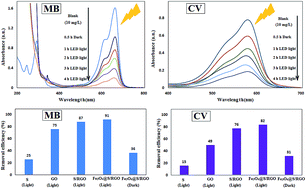
Absorption at wavelengths 664 nm (maximum peak of MB) and 580 nm (maximum peak of CV) was chosen to monitor the photocatalysts degradation process of MB and CV solutions, respectively. The removal efficiency of MB and CV by Fe3O4@S/RGO, S/RGO, pure graphene, and pure sulfur are illustrated in Fig. 7C and D, respectively. Comparison between these catalysts showed that Fe3O4@S/RGO has the highest capability for degrading the dyes. In addition, the compounds have been used to degrade anionic dye (MO),12 but it has been demonstrated that Fe3O4@S/RGO is better for cationic dyes rather than anionic dyes.
The kinetic studies of the photocatalytic degradation of MB and CV under visible light were demonstrated in Fig. 8A and B, respectively. The photodegradation reaction of MB and CV by Fe3O4@S/RGO exhibited a Pseudo-first-order kinetic model which is expressed as follows:
![]() | ||
| Fig. 8 The kinetics of photocatalytic degradation of (A) MB and (B) CV (10 and 20 mg L−1) in presence of Fe3O4@S/RGO catalyst under 7 W LED visible light irradiation. | ||
Fe3O4 acts as a magnetization function with the composite; moreover, due to the low band gap, it can be easily excited by visible light irradiation and the electrons promoted from their ground state to the excited state. However, electrons may return from CB to VB. The graphene sheets act as an excellent electron collector. With immobilizing of Fe3O4 on graphene, electrons can be injected into graphene sheets and the probability of electron–hole recombination can be reduced. Therefore, this composite makes better electron-conducting surfaces and increases photocatalytic activities, essentially due to the effective prevention of photo-generated electron–hole pair recombination.34–36 The schematic for the excitation and charge transfer process from S and Fe3O4 to graphene sheets under light irradiation is shown in Scheme 1. The holes can directly oxidize MB and CV molecules adsorbed on the catalyst surface. In addition, the graphene sheets can convey photo-generated electrons to dissolved oxygen molecules leading to the production of oxygen peroxide radicals (O2˙). The positive charged hole also can react with OH− derived from H2O to generate hydroxyl radicals (OH˙). The MB and CV molecules then can be photocatalytically degraded by the O2˙ and OH˙ radicals to CO2, H2O, and other mineralization products.37,38
![]() | ||
| Scheme 1 Proposed mechanism of photocatalytic degradation of MB and CV by the Fe3O4@S/RGO composite. | ||
| Entry | H2O2 (mL) | Catalyst loading (mg) | Solvent | Visible light | Conversionb (%) | Selectivityb (%) |
|---|---|---|---|---|---|---|
| a Reaction conditions: alcohol (1 mmol), 80 °C, 90 min, reflux.b Conversion and selectivity were determined by GC. | ||||||
| 1 | 0.2 | 20 | — | — | 10 | 100 |
| 2 | 0.2 | 20 | H2O | — | 20 | 100 |
| 3 | 0.2 | 20 | CH3CN | — | 88 | 100 |
| 4 | 0.1 | 20 | CH3CN | — | 80 | 100 |
| 5 | 0.4 | 20 | CH3CN | — | 85 | 100 |
| 6 | — | 20 | CH3CN | — | 70 | 100 |
| 7 | 0.2 | 30 | CH3CN | — | 91 | 100 |
| 8 | 0.2 | 20 | CH3CN | Was used | 99 | 100 |
In order for a catalytic evaluation of the Fe3O4@S/RGO composite to selectively convert benzyl alcohol to benzaldehyde, other substituted derivatives in presence of this catalyst were carried out under the optimal conditions (Table 3).
| Entry | Structure of alcohol | Name of alcohols | Time (min) | Conversionb (%) | Selectivityb (%) |
|---|---|---|---|---|---|
| a Reaction conditions: alcohol (1 mmol), catalyst (20 mg), H2O2 (2 mmol), CH3CN (6 mL), reflux, 80 °C, under visible LED lamp irradiations.b Conversion and selectivity were determined by GC-Ms. | |||||
| 1 | ![]() |
C6H5CH2OH | 90 | 99 | 100 |
| 2 | ![]() |
2-MeC6H5CH2OH | 120 | 35 | 100 |
| 3 | ![]() |
4-MeC6H5CH2OH | 120 | 56 | 100 |
| 4 | ![]() |
2-ClC6H5CH2OH | 120 | 56 | 100 |
| 5 | ![]() |
4-ClC6H5CH2O | 100 | 65 | 100 |
| 6 | ![]() |
2-N2OC6H5CH2OH | 120 | 45 | 80 |
| 7 | ![]() |
4-N2OC6H5CH2OH | 120 | 55 | 67 |
| 8 | ![]() |
3,4-Di-OMeC6H5CH2OH | 100 | 30 | 100 |
The best conversion belongs to benzyl alcohol because of no substituted positions and thus easier oxidizing. Both electron deficient and electron rich derivatives of benzyl alcohol demonstrated good reactivity and excellent selectivity. On the other hand, para derivatives have excellent conversion relative to other derivatives (in ortho or meta positions), because they have minimum steric hindrance in comparison to ortho substituted positions. As seen at Table 3, the conversion of 3,4-di-OMeC6H5CH2OH (entry 8) with two electron donor substituents (methoxy groups) was only 30%, while in entry 4 and entry 5, with electron acceptor substituents (chloride) in ortho and para locations were 56% and 60%, respectively. Therefore, benzyl alcohols with electron acceptor substituents were oxidized more efficiency than benzyl alcohols with electron donor substituents. In addition, para substituents (entry 3, entry 5, and entry 7) were better than ortho substitutes (entry 2, entry 4, and entry 6) because para substituents have less steric hindrance than ortho substituents.
The comparison between various catalysts is shown in Table 4. As can be seen, results in the presence of Fe3O4@S/RGO catalyst with less time and less power consumption and H2O2 are the best (96% conversion, 100% selectivity).
| Entry | Catalyst conditions | Catalyst loading (mg) | Time (min) | Conversion (%) | Selectivity (%) | Ref. |
|---|---|---|---|---|---|---|
a Conditions of reactions: 0.5 mL benzyl alcohol, 20 mL H2O plus 5 mL Na2CO3–NaHCO3 buffer solution (pH = 9), T = 100 °C, 3 atm O2.b 16.7 mmol benzyl alcohol, 50.1 mmol H2O2, T = 100 °C.c 0.1 mmol alcohol, 80 mL H2O, 1 atm O2, T = 343 K, 1300 rpm.d 0.1 mmol alcohol, room temperature, atmospheric pressure.e magnetic stirrer under argon environment, 2 mL acetonitrile solvent, 2.0 mL benzyl alcohol, 1 mL 30% H2O2, room temperature.f 1 mmol alcohol, 0.5 mL CH3CN·H2O, 5 equiv. 30% H2O2, T = 90 °C.g 1 mmol of substrate, 5 mL of CH3CN, room temperature.h 1 mmol benzyl alcohol, 1.25 mmol NaOCl, pH = 8.6 in the presence of 1 mol% TEMPO, 1 mol% porphyrins or 1 mol% metalloporphyrins, 10 mol% KBr, 8 mL CH2Cl2/H2O = 1 : 1, T = 0 °C, 30 min. |
||||||
| 1 | Au/RGO | 75 | 480 | 65 | 93 | 41a |
| 2 | GO–N–PW | 100 | 360 | 76 | 99 | 42b |
| 5 | Au/NG | 30 | 360 | 67 | 40 | 43c |
| 6 | CdS/RGO | 8 | 240 | 35 | 71 | 44d |
| 7 | ZnFe2O4 | 24.1 | 10 | 6.9 | 95.9 | 45e |
| 8 | WO42−@PMO-IL | 230 | 12 | 75 | 100 | 46f |
| 9 | FeBr3 | 59 | 24 | 70 | 100 | 47g |
| 10 | Porphyrin/Mn(TDCPP)Cl | 520 | 0.5 | 48 | 99 | 48h |
| 11 | Fe3O4@S/RGO | 20 | 90 | 96 | 99 | This work |
In the first step, after the collision, with visible light to Fe3O4@S/RGO, it can produce holes and electrons and then h+ can react with benzyl alcohol to produce free radicals of PhCHOH.
Step 1:
| Fe3O4@S/RGO + hν → Fe3O4@S/RGO (h+ + e−) |
| PhCH2OH + h+ → PhCHOH + H+ |
On the other hand, H2O2 is decomposed into oxygen and water by heat. Oxygen can react with e− to O2−. In the next step, some of the free radicals of PhCHOH can react with h+ and some of them react with O2− to generate benzaldehyde. Therefore, benzaldehyde can be formed in two reactions (step 2).
Step 2:
| H2O2 + heat → H2O + ½O2 |
| O2 + e− → O2− |
| PhCHOH + h+ → PhCHO + H+ |
| PhCHOH + O2− + H+ → PhCHO + H2O |
In order to investigate active species in the experiment, isopropanol was used as the scavenger of hydroxide radicals, KI as the scavenger for holes, and N2 perch as scavenger for superoxide. When KI was added into the reaction, strong low oxidation activity was observed. Therefore, h+ plays an obligatory role in the oxidation process. However, when isopropanol was added to the reaction, reaction activity declined poorly; therefore, radical hydroxide doesn't have a key role in the reaction. In addition, when N2 perch was added, the activity only partly decreased, showing that O2− also takes part in the reaction, but that it is not necessary.
The chromatogram of photocatalytic oxidation products of benzyl alcohol (Fig. S1†) shows both benzyl alcohol and benzaldehyde, whereas, there is no peak for benzoic acid or other products from the reaction. Actually, because benzyl alcohol is easier to be adsorbed on catalysts than benzaldehyde, benzaldehyde may desorb from catalysts after formation, inhibiting further oxidation.39,40
The reusability of Fe3O4@S/RGO catalyst in the oxidation of benzyl alcohols was examined and the results are shown in Fig. 9. All the catalytic tests were conducted under previous experimental conditions. Results show that the benzyl alcohol conversion decreases slowly from 99% to 96% after 3 runs; however, benzaldehyde selectivity remains above 99%. One reason for the negligible decrease in the activity is due to mass loss during the filtration procedure.
Stability of the Fe3O4@S/RGO composite was studied using EDX analysis of it after an oxidation reaction carried out. The percentage of Fe and S elements in the composite remained approximately constant (71.2% and 1.4%, respectively). Because of the anti-leaching feature of the Fe3O4@S/RGO composite, it is able to serve as a stable, reusable catalyst with ignorable activity loss for selective oxidation of alcohols and degradation of MB and CV in water.
Footnote |
| † Electronic supplementary information (ESI) available. See DOI: 10.1039/c6ra00137h |
| This journal is © The Royal Society of Chemistry 2016 |