Observation of large dielectric permittivity and dielectric relaxation phenomenon in Mn-doped lanthanum gallate

Hari Mohan Raia, Shailendra K. Saxenaa, Ravikiran Latea, Vikash Mishraa, Parasmani Rajputb, Archna Sagdeob, Rajesh Kumara and P. R. Sagdeo*a
aMaterial Research Lab (MRL), Department of Physics and MSE, Indian Institute of Technology Indore, Simrol, Indore, M.P. – 452020, India. E-mail: prs@iiti.ac.in
bRaja Ramanna Center for Advance Technology (RRCAT), Indore, M.P. – 452013, India

Received 30th December 2015 , Accepted 28th February 2016

First published on 1st March 2016


Abstract

Polycrystalline LaGa1−xMnxO3 (x = 0, 0.05, 0.1, 0.15, 0.2 and 0.3) samples were prepared via the solid-state reaction method. These samples were characterized using synchrotron-based X-ray diffraction (XRD) and the X-ray absorption near edge structure (XANES). XRD studies confirm the orthorhombic structure for the prepared samples whereas XANES analysis reveals the co-existence of Mn3+ and Mn4+ in all Mn-doped samples. Dielectric relaxation is observed for all Mn-doped samples whereas a large dielectric constant (ε′) is perceived in samples with higher Mn doping (x = 0.2 and x = 0.3). Occurrence of a large ε′ is attributed to the huge decrease in impedance with increasing Mn doping which is governed by the hopping charge transport and extrinsic interface effects, whereas at high frequencies, this effect is observed possibly due to dipolar effects associated with the possible off-centrosymmetry of the MnO6 octahedron which is indicated by the pre-edge feature (Mn K-edge) in XANES and validated through PE measurements. The appearance of dielectric relaxation was credited to the dipolar effects associated with the flipping of the Mn3+/Mn4+ dipole i.e., with the hopping of charge carriers between Mn3+ and Mn4+ under an external electric field. The value of activation energy (Ea = 0.36 eV), extracted from temperature-dependent dielectric data, reveals the polaron hopping mechanism.

Introduction

Recently the search for new multiferroic and/or magneto-dielectric materials has triggered intense scientific research worldwide.1 Connected to this, lead-free and bismuth-based materials are investigated to a large extent2,3 and the high k dielectric materials such as BaTiO3, SrTiO3 etc. were doped with magnetic impurities to achieve the above-mentioned properties.4 Furthermore, the effect of doping on the occurrence of large (colossal) dielectric permittivity (ε′) has been vastly investigated in single layer and double layer perovskite oxides5–11 due to their possible potential applications in electronic industries12 and also due to interesting physics.5 The large value of ε′ may be an intrinsic property of these materials which originated from the dipolar effects (ferroelectricity) associated with structural distortions (like the presence of a non-centrosymmetric octahedron in different perovskite oxides5,13,14). Additionally, this effect may appear also due to extrinsic processes such as the hopping charge transport mechanism and interface effects associated with the Maxwell–Wagner (M–W)-type heterogeneous structures5–7,15 which are discussed in detail along with charge density waves and metal–insulator transitions by Lunkenheimer et al.,5 as existing possible mechanisms responsible for the occurrence of a high ε′ in different materials. Moreover, the appearance of a large ε′ in some compounds having unfilled and unscreened subshells such as rare-earth metal tungstates, has been attributed to the field-induced polarization.16,17 Recently we have demonstrated the magneto-dielectric effect at room temperature in Mn-doped LaGaO3 (LGO)18 and in the present article we report the appearance of a large ε′ along with dielectric relaxation in Mn-doped lanthanum gallate (LGO).

LGO is a well-established ABO3-type dielectric compound which is known for its potential application as an electrolyte in solid oxide fuel cells (SOFCs).19–24 Furthermore, LGO exhibits a moderate dielectric constant (ε′ ≈ 25)25–27 with very low dielectric losses (Fig. S1 (ESI)) (tan[thin space (1/6-em)]δ < 0.01).25,27 It is noticeable that this value of ε′ is the highest amongst the lanthanide gallates ranging from La to Gd (LnGaO3; Ln = La to Gd) as reported by Senyshyn et al.26 through rigorous computational analysis. In addition, a frequency-independent and also a temperature-independent (up to ∼400 K) dielectric response (for ε′ and tan[thin space (1/6-em)]δ) of LGO along with such low losses (Fig. S1 (ESI)) (tan[thin space (1/6-em)]δ < 0.01)25,27 makes it a good choice as a dielectric material. Moreover, LGO exhibits room temperature (RT) orthorhombic crystal symmetry with the Pnma space group and it undergoes various structural phase transformations under different temperature and pressure conditions.27–31 It can be expected that the inclusion of a small amount of transition metal (TM) atoms at the B site in LGO (i.e., by replacing Ga) may change its dielectric response (ε′ and tan[thin space (1/6-em)]δ) significantly as other interesting properties are already observed to be altered in LGO due to such TM doping.32–36 However, although significant literature on Mn-doped LGO32–36 is available, the effect of Mn doping on the dielectric behaviour of LGO has not been studied so far. Keeping this in view, we present a detailed study showing the effect of Mn doping (at Ga sites) on the dielectric behaviour (i.e., ε′, tan[thin space (1/6-em)]δ and dielectric relaxation) of LGO. Observation of a large dielectric constant for LaGa1−xMnxO3 (LGMO) with higher Mn doping (x = 0.2 and x = 0.3) and the appearance of dielectric relaxation in all the Mn-doped LGO samples are reported here in detail. Similar effects such as the occurrence of a large ε′ and temperature-dependent frequency dispersion of dielectric anomalies are reported also in various other systems like rare-earth tungstate CoEu4W3O16,17 A/B co-substituted Bi0.5Na0.5TiO3 perovskite,37 barium strontium titanate Ba0.85Sr0.15TiO3,38 etc. The present results have been examined by means of impedance spectroscopy, XANES analysis and PE (polarization versus electric field) measurements.

Experimental

Polycrystalline samples of Mn-doped LaGa1−xMnxO3 (LGMO), with x = 0, 0.05, 0.1, 0.2 and 0.3 were prepared by the conventional solid-state reaction route by completely following the process described in a previous report on Mn-doped LGO.18 The starting materials were La2O3 (99.99%), Ga2O3 (99.99%), and MnO2 (99.98%). In order to examine the phase purity of the prepared samples the powder X-ray diffraction (XRD) experiments were carried out in angle dispersive mode using a Huber 5020 diffractometer at a BL-12 XRD beam line on an Indus-2 synchrotron radiation source. The energy of the incidence X-ray beam was kept at 15 keV.18,39 The Fullprof Rietveld refinement package was used for refining the XRD data.40,41 For dielectric measurements single phase powdered samples were pelletized at a high pressure of 15 tons to form 1 mm thick circular discs of 12 mm in diameter, and these pellets were sintered in air at 1400 °C for 24 hours.18 The capacitance of the prepared pellets has been measured at room temperature for a frequency range of 20 Hz to 10 MHz using a Wynne Kerr 65120B precision impedance analyzer. Moreover, in order to demonstrate the effect of temperature on the ε′ and dielectric loss (tan[thin space (1/6-em)]δ), temperature-dependent dielectric measurements were carried out in a temperature range of 120–430 K with the frequencies ranging from 100 Hz to 1 MHz. Mn K-edge XANES measurements have been carried out on the scanning extended X-ray absorption fine structure (EXAFS) beamline42 (BL-9) of an Indus-2 synchrotron source, in transmission mode. The beamline consists of a Rh/Pt-coated meridional cylindrical mirror for collimation and a Si (111) based double crystal monochromator (DCM) to select the excitation energy. The second crystal of the DCM is a sagittal (bent in the direction perpendicular to the beam) cylinder with a radius of curvature in the range 1.28–12.91 metres which provides horizontal focusing to the beam. The energy range of XANES was calibrated using Mn foil. The room temperature ferroelectric hysteresis PE loop was measured at a frequency of 1000 Hz using a precision material analyzer (Radiant Technologies INC).

Results and discussion

(A) X-ray diffraction studies

Fig. 1(a) shows the powder XRD pattern for the prepared samples whereas Fig. 1(b) shows the refined XRD pattern for LaGa0.7Mn0.3O3. XRD patterns were refined considering the orthorhombic structure with the Pnma space group.18 The value for the goodness of fit was found to be ∼1.45 for all samples. It should be noted that the absence of any unaccounted peak in the refined XRD patterns confirms the phase purity of the samples.
image file: c5ra28074e-f1.tif
Fig. 1 (a) X-ray diffraction data of LaGa1−xMnxO3 powder samples collected using an Indus-2 synchrotron radiation source. (b) Representative Rietveld refined X-ray diffraction data for LaGa0.7Mn0.3O3. The absence of any unaccounted peak confirms the purity of the structural phase of the prepared samples.

(B) Room temperature dielectric study

The high purity samples in the form of circular pellets were used for dielectric measurements. The RT frequency response of the dielectric constant/dielectric permittivity (ε′) for LaGa1−xMnxO3 (x = 0, 0.05, 0.1, 0.2, and 0.3) is shown in Fig. 2. It can be clearly observed that the value of the RT ε′ (∼24) for undoped LaGaO3 (LGO) remains almost unaffected over the entire range of probing frequency whereas for the Mn-doped samples (x ≥ 0.1) the value of ε′ decreases rapidly with increasing frequency in the lower frequency region and the same decreases marginally in the higher frequency region. Furthermore, the value of the ε′ at RT increases significantly with increasing Mn doping throughout the frequency range. Interestingly a very large value of ε′ (of the order of 104) is observed for samples with x = 0.2 and x = 0.3. Moreover, a diffused anomaly in the εversus frequency data starts appearing with 5% doping of Mn and it is clearly visible for samples with a higher percentage of Mn doping (≥10%). The presence of such an anomaly, corresponding to the characteristic frequency, points towards the existence of a relaxation process in the present system.43 It is noticeable that the frequency range, corresponding to this diffused anomaly shifts towards the higher frequency side with increasing Mn doping.
image file: c5ra28074e-f2.tif
Fig. 2 Room temperature frequency response of the dielectric constant for the LaGa1−xMnxO3 samples with x = 0, 0.05, 0.1, 0.15, 0.2 and 0.3.

Fig. 3 represents the RT frequency dependence of the dielectric loss (tan[thin space (1/6-em)]δ) for the LGMO samples with x = 0, 0.05, 0.1, 0.2, and 0.3. It is clear from this figure that for the undoped LGO sample no obvious peak/anomaly in the tan[thin space (1/6-em)]δ curve is observed and its value is of the order of 10−3 which remains almost unchanged over the entire probing frequency range and this is consistent with the stable nature of its ε′ as shown in Fig. 2. Interestingly, a small peak starts emerging in the tan[thin space (1/6-em)]δ curve at 5% doping of Mn and it becomes prominent in appearance for samples with a higher percentage of Mn doping as depicted in Fig. 3 and its corresponding insets. The loss spectra which are characterized by a prominent peak appearing at a characteristic frequency for Mn-doped samples indicate the presence of dielectric relaxation in all the presently studied LGMO samples.43,44 These broad tan[thin space (1/6-em)]δ peaks are equivalent to the diffusive anomaly observed in ε′ (Fig. 2) for the corresponding LGMO compositions, and it is noticeable that, analogous to the shifting of this diffusive anomaly in ε′ (Fig. 2), the position of the tan[thin space (1/6-em)]δ peaks also shifts towards the higher frequency side with an increasing percentage of Mn doping. This observed consistency in the results of the ε′ and tan[thin space (1/6-em)]δ is well known for the compounds which exhibit a dielectric relaxation phenomenon.43–49 Moreover, a large ε′ (104), observed presently for the LGMO samples with x = 0.2 and x = 0.3, is comparable with compounds which exhibit a colossal dielectric constant (CDC),5,7,50–53 and interestingly, the corresponding dielectric loss for the present samples is found to be relatively small as compared with the above cited other CDC compounds.5,7,50–53 In addition, at MHz frequencies (≥1 MHz), the value of tan[thin space (1/6-em)]δ is found to be fairly small (tan[thin space (1/6-em)]δ < 1; this can be seen also in inset (3) of Fig. S2 (ESI)) for all the presently studied LGMO samples which makes them useful for high-frequency applications,54 especially LGMO with x = 0.3, as its ε′ is ∼90 to 100 at MHz frequencies, which is comparable with the ε′ of titanates at the corresponding frequencies.55,56 It is important to note that for LGMO with x = 0.3, the value of tan[thin space (1/6-em)]δ is <1 even at low frequencies ranging from 2 kHz to 20 kHz (inset (1) of Fig. S2 (ESI)) and the value of its ε′ in this frequency range is as high as 104.


image file: c5ra28074e-f3.tif
Fig. 3 Room temperature frequency dependence of loss tangent (tan[thin space (1/6-em)]δ) for LaGa1−xMnxO3 samples. In order to keep the figure in a presentable format, the data corresponding to x = 0.3 are displayed separately in two insets (also refer to Fig. S2 (ESI)). The bigger inset shows the complete range of probing frequency whereas the small inset is showing a magnified view of the characteristic peak in tan[thin space (1/6-em)]δ for the corresponding composition.

Since it is already known for ABO3-type oxides that the presence of mixed charge states of B site cations significantly contributes to the dielectric nature (ε′, tan[thin space (1/6-em)]δ and relaxation behavior)46,48,57–59 of these materials, therefore, in order to explain the present results, the charge states of Mn are estimated using XANES (X-ray absorption near edge structure) measurements39,60–62 which are carried out with K-edge (Mn) energy of 6539 eV and the same is shown in Fig. 4. The energies corresponding to the absorption edge of pure Mn metal foil (Mn0) and powders of MnO (Mn2+), Mn2O3 (Mn3+) and MnO2 (Mn4+) have been used as references/standards. Fig. 4 compares the normalized XANES spectra of LGMO (x = 0.05 to x = 0.3) with Mn3+ and Mn4+ references. With an obviously noticeable chemical shift, the absorption edge of all Mn-doped LGO samples is found to be situated between Mn3+ and Mn4+ which points towards the presence of mixed Mn charge states in all the presently studied LGMO samples. Moreover, the oxidation states of Mn references (i.e., 0, 2+, 3+ and 4+) are plotted as a function of the corresponding K-edge energies as shown in inset (1) of Fig. 4. These data are fitted with a 2nd order polynomial39 and using fitting parameters the oxidation states of Mn for all the LGMO (x = 0.05 to x = 0.3) samples are estimated to range between +3 and +4. These values of oxidation states suggest co-existence of Mn3+ and Mn4+ in all the present LGMO samples (x = 0.05 to x = 0.3) which might appear due to the oxygen off-stoichiometry i.e., due to an excess of oxygen.18 This co-existence of Mn charge states may lead to Jahn–Teller (JT) polaron hopping in these samples via the Mn3+–O2−–Mn4+ path. It is well known that Mn3+ is a JT active/distorted ion63 therefore it is noticeable that when an electron hops from Mn3+ to Mn4+ ion, the acceptor cation site becomes Mn3+, and carries the JT distortion i.e. the octahedron around the donor (acceptor) Mn ion only shrinks (expands) as a whole, while its shape remains normal, mimicking the movement of breathing. This movement of electrons by carrying JT distortion in company suggests the manifestation of the polaron hopping mechanism46,64,65 in the present LGMO system. In addition, since the chemical potential of Mn3+ is different to that of Mn4+, a pair of nearest Mn3+ and Mn4+ can be treated jointly as an electric dipole (or Mn3+/Mn4+ localized dipole) with finite local polarization similar to the Fe2+/Fe3+ (ref. 48 and 66) and Mn3+/Mn4+ dipoles.46 Due to the application of an electric field, when an electron jumps between Mn3+ and Mn4+ via O2−, this polaron hopping is considered to be analogous to the flipping of the Mn3+/Mn4+ dipole which contributes significantly to the dielectric behavior of the material.66


image file: c5ra28074e-f4.tif
Fig. 4 Room temperature XANES data carried out at Mn K-edge for LaGa1−xMnxO3 samples and two references corresponding to Mn3+ (Mn2O3: black dotted curve) and Mn4+ (MnO2: green smooth curve) charge states. The mixed charge state of Mn in all presently studied LGMO samples is observed as the corresponding edge energies for all LGMO samples which are found to be situated between the edge energies of the Mn3+ and Mn4+ references. Inset (1) shows the oxidation states of Mn references (i.e., 0, 2+, 3+ and 4+) as a function of the corresponding K-edge energies. The red curve is displaying a 2nd order polynomial fit of this data. Inset (2) is highlighting the pre-K-edge features for all the LGMO samples.

Now, with this background, we have explained the present results for LGMO (x = 0.0, 0.05, 0.1, 0.2, and 0.3) as follows: the RT (i) large ε′ (i.e., frequency response of ε′), (ii) frequency response of tan[thin space (1/6-em)]δ and then (iii) shifting of the dielectric anomaly.

(i) Large ε′ (frequency response of ε′) (Fig. 2). In order to understand the reason for the largely enhanced dielectric permittivity with Mn doping, in addition to XANES analysis, the Cole–Cole diagram is also plotted between the imaginary and real parts of the impedance for all Mn-doped LGO samples as shown in Fig. 5. Depressed semicircles have been observed for all LGMO samples (see Fig. 5 and its insets) as the centres of all these semicircles appear to be located below the real axis which points towards the deviation from a single Debye relaxation process43,44 in all these samples. It is clearly visible from Fig. 5 and its corresponding insets (intercepts of semicircles on the x-axis and maximum value of curvature along the y-axis) that with the increasing Mn concentration from 5% to 30%, the maximum value of both the real and imaginary parts of impedance, by taking all three contributions i.e. space charge, grain boundaries (GBs) and grains into account, decreases enormously by an order of magnitude (i.e., from MΩ to kΩ). The present analysis reveals that with a higher percentage of Mn doping the AC conductivity increases due to the increased concentration of both Mn3+ and Mn4+ sites. As a consequence a large ε′ (or capacitance) is observed due to apparently reduced thickness of the sample under study as also discussed by Catalan and Krohns et al.6,15 on the basis of the capacitor model by considering the effective contributions from the GBs and electrode–sample interface due to the electrical heterogeneity present in the investigated samples especially at the low frequency range. Thus, the hopping charge transport mechanism along with non-intrinsic interface effects (arising due to the accumulation of free charges at the interface between different grains within the bulk itself and at the electrode–sample interface which are recognized as Maxwell–Wagner and space charge polarizations respectively), out of the five most prominent mechanisms associated with the occurrence of the colossal dielectric constant (CDC) (as reported by Lunkenheimer et al.5 for different transition metal oxides 6,53,67) seems to be responsible for the presently observed large ε′ especially in the low frequency regime. Moreover, it has been already reported in the case of tungstates16,17 that an applied electric field polarizes the compound which contains ions having electrons in their unfilled and unscreened subshells (e.g. Mn for the present case), therefore, there is a possibility that the presently studied LGMO samples have turned out to be polarized due the application of an electric field which may be another possible reason for the enormous increase observed in the ε′ of LGO after Mn doping. However, as shown in inset (2) of Fig. 4, a pre-edge feature indicating the presence of non-centrosymmetry around Mn68–70 in the XANES data appears for all the Mn-doped LGO samples35,36 which points towards the possibility of dipolar contribution due to the ferroelectricity; a mechanism which is accountable for the intrinsically enhanced ε′.5 A similar intrinsic effect has been observed in an extensively explored compound, CCTO (CaCu3Ti4O12),71 where its intrinsic large ε′ was attributed to its ferroelectric relaxor behaviour associated with the correlated off-center displacement of Ti ions along each single (001) orientation. Moreover, it has been already reported by Joly et al.72 that pre-K-edge features in A(TM)O3 (TM: transition metal ion) oxides arise possibly due to the strong mixing of 3d states of neighbouring TM atoms via hybridization with 2p states of intermediate oxygen which is supported well by other reports.35,36 This strong mixing of 3d states probably causes local distortions which may lead to the reduction in inversion symmetry around the TM atom in the (TM)O6 octahedron36 and consequently gives rise to a net electric dipole moment (ferroelectricity). It is noticeable that the intensity of pre-K-edge features signifies stronger reduction in the cetrosymmetry of the (TM)O6 octahedron i.e., it is a measure of strength of the above-mentioned mixing of 3d states via oxygen 2p states.36,68 For the present LGMO systems, the observed pre-K-edge features may be credited to 1s → 3d dipolar (forbidden) and quadrupole (allowed) transitions.35,36 The contribution of the latter transitions is weaker whereas the former ones contribute strongly as they become allowed probably due to the above-discussed strong mixing of Mn 3d states via oxygen 2p states.35,36,72 This pre-K-edge analysis suggests that the appearance of a large ε′ as observed for all the LGMO samples especially at MHz frequencies can be attributed to intrinsic dipolar (ferroelectric) contributions.
image file: c5ra28074e-f5.tif
Fig. 5 Room temperature impedance spectroscopy (Cole–Cole plot) for LaGa1−xMnxO3 samples with x = 0.05, 0.1, 0.15, 0.2 and 0.3. Inset (1) is showing a magnified view of the semicircles for LGMO corresponding to x = 0.1 and x = 0.15 whereas insets (2) and (3) display a magnified view of semicircles for LGMO with x = 0.2 and x = 0.3 respectively.

In order to further confirm the presence of non-centrosymmetry in the sample we have measured the electric polarization as a function of applied electric field (PE) for the undoped and Mn-doped LGO samples using a precision material analyzer (Radiant Technologies INC). Fig. 6 shows the PE curve for the undoped and 5% Mn-doped LGO sample. From this figure it is clear that the Mn-doped sample clearly shows the hysteresis loop, which is possible only for the sample having a non-centrosymmetric crystallographic structure, hence we have refined the experimental diffraction data obtain for the Mn-doped sample with a lower symmetry space group Pna21. It should be noted that the value of the Bragg R factor and χ2 both are better as compared to that of the orthorhombic structure. Thus it appears that ferroelectricity is also contributing in the presently observed large ε′. It is important to note that the ferroelectric contribution may be very little as the shape of the observed PE loop is similar to that originating due to leakage currents.14,73 However, the corresponding pre-K-edge feature, observed in the XANES data (Fig. 4), points towards the possibility of a finite ferroelectric contribution. Thus, further experimental and theoretical investigations may be interesting and helpful in order to conclude that which one, out of these possible mechanisms, is dominatingly responsible for the presently observed large ε′.


image file: c5ra28074e-f6.tif
Fig. 6 Room temperature PE plot for undoped LGO and LaGa1−xMnxO3 with x = 0.05.
(ii) Frequency response of tan[thin space (1/6-em)]δ (Fig. 3). The small values of tan[thin space (1/6-em)]δ observed (specifically for the compositions with x < 0.3) at low (<102 Hz) frequencies and also at very high (≥104 Hz) frequencies can be understood, in terms of electron/polaron hopping between Mn3+ and Mn4+ ions (i.e., in terms of dipolar oscillations of the Mn3+/Mn4+ dipole), in the following manner.

Below the characteristic frequency, the frequency of the applied AC field is low enough that the hopping electron/polaron follows the field, between Mn3+ and Mn4+ sites, and as a result the dielectric loss (tan[thin space (1/6-em)]δ) is found to be small in the frequency range below the characteristic frequency.74,75 It is noticeable that this tan[thin space (1/6-em)]δ (ε′) continuously increases (decreases) upto the characteristic frequency with increasing ω, and after that tan[thin space (1/6-em)]δ (ε′) starts (continues) decreasing. When the frequency of the applied AC electric field is much larger as compared to the frequency of dipolar oscillations of the Mn3+/Mn4+ dipole then the electrons/polarons have no chance to jump at all thus the loss is found to be very small74,75 also at frequencies higher to the characteristic/cut-off frequency. Furthermore, the emergence of a relaxation peak (diffusive anomaly) in tan[thin space (1/6-em)]δ (ε′) takes place when the frequency of polaron hopping between Mn3+ and Mn4+ ions at B-sites (ABO3) matches with the frequency of the applied AC electric field.74,76 It is already known that a step-like sharp drop in the ε′ across the characteristic relaxation frequency represents a single relaxation time which is recognized as the Debye single relaxation process (Debye relaxation) whereas a diffusive feature exhibits a distribution of relaxation time.43,44 It is thus noticeable that none of the presently investigated samples (which show a relaxation-like feature) exhibit an ideal Debye relaxation character (single relaxation time) as the drop in the RT ε′ across the characteristic relaxation frequency is diffusive (Fig. 2) in nature which points towards the distribution of relaxation time.

(iii) Shifting of the dielectric anomaly. In order to understand the shifting of the characteristic dielectric anomaly towards a higher frequency with increasing Mn doping and to address the type of relaxation process present in these Mn-doped LGO samples, the data obtained for the dielectric constant as a function of frequency (Fig. 2) have been fitted using the following Cole–Cole relation:43–45
 
image file: c5ra28074e-t1.tif(1)
where ε(ω)* = ε′ + iε′′ is the complex dielectric permittivity, ω is the angular frequency, τ is the mean relaxation time, εs and ε are the values of the dielectric constant in the low frequency (static) and high frequency limit respectively, the change εsε = Δε′ is the strength of dielectric relaxation and α is the exponent parameter which is a measure of relaxation broadening (i.e., the sharpness in the step-like feature observed in the εversus frequency plot) and it varies between 0 and 1. For α = 0, the Cole–Cole expression (1) reduces to the Debye single relaxation process.43,44 Fig. 7 shows the Cole–Cole fitting of εversus probing frequency data for LaGa0.8Mn0.2O3 (as a representative) using eqn (1).

image file: c5ra28074e-f7.tif
Fig. 7 Fitting of room temperature εversus frequency data for LaGa0.8Mn0.2O3 (as a representative of the present LGMO series) using the Cole–Cole relation which is expressed as eqn (1). The variation of the fitting parameters, α, the exponent term and τ, the mean relaxation time, are tabulated in the inset table for the LaGa1−xMnxO3 samples with x = 0.05, 0.1, 0.15, 0.2 and 0.3.

The data is fitted well over the entire range of probing frequency with the fitting parameters (α and τ) tabulated in the table presented in Fig. 7. The perusal of the table reveals that the value of α for all the Mn-doped samples varies from 0.34 to 0.89 which points towards a distribution of relaxation time rather than a single relaxation process. Importantly, the value of τ is decreasing with increasing Mn in the sample which suggests that the average hopping frequency is increased possibly due to the presence of an increased average number of hopping sites (Mn3+ and Mn4+ ions). This may be the reason for the shifting of the dielectric anomaly towards the higher frequency side for LGO samples with higher Mn doping. In addition, an increased average number of hopping sites leads to an increase in conductivity which contributes to the observed large ε′ (especially at low frequencies) by following the hopping charge mechanism5 and interfacial effects6,15 as discussed above.

(C) Temperature-dependent study: dielectric relaxation

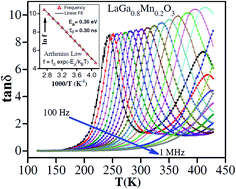
In order to investigate the presence of dielectric relaxation in the samples under study, temperature-dependent dielectric measurements were carried out for a temperature range of 120 K to 430 K at selected frequencies between 100 Hz and 1 MHz. Since the results of these temperature-dependent measurements for all the studied LGMO samples with x ≥ 0.1 are found to be almost similar in nature (from a relaxation perspective), the results for only the LaGa0.8Mn0.2O3 sample along with undoped LGO are discussed in the rest of the text and the same is presented in Fig. 8. It has been observed that undoped LGO undergoes a phase transition near 418 K as shown in the inset of Fig. 8(a). This phase transition is structural in nature as it has been already reported by Dube et al.27 that the RT orthorhombic symmetry of pure LGO changes to rhombohedral symmetry above 418 K. This transition temperature is independent of frequency as no frequency dispersion is observed in the ε′–T curve for this pure LGO sample (inset of Fig. 8(a)). This is consistent with the temperature response of tan[thin space (1/6-em)]δ as it is also found to be independent of probing frequency for the same sample. Additionally, the value of tan[thin space (1/6-em)]δ for this undoped LGO is of the order of 10−3 (i.e., <0.01, Fig. S1 (ESI)) which remains almost unchanged over the entire probing frequency range. Such a small value of tan[thin space (1/6-em)]δ points towards the insulating nature of this sample77 and hence makes this undoped LGO a good choice for applications as a dielectric material. On the other hand in the case of the Mn-doped samples, strong frequency dispersion in the ε′ and tan[thin space (1/6-em)]δ is observed at higher temperature (for LaGa0.8Mn0.2O3 at T > 170 K) whereas both of these (ε′ and tan[thin space (1/6-em)]δ) are found to be nearly frequency- and also temperature-independent at lower temperatures (<170 K) as shown in Fig. 8(a) and (b) respectively. In the low temperature range (<170 K), the static dielectric constant εs and the high frequency limit dielectric constant ε reach a common limit value of ∼24. It is clear from the ε′–T and tan[thin space (1/6-em)]δT plots (of LaGa0.8Mn0.2O3) that the anomaly observed in ε′ coincides with the peak observed in tan[thin space (1/6-em)]δ and it shifts to the higher temperature side with increasing frequency which indicates the presence of dielectric relaxation in the sample. Similarly the tan[thin space (1/6-em)]δ peak also shifts to the higher temperature side also indicating a thermally activated relaxation process. Moreover, the observed shifting of the peak position is credited to the increased kinetic energy of hopping polarons due to the increasing temperature, as a result of which Mn3+/Mn4+ dipoles start oscillating at a higher frequency and thus the anomaly (peak) in ε′ (tan[thin space (1/6-em)]δ) shifts towards the higher temperature side with increasing frequency. This temperature-dependent behavior is found to be similar to the already reported results for other manganites,45,46,59,64,78–80 ferrites48,57,66 and different perovskite systems81–85 and it has been attributed to localized hopping of polarons between lattice sites (presently between Mn3+ and Mn4+) with a characteristic timescale. Beside this observed frequency dispersion of dielectric anomalies, an increase in the ε′ by orders of magnitude is also perceived due to increasing temperature (Fig. 8(a)) which may be attributed again to speedy hopping charge transport5 along with the possibility of electric field-induced polarization in LGMO samples probably due to unfilled and unscreened subshells of Mn ions as the same mechanism has already been discussed for tungstates.16,17 It is worth noticing that a 2nd peak in the tan[thin space (1/6-em)]δT plot also appears around 420 K for different frequencies. This temperature is close that of the structural transition observed in undoped LGO (inset of Fig. 8(a)).27 It will be interesting to explore these secondary peaks in future for LGMO samples as the corresponding peak position appears to be shifted with temperature for different probing frequencies. Moreover, it is well established that the effect of temperature on the dielectric relaxation frequency (1/2πτ0) can be described on the basis of the following Arrhenius relation:45–48,52,58,59,66,74,81
 
f = f0[thin space (1/6-em)]exp(−Ea/kBT) (2)
where f0 is the Debye relaxation frequency, Ea is the activation energy, and kB is the Boltzmann constant. Thus in order to confirm our speculation of the presence of polaron (JT polaron) hopping as a driving mechanism for the observed dielectric relaxation in the present system, ln(f) is plotted as a function of tan[thin space (1/6-em)]δ peak temperature (103/T) as shown in the inset of Fig. 8(b). The data for relaxation frequency is fitted well to the Arrhenius relation with the fitting parameters τ0 (1/2πf0) = 30 ns and Ea = 0.36 eV; here, the activation energy is calculated from the slope of the fitted straight line and τ0 is determined from the value of the intercept on the frequency axis. This value of activation energy (Ea = 0.36 eV) is found to be close to the earlier reported values of Ea corresponding to the polaron hopping mechanism e.g. 0.33 eV,46 0.4 eV,59 and 0.30 eV[thin space (1/6-em)]64 (for the systems with co-existence of Mn3+ and Mn4+) and 0.29 eV,52 0.29 eV,57 and 0.45 eV[thin space (1/6-em)]81 (for the systems with co-existence of Fe2+ and Fe3+). These comparative values of activation energies and co-existence of Mn3+ and Mn4+ in the present samples suggest that possibly, the polaron hopping mechanism is responsible for the presently observed dielectric relaxation in LaGa0.8Mn0.2O3. Finally, an observation of a RT large ε′ and appearance of dielectric relaxation in Mn-doped lanthanum gallate is reported here.

image file: c5ra28074e-f8.tif
Fig. 8 Dielectric relaxation in LaGa0.8Mn0.2O3 (as a representative of the present LGMO series): shifting of characteristic- (a) anomaly in ε′ and (b) peak in tan[thin space (1/6-em)]δ with increasing temperature for different probing frequencies ranging from 100 Hz to 1 MHz. The inset of (a) displays the variation in the ε′ of undoped LGO with increasing temperature for frequencies ranging from 100 Hz to 1 MHz. The structural phase transition around 418 K is indicated through an arrow in the same inset. The inset of (b) shows linear fitting of the frequency versus temperature values corresponding to peaks observed in the tan[thin space (1/6-em)]δT curves for different frequencies with the help of the Arrhenius law.

Conclusions

In conclusion, a large ε′ at RT (for a higher percentage of Mn doping) and dielectric relaxation response is observed in Mn-doped lanthanum gallate. Both of these observed effects have been analyzed by considering intersite polaron hopping via the Mn3+–O2−–Mn4+ path and/or a flipping Mn3+/Mn4+ dipole under an AC electric field as the co-existence of Mn3+ and Mn4+ charge states is validated through XANES measurements. The appearance of a large ε′ is attributed to the increased conductivity governed by the hopping charge transport mechanism and interface effects along with the possibility of dipolar contributions associated with the off-centrosymmetry of the MnO6 octahedron as it has been revealed through impedance spectroscopy, XANES (pre-K-edge) and PE analysis. The latter effect, the presence of dielectric relaxation, is ascribed as a thermally activated relaxation process with the activation energy found to be close to that of polaron hopping at 0.36 eV. Finally, we introduce the appearance of dielectric relaxation and occurrence of a large ε′ in LaGa1−xMnxO3+δ with x = 0.05 to 0.3 and x = 0.2 and 0.3 respectively.

Acknowledgements

The authors sincerely thank Prof. P. Mathur, Director IIT Indore for his encouragement. SIC IIT Indore is acknowledged for providing some of the experimental facilities. We sincerely thank Raja Ramanna Center for Advance Technology (RRCAT) Indore for providing synchrotron radiation facilities. The authors sincerely thank Dr S. M. Gupta, Dr S. N. Jha and Mr Aditya N. Pandey of RRCAT Indore for providing experimental facilities and for valuable comments on the manuscript. We sincerely acknowledge Dr N. P. Lalla of UGC-DAE CSR for the valuable discussion and suggestions. Smt. Aarti Deshpande from RRCAT is acknowledged for providing important references. CSIR, New Delhi is acknowledged for funding high temperature furnace under the project 03(1274)/13/EMR-II used for the sample preparations. One of the authors (HMR) acknowledges the Ministry of Human Resource Development (MHRD), government of India for providing financial support as Teaching Assistantship. PRS would like to thank DAE-BRNS (No. 2013/37P/31/BRNS) for funding the Impedance Analyzer used for the present measurements.

References

  1. M. Guennou, M. Viret and J. Kreisel, C. R. Phys., 2015, 16, 182 CrossRef CAS.
  2. R. Ramesh, Nature, 2009, 461, 1218 CrossRef CAS PubMed.
  3. S.-W. Cheong and M. Mostovoy, Nat. Mater., 2007, 6, 13 CrossRef CAS PubMed.
  4. T.-L. Phan, P. D. Thang, T. A. Ho, T. V. Manh, T. D. Thanh, V. D. Lam, N. T. Dang and S. C. Yu, J. Appl. Phys., 2015, 117, 17D904 CrossRef.
  5. P. Lunkenheimer, S. Krohns, S. Riegg, S. G. Ebbinghaus, A. Reller and A. Loidl, Eur. Phys. J.: Spec. Top., 2010, 180, 61 CrossRef.
  6. S. Krohns, P. Lunkenheimer, C. Kant, A. V. Pronin, H. B. Brom, A. A. Nugroho, M. Diantoro and A. Loidl, Appl. Phys. Lett., 2009, 94, 122903 CrossRef.
  7. S. Krohns, P. Lunkenheimer, S. G. Ebbinghaus and A. Loidl, Appl. Phys. Lett., 2007, 91, 022910 CrossRef.
  8. C. M. Rey, H. Mathias, L. R. Testardi and S. Skirius, Phys. Rev. B: Condens. Matter Mater. Phys., 1992, 45, 10639 CrossRef CAS.
  9. J. Rivas, B. Rivas-Murias, A. Fondado, J. Mira and M. A. Señarís-Rodríguez, Appl. Phys. Lett., 2004, 85, 6224 CrossRef CAS.
  10. T. Park, Z. Nussinov, K. R. A. Hazzard, V. A. Sidorov, A. V. Balatsky, J. L. Sarrao, S.-W. Cheong, M. F. Hundley, J.-S. Lee, Q. X. Jia and J. D. Thompson, Phys. Rev. Lett., 2005, 94, 017002 CrossRef PubMed.
  11. X. Q. Liu, S. Y. Wu, X. M. Chen and H. Y. Zhu, J. Appl. Phys., 2008, 104, 054114 CrossRef.
  12. J. Sebald, S. Krohns, P. Lunkenheimer, S. G. Ebbinghaus, S. Riegg, A. Reller and A. Loidl, Solid State Commun., 2010, 150, 857 CrossRef CAS.
  13. L. Liu, H. Fan, X. Chen and P. Fang, J. Alloys Compd., 2009, 469, 529 CrossRef CAS.
  14. M. E. Lines and A. M. Glass, Principles and Applications of Ferroelectrics and Related Materials, Clarendon Press-Oxford, 1977 Search PubMed.
  15. G. Catalan, Appl. Phys. Lett., 2006, 88, 102902 CrossRef.
  16. Z. Kukuła, E. Tomaszewicz, S. Mazur, T. Groń, H. Duda, S. Pawlus, S. M. Kaczmarek, H. Fuks and T. Mydlarz, Philos. Mag., 2012, 92, 4167 CrossRef.
  17. T. Groń, E. Tomaszewicz, Z. Kukuła, S. Pawlus and B. Sawicki, J. Mater. Sci. Eng. B, 2014, 184, 14 CrossRef.
  18. H. M. Rai, R. Late, S. K. Saxena, V. Mishra, R. Kumar, P. R. Sagdeo and A. Sagdeo, Mater. Res. Express, 2015, 2, 096105 CrossRef.
  19. J. W. Yan, Z. G. Lu, Y. Jiang, Y. L. Dong, C. Y. Yu and W. Z. Li, J. Electrochem. Soc., 2002, 149, A1132 CrossRef CAS.
  20. H. Ishikawa, M. Enoki, T. Ishihara and T. Akiyama, Mater. Trans., 2006, 47, 149 CrossRef CAS.
  21. W. Guo, J. Liu and Y. Zhang, Electrochim. Acta, 2008, 53, 4420 CrossRef CAS.
  22. M. Feng, J. B. Goodenough, K. Huang and C. Milliken, J. Power Sources, 1996, 63, 47 CrossRef CAS.
  23. K. Huang and J. Goodenough, J. Alloys Compd., 2000, 303–304, 454 CrossRef CAS.
  24. T. Ishihara, J. Tabuchi, S. Ishikawa, J. Yan, M. Enoki and H. Matsumoto, Solid State Ionics, 2006, 177, 1949 CrossRef CAS.
  25. R. L. Sandstrom, E. A. Giess, W. J. Gallagher, A. Segmüller, E. I. Cooper, M. F. Chisholm, A. Gupta, S. Shinde and R. B. Laibowitz, Appl. Phys. Lett., 1988, 53, 1874 CrossRef CAS.
  26. A. Senyshyn, H. Ehrenberg, L. Vasylechko, J. D. Gale and U. Bismayer, J. Phys.: Condens. Matter, 2005, 17, 6217 CrossRef CAS.
  27. D. C. Dube, H. J. Scheel, I. Reaney, M. Daglish and N. Setter, J. Appl. Phys., 1994, 75, 4126 CrossRef CAS.
  28. G. A. Tompsett, N. M. Sammes and R. J. Phillips, J. Raman Spectrosc., 1999, 30, 497 CrossRef CAS.
  29. L. Malavasi, M. Baldini, D. di Castro, A. Nucara, W. Crichton, M. Mezouar, J. Blasco and P. Postorino, J. Mater. Chem., 2010, 20, 1304 RSC.
  30. M. M. Guenter, M. Lerch, H. Boysen, D. Toebbens, E. Suard and C. Baehtz, J. Phys. Chem. Solids, 2006, 67, 1754 CrossRef CAS.
  31. J. Kobayashi, Y. Tazoh, M. Sasaura and S. Miyazawa, J. Mater. Res., 1991, 6, 97 CrossRef CAS.
  32. N. Noginova, G. B. Loutts, E. S. Gillman, V. A. Atsarkin and A. A. Verevkin, Phys. Rev. B: Condens. Matter Mater. Phys., 2001, 63, 174414 CrossRef.
  33. J. Farrell and G. A. Gehring, New J. Phys., 2004, 6, 168 CrossRef.
  34. R. Vidya, P. Ravindran, P. Vajeeston, A. Kjekshus and H. Fjellvåg, Phys. Rev. B: Condens. Matter Mater. Phys., 2004, 69, 092405 CrossRef.
  35. M. C. Sánchez, G. Subías, J. García and J. Blasco, Phys. Rev. B: Condens. Matter Mater. Phys., 2004, 69, 184415 CrossRef.
  36. M. C. Sánchez, J. García, G. Subías and J. Blasco, Phys. Rev. B: Condens. Matter Mater. Phys., 2006, 73, 094416 CrossRef.
  37. X. Liu, H. Fan, J. Shi and Q. Li, Sci. Rep., 2015, 5, 12699 CrossRef CAS PubMed.
  38. Z. Li and H. Fan, J. Appl. Phys., 2009, 106, 054102 CrossRef.
  39. A. Sagdeo, K. Gautam, P. R. Sagdeo, M. N. Singh, S. M. Gupta, A. K. Nigam, R. Rawat, A. K. Sinha, H. Ghosh, T. Ganguli and A. Chakrabarti, Appl. Phys. Lett., 2014, 105, 042906 CrossRef.
  40. H. Rietveld, J. Appl. Crystallogr., 1969, 2, 65 CrossRef CAS.
  41. J. Rodríguez-Carvajal, Phys. Rev. B: Condens. Matter Mater. Phys., 1993, 192, 55 CrossRef.
  42. S. Basu, C. Nayak, A. K. Yadav, A. Agrawal, A. K. Poswal, D. Bhattacharyya, S. N. Jha and N. K. Sahoo, J. Phys.: Conf. Ser., 2014, 493, 012032 CrossRef.
  43. A. K. Jonscher, Dielectric Relaxation in Solids, Chelsea Dielectrics Press Ltd, London, 1983 Search PubMed.
  44. G. G. Raju, Dielectrics in Electric Fields, CRC Press, 2003 Search PubMed.
  45. R. S. Freitas, J. F. Mitchell and P. Schiffer, Phys. Rev. B: Condens. Matter Mater. Phys., 2005, 72, 144429 CrossRef.
  46. Y. Q. Lin and X. M. Chen, Appl. Phys. Lett., 2010, 96, 142902 CrossRef.
  47. Y. González-Abreu, A. Peláiz-Barranco, E. B. Araújo and A. F. Júnior, Appl. Phys. Lett., 2009, 94, 262903 CrossRef.
  48. X. Wu, X. Wang, Y. Liu, W. Cai, S. Peng, F. Huang, X. Lu, F. Yan and J. Zhu, Appl. Phys. Lett., 2009, 95, 182903 CrossRef.
  49. P. Lunkenheimer, V. Bobnar, A. V. Pronin, A. I. Ritus, A. A. Volkov and A. Loidl, Phys. Rev. B: Condens. Matter Mater. Phys., 2002, 66, 052105 CrossRef.
  50. M. Shah, M. Nadeem and M. Atif, J. Appl. Phys., 2012, 112, 103718 CrossRef.
  51. J. R. Sahu, C. R. Serrao, N. Ray, U. V. Waghmare and C. N. R. Rao, J. Mater. Chem., 2006, 17, 42 RSC.
  52. J. M. Costantini, J. P. Salvetat and F. Brisard, J. Appl. Phys., 1997, 82, 5063 CrossRef CAS.
  53. P. Lunkenheimer, R. Fichtl, S. G. Ebbinghaus and A. Loidl, Phys. Rev. B: Condens. Matter Mater. Phys., 2004, 70, 172102 CrossRef.
  54. K. Fukunaga, IEEE Trans. Dielectr. Electr. Insul., 2006, 13, 687 CrossRef.
  55. R. W. Wolfe and R. E. Newnham, J. Electrochem. Soc., 1969, 116, 832 CrossRef CAS.
  56. A. Mishra, N. Mishra, S. Bisen and K. M. Jarabana, J. Phys.: Conf. Ser., 2014, 534, 012011 CrossRef.
  57. N. Ikeda, H. Ohsumi, K. Ohwada, K. Ishii, T. Inami, K. Kakurai, Y. Murakami, K. Yoshii, S. Mori, Y. Horibe and H. Kitô, Nature, 2005, 436, 1136 CrossRef CAS PubMed.
  58. Y. Ma, X. M. Chen and Y. Q. Lin, J. Appl. Phys., 2008, 103, 124111 CrossRef.
  59. J. Yang, X. J. Meng, M. R. Shen, L. Fang, J. L. Wang, T. Lin, J. L. Sun and J. H. Chu, J. Appl. Phys., 2008, 104, 104113 CrossRef.
  60. C. Li, X. Han, F. Cheng, Y. Hu, C. Chen and J. Chen, Nat. Commun., 2015, 6, 7345 CrossRef CAS PubMed.
  61. M. Sikora, C. Kapusta, K. Knížek, Z. Jirák, C. Autret, M. Borowiec, C. J. Oates, V. Procházka, D. Rybicki and D. Zajac, Phys. Rev. B: Condens. Matter Mater. Phys., 2006, 73, 094426 CrossRef.
  62. K. Olimov, M. Falk, K. Buse, T. Woike, J. Hormes and H. Modrow, Phys. Rev. B: Condens. Matter Mater. Phys., 2006, 18, 5135 CrossRef CAS.
  63. J. B. Goodenough, A. Wold, R. J. Arnott and N. Menyuk, Phys. Rev., 1961, 124, 373 CrossRef CAS.
  64. E. Pollert, S. Krupička and E. Kuzmičová, J. Phys. Chem. Solids, 1982, 43, 1137 CrossRef CAS.
  65. A. J. Millis, P. B. Littlewood and B. I. Shraiman, Phys. Rev. Lett., 1995, 74, 5144 CrossRef CAS PubMed.
  66. Z. X. Cheng, H. Shen, J. Y. Xu, P. Liu, S. J. Zhang, J. L. Wang, X. L. Wang and S. X. Dou, J. Appl. Phys., 2012, 111, 034103 CrossRef.
  67. P. Lunkenheimer, T. Rudolf, J. Hemberger, A. Pimenov, S. Tachos, F. Lichtenberg and A. Loidl, Phys. Rev. B: Condens. Matter Mater. Phys., 2003, 68, 245108 CrossRef.
  68. T. E. Westre, P. Kennepohl, J. G. DeWitt, B. Hedman, K. O. Hodgson and E. I. Solomon, J. Am. Chem. Soc., 1997, 119, 6297 CrossRef CAS.
  69. A. L. Roe, D. J. Schneider, R. J. Mayer, J. W. Pyrz, J. Widom and L. Que, J. Am. Chem. Soc., 1984, 106, 1676 CrossRef CAS.
  70. J. Wong, F. W. Lytle, R. P. Messmer and D. H. Maylotte, Phys. Rev. B: Condens. Matter Mater. Phys., 1984, 30, 5596 CrossRef CAS.
  71. S. Ke, H. Huang and H. Fan, Appl. Phys. Lett., 2006, 89, 182904 CrossRef.
  72. Y. Joly, D. Cabaret, H. Renevier and C. R. Natoli, Phys. Rev. Lett., 1999, 82, 2398 CrossRef CAS.
  73. J. F. Scott, Phys. Rev. B: Condens. Matter Mater. Phys., 2008, 20, 021001 CrossRef.
  74. M. A. El Hiti, J. Magn. Magn. Mater., 1999, 192, 305 CrossRef.
  75. W. D. Kingery, H. K. Bowen and D. R. Uhlman, Introduction to Ceramics, Wiley, New York, 2nd edn, 1976, ch. 18 Search PubMed.
  76. V. R. K. Murthy and J. Sobhanadri, Phys. Status Solidi A, 1976, 36, K133 CrossRef CAS.
  77. S. Sharma, T. Basu, A. Shahee, K. Singh, N. P. Lalla and E. V. Sampathkumaran, Phys. Rev. B: Condens. Matter Mater. Phys., 2014, 90, 144426 CrossRef.
  78. J. L. Cohn, M. Peterca and J. J. Neumeier, Phys. Rev. B: Condens. Matter Mater. Phys., 2004, 70, 214433 CrossRef.
  79. A. Seeger, P. Lunkenheimer, J. Hemberger, A. A. Mukhin, V. Y. Ivanov, A. M. Balbashov and A. Loidl, Phys. Rev. B: Condens. Matter Mater. Phys., 1999, 11, 3273 CrossRef CAS.
  80. J. L. Cohn, M. Peterca and J. J. Neumeier, J. Appl. Phys., 2005, 97, 034102 CrossRef.
  81. V. G. Nair, A. Das, V. Subramanian and P. N. Santhosh, J. Appl. Phys., 2013, 113, 213907 CrossRef.
  82. V. G. Nair, L. Pal, V. Subramanian and P. N. Santhosh, J. Appl. Phys., 2014, 115, 17D728 CrossRef.
  83. O. Bidault, M. Maglione, M. Actis, M. Kchikech and B. Salce, Phys. Rev. B: Condens. Matter Mater. Phys., 1995, 52, 4191 CrossRef CAS.
  84. N. Ikeda, K. Kohn, H. Kito, J. Akimitsu and K. Siratori, J. Phys. Soc. Jpn., 1994, 63, 4556 CrossRef CAS.
  85. E. Iguchi, N. Kubota, T. Nakamori, N. Yamamoto and K. J. Lee, Phys. Rev. B: Condens. Matter Mater. Phys., 1991, 43, 8646 CrossRef CAS.

Footnote

Electronic supplementary information (ESI) available. See DOI: 10.1039/c5ra28074e

This journal is © The Royal Society of Chemistry 2016
Click here to see how this site uses Cookies. View our privacy policy here.