

Efficient flame retardant polyvinyl alcohol membrane through surface graft method
Li Liua,
Yuansen Liub,
Yuan Liu*a and
Qi Wanga
aThe State Key Laboratory of Polymer Materials Engineering, Polymer Research Institute of Sichuan University, Chengdu 610065, China. E-mail: liuyuan42001@163.com; Fax: +83-28-85402463; Tel: +83-28-85405133
bEngineering Research Center of Marine Biological Resource Comprehensive Utilization, Third Institute of Oceanography, State Oceanic Administration, Xiamen, 361000, China
First published on 24th March 2016
Abstract
The preparation of flame retardant polyvinyl alcohol (PVA) membranes with high performance is a challenge using conventional methods by physically mixing flame retardants with a PVA solution. In this study, the surface grafting of a flame retardant on neat PVA membrane was adopted instead of conventional physical mixing. The structure and grafting ratio of the flame retardant grafted chemically on a PVA membrane was examined and characterized. A comparison of the performance between the surface grafted and the conventional mixed flame retardant PVA membranes were conducted by cone calorimetry, vertical flame, thermo-gravimetric analysis (TGA), differential scanning calorimetry (DSC), mechanical properties and transparency tests. The results showed that with the same flame retardant content, the one with the surface grafted had much better flame retardance, mechanical properties and transparence, as well as an enhanced melt point and thermal stability. In conclusion, the surface grafting of the flame retardant PVA membrane is very promising for many applications due to its remarkably improved properties.
1. Introduction
As a polyol polymer, PVA is used widely in textile industries, medical treatments, construction materials and many other fields owing to its excellent mechanical properties, non-toxicity, biocompatibility and biodegradability.1–3 With good membrane forming, barrier and transparence, PVA membranes usually serve as clean packaging and biomedical materials. However, like most polymer materials, flammability is a typical shortcoming of PVA, with a limiting oxygen index (LOI) of 19%,4 its applications in some fields with fire-proof requirements are restricted.5–8 In particular, as result of thin wall structure, the membrane shows higher combustibility compared to other product forms. Therefore, it is of great significance to prepare a PVA membrane with satisfying flame retardance.Possessing a great number of hydroxyl groups in the macromolecular chains, PVA exhibits latent charring property, which means that PVA is a self-charring agent. Thus, introducing additional acid catalyst can further improve the charring capability. In fact, many references reported that some phosphorus-containing flame retardants endow PVA with greatly enhanced flame retardance in the condensed phase. Chen9 adopted self-synthesized bisneopentyl glycol dithiopyrophosphate microencapsulated with melamine formaldehyde (MF) to add to a PVA solution to prepare a flame retardant PVA membrane. The results indicated that the membrane showed good retardancy with a LOI of 31.8%. Zhao10 chose APP and layered double hydroxide as a synergistic flame retardant system to disperse in a PVA solution, and the flame retardant PVA sheets achieved a high LOI of 33% and a V-0 rating. Hu11 used a urea salt of chitosan phosphate and synthesized natural carbon agent in PVA matrix. The flame retardant system could accelerate the dehydration and char formation of PVA,12–16 thus realizing satisfactory flame resistance.
The abovementioned investigations promoted the development of flame retardant PVA materials. However, a flame retardant PVA membrane has not been commercially successful to date because the addition of flame retardants largely deteriorates the membrane forming processability and mechanical properties and also results in a decrease in transparence (e.g., even several percent of flame retardant will make the membrane opaque). In addition, due to usually poor compatibility between the flame retardants and PVA matrix,17–20 flame retardant particles tend to migrate to the membrane surface, leading to serious blooming problems.
In this study, an alcohol solution containing a reactive P–Si flame retardant was coated uniformly on the surface of a clean PVA membrane and then heated. The flame retardant was grafted onto the membrane surface through a chemical reaction between the reactive groups of the P–Si compound and hydroxyl ones of PVA.21 This method can overcome the disadvantages of the conventional preparation and obtain flame retardant PVA membranes with excellent fire-resistance, mechanical properties, thermal stability and transparence, showing a promising future for commercial applications.
2. Experimental
2.1 Materials
PVA, with a polymerization degree of 1700 and an alcoholysis degree of 99%, was supplied by Sichuan Vinylon Corporation Co. China. The flame retardant, 9,10-dihydro-9-oxa-10-phosphaphenanthrene-10-oxide-γ-(2,3-epoxypropoxy) propyltrimethoxysilane (DPP), was synthesized in our laboratory. Its molecular structure is shown in Scheme 1.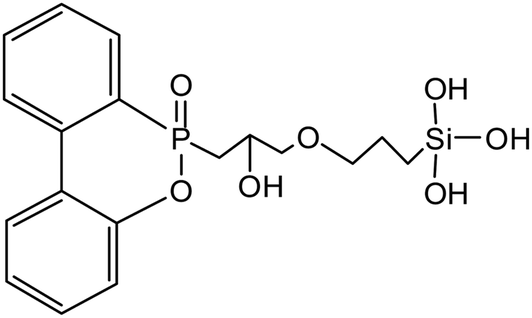 | ||
| Scheme 1 The molecular structure of the flame retardant DPP. | ||
2.2 Preparation of PVA, mixed flame retardant PVA and surface graft flame retardant PVA membranes
A 20% PVA/80% water solution was heated to 80 °C and under a vacuum of 0.098 MPa for 2 h in a rotating evaporator to obtain pristine PVA membrane with a 0.20 mm thickness.The mixed flame retardant PVA membrane (PVA/DPP) was manufactured by 1.5% DPP/18.5% PVA/80.0% water suspension solution (DPP is insoluble in water) according to the same preparation process of pristine PVA membrane (the percentage of DPP in PVA membrane is 7.50%).
Surface grafting flame retardant PVA membrane (PVA-DPP) was obtained by uniformly coating 8.0 g 40% DPP alcohol solution on a sheet of 2.6 g neat PVA membrane (0.15 mm in thickness) and then heated at 120 °C for 30 min in an oven. The grafted PVA was washed repeatedly with alcohol to remove the unreacted DPP. The weight difference of PVA-DPP and PVA is the real graft amount of the flame retardant (the calculated percentage of the DPP grafted on PVA membrane was 7.44% and the thickness of PVA-DPP membrane was about 0.19 mm).
2.3 Characterization
Fourier transform infrared (FT-IR) spectra of PVA and PVA-DPP were obtained on a Nicolet 20SXB Infrared spectrometer.The 1H NMR spectra of PVA and PVA-DPP were obtained using an AVANCE 600 Bruker Spectrometer at room temperature using dimethyl sulfoxide as a solvent.
X-ray photoelectron spectroscopy (XPS) of PVA and PVA-DPP was performed using a Shimadzu/Kratos AXIS Ultra DLD multifunctional X-ray photoelectron spectrometer (Manchester, UK).
Cone calorimetry (Fire Testing Technology Ltd, UK) was employed to investigate the combustion behavior at an incident radiant flux of 50 kW m−2 according to ISO 5660.
The vertical burning test (UL-94 VTM) was performed on HK-HVRA instrument according to ASTM D 5207 testing procedure.
The surface morphology of the membrane sample after heating at 500 °C for 30 min in a muffle furnace were observed using a scanning electron microscope (SEM) (JSM-5900LV, JEOL Ltd., Tokyo, Japan), with a conductive gold layer coated and with an accelerating voltage of 10 kV. Energy dispersive spectrometry (EDS) (INCA, Oxford Instrument) was performed to analyze the surface elemental compositions of PVA/DPP and PVA-DPP membranes.
DSC tests of PVA, PVA/DPP and PVA-DPP were performed using Auto Q20 differential scanning calorimeter (TA Instruments Co. Ltd, New Castle, DE, USA). An approximate 7 mg sample was heated from ambient temperature to 240 °C at a heating rate of 10 °C min−1 under a nitrogen atmosphere.
TGA of PVA, PVA/DPP, PVA-DPP and DPP was conducted on a TGA Q-50 (TA Instruments Co. Ltd, New Castle, DE, USA). The 8 mg samples were examined from the room temperature to 700 °C at a heating rate of 10 °C min−1 under a nitrogen atmosphere with a flow rate of 50 mL min−1.
The tensile and elongation tests of the membrane samples were performed at room temperature with a crosshead speed of 50 mm min−1 using an Instron universal material tester (Model 5567, USA).
The abovementioned PVA membranes were placed on a piece of paper; the clarity of the words in the paper was evaluated. In addition, the test of the light transmission ratio was performed according to the ISO 13468 standard by a GYX-051 transmissivity test apparatus, Gaoyan Instruments Co., China.
3. Results and discussion
3.1 The characterization of prepared PVA-DPP
As a reactive Si–P containing flame retardant, Si–OH of DPP can react with the –OH of PVA through hydroxyl condensation (Scheme 2). | ||
| Scheme 2 Graft reaction between DPP and PVA. | ||
From FT-IR spectra of PVA and DPP-PVA (Fig. 1), one can observe that in addition to the absorption peaks at 3324 cm−1 due to the vibration of –OH, 2941 and 1331 cm−1 due to the vibration of C–H, and 1425 cm−1 due to the vibration of –CH2– of PVA chain structure, a series of new absorption peaks appeared in PVA-DPP, including the absorption peak at 1652 cm−1 due to the C![[double bond, length as m-dash]](https://www.rsc.org/images/entities/char_e001.gif) C group, 1202 cm−1 for the PO group, 1113 cm−1 for the Si–O–Si group and 758 cm−1 for the phenyl group. These new absorption peaks verified the chemical structure of DPP grafted on PVA membrane.
C group, 1202 cm−1 for the PO group, 1113 cm−1 for the Si–O–Si group and 758 cm−1 for the phenyl group. These new absorption peaks verified the chemical structure of DPP grafted on PVA membrane.
 | ||
| Fig. 1 FT-IR spectra of (a) PVA and (b) PVA-DPP. | ||
The chemical structure of PVA-DPP was also confirmed further by 1H NMR. As shown in Fig. 2, the peak shift at 4.2–4.7 ppm was attributed to the hydrogen of the –OH, 3.5–4.0 ppm for the hydrogen of the C–H group, and 1.0–1.5 ppm for the hydrogen of ethyl group for PVA. In contrast, the new shifts at 7.0–8.5 ppm corresponded to the eight aromatic hydrogen atoms of the biphenol section and 1.9 ppm to the hydrogen atoms of the ethylene for PVA-DPP. 1H NMR further confirmed the structure of DPP-grafted PVA.
 | ||
| Fig. 2 1H-NMR spectra of (a) PVA and (b) PVA-DPP. | ||
As a surface element analysis method, XPS can not only confirm the grafting chemical structure, but also quantitatively determine P content of the surface of the flame retardant PVA membrane, and thus calculate the surface grafting ratio of DPP. From the XPS spectrum of PVA-DPP presented in Fig. 3(b), a series of new peaks, including P2s, P2p, Si2s and Si2p originated from DPP grafted on the surface of PVA membrane were observed. Their corresponding chemical structures are listed in Table 1. According to the 1.29% P content on the PVA-DPP surface from the XPS test, the calculated surface graft percentage of DPP was 7.21%, closely matching the results calculated by the weight increase ratio (7.44%) of PVA before and after the graft reaction.
 | ||
| Fig. 3 XPS spectra of (a) PVA and (b) PVA-DPP membranes. | ||
| Elements | PVA | PVA-DPP | ||||
|---|---|---|---|---|---|---|
| Content (%) | Binding energy (eV) | Peaking attribution | Content (%) | Binding energy (eV) | Peaking attribution | |
| C | 74.78 | 284.9, 286.1 | C–C, C–H, C–O | 73.12 | 284.8, 286.5 | C–C, C–H, C–O, C–O–P |
| O | 25.22 | 532.2 | O–H, C–O–C | 24.38 | 532.4 | O–H, C–O–C, C–O–P |
| P | 0.00 | — | — | 1.29 | 133.1 | P–O–C |
| Si | 0.00 | — | — | 1.16 | 102.5 | Si–O, Si–C |
3.2 Flame retardance and the corresponding mechanisms of the flame retardant membranes
Table 2 and Fig. 4 compare the flame retardance of PVA, PVA/DPP, and PVA-DPP membranes by the UL94 vertical flame test and cone calorimetry. With equivalent flame retardant content, PVA-DPP showed a lower extinction time and also smaller THR and HRR than PVA/DPP. Obviously, the former exhibited better flame retardance.| Samples | UL94 VTM test (0.2 mm) | |
|---|---|---|
| Total flame time of 5 bars (s) | Rating | |
| PVA | No self-extinction | Fail |
| PVA/DPP | 42.3 | VTM-V0 |
| PVA-DPP | 24.8 | VTM-V0 |
 | ||
| Fig. 4 THR (a) and HRR (b) curves of PVA, PVA/DPP and PVA-DPP membranes. | ||
The char formation plays a significant role in improving the flame retardancy of materials in the condensed phase. For thin wall products such as membranes, their surface properties have greater influence on the material performances than those of thick wall products. When a polymer membrane is flamed, the quick formation of a char layer on the surface is important for achieving satisfactory flame retardance. Comparing PVA-DPP (the flame retardant grafted on the surface) and PVA/DPP (the flame retardant dispersed in the entire resin matrix), the former can more quickly form a continuous char barrier on the surface due to the higher flame retardant concentration on the surface and therefore manifesting a higher efficiency.
Fig. 5 shows SEM images of the char morphologies of the carbonized membranes. There was an obvious difference between the PVA/DPP and PVA-DPP. For the mixed flame retardant system, the char morphology, similar to neat PVA, was not very continuous, and there were many char fragments observed. In contrast, surface grafted system possessed smoother and more continuous chars, demonstrating that PVA-DPP behaved more uniformly during charring.
 | ||
| Fig. 5 Morphologies of the carbonized (a) PVA, (b) PVA/DPP and (c) PVA-DPP membranes. | ||
In addition to the difference of flame retardant concentration on the surface, the charring quality of the abovementioned membranes is also linked to the evenness of the flame retardant distributed in the resin matrix. Fig. 6 shows the morphologies of PVA/DPP and PVA-DPP membrane observed by SEM.
 | ||
| Fig. 6 Morphologies of (a) PVA/DPP and (b) PVA-DPP membranes. | ||
For the mix system, the DPP aggregates distributed in the PVA matrix were clearly seen, and evidently, the distribution was not uniform. However, only one phase in PVA-DPP was observed for the surface grafted system. Because DPP solution coating made the flame retardant molecules evenly distributed over the PVA membrane surface, and the following chemical graft reaction can further fix the uniformly dispersed flame retardant molecules onto PVA chains; consequently, the flame retardant elements in the PVA-DPP membrane is homogeneous. EDS analysis at three random points of PVA-DPP membrane indicated that the Si contents were similar, illustrating the high uniformity of DPP.
The different flame retardant distribution states resulted in different charring uniformity for PVA-DPP and PVA/DPP membranes, which can be described in Scheme 3.
 | ||
| Scheme 3 Difference in the charring uniformity caused by the different flame retardant dispersion state for (a) PVA-DPP and (b) PVA/DPP. | ||
3.3 Thermal properties of the flame retardant membrane
Thermal analysis, including DSC and TG, showed that the thermal stability and melt point of PVA-DPP had great enhancement compared to PVA/DPP.Fig. 7 presents the DSC curves of PVA, PVA/DPP and PVA-DPP. As the melting point of PVA is related to the cohesion force caused mainly by hydrogen bonds, the markedly improved melting point (240 °C) of PVA-DPP means a considerable increase of intermolecular attraction. This proved that the grafted DPP should participate in the hydrogen bonds system through combination between the –OH of PVA chains and –OH of DPP. However, the melting point of PVA/DPP (229 °C) was almost unchanged compared to that of the neat PVA (231 °C) because the contribution of the hydrogen bonds between DPP and PVA is relatively weak for this system wherein there are no abundant hydrogen bonds formed between the agglomerated DPP particles and PVA chains.
 | ||
| Fig. 7 DSC curves of PVA, PVA/DPP and PVA-DPP. | ||
The remarkable increase in the interaction due to hydrogen bonds also resulted in improvement of the decomposition temperature reflected by TGA results. Fig. 8 shows the TG curves of DPP, PVA, PVA/DPP and PVA-DPP. The main decomposition temperature of DPP was over 350 °C, which indicated that the thermal stability of this flame retardant is good. The temperature of PVA-DPP at the maximum decomposition temperature was as high as 372 °C, which is much higher than that of PVA/DPP (324 °C) and neat PVA (319 °C). On the other hand, due to the faster rate and higher quality of the surface char formation on the PVA-DPP membrane, it can protect the inner resin matrix more effectively and retard the further degradation of the resin. Accordingly, the PVA-DPP membrane retained 20.1% residues, but only 3.6% and 3.8% were retained for PVA/DPP and PVA, respectively.
 | ||
| Fig. 8 TG curves of DPP, PVA, PVA/DPP and PVA-DPP. | ||
3.4 The mechanical properties of the flame retardant membranes
Table 3 shows that the tensile strength of PVA/DPP decreased by 23.7% relative to that of PVA, showing that the stress concentration caused by DPP aggregate particles deteriorated the mechanical properties seriously. By contrast, the PVA-DPP system had a marked increase in tensile strength and elongation at break compared to pristine PVA membrane, because there was no stress concentration effect in a homogenous system. Moreover, a notable increase of hydrogen bonding interactions should also contribute to the improvement in mechanical strength.| Membranes | Tensile strength (MPa) | Elongation at break (%) |
|---|---|---|
| PVA | 20.3 | 305.8 |
| PVA/DPP | 17.2 | 425.6 |
| PVA-DPP | 24.5 | 507.5 |
3.5 Transparency of the flame retardant membranes
Transparency is important for PVA membranes. Table 4 and Fig. 9 compare the light transmission ratio (LTR) and transparency of the three membranes studied. The mixed flame retardant membrane is semitransparent with only 54.5% LTR because DPP aggregate particles strongly reflected/refracted the light. In comparison, surface grafted flame retardant membrane showed much better transparency with 82.3% LTR, which is close to that of the neat PVA membrane due to the dispersion at the molecular level for the flame retardant chemically attached to the membrane surface.| Sample | PVA | PVA/DPP | PVA-DPP |
|---|---|---|---|
| Light transmission ratio% | 89.2 | 54.5 | 82.3 |
 | ||
| Fig. 9 Transparency comparison of (a) PVA, (b) PVA/DPP and (c) PVA-DPP. | ||
4. Conclusion
A surface-grafted flame retardant PVA membrane was prepared successfully by a DPP solution coating and hydroxyl group condensation. Compared to the physically mixed PVA/DPP membrane, the former can form a much more even and continuous char as a higher concentration of flame retardant is distributed more uniformly over the membrane surface, and thus achieve better flame retardancy. As a homogenous membrane, PVA-DPP can overcome disadvantages such as interfacial defects, stress concentration, and light-block caused by the aggregated flame retardant particles in the resin matrix of PVA/DPP. With the strengthened hydrogen bond interaction, PVA-DPP showed a considerably improved melting point, thermal stability, and mechanical properties, as well as almost equivalent transparency to the pristine PVA membrane. Therefore, the surface grafted flame retardant PVA membranes can be applied commercially in advanced package materials in the future.5. Acknowledgments
Financial supports from the National Natural Science Foundation of China (No. 51473095), NSAF Fund (No. U1330122), Foundation for Innovative Research Groups of the National Natural Science Foundation of China (51421061), Public science and technology research funds projects of ocean (No. 201505029), the Scientific Research Foundation of the Third Institute of Oceanography, SOA (No. 2013013) and State Key Laboratory of Polymer Materials Engineering (No. sklpme2014-3-11) are gratefully acknowledged.References
- J. Lu, T. Wang and L. T. Drzal, Composites, Part A, 2008, 39, 738–746 CrossRef.
- T. Abitbol, T. Johnstone, T. M. Quinn and D. G. Gray, Soft Matter, 2011, 7, 2373–2379 RSC.
- J. Wang, C. Gao, Y. Zhang and Y. Wan, Mater. Sci. Eng., C, 2010, 30, 214–218 CrossRef CAS.
- J. S. Lin, Y. Liu, D. Y. Wang, Q. Qin and Y. Z. Wang, Ind. Eng. Chem. Res., 2011, 50, 9998–10005 CrossRef CAS.
- P. S. Thomas, J. P. Guerbois, G. F. Russell and B. J. Briscoe, J. Therm. Anal. Calorim., 2001, 64, 501–508 CrossRef CAS.
- H. D. Lu and C. Wilkie, Polym. Degrad. Stab., 2010, 95, 564–571 CrossRef CAS.
- D. M. Fernandes, A. A. Hechenleitner and E. A. Pineda, Thermochim. Acta, 2006, 441, 101–109 CrossRef CAS.
- X. P. Hu, Y. L. Li and Y. Z. Wang, Macromol. Mater. Eng., 2004, 289, 208–212 CrossRef CAS.
- W. L. Chen, X. W. Fu, W. B. Ge, J. J. Xu and M. G. Jiang, Polym. Degrad. Stab., 2014, 102, 81–87 CrossRef CAS.
- C. X. Zhao, Y. Liu, D. Y. Wang, D. L. Wang and Y. Z. Wang, Polym. Degrad. Stab., 2008, 93, 1323–1331 CrossRef CAS.
- S. Hu, L. Song, H. F. Pan and Y. Hu, J. Therm. Anal. Calorim., 2013, 112, 859–864 CrossRef CAS.
- B. J. Holland and J. N. Hay, Polymer, 2001, 2, 6775–6783 CrossRef.
- C. X. Zhao, Y. Liu, D. Y. Wang, D. L. Wang and Y. Z. Wang, Polym. Degrad. Stab., 2008, 93, 1323–1331 CrossRef CAS.
- K. Wu, L. Song, Z. Wang and Y. Hu, Polym. Adv. Technol., 2008, 19, 1914–1921 CrossRef CAS.
- H. Lu, C. A. Wilkie, M. Ding and L. Song, Polym. Degrad. Stab., 2011, 96, 1219–1224 CrossRef CAS.
- J. Zuo, Y. Su, S. Liu and Q. Sheng, J. Polym. Res., 2011, 18, 1125–1129 CrossRef CAS.
- D. Y. Wang, Y. Z. Wang, J. S. Wang, D. Q. Chen, Q. Zhou and B. Yang, et al., Polym. Degrad. Stab., 2005, 87, 171–176 CrossRef CAS.
- D. L. Wang, Y. Liu, D. Y. Wang, C. X. Zhao, Y. R. Mou and Y. Z. Wang, Polym. Degrad. Stab., 2007, 92, 1555–1564 CrossRef CAS.
- P. Alexy, D. Bakos, G. Crkonova, Z. Kramarova, J. Hoffmann and M. Julinova, Polym. Test., 2003, 22, 811–818 CrossRef CAS.
- P. Jash and C. A. Wilkie, Polym. Degrad. Stab., 2005, 88, 401–406 CrossRef CAS.
- Z. L. Ma and W. G. Zhao, Polym. Mater.: Sci. Eng., 2002, 18, 44–46 CAS.
| This journal is © The Royal Society of Chemistry 2016 |