Leqiang Shao,
Jie Li,
Ximeng Liang,
Tian Xie,
Suci Meng,
Deli Jiang and
Min Chen*
School of Chemistry and Chemical Engineering, Jiangsu University, Zhenjiang 212013, China. E-mail: chenmin3226@sina.com
First published on 5th February 2016
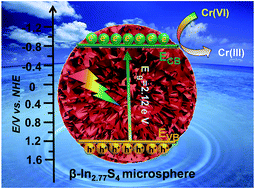
A novel nanosheet-assembled hierarchical sulfur-deficient β-In2.77S4 microsphere photocatalyst was prepared via a facile hydrothermal method. The phase evolution and possible formation mechanism of the nanosheet-assembled hierarchical β-In2.77S4 microspheres have been explored by virtue of temperature- and time-dependent experiments. The results demonstrated that the β-In2.77S4 microspheres were composed of many thin nanosheets, and underwent the Oswald ripening and self-assembly processes. This unique hierarchical structure showed faster charge separation efficiency of photogenerated electron–hole pairs. It was found that the product synthesized under suitable hydrothermal conditions showed a large specific surface area (157.86 m2 g−1) and high visible light photocatalytic activity in the reduction of aqueous Cr(VI). The highest activity is obtained for β-In2.77S4 (140 °C, 24 h), over which more than 99% of Cr(VI) was reduced after 50 min. The results suggested that nanosheet-assembled hierarchical β-In2.77S4 microspheres have potential application in the efficient utilization of solar energy for the treatment of Cr(VI)-containing wastewater.
As a typical metal sulfide, indium sulfide has been widely explored for many different kinds of applications, such as photocatalysis,16,17 cancer diagnoses,18,19 color televisions,20 lithium ion batteries,21 solar cells22,23 and so on. Generally, indium sulfide has two kinds of composition forms, InS and In2S3, with band gaps of 2.44 eV and 2.0–2.2 eV, respectively.24 Between these two compounds, most of the research works have been focused on In2S3. In2S3 with various morphologies (nanowires,25 nanorods,26 nanosheets27 and hollow nanosphere,28 etc.) and its composites have been synthesized and applied to produce hydrogen and photocatalytic degradation dyes. For example, Qiu et al.29 has synthesized In2S3 by biomolecule-assisted hydrothermal method and the In2S3 shown enhanced photocatalytic performances for degradation of methyl orange. Fu et al.30 has prepared tetragonal and cubic β-In2S3 by hydrothermal method and the as-prepared β-In2S3 photocatalysts exhibited excellent photocatalytic activity for H2 production. Chen et al.31 has synthesized Bi2S3/In2S3 composite with efficient photocatalytic degradation of 2,4-dichlorophenol under visible light irradiation. In our group, Xing et al.32 prepared In2S3/g-C3N4 heterojunctions with high photocatalytic activity in the degradation of RhB. However, the study on the photocatalytic reduction of Cr(VI) was still limited, and therefore, exploration of indium sulfide in photocatalytic remove of Cr(VI) is highly desirable.
Herein, we reported the synthesis of novel nanosheet-assembled hierarchical sulfur deficient β-In2.77S4 microsphere photocatalyst via a facile hydrothermal method. The photocatalytic activity of the β-In2.77S4 samples were evaluated by the reduction of Cr(VI) under visible light irradiation. The as-prepared β-In2.77S4 hierarchical microsphere exhibited high photocatalytic activity for Cr(VI) reduction. In addition, the possible mechanism of the photocatalytic reduction reaction was proposed by introducing scavengers into the photocatalytic reaction system.
X-ray photoelectron spectroscopy (XPS) was employed to further study the surface elemental of β-In2.77S4-140 sample. The typical full survey scans spectrum indicates that the presence of S, In, C and O. C 1s peaks of the β-In2.77S4 are mainly ascribed to the hydrocarbon from the XPS instrument itself (Fig. 1b). The oxygen peak at a binding energy of 532.6 eV is due to the presence of H2O absorbed on the sample surface. The binding energies obtained in XPS analysis were corrected for specimen charging by referencing C 1s to 284.6 eV. As shown in Fig. 1c, two strong peaks located at approximately 444.6 and 452.6 eV were assigned to In 3d5/2 and In 3d3/2, respectively.33 For the spectrum of S 2p shown in Fig. 1d, the peaks at 161.6 and 162.2 eV can be attributed to S 2p3/2 and S 2p1/2, respectively.30 The above XPS results confirm that the as-obtained product is only composed of In and S element.
The morphology and microstructure of β-In2.77S4-120, 140 and 160 samples were firstly investigated by SEM. As shown in Fig. 2a, the β-In2.77S4-120 microsphere with sizes of about 2 μm was formed. The magnified image of the sample (Fig. 2b) indicates that the surface of sphere was partially smooth. As the reaction temperature increases to 140 °C (Fig. 2c), the SEM image clearly demonstrates that the β-In2.77S4 microspheres had a unique marigold-like spherical superstructure. It was observed that the microsphere was composed of numerous nanosheets (Fig. 2d). When the reaction temperature increases to 160 °C (Fig. 2e and f), the flower-like microsphere can be found as prepared at 140 °C, the surface of β-In2.77S4-160 microsphere was also composed of a large number of nanosheets. The comparative experiments indicate that the appropriate temperature is important for the preparation of nanosheet-assembled hierarchical β-In2.77S4 microspheres.
![]() | ||
| Fig. 2 The low-magnification SEM and the corresponding high magnification images of β-In2.77S4 prepared at different reaction temperature for 24 h: (a, b) 120 °C, (c, d) 140 °C and (e, f) 160 °C. | ||
The microstructure and morphology of β-In2.77S4-140 microspheres was further investigated by TEM. From the low-magnification TEM image (Fig. 3a and b) it can be found that the as-obtained hierarchical microsphere surface was composed of nanosheets, which is consistent with the SEM results. HRTEM image of the β-In2.77S4 sample was presented in Fig. 3c. The clear lattice fringe with d = 0.267 nm matches the (400) planes of cubic phase β-In2.77S4. The above results manifest that the uniform nanosheet-assembled β-In2.77S4 microspheres have been successfully prepared by the one-pot hydrothermal route developed here.
In order to understand the evolution process of the nanosheet-assembled β-In2.77S4 microspheres, time-dependent experiments were carried out, during which the samples were collected at different times. Their structural information and phase composition were subjected to the XRD investigation. Fig. 4 shows the XRD patterns of the β-In2.77S4 samples collected at 2 h, 8 h, 12 h, 16 h, 24 h, respectively. When the reaction time was 2 h, main diffraction peaks ascribed to the β-In2.77S4 almost do not appear (Fig. 4a). It is obvious to find that the main diffraction peaks gradually strengthen with time prolonging from 8 to 16 h (Fig. 4b–d). With further increases the reaction time to 24 h, as illustrated in Fig. 4e, all the characteristic XRD peaks for β-In2.77S4 can be easily detected.
![]() | ||
| Fig. 4 XRD patterns of the β-In2.77S4-140 obtained at (a) 2 h, (b) 8 h, (c) 12 h, (d) 16 h and (e) 24 h. | ||
Fig. 5 shows the SEM images of the products obtained after 2, 8, 12 and 16 h, respectively, which reveals that the morphologies of these intermediates. Several obvious evolution stages can be observed. In the first stage (2 h), the microsphere was not fully formed (Fig. 5a and b). In the second stage (8 h), the microsphere was formed with small size (Fig. 5c). The corresponding high magnification image of the sample (Fig. 5d) indicated that the surface of microsphere was relatively smooth. As the reaction proceeds (12 h), the microsphere size was increased and the magnified image showed that the flakes began to form on the surface of microsphere (Fig. 5e and f). Notably, with the extension of the reaction time (16 h), the β-In2.77S4 microsphere grows larger (Fig. 5g). The magnification SEM indicated that the thin nanosheets were not fully formed (Fig. 5h). Upon prolonging reaction time to 24 h (Fig. 2c), the product was composed of flakes-built nanostructures, which reveals that extending the reaction time to 24 h is favorable for the formation of uniform nanosheet-assembled hierarchical microsphere nanostructure.
![]() | ||
| Fig. 5 SEM and the corresponding high magnification images of the β-In2.77S4-140 obtained at (a, b) 2 h, (c, d) 8 h, (e, f) 12 h, (g, h) 16 h. | ||
Based on the above experimental results, we proposed a possible formation mechanism for the β-In2.77S4 microspheres, as shown in Fig. 6. First, β-In2.77S4 nuclei are formed through the reaction among In(NO3)3·4.5H2O and L-cysteine (C3H7NO2S). Then, these newly produced nuclei self-assemble in situ, and driven by the anisotropy growth tendency of hexagonal crystal structure. The β-In2.77S4 rudiment underwent the process of Oswald ripening, and further generated nanosheet-assembled microspheres as a result of an intrinsic lamellar structure of the cubic β-In2.77S4 phase under certain hydrothermal conditions.
Fig. 7a presents the UV-vis diffuse reflectance spectra (DRS) of β-In2.77S4 samples prepared at different reaction temperatures. On the basis of the DRS absorbance, the samples absorption edge is about from 620 to 640 nm. The absorption edges of the samples shift to longer wavelengths as the temperature increases, which can be clearly reflected by the color change of the as-prepared sample powder (see the digital pictures in Fig. 7a, inset). The energy level and band gap of the semiconductors play a crucial role in determining their physical properties. The band gap energy of a semiconductor can be calculated by the following equation:
| αhν = A(hν − Eg)n/2 | (1) |
The photocatalytic activity of the as-prepared β-In2.77S4 nanophotocatalysts were investigated by visible light reduction of Cr(VI) in aqueous solution at room temperature (Fig. 8). The time-dependent absorption spectra of Cr(VI) solutions under visible light illumination in the presence of β-In2.77S4, which prepared at different reaction temperature are first shown in Fig. 8a–c. The β-In2.77S4-120 and β-In2.77S4-160 samples could reduce Cr(VI) reaching 78.1% and 82.6% after 50 min under visible light irradiation, while approximately 99% reduction of Cr(VI) is observed for the β-In2.77S4-140 sample (Fig. 8a–c). Fig. 8d shows the photocatalytic reduction of Cr(VI) (pH = 4) as a function of irradiation time over different photocatalysts. Prior to illumination, the suspension was magnetically stirred for 30 min in the dark to achieve the adsorption equilibrium of the Cr(VI) on the photocatalyst powders. The photocatalytic reduction of Cr(VI) in the absence of photocatalyst was almost negligible under the same condition. The best visible light photocatalytic activity was achieved at β-In2.77S4-140. Compared with other reported photocatalysts for the reduction of Cr(VI), our β-In2.77S4-140 microspheres shown high photocatalytic performance. Zhang et al.9 has synthesized SnS2 by hydrothermal method and more than 85% of Cr(VI) was reduced after 50 min. Ku et al.34 has prepared TiO2 shown photocatalytic reduction 68% of Cr(VI) (pH = 2 ± 0.1) after 300 min. However, β-In2.77S4 shown enhanced photocatalytic performances for reduction of Cr(VI), Which more than 99% of Cr(VI) was reduced after 50 min.
To further understand the reaction kinetics of Cr(VI) reduction, the apparent pseudo-first-order model expressed by eqn (2) was applied in the experiments:
| ln(C0/C) = kappt | (2) |
![]() | ||
| Fig. 9 ln(C0/C) versus time curves of Cr(VI) reduction over β-In2.77S4-120, 140 and 160 samples. The inset is the comparison of reaction rate constant, k, obtained from linear fitting. | ||
The different photocatalytic activity of the samples can be influenced by many factors, such as the crystallinity, band gap, surface area, lifetime of the photocarriers and grain boundary effect, etc.35 It is well-known that photocatalysts with higher specific surface areas and bigger pore volumes are beneficial for the enhancement of photocatalytic performance due to there being more surface active sites for the adsorption of the reactant molecules, ease of transportation of the reactant molecules and products through the interconnected porous networks, and enhanced harvesting of light.36 Nitrogen (N2) adsorption–desorption isotherms and BJH pore size distribution curves (inset), as presented in Fig. 10, reveal the BET surface area and porosity of β-In2.77S4 materials. It is observed that the BET specific surface area of β-In2.77S4-140 (157.86 m2 g−1) is the highest among those samples. The surface area for the β-In2.77S4-120 and β-In2.77S4-160 is 62.13 and 132.68 m2 g−1, respectively. Meanwhile, the inset reflects that the samples are mesoporous structure (about 2–5 nm), β-In2.77S4-140 has bigger pore volumes. It is easy to find that the β-In2.77S4-140 exhibits stronger reduction ability toward Cr(VI) with a higher surface area, which suggests that photocatalysts with higher specific surface areas and bigger pore volumes are beneficial for the enhance photocatalytic activity toward Cr(VI) reduction.
![]() | ||
| Fig. 10 Nitrogen sorption isotherms of the β-In2.77S4-120, 140 and 160; the inset is the corresponding pore diameter distribution. | ||
As well known that photoluminescence (PL) spectrum is widely used to investigate the migration, transfer and recombination of electron–hole pairs.37 In order to investigate the photocatalytic mechanism, the photoluminescence (PL) spectrum and transient photocurrent analysis were employed. Fig. 11a shows that at an excitation wavelength of 426 nm. The main emission peak centers at about 430 nm for the β-In2.77S4, which can be ascribed to the band gap recombination of electron–hole pairs. The β-In2.77S4-140 displayed the lowest PL intensity, which means that β-In2.77S4-140 has a higher separation efficiency of photogenerated electron–hole pairs.
![]() | ||
| Fig. 11 (a) Photoluminescence (PL) spectra of the β-In2.77S4-120, 140 and 160; (b) transient photocurrent responses of the β-In2.77S4-120, 140 and 160. | ||
To further improved carrier separation efficiency of the β-In2.77S4 samples, the photocurrent–time measurement was performed. Fig. 11b shows a comparison of the photocurrent–time (I–t) curves for these samples with typical on–off cycles of intermittent visible light irradiation. The photocurrent intensity remained at a relatively high constant value when the light was on, and rapidly decreased to zero as soon as the light was turned off. Notably, the photocurrent value of β-In2.77S4-140 is several times higher than β-In2.77S4-120 and β-In2.77S4-160. This observation indicated that the as-prepared β-In2.77S4-140 material allows for more efficient separation of photogenerated electron–hole pairs and the photoinduced carrier recombination will be reduced. As a result, the improved transfer efficiency of charge carriers could lead to the enhanced photocatalytic activity of β-In2.77S4-140 microsphere.
To elucidate the charge separation process of the β-In2.77S4 microsphere, the band positions of β-In2.77S4 could be calculated using following equations:
| ECB = χ − Ee − 0.5Eg | (3) |
Taking K2S2O8 as scavenger for photogenerated electrons,10,38 the control experiments for the photoreduction of Cr(VI) under visible light illumination have been performed. As shown in Fig. 12, the adding of K2S2O8 scavenger for electrons inhibit the photocatalytic reduction of Cr(VI). The results evidently demonstrate that the photogenerated electron in the hierarchical β-In2.77S4 microspheres indeed plays a motivational role to the photocatalytic reduction of Cr(VI). On the basis of the related literature work and the experimental results described above,39,40 the corresponding photocatalytic reduction of Cr(VI) reactions may be expressed by the following equations:
| β-In2.77S4 + hv → β-In2.77S4 (h+ + e−) | (4) |
| Cr2O72− + 14H+ + 6e− → 2Cr3+ + 7H2O | (5) |
| 2H2O + 4h+ → O2 + 4H+ | (6) |
![]() | ||
| Fig. 12 Controlled experiments for photoreduction of Cr(VI) over the samples of β-In2.77S4 using K2S2O8 as scavenger for photogenerated electrons under visible light irradiation. | ||
Based on the above experiments, a tentative photocatalytic reaction mechanism for reduction of Cr(VI) over the β-In2.77S4 can be schematically proposed in Scheme 1. Upon the visible light irradiation, the electrons in the valence band (VB) of β-In2.77S4 are photoexcited to the conduction band (CB), leaving holes in the valence band. Due to the faster photogenerated electrons transfer to the surface of β-In2.77S4-140, which hampers the recombination of electrons and holes efficiently. As a result, the improved lifetime and transfer of photogenerated electrons significantly contribute to the remarkably enhanced photoactivity of β-In2.77S4-140 toward reduction of Cr(VI) to Cr(III).
![]() | ||
| Scheme 1 Possible schematic mechanism for photocatalytic reduction of Cr(VI) over β-In2.77S4 samples under visible light irradiation. | ||
The stability and recyclability of the photocatalysts are significant factors in their practical application. As shown in Fig. 13a, the recycling experiment for Cr(VI) reduction was conducted with β-In2.77S4-140 photocatalyst. The photocatalyst exhibits a slight loss of activity after four cycles, suggesting that the β-In2.77S4-140 material is a stable photocatalyst for the reduction of Cr(VI). The XRD pattern of the β-In2.77S4-140 sample was also investigated after four recycling runs for reduction of Cr(VI) (shown in Fig. 13b). It was found that the catalyst exhibits no obvious change compared with the catalyst before the photocatalytic reaction. As a result, it can be concluded that the β-In2.77S4-140 photocatalyst is stable and can be easily recycled for their practical application.
Fig. 14 shows the XPS spectra of β-In2.77S4 recovered before and after use in the photocatalytic reduction of Cr(VI). The survey XPS spectrum of β-In2.77S4 revealed the presence of C, O, S, In and Cr elements. The In 3d XPS spectrum displayed two peaks at 444.6 and 452.6 eV (Fig. 14b), the S 2p XPS spectrum showed two peaks at 161.6 and 162.2 eV (Fig. 14c), respectively. The binding energies of In 3d and S 2p of β-In2.77S4 (Fig. 14b and c) were almost the same as those of fresh β-In2.77S4 (Fig. 1), suggesting the chemical states of the In and S components of β-In2.77S4 remained unchanged after the four cycle photocatalytic test. While the Cr 2p peaks of β-In2.77S4 were observed at the binding energies of 577.1 and 588.1 eV, respectively (Fig. 14d), which can be assigned to Cr(III).41,42 The result suggested that Cr(VI) was reduced during photoreaction and the resultant Cr(III) adsorbed on the surface of catalyst.
![]() | ||
| Fig. 14 XPS spectra of the used β-In2.77S4 before and after washing with ethanol and deionized water: (a) survey spectrum, (b) In 3d, (c) S 2p and (d) Cr 2p. | ||
| This journal is © The Royal Society of Chemistry 2016 |