
Ümit Çağrı Üst,
Şemsi Betül Demir,
Kader Dağcı and
Murat Alanyalıoğlu*
Atatürk University, Sciences Faculty, Department of Chemistry, 25240, Erzurum, Turkey. E-mail: malanya@atauni.edu.tr; Fax: +90 442 231 4109; Tel: +90 442 231 4283
First published on 13th January 2016
We report a simple preparation procedure for free-standing and flexible rGO/PbSe0.5S0.5 paper. The fabrication process includes two steps: first, graphene oxide (GO) paper was obtained by vacuum-filtration of a GO dispersion through a membrane and then the GO paper was transformed to rGO paper by chemical reduction with HI. The second step includes formation of a rGO/PbSe0.5S0.5 hybrid paper electrode by one-pot electrodeposition of PbSe0.5S0.5 nanoparticles onto an rGO paper electrode from a solution containing saturated PbS and PbSe. The electrodeposition process is based on underpotential deposition of Pb2+, Se4+, and S2− electroactive species which are produced by the dissolution of both PbS and PbSe in the solution at 70 °C. For this purpose, the electrodeposition step was initially tested on Au(111) electrodes and then applied on an rGO paper electrode. Suitable constant electrodeposition potentials were determined as −300 and −450 mV on Au(111) and rGO paper electrodes, respectively. Characterization of the prepared samples has been performed using scanning tunneling microscopy, scanning electron microscopy, powder X-ray diffraction, electron dispersive spectroscopy, Fourier transform-infrared spectroscopy, UV-vis-NIR, chronoamperometry, and cyclic voltammetry techniques.
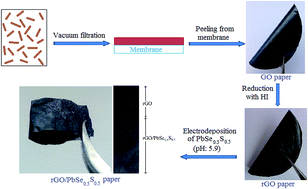
In recent years, free-standing graphene papers (GPs) have been fabricated due to their high mechanical flexibility, electrochemical performance and chemical stability in various potential applications as membranes,26 fuel cells,27 Li-ion batteries,28 electrochemical sensors,29–31 electrochemical capacitors,32 and energy storage devices.33 Doping GPs with different amounts of metal or semiconductor nanoparticles can provide a tuning opportunity of the physical properties of GPs as desired.27–33 GPs can be made of either graphene oxide (GO) or reduced graphene oxide (rGO) by a simple vacuum filtration of a graphene-containing suspension.27,28,33 To date, semiconductive thin films have been prepared on metal electrodes. Decorating free-standing GPs with semiconductive thin films can provide portable electronics and lab-on-a-chip applications with a flexible platform. To our best knowledge, a PbSexS(1−x) thin film structure on rGO paper has not been prepared using electrochemical techniques until now.
In this paper, we have prepared for the first time a flexible and free-standing rGO/PbSe0.5S0.5 hybrid paper by using the following steps: vacuum-filtration of a GO suspension through a membrane, followed by peeling it off, reduction of the free-standing GO paper, and then electrodeposition of PbSe0.5S0.5 on the rGO paper electrode. Before electrodeposition of PbSe0.5S0.5 thin films on rGO paper, PbSexS(1−x) thin films (x = 0.0, 0.5, 1.0) were studied on a Au(111) single crystal electrode as a model platform in order to optimize the electrodeposition conditions. Morphological characterization of the prepared samples has been performed using scanning tunneling microscopy (STM) and scanning electron microscopy (SEM). The crystal structure has been determined using a powder X-ray diffraction (XRD) system. Electron dispersive spectroscopy (EDS) and UV-vis-NIR experiments have been carried out for stoichiometry and optical characterization of the thin films, respectively.
Concentrated H2SO4 (115 mL) was kept in an ice bath maintained at 0 °C. The pre-oxidized graphite was then added to the acid and stirred. KMnO4 (Sigma Aldrich, 15 g) was added slowly and allowed to dissolve. The addition was done carefully so that the temperature of the reaction mixture never went beyond 10 °C. This mixture was allowed to react at 35 °C for 2 h. After 2 h, 250 mL of distilled water was added. The water addition was done in such a way that the temperature did not exceed 50 °C. The mixture was stirred for an additional 2 h. Then, 750 mL of distilled water and 12.5 mL of 30% H2O2 were added. The mixture was kept undisturbed for a day and then the supernatant was decanted. The remaining solution was washed with 10% HCl solution several times, followed by washing with distilled water. The resulting solid was dried in air and diluted to make a 2% (w/w) dispersion. It was then put through dialysis for 3 weeks to remove any remaining metal contamination. Then, the graphite oxide solution after dialysis was filtered and 0.5 g of the dried graphite oxide was added to 500 mL of deionized water. The mixture was sonicated for 5 h in order to obtain GO nanosheets dispersed in water (1.0 mg mL−1).
The pH of the solution in an electrochemical cell is a very critical issue. If the electrochemical studies are applied at pH values lower than 5.9, both sulfur species turn immediately from S−2 or HS− to the H2S(g) form38 and the underpotential deposition (UPD) of selenium shifts to positive potentials, which does not fit into our one-pot electrodeposition procedure depending on the UPD of each element.39 In cases where the pH value of the solution is kept higher than 5.9, soluble Pb2+ species start to precipitate as Pb(OH)2(s). So, the buffer solution used for investigation of the electrochemical properties of PbSexS(1−x) thin films was 0.1 M ABS with a pH of 5.9.
A suitable electrodeposition potential value taking into account the UPD of each element was determined using a potentiodynamic (cyclic voltammetry) method. Current–time (i–t) transients were obtained from potentiostatic application during the electrodeposition process. The solutions were deoxygenated by passing dry nitrogen through the electrochemical cell for at least 15 min prior to each electrochemical study. All electrochemical studies were carried out with an Epsilon (BASi) potentiostat system connected to a three electrode cell by using different working electrodes of single crystal Au(111), polycrystalline Au, indium tin oxide coated glass (ITO), and rGO paper.
Single crystal Au(111) electrodes were prepared as previously described by Hamelin.17,40 Au(111) single crystal substrates with a surface area around 5 mm2 were prepared especially for powder XRD characterization of the prepared thin films by polishing them parallel to the (111) direction.41 The polycrystalline regions of the prepared substrates were covered with an electrochemically inert epoxy (Epoxy-Patch) to perform electrochemical measurements on the Au(111) electrodes. Optical studies were applied on optically transparent ITO electrodes and they were cleaned by sonication in a detergent solution for 5 min and then rinsed with a large amount of doubly distilled water. Further sonication in ethanol for 5 min was applied before being blown dry with an argon stream. In all cases, an Ag/AgCl (3 M NaCl) (BASi) electrode served as the reference electrode and a Pt wire was used as the counter electrode.
Fig. 2 exhibits potentiostatic i–t transients for 2 h electrodeposition of PbS, PbSe, and PbSe0.5S0.5 thin films on the Au electrode at an electrodeposition potential of −300 mV. In general view of all the i–t curves in Fig. 2, the current value rises initially and then declines exponentially after a maximum following a certain amount of time. This type of i–t transient is quite common for two-dimensional nucleation and growth phenomena, which possibly results in regular and highly-oriented crystalline thin film formation.38,42
Morphological investigation of PbSe, PbS, and PbSe0.5S0.5 thin films on an Au(111) electrode prepared at −300 mV was carried out using STM (Fig. 3) and SEM (Fig. 4) techniques. As shown in Fig. 3a, the PbSe thin film surface includes both randomly dispersed nanoparticles with an average diameter of around 40 nm and regular chain-like nanowires when compared to the naked Au(111) surface.43 The SEM image of the PbSe thin film (Fig. 4a) exhibits that these nanoparticles coalesce and the surface is coated with large PbSe particles with an average diameter of about 500 nm. In the case of the PbS thin films, the surface is characterized by cubic-like nanoparticles with an average diameter of around 80 nm (Fig. 3b). The SEM image of the PbS thin film in Fig. 4b also shows that the Au(111) surface is almost totally covered with a very smooth PbS thin film, which includes nanoparticles.
![]() | ||
| Fig. 3 STM images (2 μm × 2 μm) of PbSe (a), PbS (b), and PbSe0.5S0.5 (c) thin films on an Au(111) electrode. The samples were prepared using the same conditions as those for Fig. 2. | ||
![]() | ||
| Fig. 4 SEM micrographs of the electrodeposited PbSe (a), PbS (b), and PbSe0.5S0.5 (c) thin films on an Au(111) electrode. The samples were prepared using the same conditions as those for Fig. 2. | ||
As can be seen in Fig. 3c and 4c, PbSe0.5S0.5 thin films on Au(111) demonstrate a different structure when compared to PbSe and PbS thin films. The PbSe0.5S0.5 surface is supposed to be a mixture of PbSe and PbS surface structures. Z-height profiles presented under the STM images in Fig. 3 indicate that the roughness of the PbSe thin film (∼50 nm) is higher than that of the PbS thin film (∼15 nm) and the roughness of PbSe0.5S0.5 thin film (∼50 nm) is very close to that of the PbSe thin film. This aspect shows that the growth mechanism of the ternary film is strongly dominated by PbSe thin films on the Au electrode.
The chemical composition of the thin film is calculated using EDS as 30.10% Se, 28.93% S, and 40.97% Pb, which indicates that the atomic ratio of Se
:
S is almost 1
:
1 (Fig. S2†). However S and Se species are higher and Pb is lower than the expected ratio for PbSe0.5S0.5 (25% for S and Se, 50% for Pb). This chemical composition is very close to the previous result, which was published by Onicha et al. They prepared ternary PbSexS(1−x) nanowires with different x values by using a precipitation method and they reported that the stoichiometry deviates slightly from the expected metal/chalcogen concentrations with a maximum variation of 14% and average variation of 6.83% of the expected stoichiometry.24
Fig. 5 demonstrates the powder XRD patterns of PbSe, PbS, and PbSe0.5S0.5 thin films on an Au(111) electrode prepared at −300 mV. It is clear in Fig. 5 that all the diffraction patterns contain an intensive peak at 2θ = 38.2°, which is due to the Au(111) electrode and is attributed to the (111) crystalline face of Au (JCPDS card no: 4-784). Except for the Au(111) diffraction, the PbS thin film includes only one diffraction peak at 2θ = 30.1° that corresponds to the cubic (200) crystalline face of PbS (JCPDS card no: 5-592). A diffraction peak at 2θ = 29.1° is observed for the PbSe thin film, which is due to the cubic (200) crystalline face of PbSe (JCPDS card no: 20-0494). The PbSe0.5S0.5 thin film contains a diffraction peak at 2θ = 29.7°, which is almost in the middle of the PbS and PbSe crystalline faces. The position of this peak strongly depends on the stoichiometry of lead chalcogenide (the x value of the PbSexS(1−x) structure). If the x value increases, this peak shifts to 29.1°, while the peak moves to 30.1° when decreasing the x value.24 Diffraction patterns for the PbSexS(1−x) thin films (x = 0.0, 0.5, and 1.0) on the Au(111) electrodes indicate that the one-pot electrodeposition process based on the UPD of each element of the semiconductive material yields thin films with single crystal orientation. Similar results have been obtained by using one-pot electrodeposition methods based on UPD for binary semiconductive materials e.g. PbS,17,19 PbTe,18 and CdS.44
![]() | ||
| Fig. 5 Powder XRD spectra of Au(111) electrodes modified with PbS (a), PbSe0.5S0.5 (b), and PbSe (c) thin films. The samples were prepared using the same conditions as those for Fig. 2. | ||
We have also investigated the optical properties of PbSe0.5S0.5 thin films on ITO electrodes for 15, 30, 60, and 120 minute electrodeposition times (Fig. S3†) and bandgap values have been calculated as 0.56, 0.52, 0.49, and 0.48 eV, respectively. The bulk bandgap value for PbS is 0.41 eV, while it is 0.28 eV for PbSe.24 It is also determined that the color of the PbSe0.5S0.5 thin film, which is prepared at −300 mV, changes when increasing the electrodeposition time (Fig. S4†). The color of the PbSe0.5S0.5 thin films is observed as brown for 30 min electrodeposition time when compared to the naked Au electrode. The thin film is observed as purple, blue, light blue, gray, and dark gray for 1 h, 2 h, 3 h, 4 h, and 5 h electrodeposition time, respectively. Both the bandgap shift to lower values and the color variation with increasing the film thickness may be attributed to the quantum-confinement effect of the synthesized ternary thin film.15,17,18
While electrodeposition of PbSe0.5S0.5 is applied on rGO paper at −450 mV, current–time transients were recorded to evaluate the nucleation and growth mechanism on the rGO paper. Current–time data (Fig. S6†) exhibit a transient starting from a maximum current value which is followed by an exponential fall after a certain amount of time, which is due to random adsorption. By increasing the time, a broad curve at about 60 min is observed, which may be attributed to the nucleation and growth process for the formation of the PbSe0.5S0.5 thin film.38,42 Depending on this i–t transient, it may be suggested that PbSe0.5S0.5 nanoparticles are adsorbed randomly onto rGO paper and they re-organize and grow regularly on the surface over time.
Typical XRD patterns of GO, rGO, and rGO/PbSe0.5S0.5 papers are presented in Fig. 6. As shown in this figure, the XRD pattern of GO paper exhibits only one peak centered at 11.2°, corresponding to the (002) diffraction of stacked GO sheets with a layer-to-layer distance (d-spacing) of 0.8 nm, due to the presence of hydroxyl, epoxy and carboxyl groups. rGO paper displays a broader (002) diffraction peak at 24.0° with a d-spacing of 0.4 nm, which is due to elimination of the oxygen-containing groups after the chemical reduction process is applied.26,27 It is clear that rGO/PbSe0.5S0.5 paper prepared with a 2 h electrodeposition process includes two main peaks at 23.9° for rGO and 29.6° for PbSe0.5S0.5 thin film, respectively. This situation indicates that one-pot electrodeposition of PbSe0.5S0.5 onto rGO paper was successfully achieved at −450 mV. The particle size of PbSe0.5S0.5 was calculated as 87 nm from the peak at 2θ = 29.6° in Fig. 6 by using the Scherrer equation (ESI†), indicating the formation of nanoparticles on the rGO paper.
![]() | ||
| Fig. 6 Powder XRD spectra of GO, rGO, and rGO/PbSe0.5S0.5 paper prepared by 2 h electrodeposition at −450 mV. | ||
Fig. 7a, c and e demonstrates large and close-view SEM images of rGO/PbSe0.5S0.5 prepared with a 1 h electrodeposition process at −450 mV. The surface structure of rGO paper contains characteristic wrinkles, arising from the flexibility of graphene (Fig. S7†). It is obvious from Fig. 7e that the rGO paper surface is covered with PbSe0.5S0.5 particles with an average size of 40 nm, while the wrinkled character of the rGO paper is still observed. Some of these nanoparticles are arranged to form worm-like wires on the rGO paper surface (Fig. 7e). A cross-sectional analysis of the rGO/PbSe0.5S0.5 paper shows layer-by-layer assembly of graphene sheets (Fig. 7g). If the electrodeposition process is extended to 2 h, flower-like large crystallites of around 7 μm in dimension arise on the rGO paper, which is probably due to growth of worm-like wires over time (Fig. 7b and d). A close-view of this surface exhibits regularly-oriented particles with a size of about 90 nm, besides flower-like large crystallites on the rGO paper (Fig. 7f). In this figure, the wrinkled graphene substrate is hardly observed, indicating that the rGO surface is almost covered with PbSe0.5S0.5 film after the 2 h electrodeposition process. The successive growth of worm-like and of flower-like crystallites can be assigned to re-organization of PbSe0.5S0.5 nanoparticles on the rGO paper over time as mentioned above. This case indicates that PbSe0.5S0.5 particle size and shape can be adjusted by controlling the electrodeposition time. Cross-sectional SEM analysis of rGO/PbSe0.5S0.5 paper after the 2 h electrodeposition process reveals flower-like vertically aligned PbSe0.5S0.5 crystallites on the layer-by-layer assembled rGO paper (Fig. 7h). However, flower-like electrochemical crystallization on rGO paper is not similar to that obtained on Au substrates. It may be suggested that the wrinkled structure of the rGO surface plays a template role for the formation of PbSe0.5S0.5 crystals and causes the re-organization of first worm-like and then flower-like crystals besides nanoparticles. The presence of flower-like PbSe0.5S0.5 crystals enlarges the electrode surface area and it can be proposed that this hybrid paper can be favorable for different electrochemical applications e.g. flexible electronics, electrocatalysis, and electrochemical capacitors with high performance.
![]() | ||
| Fig. 7 Top view (a–f) and cross-sectional view (g and h) SEM images of rGO/PbSe0.5S0.5 paper prepared by 1 h (a, c, e, g) and 2 h (b, d, f, h) electrodeposition at −450 mV. | ||
FTIR characterization was carried out to verify the reduction of GO paper and formation of PbSe0.5S0.5 crystals on the rGO paper (Fig. 8). GO paper demonstrates a large band at 3470 cm−1, which corresponds to the –OH functional group on the GO paper. The FTIR spectrum of GO paper contains other peaks at 2970, 1740, and 1650 cm−1 due to C–H, C
O, and C
C functional groups, respectively. After treatment with HI and formation of rGO paper, the intensities of all these peaks decrease, indicating removal of oxygen-containing groups. The loss of oxygen-containing groups results in the formation of residual holes on the rGO paper, where PbSe0.5S0.5 nanoparticles can be easily anchored to form worm-like and flower-like large crystallites because the defects serve as active adsorption sites and can be useful places to start the nucleation and growth.45 The rGO/PbSe0.5S0.5 paper includes almost the same FTIR spectrum as that of rGO paper. When compared to rGO paper, only one difference is observed for rGO/PbSe0.5S0.5 paper with an additional band at 2850 cm−1, which may be attributed to PbSe0.5S0.5 crystals and this wavenumber corresponds to the bandgap value of 0.35 eV. The bulk bandgap values of PbS and PbSe are 0.41 and 0.28 eV, respectively, and the calculated bandgap value of PbSe0.5S0.5 crystals on rGO paper is between the bandgap values of PbS and PbSe as expected.
:
S of PbSe0.5S0.5 thin film composition is almost 1
:
1. UV-vis-NIR experiments revealed a bandgap shift with increasing film thickness, which is attributed to the quantum-confinement effect of prepared ternary thin films. The bandgap value of electrodeposited PbSe0.5S0.5 crystals on rGO paper was estimated as 0.35 eV, which is between the bulk bandgap values of PbS and PbSe. XRD data exhibited that the one-pot electrodeposition process resulted in single crystal PbSe0.5S0.5 thin films on both Au(111) and rGO paper.
Footnote |
| † Electronic supplementary information (ESI) available. See DOI: 10.1039/c5ra26803f |
| This journal is © The Royal Society of Chemistry 2016 |