
Dandan
Zhao
,
Yang
Yu
and
J. Paul
Chen
*
Department of Civil and Environmental Engineering, National University of Singapore, 10 Kent Ridge, Singapore 117576. E-mail: paulchen@nus.edu.sg; jchen.enve97@gtalumni.org
First published on 18th February 2016
Arsenic contamination in groundwater has raised great concern in many countries around the world. In this study, a new activated carbon fiber (ACF) based material targeting the simultaneous removal of arsenic and natural organic matter was developed. The ACF, as a support material, was modified by doping with zirconium-based nanoparticles (NP) with chitosan as a linking polymer. The fabrication of Zr-based NP doped ACF was optimized by a L9 (3)4 orthogonal experimental design approach. The adsorption kinetics study showed that the adsorption equilibrium was established within 30 h. The adsorption increased as the solution pH was decreased; the optimal pH for adsorption was 3.0. The experimental data were better described by the Langmuir equation than the Freundlich equation; the maximum adsorption capacity of 21.7 mg As per g was achieved at pH 3.0. The adsorption was not reduced in the presence of carbonate. The presence of fluoride and phosphate had some negative effects on the adsorption. The arsenic uptake was however greatly retarded by the silicate. The fixed-bed column filtration experiment demonstrated that the sorbent had 570.4 bed volumes, to meet the maximum contaminant level of 10 µg L−1 when treating simulated arsenic contaminated water with an initial concentration of 106 µg L−1. The XPS analysis indicated that the adsorption of arsenate was mainly associated with an ion-exchange reaction between hydrogen sulfate and arsenate ions.
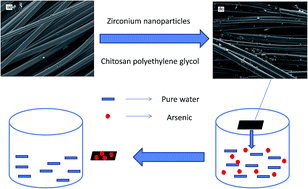
Such technologies as ion exchange, membrane filtration, adsorption, and chemical precipitation/coagulation have been widely applied for arsenic removal from water.5,6 Among them, adsorption is considered as a prevailing technology due to its ease in operation, low cost and availability of various sorbents.7 Many types of materials such as activated carbon, activated alumina, manganese dioxide loaded resin, titanium dioxide, zirconium, iron oxide, silicate clay and organic materials have been reported for arsenic removal from water.8–14
A series of nano-sized sorbents have been studied for decontamination of arsenic, such as nano-sized titania, nanostructured iron–copper binary oxide, and nano zerovalent iron.15–17 Better performances in arsenic adsorption onto several nano-particles (NPs) were well reported, since they have better physicochemical properties such as higher specific surface area, stronger binding for contaminants and rapid adsorption kinetics.18–20 A promising zirconium-based nano-sized sorbent with an excellent arsenic adsorption capacity of 256.4 mg g−1 was synthesized in our laboratory and reported in the literature.21 The optimal reaction pH for this particle is about 3.0 and typically the industrial wastewater containing arsenic is acidic. As such, this particle is more applicable for arsenic removal in the industrial wastewater.22,23
Although, nano-sized sorbents have high adsorption capacity of arsenic, they must be separated after water is treated because of their adverse effects on human health. Since they are rather small, it is challenging to use settling or filtration to remove them. To solve the problem, a media can be used to support the nanoparticles in order that they are not dispersed in the water.
Activated carbon fiber (ACF) is used in the purification of air and water due to higher adsorption capacities than granular activated carbons.24 It can be used as a supporting matrix for the NP developed in our previous study for water treatment to avoid the dispersion problem of the NPs. ACF has great mechanical and physical properties and stability under different chemical and physical conditions.25,26 It can also remove both natural organic matters (NOMs)27 and various synthetic organic contaminates (SOCs) such as dynamic pesticide,28 synthetic organic dyes,29 trichloroethene and methyl tertiary-butyl ether30 and phenol.31 Since arsenic coexists with NOMs and SOCs in natural water, ACF based sorbent may become a promising material, for removal of both arsenic and organic matters from contaminated groundwater and industrial wastewater.
In order to attach the NPs onto the ACF, a chitosan (CTS) was selected as a polymer linker. The CTS has advantages of being biodegradable, non-toxic and renewable. When the particles are attached onto the surfaces of the ACF, the internal pores may be filled with the CTS. Therefore, it is desirable to create internal pores in order to facilitate the adsorption kinetics. Polyethylene glycol (PEG) as a highly water-soluble polymer was therefore used as pore-forming additive.
In this study, a Zr-based NP doped ACF was first fabricated for arsenic removal from aqueous solution. A series of batch adsorption experiments of pH effect, adsorption kinetics, adsorption isotherm and influence of coexisting substances were carried out to evaluate the performance of the sorbent. The NP doped ACF was tested for its removal capacity for organic matters by using the lake water and a humic acid solution. Finally, the X-ray photo electron spectroscopy (XPS) was used to better understand the adsorption mechanism.
The loading of NP onto the ACF was studied. 0.1 g NP doped ACF was added into 100 mL DI water and the pH was adjusted to 1.0 to dissolve the NP on the ACF. The zirconium concentration was measured for calculation of the amount of Zr-based NP doped onto the ACF. The zirconium concentration and the mass of Zr-based NP were strongly linearly related (r2 = 0.997).
The specific surface areas of the ACFs were determined by low-temperature nitrogen adsorption using a NOVA 1000 BET Analyzer (QuantaChrome, USA). The samples were firstly purged with pure nitrogen gas at a temperature of 150 °C for overnight to remove excessive contaminant and moisture which may be present on the ACF surfaces. The multipoint Brunauer–Emmett–Teller (BET) model was applied to calculate the apparent surface area.
The point of zero charge (PZC) of the ACF was conducted according to the method described by Kosmulski.32 0.1 g NP doped ACF was added into different glass vials with 50 mL DI water separately. The pH of the solutions was adjusted to 4 to 10 by adding NaOH or HNO3 solution. Then 1.5 g of NaNO3 was added to each glass vial to bring final electrolyte concentration to approximately 0.45 M. After 24 h, the final pH of the solutions was measured. ΔpH (final pH − initial pH) versus initial pH was plotted to find the PZC.
In the adsorption kinetics experiment, 0.5 g ACF was added into 1 L As(V) solution with the initial concentration of 10 mg L−1. The solution pH was adjusted to 3.0. The mixture was gently stirred at room temperature for 50 h. The samples were collected at different time intervals, filtrated by with 0.45 µm filters, and analysed for As(V) concentration by the inductively coupled plasma-optical emission spectrometer (ICP-OES, Perkin Elmer Optima 3000 DV). The solution pH 3.0 was maintained during the experiment.
In the pH effect experiment, the pH of arsenate solutions (50 mL and 10 mg L−1) was adjusted by adding 0.1 M nitric acid or sodium hydroxide solution. The 0.5 g L−1 NP doped ACF was added into the solution, and the mixtures were shaken at 25 ± 1 °C for 48 h. During the adsorption, the pH of the solution was maintained by adding 0.1 M nitric acid or sodium hydroxide solution. At the end of experiment, the samples were taken and filtered with 0.45 µm filters. The filtrate was analysed for the residual As(V) concentration. The amount of NP which was loaded onto the ACF was calculated; the pH effect study was repeated with that corresponding amount of NP (0.5 g L−1 × 12.4% = 0.062 g L−1).
Furthermore, another pH effect experiment was conducted with the same approach with an exception that the solution pH was not maintained during the experiment. This study was to find the relationship between final pH and initial pH of the solution and whether the change in the pH affected the adsorption.
In the adsorption isotherm experiment, 0.025 g sorbent was added into 50 mL As(V) solutions with the arsenic concentration ranging from 1 to 120 mg L−1. The pH was maintained at 3.0 during the adsorption process. Other procedures were the same as those used in the pH effect experiments.
Effects of NOMs and coexisting anions on the arsenic uptake were studied. In each experiment, the humic acid sodium salts (HA) or coexisting anions (namely F−, CO32−, PO43−, and SiO32−) were added into the As(V) solution. 50 mL As(V) solutions with initial concentration of 10 mg L−1 and different concentration of HA and coexisting anions were prepared in glass vials. The solution pH was kept at 3. The mixtures were shaken at the room temperature for 48 h. Other procedures were the same as the pH effect experiments.
During the filtration the water sample was taken and the As(V) concentration was measured by the ICP-OES. Bed volume (BV) calculated by the below equation was used in the equation of the performance of the NP doped ACF filtration.
![]() | (1) |
| Parameter | Value | Parameter | Value |
|---|---|---|---|
| pH | 7.99 | SO42−, mg L−1 | 14.40 |
| TN, mg L−1 | 0.46 | Ca2+, mg L−1 | 16.67 |
| Conductivity, µ S cm−1 | 182.20 | Mg2+, mg L−1 | 0.48 |
| Cl−, mg L−1 | 17.91 | Na+, mg L−1 | 10.50 |
| NO3−, mg L−1 | 0.70 | K+, mg L−1 | 3.04 |
The orthogonal array design approach is a method for designing experiments to evaluate how different factors affect the variance of the experiments.33,34 As a systematic analysis tool, it shows certain advantages. For example, it largely decreases the number of experiments and is able to isolate defects and assess performance. In this experiment, the four factors/three levels experiment totally requires 81 runs, while only 9 runs were needed according to the L9 (3)4 orthogonal array design approach, which significantly decreased the number of the experiment.
The CTS can be dissolved in acidic solution and become solidified in basic solution. Thus, the Zr-based NP can well be mixed with the CTS in acidic condition, and then formed a film on the ACF in basic solution. According to Table S2,† the model terms are significant with a value of “Sig.” less than 0.05. In this case, the dosage of Zr is a significant model term. As given in Fig. 1, the optimal composition for the ACF modification was 0.3% CTS with low molecular weight, 0.2% PEG and 0.6 wt% Zr-based NP.
The concentration of the CTS was an important factor that determines the adsorption capacity, which indicated more CTS could increase the impregnation amount of the Zr-based NP. The maximum mass of Zr-based NP was selected to be 0.6 g in 100 mL impregnation solution since the particles would not disperse uniformly once the amount of Zr-based NP exceeded 0.6 g as shown in Fig. S1.† After testing the zirconium concentration of dissolved NP on the ACF, the mass of Zr-based NP doped onto the ACF was calculated to be 124 mg g−1 and the mass ratio was 12.4%.
After the impregnation solution, a film abundant between slits could be observed on the surface of the ACF fibers in Fig. 2(b). The agglomerates are found among the film abundance in the Fig. 2(c). As shown in the higher magnification images of Fig. 2(d), the agglomerates contain the Zr-based NPs that are nano-sized. The results indicate that the Zr-based NP is fixed onto the ACF. In addition, the specific surface area reduces from 1721 m2 g−1 of the virgin ACF to 1409 m2 g−1 of the NP doped ACF. That may be due to the film abundance and subsequently blockage resulting from the application of the polymer for the attachment of NPs.
As shown in Fig. 3, ΔpH decreases with an increase in initial pH, and the PZC of the ACF is 6.67 (defined as the pH when the ΔpH equals to 0). As reported in previous studies, the PZC of the Zr-based NP and the unmodified ACF was 2.85
21 and 6.9–9,35 respectively. The Zr-based NP in the ACF reduced the PZC value of the ACF due to its lower PZC value. The results indicates that the surface charge of the NP doped ACF is highly pH dependent. When the solution pH is lower than the PZC, the surface of the sorbent is positively charged which is favourable for adsorption of anions. On the contrary, the surface of the sorbent is negatively charged when the solution pH is higher than the PZC.
![]() | ||
| Fig. 4 pH effect on As(V) adsorption (pH was controlled through experiment, m = 0.5 g L−1 (Zr-based NP doped ACF), m = 0.062 g L−1 (Zr-based NP), [As(V)]0 = 10 mg L−1). | ||
However, the arsenate uptake of the NP doped ACF is higher than that of the Zr-based NP from pH 6 to 11. Since the ACF has certain ability for arsenate removal from water and the optimal pH for the adsorption process is about 5.0,36 the higher adsorption capacities of arsenate from pH 6–11 may be caused by the adsorption of arenate by both Zr-based NP and ACF. In addition, the PZC of Zr-based NP doped ACF is larger than the Zr-based NP. This may also cause the higher adsorption of the Zr-based NP doped ACF for the arsenic uptake than the Zr-based NP.
As shown in Fig. 5, the pH edge in the non-pH controlled experiment is similar to that in the pH control experiment. The adsorption capacity decreases as the pH is increased from 4 to 11, and the optimal initial pH is found to 4.0. If we look at the trend of the initial vs. the final pH in the inset of Fig. 5, we can find that the final pH become slightly lower than the initial pH. The optimal initial pH of 4.0 corresponds to final pH of 3.8 and 3.5 when the NP-doped ACF and the Zr-based NP are used, respectively. The result suggests that the hydrogen ions are released into the solution during adsorption process.
![]() | ||
| Fig. 5 pH effect on As(V) adsorption (pH was not controlled through experiment, m = 0.5 g L−1 (Zr-based NP doped ACF), m = 0.062 g L−1 (Zr-based NP), [As(V)]0 = 10 mg L−1). | ||
In addition, the decrease in pH of Zr-based NP doped ACF is less than that of the Zr-based NP as demonstrated in the inset of Fig. 5, which could result from the buffering effect from the ACF as well as the presence of hydroxyl group from the sodium hydroxide treatment in the impregnation.
Comparing to the NP's adsorption equilibrium time of 12 h,21 the adsorption process is slightly slower. This is due to mass transfer resistance in the ACF (namely, diffusion and external mass transfer).
In order to better understand the adsorption kinetics, the pseudo-first order model37 and the pseudo-second order model38 were used to fit the experimental data. The mathematical representations of the models are given below.
ln(qe − qt) = ln qe − k1t | (2) |
![]() | (3) |
In addition, an intraparticle diffusion model was employed to simulate the adsorption process. The pore diffusion is used in the modelling due to the larger specific surface area of the ACF. The mathematical equations and corresponding initial and boundary conditions are expressed as follows:39
![]() | (4) |
| q = 0, 0 ≤ r ≤ ap, t < 0 | (5) |
![]() | (6) |
![]() | (7) |
The rate constants obtained from both pseudo-first order and pseudo-second order models, and correlation coefficients obtained from the nonlinear curve fitting are summarized in Table 2. The pseudo-second order model seems better than the pseudo-first order model in the fitting, based on the comparison of the correlation coefficients. Ho and McKay conducted a detailed review on the metals removal by various sorbents. They suggested that the pseudo-second order equation may be applied for the chemisorption process.40,41 Consequently, the adsorption process by the ACF in this study could be chemisorption.
| Pseudo-first order model | Pseudo-second order model | Intraparticle diffusion model | |||||
|---|---|---|---|---|---|---|---|
| k 1 (h−1) | q e (mg g−1) | r 2 | k 2 (g mg−1 h−1) | q e (mg g−1) | r 2 | k f (m s−1) | D p (m2 s−1) |
| 0.173 | 16.01 | 0.945 | 0.022 | 16.01 | 0.980 | 2.5 × 10⁻⁴ | 8 × 10⁻¹¹ |
The intraparticle model used in this study is based on the Fick's law. It works with an assumption of a two-step mass transport mechanism where As(V) first transfers through the external liquid film from the bulk solution (represented as external mass transfer, kf) and subsequently diffuses inside the sorbent (represented as internal mass transfer, Dp) before finally being adsorbed by the sorbent. Once we obtain the values of kf and Dp, we can easily predict any other adsorption history under various conditions, such as different concentrations of adsorbate and adsorbent.42 On the other hand, the model parameters for pseudo-first and second order models are experimental specific, and they cannot predict adsorption history under other conditions. This is the major advantage of the intraparticle model over the two empirical models.
The constants of kf and Dp used in the modeling are 2.5 × 10⁻⁴ m s−1 and 8.0 × 10⁻¹¹ m2 s−1, respectively. In our previous study, the constants of the Zr-based NP are 2.1 × 10⁻⁴ m s−1 and 3 × 10⁻¹⁰ m2 s−1.21 The comparison of the constants from both cases indicates that the slow internal diffusion in the ACF (represented by Dp) plays a key role in the kinetics.
In the adsorption kinetics study, the amount of sulfate released in the solution as a function of contact time was observed (inset of Fig. 6). The amount of sulfate release from the ACF increases as time goes. This suggests that the arsenic uptake is associated with the release in sulfate ions from the sorbent. This will be further discussed in the XPS analysis.
![]() | (8) |
As shown in Table 3, the results from both approaches are virtually the same. The obtained results from χ2 test are in agreement with those from the r2 values of the linear regression.
| Model | Langmuir equation | Freundlich equation | ||||||
|---|---|---|---|---|---|---|---|---|
| q max (mg g−1) | b (L mg−1) | r 2 | χ 2 | k f | n | r 2 | χ 2 | |
| Linear | 21.74 | 1.59 | 0.998 | N/A | 2.94 | 3.94 | 0.672 | N/A |
| Non-linear | 21.16 | 2.70 | 0.929 | 2.92 | 12.03 | 6.88 | 0.783 | 9.03 |
As shown in Fig. 7 and Table 3, the Langmuir equation fits the experimental data much better than Freundlich equation. The maximum adsorption capacity calculated from the Langmuir model is 21.74 mg As per g. Since the Langmuir equation is based on monolayer adsorption onto homogeneous surface, the arsenate uptake is mainly due to the monolayer adsorption.
From our previous work, the maximum adsorption capacity of As(V) is 256.4 mg g−1.21 The mass ratio of NP to NP doped ACF is 12.4%. The estimated maximum adsorption capacity of the NP doped ACF should be 31.8 mg g−1 (12.4% × 256.4 mg g−1 = 31.8 mg g−1). However, the maximum adsorption of NP doped ACF obtained from Table 3 is 21.16 mg g−1, lower than the estimated. This indicates that the coating layer may block some adsorption sites of the NP.
It is worthwhile to compare the adsorption capacity of arsenic on this sorbent with other reported carbon based sorbents. As shown in Table 4, our sorbent exhibits a better performance than many other sorbents. In addition, our sorbent has a relatively higher specific surface area, one of the key factors for a sorbent. The results indicate that this material is a better sorbent for the decontamination of arsenic in both groundwater and industrial waste water.
| Adsorbent | pH | Surface area (m2 g−1) | Max. adsorption capacity | Ref. | |
|---|---|---|---|---|---|
| (mg g−1) | (mg m−2) | ||||
| Fe-oxide impregnated activated carbon | 7.0 | 840 | 4.5 | 0.0054 | 44 |
| Iron particle doped phenolic resin based activated carbon | 6.0–10.0 | 781 | 5.68 | 0.0073 | 45 |
| Iron impregnated granular activated carbon | 4.0 | 1316 | 1.95 | 0.0015 | 46 |
| Magnetite-doped activated carbon fiber | 4.16 | 1392 | 4.0 | 0.0029 | 47 |
| Zero-valent iron/activated carbon | 7.0 | — | 10 | — | 48 |
| Polyaniline modified activated carbon | 6.5 | 660 | 8.0 | 0.0121 | 49 |
| Zirconyl-functionalized activated carbon | 3.0–9.0 | 630 | 0.9 | 0.0014 | 50 |
| Iron oxide impregnated activated carbon | 3.0–7.0 | 1065 | 4.42 | 0.0042 | 51 |
| Iron hydro(oxide) nanoparticles onto activated carbon | 7.0 | 1058 | 4.56 | 0.0043 | 52 |
| Zr-based NP doped ACF | 2.5 | 1409 | 21.7 | 0.0154 | This study |
In this study, a humic acid was used to represent the NOMs in water. As shown in Fig. 8, the HA has certain negative influence on the adsorption. The uptake of arsenic decreases significantly with a HA concentration of 2 mg L−1; while the uptake of arsenic do not further decrease with the HA concentration from 2 to 10 mg L−1. In this case, the HA would affect the uptake through at least two possible mechanisms: (1) blockage of available adsorption sites, which is due to the HA adsorption onto the surface of the material; (2) competition with arsenic ions for the adsorption sites, which is due to ion exchange reaction(s).
It has been reported that the ACF is able to adsorb the NOMs and other trace organic contaminants.54 That indicates that the HA may be adsorbed onto the NP doped ACF and then block the available adsorption sites. On the other hand, HA has a pKa value of 4.64,55 which means the dominant species are HA molecules with pH < 4.64; HA anions with pH > 4.64. The solution pH in our experiment is 3.0. That indicates most of HA species in the solution are HA molecules, which may not compete with arsenate anions. From above analysis, the first mechanism seems the dominant mechanism for the effect of HA on the uptake of arsenate. In addition, the adsorption study of NOMs by the ACF was conducted and the results are discussed in Section 3.5.
![]() | ||
| Fig. 9 Effect of anions on the adsorption: (a) fluoride; (b) carbonate; (c) phosphate; (d) silicate (m = 0.5 g L−1, pH = 3, [As(V)]0 = 10 mg L−1). | ||
As shown in Fig. 9, the uptake of As(V) is inhibited by the competing ions with a sequence of CO32− < F− < PO43− < SiO32−. The standard deviation of the uptake under different content of carbonate is calculated to be 0.54; this indicates that the presence of carbonate has almost no effect on the arsenic uptake. This is likely due to adsorption of carbonate ions onto the activated carbon. The inhibitory effects from fluoride, phosphate and silicate can be attributed to the competitive adsorption with arsenate ions. For example, the fluoride ions can be removed by the Zr-based NP. Thus, the fluoride ions can lead to decline of adsorption capacity for arsenate.56 The results of NP based ACF is almost the same as that of the NP,21 which indicates the Zr-based NP is the dominant for the arsenic removal.
![]() | ||
| Fig. 10 Filtration study for arsenic removal by NP doped ACF ([As]0 = 106 µg L−1, pH = 7.2, dosage = 10 g). Solid and hollow points represent Ceff/Cinf and effluent pH, respectively. | ||
The initial concentration is 106 µg L−1, and the Ceff/Cinf should be less than 0.1 to meet the MCL of arsenic concentration (10 µg L−1). The filtration time is from 0.42 d to 3.83 d when the Ceff/Cinf is below 0.1. 10 g NP doped ACF could successfully treat 570.4 BV of arsenic solution.
The change in pH during the filtration is observed in Fig. 10. The initial pH of solution prepared by the DI water is 7.20. The pH slightly drops to 6.5 at the beginning and then increases to the initial pH during the filtration process. The pH in the influent becomes the same as that in effluent at around 7 d. The decrease in pH is due to the ion exchange between arsenic and sulfate ions during the arsenic uptake (Sections 3.3.2 and 3.6), as the presence of sulfate ions in water can cause release of hydrogen ions and low pH.
![]() | ||
| Fig. 12 XPS wide scan spectra of the sorbents: (a) virgin NP doped ACF; (b) As(V)-loaded NP doped ACF. | ||
| Atomic conc. (%) | O 1s | N 1s | C 1s | Zr 3d | S 2p | As 3d |
|---|---|---|---|---|---|---|
| Virgin sorbent | 36.76 | 5.9 | 53.30 | 1.48 | 2.56 | 0 |
| As-Loaded sorbent | 39.98 | 6.12 | 50.29 | 1.41 | 0.91 | 1.29 |
As shown in Fig. 13, the high resolution scan of O 1s spectra are decomposed into four component peaks for both virgin NP doped ACF and As(V) loaded NP doped ACF. The peaks with binding energy of 531.1 ± 0.1, 530.3 ± 0.1, 529.6 ± 0.1 and 528.6 ± 0.1 eV can be assigned to the O in the forms of O–S, O
C and O
As, O–C and O–As, and O–H and O–Zr, respectively.21,58 The relatively content of each peak is summarized in Table 6. After adsorption, the content of peak O–S decreases from 25.06 to 13.8%, while the content of peak O–C increases from 23.89 to 28.86% and the content of peak O
C increases from 28.19 to 32.83%. The results reveal that the uptake of arsenic introduce the O–As and O
As bonds, which increase the peak areas of O–C and O
C.
![]() | ||
| Fig. 13 XPS spectra of O 1s on the adsorbents: (a) virgin NP doped ACF; (b) As(V)-loaded NP doped ACF. | ||
| Valence state | Sample | Proposed component | Binding energy (eV) | Relative content (%) |
|---|---|---|---|---|
| O 1s | Virgin sorbent | O–Zr/O–H | 528.66 | 22.86 |
| O–C | 529.74 | 23.89 | ||
O C |
530.41 | 28.19 | ||
| O–S | 531.14 | 25.06 | ||
| As-Loaded sorbent | O–Zr/O–H | 528.55 | 24.51 | |
| O–C/O–As | 529.66 | 28.86 | ||
O C/O As |
530.33 | 32.83 | ||
| O–S | 531.20 | 13.80 |
Additionally, as illustrated in Fig. 14, the peak at 45.7 eV detected in the NP doped ACF is attributed to As(V). As reported in literatures, the binding energies of 44.2, 44.9 and 45.5 eV are respectively attributed to AsO43−, HAsO42−, and H2AsO4− respectively.59,60 The adsorbed arsenic in the NP doped ACF is mainly in the form of H2AsO4−. The As(V)-loaded sorbent was from an experiment conducted under pH 3. At pH 3, H2AsO4− is the domain species among all the arsenic species.8 The finding of H2AsO4− as the main species here through the XPS study indicates that the uptake process does not change the chemistry of arsenic.
In our previous studies, the adsorption mechanism of the arsenate, arsenite and monomethyl arsenic by the Zr-based NP is due to the ion exchange between arsenic species and hydrogen surface ions.21,61,62 From the above experimental results and spectroscopic analysis, the uptake of arsenate by the NP-doped ACF is likely due to be ion exchange between hydrogen sulfate and arsenic ions.
Footnote |
| † Electronic supplementary information (ESI) available. See DOI: 10.1039/c5ra25030g |
| This journal is © The Royal Society of Chemistry 2016 |