Adsorption of tungstate on kaolinite: adsorption models and kinetics

Li Ruiping, Lin Chunye* and Liu Xitao
State Key Joint Laboratory of Environmental Simulation and Pollution Control, School of Environment, Beijing Normal University, Beijing 100875, China. E-mail: c.lin@bnu.edu.cn; Fax: +86 10 58801858; Tel: +86 10 58801858

Received 16th November 2015 , Accepted 10th January 2016

First published on 14th January 2016


Abstract

The adsorption characteristics of tungstate onto kaolinite have been studied using batch experiments under ambient temperature. The effects of various operating variables, viz., contact time, initial concentration, solution pH, ionic strength and competitive anions, have been investigated. The optimum contact time needed to reach equilibrium was found to be 48 h. Tungstate adsorption isotherms fitted well with both Langmuir and Freundlich models and the maximal adsorption capacity of the kaolinite sample is 35.54 mmol kg−1. Tungstate adsorption increases in the pH range of 3–5 and reaches a maximum at an average equilibrium pH of 4.24, but decreases from 83.7% to 10.6% as the pH increases from 5.35 to 11.03. Tungstate adsorption increases from 71.9% to 89.4% as ionic strength increases from 0.001 M to 0.1 M NaCl. As the P/W molar ratio increases from 0 to 10, tungstate adsorption decreases from 24.38 mmol kg−1 to 21.61 mmol kg−1, while phosphate adsorption increases from −2.09 mmol kg−1 to 27.45 mmol kg−1. These results demonstrate that tungstate might be adsorbed onto tungstate-specific adsorption sites of the kaolinite minerals, mainly via inner-sphere complexation.

1. Introduction

Tungsten is a transition metal and has attracted increased interest due to the scrutiny of a childhood leukemia cluster in Fallon, NV, and suspected cases in Sierra Vista, AZ and Elk Grove, CA.1–3 Anthropogenic activities, such as W mining and smelting, military combat/training operations, agrochemical practices including the application of W-containing fertilizers, and non-sustainable disposal of W-containing substances (e.g. disposal of light bulbs in landfills and land application of wastewater residuals), significantly increase tungsten release in environmental systems.3,4 Tungsten metal in nature persists primarily as the tungstate anion and is thermodynamically stable in the environment.1,2,4,5

Only very few adsorption studies of tungstate on natural sorbents have been reported to date.5–8 Furthermore, these studies mainly focused on tungstate adsorption on iron oxides/hydroxides and demonstrated that tungstate can strongly bind to iron oxides/hydroxides, pH has a strong influence on tungstate adsorption and phosphate has a comparable competitive effect on tungstate adsorption.5,6,9 Kaolinite is the most abundant mineral in soil and sediments10 and has received considerable recognition as a natural scavenger because of its high adsorption capacity. However, studies reported that the adsorption of tungstate on kaolinite is poor.7,8

China is the world's largest W producer and consumer. Ganzhou in the south of Jiangxi province, being the birth place of the Chinese W industry, is extremely rich in W sources. Thus, Ganzhou is called the “Tungsten capital of the world”. There are three major tungsten mines: Xihuashan, Dangping, and Piaotang, among which Xihuashan was the first tungsten mine to be operated in China. It is believed that tungsten pollution from tungstate mining and smelting activities is very severe, resulting in significant environmental problems in China.11 However, the existing knowledge base does not provide clear information about the fate of tungsten in the environment. Therefore, it is essential to understand tungstate adsorption/desorption and quantify the maximal tungstate adsorption capacity on kaolinite. In addition, knowledge on tungstate adsorption/desorption on kaolinite is lacking and thus would be interesting to scientists worldwide.

The purpose of this study is to elucidate the role of pH, ionic strength and a competitive anion (PO43−) on tungstate adsorption onto a kaolinite surface. Adsorption data has been analyzed with the help of adsorption models to determine the adsorption constants and obtain thermodynamic parameters associated with the adsorption process.

2. Materials and methods

2.1. Reagents and materials

All the chemicals used in the study were of analytical grade or higher. All the solutions were prepared with double-distilled water and all the polypropylene centrifuge tubes were cleaned by soaking in 10% HNO3 and rinsed with deionized water. All the experiments were performed in duplicate.

The kaolinite used in this study was obtained from Beijing Mengyimei Bio-Tech Co., Ltd (Beijing, China). The specific surface area of the kaolinite was measured using a Model QS-7 Quantasorb surface area analyzer (Quantachrom Co., Greenvale, NY). The X-ray diffraction (XRD) pattern of the kaolinite was obtained using an X'Pert PRO MPD instrument (PANalytical B.V., Netherlands) with filtered Cu Kα radiation (n = 0.1548 nm) operated at 40 kV and 40 mA. The kaolinite sample was also characterized using an S4800 scanning electron microscope.

2.2. Adsorption experiments

2.2.1 Kinetic studies. Kinetic studies were conducted to examine the influence of time on the adsorption of tungstate on kaolinite in 0.1 M NaCl at pH 5.0. A batch method was used to examine the effect of time on the adsorption by shaking kaolinite suspensions in a series of 50 mL polypropylene centrifuge tubes containing 500 mg of kaolinite in 25 mL of 50 mg L−1 WO42− (Na2WO4·2H2O) for 1, 2, 4, 8, 12, 24, 36, 48 and 60 h. At the designated time, the tubes were centrifuged at 8000 rpm for 20 min using a Xiang Yi centrifuge (H-1650, China) to separate the solid from liquid phases, followed by filtering with a 0.45 μm filter.
2.2.2 Adsorption isotherms. The influence of the initial WO42− concentration was determined in 0.1 M NaCl at pH 5.0. The tests were run with an initial WO42− concentration ranging from 1 to 300 mg L−1 at 25 ± 1 °C to calculate the thermodynamic parameters of the adsorption reaction.
2.2.3 Adsorption of tungstate as a function of pH and ionic strength. Batch adsorption of WO42− at different pH values and ionic strengths was examined by shaking kaolinite suspensions in 50 mL polypropylene centrifuge tubes containing 500 mg of kaolinite in 25 mL of 100 mg L−1 WO42− for 48 h. The suspension pH was maintained throughout the experiment using dilute HCl and NaOH solutions. The ionic strength was maintained by adding various concentrations of NaCl solution. After the 48 h reaction period, the tubes were centrifuged and filtered.
2.2.4 Competitive anion. The influence of the competitive anion (PO43−) (NaH2PO4·2H2O) on WO42− adsorption was investigated by simultaneously adding WO42− and PO43− stock solutions to the sorbent suspension. The molar concentration ratio (P/W) was in the range of 0.1, 0.5, 1, 5 and 10.
2.2.5 Analytical methods. The pH of the solutions was measured using a basic PB-10 pH meter (Sartorius, Germany), calibrated using commercial pH 4.01, 6.86 and 9.18 buffers. The concentration of W and P in the supernatants was measured using ICP MS (X Series II, Thermo Electron) and ICP AES (SPECTRO ARCOS EOP, SPECTRO Analytical Instruments GmbH).

3. Results and discussion

3.1. Characterization of the kaolinite

An X-ray diffraction spectrograph of the kaolinite clay is shown in Fig. 1. The structure of the kaolinite clay is given as Al2(Si2O5)(OH)4 by XRD and it mainly consists of kaolinite and quartz. An SEM image of a kaolinite sample (Fig. 2) demonstrates that kaolinite is mainly composed of flakes, which is in agreement with the reported microscopic observation of kaolinite. The specific surface area of the kaolinite clay was determined by the BET method using N2, and was found to be 15.8 m2 g−1.
image file: c5ra24201k-f1.tif
Fig. 1 The XRD pattern of kaolinite clay.

image file: c5ra24201k-f2.tif
Fig. 2 SEM micrograph of kaolinite clay.

3.2. Effect of contact time

A plot of WO42− adsorption on kaolinite with different contact times at a pH value of 5.0 is shown in Fig. 3. The adsorption of WO42− occurred very quickly during the first 12 h, and then the remaining concentration of WO42− became asymptotic to the time axis, such that there was no appreciable change in the remaining concentration after 48 h. This time is presumed to represent the equilibrium time, at which an equilibrium concentration is presumed to have been attained. All further experiments were conducted for 48 h.
image file: c5ra24201k-f3.tif
Fig. 3 Adsorption of tungstate onto kaolinite clay as a function of contact time, with following reaction conditions: ionic strength (I) = 0.1 M NaCl, pH = 5.0 ± 0.1, T = 298 ± 1 K, and initial concentration (WO42−) = 0.27 mM.

To analyze the rate constants for tungstate adsorption on kaolinite, the Lagergren's first-order rate expression12 and a pseudo-second-order rate expression13 (eqn (1) and (2)) were used to simulate the kinetic adsorption data:

 
image file: c5ra24201k-t1.tif(1)
 
image file: c5ra24201k-t2.tif(2)
where q and qe are the amounts of WO42− adsorbed (mmol kg−1) at time, t (h) and at equilibrium, respectively, kad is the Lagergren's rate constant for tungstate adsorption (1/h) and k2 is the pseudo-second-order rate constant (kg mmol−1 h−1).

The straight line plot of log(qeq) versus t (Fig. 4a) indicates the applicability of the abovementioned equation. The value of kad calculated from the slope of the linear plot was determined to be 1.05 × 10⁻² h−1, which is consistent with tungstate adsorption onto oxisols (kad 1.10 × 10⁻² h−1 at an initial tungstate concentration of 0.04 mM).11 The straight line plot of t/qt versus t (Fig. 4b) indicates that the kinetics of WO42− adsorption on kaolinite can be well described by the pseudo-second order rate equation (R2 = 1).


image file: c5ra24201k-f4.tif
Fig. 4 Kinetic simulation of tungstate adsorption onto kaolinite: (a) pseudo-first-order model, (b) pseudo-second-order model, and (c) intraparticle diffusion model.

To further discuss the rate of internal mass transfer, the adsorption data was fitted to the intraparticle diffusion model given by Weber and Morris14 (eqn (3)):

 
q = kidt1/2 (3)
where kid is the relevant rate constant (mmol kg−1 h1/2). A plot of tungstate adsorbed, q versus t1/2, is presented in Fig. 4c. The plot follows three phases, an initial curved portion followed by a linear portion and a plateau. The initial curved portion is attributed to bulk diffusion, the linear portion to intraparticle diffusion and the plateau to equilibrium. The features of the plot indicate that the transport of WO42− from the solution, through the particle–solution interface, and into the pores of the particles, as well as the adsorption on the available surface of kaolinite are responsible for the uptake of WO42−. The deviation of the curves from the origin also indicates that intraparticle transport is not the only rate-limiting step. The rate constant (kid) obtained from the slope of the linear portion of the curve was 0.185 mmol kg−1 h1/2.

3.3. Adsorption isotherm

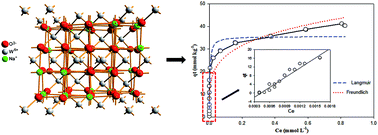
The adsorption isotherms of tungstate are shown in Fig. 5. The adsorption isotherm plot illustrated a linear distribution in the range of 0–1.63 mmol L−1. Furthermore, for the same equilibration time, the adsorption of tungstate is higher for greater values of initial concentrations of tungstate anion, which decreases with increasing initial concentration. This may be due to the limited total available adsorption sites for a fixed adsorbent dose.
image file: c5ra24201k-f5.tif
Fig. 5 Adsorption isotherm plot for the adsorption of tungstate onto kaolinite clay.

Adsorption models have been used to determine the mechanistic parameters associated with the adsorption process. In this study, the Langmuir model and the Freundlich model were applied to evaluate the WO42− adsorption isotherm data.

The Langmuir model is described by the following equation:15

 
image file: c5ra24201k-t3.tif(4)
where Ce is the equilibrium concentration of tungstate in solution, qe is the amount of tungstate adsorbed, qm is the maximal adsorption capacity, and KL (L mmol−1) is a constant related to the binding energy.

The Freundlich model has the general form:

 
qe = KFCe1/n (5)
where Ce is the equilibrium concentration of tungstate in solution, qe is the amount of tungstate adsorbed, and KF (mmol1−n kg−1 Ln) and n are Freundlich constants related to the adsorption intensity and adsorption capacity, respectively.

Table 1 lists the isothermal parameters for tungstate adsorption on kaolinite based on the simulations with experimental data shown in Fig. 5. Based on the correlating coefficients, the Langmuir model was found to fit the test data better than the Freundlich model. The maximal tungstate adsorption capacity calculated from the Langmuir model is 35.54 mmol kg−1, and the Langmuir equilibrium constant, KL, had a value of 0.0035 L mmol−1. These results are in agreement with a previous study reported by Tuna et al.7 They investigated tungsten adsorption from canister round munitions onto natural kaolinite. They found that tungsten adsorption on natural kaolinite was fitted best by the Langmuir model and the maximal tungsten adsorption capacity was 8.28 mmol kg−1. The difference observed for the tungstate maximal adsorption capacity is probably related to the impurity of the natural kaolinite used in the study by them. Our earlier study showed that the maximal capacity for tungstate adsorption onto oxisols was also best fitted by both the Langmuir model and the Freundlich model, with a maximal capacity of 10.09 mmol kg−1 and a distribution coefficient of 12.6 L g−1. Xu et al.6 found that the maximal capacity for tungstate adsorption onto goethite was much higher than that on kaolinite with a maximal capacity of 225.7 mmol kg−1 and a distribution coefficient of 159.1 L g−1. This difference is due to the characteristics of goethite being different from those of kaolinite. Therefore, the maximal tungstate adsorption capacity onto kaolinite is higher than that onto oxisols, but much lower than that onto goethite.

Table 1 Parameters of Langmuir and Freundlich models
Model KL (L mmol−1) Qmax (mmol kg−1) KF (mmol1−n kg−1 Ln) n R2 SE
Langmuir 0.0035 35.54 0.94 3.65
Freundlich 45.92 4.30 0.87 5.40


According to Hall et al.16 and Sari et al.,17 the essential features of the Langmuir isotherm can be expressed in terms of a dimensionless constant separation factor or equilibrium parameter RL, which is defined by the following relationship (eqn (6)):

 
image file: c5ra24201k-t4.tif(6)
where C0 (mmol L−1) is the initial amount of tungstate. The RL parameter is considered to be a more reliable indicator of the adsorption. There are four probabilities for the RL value: (i) for favorable adsorption, 0 < RL < 1, (ii) for unfavorable adsorption, RL > 1, (iii) for linear adsorption, RL = 1, and (iv) for irreversible adsorption, RL = 0. The value of RL for tungstate adsorption onto kaolinite ranges from 0.007 to 0.298 between 0.08 and 1.63 mmol L−1 and approaches zero as C0 increases (Fig. 6). This parameter (0 < RL < 1) indicates that kaolinite clay is a suitable adsorbent for the adsorption of tungstate from an aqueous solution.


image file: c5ra24201k-f6.tif
Fig. 6 Variation of adsorption intensity (RL) with initial tungstate concentration.

3.4. Effect of pH

The adsorption of tungstate (WO42−) on kaolinite as a function of pH from pH 3 to 11 is illustrated in Fig. 7. The adsorption of tungstate increases over the pH range of 3–5 and reaches a maximum at an average equilibrium pH 4.24 (equilibrium pH 4.35, 4.16, and 4.21); but the adsorption of tungstate on kaolinite decreases significantly from 83.7% to 16.7% for pH 5–7, then it decreases very slowly to approximately 11% for pH > 7. The effect of pH on tungstate adsorption onto kaolinite is consistent with the results published by Tuna and Braida.8 They found that the maximum adsorption of tungstate on natural kaolinite was at pH 3 (87%) and that adsorption decreased slowly from pH 6 to 10. A similar pH-dependence curve for tungstate adsorption on iron oxide has been reported by Xu et al.9 They found that tungstate has a broad adsorption envelope onto goethite across a wide pH range, with the maximum adsorption below pH 5.1, while only 10% above pH 10 on the goethite surface. These results may be explained by the findings of Hingston et al.,18 who concluded that adsorption for the anions of weak acids is the strongest at pH values near their acid dissociation constants (pKa). The two pKa values for H2WO4 (pKa1 = 3.62, (Wesolowski et al.19); pKa2 = 5.08, (Wood and Samson20)) cover a wider pH range where the maximum adsorption of WO42− on kaolinite occurs. On the other hand, the solution pH affects the tungstate speciation, which is related to its adsorption mechanism on kaolinite. Tungstate speciation is complex and it tends to polymerize to form some insoluble isopolytungstate under acidic conditions, such as [HW6O12]3−/[H2W6O4]6− at pH = 4.0, [W2O(OH)8]2+/[W2O4(OH)]3− at pH = 6.0. Thus, there may be more than one mechanism for tungstate adsorption onto kaolinite: i.e. adsorption and polymerization at a low pH. Tungstate occurs in the WO42−/W(OH)82− form only when pH > 6.2.2 The decreasing trend of tungstate adsorption on kaolinite with increasing pH may be explained by the fact that the highly negatively charged surface sites of kaolinite did not favor the adsorption of tungstate due to electrostatic repulsion with increasing pH. Moreover, an abundance of OH ions in basic solution creates a competitive environment with anionic ions of tungstate for the adsorption sites, causing a decrease in adsorption.
image file: c5ra24201k-f7.tif
Fig. 7 Effect of pH on the adsorption of tungstate onto kaolinite clay.

3.5. Effect of ionic strength

Fig. 8 shows the effect of ionic strength on the adsorption of tungstate onto kaolinite clay. It was observed that tungstate adsorption increased from 71.9% to 89.4% with ionic strength ranging from 0.001 M to 0.1 M NaCl. It is possible to distinguish between inner-sphere and outer-sphere anion surface complexes by studying the effects of ionic strength on anion partitioning, and hence to obtain some useful information about the adsorption mechanism.21–24 Adsorption behavior that responds to higher ionic strength with greater adsorption is macroscopic evidence for inner-sphere complexation. McBride25 indicated that higher ionic strength might lead to the transformation of adsorbate from outer-sphere complex to inner-sphere complex and hence might increase the overall adsorption. A similar adsorption trend was reported for borate and arsenate.26–28 Thus, an increase in ionic strength might lead to the formation of more tungstate inner-sphere complexes on the clay colloids, thus increasing the overall tungstate adsorption onto them.
image file: c5ra24201k-f8.tif
Fig. 8 Effect of ionic strength on the adsorption of tungstate onto the kaolinite clay.

3.6. Effect of competitive anions

Competitive anions greatly affect the mobility and bioavailability of tungstate in the environment. An experiment to investigate the effect of the presence of PO43− on the amount of WO42− adsorbed on kaolinite was designed, in which the initial tungstate concentration was 0.5 mM, while the initial phosphate concentration ranged from 0.05 to 5.0 mM (Fig. 9). With an increase of the P/W molar ratio from 0 to 10, tungstate adsorption decreased from 24.38 mmol kg−1 to 21.61 mmol kg−1, while phosphate adsorption increased from −2.09 mmol kg−1 to 27.45 mmol kg−1 (Fig. 9). As shown in Fig. 9, the decrease in the amount of tungstate adsorbed on kaolinite as the ratio P/W increases, is less than the increase in the amount of phosphate adsorbed. This observation must arise from some adsorption taking place without the displacement of tungstate. Mulcahy et al.29 concluded that the tungstate adsorbed on the two types of surface sites of alumina, producing loosely and tightly bound surface species. Therefore, it can be concluded that the kaolinite might have small adsorption sites for both tungstate and phosphate anions, whereas large adsorption sites specific for either tungstate or phosphate anions.
image file: c5ra24201k-f9.tif
Fig. 9 Effect of PO43− at various concentrations on the adsorption of tungstate with the reaction conditions: pH = 5.0 ± 0.5, initial tungstate concentration = 0.5 mM, reaction time = 48 h, and T = 298 ± 1 K.

4. Conclusion

In this study, the adsorption of tungstate on high purity kaolinite was discussed for the first time and the effect of contact time, initial concentration, pH, ionic strength and a competitive anion was examined. Tungstate adsorption onto high purity kaolinite generally reached equilibrium after 48 h. The adsorption isotherms can be well described with both the Langmuir model and the Freundlich model. Tungstate adsorption increases over the pH range of 3–5 and decreases significantly at pH > 7, while it increases markedly as the ionic strength increases from 0.001 M to 0.1 M NaCl. As the phosphate concentration increases from 0.05 mM to 5.0 mM, tungstate adsorption slightly decreases from 24.38 mmol kg−1 to 21.61 mmol kg−1. These results demonstrate that tungstate might be adsorbed onto the tungstate-specific adsorption sites on the kaolinite clay, mainly via inner-sphere complexation. The results clearly show that the adsorption of tungstate on kaolinite play an important role in determining the fate and transformation of tungstate in natural environments. Spectroscopic studies on the microstructure of tungstate may be necessary to identify the species of tungstate on a kaolinite surface in the future.

Acknowledgements

This study was supported by the National Natural Science Foundation of China (41371441) and the Ministry of Environmental Protection Funded Project (201309044).

References

  1. R. L. Seiler, K. G. Stollenwerk and J. R. Garbarino, Appl. Geochem., 2005, 20, 423–441 CrossRef CAS.
  2. A. Koutsospyros, W. Braida, C. Christodoulatos, D. Dermatas and N. Strigul, J. Hazard. Mater., 2006, 136, 1–19 CrossRef CAS PubMed.
  3. P. R. Sheppard, G. Ridenour, R. J. Speakman and M. L. Witten, Appl. Geochem., 2006, 21, 152–165 CrossRef CAS.
  4. N. Strigul, A. Koutsospyros, P. Arienti, C. Christodoulatos, D. Dermatas and W. Braida, Chemosphere, 2005, 61, 248–258 CrossRef CAS PubMed.
  5. J. P. Gustafsson, Chem. Geol., 2003, 200, 105–115 CrossRef CAS.
  6. N. Xu, C. Christodoulatos, A. Koutsospyros and W. Braida, Land Contamination & Reclamation, 2009, 17, 45–57 Search PubMed.
  7. G. S. Tuna, W. Braida, A. Ogundipe and D. Strickland, Chemosphere, 2012, 86, 1001–1007 CrossRef CAS PubMed.
  8. G. S. Tuna and W. Braida, Soil Sediment Contam., 2014, 23, 838–849 CrossRef.
  9. N. Xu, C. Christodoulatos and W. Braida, Chemosphere, 2006, 64, 1325–1333 CrossRef CAS PubMed.
  10. J. Chen, A. Anandarajah and H. Inyang, J. Geotech. Geoenviron. Eng., 2000, 126, 798–807 CrossRef CAS.
  11. R. Li, R. Luan, C. Lin, D. Jiao and B. Guo, RSC Adv., 2014, 4, 63875–63881 RSC.
  12. S. Lagergren, K. Sven. Vetenskapsakad. Handl., 1898, 24, 1–39 Search PubMed.
  13. S. Veli and B. Alyuz, J. Hazard. Mater., 2007, 149, 226–233 CrossRef CAS PubMed.
  14. W. J. Weber and J. C. Morris, J. Environ. Eng. Div., 1963, 89, 31–60 Search PubMed.
  15. I. Langmuir, J. Chem. Soc., 1918, 40, 1361–1403 CAS.
  16. K. R. Hall, L. C. Eagleton, A. Acrivos and T. Vermeulen, Ind. Eng. Chem. Fundam., 1966, 5, 212–223 CAS.
  17. A. Sari, M. Tuzen, D. Citak and M. Soylak, J. Hazard. Mater., 2007, 149, 283–291 CrossRef CAS PubMed.
  18. F. Hingston, A. Posner and J. Quirk, Discuss. Faraday Soc., 1971, 52, 334–342 RSC.
  19. D. Wesolowski, S. Drummond, R. Mesmer and H. Ohmoto, Inorg. Chem., 1984, 23, 1120–1132 CrossRef CAS.
  20. S. A. Wood and I. M. Samson, Econ. Geol., 2000, 95, 143–182 CrossRef CAS.
  21. K. F. Hayes, C. Papelis and J. O. Leckie, J. Colloid Interface Sci., 1988, 125, 717–726 CrossRef CAS.
  22. M. J. Angove, B. B. Johnson and J. D. Wells, Colloids Surf., A, 1997, 126, 137–147 CrossRef CAS.
  23. D. L. Sparks, Environmental soil chemistry, Academic press, 2003 Search PubMed.
  24. S. Goldberg, J. Colloid Interface Sci., 2005, 285, 509–517 CrossRef CAS PubMed.
  25. M. B. McBride, Clays Clay Miner., 1997, 45, 598–608 CAS.
  26. S. Goldberg, H. Forster and E. Heick, Soil Sci. Soc. Am. J., 1993, 57, 704–708 CrossRef CAS.
  27. E. Deliyanni, D. Bakoyannakis, A. Zouboulis and K. Matis, Chemosphere, 2003, 50, 155–163 CrossRef CAS PubMed.
  28. K. B. Payne and T. M. Abdel-Fattah, J. Environ. Health Sci., 2005, 40, 723–749 CrossRef CAS.
  29. F. M. Mulcahy, M. J. Fay, A. Proctor, M. Houalla and D. M. Hercules, J. Catal., 1990, 124, 231–240 CrossRef CAS.

This journal is © The Royal Society of Chemistry 2016
Click here to see how this site uses Cookies. View our privacy policy here.