Mengchun Yu,
Chuncheng Yang,
Xiufang Bian*,
Shuchun Zhao,
Tianqi Wang,
Shuai Liu and
Tongxiao Guo
Key Laboratory for Liquid-Solid Structural Evolution and Processing of Materials, Ministry of Education, Shandong University, Jinan 250061, China. E-mail: xfbian@sdu.edu.cn; Fax: +86 0531 88395011; Tel: +86 0531 88392748
First published on 22nd February 2016
Fe78Si9B13 amorphous particles are applied in the preparation of silicon oil-based magnetorheological (MR) fluids. The structure and morphology of the Fe78Si9B13 amorphous particles were characterized by X-ray diffraction and scanning electron microscopy, respectively. The magnetic properties of the Fe78Si9B13 amorphous particles and the MR fluids prepared with Fe78Si9B13 amorphous particles were characterized by vibrating sample magnetometry. The MR effect of the MR fluids was investigated with a rotational rheometer. The results of VSM show that the saturation magnetization of Fe78Si9B13 amorphous particles is 169.48 emu g−1, accompanying low remanence and low coercivity. The results of rotational rheometry manifest that the MR fluids with Fe78Si9B13 amorphous particles have an improved magnetorheological response compared with magnetic fluids with Fe3O4 nanoparticles under an applied magnetic field.
The magnetic performance of a magnetic fluid is mainly determined by the magnetic particles and the application field of the magnetic fluid is closely related with the property of the liquid carrier. Silicone oil is frequently chosen as the liquid carrier due to its excellent thermostability and low volatility as well as its low viscosity-temperature coefficient.12–14 Fe3O4 particles are popularly selected to prepare magnetic fluids due to Fe3O4 particles own numerous superiorities such as easy preparation, low cost and good biological compatibility. Nevertheless, Fe3O4 particles have low magnetic energy-density per unit volume, resulting in low saturation magnetization of magnetic fluids with Fe3O4 particles, which in turn limits the magnetorheological response of MR fluids under an applied magnetic field. The saturation magnetization of Fe3O4 particles is commonly no more than 80 emu g−1.15–20 However, magnetic fluids with higher saturation magnetization are necessary for many applications.8,21–23 For instance, MR brake is a device to transmit torque by the shear stress of MR fluids and the shear stress is determined by the saturation magnetization of magnetic particles. MR fluids with carbonyl iron particles were used to make MR brake.23 However, the remanence and coercivity are high in their research. Of course, there are high grade carbonyl iron particles to be used to prepare MR fluids.24,25
Magnetic particles are expected to be synthesized with high saturation magnetization, low remanence and low coercivity simultaneously. The Fe-based amorphous materials have broad prospects due to the low cost of raw materials together with their unique magnetic properties.15,26,27 Application of Fe-based amorphous alloys for efficient transformer cores is becoming more widespread due to the excellent soft magnetic properties.28 The perfect soft magnetic properties of Fe-based amorphous particles make it have development potential in the application of magnetic fluids.15 Nevertheless, there are few researches that apply amorphous particles in the preparation of MR fluids.
We prepared silicon oil-based MR fluids with Fe78Si9B13 amorphous particles. The experiment results prove that Fe78Si9B13 amorphous particles and MR fluids with Fe78Si9B13 amorphous particles have high saturation magnetization together with low remanence and low coercivity. Moreover, the viscosity of MR fluids with Fe78Si9B13 amorphous particles shows faster average growth rate and MR fluids with Fe78Si9B13 amorphous particles show stronger magnetic response than that of magnetic fluids with Fe3O4 particles under an applied magnetic field.
| Fe2+ + 2Fe3+ + 8NH3·H2O = Fe3O4 + 8NH4+ + 4H2O |
Certain amounts of the spraying amorphous particles and Fe3O4 particles were firstly dispersed in deionized water (100 mL). Then a certain amount of oleic acid (0.8 mL) was added to coat on the surface of the particles with mechanical stirring and supersonic dispersion for 40 min. Next, the coated particles were dispersed in silicon oil with mechanical stirring and supersonic dispersion for about 1.5 h, respectively. The processes were operated at around 50 °C. Ultimately, the two kinds of magnetic fluids with a volume concentration (5%) were prepared.
The DSC curves of the Fe78Si9B13 ribbon amorphous particles after being milled for 24 h and 84 h are shown in Fig. 2. The two exothermic peaks during heating progress demonstrate two stages crystallization of the amorphous particles, which reveal that the particles remain amorphous even after being milled for 24 h and 48 h. The results correspond well with the XRD patterns of Fe78Si9B13 ribbon amorphous particles as mentioned in Fig. 1(a).
Fig. 3(a), (c) and (e) show the SEM images of Fe78Si9B13 spraying amorphous particles and Fe78Si9B13 ribbon amorphous particles, with a typical size in the range of 4–10 μm. Fig. 3(a) is the image of Fe78Si9B13 spraying amorphous particles and the particles are regular spheres. The SEM images demonstrate that the change of the size of Fe78Si9B13 spraying amorphous particles after being milled for 84 h is little. Fig. 3(b), (d) and (f) are the EDS spectrograms corresponding to each picture in Fig. 3(a), (c) and (e). The spectrograms show that the element content almost remains unchanged. TEM images of Fe78Si9B13 spraying amorphous particles before and after the coating process are shown in Fig. 3(g) and (h).
Fig. 4 shows the magnetic properties of (a) Fe78Si9B13 ribbon amorphous particles after being milled for 24 h and 84 h and (b) Fe78Si9B13 spraying amorphous particles after being milled for 0 h, 24 h, 60 h and 84 h. It turns out that the saturation magnetization of Fe78Si9B13 ribbon amorphous particles and Fe78Si9B13 spraying amorphous particles decreases slightly with increasing milling time.
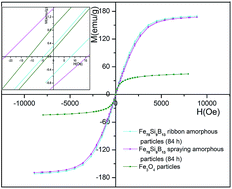
The magnetic hysteresis curves of Fe78Si9B13 ribbon amorphous particles after being milled for 84 h, Fe78Si9B13 spraying amorphous particles after being milled for 84 h and Fe3O4 nanoparticles are shown in Fig. 5. The results indicate that the saturation magnetization of Fe78Si9B13 spraying amorphous particles and Fe78Si9B13 ribbon amorphous particles after being milled for 84 h are 167.01 emu g−1 and 169.48 emu g−1, respectively, while the saturation magnetization of traditional Fe3O4 particles is just 46.89 emu g−1 in our research. What's more, the remanence and coercivity of Fe78Si9B13 spraying amorphous particles are just 2.5 emu g−1 and 36 Oe, respectively. At the same time, the remanence and coercivity of Fe78Si9B13 ribbon amorphous particles are just 1.4 emu g−1 and 19 Oe. The possible reason that Fe78Si9B13 ribbon amorphous particles own low remanence and low coercivity is that the atoms are spatial disordered without macroscopical magnetic anisotropy. As the Fe78Si9B13 spraying amorphous particles are only partial transformation to the amorphous state originally, the remanence and coercivity of Fe78Si9B13 spraying amorphous particles is slightly higher than that of Fe78Si9B13 ribbon amorphous particles. Considering the excellent soft magnetic properties of Fe78Si9B13 amorphous particles, the particles could be used to prepare magnetic fluids with high saturation magnetization, low remanence and low coercivity.
Magnetic properties for Fe78Si9B13 ribbon amorphous particles, Fe78Si9B13 spraying amorphous particles and Fe3O4 particles have been given in Table 1. Numerical values of saturation magnetization (Ms), remanence (Mr) and coercivity (Hci) of the three kinds of particles are shown in Table 1.
| Magnetic properties | Fe78Si9B13 ribbon amorphous particles | Fe78Si9B13 spraying amorphous particles | Fe3O4 particles | ||||
|---|---|---|---|---|---|---|---|
| 24 h | 84 h | 0 h | 24 h | 60 h | 84 h | ||
| Ms (emu g−1) | 176.46 | 169.48 | 178.00 | 174.91 | 170.30 | 167.01 | 42.41 |
| Hci (Oe) | 25 | 19 | 38 | 50 | 30 | 36 | 4.8 |
| Mr (emu g−1) | 4 | 1.4 | 2.5 | 3.8 | 2.13 | 2.5 | 3.65 |
The magnetic properties of MR fluids are shown in Fig. 6. The results show that the saturation magnetization of MR fluids with Fe78Si9B13 ribbon amorphous particles and Fe78Si9B13 spraying amorphous particles after being milled for 84 h is 3.7 emu g−1 and 3.5 emu g−1, respectively. The saturation magnetization of magnetic fluids with the same Fe3O4 particles volume fraction is about 0.8 emu g−1. This demonstrates that excellent magnetic properties of magnetic particles will contribute to excellent magnetic properties of MR fluids.
Therefore, because of the excellent magnetic properties of Fe78Si9B13 amorphous particles, the MR fluids can provide larger shear stress compared with magnetic fluids prepared with Fe3O4 particles, which can produce greater torque and friction. In the meantime, as the MR fluids we made have low remanence and low coercivity, the agility to react is insured. These MR fluids should have potential applications, especially in the devices to transmit torque and friction by the shear stress of magnetic fluids,22 such as clutch, brake, damper and so on.
The viscosity versus temperature of MR fluids under applied magnetic strength of 0 Gs, 500 Gs and 1100 Gs are measured by a rotational viscometer. A simplified schematic of the rotational viscometer is shown in Fig. 7(a). The chain-like structures in the absence of magnetic field and under an external magnetic field is shown in Fig. 7(b) and (c). Fig. 8 manifests that the viscosity of MR fluids with Fe78Si9B13 amorphous particles increases when the temperature decreases and magnetic strength increases. The effect of temperature on viscosity mainly depends on the viscosity-temperature property of silicon oil and the influence of magnetic strength on viscosity mainly depends on the magnetic property of the particles. In addition, the viscosity of MR fluids with Fe78Si9B13 amorphous particles is about two to three times higher than that of magnetic fluids with Fe3O4 nanoparticles under an applied magnetic field. With the increase of magnetic strength from 0 Gs to 1100 Gs, the average growth rate of the viscosity of MR fluids with Fe78Si9B13 amorphous particles is 9.64 cp per Gs, which is much faster than that of magnetic fluids with Fe3O4 particles. The reason might be interpreted as follows. The suspended particles will be polarized under an applied magnetic field and the dipole–dipole interaction between the particles causes the formation of linear chains, parallel to the applied field. And the chain-like structures inhibit the deformation of magnetic fluids. Therefore, the field-induced particles in the form of chain-like structures result in the increasing of the viscosity of MR fluids. The linking of chain-like structures becomes stronger with the increase of magnetic strength. However, the effect of the magnetic strength can approach a limit which is determined by the saturation magnetization of the particles. Therefore, the higher saturation magnetization of MR fluids with Fe78Si9B13 amorphous particles contributes to the formation of much stronger chainlike structures.
![]() | ||
| Fig. 7 (a) Schematic diagram of the rotational viscometer; (b) and (c) the chain-like structures in the absence of magnetic field and under an external magnetic field, respectively. | ||
The rheological properties of magnetic fluids can be measured by a rotational rheometer. And a simplified schematic of the rotational rheometer is shown in Fig. 9(a). The chain-like structures in the absence of magnetic field and under an external magnetic field is shown in Fig. 9(b) and (c). Shear stress and viscosity as a function of shear rate of magnetic fluids with Fe78Si9B13 particles (filled symbols) and Fe3O4 particles (open symbols) under different magnetic strengths on a logarithmic scale are shown in Fig. 10(a) and (b). Both the magnetic fluids with Fe78Si9B13 particles and Fe3O4 particles show an increase in shear stress and shear viscosity with increasing magnetic strength. However, applied magnetic field affects magnetic fluids of Fe78Si9B13 particles more significantly than that with Fe3O4 particles. In Fig. 10(a), in absence of magnetic field, the shear stress of both the magnetic fluids with Fe78Si9B13 particles and Fe3O4 particles exhibited a linear increase with increasing shear rate. Under a magnetic field, magnetic fluids with Fe78Si9B13 particles show a greater increase than that with Fe3O4 particles in shear stress. Typical Bingham behavior can be observed for MR fluids with Fe78Si9B13 particles and the shear stress show a wide plateau range over wide shear rate ranges. The possible reason is that the chain-like structures of particles are formed via dipole–dipole interactions under an applied magnetic field, resulting in the solid-like properties of the MR fluids.29,30 Fig. 10(b) shows that the shear viscosity of both magnetic fluids decreases with increasing shear rate, which is called the shear thinning behavior. The yield stress of the magnetic fluids can be obtained by linear extrapolation method and the intercept of each fitting curve is considered as the yield stress of the magnetic fluids under the corresponding magnetic field. Therefore, the yield stress of the two magnetic fluids under different magnetic field is obtained in Fig. 10(c). For example, at 250 kA m−1, the yield stresses of magnetic fluids with Fe78Si9B13 particles and Fe3O4 particles are 4.85 kPa and 36 Pa, respectively. It indicates that the yield stress of both magnetic fluids increases with increasing magnetic strength, especially the MR fluids with Fe78Si9B13 particles. The reason is that chain-like structure is well formed under the applied magnetic field and the force between particles becomes stronger with increasing magnetic strength. What's more, the yield stress of magnetic fluids is attributed to the magnetization intensity of the magnetic particles.31 Fe78Si9B13 particles are more easily magnetized than Fe3O4 particles under the same magnetic strength, increasing the magnetic interactions between the particles. Similarly, higher magnetic strength also increases the magnetic interactions between the particles. This means that the chain-like structures of magnetic fluids with Fe78Si9B13 particles under higher applied magnetic field aren't easily broken.
![]() | ||
| Fig. 9 (a) Schematic diagram of the rotational rheometer; (b) and (c) the chain-like structures in the absence of magnetic field and under an external magnetic field, respectively. | ||
| This journal is © The Royal Society of Chemistry 2016 |