
Shan-Shan Huang,
Kai-Li Jian,
Rui-Jun Li,
Ling-Yi Kong* and
Ming-Hua Yang*
State Key Laboratory of Natural Medicines, Department of Natural Medicinal Chemistry, China Pharmaceutical University, 24 Tong Jia Xiang, Nanjing 210009, People's Republic of China. E-mail: skeepjack@163.com; cpu_lykong@126.com; Fax: +86-25-8618-5039; Fax: +86-25-8327-1405; Tel: +86-25-8618-5039 Tel: +86-25-8327-1405
First published on 11th January 2016
Six phytosteroids and three dammarane-type triterpenoids, namely chisopanoids A–F (1–6) and chisopanones G–I (7–9), together with nine known triterpenoids (10–18) were isolated from the leaves of Chisocheton cumingianus. Their structures were elucidated by extensive spectroscopic analysis, X-ray crystallographic analysis, Mosher's method and Mo2(OAc)4-induced electronic circular dichroism (ECD) data. All compounds were evaluated for their cytotoxicities against HepG2, U2OS and MCF-7 human cancer cell lines, as well as inhibitory effects on nitric oxide (NO) production in LPS-activated RAW 264.7 macrophages. Compounds 5 and 6 showed potent cytotoxicities towards MCF-7 with IC50 values of 3.24 ± 1.39 and 8.85 ± 4.73 μM, and were further proved to inhibit the cell proliferation mainly by inducing apoptosis.
| Position | 1b | 2b | 3a | 4a | 5b | 6a | ||||||
|---|---|---|---|---|---|---|---|---|---|---|---|---|
| δH (multi, J in Hz) | δC | δH (multi, J in Hz) | δC | δH (multi, J in Hz) | δC | δH (multi, J in Hz) | δC | δH (multi, J in Hz) | δC | δH (multi, J in Hz) | δC | |
| a Measured in CDCl3.b Measured in methanol-d4. | ||||||||||||
| 1a | 1.90 m | 38.1 | 1.89 m | 38.1 | 1.86 m | 37.2 | 1.86 m | 37.2 | 1.87 m | 38.3 | 1.95 m | 36.5 |
| 1b | 1.22 m | 1.20 m | 1.12 m | 1.13 m | 1.05 m | 1.21 m | ||||||
| 2a | 1.84 m | 32.2 | 1.84 m | 32.1 | 1.85 m | 31.5 | 1.84 m | 31.6 | 1.80 m | 32.3 | 1.94 m | 31.3 |
| 2b | 1.57 m | 1.54 m | 1.51 m | 1.51 m | 1.50 m | 1.63 m | ||||||
| 3 | 3.52 m | 72.1 | 3.51 m | 72.1 | 3.59 m | 71.4 | 3.59 m | 71.6 | 3.41 m | 72.2 | 3.68 m | 70.7 |
| 4a | 2.33 m | 42.9 | 2.33 m | 42.9 | 2.34 m | 42.1 | 2.33 m | 42.2 | 2.25 m | 42.6 | 2.50 m | 42.0 |
| 4b | 2.30 m | 2.30 m | 2.28 m | 2.27 m | 2.25 m | 2.40 m | ||||||
| 5 | 146.7 | 146.7 | 146.3 | 146.4 | 144.1 | 165.1 | ||||||
| 6 | 5.59 d (5.1) | 125.0 | 5.57 d (5.2) | 125.0 | 5.60 d (3.9) | 124.0 | 5.60 d (4.4) | 124.1 | 5.28 br s | 127.4 | 5.68 d (1.2) | 126.3 |
| 7 | 3.81 br s | 65.9 | 3.79 br s | 65.9 | 3.85 br s | 65.4 | 3.85 br s | 65.5 | 3.72 m | 73.8 | 202.3 | |
| 8 | 1.53 m | 39.0 | 1.51 m | 39.0 | 1.46 m | 37.6 | 1.44 m | 37.6 | 1.44 m | 41.3 | 2.24 dd (11.6, 11.5) | 45.6 |
| 9 | 1.37 m | 43.5 | 1.36 m | 43.4 | 1.22 m | 42.4 | 1.22 m | 42.5 | 1.04 m | 50.1 | 1.56 m | 50.1 |
| 10 | 38.5 | 38.5 | 37.5 | 37.7 | 37.4 | 38.4 | ||||||
| 11a | 1.61 m | 21.8 | 1.64 m | 21.8 | 1.53 m | 20.8 | 1.52 m | 21.0 | 1.60 m | 22.3 | 1.58 m | 21.4 |
| 11b | 1.61 m | 1.54 m | 1.53 m | 1.52 m | 1.51 m | 1.58 m | ||||||
| 12a | 2.05 dt (12.6, 3.2) | 40.6 | 2.05 dt (12.6, 3.2) | 40.6 | 2.00 dt (12.6, 3.3) | 39.3 | 1.99 dt (12.6, 3.2) | 39.4 | 2.05 dt (12.6, 3.3) | 41.1 | 2.03 dt (12.9, 3.3) | 38.9 |
| 12b | 1.24 m | 1.24 m | 1.17 m | 1.17 m | 1.17 m | 1.15 m | ||||||
| 13 | 43.2 | 43.2 | 42.2 | 42.3 | 44.1 | 43.3 | ||||||
| 14 | 1.53 m | 50.8 | 1.52 m | 50.7 | 1.46 m | 49.5 | 1.46 m | 49.6 | 1.15 m | 57.8 | 1.51 m | 50.2 |
| 15a | 1.81 m | 25.1 | 1.78 m | 25.2 | 1.72 m | 24.4 | 1.72 m | 24.5 | 1.87 m | 27.3 | 2.41 m | 26.5 |
| 15b | 1.16 m | 1.12 m | 1.13 m | 1.14 m | 1.43 m | 1.35 m | ||||||
| 16a | 1.82 m | 30.2 | 1.80 m | 30.2 | 1.90 m | 28.4 | 1.91 m | 28.5 | 1.88 m | 29.6 | 1.91 m | 28.7 |
| 16b | 1.36 m | 1.35 m | 1.29 m | 1.29 m | 1.30 m | 1.29 m | ||||||
| 17 | 1.27 m | 57.3 | 1.27 m | 57.4 | 1.18 m | 55.8 | 1.18 m | 55.7 | 1.12 m | 56.9 | 1.11 m | 54.9 |
| 18 | 0.79 s | 12.3 | 0.78 s | 12.3 | 0.69 s | 11.7 | 0.68 s | 11.8 | 0.73 s | 12.4 | 0.68 s | 12.1 |
| 19 | 1.06 s | 18.7 | 1.04 s | 18.6 | 1.00 s | 18.3 | 0.99 s | 18.4 | 1.07 s | 19.5 | 1.20 s | 17.5 |
| 20 | 2.13 m | 41.8 | 2.15 m | 41.9 | 1.38 m | 36.1 | 1.44 m | 36.6 | 1.39 m | 37.6 | 1.38 m | 36.2 |
| 21 | 1.10 d (6.6) | 21.7 | 1.10 d (6.7) | 21.7 | 0.93 d (6.5) | 18.9 | 0.97 d (6.5) | 19.0 | 0.96 d (6.5) | 19.4 | 0.92 d (6.5) | 19.1 |
| 22a | 5.29 dd (15.2, 8.5) | 140.0 | 5.31 dd (15.2, 8.8) | 141.4 | 1.19 m | 34.0 | 1.44 m | 36.6 | 1.08 m | 35.0 | 1.20 m | 34.1 |
| 22b | 1.05 m | 1.13 m | 1.08 m | 1.05 m | ||||||||
| 23a | 5.14 dd (15.2, 9.4) | 130.2 | 5.11 dd (15.2, 9.5) | 129.4 | 1.19 m | 27.0 | 1.45 m | 22.8 | 1.24 m | 28.1 | 1.20 m | 27.2 |
| 23b | 1.19 m | 1.15 m | 1.24 m | 1.20 m | ||||||||
| 24 | 1.87 m | 47.0 | 1.74 m | 58.1 | 1.16 m | 40.9 | 0.98 m | 51.6 | 1.17 m | 42.1 | 1.18 m | 40.9 |
| 25 | 1.60 m | 33.5 | 73.3 | 1.69 m | 29.9 | 1.78 m | 29.1 | 1.69 m | 31.0 | 1.69 m | 29.9 | |
| 26 | 0.95 d (6.8) | 21.3 | 1.18 s | 29.6 | 0.85 d (6.3) | 19.3 | 0.94 d (6.9) | 21.2 | 0.87 d (6.8) | 19.5 | 0.84 d (7.0) | 19.4 |
| 27 | 0.90 d (6.8) | 19.4 | 1.12 s | 25.8 | 0.84 d (6.3) | 19.1 | 0.88 d (6.8) | 19.9 | 0.86 d (6.8) | 19.7 | 0.83 d (6.8) | 19.2 |
| 28a | 1.71 m | 36.6 | 1.75 m | 22.5 | 1.56 m | 34.2 | 3.92 m | 69.4 | 1.55 m | 34.9 | 1.57 m | 34.3 |
| 28b | 1.47 m | 1.23 m | 1.40 | 1.41 m | 1.40 m | |||||||
| 29a | 3.60 m | 61.7 | 0.87 t (7.3) | 13.0 | 3.66 m | 62.1 | 1.18 d (6.5) | 22.2 | 3.56 m | 62.0 | 3.65 m | 62.2 |
| 29b | 3.51 m | 3.64 m | 3.65 m | |||||||||
HMBC correlations (Fig. 2) traced from the methyl protons to their neighboring carbons enabled the establishment of stigmastane skeleton. Two double bonds were placed across C-5/C-6 and C-22/C-23 due to the HMBC correlations from H-6 to C-7/C-8/C-10/C-4, from H-22 to C-20/C-21/C-23/C-24, and from H-23 to C-20/C-22/C-24/C-25/C-28. Besides, the olefinic bond between C-22 and C-23 was assigned to be an E geometry due to its large vicinal coupling (J = 15.2 Hz). In combination with the chemical shift, the cross peaks from H-1a/H-4 to C-3, from H-6 to C-7, and from H-29a to C-24/C-28 implied the locations of three hydroxy groups at C-3, C-7 and C-29 respectively. Thus, the gross structure of 1 was established as shown (Fig. 1). The relative configuration of 1 was elucidated mainly from the analysis of its ROESY spectrum (Fig. 2). Correlations of Me-19/H-1a, Me-18/Me-19, Me-18/H-12a, and Me-18/H-8 revealed that they were cofacial and assigned as β-oriented. In turn, the ROESY correlations of H-3/H-1b, H-12b/H-9, H-12b/H-14, H-12b/H-17 and H-12b/Me-21 suggested that they are cofacial and α-oriented. As for the 7-OH, since chemical shift of H-6 (δH 5.60/5.29) and C-7 (δC 65.5/73.3) are highly diagnostic between 7α and 7β-hydroxy-5-ene sterols,11 1 was obviously substituted with a 7α-OH (Table 1). To further confirm the structure and establish the absolute configuration, single crystals of 1 were obtained and subjected to an X-ray diffraction experiment using a mirror Cu Kα radiation.12 As shown in Fig. 3, the structure of 1 was further proved and certified to be 3S, 7S, 8S, 9S, 10R, 13R, 14S, 17R, 20R and 24S configurations with a Flack parameter value of −0.07(6). Hence, 1 was determined as (3S,7S,20R,22E,24S)-stigmast-5,22-dien-3,7,29-triol.
Chisopanoid B (2) closely resembled 1 except for the location of the hydroxy on the side chain. The singlets of Me-26, Me-27 [δH 1.18 (3H, s), 1.12 (3H, s)] in 2 which were doublets in 1, along with the appearance of a triplet methyl signal at δH 0.87 (3H, t, J = 7.3 Hz), suggested that the hydroxy group shifted from C-29 to C-25. The HMBC correlations from Me-26 and Me-27 to C-25 further proved the supposed structure. As a result, 2 was assigned as (3S,7S,20R,22E,24S)-stigmast-5,22-dien-3,7,25-triol.
Chisopanoid C (3) was isolated as a white powder. Its HRESIMS showed a positive ion at m/z 469.3655 [M + Na]+ (calcd for C29H50NaO3, 469.3652), corresponding to a molecular formula of C29H50O3, 2 mass units more than that of 1. NMR data comparison between 3 and 1 showed their identical tetracyclic moieties but different side chains. In accordance with the molecular formula and HMBC correlations, the Δ22(23) olefinic signal in 1 was transformed to single bond, which established the sitostane skeleton of 3. ROESY experiments indicated that the relative configuration of 3 was similar to that of 1. Chisopanoid D (4), an isomer of 3, shared the same skeleton with mild difference in the side chain. The hydroxy group at C-29 in 3 transferred to C-28 in 4, resulting in the emergence of an additional methyl group δH 1.18 (d, J = 6.5 Hz) and the vanishment of an oxygenated proton. The same relative configuration of 3β-OH, 7α-OH and 21α-Me with above-mentioned compounds was advised from the ROESY experiment. The absolute configuration was determined by Mosher's method.13 Treatment of 4 with (R)-(−)- and (S)-(+)-α-methoxy-α-(trifluoromethyl)-phenylacetyl (MTPA-Cl) gave the (S)- and (R)-MTPA esters 4a and 4b, respectively. The 1H NMR signals of the two MTPA esters were assigned on the basis of their 1H–1H COSY spectra, and the ΔδH(S–R) values were then calculated as shown in Fig. 4. Therefore, the absolute configuration of 4 was determined as 3S and 28R, and thus 4 was established as (3S,7S,20R,28R)-stigmast-5-ene-3,7,28-triol. As 3 owned semblable NMR data and electronic Cotton effects (see ESI Fig. S22 and S29†) to 4, it had identical absolute configuration and was then determined to be (3S,7S,20R)-stigmast-5-ene-3,7,29-triol.
Chisopanoid E (5) was an analogue of 3, differed only in the configuration of 7-OH. The characteristic signal of H-6 (δH 5.28, br s) and C-7 (δC 73.8) demonstrated that 5 was substituted with a 7β-hydroxy group,11 accordingly 7R configuration. Thus, 5 was named as (3S,7R,20R)-stigmast-5-ene-3,7,29-triol. Chisopanoid F (6), obtained as a colorless gum, possessing the molecular formula of C29H48O3 by HRESIMS m/z 467.3498 [M + Na]+ (calcd for C29H48NaO3, 467.3496), 2 mass units less than that of 3. Analysis of its NMR data revealed that 6 was structurally similar to 3. But the existence of α,β-unsaturated ketone moiety (λmax 238 nm in UV) indicated the oxidation of 7-OH in 6, causing the downfield-shifted carbon resonances at δC 202.3 (Δδ +136.9, C-7), δC 165.1 (Δδ +18.8, C-5), 126.3 (Δδ +2.3, C-6), 45.6 (Δδ +8.0, C-8), 50.1 (Δδ +7.7, C-9) and 26.5 (Δδ +2.1, C-15). This deduction was further confirmed by the HMBC correlations from H-8/H-14 to C-7. Additionally, 6 possessed the same configuration as 3 and was determined to be (3S,20R)-3,29-dihyodroxy-stigmast-5-ene-7-one.
Chisopanone F (7) was obtained as a white powder. HRESIMS gave a molecular formula of C30H50O4, deduced from the positive ion peak at m/z 497.3603 [M + Na]+ (calcd for C30H50NaO4, 497.3601), requiring six indices of unsaturation. The 1H NMR spectrum (Table 2) displayed seven tertiary methyl groups (δH 0.71, 0.83, 0.97, 1.03, 1.14, 1.17 and 1.17, each 3H, s), two oxygenated protons [3.27 (1H, m) and δH 3.97 (1H, s)], and a terminal double bond (δH 4.74 and 4.76, each 1H, br s). In 13C NMR spectrum (Table 2), 30 well resolved carbon signals were found, which were classified with the aid of HSQC experiment as seven methyls, ten methylenes, six methines (two oxygenated) and seven quaternary carbons (one oxygenated and one carbonyl). All evidence advised a dammarane-type triterpene skeleton, structurally similar to 24,25-dihydroxydammar-20-en-3-one.14 The carbonyl group moved upfield to δC 212.9, and a sharp oxygenated proton at δH 3.97 (1H, s) emerged in 7, corresponding to those of ring A in viburnudienones H1.15 HMBC correlations (Fig. 5) from H-1a/H-1b/H-3 to C-2, and from H-1a/Me-28/Me-29 to C-3 further confirmed the ring A moiety with carbonylated C-2 and hydroxylated C-3. ROESY experiment of 7 gave the relative configuration of the dammarane-type tetracyclic core (Fig. 5), and the correlations of Me-19/H-1a, H-3/H-1b, H-3/H-5, H-3/Me-28 indicated the α-orientation for H-3. The absolute configuration of C-24 was assigned by using the in situ Mo2(OAc)4-induced electronic circular dichroism (ECD) method.16 According to the empirical rule proposed by Snatzke,17,18 the well induced ECD spectrum (see ESI Fig. S53†) with positive Cotton effect at 305 nm permitted the assignment of 24S configuration. In summary, 7 was established as (24S)-3β,24,25-trihydroxydammar-20-en-2-one.
| Position | 7b | 8b | 9a | |||
|---|---|---|---|---|---|---|
| δH (multi, J in Hz) | δC | δH (multi, J in Hz) | δC | δH (multi, J in Hz) | δC | |
| a Measured in CDCl3.b Measured in methanol-d4. | ||||||
| 1a | 2.42 d (12.0) | 55.1 | 2.41 d (12.0) | 55.1 | 1.41 m | 33.8 |
| 1b | 2.22 d (12.0) | 2.22 d (12.0) | 1.31 m | |||
| 2a | 212.9 | 212.9 | 1.95 m | 25.6 | ||
| 2b | 1.55 m | |||||
| 3 | 3.97 s | 83.9 | 3.97 s | 84.0 | 3.40 br s | 76.4 |
| 4 | 46.5 | 46.5 | 37.8 | |||
| 5 | 1.57 m | 56.5 | 1.57 m | 56.4 | 1.27 m | 49.7 |
| 6a | 1.69 m | 19.7 | 1.69 m | 19.7 | 1.43 m | 18.4 |
| 6b | 1.58 m | 1.58 m | 1.43 m | |||
| 7a | 1.76 m | 36.2 | 1.81 m | 36.0 | 1.58 m | 35.3 |
| 7b | 1.38 m | 1.36 m | 1.27 m | |||
| 8 | 42.1 | 42.0 | 40.8 | |||
| 9 | 1.75 m | 50.7 | 1.77 m | 51.7 | 1.45 m | 50.6 |
| 10 | 44.8 | 44.8 | 37.5 | |||
| 11a | 1.46 m | 22.7 | 1.43 m | 22.9 | 1.56 m | 21.5 |
| 11b | 1.31 m | 1.28 m | 1.27 m | |||
| 12a | 1.45 m | 30.1 | 1.92 m | 28.2 | 1.84 m | 27.7 |
| 12b | 1.17 m | 1.27 m | 1.25 m | |||
| 13 | 1.77 m | 46.3 | 1.65 m | 44.1 | 1.66 m | 42.7 |
| 14 | 46.9 | 51.2 | 50.7 | |||
| 15a | 1.68 m | 32.5 | 1.53 m | 32.5 | 1.47 m | 31.2 |
| 15b | 1.17 m | 1.11 m | 1.11 m | |||
| 16a | 1.62 m | 26.0 | 1.52 m | 26.8 | 1.76 m | 25.1 |
| 16b | 1.16 m | 1.10 m | 1.48 m | |||
| 17 | 1.75 m | 51.9 | 1.84 m | 50.9 | 1.75 m | 50.9 |
| 18 | 1.03 s | 15.8 | 1.00 s | 15.6 | 0.97 s | 15.7 |
| 19 | 0.83 s | 17.6 | 0.82 s | 17.5 | 0.87 s | 16.2 |
| 20 | 153.9 | 87.7 | 75.6 | |||
| 21a | 4.76 br s | 108.3 | 1.13 s | 23.6 | 1.17 s | 26.5 |
| 21b | 4.74 br s | |||||
| 22a | 2.30 m | 32.4 | 1.80 m | 36.4 | 2.44 dd (13.8, 6.9) | 43.8 |
| 22b | 2.30 m | 1.67 m | 2.35 dd (13.8, 8.5) | |||
| 23a | 1.98 m | 31.4 | 1.79 m | 27.4 | 6.91 ddd (16.0, 8.5, 6.9) | 144.6 |
| 23b | 1.98 m | 1.52 m | ||||
| 24 | 3.27 m | 79.4 | 3.75 dd (7.2, 7.2) | 84.8 | 6.12 d (16.0) | 134.0 |
| 25 | 73.8 | 72.8 | 198.4 | |||
| 26 | 1.14 s | 25.1 | 1.15 s | 25.4 | 2.27 s | 27.1 |
| 27 | 1.17 s | 25.5 | 1.13 s | 26.2 | ||
| 28 | 1.17 s | 29.5 | 1.16 s | 29.5 | 0.84 s | 22.3 |
| 29 | 0.71 s | 16.9 | 0.71 s | 16.9 | 0.95 s | 28.5 |
| 30 | 0.97 s | 16.4 | 0.96 s | 16.9 | 0.90 s | 16.7 |
Chisopanone H (8), a white amorphous powder, was an isomer of 7. Due to the NMR data analysis, 8 was also a dammarane-type triterpene, and differed from 7 in the side chain. The disappearance of the terminal double bond signals but unchanged degrees of unsaturation suggested a (20,24)-epoxydammarane triterpene structure, which allowed the downfield-shifted carbon resonance at δC 84.8 (Δδ +5.4, C-24) and emergence of the additional oxygenated carbon resonance at δC 87.7 (C-20). The HMBC correlations from Me-21 to C-17/C-20/C-22, and from H-24 to C-25/C-27 further verified the epoxy ring. The ROESY spectrum proved that 8 possessed the identical 3β-OH as that of 7. Moreover, correlations between Me-18/H-13, H-13/Me-21, Me-21/H-24, along with the characteristic carbon resonances of the side chain, supported the proposal for 20S,24R stereochemistry on the basis of the molecular model.19 Thus, 8 was determined to be (20S,24R)-3β,25-dihydroxy-20,24-epoxydammaran-2-one.
Chisopanone I (9) was obtained as a white powder and its molecular formula was determined to be C29H48O3 by HRESIMS ion at m/z 467.3494 [M + Na]+ (calcd for C29H48NaO3, 467.3496), suggesting six degrees of unsaturation. The 1H NMR spectroscopic data of 9 (Table 2) displayed two olefinic protons (δH 6.12 and 6.91) in a trans relationship (J = 16.0 Hz), and seven methyl signals (δH 0.84, 0.87, 0.90, 0.95, 0.97, 1.17, and 2.27, each 3H, s). The 13C NMR spectrum (Table 2) with the help of HSQC experiment revealed 29 carbon resonances including one double bond, seven methyls, nine methylenes, five methines and six quaternary carbons (one oxygenated and one carbonyl), suggesting that 9 was identical to 27-demethyl-20(S)-dammar-23-ene-20-ol-3,25-dione,20 a 27-demethyl dammarane-type nortriterpene. Detailed analysis of NMR data showed the same framework except for the reduced hydroxyl group at C-3 in 9, which was further confirmed by HMBC correlations. Furthermore, ROESY correlations of H-3/H-5 and H-5/Me-29 indicated a β-orientation for H-3. Thus, 9 was established as 27-demethyl-(3R,20S)-dammar-23E-ene-3,20-diol-25-one.
By comparison of the NMR and MS spectra with the published data, nine known compounds were identified as 27-demethyl-20(S)-dammar-23-ene-20-ol-3,25-dione (10),20 (20S,25)-dihydroxy-dammar-23-en-3-one (11),21 isofouquierone peroxide (12),22 (20S,24S)-dihydroxydammar-25-en-3-one (13),21 (24R,25)-dihydroxydammar-20-en-3-one (14),23 aglaiabbreviatin E (15),24 (20S)-dammar-24-ene-3β,20,26-triol (16),25 24-(E)-3-oxo-dammara-20,24-dien-26-ol (17),26 20S-dammar-24-ene-3β,20-diol (18),25 respectively.
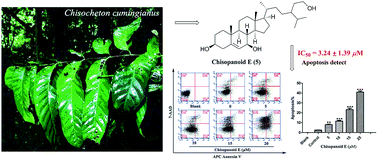
All compounds were evaluated for their cytotoxicities against HepG2, U2OS and MCF-7 cancer cell lines with doxorubicin as the positive control. The results were presented in Table 3. Among them, 5 and 6 showed most potent cytotoxic activities against MCF-7 with IC50 values of 3.24 ± 1.39 and 8.85 ± 4.73 μM, which also behaved moderate cytotoxicities towards HepG2 and U2OS cell lines. To clarify the mechanism that induced MCF-7 cells death, the APC Annexin V and 7-AAD costaining flow cytometric analysis was performed. The results demonstrated that 5 triggered massive apoptosis in a dose-dependent manner (Fig. 6), suggesting that they might inhibit the proliferation of MCF-7 cells by inducing apoptosis.
| Compounds | HepG-2 | U20S | MCF-7 |
|---|---|---|---|
| a Results were expressed as IC50 values in μM (n = 3).b Positive control. | |||
| 1 | >50 | >50 | 40.28 ± 6.15 |
| 2 | >50 | 10.01 ± 3.25 | 17.95 ± 3.61 |
| 3 | 28.78 ± 4.92 | 27.84 ± 5.89 | 17.98 ± 2.23 |
| 4 | >50 | >50 | 27.85 ± 2.66 |
| 5 | 14.47 ± 2.77 | 6.89 ± 1.57 | 3.24 ± 1.39 |
| 6 | 16.84 ± 0.75 | 13.42 ± 2.88 | 8.85 ± 4.73 |
| 7 | >50 | >50 | >50 |
| 8 | >50 | >50 | >50 |
| 9 | >50 | >50 | >50 |
| 11 | >50 | 11.67 ± 3.66 | 26.35 ± 2.01 |
| Doxorubicinb | 3.05 ± 0.32 | 1.32 ± 0.19 | 2.05 ± 1.40 |
To all three human tumor cells, sitostane-type steroids with 7β-hydroxy (5) displayed most potent cytotoxicities, followed by 7-keto group (6) and 7α-hydroxy (3) successively, implying the importance of the substituent attached to C-7. As reported, cholestane-type steroids linked with 7β-hydroxy exhibited better activity than 7α-hydroxy on U937 cells,27 which was consistent with our findings with sitostane-type steroids. On the other hand, when compared with 3, the presence of the 22,23-double bond in the analogue 1 resulted in noticeable decrease of the activities to all three cell lines, in accordance with the report that β-sitosterol oxides displayed better cytotoxicities than stigmasterol oxides.28 Besides, 3β-hydroxy-stigmast-5-ene-7-one was reported inactive to HepG2 cells, but compound 6 only with one more hydroxy group on C-29 demonstrated strong cytotoxicities, suggesting that branched chain oxidation might affect its biological activity.
The individual compounds were also evaluated for their inhibitory effects on NO production in LPS-activated RAW 264.7 macrophages with L-NMMA as the positive control. Notably, triterpenoid 10 showed significant activities against RAW 264.7 cells with IC50 value of 5.14 ± 2.16 μM, nearly 7 times better than that of the positive control L-NMMA (IC50 = 37.46 ± 2.75 μM). As well, triterpenoid 7 and 17 displayed moderate activities with IC50 values of 30.85 ± 2.75 and 22.36 ± 3.70 μM respectively.
:
1 to 0
:
100, v/v) to afford six fractions (A–F). Among them, fraction D (6.0 g) behaved strongest cytotoxicity, which was submitted to a MCI gel column eluted with MeOH/H2O (30
:
70 to 100
:
0, v/v) to give four subfractions (D1–D4). Fraction D3 (1.2 g) was subjected to a reversed-phase C18 column (MeOH/H2O, 40
:
60 to 100
:
0, v/v) to obtain five subfractions (D3A–D3E). Further purification of fraction D3D by preparative HPLC (MeCN/H2O, 75
:
25, v/v) generated 1 (11.2 mg), 3 (20.5 mg), 4 (6.2 mg) and 16 (4.6 mg). Taking the similar method, fraction D3E yielded compounds 2 (2.3 mg) and 5 (5.3 mg). In addition, fraction C (7.0 g) was applied to a MCI gel column eluted with MeOH/H2O (30
:
70 to 100
:
0, v/v) to afford six subfractions (C1–C6). Fraction C4 (2.7 g) was chromatographed on a silica gel column using petroleum ether–acetone (5
:
1 to 1
:
1, v/v), and further purified by preparative HPLC (MeCN/H2O, 70
:
30, v/v) to obtain 7 (5.8 mg), 8 (4.2 mg), 9 (2.5 mg), and 11 (14.9 mg). Fraction C5 (1.5 g) was isolated by a silica gel column, eluted with petroleum ether–acetone (4
:
1), to give 13 (11.3 mg) and 6 (3.4 mg). Separation of fraction B (12.2 g) via silica gel and Sephadex LH-20 gel columns successively produced six subfractions (B3A–B3F). Fraction B3D (1.5 g) was subjected to an RP-C18 column using a gradient of MeOH–H2O (50
:
50 to 100
:
0, v/v), to give three subfractions (B3D1–B3D3). Fraction B3D2 (86.2 mg) was purified by preparative HPLC (MeOH/H2O 90
:
10, v/v) to yield 14 (18.0 mg), 10 (2.9 mg), and 12 (7.1 mg). Using the same purification procedures, fraction B3B (76.1 mg) yielded 15 (4.2 mg), 17 (14.5 mg) and 18 (4.3 mg).
:
1); mp 187–189 °C; [α]25D −79.8 (c 0.12, MeOH); ECD (MeCN) λ (Δε) 197 (−14.819), 221 (+0.246); UV (MeOH) λmax (log
ε) 204 (3.48) nm; IR (KBr) vmax 3450, 2969, 2865, 2316, 1639, 1465, 1384, 1251, 1076 cm−1; 1H NMR and 13C NMR data, see Table 1; HRESIMS m/z 467.3493 [M + Na]+ (calcd for C29H48NaO3, 467.3496).
ε) 204 (3.45) nm; IR (KBr) vmax 3457, 2973, 2935, 2867, 2313, 1640, 1465, 1386, 1068 cm−1; 1H NMR and 13C NMR data, see Table 1; HRESIMS m/z 467.3498 [M + Na]+ (calcd for C29H48NaO3, 467.3496).
ε) 204 (3.61), 239 (2.21) nm; IR (KBr) vmax 3444, 2937, 2870, 2320, 1641, 1464, 1384, 1243, 1055 cm−1; 1H NMR and 13C NMR data, see Table 1; HRESIMS m/z 469.3655 [M + Na]+ (calcd for C29H50NaO3, 469.3652).
ε) 204 (3.49) nm; IR (KBr) vmax 3455, 2967, 2856, 2320, 1640, 1461, 1384, 1262, 1077 cm−1; 1H NMR and 13C NMR data, see Table 1; HRESIMS m/z 469.3650 [M + Na]+ (calcd for C29H50NaO3, 469.3652).
ε) 205 (3.53) nm; IR (KBr) vmax 3446, 2935, 2868, 2320, 1642, 1465, 1383, 1058 cm−1; 1H NMR and 13C NMR data, see Table 1; HRESIMS m/z 467.3498 [M + Na]+ (calcd for C29H48NaO3, 467.3496).
ε) 199 (3.42), 238 (3.72), 278 (3.60) nm; IR (KBr) vmax 3451, 2966, 2867, 2312, 1641, 1465, 1384, 1077 cm−1; 1H NMR and 13C NMR data, see Table 1; HRESIMS m/z 467.3498 [M + Na]+ (calcd for C29H48NaO3, 467.3496).
ε) 204 (3.30), 270 (2.13) nm; IR (KBr) vmax 3444, 2969, 2854, 2320, 1639, 1463, 1385, 1257, 1079 cm−1; 1H NMR and 13C NMR data, see Table 2; HRESIMS m/z 497.3603 [M + Na]+ (calcd for C30H50NaO4, 497.3601).
ε) 204 (3.17), 269 (2.28) nm; IR (KBr) vmax 3455, 2971, 2863, 2349, 1642, 1467, 1386, 1082 cm−1; 1H NMR and 13C NMR data, see Table 2; HRESIMS m/z 497.3605 [M + Na]+ (calcd for C30H50NaO4, 497.3601).
ε) 203 (3.14), 219 (3.09), 291 (2.40) nm; IR (KBr) vmax 3452, 2922, 2854, 2320, 1639, 1384, 1260, 1077 cm−1; 1H NMR and 13C NMR data, see Table 2; HRESIMS m/z 467.3494 [M + Na]+ (calcd for C29H48NaO3, 467.3496).
:
1). Crystal data were obtained on a Bruker Smart-1000 CCD with a graphite monochromator with Cu Kα radiation (λ = 1.54184 Å) at 290(2) K. The structure was solved by direct methods using the SHELXS-97 (ref. 31) and expanded using difference Fourier techniques, refined with the SHELXL-97.32 Crystallographic data for the structure of 1 has been deposited in the Cambridge Crystallographic Data Centre with the deposition number of CCDC 1433008.†
972 reflections measured (10.836 ≤ 2Θ ≤ 140.112); 9934 unique (Rint = 0.0155, Rsigma = 0.0164) which were used in all calculations; the final refinement gave R1 = 0.0501 (>2sigma(I)) and wR2 = 0.1612 (all data); flack parameter = −0.07 (6).
:
5, v/v) to give pure (S)-MTPA ester 4a (0.9 mg). The (R)-MTPA ester 4b was prepared using the method described above.
| % Cell viability = (At/As) × 100% |
Footnote |
| † Electronic supplementary information (ESI) available. CCDC 1433008. For ESI and crystallographic data in CIF or other electronic format see DOI: 10.1039/c5ra23626f |
| This journal is © The Royal Society of Chemistry 2016 |