Effect of amino group on the excited-state intramolecular proton transfer (ESIPT) mechanisms of 2-(2′-hydroxyphenyl)benzoxazole and its amino derivatives

Chaozheng Li, Yonggang Yang, Chi Ma and Yufang Liu*
College of Physics and Electronic Engineer, Henan Normal University, Xinxiang 453007, China. E-mail: yf-liu@htu.cn; Fax: +86 373 3329297

Received 5th November 2015 , Accepted 3rd January 2016

First published on 6th January 2016


Abstract

The excited-state intramolecular proton transfer (ESIPT) reactions of 2-(2′-hydroxyphenyl)benzoxazole (HBO), 5-amino-2-(2′-hydroxyphenyl)benzoxazole (5A-HBO) and 6-amino-2-(2′-hydroxyphenyl)benzoxazole (6A-HBO) were investigated with the time-dependent density functional theory (TD-DFT) method at the B3LYP/6-31G(d,p) theoretical level. The primary bond lengths and infrared (IR) vibrational spectra show that the intramolecular hydrogen bond is significantly strengthened in S1 state. The Mulliken's charge distribution and the frontier molecular orbitals (MOs) were analyzed. The result is consistent with the ESIPT mechanism proposed by Han and co-workers. Upon photo-excitation, the intramolecular hydrogen bond of 5A-HBO-enol (1.73 Å) and 6A-HBO-enol (1.74 Å) in the S1 state is weaker than that of HBO-enol (1.69 Å) due to the influence of the amino group in the HBO framework. After vertical excitation to the S1 state, the electronic density redistributes and migrates from the phenol ring to the benzoxazole ring of HBO. While for 5A-HBO and 6A-HBO, it transfers from the amino-benzoxazole moiety to the phenol ring. The analysis of the potential energy curves of HBO, 5A-HBO and 6A-HBO indicates that the ESIPT process of HBO occurs most easily. It is demonstrated that the presence and the position of the amino group in the HBO framework can change the behavior of the intramolecular hydrogen bonds O–H⋯N in the S1 state and thus hinder the ESIPT processes to some extent.

1. Introduction

Excited-state proton transfer (ESPT) reaction has been discovered and recognized to be one of the most elementary and important photochemical reactions in a variety of biological and physicochemical processes.1–8 The excited state intramolecular proton transfer (ESIPT) reaction dynamic has been investigated both experimentally and theoretically by many groups since the first experimental observation of the phenomenon by Weller and co-workers in 1965.9–17 A mechanism of an excited state H-atom-transfer reaction along a hydrogen-bonded “wire” has been proposed and widely studied in photochemical18–20 and biological21,22 processes. Though the hydrogen bonding in the ground state has been studied by different experimental and theoretical methods, little is known about electronic excited state hydrogen bonding mainly due to the extremely short time scales involved.23 Recently, Han and co-workers have investigated the intermolecular and intramolecular hydrogen bonds between proton donors and proton acceptors in ground states and excited states.24–30 The intermolecular and intramolecular hydrogen bonds are significantly strengthened in the excited state, which provides a driving force in facilitating the ESIPT reaction.31,32 The proton transfer along with hydrogen bonding have drawn more and more attention in recent years because of the important role hydrogen bonds play in the ESIPT reaction.33–35 Although the spectroscopic technique was performed to investigate the PT processes in the ground and excited state, there still exist some unsolved problems.36 To better elucidate the transfer mechanisms, density functional theory (DFT) and time-dependent density functional theory (TD-DFT) were adopted to research the PT and ESIPT reactions.23 The mechanism of the ESIPT generally includes the transfer of a hydroxyl (or amino) proton to an oxygen or nitrogen acceptor atom.23 Upon photo-excitation, the molecule is projected on the excited state potential energy surface, leading to the proton in an unstable state.17 The difference between the locally excited and relaxed excited state energies provides the driving force for the transformation.36

As a type of proton transfer dye, 2-(2′-hydroxyphenyl)benzoxazole (HBO) exhibits remarkable changes in the ESIPT reaction and related spectroscopy when an acceptor or a donor group is present in its molecular framework.37 A number of investigations have been done on HBO derivatives, which contain an electron acceptor substituent (–NO2, –COOH, –COOR or –RCN) in the benzazole ring.38–40 For these well-known dyes, the proposed mechanism is a proton motion followed by an intramolecular charge transfer process.38–40 On the contrast, the intramolecular charge transfer process occurs prior to the ESIPT when the substituent is an electron donor group (–NH2, –NR2, or –CH3).41 In polar and hydroxylic media, HBO exhibits an ESIPT reaction, giving rise to the corresponding anionic species.42 To explore the anion formation in both the S0 and S1 states, the steady-state UV-visible spectra and picoseconds time-resolved fluorescence behavior of HBO and its amino derivatives (5A-HBO and 6A-HBO) have been investigated by Alarcos and co-workers.43 Spectroscopic techniques, such as time-resolved fluorescence spectroscopy, can only provide indirect information about some photo-physical properties.

This paper explored the effect of the presence and position of the amino group in the HBO moiety by using density functional theory (DFT) and time-dependent density functional theory (TD-DFT) methods. The configurations of the S0 and S1 states were optimized, and the IR vibrational spectra, absorption and fluorescence spectra, frontier molecular orbitals (MOs) and potential energy curves were obtained. These calculation results could provide direct information on the ESIPT process, which show that the presence and the position of the amino group in the HBO framework can largely change the behavior of the S0 and S1 state.

2. Computational details

In the present work, all calculations were performed on the Gaussian 09 program suite.44 The ground state and the electronic excited state geometric optimizations of HBO and its amino derivatives were performed using DFT and TD-DFT, respectively. The TD-DFT method has been confirmed to be a reliable tool to gain insight into the hydrogen bonding interaction in the excited state of hydrogen-bonded systems.24 Becke's three-parameter hybrid exchange functional with Lee–Yang–Parr gradient-corrected correlation functional (B3LYP) and the 6-31G(d,p) basis set have been used in all the calculations.45–47 All the local minima were confirmed by the absence of an imaginary mode in the vibrational analysis calculations. In addition to the unconstrained optimization, constrained calculations on the S0 and S1 potential energy curves of the HBO and its amino derivatives have been scanned by fixing the O–H bond length a series of values.

The dichloromethane (DCM) was selected as the solvent in the calculations based on the Polarizable Continuum Model (PCM) using the integral equation formalism of the Polarizable Continuum Model (IEFPCM).48–50 Fine quadrature grids 4 were also employed. The self-consistent field (SCF) convergence thresholds for the energy in both the ground state and excited state optimizations were set to 10−8 (default settings are 10−6). Harmonic vibrational frequencies in both the ground-state and excited state were determined by diagonalization of the Hessian.51 The excited state Hessian was obtained by numerical differentiation of the analytical gradients using central differences and default displacements of 0.02 Bohr.52 The infrared intensities were determined using the gradients of the dipole moment.

3. Results and discussion

3.1. Optimized geometric structures

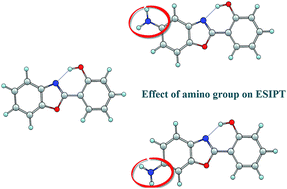
We studied the HBO and its amino derivatives which contain an electron donor group (–NH2) on the benzoxazole moiety: 5-amino-2-(2′-hydroxyphenyl)benzoxazole (5A-HBO) and 6-amino-2-(2′-hydroxyphenyl)benzoxazole (6A-HBO) based on the DFT and TD-DFT methods for the S0 and S1 states. The optimized enol tautomer and keto tautomer structures of HBO and its amino derivatives were obtained at the B3LYP/6-31G(d,p) basis set level (shown in Fig. 1), with a subsequent vibrational frequency analysis to ensure the validity of the stationary points. The structure parameters are listed in Table 1. The calculated bond lengths of O–H and H–N for HBO-enol, 5A-HBO-enol and 6A-HBO-enol are 0.99 and 1.76 Å, 0.99 and 1.75 Å, and 0.99 and 1.76 Å, respectively. While, in S1 state, the O–H bond lengths elongate to 1.01, 1.00 and 1.01 Å, and the H–N bond lengths shorten to 1.69, 1.73 and 1.74 Å, respectively. These results clearly show that, upon photo-excitation, the intramolecular hydrogen bonds O–H⋯N is significantly strengthened, which can facilitate the ESIPT reaction. This phenomenon is in agreement with previous finding drawn by Zhao and co-workers.26,27 It should be noted that the H–N bonds lengths of the HBO-enol, 5A-HBO-enol and 6A-HBO-enol in S1 state are different, which are 1.69, 1.73 and 1.74 Å, as described above. The intramolecular hydrogen bond of HBO-enol in S1 state is stronger than that of 5A-HBO-enol and 6A-HBO-enol, demonstrating that the presence and position of the amino group in HBO framework can change the behaviors of the intramolecular hydrogen bonds O–H⋯N in S1 state and thus hinder the ESIPT reactions to some extent. In addition, the bond lengths of O–H for HBO-keto, 5A-HBO-keto and 6A-HBO-keto increase to 1.93, 1.92 and 1.92 Å, and the H–N bond lengths reduce to 1.02, 1.02 and 1.02 Å in S1 state, respectively. The H–N bonds are more stable in S1 states. That is to say, for the ESIPT form HBO-keto, 5A-HBO-keto and 6A-HBO-keto, the stable structures exist only in S1 state, which can be found in the discussion of part 3.3.
image file: c5ra23261a-f1.tif
Fig. 1 The optimized enol and keto-tautomer structures of the HBO and its amino derivatives at the B3LYP/6-31G(d,p) theoretical level.
Table 1 The calculated geometric parameters (bond lengths in Å and angles in °) for HBO, 5A-HBO and 6A-HBO in ground state and excited state
  HBO-enol HBO-keto 5A-HBO-enol 5A-HBO-keto 6A-HBO-enol 6A-HBO-keto
Electronic state S0 S1 S0 S1 S0 S1 S0 S1 S0 S1 S0 S1
O–H 0.99 1.01 1.60 1.93 0.99 1.00 1.63 1.92 0.99 1.01 1.59 1.92
H–N 1.76 1.69 1.06 1.02 1.75 1.73 1.06 1.02 1.76 1.74 1.07 1.02
δ(O–H–N) 147 150 139 126 147 149 138 127 147 149 139 127


The vibrational frequencies of the O–H stretching vibration can provide evidence for excited state intramolecular hydrogen bond strengthening or weakening through the electronic spectra red-shift or blue-shift.28 Therefore, we used this rule to detect whether the intramolecular hydrogen bonds O–H⋯N are strengthened or not. The calculated infrared spectra of the O–H bonds both in S0 and S1 states are shown in Fig. 2. It can be noted that, for HBO in S0 state, the calculated O–H stretching vibrational frequency is located at 3306 cm−1, whereas the mode in S1 state is 2915 cm−1. The strong red-shift of 391 cm−1 for the O–H stretching mode suggests that the intramolecular hydrogen bond O–H⋯N is significantly strengthened in S1 state. Analogously, the O–H stretching band red-shifts from 3295 cm−1 in S0 state to 3269 cm−1 in S1 state for 5A-HBO and from 3299 cm−1 to 3214 cm−1 for 6A-HBO. The stretching mode of O–H group in S0 state for HBO is red-shift of 391 cm−1, which is larger than that of 5A-HBO (26 cm−1) and 6A-HBO (85 cm−1). It can also be concluded that the intramolecular hydrogen bond of 5A-HBO and 6A-HBO is weaker than that of HBO due to the influence of amino group in HBO framework.


image file: c5ra23261a-f2.tif
Fig. 2 Calculated IR spectra of HBO (a), 5A-HBO (b) and 6A-HBO (c) in the spectral region of O–H stretching band based on the B3LYP/6-31G(d,p) theoretical level.

3.2. Electronic spectra and frontier molecular orbitals (MOs)

The calculated absorption and fluorescence spectra of HBO, 5A-HBO and 6A-HBO at the TD-DFT/B3LYP/6-31G(d,p) theoretical level are shown in Fig. 3. The absorption peak of HBO was at 318.1 nm, which is in good agreement with the experimental result of 280–330 nm.53 The calculated fluorescence peak of HBO was at 325.3 nm. A red-shift of 7.2 nm relative to the absorption peak should be ascribed to the Stokes shift. In addition, the absorption peaks of 5A-HBO and 6A-HBO were at 369.7 and 348.1 nm, which is consistent with the experimental result of 346 and 339 nm.42,54 Similarly, the red-shift of 5.7 nm for 5A-HBO and 10.0 nm for 6A-HBO are ascribed to the Stokes shift. The agreement with the experimental values justifies the validity of our calculation method and the red-shift of the electronic emissive spectra is believed to influence the ESIPT process. The amino group on the benzoxazole rings gives rise to a red-shift in the absorption and fluorescence spectra of 5A-HBO and 6A-HBO when compared with HBO. However, 5A-HBO and 6A-HBO exhibit different spectra bands, reflecting that the different position of the amino groups in HBO molecular structure may influence the distribution of the spectra bands.
image file: c5ra23261a-f3.tif
Fig. 3 The calculated electronic spectra of HBO (a), 5A-HBO (b) and 6A-HBO (c) at B3LYP/6-31G(d,p) theoretical level.

To further investigate the nature of the charge distribution and charge transfer in the electronic excited state, the frontier MOs of HBO, 5A-HBO and 6A-HBO in DCM are depicted in Fig. 4. The calculated electronic excitation energies and the corresponding oscillator strengths of the first six states for the HBO, 5A-HBO and 6A-HBO are listed in Table 2. The oscillator strength of S0 → S1 transition of HBO, 5A-HBO and 6A-HBO are 0.544, 0.276 and 0.744, respectively, showing that the amino group has a positive effect on 6A-HBO. This paper only discussed the highest occupied molecular orbital (HOMO) and lowest unoccupied molecular orbital (LUMO) since the first excited is associated with the two orbitals. It is noted that the HOMO orbitals of the studied molecular system are π type orbitals while the LUMO orbitals are π* character, indicating that the first excited states are of the ππ*-type transition from HOMO to LUMO. The HOMO and LUMO are localized on different parts of the molecules. In addition, the H⋯N bonds in the LUMO orbital has σ character, showing that the N atoms with strong electron pair donation ability can form a covalent bond with the H atoms after photo-excitation to the S1 state. The calculated Mulliken charges of the hydroxyl moiety O atom and the neighboring N atom for HBO, 5A-HBO and 6A-HBO are shown in Table 3. Upon transition from the HOMO to LUMO, the decrease of electron density in the hydroxyl moiety and the increase in N atoms are expected to directly influence the intramolecular hydrogen bonding. That is, the H⋯N bonds length is shortened upon excitation to S1 state. From the viewpoint of the valence bond theory, the transition from S0 to S1 state leads to more negative charge distributed on the N atoms, and the enlarged interaction between the lone pair electron of N atoms and the σ* (O–H) orbital will facilitate ESIPT processes from O atom to N atom. Therefore, the ESIPT is expected to occur due to the intramolecular charge transfer.


image file: c5ra23261a-f4.tif
Fig. 4 Calculated frontier molecular orbitals HOMO and LUMO for HBO (a), 5A-HBO (b) and 6A-HBO (c) at TD-DFT/B3LYP/6-31G(d,p) theoretical level.
Table 2 The calculated electronic excitation energy (nm) and corresponding oscillator strengths (OS) of HBO, 5A-HBO and 6A-HBO at TD-DFT/B3LYP/6-31G(d,p) level. The orbital transitions and contributions are also listed. H: highest occupied molecular orbital (HOMO); L: lowest unoccupied molecular orbital (LUMO)
  HBO 5A-HBO 6A-HBO
E (nm) OS E (nm) OS E (nm) OS
S1 318 0.544 370 0.276 348 0.744
H → L (0.953) H → L (0.987) H → L (0.987)
Exp. 280–330 346 339
S2 279 0.329 309 0.295 293 0.025
S3 264 0.033 275 0.336 273 0.021
S4 236 0.004 260 0.024 252 0.055
S5 228 0.042 248 0.009 248 0.086
S6 219 0.001 233 0.075 236 0.206


Table 3 The calculated Mulliken charges (in a.u.) of the hydroxyl moiety O atom and the neighboring N atom for HBO, 5A-HBO and 6A-HBO at TD-DFT/B3LYP/6-31G(d,p) level
  HBO 5A-HBO 6A-HBO
S0 S1 S0 S1 S0 S1
O −0.589 −0.542 −0.592 −0.591 −0.592 −0.581
N −0.662 −0.684 −0.673 −0.709 −0.663 −0.704


The total Mulliken charge distribution analysis and natural bond orbital (NBO) analysis of the phenol moiety for HBO, 5A-HBO and 6A-HBO are shown in Table 4. It is noted that, the charge of the phenol moiety of HBO increases from 0.071 in S0 state to 0.133 in S1 state. For 5A-HBO and 6A-HBO, the charges of the phenol moiety decrease from 0.051 to −0.218 and 0.045 to −0.149, respectively. In addition, the NBO analysis method has also been used to investigate the charge distribution. The charge of the phenol moiety increases from 0.033 in S0 state to 0.118 in S1 state for HBO, while it decrease from 0.017 to −0.259 and 0.009 to −0.187 respectively for 5A-HBO and 6A-HBO. The analogous results between Mulliken charge distribution analysis and NBO analysis were obtained. It can be concluded that the electronic density migrates from phenol ring to the benzoxazole ring of HBO after a vertical excitation to S1 state, while for 5A-HBO and 6A-HBO it moves from the amino-benzoxazole moiety to the phenol ring. On the whole, the presence of the amino group modifies the electronic density of the molecule, which can influence the ESIPT reaction in S1 state.

Table 4 The calculated total Mulliken (no parentheses) and NBO (in parentheses) charges (in a.u.) of the phenol moiety for HBO, 5A-HBO and 6A-HBO at TD-DFT/B3LYP/6-31G(d,p) level
  S0 S1
HBO 0.071(0.033) 0.133(0.118)
5A-HBO 0.051(0.017) −0.218(−0.259)
6A-HBO 0.045(0.009) −0.149(−0.187)


3.3. Potential energy curves

To further reveal the nature of the ESIPT process, the S0 state and S1 state potential energy curves of the HBO, 5A-HBO and 6A-HBO were scanned based on constrained optimizations in their corresponding electronic states at fixed O–H distance for a series of values. Previous research indicates that the TD-DFT/B3LYP calculation method is reliable in exploring the shape of the hydrogen-transfer potential energy curves of ESIPT process, though this method may be expected to be inaccurate in surmounting the correct ordering of the closely spaced excited states.55–57 The potential energy curves were constructed, keeping the O–H bond distance fixed at values in the range from 0.99 Å to 2.15 Å in steps of 0.05 Å, as shown in Fig. 5. These potential energy curves can provide qualitative description for the ESIPT process. It can be seen clearly that the energy of the S0 state increases along with the lengthening of the O–H bond from the initial length without a stable energy point and that the potential barriers are 10.47, 10.01 and 9.65 kcal mol−1, respectively. While, the S1 state potential energy curves exhibit a barrier of 2.30, 8.74 and 8.73 kcal mol−1, respectively. The ESIPT processes are therefore more likely to proceed in S1 state than in S0 state. After crossing the potential barrier, the energy of the S1 state decreases without any barrier with the increase of the O–H bond length until the energy reaches a stable point at the O–H bond length about 1.891, 1.893 and 1.891 Å, which corresponds to the stable optimized geometry of the HBO-keto, 5A-HBO-keto and 6A-HBO-keto tautomers.
image file: c5ra23261a-f5.tif
Fig. 5 Potential energy curves of S0 and S1 states for 6A-HBO–MeOH complex along with O–H bond length of 6A-HBO. The insert shows the corresponding optimized geometries.

In order to reveal the potential energies more visually, the precise Hartree–Fock energy values of the S0 state and the S1 state for HBO, 5A-HBO and 6A-HBO are shown in Table 5. It is noted that the S0 state is more stable than the S1 state, indicating that the proton transfer processes are unlikely to occur in the S0 state. Thus, it can be concluded that in S0 state the N atom can capture the proton of the hydroxyl group to form an intramolecular hydrogen bond O–H⋯N. Through photo-excitation, the intramolecular hydrogen bonds were strengthened, which provides a driving force in facilitating the ESIPT reaction. Subsequently, the ESIPT occurs with the hydroxyl group acting as a proton donor and the neighboring N atom acting as a proton acceptor. The lower potential barriers of the S1 state can be easily overcome to reach the stable optimized geometry of the HBO-keto, 5A-HBO-keto and 6A-HBO-keto tautomers.

Table 5 Potential energies (hartree) of these stable structures on the potential energy curves of the S0 and S1 states based on the DFT and TD-DFT methods, respectively
  HBO 5A-HBO 6A-HBO
S0 S1 S0 S1 S0 S1
Energy −706.043 −706.034 −761.401 −761.392 −761.404 −761.395


As described above, the S1 state potential energy curves exhibit a barrier of 2.30, 8.74 and 8.73 kcal mol−1 for HBO, 5A-HBO and 6A-HBO, respectively. This result indicates that the ESIPT process can more easily occur for HBO by undergoing a relatively low barrier of 2.30 kcal mol−1. While for 5A-HBO and 6A-HBO, the ESIPT processes should overcome the larger barriers of 8.74 and 8.73 kcal mol−1, respectively. This finding shows that the presence and position of the amino group in the HBO framework may hinder the ESIPT processes to some extent.

4. Conclusions

In this work, an investigation has been performed to study the ESIPT processes of the HBO and its amino derivatives based on DFT and TD-DFT methods using B3LYP exchange-correlation functional at the basis set of 6-31G(d,p). The DCM was selected as the solvent in the calculations using the IEFPCM. The analysis of the bond lengths and IR vibrational spectra indicates that the intramolecular hydrogen bond O–H⋯N is significantly strengthened in the electronically excited state, which provides a driving force in facilitating the ESIPT reaction. In addition, the calculations of the absorption spectra are consistent with the experimental results, showing that the TD-DFT method can be used to decipher the experiment reasonably. The analysis of the Mulliken's charge distribution and the frontier MOs reveals that the arrangement of electronic density is an important positive factor for the proton transfer and that the ESIPT reaction occurs after the intramolecular charge transfer in S1 state. The analysis of the potential energy curves and Hartree–Fock energy show that the ESIPT reaction is unlikely occurs in S0 state.

What's more, the intramolecular hydrogen bond of 5A-HBO-enol (1.73 Å) and 6A-HBO-enol (1.74 Å) in S1 state is weaker than that of HBO-enol (1.69 Å) due to the influence of amino group in HBO framework. After a vertical excitation to S1 state, the electronic density redistributes and migrates from phenol ring to benzoxazole ring of HBO. For 5A-HBO and 6A-HBO, it transfers from the amino-benzoxazole moiety to the phenol ring. The analysis of the potential energy curves of HBO, 5A-HBO and 6A-HBO indicate that the ESIPT process of HBO most easily occurs. It is demonstrated that the presence and position of the amino group in the HBO framework can change the behaviors of the intramolecular hydrogen bonds O–H⋯N in S1 state and thus hinder the ESIPT processes to some extent. Our findings might be enlightening in the design of proton transfer materials and related fields.

Acknowledgements

This work is supported by National Natural science Foundation of China (Grant No. 11274096), Innovation Scientists and Technicians Troop Construction Projects of Henan Province (Grant No. 124200510013) and Innovative Research Team in Science and Technology in University of Henan Province (Grant No. 13IRTSTHN016).

References

  1. S. Ameer-Beg, S. M. Ormson, R. G. Brown, P. Matousek, M. Towrie, E. T. Nibbering, P. Foggi and F. V. Neuwahl, J. Phys. Chem. A, 2001, 105, 3709–3718 CrossRef CAS.
  2. R. de Vivie-Riedle, V. de Waele, L. Kurtz and E. Riedle, J. Phys. Chem. A, 2003, 107, 10591–10599 CrossRef CAS.
  3. Y. Komoto, K. Sakota and H. Sekiya, Chem. Phys. Lett., 2005, 406, 15–19 CrossRef CAS.
  4. N. Kungwan, R. Daengngern, T. Piansawan, S. Hannongbua and M. Barbatti, Theor. Chem. Acc., 2013, 132, 1–10 CrossRef CAS.
  5. A. L. Sobolewski and W. Domcke, Phys. Chem. Chem. Phys., 1999, 1, 3065–3072 RSC.
  6. P. T. Chou, Y. I. Liu, H. W. Liu and W. S. Yu, J. Am. Chem. Soc., 2001, 123, 12119–12120 CrossRef CAS PubMed.
  7. Y. Chen, F. Gai and J. Petrich, J. Am. Chem. Soc., 1993, 115, 10158–10166 CrossRef CAS.
  8. F. T. Hung, W. P. Hu and P. T. Chou, J. Phys. Chem. A, 2001, 105, 10475–10482 CrossRef CAS.
  9. P. Kukura, D. W. McCamant and R. A. Mathies, Annu. Rev. Phys. Chem., 2007, 58, 461–488 CrossRef CAS PubMed.
  10. S. R. Meech, Chem. Soc. Rev., 2009, 38, 2922–2934 RSC.
  11. T. J. Martínez, Acc. Chem. Res., 2006, 39, 119–126 CrossRef PubMed.
  12. S. Hayashi, E. Tajkhorshid and K. Schulten, Biophys. J., 2009, 96, 403–416 CrossRef CAS PubMed.
  13. K. L. Han and G. Z. He, J. Photochem. Photobiol., C, 2007, 8, 55–66 CrossRef CAS.
  14. T. Kobayashi, T. Saito and H. Ohtani, Nature, 2001, 414, 531–534 CrossRef CAS PubMed.
  15. S. Chai, G. J. Zhao, P. Song, S. Q. Yang, J. Y. Liu and K. L. Han, Phys. Chem. Chem. Phys., 2009, 11, 4385–4390 RSC.
  16. H. Beens, K. Grellmann, M. Gurr and A. Weller, Discuss. Faraday Soc., 1965, 39, 183–193 RSC.
  17. J. Zhao, H. Yao, J. Liu and M. R. Hoffmann, J. Phys. Chem. A, 2015, 119, 681–688 CrossRef CAS PubMed.
  18. T. S. Chu, Y. Zhang and K. L. Han, Int. Rev. Phys. Chem., 2006, 25, 201–235 CrossRef CAS.
  19. M. Thut, C. Tanner, A. Steinlin and S. Leutwyler, J. Phys. Chem. A, 2008, 112, 5566–5572 CrossRef CAS PubMed.
  20. M. S. Mehata, Chem. Phys. Lett., 2007, 436, 357–361 CrossRef CAS.
  21. O. A. Sytina, D. J. Heyes, C. N. Hunter, M. T. Alexandre, I. H. van Stokkum, R. van Grondelle and M. L. Groot, Nature, 2008, 456, 1001–1004 CrossRef CAS PubMed.
  22. M. Zimmer, Chem. Rev., 2002, 102, 759–782 CrossRef CAS PubMed.
  23. J. Zhao, J. Chen, Y. Cui, J. Wang, L. Xia, Y. Dai, P. Song and F. Ma, Phys. Chem. Chem. Phys., 2015, 17, 1142–1150 RSC.
  24. G. J. Zhao and K. L. Han, J. Comput. Chem., 2008, 29, 2010–2017 CrossRef CAS PubMed.
  25. G. J. Zhao and K. L. Han, Biophys. J., 2008, 94, 38–46 CrossRef CAS PubMed.
  26. G. J. Zhao and K. L. Han, J. Phys. Chem. A, 2007, 111, 2469–2474 CrossRef CAS PubMed.
  27. G. J. Zhao, J. Y. Liu, L. C. Zhou and K. L. Han, J. Phys. Chem. B, 2007, 111, 8940–8945 CrossRef CAS PubMed.
  28. G. J. Zhao and K. L. Han, Acc. Chem. Res., 2012, 45, 404–413 CrossRef CAS PubMed.
  29. F. Yu, P. Li, G. Li, G. Zhao, T. Chu and K. Han, J. Am. Chem. Soc., 2011, 133, 11030–11033 CrossRef CAS PubMed.
  30. F. Yu, P. Li, B. Wang and K. Han, J. Am. Chem. Soc., 2013, 135, 7674–7680 CrossRef CAS PubMed.
  31. G. J. Zhao and K. L. Han, J. Phys. Chem. A, 2009, 113, 14329–14335 CrossRef CAS PubMed.
  32. N. Kungwan, F. Plasser, A. J. Aquino, M. Barbatti, P. Wolschann and H. Lischka, Phys. Chem. Chem. Phys., 2012, 14, 9016–9025 RSC.
  33. G. J. Zhao and K. L. Han, Phys. Chem. Chem. Phys., 2010, 12, 8914–8918 RSC.
  34. A. Kawanabe, Y. Furutani, K. H. Jung and H. Kandori, J. Am. Chem. Soc., 2009, 131, 16439–16444 CrossRef CAS PubMed.
  35. T. S. Chu and K. L. Han, Phys. Chem. Chem. Phys., 2008, 10, 2431–2441 RSC.
  36. J. Zhao and P. Li, RSC Adv., 2015, 5, 73619–73625 RSC.
  37. H. Wang, H. Zhang, O. Abou-Zied, C. Yu, F. Romesberg and M. Glasbeek, Chem. Phys. Lett., 2003, 367, 599–608 CrossRef CAS.
  38. J. Seo, S. Kim and S. Y. Park, J. Am. Chem. Soc., 2004, 126, 11154–11155 CrossRef CAS PubMed.
  39. C. C. Hsieh, Y. M. Cheng, C. J. Hsu, K. Y. Chen and P. T. Chou, J. Phys. Chem. A, 2008, 112, 8323–8332 CrossRef CAS PubMed.
  40. C. H. Kim, J. Park, J. Seo, S. Y. Park and T. Joo, J. Phys. Chem. A, 2010, 114, 5618–5629 CrossRef CAS PubMed.
  41. Y. M. Cheng, S. C. Pu, C. J. Hsu, C. H. Lai and P. T. Chou, ChemPhysChem, 2006, 7, 1372–1381 CrossRef CAS PubMed.
  42. N. Alarcos, M. Gutierrez, M. Liras, F. Sanchez and A. Douhal, Phys. Chem. Chem. Phys., 2015, 17, 16257–16269 RSC.
  43. N. Alarcos, M. Gutierrez, M. Liras, F. Sanchez and A. Douhal, Photochem. Photobiol. Sci., 2015, 14, 1306–1318 CAS.
  44. M. J. Frisch, G. W. Trucks, H. B. Schlegel, G. E. Scuseria, M. A. Robb, J. R. Scalmani, G. Cheeseman, V. Barone, B. Mennucci, G. A. Petersson, H. Nakatsuji, M. Caricato, X. Li, H. P. Hratchian, A. F. Izmaylov, J. Bloino, G. Zheng, J. L. Sonnenberg, M. Hada, M. Ehara, K. Toyota, R. Fukuda, J. Hasegawa, M. Ishida, T. Nakajima, Y. Honda, O. Kitao, H. Nakai, T. Vreven, J. A. Montgomery Jr, J. E. Peralta, F. Ogliaro, M. Bearpark, J. J. Heyd, E. Brothers, K. N. Kudin, V. N. Staroverov, R. Kobayashi, J. Normand, K. Raghavachari, A. Rendell, J. C. Burant, S. S. Iyengar, J. Tomasi, M. Cossi, N. Rega, J. M. Millam, M. Klene, J. E. Knox, J. B. Cross, V. Bakken, C. Adamo, J. Jaramillo, R. Gomperts, R. E. Stratmann, O. Yazyev, A. J. Austin, R. Cammi, C. Pomelli, J. W. Ochterski, R. L. Martin, K. Morokuma, V. G. Zakrzewski, G. A. Voth, P. Salvador, J. Dannenberg, S. Dapprich, A. D. Daniels, O. Farkas, J. B. Foresman, J. V. Ortiz, J. Cioslowski and D. J. Fox, Gaussian 09, Revision A.02, Gaussian, Inc., Wallingford, CT, 2009 Search PubMed.
  45. M. M. Francl, W. J. Pietro, W. J. Hehre, J. S. Binkley, M. S. Gordon, D. J. DeFrees and J. A. Pople, J. Chem. Phys., 1982, 77, 3654–3665 CrossRef CAS.
  46. A. D. Becke, Phys. Rev. A, 1988, 38, 3098 CrossRef CAS.
  47. C. Lee, W. Yang and R. G. Parr, Phys. Rev. B: Condens. Matter Mater. Phys., 1988, 37, 785 CrossRef CAS.
  48. R. Cammi and J. Tomasi, J. Comput. Chem., 1995, 16, 1449–1458 CrossRef CAS.
  49. E. Cances, B. Mennucci and J. Tomasi, J. Chem. Phys., 1997, 107, 3032–3041 CrossRef CAS.
  50. B. Mennucci, E. Cances and J. Tomasi, J. Phys. Chem. B, 1997, 101, 10506–10517 CrossRef CAS.
  51. O. Treutler and R. Ahlrichs, J. Chem. Phys., 1995, 102, 346–354 CrossRef CAS.
  52. F. Furche and R. Ahlrichs, J. Chem. Phys., 2002, 117, 7433–7447 CrossRef CAS.
  53. R. Daengngern and N. Kungwan, Chem. Phys. Lett., 2014, 609, 147–154 CrossRef CAS.
  54. N. Alarcos, M. Gutierrez, M. Liras, F. Sanchez, M. Moreno and A. Douhal, Phys. Chem. Chem. Phys., 2015, 17, 14569–14581 RSC.
  55. Y. Wang, H. Yin, Y. Shi, M. Jin and D. Ding, New J. Chem., 2014, 38, 4458–4464 RSC.
  56. H. Yin, Y. Shi and Y. Wang, Spectrochim. Acta, Part A, 2014, 129, 280–284 CrossRef CAS PubMed.
  57. J. Zhao, P. Song, Y. Cui, X. Liu, S. Sun, S. Hou and F. Ma, Spectrochim. Acta, Part A, 2014, 131, 282–287 CrossRef CAS PubMed.

This journal is © The Royal Society of Chemistry 2016
Click here to see how this site uses Cookies. View our privacy policy here.