Role of iron in the reduction of H2O2 intermediate during the oxygen reduction reaction on iron-containing polyimide-based electrocatalysts

Azhagumuthu Muthukrishnana, Yuta Nabaeb and Takeo Ohsaka*a
aDepartment of Electronic Chemistry, Interdisciplinary Graduate School of Science and Engineering, Tokyo Institute of Technology, G1-5, 4259 Nagatsuta, Midori-ku, Yokohama 226-8502, Japan. E-mail: ohsaka@echem.titech.ac.jp
bDepartment of Organic and Polymeric Materials, Graduate School of Science and Engineering, Tokyo Institute of Technology, 2-12-1, Ookayama, Meguro-ku, Tokyo 152-8552, Japan

Received 4th November 2015 , Accepted 22nd December 2015

First published on 23rd December 2015


Abstract

Understanding the role of Fe in each step of the oxygen reduction reaction (ORR) on Fe-containing N-doped carbon catalysts for the ORR in PEMFCs is of great importance in designing higher performance ORR catalysts. The direct 4-electron ORR has been found to be catalyzed by Fe whereas the importance of Fe in the consecutive 2 × 2-electron ORR remains unclear. The reduction of H2O2 on the Fe-containing polyimide (Fe/PI) and Fe-free polyimide (PI) catalysts was studied in acidic media using rotating disk electrode (RDE) voltammetry and the corresponding rate constants were estimated. The results demonstrate that the Fe in the Fe/PI catalyst plays a crucial role in the enhanced H2O2 reduction and consequently a consecutive 2 × 2-electron ORR via adsorbed H2O2 intermediate, i.e., a so-called two-site reduction process, as well as a direct 4-electron ORR could significantly contribute to the overall 4-electron ORR.
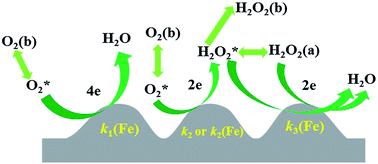

Fe-containing and nitrogen-modified carbon catalysts (Fe–N–C) are one of the typical non-precious metal catalysts for the oxygen reduction reaction (ORR) in polymer electrolyte membrane fuel cells (PEMFC) and a large number of research articles have been consequently published particularly focusing on their preparations, characterization and ORR activity. However, the mechanism of the ORR including the role of Fe and nitrogen-containing active sites as well as the kinetics remains elusive. In general the ORR mechanism is considered to be composed of a direct 4-electron reduction of O2 to H2O and a consecutive 2 × 2-electron reduction via the formation of H2O2 intermediate, as typically shown by the Damjanovic model1 (Scheme 1).
image file: c5ra23162k-s1.tif
Scheme 1 Kinetic model for the ORR proposed by Damjanovic et al. Indices b and * designate the bulk species and the species in the vicinity of the disk electrode, respectively.

The mechanism depends on the relative amplitude of the individual rate constants (k1, k2 and k3); (i) when k1k2, a direct 4-electron ORR takes place, (ii) when k1 = 0, a consecutive 2 × 2-electron ORR occurs and (iii) when k1 and k2 are comparable and k3 is not negligible, both reaction paths are possible as the overall 4-electron ORR. The individual rate constants largely depend on the introduction of Fe and N, i.e., their content and how they are on a molecular level introduced into carbon matrices. For example, two different Fe-based active sites were proposed as Fe–N4–C and Fe–N2–C species using ToF-SIMS analysis.2 The mechanism of the direct 4-electron reduction on the Fe-macrocycles was explained by Boulatov.3 The majority of the active sites present in the Fe–N–C catalysts synthesized from the non-macrocyclic compounds consist of Fe–Nx–C (x can be any number between 1 and 4), but their role in the ORR and the mechanism are not clarified sufficiently. Only a few papers have discussed the relationship between the ORR mechanism and the properties of the active sites.2,4,5 It is also reported in the Fe–N4–C catalysts that the Fe-metal center of the Fe–N4 structure is involved in both 4-electron and 2-electron reduction.4 However, such mechanisms failed to clarify the reason for the ORR activity of the metal-free catalysts in alkaline media. It can be easily understood from the previous experiments that reduction of oxygen on N-modified carbon-based catalysts in the absence of Fe predominantly produces H2O2 by 2-electron reduction which indicates that the reduction of O2 to H2O2 by 2-electron process in the consecutive 2 × 2-electron mechanism of the ORR does not involve Fe-containing active sites.6,7 It is also proposed that the ORR may follow a 2 × 2-electron reduction via an adsorbed H2O2 intermediate.8 Our recent study9 on the Fe–N–C catalyst loading dependence of the rate constants k1, k2 and k3 indicates that the ORR on the Fe–N–C catalyst predominantly follows the 2 × 2-electron pathway. Thus, for a better understanding of the whole mechanism of the ORR on Fe–N–C catalysts, it is important to clarify the role of Fe in the reduction of H2O2 intermediate. In this study, we have succeeded in clarifying the role of Fe in the H2O2 reduction by comparing the reduction activity of Fe-free (PI) and Fe-containing (Fe/PI) polyimide based catalysts.

The Fe/PI catalyst was synthesized according to the recently reported procedure9–11 Briefly, polyimide nanoparticles precursor (ca. 100 nm in size) was synthesized from pyromellitic acid dianhydride and 4,4′-oxydianiline in the presence of tris(acetylacetonato)iron(III) (Fe(acac)3). The precursor was subjected to the multi-step pyrolysis reported earlier. Elemental analysis: C 84 wt%, H 1.2 wt%, N 2.6 wt%. EPMA: Fe 1.1 wt%. BET surface area: 1200 m2 g−1.9 A SEM image of the Fe/PI catalyst is shown in Fig. 1a.


image file: c5ra23162k-f1.tif
Fig. 1 Scanning electron microscopic images of the Fe/PI (A) and Fe-free PI (B) catalysts.

The Fe-free PI catalyst was produced using slightly modified-pyrolysis method in the absence of Fe(acac)3 (see ESI). Elemental analysis: C 74 wt%, H 1.6 wt%, N 6.0 wt%. BET surface area: 894 m2 g−1.9 A SEM image of the Fe-free PI catalyst is shown in Fig. 1b.

Electrochemical experiments were carried out using CHI four-electrode bipotentiostat (model 700D) with a custom-build electrochemical cell. The glassy carbon (GC, 6 mm in diameter) rotating disc electrode (RDE), carbon plate (∼7 cm2 area) and Ag/AgCl (sat. KCl) were used as the working, counter and reference electrodes, respectively. All the potentials are indicated with respect to a reversible hydrogen electrode (RHE). The GC electrode was first polished with 1 μm and then 0.06 μm alumina powder to mirror finish and sonicated to remove the abrasive particles and then modified with the catalyst using a similar drop coating procedure adopted earlier11 with the loading density of 200 μg cm−2. Before the H2O2 reduction experiments, the background current was measured by scanning the electrode potential from 1.1 to 0.05 V in O2-saturated 0.5 M H2SO4 solution at a scan rate of 5 mV s−1 at various electrode rotation speeds of 400 to 3600 rpm. The whole set of experiments were repeated after the addition of H2O2 (the final concentration is 2.0 mM) to the O2-saturated 0.5 M H2SO4 solution. The reduction current corresponding to the H2O2 reduction was estimated by subtracting the ORR current obtained in the O2-saturated 0.5 M H2SO4 from the total reduction current obtained in the O2-saturated 0.5 M H2SO4 solution containing 2.0 mM H2O2 under the same conditions (cf. ESI).

The steady-state voltammograms at various rotational speeds for the reduction of H2O2 on the Fe/PI catalyst are shown in Fig. 2A. The voltammograms were analysed using the Koutecký–Levich equation:

 
image file: c5ra23162k-t1.tif(1)
 
image file: c5ra23162k-t2.tif(2)
where iD and ik refer to the disk and kinetic current densities at a given potential, respectively. iL is the Levich current density and n, F, image file: c5ra23162k-t3.tif, DH2O2, v and ω are the number of electrons, the Faraday constant (96[thin space (1/6-em)]485 C mol−1), the bulk concentration of H2O2 (2.0 mM), the diffusion coefficient of H2O2 (1.3 × 10⁻⁵ cm2 s−1), the kinematic viscosity of the solution (0.01 cm2 s−1) and the rotational speed (s−1), respectively. The linearity of the K–L plots indicates that the H2O2 reduction is first order with respect to the dissolved H2O2. The n can be considered as 2 for the reduction of H2O2 to H2O and also can be estimated from the slopes of the K–L plots shown in Fig. 2B; the n values are 1.8 to 2.4 in the potential range analysed. A slightly larger n than 2 may be attributed to the ORR of the O2 produced through the disproportionation of H2O2 on the electrode surface. The ik values are obtained from the intercepts of the K–L plots and they are further used to estimate the rate constants (k3) for the reduction of H2O2 to H2O using eqn (3).12
 
image file: c5ra23162k-t4.tif(3)


image file: c5ra23162k-f2.tif
Fig. 2 (A) Hydrodynamic steady-state voltammograms obtained for the reductions of 2.0 mM H2O2 on the Fe/PI and Fe-free PI coated GC rotating electrode in 0.5 M H2SO4 solution at the scan rate of 5 mV s−1 for different rotational speeds. The loading density of the catalysts is 200 μg cm−2. The inset shows the enlarged portion of the H2O2 reduction on the Fe-free PI catalyst. (B) Koutecký–Levich plots for the reduction of H2O2 on the Fe/PI catalyst at various potentials. Data were obtained from (A).

The current density at the kinetic limitation (i.e., mass transport corrected ik) is evaluated assuming that the mass transport is highly efficient enough to keep the surface concentration of H2O2 equal to the bulk concentration. Hence in eqn (3), the bulk concentration of H2O2 is used for the estimation of k3. The H2O2 reduction activity on the Fe-free PI-based catalyst was also studied for comparison with that of the Fe/PI catalyst. Also Fig. 2A shows the background subtracted steady-state voltammograms (the background current in O2-saturated 0.5 M H2SO4) for the reduction of H2O2 on the Fe-free PI catalyst in O2-saturated 0.5 M H2SO4 solution at various rotational speeds. The inset of the Fig. 2A shows the enlarged portion of the H2O2 reduction on the Fe-free PI catalyst. Interestingly, the reduction peaks were obtained at around 0.3 V and their height is dependent on the electrode rotation speed, probably suggesting the reduction of O2 which is produced by the disproportionation reaction of the H2O2 adsorbed on the catalyst surface. The current response corresponding to the reduction of H2O2 obtained at the more negative potential than ca. 0.2 V is almost independent of the electrode rotational speed as obtained by Jaouen and Dodelet13 for Fe–N–C catalyst. In this case, the H2O2 reduction is kinetically controlled and the kinetic parameters, i.e., the rate constant (k3) and the Tafel slope were estimated accordingly.

The H2O2 reduction rate constants (k3) could be estimated from the intercepts of the K–L plots (Fig. 2B) obtained at the Fe/PI catalyst and are shown in Fig. 3A together with those14 estimated from the RRDE voltammograms for the ORR at the same catalyst according to the Damjanovic model and the rate constants for the reduction of H2O2 on the Fe-free PI catalyst.


image file: c5ra23162k-f3.tif
Fig. 3 (A) Variation of k3 with electrode potential, obtained from the K–L plots for the reduction of H2O2 (‘k3(Fe)’, black line) on Fe/PI catalyst, from the RRDE voltammograms for the ORR on the Fe/PI catalyst according to the Damjanovic model (k3(Fe), red line) and from the RDE voltammograms for the reduction of H2O2 (‘k3’, green line) on the Fe-free PI catalyst. (B) Mass-transport corrected Tafel plots (black and red lines) for the reduction of H2O2 on the Fe/PI electrode and Tafel plots (green and blue lines) for the same reaction on the Fe-free PI coated GC electrode at 900 (black and green lines) and 1600 rpm (red and blue lines) rotational speeds.

From Fig. 3A, at a glance, we can see that the k3 values (‘k3(Fe)’) on the Fe/PI catalysts are much larger than those (‘k3’) on the Fe-free PI catalyst, e.g., ‘k3(Fe)’/‘k3’ ≈ 30 at 0.2 V (Fig. 4C). That is, the Fe in the former catalyst plays a crucial role in enhancing the reduction of H2O2 to H2O. To our knowledge, this is the first report showing that Fe significantly takes part in the reduction of H2O2 to H2O on Fe-containing N-modified carbon-based catalysts. In general, it has been believed that the presence of Fe ions coordinated by nitrogen (typically represented as Fe–Nx sites) is responsible for the improved direct 4-electron ORR15–17 and the Fe–N4 active sites are involved in enhancing the direct 4-electron reduction of O2 to H2O.3 In addition, the present results suggest that a consecutive 2 × 2-electron ORR as well as a direct 4-electron ORR could significantly contribute to the overall 4-electron ORR, when H2O2 intermediate is adsorbed on the catalyst surface and k3 is not negligible.


image file: c5ra23162k-f4.tif
Fig. 4 Schematic illustration of (A) ORR mechanism proposed by Damjanovic et al., (B) ORR mechanism of the Damjanovic model type including the contribution of H2O2 (a) in the ORR and (C) hydrogen peroxide reduction mechanism including H2O2 (a) species. Indices b, * and a represent the bulk species, the species in the vicinity of the catalyst surface and the adsorbed species, respectively. ki and ki(Fe) (i = 1, 2 and 3) correspond to the rate constants at the Fe-free PI and Fe/PI catalysts, respectively. ‘k3’ and ‘k3(Fe)’ represent the rate constants for the H2O2 reduction on the Fe-free PI and Fe/PI catalysts, respectively.

Comparison of the k3 values (‘k3(Fe)’) obtained from the K–L plots (Fig. 2B) with those (k3(Fe)) obtained from the kinetic analysis of the RRDE voltammograms for the ORR according to the Damjanovic model demonstrates that the k3 values obtained by both procedures are not so different at the low over-potential region, but at the high over-potential region the values obtained by the former procedure trend to become gradually larger than those obtained by the latter one. This is explicable as follows: in the Damjanovic model, H2O2 as a reaction intermediate is assumed to be present near the catalyst surface, but not adsorbed on it (as H2O*2 in Fig. 4A). However, if H2O*2 is adsorbed on the catalyst surface and the adsorbed species (H2O2 (a)) is formed during the ORR (Fig. 4B), then a consecutive 2 × 2-electron ORR process via an adsorbed H2O2 intermediate. i.e., so called two-site reduction process may be actually regarded as an overall 4-electron ORR, because it is accepted that the direct 4-electron reaction described by k1 may proceed through an adsorbed H2O2 intermediate, but this adsorbed intermediate does not lead to a solution phase peroxide species,8 and consequently k1 is overestimated, while k3 (and k2) is underestimated. The difference between ‘k3(Fe)’ and k3(Fe) becomes larger as the electrode potential becomes more negative, probably reflecting the effect of the H2O2 adsorption on the reduction, i.e., the more H2O2 is produced at the more negative potential, the more the H2O2 adsorption is favourable, and thus k1 is overestimated and k3 (and k2) is underestimated.

The Tafel plots for the H2O2 reduction on the Fe/PI and Fe-free PI catalysts, shown in Fig. 3B, gave the Tafel slopes of −385 and −300 mV dec−1, respectively, and also the exchange current densities (i0) of 1.5 × 10⁻⁶ and 3.0 × 10⁻¹⁰ A cm−2, respectively. The i0 value on the Fe/PI catalyst is much larger than that on the Fe-free catalyst, indicating the enhanced activity of the H2O2 reduction in the presence of Fe.

In conclusion, the activity of the Fe-containing N-modified carbon-based (Fe–N–C) catalyst (Fe/PI catalyst) for the reduction of H2O2 was analysed using a RDE voltammetry in comparison with that of the Fe-free PI catalyst. The rate constants for the reduction of H2O2 on the Fe/PI catalyst (‘k3(Fe)’) are much larger than those (‘k3’) on Fe-free PI catalyst, for the first time indicating that the Fe in the Fe–N–C catalyst plays a crucial role in the enhanced H2O2 reduction and consequently suggesting that a consecutive 2 × 2-electron ORR via an adsorbed H2O2 intermediate as well as a direct 4-electron ORR could significantly contribute to the overall 4-electron ORR. Also, the ‘k3(Fe)’ values are much larger than the k3(Fe) values estimated from the ORR using the Damjanovic model. This is considered as a result of the fact that in the Damjanovic model H2O2 intermediate is assumed to be present near the catalyst surface (but not adsorbed on it), but if the H2O2 intermediate is adsorbed on the catalyst layer, then a consecutive 2 × 2-electron ORR may be actually regarded as an overall 4-electron ORR and consecutively the k3(Fe) values are underestimated (while the k1(Fe) values are overestimated), compared with the case where the corresponding k3 values (i.e., ‘k3(Fe)’) are estimated directly from the H2O2 reduction on the Fe/PI catalyst. The present results also suggest a two-site reduction mechanism of the ORR on the Fe/PI catalyst where O2 is reduced at an active site to give H2O2 intermediate and the H2O2 intermediate is adsorbed at another (Fe-containing) active site and further catalytically reduced to H2O.

Acknowledgements

This work was financially supported by the New Energy and Industrial Technology Development Organization (NEDO), Japan.

References

  1. A. Damjanovic, M. A. Genshaw and J. O. M. Bockris, J. Chem. Phys., 1966, 45, 4057–4059 CrossRef CAS.
  2. M. Lefevre, J. P. Dodelet and P. Bertrand, J. Phys. Chem. B, 2002, 106, 8705–8713 CrossRef CAS.
  3. R. Boulatov, in N4-Macrocyclic Metal Complexes, ed. H. J. Zagal, B. Fethi and J.-P. Dodelet, Springer, 2006, pp. 1–40 Search PubMed.
  4. U. Tylus, Q. Jia, K. Strickland, N. Ramaswamy, A. Serov, P. Atanassov and S. Mukerjee, J. Phys. Chem. C, 2014, 118, 8999–9008 CAS.
  5. M. H. Robson, A. Serov, K. Artyushkova and P. Atanassov, Electrochim. Acta, 2013, 90, 656–665 CrossRef CAS.
  6. I. Morcos and E. Yeager, Electrochim. Acta, 1970, 15, 953–975 CrossRef CAS.
  7. J. Park, Y. Nabae, T. Hayakawa and M.-A. Kakimoto, ACS Catal., 2014, 4, 3749–3754 CrossRef CAS.
  8. W. E. O'Grady, E. J. Taylor and S. Srinivasan, J. Electroanal. Chem. Interfacial Electrochem., 1982, 132, 137–150 CrossRef.
  9. A. Muthukrishnan, Y. Nabae, T. Okajima and T. Ohsaka, ACS Catal., 2015, 5, 5194–5202 CrossRef CAS.
  10. Y. Nabae, Y. Kuang, M. Chokai, T. Ichihara, A. Isoda, T. Hayakawa and T. Aoki, J. Mater. Chem. A, 2014, 2, 11561–11564 CAS.
  11. A. Muthukrishnan, Y. Nabae, C. W. Chang, T. Okajima and T. Ohsaka, Catal. Sci. Technol., 2015, 5, 1764–1774 CAS.
  12. A. J. Bard and L. R. Faulkner, Electrochemical methods: fundamentals and applications, Wiley, New York, 1980 Search PubMed.
  13. F. Jaouen and J.-P. Dodelet, J. Phys. Chem. C, 2009, 113, 15422–15432 CAS.
  14. A. Muthukrishnan, Y. Nabae, T. Hayakawa, T. Okajima and T. Ohsaka, Catal. Sci. Technol., 2015, 5, 475–483 CAS.
  15. Y. Li, W. Zhou, H. Wang, L. Xie, Y. Liang, F. Wei, J.-C. Idrobo, S. J. Pennycook and H. Dai, Nat. Nanotechnol., 2012, 7, 394–400 CrossRef CAS PubMed.
  16. D.-W. Kim, O. L. Li and N. Saito, Phys. Chem. Chem. Phys., 2014, 16, 14905–14911 RSC.
  17. W. Li, J. Wu, D. C. Higgins, J.-Y. Choi and Z. Chen, ACS Catal., 2012, 2, 2761–2768 CrossRef CAS.

Footnote

Electronic supplementary information (ESI) available. See DOI: 10.1039/c5ra23162k

This journal is © The Royal Society of Chemistry 2016
Click here to see how this site uses Cookies. View our privacy policy here.