DOI:
10.1039/C5RA23091H
(Paper)
RSC Adv., 2016,
6, 10507-10512
Electronic structure and thermoelectric properties of p-type half-Heusler compound NbFeSb: a first-principles study†
Received
3rd November 2015
, Accepted 19th January 2016
First published on 21st January 2016
Abstract
The electronic structure and thermoelectric (TE) properties of p-type NbFeSb are studied by first-principles calculations and the Boltzmann transport equation under the constant relaxation time approximation. The carrier concentration dependences of TE properties of p-type NbFeSb are calculated to be well agreement with the experimental data. When the minimum lattice thermal conductivity is obtained, the maximum ZT of 1.4 is achievable at 800 K, ∼40% higher than the value of 1 for the best p-type Nb1−xHfxFeSb compounds. To further evaluate the optimal electrical transport properties of p-type NbFeSb at higher temperatures, the maximum power factors and corresponding optimal carrier concentrations are calculated. The temperature dependence of Seebeck coefficient and power factor are also studied based on the estimated optimal doping levels, which indicates that further composition optimization can't improve the power factors when the carrier concentration reaches ∼2.6 × 1021 cm−3.
1. Introduction
Thermoelectric (TE) materials are of current interest for direct thermal-to-electric energy conversion with reliable, silent, vibration-free operation and no moving parts.1 The main hurdle for the widespread application of TE materials is their low efficiency compared to conventional technologies.2 The efficiency of TE materials is gauged by the dimensionless figure of merit, ZT = S2σT/κ, where S, σ, T, and κ are respectively Seebeck coefficient, electrical conductivity, absolute temperature, and thermal conductivity. The thermal conductivity (κ = κe + κL) consists of those from electrons (κe) and lattice parts (κL).3 In order to obtain a higher ZT value, one needs to maximize the power factor S2σ, while keeping the thermal conductivity κ suppressed.
Half-Heusler (HH) compounds, with a valence electron count (VEC) of 18, have been extensively studied as promising TE materials for high temperature power generation due to their good electrical properties and high temperature stability.4–8 Up to now, the state-of-the-art HH compounds are MNiSn (M = Ti, Zr, Hf)9–11 for n-type and MCoSb (M = Ti, Zr, Hf)12–14 for p-type. The maximum ZT values for both n- and p-type are close to unity. At the same time, one prominent problem of these HH compounds for large scale application is the cost if a lot of Hf is needed.15
Recently, NbFeSb-based HH compounds, with abundantly available constituent elements, have attracted great attentions due to the excellent thermoelectric performances at high temperatures.16–18 Fu et al.16 reported that the maximum ZT of 0.8 is achieved for p-type Ti doped FeV0.6Nb0.4Sb at 900 K due to a high band degeneracy of 8. It was found experimentally17 that increasing Nb content in the FeV1−yNbySb solid solutions can reduce the optimal carrier concentration, which is favorable for p-type Fe(V1−yNby)1−xTixSb due to the limited solubility of Ti, leading to a higher ZT value of 1.1 at 1100 K for FeNb0.8Ti0.2Sb. Then Fu et al.7 reported a record-high ZT of ∼1.5 at 1200 K for the p-type FeNbSb heavy-band half-Heusler alloys by changing the dopant from Ti to Hf. Joshi et al.18 also achieved a high ZT of ∼1 at 973 K in a nanostructured p-type Nb0.6Ti0.4FeSb0.95Sn0.05 composition.
On the theoretical side, Yang et al.19 calculated the electronic transport properties of 36 semiconducting HH compounds including NbFeSb, and estimated their optimal doping concentrations. However, most of the theoretical researches focused only on the electronic band structures,16–18,20 only limited research has been conducted on the thermoelectric performance of NbFeSb compounds. In this paper, based on the band structure calculations, the semi-classic Boltzmann transport theory is used to investigate the thermoelectric performance of p-type NbFeSb. The results are compared with the available experimental data. The electrical transport properties of p-type NbFeSb at high temperatures are also calculated based on the optimal doping concentrations corresponding to the maximum power factors. Our results can offer useful guidance on the experimental investigations.
2. Computational method
All initio calculations including band structure and DOS are performed by the projector augmented wave (PAW) method21,22 as implemented in the Vienna ab-initio simulation package (VASP).23 The exchange–correlation energy is in the form of Perdew–Burke–Ernzerh of with generalized gradient approximations (GGA).24 A plane-wave cutoff energy of 400 eV and an energy convergence criterion of 10−6 eV for self-consistency are adopted throughout our calculations. Spin–orbit coupling is not considered. A 15 × 15 × 15 Monkhorst–Pack uniform k-point sampling is used for the self-consistency calculations.
We extended our band structure studies to calculate the transport properties, which are calculated employing Boltzmann theory with constant scattering time approximation (CSTA) as implemented in the BoltzTraP code.25 In order to get reasonable transport properties, a 31 × 31 × 31 Monkhorst–Pack k-point sampling is used. In the CSTA, an energy-independent constant τ is adopted in all our calculations and Seebeck coefficient S can be directly calculated with no adjustable parameters. Thus the temperature and carrier concentration dependence of S discussed in this article should be reasonably realistic. In addition to the CSTA, we also treat doping within the rigid band approximation (RBA).26 According to the RBA, doping a system does not change its band structure but only the chemical potential. This approximation is widely used in theoretical calculations of transport properties of many thermoelectric materials, including HH compounds.19,27–30
3. Results and discussion
3.1 Crystal structure and stability
NbFeSb HH compound crystallizes in the cubic MgAgAs-type structure (space group F
3m), which is shown in Fig. 1(a). Elements Nb and Sb form a rock salt structure and Fe is located at one of the two body diagonal positions (1/4, 1/4, 1/4) in the cell, leaving the other one (3/4, 3/4, 3/4) unoccupied. The lattice constant is calculated to be 5.968 Å, comparable to the experimental value of 5.949 Å.17 For potential TE applications at high temperatures, it is worth discussing the stability of NbFeSb-based HH compound. As known, thermal stability at high temperatures is one of the biggest advantages for HH compounds,5,7,8 and no imaginary phonon frequency appears in the phonon dispersion curves of NbFeSb compound, indicating that it is dynamically stable.18,31 Accordingly, we only focus on the stability of doped systems here. Previous experimental work7,17,18 showed that Ti, Zr and Hf doping at Nb site can simultaneously optimize the electrical power factor and suppresses thermal conductivity, and Hf dopant is more efficient in supplying carriers than Zr and Ti. To explain the doping efficacy, we calculated the formation energies (Ef) for NbFeSb using a R (R = Ti, Zr or Hf) atom to replace Nb in the conventional cell. The formation energy was calculated using the following formula:| | |
Ef = Edoped − Ebulk − ENb + ER
| (1) |
where, Edoped and Ebulk are the total energies for the conventional cell containing the dopant R and the same bulk NbFeSb conventional cell, respectively. ENb and ER are the host and doping atom energies in the bulk phase. At the doping content of 25%, the formation energies of Hf, Zr and Ti-doping NbFeSb are 0.209, 2.953 and 4.345 eV, respectively. Therefore, Hf-doping NbFeSb is the most stable among the considered doping systems, which is an important reason making Hf more efficient to supply carriers than Zr or Ti.
 |
| | Fig. 1 (a) The conventional cell of NbFeSb and (b) the band structure of NbFeSb. | |
3.2 Electronic structures
The band structure of NbFeSb in Fig. 1(b) shows an indirect band gap of 0.51 eV from L → X, which is well agreement with the previous calculated results.16–19 Unfortunately, as far as we know, there is no available experimental band gap to validate the calculated value. The bands near the valence-band maximum (VBM) and conduction-band minimum (CBM) are both approximately parabolic. But the characteristic of valence band shows great disparity from the conduction band. Because of the combination of heavy and light bands, band degeneracy Nv for VBM is 8,16 while Nv is only 3 for CBM with one band. According to the formula m* = Nv2/3m*b and μ ∝ 1/m*b5/2 (where m* is the density-of-states (DOS) effective mass, m*b is band effective mass, and μ is the mobility of carriers),31 large Nv is beneficial to large m* without deterioration of μ. As known, the optimal ZT depends primarily on the TE quality factor B ∝ μm*3/2/κL.32,33 Therefore, the high band degeneracy Nv for VBM implies that NbFeSb is one of the good p-type TE materials.
To see clearly the states near the Fermi level, the total density of states (DOS) of NbFeSb and the projected density of states (PDOS) of atoms are shown in Fig. 2(a). It can be seen that the total DOS near the VBM is higher than that near the CBM. The conduction band and valence band of NbFeSb are mostly composed of localized transition metal d states. The conduction band is dominated by Nb states and the valence band is derived primarily from Fe states. The total DOS of Nb0.75R0.25FeSb (R = Ti, Zr and Hf) are also shown to investigate the effect of doping on electronic structure (Fig. 2(b)). The shift of the Fermi level upon doping is significant, and at such a high doping content, the Fermi level enters the valence band. Despite the doping content of R is up to 25%, the unchanged DOS profiles near the Fermi level indicates that the contribution of the doping elements to the DOS is almost negligible (ESI Fig. 1†). This can be understood from the fact that the valence band structure is dominated by the electronic character of the Fe element, and is also consistent with the previous experimental results.17 Therefore, the RBA can be reasonably employed for investigating the p-type transport properties with heavily doping at Nb site in NbFeSb.
 |
| | Fig. 2 (a) Total and projected DOS of atoms for NbFeSb and (b) total DOS of Nb1−xRxFeSb (R = Ti, Zr and Hf) compared with NbFeSb with conventional cell. | |
3.3 Thermoelectric properties
The calculated thermoelectric properties versus carrier concentration n for p-type NbFeSb are presented in Fig. 3, and compared with the attainable experimental data.7 The Seebeck coefficient S decreases with increasing carrier concentration (Fig. 3(a)). A good agreement between the calculated values and experimental data indicates that the valence band structure has weak dependence on doping, consistent with the discussion relevant to Fig. 2(b). Within the framework of the Boltzmann transport equation in CSTA, the electrical conductivity σ is expressed in the form of the ratio σ/τ (where τ is the electronic relaxation time). According to the standard electron–phonon dependence on temperature T and carrier concentration n for τ, namely, τ = CT−1n−1/3,34 we determined τ = 3.12 × 10⁻¹²n−1/3 and 2.82 × 10⁻¹²n−1/3 at 300 and 800 K, respectively. σ increases linearly with the increasing carrier concentration and shows a metal-like behaviour (Fig. 3(b)). The carrier concentration dependence of power factor for NbFeSb are shown in Fig. 3(c). The maximum power factor and corresponding optimum carrier concentration increase with increasing temperature. It is noteworthy that the experimental maximum carrier concentrations of Ti and Hf doping samples at 800 K is almost optimal based on our calculations.
 |
| | Fig. 3 Carrier concentration dependence of (a) Seebeck coefficient S, (b) electrical conductivity σ, (c) power factor and (d) ZT for p-type NbFeSb at 300 K, and 800 K. | |
The total thermal conductivity in a material includes both electronic thermal conductivity κe and lattice thermal conductivity κL. Generally, the maximum ZT value is achievable when the minimum lattice thermal conductivity is reached. The minimum lattice thermal conductivity κmin can be approximately calculated using the Cahill's model,35
| |
 | (2) |
where
V is the average volume per atom,
kB is the Boltzmann constant,
vs and
vl are the shear and longitudinal velocities, respectively. The calculated
κmin of NbFeSb is 0.96 W m
−1 K
−1. This represents a 60% reduction compared to the value of 2.5 W m
−1 K
−1 for the best p-type NbFeSb-based compound (Nb
0.86Hf
0.14FeSb, with the highest ZT of ∼1.5 (
ref. 7)). However, as a heavy-band material, NbFeSb system needs a high carrier concentration to optimize the power factor. Such a high carrier concentration will also deduce a high
κe. Typically, when the optimal power factors are reached, the experimental
κe of Nb
1−xR
xFeSb (R = Ti, Zr and Hf) are in the range of 2.7–4.2 and 1.9–2.5 W m
−1 K
−1 at 300 and 800 K, respectively. Here the minimum
κe (2.7 W m
−1 K
−1 for 300 K and 1.9 W m
−1 K
−1 for 800 K) are considered to calculated the maximum ZT value, which is shown in
Fig. 3(d). At 800 K, when the minimum
κL is reached, the maximum ZT can be up to 1.4, ∼40% higher than the value of 1 for Nb
0.86Hf
0.14FeSb at the same temperature.
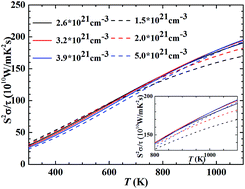
Since the working temperature of half-Heusler thermoelectric modules is as high as 1000 K, it is urgent to investigate the optimal carrier concentration and corresponding electrical transport properties of p-type NbFeSb at higher temperatures. The carrier concentration dependence of power factor over relaxation time S2σ/τ for p-type doping is calculated to obtain the optimal carrier concentration nopt at 700 K, 900 K, and 1100 K (ESI Fig. 1†). The values of maximum S2σ/τ and corresponding optimal nopt are listed in Table 1. As aforementioned, the maximum S2σ/τ and corresponding optimum carrier concentration increase with increasing temperature. To further evaluate the thermoelectric performance of p-type NbFeSb at the nopt shown in Table 1, S and S2σ/τ as a function of temperature are calculated. Fig. 4(a) shows that S increases with increasing temperature, and decreases with increasing carrier concentration. It is noteworthy S2σ/τ is almost independent of carrier concentration at a given temperature (Fig. 4(b)). Specifically, the S2σ/τ–T curves are nearly overlapping at three different carrier concentrations (2.6 × 10²¹, 3.2 × 10²¹ and 3.9 × 1021 cm−3). Unchanged S2σ/τ with increasing carrier concentration indicates that composition optimization can't further improve the S2σ/τ when the carrier concentration reaches ∼2.6 × 1021 cm−3. In order to validate the above analysis, temperature dependence of S and S2σ/τ at lower (1.5 × 10²¹ and 2.0 × 1021 cm−3) and higher (5.0 × 1021 cm−3) carrier concentrations for p-type NbFeSb are also calculated. As shown in Fig. 4(a), Seebeck coefficient S still decreases with increasing carrier concentration n. Nevertheless, the S2σ/τ–T curve at lower carrier concentrations (1.5 × 10²¹ and 2.0 × 1021 cm−3) is different from that at higher carrier concentrations (2.6 × 10²¹, 3.2 × 10²¹, 3.9 × 10²¹ and 5.0 × 1021 cm−3), which is shown in Fig. 4(b). For example, at n = 2.0 × 1021 cm−3, S2σ/τ is almost equal to that at other carrier concentrations as T increases from 300 to 800 K, but it is lower than that at higher carrier concentrations above 800 K, as plotted in the inset of Fig. 4(b). The S2σ/τ–T curves are nearly unchanged when carrier concentration is higher than 2.6 × 1021 cm−3, even up to 5.0 × 1021 cm−3. All of the abovementioned results undoubtedly show that further increasing carrier concentration can't improve the S2σ/τ of NbFeSb greatly when carrier concentration reaches ∼2.6 × 1021 cm−3. The TE performance may be further improved by grain refinement36,37 and incorporating nanoscale precipitates38–40 to reduce the lattice thermal conductivity.
Table 1 The optimal power factor over relaxation time S2σ/τ and the corresponding optimal carrier concentration nopt for p-type NbFeSb at 700 K, 900 K, and 1100 K
| |
700 K |
900 K |
1100 K |
| S2σ/τ (W m−1 K−2 s−1) |
11.8 × 10¹¹ |
16.0 × 10¹¹ |
19.6 × 10¹¹ |
| nopt (cm−3) |
2.6 × 10²¹ |
3.2 × 10²¹ |
3.9 × 10²¹ |
 |
| | Fig. 4 Temperature dependence of p-type (a) Seebeck coefficient S, and (b) power factors with respect to relaxation time S2σ/τ for NbFeSb at the different optimal doping carrier concentrations. Inset of (b) shows magnified view of (b) for a temperature range of 800–1100 K. | |
4. Conclusions
In conclusion, the electronic structure of half-Heusler compound NbFeSb is studied by ab initio density functional methods, and the thermoelectric properties are also investigated by combining the Boltzmann transport theory with the electronic structures. The high band degeneracy Nv for valence band maximum (VBM) implies that NbFeSb is a potentially good p-type thermoelectric material. The carrier concentration dependences of thermoelectric properties for p-type NbFeSb are calculated, and in good agreement with the experimental data. At 800 K, the ZT value can be further improved by 40% when the minimum κL is reached. Based on the optimal carrier concentration from the maximum power factor, the temperature dependences of Seebeck coefficient and power factor are investigated to indicate that further increasing carrier concentration through composition optimization can't improve the power factors when the carrier concentration reaches ∼2.6 × 1021 cm−3.
Acknowledgements
This research was supported by the National Natural ScienceFoundation of China (No. 51171208 and No. 51271201).
References
- L. E. Bell, Science, 2008, 321, 1457 CrossRef CAS PubMed.
- J. S. Zhang, X. Feng, Y. Xu, M. H. Guo, Z. C. Zhang, Y. B. Ou, Y. Feng, K. Li, H. J. Zhang, L. L. Wang, X. Chen, Z. X. Gan, S. C. Zhang, K. He, X. C. Ma, Q. K. Xue and Y. Y. Wang, Phys. Rev. B: Condens. Matter Mater. Phys., 2015, 91, 075431 CrossRef.
- G. J. Snyder and E. S. Toberer, Nat. Mater., 2008, 7, 105 CrossRef CAS PubMed.
- C. Yu, T. J. Zhu, R. Z. Shi, Y. Zhang, X. B. Zhao and J. He, Acta Mater., 2009, 57, 2757 CrossRef CAS.
- W. Xie, A. Weidenkaff, X. Tang, Q. Zhang, J. Poon and T. M. Tritt, Nanomaterials, 2012, 2, 379 CrossRef CAS.
- H. H. Xie, H. Wang, Y. Z. Pei, C. G. Fu, X. H. Liu, G. J. Snyder, X. B. Zhao and T. J. Zhu, Adv. Funct. Mater., 2013, 23, 5123 CrossRef CAS.
- C. G. Fu, S. Q. Bai, Y. T. Liu, Y. S. Tang, L. D. Chen, X. B. Zhao and T. J. Zhu, Nat. Commun., 2015, 6, 8144, DOI:10.1038/ncomms9144.
- T. J. Zhu, C. G. Fu, H. H Xie, Y. T. Liu and X. B. Zhao, Adv. Energy Mater., 2015, 5, 1500588 Search PubMed.
- X. Yan, W. S. Liu, H. Wang, S. Chen, J. Shiomi, K. Esfarjani, H. Z. Wang, D. Z. Wang, G. Chen and Z. F. Ren, Energy Environ. Sci., 2012, 5, 7543 CAS.
- S. Chen, K. C. Lukas, W. S. Liu, C. P. Opeil, G. Chen and Z. F. Ren, Adv. Energy Mater., 2013, 3, 1210 CrossRef CAS.
- Y. W. Chai, T. Oniki and Y. Kimura, Acta Mater., 2015, 85, 290–300 CrossRef CAS.
- X. Yan, W. S. Liu, S. Chen, H. Wang, Q. Zhang, G. Chen and Z. F. Ren, Adv. Energy Mater., 2013, 3, 1195 CrossRef CAS.
- E. Rausch, B. Balke, S. Ouardi and C. Felser, Phys. Chem. Chem. Phys., 2014, 16, 25258 RSC.
- R. He, H. S. Kim, Y. C. Lan, D. Z. Wang, S. Chen and Z. F. Ren, RSC Adv., 2014, 4, 64711 RSC.
- S. Chen and Z. F. Ren, Mater. Today, 2013, 16, 387–395 CrossRef CAS.
- C. G. Fu, T. J. Zhu, Y. Z. Pei, H. H. Xie, H. Wang, G. J. Snyder, Y. Liu, Y. T. Liu and X. B. Zhao, Adv. Energy Mater., 2014, 4, 1400600 Search PubMed.
- C. G. Fu, T. J. Zhu, Y. T. Liu, H. H. Xie and X. B. Zhao, Energy Environ. Sci., 2015, 8, 216–220 CAS.
- G. Joshi, R. He, M. Engber, G. Samsonidze, T. Pantha, E. Dahal, K. Dahal, J. Yang, Y. C. Lan, B. Kozinsky and Z. F. Ren, Energy Environ. Sci., 2014, 7, 4070 CAS.
- J. Yang, H. M. Li, T. Wu, W. Q. Zhang, L. D. Chen and J. H. Yang, Adv. Funct. Mater., 2008, 18, 2880–2888 CrossRef CAS.
- D. P. Young, P. Khalifah, R. J. Cava and A. P. Ramirez, J. Appl. Phys., 2000, 87, 317 CrossRef CAS.
- P. E. Blöchl, Phys. Rev. B: Condens. Matter Mater. Phys., 1994, 50, 17953 CrossRef.
- G. Kresse and D. Joubert, Phys. Rev. B: Condens. Matter Mater. Phys., 1999, 59, 1758 CrossRef CAS.
- G. Kresse and J. Furthmuller, Phys. Rev. B: Condens. Matter Mater. Phys., 1996, 54, 11169 CrossRef CAS.
- J. P. Perdew, K. Burke and M. Ernzerhof, Phys. Rev. Lett., 1996, 77, 3865 CrossRef CAS PubMed.
- G. K. H. Madsen and D. J. Singh, Comput. Phys. Commun., 2006, 175, 67 CrossRef CAS.
- M. G. Holland, Phys. Rev., 1963, 132, 2461 CrossRef CAS.
- J. M. Yang, Y. L. Yan, Y. X. Wang and G. Yang, RSC Adv., 2014, 4, 28714 RSC.
- A. H. Reshak, RSC Adv., 2015, 5, 47569 RSC.
- L. L. Wang, L. Miao, Z. Y. Wang, W. Wei, R. Xiong, H. J. Liu, J. Shi and X. F. Tang, J. Appl. Phys., 2009, 105, 013709 CrossRef.
- B. Z. Sun, Z. J. Ma, C. He and K. C. Wu, RSC Adv., 2015, 5, 56382 RSC.
- C. Çoban, K. Çolakoğlu and Y. Ö. Çiftçi, Phys. Scr., 2015, 90, 095701 CrossRef.
- Y. Z. Pei, X. Y. Shi, A. Lalonde, H. Wang, L. D. Chen and G. J. Snyder, Nature, 2011, 473, 66 CrossRef CAS PubMed.
- Y. Z. Pei, H. Wang and G. J. Snyder, Adv. Mater., 2012, 24, 6125 CrossRef CAS PubMed.
- J. M. Yang, Y. L. Yan, Y. X. Wang and G. Yang, RSC Adv., 2014, 4, 28714 RSC.
- D. G. Cahill, S. K. Watson and R. O. Pohl, Phys. Rev. B: Condens. Matter Mater. Phys., 1992, 46, 6131 CrossRef CAS.
- G. Joshi, X. Yan, H. Wang, W. Liu, G. Chen and Z. F. Ren, Adv. Energy Mater., 2011, 1, 643 CrossRef CAS.
- X. Yan, G. Joshi, W. S. Liu, Y. C. Lan, H. Wang, S. Lee, J. W. Simonson, S. J. Poon, T. M. Tritt, G. Chen and Z. F. Ren, Nano Lett., 2011, 11, 556–560 CrossRef CAS PubMed.
- W. J. Xie, J. He, S. Zhu, X. L. Su, S. Y. Wang, T. Holgate, J. W. Graff, V. Ponnambalam, S. J. Poon, X. F. Tang, Q. J. Zhang and T. M. Tritt, Acta Mater., 2010, 58, 4705–4713 CrossRef CAS.
- J. P. A. Makongo, D. K. Misra, X. Y. Zhou, A. Pant, M. R. Shabetai, X. L. Su, C. Uher, K. L. Stokes and P. F. P. Poudeu, J. Am. Chem. Soc., 2011, 133, 18843–18852 CrossRef CAS PubMed.
- W. J. Xie, Y. G. Yan, S. Zhu, M. Zhou, S. Populoh, K. Gałązka, S. J. Poon, A. Weidenkaff, J. He, X. F. Tang and T. M. Tritt, Acta Mater., 2013, 61, 2087–2094 CrossRef CAS.
Footnote |
| † Electronic supplementary information (ESI) available. See DOI: 10.1039/c5ra23091h |
|
| This journal is © The Royal Society of Chemistry 2016 |
Click here to see how this site uses Cookies. View our privacy policy here.