
Dielectric investigation of a conducting fibrous nonwoven porous mat fabricated by a one-step facile electrospinning process

Jitendra Tahalyania, Khushbu K. Rahangdalea, Radhamanohar Aepurua, Balasubramanian Kandasubramanian*a and Suwarna Datarb
aDepartment of Materials Engineering, Defence Institute of Advanced Technology, Girinagar, 411021, India. E-mail: meetkbs@gmail.com; Fax: +91 020 2438 9509; Tel: +91 020 2438 9680
bDepartment of Applied Physics, Defence Institute of Advanced Technology, Girinagar, 411021, India

Received 2nd November 2015 , Accepted 29th February 2016

First published on 31st March 2016


Abstract

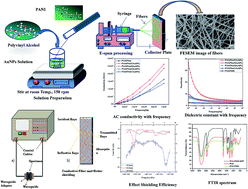
Currently, there is a considerable demand for materials with inter-balanced dielectric properties to replace the existing traditional insulators in variegated electronic appliances over the range of audio and radio frequency. In the current work, a one-step facile electrospun (E-spun) technique is adopted to fabricate a non woven mat consisting of nano-scale conducting fibers of polyaniline (PANI) and gold nanoparticles (AuNPs) using polyvinyl alcohol (PVA) as a binder. The influence of different amounts of the AuNP solution on the size and distribution of fibers was investigated using high resolution transmission electron microscopy (HRTEM) and field emission scanning electron microscopy (FESEM). The dielectric constant, losses, AC conductivity and modulus of nanofibers were investigated over a wide frequency and temperature range of 0.1 Hz to 10 MHz and −40 °C to 60 °C respectively by means of Broadband Dielectric Spectroscopy (BDS). AC conductivity varies as a function of frequency, according to Jonscher's power law (JPL), and the behavior of the temperature dependent frequency exponent using JPL suggests that the Correlated Barrier Hopping (CBH) is the dominant charge transport mechanism for conducting nanofibrous nonwoven mats. By using the CBH model the maximum barrier height, hopping distance and density of state (DOS) were calculated for the whole temperature range. The incremental increase from 1.6 × 10⁻⁶ S cm−1 to 2.5 × 10⁻⁶ S cm−1 with increasing amounts of AuNP solution was noticed and is ascribed to the corresponding increased conducting network and reduced trapping centers in the mat. Dielectric constant increases with both increased loading of nanoparticle solution in the mat and the increased temperature, which may be attributed to enhanced interfacial polarization. Shifting and broadening of well-defined peaks were observed in the imaginary part of the dielectric modulus spectrum, indicating Maxwell–Wargner–Sillars (MWS) interfacial polarization. Effective electro-magnetic (EM) shielding was also evaluated for all compositions and a sharp peak of 22.99 dB (>99%) at 11.18 GHz was noticed for a 0.5 mm thick mat of the composite. This was observed to be dependent on the concentration of AuNPs and the thickness of the mat.

1. Introduction

The fabrication of new materials with outstanding electrical and mechanical properties is required for electromagnetic shielding and modern microelectronic devices.1,2 In recent studies, to achieve the above properties, conducting polymers or their blends decorated with metal nanoparticles have shown improvement in mechanical, electrical, optical and physical properties.3–5 As reported, these nanoparticles form conducting junctions between the polymer chains which enhances the electrical conduction of composites.6

Among the family of conducting polymers, polyaniline (PANI) has the ability to control the electrical properties reversibly by protonation as well as by charge transfer doping, thus finding applications in flexible electrodes and LED's, electromagnetic shielding, sensors and actuators etc.7–10 PANI/metal nanoparticle composites developed with significant improvements in physical and chemical properties are getting great attention from world-wide industries and academics.11–14 Electrical properties of PANI/AuNP film,3 PANI/PVA + Cu(II) pellet,15 PVA/Ag film16 have shown improvement in the conductivity by decreasing the trapping centers of charge carriers due to increased conducting network. Dielectric properties of the composites were also enhanced with the incorporation of conducting foreign nanofillers in the polymer matrix.

A high throughput strategy is expanded to fabricate materials which are lightweight and breathable having ultrafine fibers and pore size, porous texture and extraordinary high surface area to volume ratio.17 Electrospinning is a versatile method to generate continuous fibers with diameters ranging from micrometers to nanometers with both solid and hollow interior structures.18 On account of their high aspect ratio, better adsorption, strong penetration, fine fabric structure as well as large specific surface area19 as compared to solution casted films, pellets and coatings. Therefore, nanofibers create the bridge of fields such as biomedical functional materials,20 sensors,21 fuel cell membranes,22 super hydrophobicity materials,23 nanotemplates24 etc. Shahi et al. have demonstrated that using an electrospinning solution consisting of PANI dissolved in a NMP solvent results in cluster of powder rather than nanofibers over the surface of the collector by virtue of the low viscosity and solubility limitation.25 Balasubramanian et al. have fabricated conducting fibers of PANI using PVA as a binder by electrospinning process and obtained enhanced AC conductivity as well as dielectric properties.26

In the present work, a tri-component composite of metal nanoparticle AuNP, conducting polymer PANI and insulating polymer PVA was used to fabricate a non-woven mat consisting of conducting fibers utilizing one step facile electrospinning technique. However, to our best knowledge the charge transport mechanism in conducting fibers and the effect of gold nanoparticle in the transport mechanism has rarely been elucidated in literature till date. To demonstrate the systematic and detail investigation on the charge transport mechanism, the AC conductivity and dielectric properties over a wide frequency range of 0.1 Hz to 10 MHz and temperature range from −40 °C to 60 °C for conducting fiberous mat were studied. Further, the electric modulus was computed to determine the defined relaxation peak and their variation with temperature. Effective EMI shielding analyses was done using vector network analyser (VNA) for different compositions and thickness.

2. Experimental section

2.1. Materials

Polyvinyl alcohol (PVA) ((C2H4O)n) (Mw = 130[thin space (1/6-em)]000 g mol−1), polyaniline (PANI) (([C6H4NH]2[C6H4N]2)n) (Mw = 15[thin space (1/6-em)]000 g mol−1), N-methyl-2-pyrrolidone (NMP) (purity 99.5%, Mw = 90.13 g mol−1) were procured from Sigma Aldrich Pvt Ltd, India. Gold chloride (crystalline, 49–50% purity) (393.63 g mol−1) was purchased from Thomas bakers. Phyllanthus emblica fruit rich in vitamin C was purchased from Prime Herbonix Health Products Pvt. Ltd. Pune, Maharashtra. De-ionized water used for all the experiment was obtained from a Millipore Milli-Q system. All chemical were used as received without further purification.

2.2. Preparation of PVA/PANI/AuNPs solution

P. emblica extract was prepared by using wet method and added drop wise in a solution of 100 ml 1 mM gold chloride (HAuCl4) and stirred till the colour of solution changed from pale yellow to red wine which confirmed gold nanoparticles in solution.27 Further the presence of AuNP particle in the prepared red wine coloured solution (ESI). PANI solution was prepared by dissolving PANI into 5 ml of NMP solvent and sonicated for 10 min. PVA in powdered form was added in different amounts of AuNP solution (10 v/v%, 30 v/v%, 50 v/v% and 70 v/v% by fixing 50 v/v% of PANI solution) and stirred for 30 min at room temperature for complete dissolution. PANI solution was added to the above prepared solution and stirred for 45 min at room temperature to get a hybrid tri-component polymeric solution which was used further for the electrospinning process.

2.3. Electrospin process

Fabrication of nonwoven conducting matrix of composite solution was achieved by carefully adjusting the concentration of PVA along with PANI/AuNP solution, potential applied to spinneret, flow rate and distance between the syringe needle and collector plate. Set-up of electrospinning consisted of 5 ml syringe having needle diameter (9.14 mm) was horizontally settled on a clamp, copper electrode and collector plate of aluminum (Al). The prepared solution was transferred into the syringe, maintaining 10 cm distance and applying 12 kV potential between spinneret and collector with flow rate of 5 μl min−1 to deposit the nonwoven matrix of fibers over the surface of Al foil. The final composition used is 70 v/v% of AuNP solution to avoid the bead formation and spitting of solution over the fibrous mat. Maximum uniform thickness of 0.5 mm of the mat was obtained by with the current machine system for tri-component composite with 70 v/v% loading of AuNP solution. Since, after depositing thick layer of mat, collector (Al foil) loses its conducting nature which drives to the non-uniformity of the mat.28 The fabricated nonwoven mats were peeled off from the Al foil to use it for further characterization.

3. Characterization

The surface morphology of electrospun fiber membrane was analysed by FESEM (Carl Zeiss AG, JSM-6700F, Germany) at 5 kV with 100k× magnification. TEM images were recorded at an acceleration voltage of 200 kV (Philips CM 200) with maximum resolution 0.23 nm. The Fourier transform infrared spectroscopy (FTIR) spectrum outputs were recorded by using Perkin Elmer BX FTIR system (PerkinElmer Inc., 55 USA) in the wave number ranging from 400–4500 cm−1. Electrical conductivity & permittivity study of nonwoven mat was examined by Novo control broadband dielectric spectrometer with integrated alpha-A analyser and temperature controller in 0.1 Hz to 10 MHz frequency range and −40 to 60 °C temperature range using gold plated electrodes (dia. 20 mm) specimen holder. Specimen electrodes were processed by coating with silver paste on each side to provide good contact with the electrodes and the data was analyzed using Win Fit software. The attenuation of microwave radiation was measured in 8–12 GHz (Agilent) frequency range (X-band) by using PNA network analyzer N5222A. X-band sample holder having rectangular block with dimension 2.5 cm × 1.6 cm (sample size).

4. Results & discussion

4.1. Electrical properties

To understand the behaviour and charge transfer mechanism of the composites, frequency assisted dielectric constant ε′, dielectric loss ε′′ and AC conductivity σAC at various temperatures were obtained by broadband dielectric spectroscopy. As composition of AuNP increased, significant improvement in dielectric constant and moderate improvement in AC conductivity was observed. Dielectric constant ε* (ability to hold the electric filed) can be calculated using:29
 
image file: c5ra23012h-t1.tif(1)
where ω frequency, Z* complex impedance, Z′ and Z′′ are real and imaginary part of impedance respectively, Co vacuum capacitance, ε′ and ε′ are real and imaginary part of complex dielectric constant. The frequency assisted AC conductivity σAC and component of energy loss ε′′ are related according to the following equation:
 
σAC = ωε′′εo (2)
4.1.1. AC conductivity. The dielectric behaviour was explained by AC conductivity analyses which demonstrate the type of transport mechanism followed in the composite.30 Incremental increase in the conductivity was observed from 1.6 × 10⁻⁶ S cm−1 to 2.3 × 10⁻⁶ S cm−1 with increased loading of AuNP solution shown in Table 1. It is slightly higher than the PVA/PANI as AuNP facilitate the route for an electric field induced charge transfer between AuNP and PANI molecules. In heterogeneous metal–polymer composites, metal particles accumulate at the interface by forming the clusters, thus control the AC conductivity and polarization.31 Existence of strong charge (polarons/bipolarons) trapping centres in conducting polymer and their localized movement influenced by externally enforced electric field, serves as an electric dipole. Electric field causes movement of localized charge carriers to their neighbouring sites which results in the dielectric relaxation (ESI). This movement of charges causes electrical conduction by forming conducting network which supports the movement of charges, physically over the entire sample.3 Charge trapping centers are reduced when PVA/PANI is loaded with AuNP, thereby leading to enormous participation of charges in the relaxation process.3 The effect of AuNP on AC conductivity as a function of frequency at room temperature is shown in Fig. 1a and b. The frequency assisted AC conductivity in conducting polymers originates from the existing interfacial polarisation and the presence of inhomogeneous system in sample.32 The log graph of frequency assisted AC conductivity shows a plateau region at a lower frequency and increases with frequency in accordance to the power law as shown in Fig. 1b and c. This behavior is called Universal Dynamic Response (UDR) due to its applicability to the wide variety of materials, which was first observed by Jonscher.33 In contrast to the conventional Debye model, the universal Jonscher power law is thus best suited for explaining entirety of the noticed responses in the solids.34 The acceleration of AC conductivity follows universal Jonscher's power law (JPL) which is represented by:35
 
σAC(ω) = σDC + A(T)ωS (3)
where σDC is DC conductivity (at zero frequency), A(T) is a function of temperature called dispersion parameter, ω is frequency and S is dimensionless fractional/frequency exponent (fitting parameter) vary in the range of 0 to 1. Fig. 1c shows frequency assisted AC conductivity spectrum over a temperature range of −40 °C to 60 °C for PVA/PANI/AuNP (70 v/v%). Increment in conductivity was detected with temperature resulting from increased segmental mobility and free volume, reveals low temperature (−40 °C to 60 °C). Inclusion of metal nanoparticles establish the charge transfer complex (CTCs), resulting in escalating the electron hopping probability across the insulator chains and the barrier interface. This produces a conducting route through amorphous zone of polymer mat driving to the incremental increase of conductivity which in agreement with González-campos et al.36 and Mahendia et al.16 It has been observed that materials exhibit various electrical and dielectric processes like tunnelling or hopping of charge carriers and different polarizations like dipole, electrode, interfacial polarization etc., which can be effectively explained by utilizing Jonscher universal power law.37,38 In this context, temperature dependent frequency exponent S is the paramount entity to explain the effective charge transport mechanism for the conducting nonwoven mat. Therefore, different models have been recommended to provide information regarding the type of conduction mechanism favourable in the material using the variation of frequency exponent with respect to the temperature. In QMT (quantum mechanical tunnelling) model, the value of S is ≈0.8, which increases with increasing temperature. In OLPT (overlapping-large polaron tunnelling) model, frequency exponent S initially decreases to a minimum value up to a certain increase in temperature and further increases with increasing temperature. In CBH model, value of S shows the decreasing behaviour with increasing temperature and vice versa which suggests small polaron model.39–41 In this study, AC conductivity spectra were fitted to eqn (3) to evaluate the value of frequency exponent (S) as shown in Table 2. Decreasing trend of S from near unity to zero value was observed with increasing temperature from −40 °C to 60 °C. This trend of S with respect to the temperature ensures that the CBH model is the best suited model for demonstrating the charge conduction mechanism for AC conduction in the nanofibers and the similar behaviour was already observed for the films of erbium-, gadolinium- and lanthanum-doped PVA and PVA–selenium nanocomposites.42 Deviation from Debye behaviour was suggested by obtained non unity value of S. The electron hop among two defects separated over potential barrier is given as:43
 
image file: c5ra23012h-t2.tif(4)
where ε is dielectric constant, εo is permittivity of free space, Weff and Wm are effective and maximum barrier height respectively, r measures distance between defects, n = 1 and n = 2 suggest single polaron and bi-polaron hopping respectively. The AC conductivity for CBH model in relation with RH (hopping distance) and N = kBTN(Ef) (density of state) is expressed by:41
 
image file: c5ra23012h-t3.tif(5)
Table 1 Dielectric constant (0.1 Hz) and maximum AC conductivity of non-woven mat with different loading of AuNP solution
Composite σAC (S cm−1) ε
PVA/PANI/AuNP (10 v/v%) 1.36 × 10⁻⁶ 9.8
PVA/PANI/AuNP (30 v/v%) 1.62 × 10⁻⁶ 1.46 × 101
PVA/PANI/AuNP (50 v/v%) 2.36 × 10⁻⁶ 1.96 × 101
PVA/PANI/AuNP (70 v/v%) 2.62 × 10⁻⁶ 3.95 × 10²


image file: c5ra23012h-f1.tif
Fig. 1 AC conductivity of PVA/PANI/AuNPs electrospun fiber matrix with increasing concentration of AuNPs (a) linear scale (b) log scale with frequency (c) AC conductivity of PVA/PANI/AuNPs (70 v/v%) electrospun fiber matrix increasing temperature with frequency.
Table 2 Dielectric constant and maximum AC conductivity obtained from BDS and transport parameters S, Wm, RH, N, N(Ef) and τm calculated by data fitting in equation (eqn (3), (5), (6), (8)) at various temperature
Temp. °C σAC × 10−6 s cm−1 ε′ 1Hz ε′ 10 MHz τm s−1 S Wm eV RH Å N N(Ef) eV−1 cm−1
−40 1.57 6.33 2.53 4.68 × 10⁻² 0.9 1.2 0.34 1.92 × 10¹² 9.3 × 10¹³
−20 1.57 1.12 × 101 2.77 3.05 × 10⁻² 0.76 0.55 0.5 1.95 × 10¹² 9.6 × 10¹³
0 2.47 3.18 × 101 3.31 3.85 × 10⁻⁴ 0.45 0.26 1.6 3.08 × 10¹³ 1.28 × 10¹⁵
20 3.55 9.67 × 10² 4.09 1.32 × 10⁻⁵ 0.24 0.2 1.9 8.42 × 10¹³ 3.24 × 10¹⁵
40 4.41 1.11 × 10⁴ 4.72 2.48 × 10⁻⁶ 0.13 0.19 3.18 1 × 10¹⁴ 3.7 × 10¹⁵
60 4.68 2.69 × 10⁴ 4.79 1.26 × 10⁻⁶ 0.1 0.19 3.2 2.17 × 10¹⁴ 7.4 × 10¹⁵


Hopping distance RH at particular frequency and temperature is expressed as:40

 
image file: c5ra23012h-t4.tif(6)
and frequency exponent S as:
 
image file: c5ra23012h-t5.tif(7)
where symbols have their usual meanings. Eqn (9) is modified by taking first approximation at low temperature as:
 
image file: c5ra23012h-t6.tif(8)

By using eqn (7), (8) and (10), value of Wm, RH and N(Ef) for frequency 1 kHz and PVA/PANI/AuNP (70 v/v%) from −40 °C to 60 °C are calculated and shown in Table 2. The maximum barrier height shows inverse dependence on AC conductivity whereas hopping distance increases with AC conductivity. Density of state displays increment with AC conductivity indicating the higher value of conductivity results from increased charge carriers. This in agreement with CBH model, also our calculated values predict increment of hopping distance with AC conductivity.

4.1.2. Frequency dependent dielectric behaviour. Frequency assisted dielectric constant ε′ and dielectric losses ε′′ at room temperature are represented in Fig. 2a and b respectively over frequency ranging from 0.1 Hz to 10 MHz. Fig. 2a shows a sharp decrement in the dielectric constant from 394.8 at initial frequency (static dielectric) to 5.3 at 10 kHz. This originates from the increased AC conductivity with increasing amount of AuNP solution.31 It is then followed by a gradual decrement to 4.57 at 10 MHz thus confirming the presence of polar material.44 Similar behavior was observed for PVA, PMMA, PVP, PVA/Ag, PVA/Se etc. confirming that for polar materials, dielectric constant reduces sharply at lower frequency and follows nearly constant behavior at higher frequency due to inadequate time for dipole to familiarize themselves with fields at higher frequency.16,43,45 This can be conceivably explained by the interfacial and electrode effect i.e. the charge carriers obstructed at electrodes.16 From Fig. 2a and Table 1, ε′ increases with increase in the amount of AuNP solution. This increased ε′ is due to dipole and interfacial charge polarization between filler (AuNP)46,47 and polymer, indicating the increased electric potential energy storing ability under influence of an electric field.31 Decrement in high frequency dielectric values of nonwoven mat ratifies their suitability for use as a substrate material of low permittivity in radio frequency microelectronic devices.48 Similarly, frequency variation of dielectric loss for different amounts of AuNP solution was observed as shown in Fig. 2b which could be due to the mobile charges within the mat. Loss factor increases with filler concentration corresponding to the increase in conductive network formation between AuNP and chain of PANI. Large dielectric loss is obtained for the initial frequency (corresponding to the DC conductivity) and decreases abruptly with slight increment in initial frequency. This behavior arises from the interfacial polarization generated by Debye losses and induced relaxations.49 At high frequencies, the rapid periodic reversal of the electric field results in insufficient ion diffusion which decreases charge accumulation, leading to decrement in values of loss factor.45 Unavailability of maximum peaks in dielectric losses shown in Fig. 2b corresponds to peak overlapping contributed by low frequency conductivity.50 Analysis of electric modulus was done to reveal the relaxation process using experimental data and adopted formulism as:51
 
image file: c5ra23012h-t7.tif(9)
 
image file: c5ra23012h-t8.tif(10)
 
image file: c5ra23012h-t9.tif(11)
where M′ and M′′ are real and imaginary component of electric modulus and ε′ and ε′′ are real imaginary component of dielectric permittivity. Though relaxation peaks are absent in the M′ curve as shown in Fig. 2c, the decrease in M′ with increase in the amount of nanoparticle solution indicates an enhanced dielectric constant.52 At lower frequencies, the M′ value tends to zero which can be attributed to the removal of electrode polarization or the reduction in dipole orientation on introducing the AuNP solution.53,54 Increment in M′ with frequency demonstrate a single step function like transition attaining asymptotic value. The variation imaginary electric modulus M′′ with frequency is shown in Fig. 2d. Presence of a well-defined relaxation peak in M′′ curve indicates Maxwell–Wargner–Sillars (MWS) interfacial polarization which is the outcome of difference in dielectric values of PVA, PANI and AuNP.55 With increasing the filler component in composite, shifting and broadening of peaks was observed indicating the accumulation of charge carriers over the fillers.56 Relaxation time for different samples was calculated from the following equation:47,57
 
image file: c5ra23012h-t10.tif(12)
where fm denotes relaxation peak frequency. The interaction of AuNP with OH groups obstructs the mobility of polymer chains causing an increment in the relaxation time (τm) with increasing AuNP solution content. This is in accordance with the explanation for enhanced dielectric constant and loss factor with increased AuNP solution content.

image file: c5ra23012h-f2.tif
Fig. 2 (a) Permittivity (b) loss factor (c) real component of electric modulus (d) imaginary component of electric modulus with frequency for PVA/PANI/AuNPs electrospun fiber matrix with increasing concentration of AuNPs.
4.1.3. Temperature dependent dielectric behaviour. Dielectric behaviour of the composite at various temperatures (plotted in Fig. 3a) displays an enhancement of the dielectric constant at low frequency and at higher temperature, as a consequence of the temperature dependent interfacial polarization or electrode polarization.41 The maximum temperature was restricted to 60 °C as the glass transition temperature of PVA is 70 °C.36 The reason behind the increased value of dielectric constant is due to the increase in segmental mobility of the molecule at higher temperatures.58 This increase can also be attributed to the restriction of the ion clusters and ion aggregation in the mat at higher temperatures.59 Temperature dependent DC contribution leads to increase in dielectric losses with increasing temperature.43 Prominent temperature dependence for lower frequency is noticed in both real and imaginary parts of dielectric constant as displayed in Fig. 3a and b. Frequency assisted real part of electric modulus at various temperature is shown in Fig. 3c, reveals the decrement of M′ with increasing temperature exhibit temperature dependent properties and M′ value tending to zero at lower frequency with increasing temperature. In the M′′ curve (Fig. 3d), shifting as well as broadening of peaks at higher frequencies are noticed with increasing temperature. Non Debye behavior was predicted by the presence of asymmetric and broad peaks with respect to their maxima. The maxima divide the graph into two parts where, the left part determines the range for long distance mobile charge carriers and right part determines short distance mobile charge carriers are confined to potential well.52,60 τm is calculated for all temperatures using eqn (4) as shown in Table 2. Decrement in τm with temperature is due to the enhanced mobility of charge carriers resulting from increased flexibility of material at higher temperatures. This suggests that the relaxation is a thermally activated process in which the charge carriers dominate through hopping process.61,62
image file: c5ra23012h-f3.tif
Fig. 3 (a) Permittivity (b) loss factor (c) real component of electric modulus (d) imaginary component of electric modulus with frequency for PVA/PANI/AuNPs (70 v/v%) electrospun fiber matrix with increasing temperature.

4.2. Morphology and topography study

The study of the morphology and topography of the tri-component composite matrix of fine fibers with different loading of AuNP solution was carried out by FESEM and HRTEM. Fig. 4, FESEM images obtained at 5 kV with 10k× magnification for all compositions shows continuous and crossed fibers of composite which display texture similar to spider's web (Fig. 4a–d). From FESEM images, the diameter of the fibers in the mat reduces as we increase the loading of AuNP solution. The increased AuNP solution proportionally decreases the concentration of polymers in the electrospinning solution which causes greater reduction in the viscoelastic force as compared to the electrostatic force and is responsible for the reduced diameter of E-spun fibers. Beads are developed over the fibers which in turn lead to the irregularity of the fibers in the mat.63–66 AuNP increases the charge density in the solution which causes an intense elongated force to be introduced in the solution in the presence of an electric field further leading to the formation of thinner composite fibers. The AuNP solution helps in the construction of dense mat of fibers by diminishing the fiber diameter as shown in Fig. 4d. The masking effect of PANI and AuNP by PVA is the reason FESEM doesn't gives an indication of their presence in the fibers. The presence of gold (AuNP) in the fibrous mat of the composite is determined by the EDAX analyses as shown in Fig. 5. HRTEM images of a single uniform electrospun fiber of PVA/PANI and PVA/PANI/AuNP are shown in Fig. 6a and b respectively. From the HRTEM image (Fig. 6b), the appearance of small, uniformly distributed, spherical shaped, dark spots in the image and the absence of dark spot in fibers of PVA/PANI blend (Fig. 6a) indicates the presence of AuNP in the fibers of composite. Further evidence for this conclusion was obtained by comparing the Fig. 6c and d which is the HRTEM image of pure AuNP particles with the Fig. 6b.
image file: c5ra23012h-f4.tif
Fig. 4 FESEM photograph of electrospun matrix at 10k× magnification (a) PVA/PANI/AuNP (10 v/v%) (b) PVA/PANI/AuNP (30 v/v%) (c) PVA/PANI/AuNP (50 v/v%) (d) PVA/PANI/AuNP (70 v/v%).

image file: c5ra23012h-f5.tif
Fig. 5 Energy dispersion X-ray spectrum of PVA/PANI/AuNP (70 v/v%) electrospun fibers.

image file: c5ra23012h-f6.tif
Fig. 6 TEM image of (a) PVA/PANI and (b) PVA/PANI/AuNP (70 v/v%) electrospun fibers (c) & (d) Au Nanoparticle.

4.3. Fourier transform IR spectrum

In order to investigate possible interaction between PVA, PANI and AuNP, FTIR spectroscopy of nonwoven fibrous mat of PVA, PVA/PANI without AuNP and with inclusion of 70 v/v% AuNP solution was performed and displayed in Fig. 7. Spectra of PVA exhibited the 3368 cm−1, 2953 cm−1, 1737 cm−1, 1265 cm−1, which were associated with O–H, CH2, C[double bond, length as m-dash]O and C–O peak represents the stretching and vibration characteristics.65 FT-IR spectra of PVA/PANI assigned stretching vibration of quinoid and benzenoid groups of PANI appears at 1581 cm−1 and 1487 cm−1 respectively.66 The bands at 1174 cm−1 and 837 cm−1 show specific feature of bending of C–H in-plane and out-plane state respectively. The intense FT-IR spectrum indicates the strong absorption band at 1175 cm−1 and 1635 cm−1 (C–N stretching) in polyaniline chain, which corresponds to high electrical conductivity due to hopping of charge carriers.26,67
image file: c5ra23012h-f7.tif
Fig. 7 Fourier transform IR spectra of PVA, PVA/PANI, PVA/PANI/AuNPs electrospunfiber matrix.

As illustrated in Fig. 7 there seems no extra peak appears and small shifting in the peaks demonstrate the interaction of AuNPs is mainly with –OH group of PVA. After introducing AuNP, intensity variation in peak position was detected which is associated to the stretching vibration of –OH (3800–3000 cm−1) involving in hydrogen bonding shifted to 3351 cm−1.59 AuNPs were engaged with PVA hydroxyl group, their probability of interaction with chains of PANI is naturally disrupted in the composite of PVA/PANI + AuNP.15 However, a shifting in the peak of C–N bond stretching to 1605 cm−1 suggests, impact of AuNP solution within PVA/PANI enrich the electron density to C–N bond to hop the charge through the chain,67 concede with detected charge transfer mechanism for our composite.

4.4. Electromagnetic interference shielding

Fig. 8a shows the pictorial representation of the experimental setup for measuring the shielding effectiveness. The specimens were cut into rectangular shape and placed between the waveguides to measure the EMI shielding effectiveness through complex scattering parameter (S11, S12, S21, & S22). The total shielding efficiency (SET) is defined as the logarithmic ratio of incident power (Pi) to outgoing power (Po) of radiation. An incident electromagnetic wave follows different radiation pathway (Fig. 8b) through the material and undergoes reflection, multiple reflection, absorption and transmittance:68,69
 
SET = 10[thin space (1/6-em)]log(Pi/Po) = SEA + SER + SEM (13)
where, SEA, SER and SEM are absorption loss, reflection loss and multiple reflection loss respectively. For SE > 10 dB, SEM can be ignored,70 equation can be modified for SET as:
 
SET = SEA + SER (14)

image file: c5ra23012h-f8.tif
Fig. 8 (a) Experimental setup of vector network analyser for EMI shielding characteristics (b) radiation pathways.

The SEA & SER can be calculated according to scattering parameter by following equation:71

 
image file: c5ra23012h-t11.tif(15)
 
image file: c5ra23012h-t12.tif(16)
 
image file: c5ra23012h-t13.tif(17)
where
 
Transmittance (T) = |S12|2 = |S21|2, (18)
 
Reflectance (R) = |S11|2 = |S22|2, (19)
 
Absorbance (A) = 1 − RT (20)

More than 20 dB of effective EMI shielding signify, 99% of the electromagnetic wave has been either reflected or absorbed which is useful for several commercial applications such as laptops and desktop computers (15–20 dB).72,73 Initially, the effect of different loading of filler on effective shielding efficiency of non-woven mat with constant thickness 0.2 mm was calculated and studied over the X band frequency ranging from 8.2 GHz to 12.4 GHz which is shown in Fig. 9. Pristine PVA gives maximum total shielding efficiency (SE) about 0.04 dB at 11.5 GHz for 0.2 mm thick sample whereas with addition of 70 v/v% AuNP solution, total SE increases to 2.56 dB for same thickness.


image file: c5ra23012h-f9.tif
Fig. 9 Total shielding efficiency of electrospunfiber matrix with respect to frequency for different amount of AuNP solution.

The skin depth for a material is the length where electromagnetic (EM) wave drops to 1/e of its initial magnitude, related to relative permeability, angular frequency and total conductivity as:74

 
image file: c5ra23012h-t14.tif(21)

Electromagnetic theory provides relation for electrically thick samples (t > δ), frequency assisted far field losses in terms of skin depth (δ), real permeability (μ′), thickness (t), and total conductivity (σ) for shield materials as:74

 
image file: c5ra23012h-t15.tif(22)
 
image file: c5ra23012h-t16.tif(23)

Using skin depth (eqn (21)), SEA is modified as:

 
image file: c5ra23012h-t17.tif(24)

As elucidated in eqn (24), SEA is proportional to the thickness of mat. Jaroszewski et al. have shown that the thickness variation and uniformity plays important role in varying shielding properties in case of non-woven fabrics.68 For further analysis, SER, SEA and SET values are calculated using eqn (15)–(17) for different thickness and plotted as shown in Fig. 10, 11 and 12 respectively. From the graphs, advances in SEA was observed to be more dominant with increased thickness of the mat compared to SER which corresponds to the increased value of total SE in X-band of frequency.74–79 The total effective shielding was achieved in nonwoven mat with thickness of 0.3 mm and 0.5 mm is 9.83 dB at frequency of 8.74 GHz and 22.99 dB at frequency of 11.18 GHz respectively for PVA/PANI/AuNP (70 v/v%) as shown in the Fig. 12. The similar type of sharp frequency dependent peaks was also observed by Shoushtari et al. for fibrous mat.75 In present fabricated nonwoven mat, determining the penetration depth does not play any significant role since F. Sarto et al. have shown that the intensity of EM field in the nano-structured material is not distributed homogenously i.e. it is localized in some regions and depressed in others which is a consequence of interference between the reflected and transmitted waves.80 The concept of penetration depth loses its meaning in case of a periodic structure which is a useful concept for uniform thick highly reflective metal films.81 These results further provide promising platform that the incorporation of the hetero atom in the polymer matrix, enhances the effective SE of PVA/PANI blend to produce featherweight novel microwave absorbers. Absorption of this can be altered by wavering the hetero atom and thickness to gratify their application in different frequency bands where back reflection of microwaves is not desire.


image file: c5ra23012h-f10.tif
Fig. 10 SER of electrospun fiber matrix with respect to frequency for different thickness of mat at 70 v/v% loading of AuNP solution.

image file: c5ra23012h-f11.tif
Fig. 11 SEA of electrospun fiber matrix with respect to frequency for different thickness of mat at 70 v/v% loading of AuNP solution.

image file: c5ra23012h-f12.tif
Fig. 12 Total shielding efficiency of electrospun fiber matrix with respect to frequency for different thickness of mat at 70 v/v% loading of AuNP solution.

5. Conclusions

Conducting nonwoven mat of fibers of tri-component composite was prepared by electrospinning system for various loading of AuNP solution to enhance the dielectric constant. Nonwoven mat shows enhancement in both AC conductivity to 2.3 × 10⁻⁶ S cm−1 and dielectric constant maximum to 394.8 was measured over wide frequency ranging from 0.1 Hz to 10 MHz at room temperature for 70 v/v% AuNP solution in PVA/PANI. Maximum AC conductivity and dielectric constant of 4.68 × 10⁻⁶ S cm−1 and 2.69 × 10⁴ S cm−1 respectively was obtained for the same sample by increasing temperature to 60 °C. The behaviour of temperature dependent frequency exponent S confirms the CBH transport mechanism in conducting fiber. Using CBH model at temperature 60 °C, frequency exponent (S) decreases to 0.1, hopping distance decreases to 0.19 eV, barrier height increases to 3.2 Å and density of state at Fermi level increases to 7.4 × 10¹⁵ eV−1 cm−1 are giving resemblance to the increased linear region in the conductivity as well as increased conductivity. The study of relaxation behaviour and relaxation peak was determined by electric modulus and dielectric constant resembles to interfacial polarization. Shifting and broadening of relaxation peaks towards higher frequency with both increasing AuNP and temperature will lead to decrease in relaxation time. Measured EMI shielding increases with loading of filler (AuNP solution) as well as by increasing the thickness and maximum shielding obtained is 22.99 dB (>99%) for 70 v/v% AuNP solution in PVA/PANI with only 0.5 mm at 11.18 GHz. Enhanced dielectric properties and high shielding efficiency for 0.5 mm thick composite nonwoven mat was achieved and decrement in high frequency dielectric constant make it useful for various electro-mechanical system/application. Obtained results advices the substitution of heteroatom in PVA/PANI nonwoven matrix may provide a promising track for enhancing the microwave absorption properties and to produce organic-inorganic composite as featherweight novel microwave absorbers for highly effective shielding.

Acknowledgements

The authors thanks to Dr Surendra Pal Vice Chancellor, Defence Institute of Advanced Technology, Pune (DIAT) (DU) for the support and DIAT-DRDO Nano Project Program (EPIPR/1003883/M/01/908/2012/D (R&D/1416 Dated: 28.03.2012, DRDO HQ, New Delhi for financial assistance. We also acknowledge to Mr D. Dhananjay Gunjal for his help with FESEM and Mr Prashant Rule for HRTEM characterisation and technical support.

Notes and references

  1. M. Angelopoulos, IBM J. Res. Dev., 2001, 45, 57–75 CrossRef CAS.
  2. A. R. Aparna, V. Brahmajirao and T. V. Karthikeyan, International Journal of Innovative Research in Science & Engineering, 2013, 2, 7391–7401 Search PubMed.
  3. A. B. Afzal, M. Javed Akhtar, M. Nadeem and M. M. Hassan, J. Phys. Chem. C, 2009, 113, 40 Search PubMed.
  4. T. K. Sarma, D. Chowdhury, A. Paul and A. Chattopadhyay, Chem. Commun., 2002, 14, 1048–1049 RSC.
  5. F. Yakuphanoglu, E. Basaran, B. F. Senkal and E. Sezer, J. Phys. Chem. B, 2006, 110, 16908–16913 CrossRef CAS PubMed.
  6. T. D. Castillo-Castro, E. Larios-Rodriguez, Z. Molina-Arenas, M. M. Castillo-Ortega and J. Tanori, Composites, Part A, 2007, 38, 107–113 CrossRef.
  7. J. Gao, J. M. Sansiena and H. L. Wang, Synth. Met., 2003, 135, 809–810 CrossRef.
  8. D.-W. Chen, J. Tan, Z.-S. Wu, I. Gentle, G. Qing Lu, H.-M. Chengei Wang, F. Li, J. Zhao, W. Ren and Z. Ga, ACS Nano, 2009, 3, 1745–1752 CrossRef PubMed.
  9. Y. C. Gustafsson, G. M. Treacy, F. Klavetter, N. Colaneri and A. J. Heeger, Nature, 1992, 357, 477–479 CrossRef.
  10. R. Dersch, M. Steinhart, U. Boudriot, A. Greiner and J. H. Wendorff, Polym. Adv. Technol., 2005, 16, 276–282 CrossRef CAS.
  11. G. M. Neelgund, E. Hrehorova, M. Joyce and V. Bliznyuk, Polym. Int., 2008, 57, 1083–1089 CrossRef CAS.
  12. A. Houdayer, R. Schneider, D. Billaud, J. Ghanbaja and J. Lambert, Synth. Met., 2005, 151, 165–174 CrossRef CAS.
  13. J. M. Kinyanjui, N. R. Wijeratne, J. Hanks and D. W. Hatchett, Electrochim. Acta, 2006, 51, 2825–2835 CrossRef CAS.
  14. J. M. Smith, M. Josowicz and J. Janata, J. Electrochem. Soc., 2003, 150, E384–E388 CrossRef CAS.
  15. R. Murugesan and E. Subramanian, Mater. Chem. Phys., 2002, 77, 860–867 CrossRef.
  16. S. Mahendia, A. K. Tomar and S. Kumar, J. Alloys Compd., 2010, 508, 406–411 CrossRef CAS.
  17. J. Zhu, Q. Bahramian, P. Gibson, H. Schreuder-Gibson and G. Sun, J. Mater. Chem., 2012, 22, 8532–8540 RSC.
  18. Z. Zhang, F. Zhang, X. Jiang, Y. Liul, Z. Guo and J. Leng, Fibers Polym., 2014, 15, 2290–2296 CrossRef CAS.
  19. Z.-M. Huang, Y.-Z. Zhang, M. Kotaki and S. Ramakrishna, Compos. Sci. Technol., 2003, 63, 2223 CrossRef CAS.
  20. M. C. Chen, Y. C. Sun and Y. H. Chen, Acta Biomater., 2013, 9, 5562–5572 CrossRef CAS PubMed.
  21. X. Wang, C. Drew, S. H. Lee, K. J. Senecal, J. Kumar and L. A. Samuelson, Nano Lett., 2002, 2, 1273 CrossRef CAS.
  22. M. Ghasemi, S. Shahgaldi, M. Iismail, Z. Yaakob and W. R. Daud, Chem. Eng., 2012, 184, 82 CrossRef CAS.
  23. M. Ma, Y. Mao, M. Gupta, K. K. Gleason and G. C. Rutledge, Macromolecules, 2005, 38, 9742 CrossRef CAS.
  24. T. Q. Liu, J. Mater. Sci. Technol., 2004, 20, 613 CAS.
  25. M. Shahi, A. Moghimi, B. Naderizadeh and B. Maddah, Sci. Iran., Trans. C, 2011, 18(6), 1327–1331 CrossRef CAS.
  26. K. K. Rahangdale, J. Tahalyani and K. Balasubramanian, IJMPE, 2015, 3, 82–86 Search PubMed.
  27. R. Yadav and K. Balasubramanian, Colloids Surf., A, 2014, 455, 174–178 CrossRef.
  28. J. Lee, Y. Hun Jeong and D.-W. Cho, Macromol. Mater. Eng., 2014, 299, 1052–1061 CAS.
  29. D. K. Pradhan, R. N. P. Choudhary and B. K. Samantary, Int. J. Electrochem., 2008, 3, 597–608 CAS.
  30. M. Antonietti and M. Neese, Langmuir, 1996, 12, 4436–4441 CrossRef CAS.
  31. A. Choudhury, Sens. Actuators, B, 2009, 138, 318–325 CrossRef CAS.
  32. N. F. Mott and E. A. Davis, Electronic processes in non crytaline solids, Clarendon, Oxford, 2012 Search PubMed.
  33. A. K. Jonscher, J. Mater. Sci., 1981, 16, 2037–2060 CrossRef CAS.
  34. D. K. Pradhan, R. N. P. Choudhary and B. K. Samantaray, Int. J. Electrochem. Sci., 2008, 3, 597–608 CAS.
  35. A. K. Jonscher, Universal Relaxation Law, Chelsea Dielectric Group, London, 1996, ch. 5 Search PubMed.
  36. J. Betzabe González-Campos, E. Prokhorov, I. C. Sanchez, J. Gabriel Luna-Bárcenas, A. Manzano-Ramírez, J. González-Hernández, Y. López-Castro and R. E. del Río, J. Nanomater., 2012, 2012, 1–11 CrossRef.
  37. M. Jaroszewski, Compos. Interfaces, 2012, 19, 171–178 CrossRef CAS.
  38. A. K. Jonscher, Dielectric relaxation in solids, Chelsea Dielectric Press, London, 1983 Search PubMed.
  39. K. PremNazeer, M. Thamilselvan, D. Mangalaraj, S. K. Narayandass and J. Yi, J. Polym. Res., 2006, 13, 17–23 CrossRef.
  40. F. Gmati, A. Fattoum, N. Bohli and A. B. Mohamed, J. Phys.: Condens. Matter, 2008, 20, 125221–125230 CrossRef.
  41. P. Chutia and A. Kumar, J. Polym. Res., 2015, 22(122), 1–10 CAS.
  42. T. A. Hanafy, J. Appl. Phys., 2012, 112, 034102 CrossRef PubMed.
  43. S. Sinha, S. Kumar Chatterjee, J. Ghosh and A. K. Meikap, J. Mater. Sci., 2015, 50, 1632–1645 CrossRef CAS.
  44. S. F. M. Zamri and F. A. Latif, Procedia Technology, 2014, 15, 850–856 CrossRef.
  45. E. W. Paul, A. J. Riccioand and M. S. Wrighton, J. Phys. Chem., 1985, 89, 1441–1447 CrossRef CAS.
  46. C. V. Chanmal and J. P. Jog, eXPRESS Polym. Lett., 2008, 2, 294–301 CrossRef CAS.
  47. P. Thomas, S. Satapathy, K. Dwarakanath and K. B. Varma, eXPRESS Polym. Lett., 2010, 4, 632–643 CrossRef CAS.
  48. Y. J. Lee, J. M. Haung, S. W. Kuo and F. C. Chang, Polymer, 2005, 46, 10056–10065 CrossRef CAS.
  49. A. J. MacKinnon, S. D. Jenkins, P. T. McGrail and R. A. Pethrick, Macromolecules, 1992, 25, 3492–3499 CrossRef CAS.
  50. C.-H. Ho, C.-D. Liu, C.-H. Hsieh, K.-H. Hsieh and S.-N. Lee, Synth. Met., 2008, 158, 630–637 CrossRef CAS.
  51. M. K. Ram, S. Annapoorni, S. S. Pandey and B. D. Malhotra, Polymer, 1998, 39, 3399 CrossRef CAS.
  52. A. Dutta, T. P. Sinha, P. Jena and S. Adak, J. Non-Cryst. Solids, 2008, 354, 3952–3957 CrossRef CAS.
  53. S. Mahendiaa, A. K. Tomar and S. Kumar, J. Alloys Compd., 2010, 508, 406–411 CrossRef.
  54. P. Dutta, S. Biswas and S. Kumar De, Mater. Res. Bull., 2002, 37, 192–200 CrossRef.
  55. S. Bhadra, N. K. Singha and D. Khastgir, Curr. Appl. Phys., 2009, 9, 396–403 CrossRef.
  56. H. Bottger and U. V. Bryskin, Hopping Conduction in Solids, Berlin, Akademie, 1985, pp. 169–213 Search PubMed.
  57. S. Choudhary and R. J. Sengwa, Polym. Bull., 2015, 12, 2591–2604 CrossRef.
  58. G. C. Psarras, E. Manolakaki and G. M. Tsangaris, Composites, Part A, 2002, 33, 375–384 CrossRef.
  59. C. W. Liew, S. Ramesh and R. Durairaj, J. Mater. Res., 2012, 27, 2996–3004 CrossRef CAS.
  60. S. B. Aziz, Z. H. Z. Abidin and A. K. Arof, eXPRESS Poly. Lett., 2010, 4, 300–310 CrossRef CAS.
  61. M. Kumar, T. Tiwari, J. K. Chauhan and N. Srivastava, Mater. Res. Express, 2014, 1, 049601 CrossRef.
  62. D. K. Pradhan, R. N. P. Choudhary and B. K. Samantaray, Mater. Chem. Phys., 2009, 115, 557–561 CrossRef CAS.
  63. X. Feng, G. Liao, J. Du, L. Dong, K. Jin and X. Jian, Polym. Eng. Sci., 2008, 48, 1007–1014 CAS.
  64. A. Rabbi, K. Nasouri, H. Bahrambeygi, A. M. Shoushtari and M. R. Babaei, Fiber Polym., 2012, 13, 1007–1014 CrossRef CAS.
  65. A. Amarnath and S. Palaniappan, Polym. Adv. Technol., 2005, 16, 420–424 CrossRef.
  66. L. Wu, X. Yuan and J. Sheng, J. Membr. Sci., 2005, 250, 167–173 CrossRef CAS.
  67. E. A. Sanches, J. C. Soares, R. M. Iost, V. S. Marangoni, G. Trovati, T. Batista, A. C. Mafud, V. Zucolotto and Y. P. Mascarenhasl, J. Nanomater., 2011, 697071, 7 Search PubMed.
  68. M. Jaroszewski, Eur. Phys. J. B, 2015, 88, 1–6 CrossRef CAS.
  69. H. M. Kim, K. Kim, C. Y. Lee, J. Joo, S. J. Cho, H. S. Yoon, D. A. Pejakovic and J. W. Yoo, Appl. Phys. Lett., 2004, 84(4), 589–591 CrossRef CAS.
  70. M. H. A. Saleh and U. Sundararaj, J. Phys. D: Appl. Phys., 2013, 46, 035304 CrossRef.
  71. H. Sheng-Tsung, C.-C. M. Ma, L. Wei-Hao, W. Yu-Sheng, L. Shin-Ming, H. Yu-Chin, Y. Ruey-Bin and L. Wen-Fan, ACS Appl. Mater. Interfaces, 2014, 6, 10667–10678 Search PubMed.
  72. Y. L. Yang, M. C. Gupta, K. L. Dudley and R. W. Lawrence, Nano Lett., 2005, 5, 2131–2134 CrossRef CAS PubMed.
  73. G. A. Gelves, M. H. Al-Saleh and U. A. Sundararaj, J. Mater. Chem., 2011, 21, 829–836 RSC.
  74. A. P. Singh, S. Anoop Kumar, A. Chandra and S. K. Dhawan, AIP Adv., 2011, 1, 022147 CrossRef.
  75. G. Salimbeygi, K. Nasouri, A. Mousavi Shoushtari, R. Malek and F. Mazaheri, Macromol. Res., 2015, 23, 741–748 CrossRef CAS.
  76. L. Du, Y. Du, Y. Li, J. Wang, C. Wang, X. Wang, P. Xu and X. Han, J. Phys. Chem. C, 2010, 114, 19600–19606 CAS.
  77. H.-B. Zhang, Q. Yan, W.-G. Zheng, Z. He and Z.-Z. Yu, ACS Appl. Mater. Interfaces, 2011, 3, 918–924 CAS.
  78. S. Pande, B. P. Singh, R. B. Mathur, T. L. Dhami, P. Saini and S. K. Dhawan, Nanoscale Res. Lett., 2009, 4, 327–334 CrossRef CAS PubMed.
  79. B. Yuan, L. Yul, L. Sheng, K. An and X. Zhaol, J. Phys. D: Appl. Phys., 2012, 45, 235108 CrossRef.
  80. F. Sarto, M. S. Sarto, M. C. Larciprete and C. Sibilia, Rev. Adv. Mater. Sci., 2013, 5, 329–336 Search PubMed.
  81. M. Scalora, M. J. Bloemer, A. S. Pethel, J. P. Dowling and C. M. Bowden, J. Appl. Phys., 1998, 83, 2377 CrossRef CAS.

Footnote

Electronic supplementary information (ESI) available. See DOI: 10.1039/c5ra23012h

This journal is © The Royal Society of Chemistry 2016
Click here to see how this site uses Cookies. View our privacy policy here.