Mehtab Parveen*a,
Shaista Azaza,
Ali Mohammed Mallaa,
Faheem Ahmada,
Musheer Ahmadbc and
Mayank Guptab
aDivision of Organic Synthesis, Department of Chemistry, Aligarh Muslim University, Aligarh, 202002, India. E-mail: mehtab.organic2009@gmail.com; Tel: +91-9897179498
bDepartment of Chemistry, Indian Institute of Technology Kanpur, 208016, India
cDepartment of Applied Chemistry, Aligarh Muslim University, Aligarh 202002, India
First published on 15th December 2015
A new one-pot three-component green approach has been developed for the synthesis of a series of pyrazolone derivatives 2(a–s) from differently substituted aromatic aldehydes, ethylacetoacetate and phenylhydrazine/2,4-dinitrophenylhydrazine in excellent yields (94–98%), employing SiO2/ZnBr2 as a recyclable Lewis acid catalyst in water under microwave heating. The molecular structure of compounds 2a and 2d were well supported by single crystal X-ray crystallographic analysis. The present protocol bears a wide substrate tolerance and is believed to be more practical, efficient, eco-friendly and compatible as compared to existing methods.
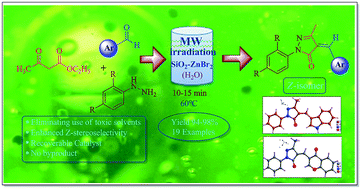
Pyrazolone derivatives are an important class of heterocyclic compounds as they play a vital role both in medicinal chemistry and in organic synthesis.3 These compounds exhibit remarkable pharmaceutical properties such as analgesic, antitubercular, antimicrobial, anti-inflammatory and antioxidant.4–8 Moreover compounds possessing pyrazolones moiety are gaining much importance especially in drug discovery programs9 and have been used as cardiotonics,10,11 anticancer (TELIN)12 and as potent inhibitors of the enzyme GSK3b.13 Pyrazolones are traditionally synthesized by treatment of δ-keto esters with hydrazine substrates under acidic conditions.14 A number of alternative methods have been documented in the literature for the synthesis of pyrazolone derivatives such as solid-state condensation,15 electrocatalytic procedure16 and ultrasonic irradiation technique17 for this synthesis. Moreover, Rajeev and co-workers reported its synthesis under microwave irradiation18 (Scheme 1). Various catalysts have also been used for the preparation of these compounds via the condensation reaction. These catalysts include acetic acid or piperidine,19 silica-bonded S-sulfonic acid,20 sodium dodecyl sulfate,21 CAN,22 and ETBA.23 Nowadays a great deal of interest has been placed towards the reactions in presence of water.24 Breslow and Lindström reported that hydrophobic effect of water is responsible for the organic reaction.25,26 Although the reported protocol has lots of significance in advance chemistry due to cheap, nontoxic and nonflammable nature of water, serves as environmentally benign solvent and good yields of the products, but long reaction time and solubility of the substrate makes it less applicable. Moreover the combination of water with microwaves has lead to the development of rapid, effective and environmentally benign synthetic methodologies.27 To the best of our knowledge silica supported zinc bromide (SiO2/ZnBr2) has not been used as a catalyst for the synthesis of 3-methyl-1-phenyl-1H-pyrazol-5(4H)-one derivatives. As a part of our research program on the development of new synthetic methods28–30 under the aspects of green chemistry, herein, we report for the first time the development of an efficient, economical and recyclable silica supported ZnBr2 promoted synthesis of pyrazolone derivatives in excellent yields via three component reaction of aromatic aldehydes, ethylacetoacetate and phenylhydrazine/2,4-dinitrophenylhydrazine (2,4-DNP) in water under microwave heating.
The SiO2/ZnBr2 catalyst has emerged as a promising heterogeneous solid catalyst for various organic transformations. Keivanloo et al. exploited SiO2/ZnBr2 for the synthesis of ynones31 by cross-coupling of acid chloride with terminal alkynes and synthesis of 4,5-disubstituted 1,2,3-(NH)-triazoles.32 Moreover, Kodomari and co-workers33 also reported the synthesis of triarylmethanes and 9,10-diarylanthracenes and Clark et al.34 reported bromination of aromatic substrate using SiO2/ZnBr2 catalyst. The catalyst possesses inherent environmentally benevolent properties such as non-toxicity, biocompatibility, physiological inertness, recyclability, inexpensiveness and thermal stability. The catalyst was prepared by employing standard procedures depicted in the literature31 and recycled up to six runs. The formation of SiO2/ZnBr2 system was evaluated by FT-IR, powder XRD and SEM-EDX analysis. The stability of the catalyst was shown by TGA/DTA analysis.
Formation of the catalytic system (SiO2/ZnBr2) was further confirmed by powder XRD analysis (Fig. 2). X-ray diffractograms (XRD) of the catalyst were recorded in the 2θ range of 20–80°. A single broad peak in the range of 2θ = 20–30° ascribed to the amorphous nature of silica. The characteristic diffraction peaks of pure ZnBr2 were reported to appear at 13.7°, 21.1°, 27.5°, 46.1° and 53.4°.36 The XRD analysis of SiO2/ZnBr2 exhibited diffraction peak for ZnBr2 only at 46.2° and 53.4°. However, the other characteristic peaks (21.1° and 27.5°) were merged with the broad peak of SiO2 (2θ = 20–30°). The appearance of these characteristics peaks indicating the dispersion of ZnBr2 on the silica material and thus confirming the formation of SiO2/ZnBr2 matrix.
SEM analysis was employed to study the surface morphology of the catalytic system (Fig. 3). SEM micrographs of the catalyst showed that the particles of ZnBr2 were well dispersed on silica surface. The 3D surface plot (Fig. S1) (ESI†) of pure silica and SiO2/ZnBr2 were provided to further verify the adsorption of ZnBr2 on silica surface. The white area of plot in Fig. S1(b)† confirmed the successful adsorption of ZnBr2 on the silica surface. The successful incorporation of zinc bromide was also confirmed by EDX analysis (Fig. 4). EDX spectrum showed the presence of Zn and Br in addition to O and Si elements.
The thermal stability of the catalyst was determined by TGA analysis (Fig. 5). The only weight loss of 16.94% in the range of 40–120 °C was attributed to loss of physically adsorbed water molecules in the silica gel framework. TGA is further supported by DTA analysis in which a prominent peak at 93.04 °C showed endothermic reaction which help in the removal of water molecule (Fig. 5). Further there is no weight loss upto 800 °C. Therefore it can be concluded that physiosorbed and chemisorbed ZnBr2 on silica surfaces is stable upto 800 °C.37
To optimize the best reaction condition for these transformations, we investigate the solvent effect, catalyst loading, effect of temperature and recyclability of the catalyst on the model reaction. Initially, indole-3-carbaldehyde (1a, 2 mmol), phenylhydrazine (2 mmol) and ethylacetoacetate (2 mmol) were refluxed in water (10 mL) at 60 °C without any catalyst. The reaction took a longer time period of 24 h to complete and afforded desired product 2a in less yield (Table 1, entry 1), signifying the need of a catalyst. The reaction was then studied in the presence of different catalysts such as AlCl3, ZnBr2, FeCl3, SiO2–Cl, SiO2/ZnBr2. Our analysis revealed that the catalytic activity of various catalysts in water at 60 °C was found to be in the order of SiO2/ZnBr2 > AlCl3 > FeCl3 > ZnBr2 > SiO2–Cl (Table 1, entries 2–6). To compare the efficiency as well as competence of the reactions under aqueous condition, the model reaction was also examined in the presence of SiO2/ZnBr2 in different solvents like MeOH, EtOH, CH3COOH, CH2Cl2, DMF and THF. The use of relatively less polar aprotic solvents CH2Cl2, DMF and THF yielded the product 2a in moderate yield (58–62%), after extended reaction time (Table 1, entries 10–12). However, in polar protic solvents MeOH, EtOH, and AcOH relatively high yield (65–70%) of the product 2a was obtained with dip in reaction time (Table 1, entries 7–9), whereas when reaction was performed in water in the presence of SiO2/ZnBr2, there was remarkable increase in the yield (86%) of the product 2a with prominent fall in reaction time (Table 1, entry 6). In order to further improve the protocol to make it more energy efficient we introduced microwaves. The use of microwaves (Anton Paar, Monowave 300) enhanced the protocol remarkably with high yield of the product 2a (98%) and short reaction period (10 min) (Table 1, entry 13).
| S. No. | Solvent | Condition | Timeb (h) | Yieldc (%) |
|---|---|---|---|---|
| a Reaction condition: indole-3-carbaldehyde (1a, 2 mmol), phenylhydrazine (2 mmol), and ethylacetoacetate (2 mmol), different solvent (10 mL), different catalyst (0.10 g).b Reaction progress monitored by TLC.c Isolated yield of products. | ||||
| 1 | Water | 60 °C, without catalyst | 24 h | 46 |
| 2 | Water | 60 °C, AlCl3 | 8 h | 56 |
| 3 | Water | 60 °C, ZnBr2 | 10 h | 52 |
| 4 | Water | 60 °C, FeCl3 | 12 h | 53 |
| 5 | Water | 60 °C, SiO2–Cl | 16 h | 51 |
| 6 | Water | 60 °C, SiO2/ZnBr2 | 4 h | 86 |
| 7 | MeOH | 60 °C, SiO2/ZnBr2 | 6 h | 65 |
| 8 | EtOH | 60 °C, SiO2/ZnBr2 | 8 h | 70 |
| 9 | CH3COOH | 60 °C, SiO2/ZnBr2 | 6 h | 68 |
| 10 | CH2Cl2 | 60 °C, SiO2/ZnBr2 | 10 h | 62 |
| 11 | DMF | 60 °C, SiO2/ZnBr2 | 14 h | 60 |
| 12 | THF | 60 °C, SiO2/ZnBr2 | 18 h | 58 |
| 13 | Water | 60 °C, SiO2/ZnBr2, MW | 10 min | 98 |
To achieve the optimum concentration of the catalyst, the model reaction (2a) was investigated at different concentrations 0.02–0.12 g (Table 2, entries 1–6) of the catalyst SiO2/ZnBr2 at 60 °C in water under MW. The best results were obtained with the use of 0.10 g of catalyst. Using less than 0.10 g of catalyst, moderate yields of the product 2a (66–83%) were obtained with extended reaction times, while increasing catalyst amount 0.10–0.12 g, there was no further increase in the yield of the product 2a, possibly due to the saturation of the catalyst. The above results signify that 0.10 g of SiO2/ZnBr2 is optimum dose in terms of efficient yield and reduced reaction time.
| Entry | Catalyst (g) | Timeb (min) | Yieldc (%) |
|---|---|---|---|
| a Reaction condition: indole-3-carbaldehyde (1a, 2 mmol), phenylhydrazine (2 mmol), and ethylacetoacetate (2 mmol), water (10 mL), SiO2/ZnBr2 (0.02–0.12 g), MW-60 °C.b Reaction progress monitored by TLC.c Isolated yield of products. | |||
| 1 | 0.02 | 35 | 60 |
| 2 | 0.04 | 30 | 68 |
| 3 | 0.06 | 28 | 75 |
| 4 | 0.08 | 25 | 83 |
| 5 | 0.10 | 10 | 98 |
| 6 | 0.12 | 10 | 98 |
To optimize the reaction temperature, the model reaction was carried out at different temperatures in water under microwave heating (Table 3, entries 1–7). It was observed that increase in temperature from 25 °C to 60 °C, has a noteworthy effect on the model reaction in terms of yield and reaction time (Table 3, entries 1–6). However, no further enhancement in the yield of product 2a was observed when the reaction temperature was raised from 60 °C to 65 °C (Table 3, entry 7).
| Entry | Temperature (°C) | Timeb (min) | Yieldc (%) |
|---|---|---|---|
| a Reaction condition: indole-3-carbaldehyde (1a, 2 mmol), phenylhydrazine (2 mmol), and ethylacetoacetate (2 mmol), water (10 mL), SiO2/ZnBr2 (0.10 g), MW, different temperature (25–65 °C).b Reaction progress monitored by TLC.c Isolated yield of products. | |||
| 1 | 25 | 75 | 72 |
| 2 | 40 | 50 | 74 |
| 3 | 45 | 35 | 78 |
| 4 | 50 | 30 | 84 |
| 5 | 55 | 25 | 88 |
| 6 | 60 | 10 | 98 |
| 7 | 65 | 10 | 98 |
After optimization of the reaction conditions, the catalyst SiO2/ZnBr2 was examined under the optimized reaction conditions using both conventional and microwave heating. A wide range of aromatic aldehydes reacted with ethylacetoacetate and phenylhydrazine to afford the target pyrazolone in excellent yields. We Further explored this devised protocol using 2,4-dinitrophenylhydrazine (2,4-DNP) to expand its product diversity and scope (Table 4). The catalyst showed good efficiency under conventional heating giving the products in 4–6 h. However, microwave induction produced excellent yields (94–98%) of products in 10–15 min. The above results demonstrate that SiO2/ZnBr2 is an efficient catalyst for the synthesis of wide range of pyrazolones in high yields under mild aqueous conditions.
| S. No. | Products | Conventional Methoda | Microwave irradiationb | ||
|---|---|---|---|---|---|
| Timec (h) | Yieldd (%) | Timec (min) | Yieldd (%) | ||
| a Reaction condition: differently substituted aromatic aldehydes 1(a–s) (2 mmol), phenylhydrazine/2,4-DNP (2 mmol), and ethylacetoacetate (2 mmol), water (10 mL), SiO2/ZnBr2 (0.10 g), 60 °C.b Reaction condition: differently substituted aromatic aldehydes 1(a–s) (2 mmol), phenylhydrazine/2,4-DNP (2 mmol), and ethylacetoacetate (2 mmol), water (10 mL), SiO2/ZnBr2 (0.10 g), MW-60 °C.c Reaction progress monitored by TLC.d Isolated yield of the products. | |||||
| 2a | ![]() |
4 | 81 | 10 | 98 |
| 2b | ![]() |
4.5 | 77 | 10 | 95 |
| 2c | ![]() |
4.5 | 80 | 15 | 98 |
| 2d | ![]() |
4 | 84 | 10 | 98 |
| 2e | ![]() |
5 | 78 | 15 | 95 |
| 2f | ![]() |
4.5 | 82 | 15 | 96 |
| 2g | ![]() |
6 | 79 | 15 | 94 |
| 2h | ![]() |
5.0 | 76 | 15 | 95 |
| 2i | ![]() |
5.5 | 81 | 10 | 97 |
| 2j | ![]() |
6.0 | 74 | 15 | 94 |
| 2k | ![]() |
4 | 83 | 10 | 97 |
| 2l | ![]() |
4.5 | 75 | 10 | 94 |
| 2m39 | ![]() |
5.5 | 84 | 10 | 98 |
| 2n39 | ![]() |
5 | 76 | 15 | 96 |
| 2o40 | ![]() |
6 | 74 | 15 | 94 |
| 2p41 | ![]() |
4.5 | 78 | 10 | 97 |
| 2q40 | ![]() |
5 | 76 | 15 | 95 |
| 2r40 | ![]() |
4 | 82 | 10 | 98 |
| 2s41 | ![]() |
5.5 | 75 | 15 | 94 |
N and C
O groups, resonating at around 1578–1603 cm−1 and 1680–1700 cm−1, respectively, which signifies the formation of a pyrazolone ring. Characteristic peaks for the different functional groups such as methoxy, nitro and hydroxyl etc. have been discussed in Experimental section. In 1H NMR spectrum, each compound displayed a sharp singlet at around δ 7.32–7.99 ascribed to the olefinic proton, a broad singlet at around 12.02–12.46 (D2O exchangeable) has been ascribed to –NH proton of indole ring. Similarly, a sharp singlet at around 9.32–9.82 corresponds to the H-2 proton of indole ring (2a–2c). Furthermore, sharp singlets resonating at around δ 10.64, 10.04, 10.12, 10.10 each integrating for one proton, has been attributed to H-2 protons of γ-pyrone ring of chromones 2d, 2e, 2f and 2g respectively. 13C NMR spectra, showed a series of signals resonating at around δ 105.13–162.18 which have been assigned to aromatic carbons, peaks resonating at around δ 137.31–153.80 and δ 163.05–170.16 corresponds to –C
N and –C
O moiety of pyrazolone ring, respectively. Similarly signals at δ 174.19–174.69 have been attributed to carbonyl group (C
Oγ-pyrone) of compounds (2d–2h). The mass spectral analysis of the synthesized compounds was also in good conformity with the proposed structures. The selective Z-geometry across C
C was authenticated by single crystal X-ray crystallographic analysis of compound 2a and 2d (Fig. 6), which was found to be stabilized by an intricate array of H-bonding (Fig. 7) and π⋯π interactions (Fig. 8). The crystallographic data of compound 2a and 2d have been presented in Table 5. Moreover, the selected bond distances (Å), bond angles (°) and packing diagram of compound 2a and 2d are shown in Tables S1 and S2 and Fig. S2–S4 (ESI†).
![]() | ||
| Fig. 6 Asymmetric unit showing thermal ellipsoids (50% probability level) of (a) compound 2a (b) compound 2d. | ||
![]() | ||
| Fig. 8 Diagrammatic representation of π⋯π interactions in (a) compound 2a, π⋯π and –CH …π interactions in (b) compound 2d. | ||
| Parameters | Compound 2a | Compound 2d |
|---|---|---|
| a GOF is defined as {∑[w(Fo2 − Fc2)]/(n − p)}1/2 where n is the number of data and p is the number of parameters.b R = {∑||Fo| − |Fc||/∑|Fo|}, wR2 = {∑w(Fo2 − Fc2)2/∑w(Fo2)2}1/2. | ||
| Empirical formula | C19H15N3O | C20H14N2O3 |
| Formula wt | 301.34 | 330.33 |
| Crystal system | Monoclinic | Triclinic |
| Space group | P21/n | P![]() |
| a, Å | 5.810(5) | 7.870(5) |
| b, Å | 9.256(5) | 8.298(3) |
| c, Å | 26.893(5) | 11.843(5) |
| α (°) | 90 | 85.806(4) |
| β (°) | 94.997(5) | 80.900(5) |
| γ (°) | 90 | 89.987(5) |
| U, Å3 | 1440.7(15) | 761.6(7) |
| Z | 4 | 2 |
| ρcalc Mg m−3 | 1.389 | 1.441 |
| μ, mm−1 | 0.089 | 0.099 |
| Temperature (K) | 100 | 100 |
| θ max | 25.50 | 25.50 |
| F(000) | 632 | 344 |
| Refl. collected | 11 010 |
9548 |
| Independent refl. | 2087 | 2314 |
| GOFa | 1.038 | 1.037 |
| Final Rb indices [I > 2σ(I)] | R1 = 0.0501 wR2 = 0.1268 | R1 = 0.0402 wR2 = 0.0970 |
| R indices (all data) | R1 = 0.0675 wR2 = 0.1380 | R1 = 0.0524 wR2 = 0.1038 |
:
2) mixture as mobile phase and exposed to iodine vapors to check the homogeneity as well as the progress of the reaction.
Caromatic), 1594 (C
N), 1680 (C
O). 1H NMR (400 MHz, DMSO-d6, δ, ppm): 7.19–7.96 (m, 5H, phenyl ring), 7.9 (s, 1H, –C
H), 12.46 (brs, 1H, –NH, D2O exchangeable), 7.14–7.67 (m, 4H, indole ring), 2.39 (s, 3H, –CH3), 9.82 (s, 1H, indole ring). 13C NMR (100 MHz, DMSO-d6, δ, ppm): 165.65 (C
O), 133.44 (C
C), 147.89 (–C
N), 143.23 (–C
H), 118.24–140.54 (phenyl ring), 111.64–137.65 (indole ring), 12.93 (CH3). Analytical cal. C19H15N3O: C, 75.73; H, 5.02; N, 13.94; found: C, 75.70; H, 5.03; N, 13.96. MS (EI): (m/z) [M+˙] 301.12.
Caromatic), 1578 (C
N), 1685 (C
O). 1H NMR (400 MHz, DMSO-d6, δ, ppm): 7.23–7.98 (m, 5H, phenyl ring), 7.83 (s, 1H, –C
H), 11.22 (brs, 1H, –NH, D2O exchangeable), 6.86–7.17 (m, 3H, indole ring), 2.31 (s, 3H, –CH3), 9.70 (s, 1H, indole ring), 10.20 (s, 1H, –OH, D2O exchangeable). 13C NMR (100 MHz, DMSO-d6, δ, ppm): 165.63 (C
O), 133.44 (C
C), 147.89 (–C
N), 143.23 (–C
H), 118.20–140.51 (phenyl ring), 111.64–137.65 (indole ring), 13.15 (CH3). Analytical cal. C19H15N3O2: C, 71.91; H, 4.76; N, 13.24; found: C, 71.90; H, 4.79; N, 13.22. MS (EI): (m/z) [M+˙] 317.12.
Caromatic), 1603 (C
N), 1688 (C
O). 1H NMR (400 MHz, DMSO-d6, δ, ppm): 7.26–7.91 (m, 5H, phenyl ring), 7.71 (s, 1H, –C
H), 12.02 (brs, 1H, –NH, D2O exchangeable), 6.89–7.27 (m, 3H, indole ring), 2.31 (s, 1H, –CH3), 9.32 (s, 1H, indole ring). 13C NMR (100 MHz, DMSO-d6, δ, ppm): 164.55 (C
O), 133.04 (C
C), 146.87 (–C
N), 142.13 (–C
H), 116.24–142.54 (phenyl ring), 112.64–135.65 (indole ring), 14.23 (CH3). Analytical cal. C20H17N3O: C, 76.17; H, 5.43; N, 13.32; found: C, 76.18; H, 5.40; N, 13.34. MS (EI): (m/z) [M+˙] 317.12.
Caromatic), 1600 (C
N), 1692 (C
O). 1H NMR (400 MHz, DMSO-d6, δ, ppm): 7.12–7.34 (m, 5H, phenyl ring), 7.99 (s, 1H, –C
H), 10.64 (s, 1H, γ-pyrone ring), 8.19–7.27 (m, 4H, chromone ring), 2.33 (s, 1H, –CH3). 13C NMR (100 MHz, DMSO-d6, δ, ppm): 163.35 (C
O), 134.67 (C
C, C-1′), 137.81 (–C
N), 155.47 (–C
H, C-2′), 118.38–142.54 (phenyl ring), 150.67 (C-2, γ-pyrone ring), 118.54 (C-3), 174.29 (C-4, C
O, γ-pyrone ring) 14.23 (CH3), 123.10 (C-4a), 125.75 (C-5), 124.56 (C-6), 135.92 (C-7), 117.59 (C-8), 161.83 (C-8b). Analytical cal. C20H14N2O3: C, 72.72; H, 4.27; N, 8.48; found: C, 72.70; H, 4.30; N, 8.47. MS (EI): (m/z) [M+˙] 330.10.
Caromatic), 1598 (C
N), 1699 (C
O). 1H NMR (400 MHz, DMSO-d6, δ, ppm): 7.10–7.31 (m, 5H, phenyl ring), 7.69 (s, 1H, –C
H), 10.04 (s, 1H, γ-pyrone ring), 8.09–7.20 (m, 3H, chromone ring), 2.30 (s, 1H, –CH3). 13C NMR (100 MHz, DMSO-d6, δ, ppm): 163.05 (C
O), 134.17 (C
C, C-1′), 137.61 (–C
N), 155.27 (–C
H, C-2′), 118.21–142.24 (phenyl ring), 150.22 (C-2, γ-pyrone ring), 118.74 (C-3), 174.19 (C-4, C
O, γ-pyrone ring), 14.13 (CH3), 123.18 (C-4a), 125.32 (C-5), 124.56 (C-6), 135.52 (C-7), 117.49 (C-8), 161.53 (C-8b). Analytical cal. C21H16N2O3: C, 73.24; H, 4.68; N, 8.13; found: C, 73.26; H, 4.69; N, 8.10. MS (EI): (m/z) [M+˙] 344.12.
Caromatic), 1599 (C
N), 1696 (C
O). 1H NMR (400 MHz, DMSO-d6, δ, ppm): 7.02–7.11 (m, 5H, phenyl ring), 7.72 (s, 1H, –C
H), 10.12 (s, 1H, γ-pyrone ring), 8.07–7.23 (m, 3H, chromone ring), 2.31 (s, 1H, –CH3). 13C NMR (100 MHz, DMSO-d6, δ, ppm): 163.25 (C
O), 134.19 (C
C, C-1′), 137.41 (–C
N), 155.23 (–C
H, C-2′), 118.27–142.21 (phenyl ring), 150.29 (C-2, γ-pyrone ring), 118.64 (C-3), 174.69 (C-4, C
O, γ-pyrone ring), 14.18 (CH3), 123.38 (C-4a), 125.30 (C-5), 124.52 (C-6), 135.56 (C-7), 117.41 (C-8), 161.50 (C-8b). Analytical cal. C20H13FN2O3: C, 68.96; H, 3.76; N, 8.04; found: C, 68.97; H, 3.78; N, 8.01. MS (EI): (m/z) [M+˙] 348.09.
Caromatic), 1580 (C
N), 1699 (C
O). 1H NMR (400 MHz, DMSO-d6, δ, ppm): 7.42–7.18 (m, 5H, phenyl ring), 7.76 (s, 1H, –C
H), 10.10 (s, 1H, γ-pyrone ring), 8.03–7.21 (m, 3H, chromone ring), 2.35 (s, 1H, –CH3). 13C NMR (100 MHz, DMSO-d6, δ, ppm): 163.23 (C
O), 133.19 (C
C, C-1′), 137.31 (–C
N), 155.54 (–C
H, C-2′), 118.19–142.29 (phenyl ring), 150.24 (C-2, γ-pyrone ring), 118.64 (C-3), 174.47 (C-4, C
O, γ-pyrone ring), 14.22 (CH3), 123.34 (C-4a), 125.39 (C-5), 120.41(C-6), 135.36 (C-7), 117.46 (C-8), 161.76 (C-8b). Analytical cal. C20H13BrN2O3: C, 58.70; H, 3.20; N, 6.85; found: C, 58.71; H, 3.22; N, 6.82. MS (EI): (m/z) [M+˙] 408.01.
Caromatic), 1580 (C
N), 1681 (C
O). 1H NMR (400 MHz, DMSO-d6, δ, ppm): 7.32–7.17 (m, 5H, phenyl ring), 7.72 (s, 1H, –C
H), 8.57 (s, 2H, –NH, D2O exchangeable), 8.08–7.27 (m, 4H, chromone ring), 2.33 (s, 1H, –CH3). 13C NMR (100 MHz, DMSO-d6, δ, ppm): 163.28 (C
O), 133.29 (C
C, C-1′), 137.38 (–C
N), 155.34 (–C
H, C-2′), 118.25–142.37 (phenyl ring), 170.24 (C-2, γ-pyrone ring), 118.61 (C-3), 174.41 (C-4, C
O, γ-pyrone ring), 14.22 (CH3), 123.28 (C-4a), 125.33 (C-5), 123.41(C-6), 135.16 (C-7), 117.26 (C-8), 161.66 (C-8b). Analytical cal. C20H15N3O3: C, 69.56; H, 4.38; N, 12.17; found: C, 69.53; H, 4.39; N, 12.19. MS (EI): (m/z) [M+˙] 345.11.
Caromatic), 1578 (C
N), 1700 (C
O). 1H NMR (400 MHz, DMSO-d6, δ, ppm): 7.19–7.97 (m, 5H, phenyl ring), 7.32 (s, 1H, –C
H), 7.28–7.32 (m, 3H, phenyl ring), 2.31 (s, 1H, –CH3), 3.38 (s, 6H, 2 × –OCH3). 13C NMR (100 MHz, DMSO-d6, δ, ppm): 163.26 (C
O), 133.22 (C
C, C-1′), 155.14 (–C
H, C-2′), 137.32 (–C
N), 118.21–142.39 (phenyl ring), 128.24 (C-1), 115.23 (C-2), 148.61 (C-3), 149.41 (C-4), 111.74 (C-5), 122.25 (C-6), 14.62 (CH3), 56.06 (O–CH3). Analytical cal. C19H18N2O3: C, 70.79; H, 5.63; N, 8.69; found: C, 70.71; H, 5.60; N, 8.71. MS (EI): (m/z) [M+˙] 322.13.
Caromatic), 1600 (C
N), 1691 (C
O). 1H NMR (400 MHz, DMSO-d6, δ, ppm): 7.19–7.97 (m, 5H, phenyl ring), 7.35 (s, 1H, –C
H), 7.12 (s, 2H, phenyl ring), 2.32 (s, 1H, –CH3), 3.34 (s, 9H, 3 × –OCH3). 13C NMR (100 MHz, DMSO-d6, δ, ppm): 163.28 (C
O), 133.29 (C
C, C-1′), 155.39 (–C
H, C-2′), 137.38 (–C
N), 118.52–142.29 (phenyl ring), 129.24 (C-1), 105.13 (C-2 and C-6), 154.11 (C-3 and C-4), 134.34 (C-5), 14.89 (CH3), 56.36 (O–CH3). Analytical cal. C20H20N2O4: C, 68.17; H, 5.72; N, 7.95; found: C, 68.20; H, 5.70; N, 7.94. MS (EI): (m/z) [M+˙] 352.14.
Caromatic), 1578 (C
N), 1687 (C
O), 1522, 1365 (NO2). 1H NMR (400 MHz, DMSO-d6, δ, ppm): 7.20–7.99 (m, 5H, phenyl ring), 7.49 (s, 1H, –C
H), 8.12 (d, 2H, C-2 and C-6), 8.18 (d, 2H, C-3 and C-5), 2.36 (s, 1H, –CH3). 13C NMR (100 MHz, DMSO-d6, δ, ppm): 163.25 (C
O), 128.21 (C
C, C-1′), 145.69 (–C
H, C-2′), 145.88 (–C
N), 118.12–142.22 (phenyl ring), 139.24 (C-1), 132.17 (C-2 and C-6), 124.18 (C-3 and C-4), 148.14 (C-5), 15.09 (CH3). Analytical cal. C17H13N3O3: C, 66.44; H, 4.26; N, 13.67; found: C, 66.41; H, 4.28; N, 13.68. MS (EI): (m/z) [M+˙] 307.10.
Caromatic), 1579 (C
N), 1693 (C
O), 1520, 1360 (NO2). 1H NMR (400 MHz, DMSO-d6, δ, ppm): 7.22–7.95 (m, 5H, phenyl ring), 7.47 (s, 1H, –C
H), 7.67–8.42 (m, 4H, phenyl ring), 2.32 (s, 1H, –CH3). 13C NMR (100 MHz, DMSO-d6, δ, ppm): 163.29 (C
O), 127.23 (C
C, C-1′), 144.63 (–C
H, C-2′), 146.98 (–C
N), 118.15–142.32 (phenyl ring), 133.34 (C-1), 125.17 (C-2), 147.08 (C-3), 123.08 (C-4), 128.18 (C-5), 123.36 (C-6), 15.19 (CH3). Analytical cal. C17H13N3O3: C, 66.44; H, 4.26; N, 13.67; found: C, C, 66.41; H, 4.27; N, 13.69. MS (EI): (m/z) [M+˙] 307.10.
Caromatic), 1591 (C
N), 1689 (C
O). 1H NMR (400 MHz, DMSO-d6, δ, ppm): 7.13–7.97 (m, 5H, phenyl ring), 7.58 (s, 1H, –C
H), 2.30 (s, 1H, –CH3), 6.84–8.66 (m, 4H, phenyl ring), 3.13 (s, 1H, 2 × CH3). 13C NMR (100 MHz, DMSO-d6, δ, ppm): 170.16 (C
O), 128.69 (C
C, C-1′), 151.56 (–C
H, C-2′), 153.80. (–C
N), 118.09–138.84 (phenyl ring), 123.92 (C-1), 137.43 (C-2 and C-6), 111.32 (C-3 and C-5), 148.18 (C-4), 15.19 (CH3), 41.28 (N–CH3). Analytical cal. C19H19N3O: C, 74.73; H, 6.27; N, 13.76; found: C, 74.70; H, 6.28; N, 13.78. MS (EI): (m/z) [M+˙] 305.15.
Caromatic), 1593 (C
N), 1697 (C
O). 1H NMR (400 MHz, DMSO-d6, δ, ppm): 7.19–7.97 (m, 5H, phenyl ring), 7.42 (s, 1H, –C
H), 2.34 (s, 1H, –CH3), 7.14–7.86 (m, 4H, phenyl ring). 13C NMR (100 MHz, DMSO-d6, δ, ppm): 168.12 (C
O), 127.60 (C
C, C-1′), 145.50 (–C
H, C-2′), 148.85. (–C
N), 118.02–139.81 (phenyl ring), 128.91 (C-1), 132.03 (C-2 and C-6), 115.36 (C-3 and C-5), 162.18 (C-4), 15.02 (CH3). Analytical cal. C17H13FN2O: C, 72.85; H, 4.67; N, 9.99; found: C, 72.82; H, 4.69; N, 10.00. MS (EI): (m/z) [M+˙] 280.10.
Caromatic), 1597 (C
N), 1686 (C
O), 1528, 1368 (NO2). 1H NMR (400 MHz, DMSO-d6, δ, ppm): 8.20–9.08 (m, 3H, phenyl ring), 7.42 (s, 1H, –C
H), 2.36 (s, 1H, –CH3), 7.40–7.66 (m, 5H, phenyl ring). 13C NMR (100 MHz, DMSO-d6, δ, ppm): 170.12 (C
O), 126.69 (C
C, C-1′), 150.56 (–C
H, C-2′), 150.80. (–C
N), 120.14–144.09 (phenyl ring), 123.02 (C-1), 136.43 (C-2 and C-6), 111.48 (C-3 and C-5), 148.88 (C-4), 15.20 (CH3). Analytical cal. C17H12N4O5: C, 57.96; H, 3.43; N, 15.90; found: C, 57.93; H, 3.45; N, 15.91. MS (EI): (m/z) [M+˙] 352.08.
Caromatic), 1593 (C
N), 1700 (C
O), 1520, 1360 (NO2). 1H NMR (400 MHz, DMSO-d6, δ, ppm): 8.22–9.02 (m, 3H, phenyl ring), 7.54 (s, 1H, –C
H), 7.68–8.30 (m, 4H, phenyl ring), 2.34 (s, 1H, –CH3). 13C NMR (100 MHz, DMSO-d6, δ, ppm): 164.20 (C
O), 127.10 (C
C, C-1′), 144.03 (–C
H, C-2′), 146.99 (–C
N), 120.15–145.32 (phenyl ring), 133.04 (C-1), 124.17 (C-2), 147.88 (C-3), 123.28 (C-4), 128.28 (C-5), 122.06 (C-6), 15.20 (CH3). Analytical cal. C17H11N5O7: C, 51.39; H, 2.79; N, 17.63; found: C, 51.36; H, 2.80; N, 17.65. MS (EI): (m/z) [M+˙] 397.30.
Caromatic), 1594 (C
N), 1688 (C
O), 1522, 1362 (NO2). 1H NMR (400 MHz, DMSO-d6, δ, ppm): 8.20–9.04 (m, 3H, phenyl ring), 7.46 (s, 1H, –C
H), 7.20–7.31 (m, 3H, phenyl ring), 2.32 (s, 1H, –CH3), 3.36 (s, 6H, 2 × –OCH3). 13C NMR (100 MHz, DMSO-d6, δ, ppm): 164.26 (C
O), 130.22 (C
C, C-1′), 150.14 (–C
H, C-2′), 139.32 (–C
N), 120.21–144.39 (phenyl ring), 128.14 (C-1), 115.53 (C-2), 148.68 (C-3), 149.45 (C-4), 111.72 (C-5), 122.25 (C-6), 14.88 (CH3), 56.02 (O–CH3). Analytical cal. C19H16N4O7: C, 55.34; H, 3.91; N, 13.59; found: C, 55.31; H, 3.93; N, 13.60. MS (EI): (m/z) [M+˙] 412.10.
Caromatic), 1593 (C
N), 1691 (C
O), 1526, 1361 (NO2). 1H NMR (400 MHz, DMSO-d6, δ, ppm): 8.28–9.01 (m, 3H, phenyl ring), 7.49 (s, 1H, –C
H), 2.32 (s, 1H, –CH3), 6.80–8.46 (m, 4H, phenyl ring), 3.10 (s, 1H, 2 × CH3). 13C NMR (100 MHz, DMSO-d6, δ, ppm): 170.12 (C
O), 126.69 (C
C, C-1′), 150.56 (–C
H, C-2′), 150.80. (–C
N), 120.14–144.09 (phenyl ring), 123.02 (C-1), 136.43 (C-2 and C-6), 111.48 (C-3 and C-5), 148.88 (C-4), 15.20 (CH3), 41.31 (N–CH3). Analytical cal. C19H17N5O5: C, 57.72; H, 4.33; N, 17.71; found: C, 57.73; H, 4.30; N, 17.73. MS (EI): (m/z) [M+˙] 395.12.
Caromatic), 1598 (C
N), 1698 (C
O), 1526, 1360 (NO2). 1H NMR (400 MHz, DMSO-d6, δ, ppm): 7.96–7.98 (m, 3H, phenyl ring), 7.42 (s, 1H, –C
H), 2.36 (s, 1H, –CH3), 7.18–7.80 (m, 4H, phenyl ring). 13C NMR (100 MHz, DMSO-d6, δ, ppm): 169.10 (C
O), 127.60 (C
C, C-1′), 145.50 (–C
H, C-2′), 148.85. (–C
N), 120.23–145.84 (phenyl ring), 128.91 (C-1), 132.00 (C-2 and C-6), 115.31 (C-3 and C-5), 162.18 (C-4), 15.01 (CH3). Analytical cal. C17H11FN4O5: C, 55.14; H, 2.99; N, 15.13; found: C, 55.15; H, 2.96; N, 15.15. MS (EI): (m/z) [M+˙] 370.07.Footnote |
| † Electronic supplementary information (ESI) available. CCDC 1409997 and 1432605. For ESI and crystallographic data in CIF or other electronic format see DOI: 10.1039/c5ra21146h |
| This journal is © The Royal Society of Chemistry 2016 |