
Yanhui Wang,
Huimin Duan,
Leilei Li,
Xiaojiao Wang,
Jianbo Li,
Yanan Bu and
Chuannan Luo*
Key Laboratory of Chemical Sensing & Analysis in Universities of Shandong (University of Jinan), School of Chemistry and Chemical Engineering, University of Jinan, Jinan 250022, China. E-mail: chm_yfl518@163.com; Tel: +86 0531 89736065
First published on 20th January 2016
In this paper, a new chemiluminescence (CL) sensor possessing high selectivity and sensitivity was established for determination of lysozyme using magnetic graphene oxide–multi-walled carbon nanotube surface molecularly imprinted polymer (MGO–MWCNTs/SMIP). The MGO–MWCNTs/SMIP was characterized by X-ray diffraction (XRD), Fourier transform infrared (FT-IR) spectroscopy and scanning electron microscopy (SEM), and the maximum adsorption capacity of MGO–MWCNTs/SMIP to lysozyme was found to be 140 mg g−1. The MGO–MWCNTs/SMIP was fixed into a glass tube and was connected to a chemiluminescent analyzer. Then a MGO–MWCNTs/SMIP-flow injection chemiluminescence (MGO–MWCNTs/SMIP-CL) sensor based on a luminol–NaOH–H2O2 CL system was established for the determination of lysozyme. The proposed sensor with high selectivity and sensitivity responded linearly to the concentration of lysozyme over the range 5.04 × 10⁻⁹ to 4.27 × 10⁻⁷ g mL−1 and the detection limit was 1.90 × 10⁻⁹ g mL−1 (3δ). The recoveries ranged from 98% to 111% when determining lysozyme in eggs and the result was satisfactory. The advantageous properties of sensor hold the potential to be applied in protein analysis, analogizing to biological analysis.
Flow injection (FI) is a rapid online analytical technique.15 Chemiluminescence (CL) technology has the advantages of high sensitivity and a wide linear range.16 FI-CL was established with a combination of these two methods. This method has the merits of high sensitivity and wide linear range,17 and it is widely used in biology,18 pharmacy,19 environmental science,20 and many other areas. Because of poor selectivity, FI-CL could not be directly used for analyzing complex samples.
The combination of SMIP with high specific recognition and FI-CL with high-sensitivity in establishing a novel sensor has great significance. Interference from coexisting substances and complex sample matrices was eliminated. Thereby, the anti-jamming capability of surface molecular imprinting chemiluminescence (SMIP-CL) analysis was substantially strengthened.
In this work, using MGO–MWCNTs as the supporting material, the lysozyme MGO–MWCNTs/SMIP was obtained. Owing to the presence of MWCNTs, the specific surface area of GO was increased obviously and the number of sites of action was increased accordingly. In addition, the agglomeration of GO was reduced by the existence of MWCNTs. With the advantages of easy separation of magnetic Fe3O4 nanoparticles, high adsorption ability of GO–MWCNTs and excellent specificity recognition of SMIP, the overall performance of MGO–MWCNTs/SMIP was increased dramatically. Subsequently, the adsorption properties of the polymers were studied. Then, the MGO–MWCNTs/SMIP-CL sensor was constructed with high selectivity and high sensitivity and an FI-CL analytical sensor for determination of lysozyme was established.
GO–MWCNTs composites were obtained by using a previously reported procedure22 with modification. 1.0 g of MWCNTs was dissolved in 70 mL of HNO3 solution (65–68 wt%). The suspension was stirred and refluxed for 11 h and the temperature was kept below 75 °C. The product was washed with distilled water until the pH = 6.5. The product was dried under a vacuum for 10 h at 80 °C. 0.3 g of GO was stripped in 80 mL of ethanol–water mixture (v
:
v = 1
:
1) for less than 3 h by sonication. 0.4 g of acidified MWCNTs was added to the alcohol–water solution at room temperature. Then, the mixed solution was sonicated for 30 min. The solution was transferred to a 200 mL Teflon-lined stainless steel autoclave and maintained at 200 °C for 6 h. Thereafter, the product was cooled to room temperature. A black cylindrical product was achieved and washed seven times with ethanol. Finally, the product of GO–MWCNTs was obtained after drying at 60 °C under vacuum.
MGO–MWCNTs composites were synthesized by using a previously reported procedure.23 50 mg of GO–MWCNTs was dissolved in 30 mL of ultrapure water and ultrasonicated for 0.5 h to disperse. 50 mg of FeCl3 and 35 mg of FeCl2 were added into this solution and supplemented with 20 mL of ultrapure water. Under the protection of N2, the solution was stirred and heated at 90 °C. NH3·H2O (28%) was added into the solution until the pH = 9.0 and the solution was heated with stirring for 0.5 h. The solution was separated with a magnet after heating and cooling to room temperature, washed twice with ethanol and dried in a vacuum oven.
In this experiment, 0.3 g of magnetic nanoparticles was added into a mixed solution (2 mL MPS and 20 mL anhydrous toluene). Under the protection of N2, the solution was refluxed for 12 h. Finally, the product was collected by an external magnetic field, washed with ultrapure water and the silane modification product was obtained.
Subsequently, 16 mg of N,N-methylene bisacrylamide, 32.6 mg of acrylamide, 0.1 mL of methacrylate, 0.1 mL of DMAEMA, 0.1 mL of EGDMA, 32 mg of lysozyme and 25 mL of phosphate buffer solution (PBS, pH = 7.47, c: 0.01 mol L−1) were added into a 250 mL iodine flask and sonicated. Then, 120 mg of MGO–MWCNTs was dissolved in 15 mL of ethanol and 5 mL of PBS solution by ultrasonication. Then, the two solutions were mixed quickly and shaken for 1 h at 25 °C, then 30 mg of (NH4)2S2O8, 0.4 mL of N,N,N,N,-tetramethylethylenediamine and 15 mg of FeSO4 were added into this solution. Subsequently, the solution was shaken under nitrogen protection for 2 h at 25 °C. The product was washed twice with distilled water. In order to remove the unreacted monomers and the template molecule, the product was washed with NaCl (0.5 mol L−1) solution under ultrasonication. In the next step, to remove excess NaCl, the product was washed twice with distilled water and dried at 60 °C.
The MGO–MWCNTs/SNIP was obtained in the same way without the addition of lysozyme. The preparation process for MGO–MWCNTs/SMIP is shown in Fig. 2.
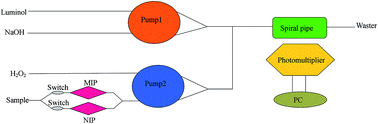
(1) Enrichment of lysozyme. Deputy pump (pump 1) stopped working. The injection valve was in the sampling position and the main pump (pump 2) transferred the lysozyme solution flowing through the column of MGO–MWCNTs/SMIP for 60 s. The lysozyme was absorbed by MGO–MWCNTs/SMIP.
(2) Removing of residual impurities. Pump 1 stopped working, the injection valve was at the sampling location and pump 2 transferred water to wash away other substances except for lysozyme.
(3) Determination of lysozyme. Pumps 2 and 1 were started and the injector valve was in the injection position. H2O2 and luminol solution flowed together in the column of MGO–MWCNTs/SMIP for 50 s and reacted with lysozyme, which generated a CL signal.
(4) Cleaning of the MGO–MWCNTs/SMIP column. Pump 1 stopped working and the injection valve was in the sampling position. The main pump transferred water through the column of MGO–MWCNTs/SMIP for 70 s. The residue was washed away from the column of MGO–MWCNTs/SMIP for the test again.
In the spectrum of MGO–MWCNTs, the peak at 3445 cm−1 is the telescopic symmetrical characteristic peak of –OH. 1735 cm−1 is the characteristic peak of carboxyl. The peak at 620 cm−1 is the characteristic peak of Fe3O4, which gives evidence of the successful preparation of the MGO–MWCNTs. In the spectrum of MGO–MWCNTs/SMIP, peaks at 1385 cm−1 (the characteristic peak of –CH3), 1465 cm−1 (the characteristic peak of –CH2) and 1533 cm−1 (the characteristic peak of –NH–) were able to justify the preparation of the SMIP. Compared to MGO–MWCNTs/SNIP, the characteristic peak at 3000 cm−1 has an obvious displacement effect from hydrogen bonding. The results prove that hydrogen bonding exists in the synthesized SMIP.
X-ray diffraction (XRD) measurements were employed to investigate the phase and structures of GO, MWCNTs, MGO–MWCNTs and Fe3O4. As shown in Fig. 4a, the GO showed a characteristic peak at 2θ = 10.9°, showing that the GO was synthesized successfully.24 Fig. 4b shows the typical XRD patterns of the MWCNTs and a sharp peak was located at 2θ = 26°. The peaks in Fig. 4d at 2θ values of 30.2°, 35.5°, 43.2°, 53.6°, 57.1° and 62.7° were consistent with the standard XRD data of Fe3O4. All characteristic peaks of GO, MWCNTs and Fe3O4 are included in Fig. 4c, which gives evidence of the successful preparation of the MGO–MWCNTs.
Fig. 5 shows the SEM images of the obtained GO, GO–MWCNTs and MGO–MWCNTs. As shown in Fig. 5, the GO (a) presents a sheet-like structure, smooth surface, and wrinkled edge. In addition, GO and MWCNTs were uniformly intertwined, as shown in Fig. 5b. It proves that GO–MWCNTs were synthesized successfully and Fe3O4 had coated onto the GO–MWCNTs surface, as shown in Fig. 5c.25 The MGO–MWCNTs/SMIP shown in Fig. 5d and MGO–MWCNTs/SNIP shown in Fig. 5e are nanoparticles and the roughness of the surface was different. The MGO–MWCNTs/SMIP contains cavities of lysozyme and the surface of the particles is rough, and MGO–MWCNTs/SNIP is smooth without imprinted cavities. The MGO–MWCNTs/SMIP was prepared with imprinted cavities.
![]() | ||
| Fig. 5 SEM images of the obtained GO (a), GO–MWCNTs (b), MGO–MWCNTs (c), MGO–MWCNTs/SMIP (d) and MGO–MWCNTs/SMIP (e). | ||
The BET surface areas of MGO–MWCNTs/SMIP and MGO–MWCNTs/SMIP were determined from Barrett–Joyner–Halenda (BJH) analysis of the isotherms. The surface area of MGO–MWCNTs/SNIP was 24.214 m2 g−1 and the surface area of MGO–MWCNTs/SMIP was 57.295 m2 g−1. Obviously, the surface area of MGO–MWCNTs/SMIP was larger than that of MGO–MWCNTs/SNIP.
![]() | ||
| Fig. 6 Adsorption dynamics curve of MGO–MWCNTs/SMIP and MGO–MWCNTs/SNIP (a); adsorption concentration curve of MGO–MWCNTs/SMIP and MGO–MWCNTs/SNIP (b). | ||
Fig. 6b shows the adsorption capacity of MGO–MWCNTs/SMIP molecules and MGO–MWCNTs/SNIP molecules, and the adsorption capacity increased with the increasing concentration of lysozyme. In addition, when the lysozyme concentration reached a certain level, the adsorption capacity of the MGO–MWCNTs/SMIP and MGO–MWCNTs/SNIP would not increase. However, the adsorption capacity of MGO–MWCNTs/SNIP (95 mg g−1) is much lower than the adsorption amount of MGO–MWCNTs/SMIP (140 mg g−1). This is owing to there being no imprinted cavities in MGO–MWCNTs/SNIP, so only MGO and MWCNTs were involved in the adsorption of lysozyme. However, not only MGO and MWCNTs were involved in the adsorption of lysozyme in MGO–MWCNTs/SMIP; the MGO–MWCNTs/SMIP molecule also has a specific recognition cavity for lysozyme, which increases the adsorption capacity of SMIP further. Therefore, the differences between MGO–MWCNTs/SMIP and MGO–MWCNTs/SNIP in adsorption appeared. In addition, a large hydrophobic groove (the active site of lysozyme) is present on the surface of lysozyme and there are a large number of amino and carboxyl groups on the surface of lysozyme. Therefore, lysozyme can interact with many small molecules. Therefore, the nonspecific adsorption of lysozyme is serious and the adsorption capacity of MGO–MWCNTs/SMIP is only 50% higher than that of MGO–MWCNTs/SNIP.
The experimental results are shown in Fig. 7. The FI-CL signal was greatly affected by the concentration of H2O2 (Fig. 7a). With the H2O2 concentration in the range from 0.02 to 0.06 mol L−1, the CL intensity reached the maximum at a 0.05 mol L−1 concentration of H2O2. Thus, the optimum concentration of H2O2 was 0.05 mol L−1.
The effect of the concentration of NaOH solution on the CL intensity was investigated in Fig. 7b. When the NaOH concentration was in the range of 0.01–0.24 mol L−1, the CL intensity increased with the concentration of NaOH up to 0.03 mol L−1. However, when the concentration of NaOH solution was over 0.03 mol L−1, the CL intensity decreased. Thus, 0.03 mol L−1 was the ideal choice for the concentration of NaOH solution.
The influence of the concentration of the luminol solution was examined over the range of 1.0 × 10⁻⁴ to 8.0 × 10⁻⁴ mol L−1; the CL intensity reached maximum when the concentration of luminol was 6.0 × 10⁻⁴ mol L−1, as shown in Fig. 7c.
The effect of the main pump (pump 2) speed on the luminous intensity is explored in Fig. 7e. As we can observe, the optimal speed of pump 2 was 45 rpm.
The effect of the deputy pump (pump 1) speed on CL intensity was studied, as shown in Fig. 7f. The optimal pump speed of pump 1 was 25 rpm.
log
c (c was the lysozyme concentration) and the correlation coefficient was 0.9950. The detection limit was 1.90 × 10⁻⁹ g mL−1 and the sensor responded linearly to the lysozyme over the range 5.04 × 10⁻⁹ to 4.27 × 10⁻⁷ g mL−1. Thence, it was proved that the method has a low detection limit.
The sensor was then placed in a vacuum oven. Two weeks later, the sensor was used to detect lysozyme and the sensor performance did not change significantly. The RSD was within the acceptable range. Therefore, the sensor exhibited good stability.
![]() | ||
| Fig. 8 Interference study. (1) Fe3+; (2) Na+; (3) citric acid; (4) cytochrome C; (5) lactate; (6) bovine serum albumin; (7) bovine hemoglobin. | ||
These results show that when MGO–MWCNTs/SMIP was used as the sensor, the detection of lysozyme was not affected by 400 times the concentration of Fe3+, 520 times the concentration of Na+, 500 times the concentration of citric acid, 100 times the concentration of cytochrome C, 480 times the concentration of lactate, 130 times the concentration of bovine serum albumin and 50 times the concentration of bovine hemoglobin. The anti-jamming capability of the sensor was increased obviously. Thus, the sensor could be used for lysozyme analysis and the selectivity has been increased dramatically.
The results are shown in Table 1. The recoveries varied from 98% to 111%. As a result, the CL sensor used for the determination of lysozyme was practical.
| Samples | Content (ng mL−1) | Added (ng mL−1) | Found (ng mL−1) | Recovery (%) | RSD (%) |
|---|---|---|---|---|---|
| 1# | 200 | 100 | 311 | 111 | 3.4 |
| 2# | 100 | 100 | 198 | 98 | 3.7 |
| 3# | 50 | 100 | 156 | 106 | 4.1 |
In view of the widespread use of H2O2 in protein modification, the mechanism of H2O2 oxidizing certain amino acids in lysozyme is not clear up to now. However, Song27 proved that lysozyme can enhance the chemiluminescence signal and the possible mechanism of the reaction was proposed. Therefore, it may be concluded that the enhancement mechanism is presented below:
| Tryptophan (in lysozyme) + H2O2 + OH− → intermediate radical (in lysozyme) | (1) |
| Intermediate radical (in lysozyme) + luminol → oxidation products + hν | (2) |
| This journal is © The Royal Society of Chemistry 2016 |