Experimental study on deep desulfurization of MTBE by electrochemical oxidation and distillation

Jing-jing Lia, Fei Zhouab, Xiao-dong Tang*ab, Tao Huab and Jin Chengbc
aCollege of Chemistry and Chemical Engineering, Southwest Petroleum University, Chengdu, 610500, China. E-mail: txda429@163.com; Fax: +86-28-83033009; Tel: +86-28-83033009
bState Key Laboratory of Oil and Gas Reservoir Geology and Exploitation, Southwest Petroleum University, Chengdu, 610500, China
cDalian Research Institute of Petroleum and Petrochemicals, Dalian, 116000, China

Received 8th October 2015 , Accepted 23rd December 2015

First published on 23rd December 2015


Abstract

With the increasing awareness of environmental protection, deep desulfurization of methyl tert-butyl ether (MTBE), which is the most important octane booster in gasoline, is extremely urgent. Herein, a new desulfurization method, involving the combination of electrochemical oxidation and distillation, is proposed to reduce the sulfur content in MTBE. Under optimum operating conditions, the sulfur content of real MTBE decreases from 132.5 μg g−1 to 2.3 μg g−1 and the desulfurization efficiency reaches 98.25%. The oxidation products with high boiling points can be separated by distillation. FTIR analyses prove that electrochemical oxidation has no influence on the main properties of MTBE. Moreover, GC/MS is used to study the conversion of model organic sulfides (dimethyl disulfide, diethyl sulfide and butyl mercaptan) in the electrochemical oxidative desulfurization process. Finally, the possible reaction mechanism of the electrochemical oxidative desulfurization of MTBE is proposed.

1. Introduction

Organic sulfides in gasoline remain a primary source of air pollution because the burning of sulfur-containing gasoline results in hazy weather and acid rain.1,2 Methyl tert-butyl ether (MTBE), which is a widely used gasoline additive,3 also adds sulfur to gasoline. In general, 5%–15 m% of MTBE is added in gasoline to improve its octane number. Since isobutene is one of the main feedstocks for MTBE production and it comes from C4 or liquefied petroleum gas (LPG) in the refinery, sulfurs are inevitably found in MTBE. Moreover, the sulfur solubility of MTBE is much higher than of C4 and LPG, which makes the sulfur content of MTBE 3 to 5 times as high as C4 feedstock. The latest environmental regulations in China require that the sulfur content in gasoline be less than 50 μg g−1.4 Therefore, as an additive, deep desulfurization of MTBE is necessary.

Conventional methods for the reduction of organic sulfides in MTBE involve pro-synthetic and post-synthetic desulfurization. Pro-synthetic desulfurization is the reduction of the sulfur content of raw material C4 and liquefied petroleum gas (LPG), via methods such as Merox oxidation–extraction and adsorption.5,6 However, these methods cannot lead to deep desulfurization. Post-synthetic desulfurization is the reduction of the sulfur content of MTBE products, which is performed via methods containing extractive distillation and oxidation.7,8 Compared with pro-synthetic desulfurization, post-synthetic desulfurization has the advantages of being a simple and inexpensive technology with high desulfurization rate of different sulfides. Thus, we place great emphasis on post-synthetic desulfurization in this report.

Zhang9 used H2O2 as an oxidant and formic acid as a catalyst. When the amount of formic acid reached 1.0% of the total mass of H2O2 and formic acid and the amount of H2O2 reached 15% of the total mass of raw material, MTBE continuously reacted for 12 h at 80 °C. The sulfur content of MTBE decreased from 463 g m−3 to <50 g m−3, and the desulfurization rate was 90%. Most of the previous reports10,11 use hydrogen peroxide (mass fraction of 30%) as the oxidizing agent to reduce the sulfur content of liquid fuel, which all exhibited a better desulfurization effect. However, they all produced a large amount of sulfur-containing wastewater in the desulfurization process because the unit mass of hydrogen peroxide (mass fraction of 30%) can produce a minimum of 85% sulfur-containing wastewater; moreover, H2O2 is a strong oxidant, and its instability could bring security risks. With the increase in stringent regulations, the current desulfurization technology is difficult to reduce the sulfur content to less than 10 μg g−1. Thus, the development of new deep desulfurization methods for MTBE is urgently required.

As a new type of desulfurization method, electrochemical oxidative desulfurization has been investigated in recent years. No consumption of oxidants and small amount of wastewater give this technology high research value.12 Chen et al.13 reported that organic sulfur compounds in coal water slurry could be effectively eliminated via electrochemical oxidation–extraction in KNO3 and ionic liquid systems. Zhao et al.14 discovered an electrochemical oxidation process to remove sulfides from coal in NaCl solution. At the same time during the reaction large amounts of hydrogen will be produced at the cathode. Wang et al.15,16 developed an electrochemical desulfurization process to eliminate organic sulfur compounds in gasoline in an electrochemical fluidized-bed reactor using a particle group anode (i.e. β-PbO2/C or CeO2/C). Schucker et al.17 invented an electrochemical oxidative process to remove sulfides from a model hydrocarbon stream. Tang et al.18,19 reported an electrochemical oxidation–extraction method to reduce the sulfur content in two types of liquid fuels and the electrolyte used was aqueous NaCl solution and graphite sheets were used as the electrode. Under the optimal conditions, after the electrochemical oxidation and the use of N-methyl-2-pyrrolidone (NMP) to remove the oxidized organic sulfides, the conversion rate of sulfur compounds reached 92.67% and 99.6%. However, there was a serious loss of liquid fuel, and the volume yield was just 90% and 86%.

However, studies on electrochemical oxidative desulfurization are mainly concentrated on coal and gasoline. To the best of our knowledge, there is no research focused on the electrochemical oxidation desulfurization of MTBE, and related experimental studies and mechanism research are scarce. Herein, the combination of electrochemical oxidation and distillation is utilized to remove organic sulfides from MTBE. The optimum desulfurization conditions of MTBE are systematically researched. Furthermore, the mechanisms of electrochemical oxidative desulfurization are also studied and discussed using model organic sulfides.

2. Experimental

2.1. Chemical materials

A real MTBE sample (purity: 99%, density: 741.7 kg m−3, sulfur content: 132.5 μg g−1, boiling point: 55 °C) was supplied by PetroChina Qingyang Petrochemical Company. NaCl (AR, 99.5%), NaOH (AR, 96%), CH3COONa (AR, 99%), H2SO4 (AR, 98%), Fe2SO4 (AR), MnSO4 (AR, 99%), MTBE (GC, 99.0%), diethyl sulfide (AR, 98.0%), and butyl mercaptan (AR, 97.0%) were supplied by Chengdu Kelong Chemical Co. Ltd. Dimethyl disulfide (GC, 99.5%) was obtained from Shanghai Aladdin reagent Co. Ltd. All reagents were used without any further purification and all solutions were prepared using ultrapure water.

2.2. Experimental methods

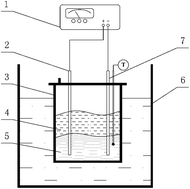
The desulfurization of MTBE was divided into two steps, electrochemical oxidation and distillation. As shown in Fig. 1, electrochemical oxidation experiments of MTBE were carried out in an electrolytic cell with different supporting electrolyte concentrations. Two graphite electrodes with the dimensions of 20 mm × 20 mm worked as the anode and cathode at a distance of 2.5 cm. 20 mL MTBE was mixed with an amount of prescribed electrolyte solution and then placed into the electrolytic cell under atmospheric pressure. After electrochemical oxidation and a few minutes standing, MTBE and the electrolyte were layered. The upper MTBE was separated using a separating funnel and the high boiling point organic sulfur products in MTBE were completely separated through distillation at 55 °C. The MTBE and electrolyte solution after desulfurization was collected and prepared for further analysis. Moreover, the optimal conditions of electrochemical oxidation desulfurization were examined.
image file: c5ra20831a-f1.tif
Fig. 1 Schematic of electrochemical desulfurization experimental setup (1 – potentiostat, 2 – anode, 3 – electrolysis cell, 4 – raw MTBE, 5 – electrolyte solution, 6 – thermostatic magnetic stirring water bath, and 7 – cathode).

Dimethyl disulfide, diethyl sulfide, and butyl mercaptan were used as model sulfur compounds to study and discuss the mechanisms of the electrochemical oxidative desulfurization process. Under optimal conditions of electrochemical oxidation, 20 mL model MTBE (pure MTBE + model sulfides) and a certain amount of electrolyte solution was put into the electrolytic cell. After electrochemical oxidation, the model MTBE was recovered and prepared for further analysis.

2.3. Analysis methods

The total sulfur content of MTBE before and after electrochemical oxidative desulfurization was determined using a WKL-3000 sulfur-chlorine analyzer (Taizhou Guochang Analytical Instruments Co. Ltd.). The properties of MTBE before and after desulfurization were analyzed via Fourier transform infrared spectroscopy (FTIR) (Beijing Beifen-Ruili Analytical Instruments Co. Ltd.). The conversions of model sulfides in model MTBE before and after desulfurization were analyzed using gas chromatography/mass spectrometry (GC-MS) (7890A GC system with an HP-5MS capillary column (30 m × 0.25 mm × 0.25 μm) and 5975C MSD, Agilent Technologies Inc.). The electrolyte solution was analyzed using an ion chromatograph (883 Basic IC plus, Metrohm China Ltd.), which was equipped with a Metrosep A Supp 5-250/4.0 ion chromatographic column (250 mm × 4.0 mm i.d., 6.1006.530). In addition, the total desulfurization efficiency (XS) of MTBE was calculated as follows:
image file: c5ra20831a-t1.tif
where XS is the desulfurization efficiency (%) of MTBE, and S0 and ST are the sulfur content (μg g−1) of raw MTBE and products, respectively.

3. Results and discussion

3.1. Electrochemical oxidative desulfurization of MTBE

3.1.1. Electrolyte effects. When electrolysis of water occurs, [O] is released as the following equations show, which has the chance to react with sulfur compounds. Different electrolytes have been tested (Table 1) to determine the effect on oxidation of sulfur compounds.
Cathode: 2H+ + 2e → H2

Anode: 4OH − 4e → 2H2O + O2
Table 1 Effect of different electrolyte systems on electrochemical desulfurizationa
No. Electrolyte system Sulfur content, μg g−1 Desulfurization efficiency, %
a Experimental conditions: cell voltage: 5.0 V, volume ratio of electrolyte solution to MTBE: 1.0, electrolysis temperature: 25 °C, electrolysis time: 15 min, and distillation temperature: 55 °C.
1 15% NaCl 24.3 81.66
2 15% CH3COONa 64.7 51.17
3 15% NaOH 95.2 28.15
4 15% H2SO4 102.3 22.79
5 15% H2SO4 + Fe2SO4 69.9 47.25
6 15% H2SO4 + MnSO4 43.3 67.32


It is interesting that neutral salt solutions have a much higher enhancement of oxidative desulfurization than pure base and acid solution. The addition of metal ions (Fe3+ or Mn2+) in an acidic solution can increase the rate of desulfurization, since the polyvalent metal ion possesses a special oxidation–reduction cycle in the electrochemical process, which can partly promote the desulfurization reaction.12 NaCl solution was also the most effective supporting electrolyte for electrochemical oxidative desulfurization among the all electrolyte systems.

3.1.2. Cell voltage. Cell voltage controls the quantity of electrons given to the reaction system. In Fig. 2, the relationship between cell voltage, current and desulfurization efficiency is demonstrated, when NaCl was used as the electrolyte. From this diagram, it can be clearly seen that in the first stage from 1.5 V to 2.5 V, the current and desulfurization efficiency increases very slowly, and this phenomenon shows that electricity energy below 2.5 V is too low for the electrochemical oxidation reaction. When the cell voltage exceeds 4.8 V, the current increases very rapidly with an increase in cell voltage. This result illustrates that electrochemical oxidative desulfurization is very violent in this voltage range. However, an excessive cell voltage leads to power loss and current efficiency drops because of anodic oxygen evolution. Excessive cell voltage will also lead to a decline in desulfurization efficiency. Therefore, an appropriate cell voltage is necessary. Based on the experimental results, 4.8 V is the optimal cell voltage.
image file: c5ra20831a-f2.tif
Fig. 2 Effect of cell voltage on electrochemical desulfurization (experimental conditions: supporting electrolyte: 15% NaCl, volume ratio of electrolyte solution to MTBE: 1.0, electrolysis temperature: 25 °C, electrolysis time: 15 min, and distillation temperature: 55 °C).
3.1.3. Electrolyte weight percent. In this experiment, NaCl was selected as the supporting electrolyte, because Cl can be oxidized at the anode to produce highly reactive oxidants (such as ClO) to promote oxidative desulfurization.14 In addition, the salting-out effect caused by high concentration salt solutions will prevent water from dissolving in MTBE. The influence of electrolyte weight percent on the electrochemical oxidative desulfurization efficiency is shown in Fig. 3. The desulfurization efficiency increased initially with the increase in weight percent of NaCl. When the weight percent of NaCl was maintained at 15%, the desulfurization efficiency reached 81.59%. After that, the desulfurization efficiency almost remains the same. Therefore, the optimum weight percent of NaCl was 15%.
image file: c5ra20831a-f3.tif
Fig. 3 Effect of electrolyte weight percent on electrochemical desulfurization (experimental conditions: cell voltage: 4.8 V, volume ratio of electrolyte solution to MTBE: 1.0, electrolysis temperature: 25 °C, electrolysis time: 15 min, and distillation temperature: 55 °C).
3.1.4. Volume ratio of electrolyte solution to MTBE. Due to the fact that MTBE can partly dissolve in an electrolyte solution, the volume ratio of electrolyte to MTBE is another important factor because it will affect mass transfer and reaction rate.20 As shown in Fig. 4, when the volume ratio of electrolyte solution to MTBE is in the range from 0.5 to 1.0, the desulfurization efficiency increases very quickly with the increase in volume ratio of electrolyte solution to MTBE. The desulfurization efficiency reached 81.59% when the volume ratio of electrolyte solution to MTBE was 1.0. Furthermore, the desulfurization efficiency remains the same. The reason for this is that the increase in electrolyte volume provides more oxidants (such as hydroxyl radicals and hypochlorite anions) to oxidize the organic sulfides in the electrolyte solution. Moreover, too much electrolyte solution will lead to oxygen evolution on the anode, which reduces the current efficiency and economic efficiency. Therefore, 1.0 is a suitable volume ratio of electrolyte solution to MTBE in the experiment.
image file: c5ra20831a-f4.tif
Fig. 4 Effect of volume ratio of electrolyte solution to MTBE on electrochemical desulfurization (experimental conditions: cell voltage: 4.8 V, supporting electrolyte: 15% NaCl, electrolysis temperature: 25 °C, electrolysis time: 15 min, and distillation temperature: 55 °C).
3.1.5. Electrolysis temperature. According to related literature,13,21 an increase in temperature will not only promote the mass transfer rate, but also accelerate oxygen evolution at the anode, which will result in a loss of energy. The effect of temperature on desulfurization is illustrated in Fig. 5. The desulfurization efficiency first increased with the increase in electrolysis temperature, reached a turning point at 35 °C, and then remained the same. Considering the desulfurization efficiency and economic efficiency, 35 °C is a suitable reaction temperature for electrochemical oxidative desulfurization.
image file: c5ra20831a-f5.tif
Fig. 5 Effect of electrolysis temperature on electrochemical desulfurization (experimental conditions: cell voltage: 4.8 V, supporting electrolyte: 15% NaCl, volume ratio of electrolyte solution to oil: 1.0, electrolysis time: 15 min, and distillation temperature: 55 °C).
3.1.6. Electrolysis time. The effect of electrolysis time on desulfurization efficiency is shown in Fig. 6. When the electrolysis time was less than 20 min, extending the reaction time could improve the desulfurization efficiency significantly. The desulfurization efficiency reached 98.25% and the sulfur content of MTBE decreased from 132.5 μg g−1 to 2.3 μg g−1 at 20 min. With an increase in electrolysis time, the sulfur content does not decrease. The reasons for this are described as follows: with the increase in reaction time, the oxidants produced at the anode could continue to oxidize organic sulfides. However, when the sulfur content is reduced to a very low level, extending the reaction time cannot improve the rate of desulfurization effectively. Consequently, 20 min is the optimal reaction time.
image file: c5ra20831a-f6.tif
Fig. 6 Effect of electrolysis time on electrochemical desulfurization (experimental conditions: cell voltage: 4.8 V, supporting electrolyte: 15% NaCl, electrolysis temperature: 35 °C, volume ratio of electrolyte solution to MTBE: 1.0, and distillation temperature: 55 °C).

The optimum operating conditions of electrochemical oxidative desulfurization are summarized as follows: cell voltage: 4.8 V, supporting electrolyte: 15% NaCl, volume ratio of electrolyte solution to MTBE: 1.0, electrolysis temperature: 35 °C, electrolysis time: 20 min, and distillation temperature: 55 °C. After electrochemical oxidation and distillation, the desulfurization efficiency reached 98.25% and the sulfur content of real MTBE decreased from 132.5 μg g−1 to 2.3 μg g−1. The total mass yield of MTBE was 91.38%. Thus, the sulfur content of MTBE has met the definite requirement of low sulfur fuels (e.g., <10 μg g−1).

3.1.7. The properties of MTBE before and after desulfurization. The properties of real MTBE before and after desulfurization are shown in Fig. 7, Tables 2 and 3. The infrared characteristic peaks of MTBE did not change after the electrochemical oxidative reaction. This result indicates that electrochemical oxidation cannot affect the main properties of MTBE.
image file: c5ra20831a-f7.tif
Fig. 7 FTIR of MTBE before and after electrochemical oxidation.
Table 2 Infrared characteristic peaks of MTBE before and after electrochemical oxidation
Characteristic peaks Wavenumber/cm−1
Before reaction After reaction
C–H stretching vibration 2988 2986
C–C stretching vibration 1623 1625
C–H bending vibration 1399 1394
C–O stretching vibration of ethers 1107 1102


Table 3 Main properties of MTBE
Oil sample Sulfur content (μg g−1) XS (%) Volume yield (%) Water content (weight percent %)
Raw MTBE 132.5     <0.03
Direct distillation 128.67 2.89 98 <0.03
Electrochemical oxidation–distillation 2.3 98.25 96 <0.03


3.2. The mechanisms of electrochemical oxidative desulfurization

Based on the abovementioned experiments, the electrochemical oxidative process has a significant desulfurization effect on MTBE. According to related literature,5,8,22 the main organic sulfides in MTBE include dimethyl disulfide, diethyl sulfide and butyl mercaptan. The understanding of the conversion of these three types of organic sulfides in electrochemical oxidative process is necessary. In this section, a mixture of model MTBE and dimethyl disulfide, diethyl sulfide and butyl mercaptan was used to study and discuss the mechanisms under the optimal conditions without distillation.
3.2.1. GC-MS analysis of model organic sulfides. The oxidation products of three types of model organic sulfides were determined by GC/MS. A solvent delay was set to mask the solvent peaks. The conversion of dimethyl disulfide is shown in Fig. 8(a), and two new organic sulfides (methanesulfonyl chloride at 3.036 min and S-methyl methanethiosulfonate at 5.648 min) were observed after electrochemical oxidation. Similarly, the main oxidation product of diethyl sulfide was diethyl sulfone (11.830 min) (as shown in Fig. 8(b)). In addition, the oxidation products of butyl mercaptan contain 1-butanesulfonyl chloride (11.113 min) and butyl disulfide (18.394 min) (as shown in Fig. 8(c)). According to previous conclusions,23 disulfides (such as butyl disulfide) can be oxidized to the corresponding sulfone. However, it cannot be detected due to its high boiling point and the extremely small content. Eventually, all these oxidation products with high boiling points can completely separate from MTBE by distillation at 55 °C.
image file: c5ra20831a-f8.tif
Fig. 8 GC/MS chromatograms of model organic sulfides before and after desulfurization (a) dimethyl disulfide, (b) diethyl sulfide, and (c) butyl mercaptan.
3.2.2. Ion chromatographic analysis of electrolyte solution. The anion ion chromatographic results of the electrolyte solution after electrochemical oxidation are shown in Fig. 9. Before and after desulfurization, a large quantity of Cl (8.05 min) and an amount of sulfate (23.34 min) were observed after oxidation. There was no sulfate used in the model MTBE and organic sulfides in the entire experiment, hence sulfate could only come from the hydrolysis of sulfoxide and sulfone.
image file: c5ra20831a-f9.tif
Fig. 9 Ion chromatograms of electrolyte before and after desulfurization.

The existence of ClO, which cannot be determined by ion chromatography, was demonstrated by the use of an indicator. After the oxidative reaction, a few drops of phenolphthalein were added into the electrolyte solution. The color of the electrolyte immediately turned pink and soon faded. These results indicate that large quantities of OH and ClO were generated after electrochemical oxidation.

3.2.3. The mechanism of electrochemical oxidative desulfurization. Based on the abovementioned analyses and previous research18,19,23–26 on desulfurization, a possible desulfurization mechanism of MTBE by electrochemical oxidation is proposed in Fig. 10. Electrochemical oxidative desulfurization is an indirect oxidation process and no conventional oxidants were used. The high-activity oxidative media (such as hydroxyl radical and hypochlorite anion) generated at the anode play a critical role during the desulfurizing process. After electrochemical oxidation, the organic sulfides transform into other sulfides, which have a very high boiling point (much high than 55 °C) and these oxidation products will be completely separated from MTBE by distillation. In addition, the oxidation products can also partially hydrolyze to sulfate and then dissolve in the electrolyte solution.
image file: c5ra20831a-f10.tif
Fig. 10 The mechanism of electrochemical oxidative desulfurization.

4. Conclusions

Herein, the removal of organic sulfides from MTBE through the combination of electrochemical oxidation and distillation has been systematically studied under the optimum operating conditions of cell voltage: 4.8 V, supporting electrolyte: 15% NaCl, volume ratio of electrolyte solution to MTBE: 1.0, electrolysis temperature: 35 °C, electrolysis time: 20 min, and distillation temperature: 55 °C. The sulfur content of MTBE decreased from 132.5 μg g−1 to 2.3 μg g−1 and the desulfurization efficiency reached 98.25%. In addition, electrochemical oxidation cannot affect the main properties of MTBE. The mechanism of electrochemical oxidation has also been studied. The main oxidation products of three types of model organic sulfides in MTBE (dimethyl disulfide, diethyl sulfide, and butyl mercaptan) were methanesulfonyl chloride and S-methyl methanethiosulfonate, diethyl sulfone, 1-butanesulfonyl chloride and butyl disulfide. These oxidation products with high boiling points can be separated from MTBE by distillation. Furthermore, a small part of oxidation products will hydrolyze to sulfate and then dissolve in the electrolyte solution.

Acknowledgements

This study is financially supported by the Young Scholars Development Fund of Southwest Petroleum University (SWPU, 201131010032). We thank the editors and anonymous reviewers for the suggestions on improving our manuscript.

References

  1. R. T. Yang, A. J. Hernandez-Maldonado and F. H. Yang, Science, 2003, 301, 79–81 CrossRef CAS PubMed.
  2. X. Chen, D. Song, C. Asumana and G. Yu, J. Mol. Catal. A: Chem., 2012, 359, 8–13 CrossRef CAS.
  3. H. X. Lu, S. F. Bu and Z. P. Wang, Appl. Mech. Mater., 2014, 521, 617–620 CrossRef.
  4. J. Qu, Y. Xi, M. Li, G. Pan, X. Jin, X. Gao and H. Nie, China Pet. Process. Petrochem. Technol., 2013, 15, 1–6 CAS.
  5. F. T. Li, Y. Liu, Z. M. Sun, L. J. Chen, D. S. Zhao, R. H. Liu and C. G. Kou, Energy Fuels, 2010, 24, 4285–4289 CrossRef.
  6. J. Lee, H. T. Beum, C. H. Ko, S. Y. Park, J. H. Park, J. N. Kim, B. H. Chun and S. H. Kim, Ind. Eng. Chem. Res., 2011, 50, 6382–6390 CrossRef CAS.
  7. L. Lv, J. Zhang, C. Huang, Z. Lei and B. Chen, Sep. Purif. Technol., 2014, 125, 247–255 CrossRef CAS.
  8. Z. L. Yao, J. T. Dun and J. B. Gao, CN, 102731268[P], October-17-2012, in Chinese.
  9. L. L. Zhang, J. B. Gao and Z. L. Yao, Ind. Catal., 2011, 88(1), 175–179 Search PubMed , (in Chinese).
  10. E. Rafiee and F. Mirnezami, J. Mol. Liq., 2014, 199, 156–161 CrossRef CAS.
  11. X. C. Chen, Y. W. Guan, A. A. Abdeltawab, S. S. Al-Deyab, X. L. Yuan, C. Y. Wang and G. G. Yu, Fuel, 2015, 146, 6–12 CrossRef CAS.
  12. V. Lam, G. Li, C. Song, J. Chen, C. Fairbridge, R. Hui and J. Zhang, Fuel Process. Technol., 2012, 98, 30–38 CrossRef CAS.
  13. Z. D. Chen, X. Z. Gong, W. Zhi, Y. G. Wang, S. Zhang and D. P. Xu, J. Fuel Chem. Technol., 2013, 41, 928–936 CrossRef CAS.
  14. W. Zhao, H. Zhu, Z. M. Zong, J. H. Xia and X. Y. Wei, Fuel, 2005, 84, 235–238 CrossRef CAS.
  15. W. Wang, S. Wang, H. Liu and Z. Wang, Fuel, 2007, 86, 2747–2753 CrossRef CAS.
  16. W. Wang, S. Wang, Y. Wang, H. Liu and Z. Wang, Fuel Process. Technol., 2007, 88, 1002–1008 CrossRef CAS.
  17. R. C. Schucker and W. C. Baird, Electrochemical oxidation of sulfur compounds in naphtha using ionic liquids, US. Pat. 6,274,026, 2001.
  18. X. D. Tang, T. Hu, J. J. Li, F. Wang and D. Y. Qing, Energy Fuels, 2015, 29, 2097–2103 CrossRef CAS.
  19. X. D. Tang, T. Hu, J. J. Li, F. Wang and D. Y. Qing, RSC Adv., 2015, 5, 53455–53461 RSC.
  20. C. Shu, T. Sun, J. Jia and Z. Lou, Ind. Eng. Chem. Res., 2013, 52, 7660–7667 CrossRef CAS.
  21. W. Zhao, W. J. Xu, S. T. Zhong and Z. M. Zong, J. China Univ. Min. Technol., 2008, 18, 571–574 CrossRef CAS.
  22. J. Zhang, J. Zhao and J. Chen, Chem. Ind. Eng. Prog., 2013, 32, 1453–1456 Search PubMed , (in Chinese).
  23. S. T. Zhong, W. Zhao, C. Sheng, W. J. Xu, Z. M. Zong and X. Y. Wei, Energy Fuels, 2011, 25, 3687–3692 CrossRef CAS.
  24. Y. Shen, T. Sun and J. Jia, RSC Adv., 2012, 2, 3123–3132 RSC.
  25. X. Gong, M. Wang, Z. Wang and Z. Guo, Fuel Process. Technol., 2012, 99, 6–12 CrossRef CAS.
  26. Y. Shen, X. Liu, T. Sun and J. Jia, RSC Adv., 2012, 2, 8867–8882 RSC.

This journal is © The Royal Society of Chemistry 2016
Click here to see how this site uses Cookies. View our privacy policy here.