
Zhuang Caiab,
Dongming Zhanga,
Liangliang Gua,
Ping Liu*c,
Ke Yea,
Kui Chenga,
Dianxue Caoa and
Guiling Wang*a
aKey Laboratory of Superlight Materials and Surface Technology of Ministry of Education, College of Materials Science and Chemical Engineering, Harbin Engineering University, Harbin, 150001, P. R. China. E-mail: wangguiling@hrbeu.edu.cn; Fax: +86-451-82589036; Tel: +86-451-82589036
bKey Laboratory of Functional Inorganic Material Chemistry, Ministry of Education, School of Chemistry and Materials Science, Heilongjiang University, Harbin, 150080, P. R. China
cBeijing Center for Diseases Prevention and Control, Beijing, 100013, P. R. China. E-mail: Cissy0511@126.com
First published on 23rd December 2015
Considering the good ability of MnO2 for the breakage of the HO–OH bond in H2O2, we employed C@TiO2 nanowire supported MnO2 as a novel catalyst for H2O2 electroreduction. The morphology and phase structure of the MnO2/C@TiO2 electrode are characterized by scanning electron microscopy, transmission electron microscopy and X-ray diffractometry. The catalytic activity of the MnO2/C@TiO2 electrode for H2O2 electroreduction is investigated by means of cyclic voltammetry and chronoamperometry. The catalyst exhibits a high catalytic activity and good stability in the electrochemical reaction process. The oxidation current density is higher than 200 mA cm−2 at −0.7 V in 1.6 mol dm−3 H2O2. The popular price, abundant reserves, and promising electrocatalytic performance make it a viable catalyst for H2O2 electroreduction.
| H2O2 + 2e− → 2OH−, E0 = 0.878 | (1) |
| O2 + 2H2O + 4e− → 4OH−, E0 = 0.401 | (2) |
The design of cathode catalysts with excellent electrocatalytic activity for H2O2 reduction is one of the decisive factors that determine the performance of FCs. In general, precious metals, such as Pt,19,20 Pd,21 Au22 and their alloys, are considered as the best catalysts for various electrocatalytic reactions due to their superior ability to trap electrons. However, the use of noble metals is limited by their scarcity and high cost, which give impetus to the attention on the inexpensive choices to supersede noble metals.
Currently, macrocycle complexes of transition metals, such as Fe- and Co-porphyrin,23–25 transition metal and their oxides, such as cobalt,21 copper oxides,26 cobalt oxides,27–31 ferric oxides,32 perovskite-type oxides14 are studied as low cost catalysts and alternative to noble metals for H2O2 electroreduction. Lei et al.31 reported an aligned Co3O4 nano-walls electrode as the H2O2 sensor based on the electrocatalytic oxidation and reduction of H2O2. A fast response and high sensitivity were successfully obtained at applied potentials of +0.8 V and −0.2 V (vs. Ag/AgCl). Our team26 previously prepared a Cu foil based CuO nanosheets through a simple chemical oxidation process. The low-cost, abundant resource and easy preparation of CuO/Cu made it a promising electrode for FCs using H2O2 as oxidants.
MnO2, as a cost-effective and important electrochemical material, has been widely used in lithium batteries,40,41 supercapacitors,42,43 FCs,44,45 electrochemical sensors46,47 and so on. For example, owning to its high specific capacitance, low cost, natural abundance, and environmental benignity, MnO2 is regarded as the most practical stuff in the field of electrochemical energy storage. Moreover, MnO2 can efficaciously break O–O bond in HO2− and catalytic HO2− disproportionation (eqn (3) and (4))33–35 and receives intensively interests on the FCs (employing O2 as oxidizer), metal/air (O2) batteries, electrochemical sensors (H2O2).33–35,45,47 However, to the best of our knowledge, few of report applied MnO2 for H2O2 electrochemical reduction in fuel cells.
| HO2− + 2H2O + 2e− → 3OH− | (3) |
| 2HO2− → 2OH− + O2 | (4) |
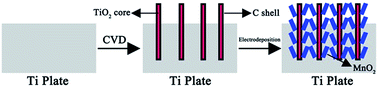
In this paper, we use a C@TiO2 nanowire based MnO2 nanosheets42 as an active and stable catalyst for H2O2 electroreduction. The C@TiO2 nanowire were prepared by a simple chemical vaporous deposition (CVD) using Ti foil as substrate and acetone as carbon source and following a electrodeposition process to deposit MnO2. This MnO2/C@TiO2 electrode owns a unique three dimensional (3D) porous structure, which is facile for the diffusion of H2O2 and the release of O2 during the reaction process (eqn (4)). The MnO2/C@TiO2 achieved an open circle potential of −0.2 V and a reduction current density of 200 mA cm−2 at −0.7 V in a solution containing 3 mol dm−3 NaOH and 1.6 mol dm−3 H2O2.
:
4
:
1 for 5 minutes. Following, the Ti foil were loaded onto a ceramic substrate and put into the center of a horizontal tube furnace after rinsing with deionized water. Before being heated to 850 °C under argon, the tube furnace was purged with argon several times. Acetone was introduced into the tube furnace by argon at a flow rate of 150 SCCM (SCCM represents standard cubic centimeter per minute at STP) for 1.5 h under 850 °C. C/TiO2 nanowires were obtained after they were cooled to room temperature under argon. During this process, carbon-containing and oxygen-containing species including ·CH3 radicals and CO were produced first by the thermal decomposition of CH3COCH3. Then, Ti atoms on the surface of Ti foil will adsorb and reacts with the as-generated CO to form TiO2 and C (Ti + 2CO → TiO2 + C). Notably, TiO2 nanowires shaped with the diffusion of Ti atoms upwards along the formed TiO2 and ·CH3 also took part in the formation of C, as described by Huo's work.48
Then, MnO2 nanosheets were coated on the as-prepared C@TiO2 through one step electrodeposition process as our previous report.42 The C/TiO2 nanowires were used as working electrode, a carbon rod (3 mm in diameter) was served as counter electrode, and a saturated Ag/AgCl, KCl electrode was used as reference electrode. Anodic electrodeposition of MnO2 nanoplates were performed at a constant current of 1 mA cm−2 for 5 minutes in a solution contained 0.01 mol dm−3 manganese acetate (MnAc2) and 0.02 mol dm−3 ammonium acetate (NH4Ac) and 10% dimethyl sulfoxide (DMSO) at 70 °C in a typical three-electrode electrochemistry cell with glass cell with an electrochemical station (CHI660D).
H2O2 electroreduction was also performed in the same three-electrode electrochemical cell using the 1 cm2 MnO2/C@TiO2 electrode. All potentials were referred to the saturated Ag/AgCl, KCl reference electrode. The morphology of the electrodes was determined using a scanning electron microscope (SEM, JEOL JSM-6480) and transmission electron microscope (TEM, FEI TeccaiG2S-Twin, Philips). The structure was analyzed by a powder X-ray diffractometer (XRD, Rigaku TTR-III) equipped with Cu Kα radiation (λ = 0.15406 nm).
![]() | ||
| Fig. 2 SEM images of C@TiO2 substrate (a) and MnO2/C@TiO2 (b–f) with different electrodeposition time (10–120 min), insert in (d) is TEM image of the single MnO2/C@TiO2 nanowire. | ||
XPS measurement was investigated to further analyze the surface composition of MnO2/C@TiO2 and the result was shown in Fig. 4. The survey scan indicated the presence of Mn, O, C and Ti in the electrode. Insert in Fig. 4 is the high resolution XPS data for Mn 2p, presenting two peaks at 641.6 and 653.3 eV owning to the binding energy of Mn 2p3/2 and Mn 2p1/2, respectively, from the Mn4+ (MnO2).
Cyclic voltammetry (CV) curve is engaged to assess the electrocatalytic performance of MnO2/C@TiO2 electrode in H2O2 solution. We first investigate the effect of electrodeposition time on the electrocatalytic activity of MnO2/C@TiO2 for H2O2 reduction and the results are shown by Fig. 5. We can see that the reduction current densities seriously depend on the MnO2 loading and the C@TiO2 substrate almost exhibits no electrocatalytic performance for H2O2 reduction, demonstrating that the C coated TiO2 only serves as supporter for the loading of MnO2, which will play the role of an efficient catalyst for H2O2 electroreduction. The current density first increased remarkably with the increase of electrodeposition time and reached to 180 mA cm−2 at −0.7 V when the time rises to 60 min, demonstrating that extending electrodeposition can obviously improve the catalytic properties of MnO2/C@TiO2. However, when the time is longer than 60 min, the current density decreased from 180 to 60 mA cm−2, respectively, in response to 90 and 120 min. Clearly, the MnO2 prepared with 60 min shows the best performance among these samples. Besides, a weak reduction peak, involved to the electroreduction of H2O2 (eqn (1)),7–32 centered at around −0.62 V, when the electrodeposition times are fixed at 10, 30 and 120 min and this phenomenon only occurred at the electrode with low efficiency. As shown in Fig. 2, the MnO2 loading is insufficient in short electrodeposition time (10 and 30 min) and superfluous in long electrodeposition time (90 and 120 min), the first situation will not provide competent active sites to contact with oxidant and the other may block up the 3D porous structure and the oxygen can't be released soon, both of which will lead a damping for H2O2 reduction. Besides, manganese oxides are semiconducting materials, increasing the amount of MnO2 will weaken the electric conductivity and further reduce the catalytic activity.
![]() | ||
| Fig. 5 Cyclic voltammetry (CV, scan rate: 5 mV s−1) curve of MnO2/C@TiO2 with different electrodeposition time (0–120 min) in 3 mol dm−3 NaOH and 1.2 mol dm−3 H2O2. | ||
OH− plays an important role in the whole reaction process (eqn (1)–(4))7–39 and it is significative to discuss the effect of NaOH concentration on the electrochemical performance. Fig. 6a presents the CVs of MnO2/C@TiO2 electrode in different concentrations of NaOH (1–4 mol dm−3) with H2O2 concentration constantly kept at 1.2 mol dm−3. It can be observed that the reduction current density of MnO2/C@TiO2 increased with the increase of NaOH concentration from 1 to 3 mol dm−3 and slightly decreased with the further increase to 4 mol dm−3. So 3 mol dm−3 NaOH gives the best performance when the H2O2 concentration is 1.2 mol dm−3 and demonstrate that the optimal electrochemical performance only occurs within suitable ration of [OH−/H2O2] (around 2) rather than immensely raise or reduce alkaline concentration.
![]() | ||
| Fig. 6 CVs (scan rate: 5 mV s−1) of MnO2/C@TiO2 (60 min) in 1.2 mol dm−3 H2O2 + x (x = 1, 2, 2.5, 3, 4) mol dm−3 NaOH. | ||
The effects of H2O2 concentration on the catalytic behavior of MnO2/C@TiO2 were investigated and the results are shown in Fig. 7. Similar as the Fig. 5, a weak reduction peak emerged in the CV curves (Fig. 7) with low catalytic performance and the current density increased with the increase of H2O2 concentration, manifesting the reaction was controlled by diffusion. The increasement tendency of reduction current density between the H2O2 concentration of 1.2 and 1.6 mol dm−3 decreased abruptly demonstrated that the current density isn't in proportion to the fuel concentration. The conclusion is in point to the NaOH concentration at the same time. Besides, it must be pointed that the bare C@TiO2 substrate almost has no catalytic activity for H2O2 reduction. Although the catalytic activity of MnO2/C@TiO2 for H2O2 reduction can't be comparable to the previous noble metals and some our prior Co3O4, CoxMnyO, NiCo2O4 electrodes,27–30 it is still a potential electrode due to its low cost and rich deposits.
![]() | ||
| Fig. 7 CVs (scan rate: 5 mV s−1) of MnO2/C@TiO2 (60 min) in 3 mol dm−3 NaOH + x (x = 0, 0.4, 0.8, 1.2, 1.6) mol dm−3 H2O2. | ||
The catalytic activity of MnO2/C@TiO2 for H2O2 electroreduction was further tested by changing the reaction temperature in a solution containing 3 mol dm−3 NaOH and 1.2 mol dm−3 H2O2, and the result was recorded in Fig. 8. Higher temperature will lead faster electrode kinetics21 and accelerate H2O2 reaction speed on MnO2 surface. Under this circumstance, more HO–OH bonds were broken, resulting in the increasing of reduction current density (from 303.15 to 333.15 K). Unfortunately, over high temperature cause a critical hydrolysis of H2O2,21,49 which will reduce the utilization of fuel and may destruct the electrode structure. As a consequence, the catalytic performances rapidly fall off when the reaction was conducted at 343.15 and 353.15 K.
![]() | ||
| Fig. 8 CVs (scan rate: 5 mV s−1) of MnO2/C@TiO2 (60 min) in 3 NaOH mol dm−3 + 1.2 mol dm−3 H2O2 at different temperature (303.15–353.15 K). | ||
The highest current density reached up to 175 mA cm−2 at −0.7 V in 1.2 mol dm−3 H2O2 at 303.15 K (Fig. 7a), which is much higher than our previous Cu based CuO electrode.26 The good electrocatalytic activity can be attributed to the following three reasons: first, the MnO2/C@TiO2 owns a unique 3D porous structure and provide an excellent electronic conductivity; second, the MnO2 nanoplates uniformly coated on the C/TiO2 surface, instead agglomeration as some other electrode prepared through slurry and coating with binders; last and the most important, according to the previous reports,33–35 MnO2 has fine ability to break the HO–OH bond during the reaction, which is the essential factor to drive the occurrence of H2O2 electroreduction. As seen from Fig. 9, the atomic oxygen may be firstly adsorbed on the MnO2 (Mn4+) surface (Fig. 9A → B) due to its weak electronegativity in H2O2. Then MnO2 absorbs some electrons, transported from external circuit, and transformed to Mn3+ (Fig. 9C → D). Mn ion has a high electron affinity, so the Mn3+ will release the electron, mentioned in (Fig. 9C → D), to the adsorbed H2O2 molecule (Fig. 9E). At last, the HO–OH bond was broken after obtain electrons and formed OH– (Fig. 9C → D). Synchronously, Mn3+ returns to Mn4+ (MnO2).
The stability of MnO2/C@TiO2 for H2O2 electroreduction at different applied potential was performed by CA test. The potential ranges from −0.6 to −0.3 V chosen from the Fig. 7 in 3 mol dm−3 NaOH and 1.2 mol dm−3 H2O2. As seen from Fig. 10, the reduction densities steady at around −140, −110, −75 and −30 mA cm−2, respectively, when the potentials are fixed at −0.6, −0.5, −0.4 and −0.3 V. Super current density will be achieved high applied potential, which can be ascribed to the drive force and fast kinetics at noble potential, similar results can be seen from some previous reports.21,50 Although some oxygen gas was produced from the hydrolysis of H2O2 on the MnO2/C@TiO2 surface,51 there isn't anything falling from the electrode during the whole reaction process, demonstrating that MnO2/C@TiO2 is stable and equal to fuel cell system.
![]() | ||
| Fig. 10 CAs of MnO2/C@TiO2 (60 min) in 3 NaOH mol dm−3 + 1.2 mol dm−3 H2O2 at different potential (−0.6 to −0.3 V). | ||
| This journal is © The Royal Society of Chemistry 2016 |