Theoretical study on the influence of a secondary metal on the Cu(110) surface in the presence of H2O for methanol decomposition

Yong-Chao Zhanga, Rui-Peng Rena, Shi-Zhong Liub, Zhi-Jun Zuo*a and Yong-Kang Lv*a
aKey Laboratory of Coal Science and Technology of Ministry of Education and Shanxi Province, Taiyuan University of Technology, Taiyuan 030024, Shanxi, China. E-mail: lykang@tyut.edu.cn; zuozhijun@tyut.edu.cn; Fax: +86 351 6010386
bDepartment of Chemistry, Stony Brook University, Stony Brook, New York 11794, USA

Received 7th September 2015 , Accepted 25th January 2016

First published on 27th January 2016


Abstract

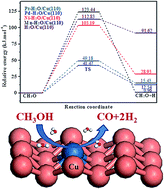
Density functional theory calculations with the continuum solvation slab model are performed to investigate the effect of metal dopants on the Cu(110) surface in the presence of H2O for the methanol decomposition. The sequential dehydrogenation of methanol (CH3OH → CH3O → CH2O → CHO → CO) is studied in the present work. The results show that the introduction of different metals (Pt, Pd, Ni, Mn) on the H2O/Cu(110) surface notably influence the adsorption configurations and adsorption energies of all adsorbates, and remarkably affect the reaction energies and activation energies of the elementary steps. The Pt, Pd and Ni doped H2O/Cu(110) surfaces are able to promote hydrogen production from methanol decomposition, but Mn doped H2O/Cu(110) surfaces are unfavorable for the reaction. The activity of methanol decomposition decreases as follows: Pd–H2O/Cu(110) > Pt–H2O/Cu(110) > Ni–H2O/Cu(110) > H2O/Cu(110) > Mn–H2O/Cu(110). Finally, the Brønsted–Evans–Polanyi plot for the main methanol dissociation steps on the metal doped and un-doped H2O/Cu(110) surfaces are identified, and a linear relationship between the reaction energies and transition state energies is obtained.

1. Introduction

Nowadays, worldwide energy consumption is still mainly based on fossil fuels,1 but the excessive consumption of fossil fuels has caused climate change2,3 due to a huge amount of greenhouse gas emissions, that has damaged our planet's ecosystem to some extent.4 In order to meet the world's energy demand and improve the adverse environmental conditions, there is an urgency to explore alternative and environmentally-friendly energy resources. As an ideal fuel, more recently, hydrogen energy is receiving more and more attention because water is the sole by-product.5 However, the intrinsic physical properties of hydrogen6,7 make it not an ideal energy media. Methanol can be used as a material for the storage of hydrogen,8–11 owing to the high energy density and H/C ratio, the absence of C–C bonds, abundant and low-cost sources as well as being safer and more convenient for long distance transportation.

Methanol decomposition (CH3OH → 2H2 + CO ΔH°298 K = 90.7 kJ mol−1) is an effective method for hydrogen production. Numerous efforts are devoted to understanding the mechanism of methanol decomposition on various metal surfaces, especially on transition metal catalysts.12–22 The Cu based catalysts are widely used in hydrogen production from methanol due to the unique catalytic activity and selectivity.15–17 However, during the reaction, the catalyst is easily suffering from the problem of thermal instability due to severe metal coking and sintering.23 To improve the catalytic performance and reduce the reaction temperature, substantial efforts are devoted to designing more effective catalysts. Bimetallic alloys are received extensively attention in heterogeneous catalysis.24–37 Due to their similar cell parameters and identical crystal structure, metallic Pt, Pd and Ni with Cu can form Pt–Cu, Pd–Cu and Ni–Cu binary alloys. Previous literature reported that the Pt–Cu alloy are used in hydrocarbon reforming reaction25 and the Pd–Cu, Ni–Cu bimetallic alloy catalyst presenting superior behavior for the steam reforming of methanol.33,34 In addition, the Cu–Mn spinel catalyst is used to the methanol steam reforming.35,36 Up to now, no experimental and theoretical are reported to understand the hydrogen formation from methanol decomposition on metal (Pt, Pd, Ni, Mn) doped Cu based catalysts, and to further explore the influence of metal dopant on the reaction. Therefore, our work would be important to clarify the influence of a secondary metal for methanol decomposition, what's more, to explore new methanol decomposition catalysts.

To the best of our knowledge, many heterogeneous catalytical processes occurred in a solvent environment for the purpose of dissolving the reactants, and then influence on the reaction rate and products selectivity.21,38–40 In the actual system for methanol decomposition, water or water vapor is almost never avoidable, and its influence on methanol dissociation needs to be deeply investigated. Unfortunately, few studies for heterogeneous catalysis which occurs on the solid/liquid interface are reported. Wang et al., Fang et al. and Okamoto et al. study the formic acid oxidation, methanol oxidation and the dehydrogenation of methanol on Pt(111) with the presence of water molecules.41–43 Their research showed that the water molecules significantly affect the adsorption energies and activation energies of the corresponding adsorbates and elementary steps. In this work, water molecules are added onto the solid surface to simulate the behavior of methanol decomposition on the solid/liquid interface environment.

Therefore, in the present study, by using the density functional theory (DFT), the methanol decomposition on the metal (Pt, Pd, Ni, Mn) doped and un-doped H2O/Cu surfaces are investigated to understand the bimetallic effect on the reaction. To further elucidate the kinetic–thermodynamic relationships, Brønsted–Evans–Polanyi (BEP) plot is also carried out. The results are expected to reveal the mechanism of methanol decomposition on the metal doped Cu catalysts with the presence of water molecules. Furthermore, the calculation results may be useful for designing new catalytic materials for methanol decomposition reaction.

2. Computational models and methods

2.1. Surface model

For methanol decomposition, the real copper catalyst is modeled by the Cu(110) surface, and explicit four water molecules are added onto the Cu(110) surface as the first solvation shell to model the solvation environment.

The Cu(110) surface is cleaved from the face-centered cubic (fcc) crystal structure, and the lattice parameter of Cu is 3.615 Å, which is in agreement with the experimental values.44,45 From the optimized bulk structure, the Cu(110) surface is modeled using a four atomic layer slabs with a periodic p(3 × 3) unit cell, and 9 atoms at each layer. Meanwhile, a 15 Å thick vacuum gap is employed to separate the periodic images of the slab. In all calculations, the top two layers and adsorbates are allowed fully relaxed and the bottom two slab layers are fixed in their bulk position. One surface Cu atom is substituted by a dopant (Pt, Pd, Ni, Mn) atom, and the corresponding dopant coverage is 1/9 ML. As shown in Fig. 1(a) and (b), the structure of M–H2O/Cu(110) (M: Pt, Pd, Ni, Mn) and un-doped H2O/Cu(110) surfaces are used for the present calculation.


image file: c5ra18226c-f1.tif
Fig. 1 The top view surface configuration of the H2O/Cu(110) surface: (a) metal (Pt, Pd, Ni, Mn) doped; (b) un-doped.

2.2. Calculation methods

The Kohn–Sham DFT calculation is performed using the Vienna ab initio simulation package (VASP)46,47 with the projector-augmented wave (PAW) pseudopotentials.48 The generalized gradient approximation (GGA) with the Perdew, Burker and Ernzerhof (PBE) functional is used to treat the exchange-correlation energy.48–50 The kinetic energy cutoff is 400 eV. A 3 × 3 × 1 Monkhorst–Pack k-point mesh with Monkhorst–Paxton smearing of 0.1 eV is sampled to the Brillouin zone.51 The transition states (TS) and the minimum energy paths (MEP) are studied using the climbing-image nudged elastic band (CI-NEB) method52 combined with the dimer method.53 The TS is identified with imaginary frequencies through the vibrational analysis. The geometries structure is deemed converged until the forces of all relax atoms are less than 0.03 eV Å−1, and the convergence of energy is set to 1 × 10⁻⁵ eV. The molecules in the gas phase are calculated using a 15 × 15 × 15 Å3 cubic unit cell.

The adsorption energy (Eads) is defined as:

Eads = E(adsorbate+4H2O)/slabE4H2O/slabEadsorbate
E(adsorbate+4H2O)/slab is the total energy of the adsorbate on the metal (Pt, Pd, Ni, Mn) doped or un-doped H2O/Cu(110) surface. E4H2O/slab is the energy of the metal (Pt, Pd, Ni, Mn) doped or un-doped H2O/Cu(110) surface. Eadsorbate is the energy of the adsorbate molecule in vacuum situation. Obviously, a negative Eads value represents exothermic adsorption, and more negative values indicates the strong interaction between the adsorbates with the H2O/Cu(110) surface.

3. Results and discussion

3.1. Reaction intermediates

The most stable adsorption configurations of the reaction intermediates on the metal (Pt, Pd, Ni, Mn) doped and un-doped H2O/Cu(110) surfaces, which involves CH3OH, CH3O, CH2O, CHO and CO, are shown in Fig. 2. In addition, we have to mention that the reaction intermediates with the presence of water molecules can form hydrogen bond,42 which may facilitate the adsorption.
image file: c5ra18226c-f2.tif
Fig. 2 The configurations of the reaction intermediates involved in methanol decomposition on the metal (Pt, Pd, Ni, Mn) doped and un-doped H2O/Cu(110) surfaces (the Cu, Pt, Pd, Ni, Mn, C, O and H atoms are shown in the brown, deep blue, dark green, watchet blue, purple, gray, red, and white balls, respectively).

3.2. Reaction mechanism

To our best knowledge, CH3OH decomposition involves a series of elementary steps on the Cu catalysts.12,13,54–56 According to the previous DFT reported,12,13,55–57 the C–H scission of methanol or intermediates during methanol decomposition is easier than that of C–O scission, and the sequential dehydrogenation steps of CH3OH is the main route for CH3OH decomposition, as follows: CH3OH → CH3O → CH2O → CHO → CO. Therefore, in the following discussion, we will concentrate on the reactions between the main dehydrogenation products on the metal (Pt, Pd, Ni, Mn) doped H2O/Cu(110) surfaces, and the results are compared with those obtained on the un-doped H2O/Cu(110) surface. In all calculations, we use IS, TS and FS to represent the initial state, the transition state and the final state, respectively.
3.2.1 Pt–H2O/Cu(110). For the methanol decomposition on the Pt doped H2O/Cu(110) surface, the potential energy diagram with the optimal pathway is shown in Fig. 3. The initial step of the reaction (CH3OH → CH3O + H) starts from the adsorbed CH3OH, where the CH3OH adsorbs on Pt through O with an adsorption energy of −38.58 kJ mol−1. The dehydrogenation step through TS1 needs to overcome a barrier of 43.40 kJ mol−1 with exothermicity of −27.00 kJ mol−1. The formation of CH2OH via C–H bond scission from CH3OH has an activation energy of 188.06 kJ mol−1, which is higher than that of the CH3O formation (43.40 kJ mol−1) (see Fig. S1 in the ESI). The result indicates that the CH3O formation from CH3OH is easily to happen. The dehydrogenation of CH3O is the next step and the CH3O adsorbs on the Pt–Cu site with an adsorption energy of −277.75 kJ mol−1. The CH2O and H are generated during the CH3O dissociation through TS2. The reaction (CH3O → CH2O + H) has an activation energy of 49.18 kJ mol−1 with endothermicity of 15.43 kJ mol−1. Immediately following, the further dehydrogenation of CH2O to CHO, which is labeled as CH2O → CHO + H. After optimization, the CH2O adsorbs on the Pt–Cu site with C and O bind to Pt and Cu, respectively. The corresponding adsorption energy is −85.83 kJ mol−1. After the TS3, the CHO and H are produced, and the reaction is exothermicity of −30.86 kJ mol−1 with an activation energy of 50.15 kJ mol−1. The adsorption energy of CHO is −286.43 kJ mol−1, where the CHO adsorbs on Pt through C. Subsequently, the dehydrogenation of CHO to CO (CHO → CO + H) through TS4 is exothermic by −72.33 kJ mol−1 and needs to overcome a barrier of 60.76 kJ mol−1.
image file: c5ra18226c-f3.tif
Fig. 3 Potential energy profile of the main route for CH3OH decomposition on the Pt doped H2O/Cu(110) surface.
3.2.2 Pd–H2O/Cu(110). On the Pd doped H2O/Cu(110) surface, the potential energy diagram of the main route for CH3OH decomposition is given in Fig. 4. The reaction initiates by the dehydrogenation of the adsorbed CH3OH to generate CH3O and H through TS5. The stable adsorption structure of CH3OH adsorbs on Pd via O with an adsorption energy of −50.15 kJ mol−1. This reaction is endothermic of 6.75 kJ mol−1 with an activation energy of 19.29 kJ mol−1. We also note that the CH2OH formation needs to overcome a high barrier of 189.99 kJ mol−1, which is higher than that of the CH3O formation (19.29 kJ mol−1). Similar to that of on the Pt doped H2O/Cu(110) surface, the CH2OH formation is unlikely to occur (the corresponding details are shown in Fig. S1 in the ESI). Subsequently, the formed CH3O further dehydrogenate to CH2O via TS6, which has an activation energy of 41.47 kJ mol−1 with endothermicity of 12.54 kJ mol−1. In this step, CH3O strongly binds to the Pd–Cu site with an adsorption energy of −280.64 kJ mol−1. After the TS6, the formed CH2O adsorbs on the Pd–Cu site through C and O bind to Pd and Cu, respectively. The corresponding adsorption energy is −82.94 kJ mol−1. The next step is the CHO formation through TS7. The dehydrogenation of CH2O is energetically neutral with exothermic by −0.96 kJ mol−1, and the activation energy is 39.54 kJ mol−1. The final step is the CO production from the CHO → CO + H reaction via TS8. After optimization, the CHO adsorbs on Pt through C with an adsorption energy of −256.53 kJ mol−1, and the formed CO binds to Pt through C. The calculated activation energy for this step is 57.86 kJ mol−1, and the reaction is exothermic by −71.37 kJ mol−1.
image file: c5ra18226c-f4.tif
Fig. 4 Potential energy profile of the main route for CH3OH decomposition on the Pd doped H2O/Cu(110) surface.
3.2.3 Ni–H2O/Cu(110). In the case of CH3OH decomposition on the Ni doped H2O/Cu(110) surface, the potential energy diagram of the main steps is presented in Fig. 5. Similar to the case of CH3OH dissociation on the Pt and Pd doped H2O/Cu(110) surface, there are two possible paths for the initial CH3OH dehydrogenation: O–H and C–H bond scission routes. For the reaction of CH3OH → CH3O + H, after optimization, the CH3OH adsorbs on Ni through O with an adsorption energy of −74.26 kJ mol−1, and the CH3O and H are generated through TS9. This step is moderately uphill, and needs to overcome a barrier of 92.58 kJ mol−1 with exothermicity of −44.36 kJ mol−1. The formation of CH2OH requires an activation energy of 169.73 kJ mol−1, which is higher than that of the CH3O formation (92.58 kJ mol−1) (see Fig. S1). Therefore, the CH3O formation is easy to occur. Subsequently, the formed CH3O further dehydrogenate to CH2O through TS10. In this step, the adsorbed CH3O binds to Ni with an adsorption energy of −338.50 kJ mol−1. The activation energy and reaction energy are 103.19 and 28.93 kJ mol−1, respectively. The next step is CH2O dissociation through TS11. In this process, the CH2O adsorbs on Ni through both C and O with an adsorption energy of −130.19 kJ mol−1. The reaction of the CHO and H production from CH2O species is calculated to be exothermic by −23.15 kJ mol−1 with an activation energy of 62.69 kJ mol−1. The last step for the stepwise dehydrogenation of CH3OH on the Ni doped H2O/Cu(110) surface is the CHO dissociation to CO via TS12, which is labeled as CHO → CO + H. The most stable adsorption configuration of CHO binds to Ni through C, and the corresponding adsorption energy is −308.61 kJ mol−1. This step is exothermic by −72.33 kJ mol−1, and needs to overcome a barrier of 27.00 kJ mol−1.
image file: c5ra18226c-f5.tif
Fig. 5 Potential energy profile of the main route for CH3OH decomposition on the metal Ni doped H2O/Cu(110) surface.
3.2.4 Mn–H2O/Cu(110). On the Mn doped H2O/Cu(110) surface, the reaction coordinates for CH3OH decomposition with the optimal pathway are depicted in Fig. 6. Initially, CH3OH adsorbs on Mn via O with an adsorption energy of −118.62 kJ mol−1. The initial step of CH3OH → CH3O + H via TS13 has an activation energy of 26.04 kJ mol−1, and the reaction energy is −91.62 kJ mol−1. As another possible pathway, the CH2OH formation is unlikely due to the high activation energy of 162.02 kJ mol−1 (see Fig. S1 in the ESI). The following step is the dehydrogenation of CH3O to CH2O through TS14 with an activation energy of 123.44 kJ mol−1, and the reaction is energetically neutral with endothermicity of 0.96 kJ mol−1. In this step, the adsorbed CH3O binds to Mn through O with an adsorption energy of −455.20 kJ mol−1. Subsequently, the formed CH2O adsorbs on the Mn–Cu site with O and C anchoring to Mn and Cu, respectively. In addition, the adsorption energy of CH2O is −270.03 kJ mol−1. Subsequently, the CH2O is prone to further dehydrogenation. After the TS15, the CHO and H are generated. This step is endothermic by 60.76 kJ mol−1 with an activation energy of 93.55 kJ mol−1. Finally, the CO is formed from the CHO dehydrogenation through TS16. In this step, the CHO adsorbs on Mn via C with an adsorption energy of −370.33 kJ mol−1, and the corresponding activation energy and reaction energy are 53.04 kJ mol−1 and −81.01 kJ mol−1, respectively.
image file: c5ra18226c-f6.tif
Fig. 6 Potential energy profile of the main route for CH3OH decomposition on the Mn doped H2O/Cu(110) surface.
3.2.5 Un-doped H2O/Cu(110). In order to compare with the results of on the metal (Pt, Pd, Ni, Mn) doped H2O/Cu(110) surfaces, we also investigate the CH3OH decomposition on the un-doped H2O/Cu(110) surface. The potential energy diagram with the optimal pathway is shown in Fig. 7. Based on the energetic data from our calculation, CH3OH adsorbs on the top site through O with an adsorption energy of −47.26 kJ mol−1, and the dissociation of CH3OH via the O–H bond scission give rise to the chemisorbed CH3O and H through TS17. The reaction CH3OH → CH3O + H is exothermic by −14.47 kJ mol−1 with an activation energy of 41.47 kJ mol−1. By contrast, the CH2OH formation needs to overcome a barrier of 167.81 kJ mol−1, which is higher than that of the CH3O formation (41.47 kJ mol−1) (see Fig. S1). Therefore, the CH3O formation is easy to happen. The CH3O intermediate leads to CH2O through TS18. In this step, the CH3O binds to the short-bridge site through O with an adsorption energy of −307.64 kJ mol−1. The calculated activation energy is 112.83 kJ mol−1, and the reaction energy is 91.62 kJ mol−1. Subsequently, the CH2O dehydrogenate to CHO via TS19. This step starts from the adsorbed CH2O, where binds to the hollow site with C and O anchoring to the Cu, and the corresponding adsorption energy is −58.83 kJ mol−1. The activation energy is 91.62 kJ mol−1 with endothermic by 19.29 kJ mol−1. Finally, the adsorbed CHO coordinates to the top site via C with an adsorption energy of −224.71 kJ mol−1, and CO is produced through TS20. The reaction CHO → CO + H requires an activation energy of 11.57 kJ mol−1 with exothermicity of −44.36 kJ mol−1.
image file: c5ra18226c-f7.tif
Fig. 7 Potential energy profile of the main route for CH3OH decomposition on the un-doped H2O/Cu(110) surface.

3.3. General discussion

In this section, a detailed comparison of CH3OH decomposition on the metal (Pt, Pd, Ni, Mn) doped and un-doped H2O/Cu(110) surfaces are presented. Obviously, the introduction of metal (Pt, Pd, Ni, Mn) affects the adsorption energies of all the adsorbates. On the un-doped H2O/Cu(110) surface, CH2O is easy to desorb instead of being further dehydrogenated due to the lower desorption energy than the activation energy of CHO formation (58.83 vs. 91.62 kJ mol−1), which is in consistence with the experimental observation.58,59 Interestingly, the introduction of metal (Pt, Pd, Ni, Mn) into H2O/Cu(110) surface increase the bonding strength of CH2O, which effectively hinders the CH2O desorption (85.83 vs. 50.15 kJ mol−1, 82.94 vs. 39.54 kJ mol−1, 130.19 vs. 62.69 kJ mol−1, 270.03 vs. 93.55 kJ mol−1). Comparing with the results of CH3OH dehydrogenation on the un-doped H2O/Cu(110) surface, it is easy to find that the doping metal (Pt, Pd, Ni, Mn) on the H2O/Cu(110) surface remarkably affect the reaction energies and activation energies of the main steps during CH3OH decomposition processes.

For un-doped H2O/Cu(110), the sequential dehydrogenation of CH3OH to form CH3O (41.47 kJ mol−1 activation energy), CH2O (112.83 kJ mol−1 activation energy), CHO (91.62 kJ mol−1 activation energy) and CO (11.57 kJ mol−1 activation energy) is calculated. The rate-limiting step is the CH3O dehydrogenation to CH2O with a high activation energy (112.83 kJ mol−1), which is in consistence with the previous DFT reported.12,13 For the Pt and Pd metals doped H2O/Cu(110), as shown in Fig. 3 and 4, the activation energies for CH3O formation are 43.40 and 19.29 kJ mol−1, respectively, and both reactions are easy to occur. More importantly, compared to that of on the un-doped H2O/Cu(110) surface, the activation energies for CH3O dehydrogenation are significantly reduced (49.18 vs. 112.83 kJ mol−1, 41.47 vs. 112.83 kJ mol−1). The CHO formation is relatively easy on both Pt and Pd metals doped H2O/Cu(110) with the activation energies of 50.15 and 39.54 kJ mol−1, respectively. The rate-limiting step is the CO formation from CHO dissociation, and the corresponding activation energies are 60.76 and 57.86 kJ mol−1, respectively. Overall, the Pt and Pd dopants are favorable for the hydrogen formation from CH3OH decomposition. For the CH3OH decomposition on the Ni-doped H2O/Cu(110), the activation energy of CH3O formation is 92.58 kJ mol−1, which is significantly higher than that on the un-doped H2O/Cu(110) surface (41.47 kJ mol−1), indicating that Ni dopant hinder the O–H bond scission of CH3OH to some extent. The CH2O formation is the rate-limiting step with an activation energy of 103.19 kJ mol−1, which is lower than that of the un-doped H2O/Cu(110) surface (112.83 kJ mol−1). Subsequently, the sequential dehydrogenation of CH2O to form CHO (62.69 kJ mol−1 activation energy) and CO (27.00 kJ mol−1 activation energy) are easy to occur. Therefore, the hydrogen formation from CH3OH decomposition is also facilitated by the Ni dopant, which is similar to the previous experimental observation.26 For the Mn-doped H2O/Cu(110), as shown in Fig. 6, the activation energies of the successive dehydrogenation of CH3OH (CH3OH → CH3O → CH2O → CHO → CO) are 26.04, 123.44, 93.55 and 53.04 kJ mol−1. The rate-limiting step is also the CH2O formation with an activation energy of 123.44 kJ mol−1, which is higher than that on the un-doped H2O/Cu(110) surface (112.83 kJ mol−1). From the perspective of kinetics, the Mn doped H2O/Cu(110) surface is slightly unfavorable for the CH3OH dehydrogenation.

In summary, the sequential dehydrogenation of CH3OH (CH3OH → CH3O → CH2O → CHO → CO) on the metal (Pt, Pd, Ni, Mn) doped and un-doped H2O/Cu(110) are calculated and compared. Among all the metals doped H2O/Cu(110) surfaces, the catalytic activity sequence for CH3OH dehydrogenation is as follows: Pd–H2O/Cu(110) > Pt–H2O/Cu(110) > Ni–H2O/Cu(110) > H2O/Cu(110) > Mn–H2O/Cu(110). Therefore, the metal dopants on the H2O/Cu(110) surface play a significant role in CH3OH decomposition reaction.

3.3.1 Electronic properties. In order to further clarify the influence of the dopants to local electronic structure of catalyst, the corresponding total density of states (DOS) and partial density of states (PDOS) of metal (Pt, Pd, Ni, Mn) doped H2O/Cu(110) and un-doped H2O/Cu(110) are investigated. As shown in the ESI of Fig. S2, from the DOS, the energy gap exist from −21.00 eV to −10.50 eV for all the metal doped and un-doped H2O/Cu(110) catalysts. Meanwhile, it is easy to find that the large and prominent peaks in DOS calculation mainly drive from Cu 3d state contribution. The low peaks in DOS from −22.20 eV to −21.00 eV and −10.50 eV to −9.00 eV are mainly drive from O 2s and O 2p state contribution, respectively.

To our knowledge, the electron distribution difference between metal dopants and neighboring copper atoms may causes the local electronic structure distortion, and then, changing the chemical and physical properties of catalysts. As shown in Fig. 8(a)–(e), comparing the PDOS curves, we can find that there exist a significant orbitals hybridization between Pt, Pd and Cu due to a large orbitals overlap of Pt 5d, Pd 4d orbital with Cu 3d orbital, respectively. There have a relative small orbital overlap between Ni and Cu, indicating that a relatively weakly hybridization of Ni 3d orbital and Cu 3d orbital. Therefore, the local electronic distribution is changed effectively, especially for Pt and Pd metal dopants. This change may facilitate the catalytic reaction. In addition, slight orbital overlap between Mn 3d and Cu 3d is observed, which may not have a positive influence on catalytic reaction.


image file: c5ra18226c-f8.tif
Fig. 8 The partial density of states (PDOS) for metal (Pt, Pd, Ni, Mn) doped H2O/Cu(110) (a–d) and un-doped H2O/Cu(110) (e). The insets are the PDOS of the metal dopants and neighboring copper atom.
3.3.2 Kinetic–thermodynamic relationships. The kinetic and thermodynamic relationship is put forward by Bronsted,60 Evans and Polanyi61(BEP), and the BEP relationship is reintroduced into the DFT framework by Neurock62 and Nørskov.63 Recently, BEP correlations are reported for the dissociation reactions, such as the diatomic molecules bond scission,63 the ethanol dissociation,64 the water-gas shift reaction65–67 and the methanol decomposition and reverse reaction.55 The BEP relationship is combined with linear scaling relations to estimate activation energy by the reaction energy changes of the elementary reaction on the corresponding catalytic processes without calculating the corresponding transition states, which saves computational cost to some extent.

Fig. 9 shows the BEP plot for the CH3OH dissociation steps associated with the main reaction route including O–H and C–H bond activation studied on the metal (Pt, Pd, Ni, Mn) doped and un-doped H2O/Cu(110) surfaces. In this work, good BEP correlation means that the activation energies increase with the increase of reaction energies for the CH3OH dehydrogenation elementary steps. In other word, the more the exothermic of the reaction is, the lower the corresponding activation energy will be. The slope of the identified BEP relationship are greater than 0.7, which means that surface decomposition reactions approach to product-like or late barrier.


image file: c5ra18226c-f9.tif
Fig. 9 Brønsted–Evans–Polanyi plots of the calculated transition state energy (E-TS) versus final state energy (E-FS) for the main route of CH3OH decomposition on the metal (Pt, Pd, Ni, Mn) doped and un-doped H2O/Cu(110) surfaces. The reactant energy in vacuum as a reference to calculate the transition and final state energies of each elementary reaction.

4. Conclusions

In this paper, the periodic and self-consistent DFT calculations are performed to systematically investigate the effect of metal dopants on the H2O/Cu(110) surface for CH3OH decomposition reaction. The sequential dehydrogenation steps of CH3OH (CH3OH → CH3O → CH2O → CHO → CO) is studied. The result show that the introduction of metal (Pt, Pd, Ni, Mn) on the H2O/Cu(110) surface notably influence the adsorption configurations and adsorption energies of all the adsorbates, and remarkably affect the reaction energies and activation energies of the elementary steps. The metal dopants are effectively hinder the by-product of CH2O desorption. Overall, the Pt, Pd and Ni dopants are able to promote the hydrogen formation from CH3OH decomposition, while Mn doped is unfavorable for the reaction. The CH3OH decomposition catalytic activity is found to decrease in the sequence: Pd–H2O/Cu(110) > Pt–H2O/Cu(110) > Ni–H2O/Cu(110) > H2O/Cu(110) > Mn–H2O/Cu(110).

On the basic of the main CH3OH decomposition pathway, the Brønsted–Evans–Polanyi plot for the CH3OH dehydrogenation steps on the metal (Pt, Pd, Ni, Mn) doped and un-doped H2O/Cu(110) surfaces is identified, and a linear relationship between all reaction energies and transition state energies are presented. Finally, our study may be useful for the designing of novel Cu-based catalysis for CH3OH decomposition on the liquid/solid interface.

Acknowledgements

The authors gratefully acknowledge the financial support of this study by the National Natural Science Foundation of China (21406154), Natural Science Foundation of Shanxi (2013021007-5), Special/Youth Foundation of Taiyuan University of Technology (2012L041 and 2013T092). The authors especially thank anonymous reviewers for their helpful suggestions.

References

  1. N. Abas, A. Kalair and N. Khan, Futures, 2015, 69, 31–49 CrossRef.
  2. X. Zhang, S. H. Chan, H. K. Ho, S.-C. Tan, M. Li, G. Li, J. Li and Z. Feng, Int. J. Hydrogen Energy, 2015, 40, 6866–6919 CrossRef CAS.
  3. D. Cebrucean, V. Cebrucean and I. Ionel, Energy Procedia, 2014, 63, 18–26 CrossRef CAS.
  4. B. Barrett, J. W. Charles and J. L. Temte, Prev. Med., 2015, 70, 69–75 CrossRef PubMed.
  5. D. Ross, Vacuum, 2006, 80, 1084–1089 CrossRef CAS.
  6. S. K. Kamarudin, W. R. W. Daud, Z. Yaakub, Z. Misron, W. Anuar and N. Yusuf, Int. J. Hydrogen Energy, 2009, 34, 2077–2088 CrossRef CAS.
  7. L. Mingyi, Y. Bo, X. Jingming and C. Jing, J. Power Sources, 2008, 177, 493–499 CrossRef.
  8. S. Sá, H. Silva, L. Brandão, J. M. Sousa and A. Mendes, Appl. Catal., B, 2010, 99, 43–57 CrossRef.
  9. G. A. Olah, Angew. Chem., Int. Ed., 2005, 44, 2636–2639 CrossRef CAS PubMed.
  10. D. R. Palo, R. A. Dagle and J. D. Holladay, Chem. Rev., 2007, 107, 3992–4021 CrossRef CAS PubMed.
  11. C. N. Hamelinck and A. P. Faaij, J. Power Sources, 2002, 111, 1–22 CrossRef CAS.
  12. D. Mei, L. Xu and G. Henkelman, J. Phys. Chem. C, 2009, 113, 4522–4537 CAS.
  13. Z.-J. Zuo, L. Wang, P.-D. Han and W. Huang, Int. J. Hydrogen Energy, 2014, 39, 1664–1679 CrossRef CAS.
  14. J. G. M. Mavrikakis, J. Am. Chem. Soc., 2004, 126, 3910–3919 CrossRef PubMed.
  15. J. Agrell, M. Boutonnet and J. L. G. Fierro, Appl. Catal., A, 2003, 253, 213–223 CrossRef CAS.
  16. H. Kobayashi, N. Takezawa and C. Minochi, J. Catal., 1981, 69, 487–494 CrossRef CAS.
  17. C. Jiang, D. Trimm, M. Wainwright and N. Cant, Appl. Catal., A, 1993, 97, 145–158 CrossRef CAS.
  18. T. Tsoncheva, I. Genova, M. Dimitrov, E. Sarcadi-Priboczki, A. M. Venezia, D. Kovacheva, N. Scotti and V. dal Santo, Appl. Catal., B, 2015, 165, 599–610 CrossRef CAS.
  19. Z. C. Kramer, X.-K. Gu, D. D. Y. Zhou, W.-X. Li and R. T. Skodje, J. Phys. Chem. C, 2014, 118, 12364–12383 CAS.
  20. Y. Sakata, K. Domen, K.-I. Maruya and T. Onishi, Appl. Surf. Sci., 1989, 35, 363–370 CrossRef CAS.
  21. C.-Q. Lv, J.-H. Liu, H. Wang and G.-C. Wang, Catal. Commun., 2015, 60, 60–64 CrossRef CAS.
  22. S. Sakong and A. Gross, J. Phys. Chem. A, 2007, 111, 8814–8822 CrossRef CAS PubMed.
  23. C. Zhang, Z. Yuan, N. Liu, S. Wang and S. Wang, Fuel Cells, 2006, 6, 466–471 CrossRef CAS.
  24. P. Mierczynski, K. Vasilev, A. Mierczynska, W. Maniukiewicz and T. P. Maniecki, Appl. Catal., A, 2014, 479, 26–34 CrossRef CAS.
  25. H. C. D. Jongste, V. Ponec and F. G. Gault, J. Catal., 1980, 63, 395–403 CrossRef.
  26. J. Xi, Z. Wang and G. Lu, Appl. Catal., A, 2002, 225, 77–86 CrossRef CAS.
  27. F. Studt, F. Abild-Pedersen, Q. Wu, A. D. Jensen, B. Temel, J.-D. Grunwaldt and J. K. Nørskov, J. Catal., 2012, 293, 51–60 CrossRef CAS.
  28. R. Pérez-Hernández, G. M. Galicia, D. M. Anaya, J. Palacios, C. Angeles-Chavez and J. Arenas-Alatorre, Int. J. Hydrogen Energy, 2008, 33, 4569–4576 CrossRef.
  29. M. R. Morales, B. P. Barbero and L. E. Cadús, Appl. Catal., B, 2006, 67, 229–236 CrossRef CAS.
  30. H. Borchert, B. Jurgens, T. Nowitzki, P. Behrend, Y. Borchert, V. Zielasek, S. Giorgio, C. Henry and M. Baumer, J. Catal., 2008, 256, 24–36 CrossRef CAS.
  31. Y.-D. Li, T.-W. Liao, C.-X. Wang, C.-S. Chao, T.-C. Hung, C. Ho, M.-F. Luo, Y.-L. Lai and Y.-J. Hsu, RSC Adv., 2014, 4, 31602–31613 RSC.
  32. M. Michalska-Domańska, M. Norek, P. Jóźwik, B. Jankiewicz, W. J. Stępniowski and Z. Bojar, Appl. Surf. Sci., 2014, 293, 169–176 CrossRef.
  33. P. Mierczynski, K. Vasilev, A. Mierczynska, W. Maniukiewicz and T. P. Maniecki, Appl. Catal., A, 2014, 479, 26–34 CrossRef CAS.
  34. R. Pérez-Hernández, G. Mondragón Galicia, D. Mendoza Anaya, J. Palacios, C. Angeles-Chavez and J. Arenas-Alatorre, Int. J. Hydrogen Energy, 2008, 33, 4569–4576 CrossRef.
  35. T. Fukunaga, N. Ryumon, N. Ichikuni and S. Shimazu, Catal. Commun., 2009, 10, 1800–1803 CrossRef CAS.
  36. J. Papavasiliou, G. Avgouropoulos and T. Ioannides, J. Catal., 2007, 251, 7–20 CrossRef CAS.
  37. R. Razzaq, H. Zhu, L. Jiang, U. Muhammad, C. Li and S. Zhang, Ind. Eng. Chem. Res., 2013, 52, 2247–2256 CrossRef CAS.
  38. B. S. Akpa, C. D'Agostino, L. F. Gladden, K. Hindle, H. Manyar, J. McGregor, R. Li, M. Neurock, N. Sinha, E. H. Stitt, D. Weber, J. A. Zeitler and D. W. Rooney, J. Catal., 2012, 289, 30–41 CrossRef CAS.
  39. J. Liu, X.-M. Cao and P. Hu, Phys. Chem. Chem. Phys., 2014, 16, 4176–4185 RSC.
  40. D. Tongsakul, S. Nishimura and K. Ebitani, J. Phys. Chem. C, 2014, 118, 11723–11730 CAS.
  41. H.-F. Wang and Z.-P. Liu, J. Phys. Chem. C, 2009, 113, 17502–17508 CAS.
  42. Y.-H. Fang and Z.-P. Liu, Surf. Sci., 2015, 631, 42–47 CrossRef CAS.
  43. Y. Okamoto, O. Sugino, Y. Mochizuki, T. Ikeshoji and Y. Morikawa, Chem. Phys. Lett., 2003, 377, 236–242 CrossRef CAS.
  44. P. Ordejón, E. Artacho and J. M. Soler, Phys. Rev. B: Condens. Matter Mater. Phys., 1996, 53, R10441 CrossRef.
  45. L. Grabow and M. Mavrikakis, ACS Catal., 2011, 1, 365–384 CrossRef CAS.
  46. G. Kresse and J. Furthmüller, Phys. Rev. B: Condens. Matter Mater. Phys., 1996, 54, 11169 CrossRef CAS.
  47. G. Kresse and J. Furthmüller, Comput. Mater. Sci., 1996, 6, 15–50 CrossRef CAS.
  48. G. Kresse and D. Joubert, Phys. Rev. B: Condens. Matter Mater. Phys., 1999, 59, 1758 CrossRef CAS.
  49. J. P. Perdew and Y. Wang, Phys. Rev. B: Condens. Matter Mater. Phys., 1992, 45, 13244–13249 CrossRef.
  50. J. P. Perdew, K. Burke and M. Ernzerhof, Phys. Rev. Lett., 1996, 77, 3865 CrossRef CAS PubMed.
  51. M. Methfessel and A. Paxton, Phys. Rev. B: Condens. Matter Mater. Phys., 1989, 40, 3616–3621 CrossRef CAS.
  52. D. Sheppard, P. Xiao, W. Chemelewski, D. D. Johnson and G. Henkelman, J. Chem. Phys., 2012, 136, 074103 CrossRef PubMed.
  53. Y. Fang and Z. Liu, Sci. China: Chem., 2010, 53, 543–552 CrossRef CAS.
  54. Z.-J. Zuo, L. Wang, P.-D. Han and W. Huang, Comput. Theor. Chem., 2014, 1033, 14–22 CrossRef CAS.
  55. R. García-Muelas, Q. Li and N. López, ACS Catal., 2015, 5, 1027–1036 CrossRef.
  56. J. Greeley and M. Mavrikakis, J. Catal., 2002, 208, 291–300 CrossRef CAS.
  57. S. Lin, R. S. Johnson, G. K. Smith, D. Xie and H. Guo, Phys. Chem. Chem. Phys., 2011, 13, 9622–9631 RSC.
  58. I. E. Wachs and R. J. Madix, J. Catal., 1978, 53, 208–227 CrossRef CAS.
  59. M. Bowker and R. Madix, Surf. Sci., 1980, 95, 190–206 CrossRef CAS.
  60. J. Bronsted, Chem. Rev., 1928, 5, 231–338 CrossRef CAS.
  61. M. Evans and M. Polanyi, Trans. Faraday Soc., 1938, 34, 11–24 RSC.
  62. V. Pallassana and M. Neurock, J. Catal., 2000, 191, 301–317 CrossRef CAS.
  63. J. K. Nørskov, T. Bligaard, A. Logadottir, S. Bahn, L. B. Hansen, M. Bollinger, H. Bengaard, B. Hammer, Z. Sljivancanin and M. Mavrikakis, J. Catal., 2002, 209, 275–278 CrossRef.
  64. R. Alcala, M. Mavrikakis and J. A. Dumesic, J. Catal., 2003, 218, 178–190 CrossRef CAS.
  65. R. C. Catapan, A. A. Oliveira, Y. Chen and D. G. Vlachos, J. Phys. Chem. C, 2012, 116, 20281–20291 CAS.
  66. S.-C. Huang, C.-H. Lin and J.-H. Wang, J. Phys. Chem. C, 2010, 114, 9826–9834 CAS.
  67. J. Jelic and R. J. Meyer, J. Catal., 2010, 272, 151–157 CrossRef CAS.

Footnote

Electronic supplementary information (ESI) available. See DOI: 10.1039/c5ra18226c

This journal is © The Royal Society of Chemistry 2016
Click here to see how this site uses Cookies. View our privacy policy here.