


Surface-initiated SET-LRP mediated by mussel-inspired polydopamine chemistry for controlled building of novel core–shell magnetic nanoparticles for highly-efficient uranium enrichment†
Abstract
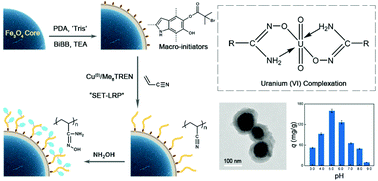
This study presents an effective and facile strategy by integrating surface-initiated single electron transfer living radical polymerization (SET-LRP) with mussel-inspired polydopamine (PDA) chemistry for controlled building of a novel class of core–shell magnetic nanoparticles (MNPs) for highly-efficient uranium enrichment. The strategy initially involves the deposition of a PDA encapsulation layer by spontaneous self-polymerization on the Fe3O4 core, which serves as a safety shell and provides an enabling platform for anchoring of 2-bromoisobutyryl bromide (BiBB) to form macro-initiators. Dense polyacrylonitrile (PAN) brushes are grown from the BiBB-attached PDA shell via SET-LRP using Cu(0)/Me6TREN as a catalytic/ligand system, followed by conversion to amidoxime (AO) functionalized polymer brushes. The core–shell Fe3O4@PDA@PAO MNPs exhibit favorable superparamagnetic characteristics and a fast response within 6 s under an applied magnetic field. Due to the strong binding ability of AO ligands, Fe3O4@PDA@PAO shows a remarkable adsorption capacity (qe = 162.5 mg g−1) toward uranyl ions under optimal pH conditions. A study on the adsorption kinetics suggests that the adsorption process might conform to the pseudo-second-order model. We conclude that the Fe3O4@PDA@PAO MNPs have the potential for effective enrichment and magnetic separation of uranium, and the integrative synthetic strategy combining the SET-LRP technique and PDA chemistry would bring extensive opportunities for versatile surface modification of nanomaterials for more demanding applications.
 Please wait while we load your content...


