
W. M. Xia*ab,
Y. J. Gua,
C. Y. Youa,
C. J. Caoa,
Z. Xub and
Z. C. Zhang*b
aFaculty of Printing, Packaging, and Digital Media Technology, Xi'an University of Technology, Xi'an 710048, Shaanxi, China
bDepartment of Applied Chemistry, School of Science, MOE Key Laboratory for Nonequilibrium Synthesis and Modulation of Condensed Matter, Xi'an Jiaotong University, Xi'an 710049, Shaanxi, China. E-mail: xiaweimin@xaut.edu.cn
First published on 14th December 2015
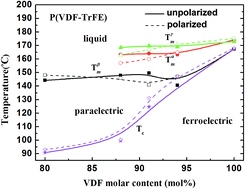
Hydrogenated P(VDF-co-TrFE)s with low TrFE molar contents were synthesized by atom transfer radical chain transfer (ATRCT) and controllable hydrogenation reactions. By using FTIR, XRD, and DSC techniques, the crystal composition was evaluated which largely depends on the TrFE content and electric field. Accordingly to explain the ferro- to paraelectric phase transition phenomenon at different electric fields, a phase diagram of hydrogenated P(VDF-co-TrFE) was drawn. Interestingly, we found that hydrogenated P(VDF-co-TrFE) with a low TrFE molar content of 9% possesses about half of all-trans beta phase in its crystal region, which is different from early reported copolymerized P(VDF-co-TrFE) with the same composition. Meanwhile, the effect of the field induced crystal structure on its ferroelectric property was depicted by dielectric spectra and displacement-electric field curves. As a result, a favourable remnant polarization of 9 μC cm−2 and a large piezoelectric value of −25 pC N−1 were obtained in a polarized hydrogenated P(VDF-co-TrFE) 80/20 mol% film, which provides a reliable result for the structure design of this kind of copolymer aiming at piezoelectric sensors and generators.
Several years later, a certain proportion of new monomers such as trifluoroethylene (TrFE) or tetrafluoroethylene (TFE) were added into PVDF molecular chains by Lovinger group for fabricating the conformation of the fluoropolymer.9–11 They found that the introduced monomer could not only improve the crystal property of PVDF but also block the stability of kinetically form of C–C chains in TGTG′ conformation. As a result, the obtained copolymer poly(vinylidene fluoride-co-trifluoroethylene) (P(VDF-co-TrFE)) possesses favorable β phase when TrFE contents were adjusted to 20–50 mol%.12,13 However, if TrFE content reduced to below 20 mol%, P(VDF-co-TrFE) shows mixed phases of α, β, and γ, where the β phase decreases as the ratio of TrFE.14 Nevertheless, after polarized the low TrFE content P(VDF-co-TrFF) at high electric filed, they appeared the phase transition from low polar α and γ to high polar β phase, and a related crystal phase diagram in regard to the relation of crystal phase composition and TrFE molar content was proposed in literatures.15
Meanwhile, in order to improve the piezoelectric property of P(VDF-co-TrFE), many researchers devoted their efforts to the field-induced phase transition mechanism and proposed a series of ferro- and paraelectric crystal phase models including the polarizing activity of crystal domain, amorphous, and interface molecular chains.14,16,17 They used FTIR (or Raman spectra) and XRD technologies to characterize the crystal phase and chain conformation of P(VDF–TrFE).18 However, neither the bands in FTIR spectra nor the diffraction reflection peaks in XRD spectra could definitively character the composition of α, β, and γ phases. Fortunately, differential scanning calorimeter (DSC) technology was proposed in some work to reveal the crystal phase evolution of PVDF or P(VDF-co-TrFE).14,19–22 Nevertheless, seldom of description using unique method is able to precisely identify and calculate the exact ratio of α, β, and γ phases involved in the phase transition at a strong applied field.
More recently, we obtained a P(VDF-co-TrFE) by an environment friendly and controllable P(VDF-co-CTFE) hydrogenation route named atom transfer chain transfer reaction (ATRCT),23 which could avoid the disadvantages of conventional copolymerized process, such as high price resulting from low productivity, the poor control ability of the copolymer composition due to varied reactivity ratios of different monomers, and the hazard and difficulty during the transportation and storage of TrFE monomer, the productivity of copolymerized P(VDF-co-TrFE) was largely restricted by the high price of TrFE monomer.24 Our previous study has demonstrated that VDF and TrFE units are mostly in head–head connection in the hydrogenated copolymer, which is responsible for the significant difference in the thermal and dielectric properties between the traditional P(VDF-co-TrFE) and hydrogenated copolymer with the consistent composition.25–27 It has also been shown that the ferro- and piezo-electric properties of the hydrogenised P(VDF-co-TrFF) bearing 20 mol% TrFE is rather close to that of direct copolymer with 25 mol% TrFE, which has been widely investigated and utilized in sensors and actuators.28 Although the influence of the composition and fabrication conditions on the electric properties of the hydrogenated P(VDF-co-TrFE) has been investigated recently, the systematic investigation of electrical filed-induced crystal phase transitions as well as the electric properties of hydrogenised P(VDF-co-TrFE)s have not been reported. By using DSC multipeak fitting technique, the crystal phase structure, TrFE content, and polarized electric field strength dependence of dielectric and ferroelectric properties was illustrated accordingly, which may provide a reference for tailoring the electrical properties of this kind of copolymers.
The crystal phase structure of P(VDF-co-TrFE) film could also be illustrated from XRD pattern. As shown in Fig. 3(a), the pattern of A6 has three well defined peaks at 17.82°, 19.94°, and 26.66°, corresponding to the plane 100, 110, and 021, respectively. All of them are the characteristics of α phase. Besides, a weak peak of 18.52° (plane 020) suggests the low content of γ phase. After polarization, the diffraction intensity plane 100 is depressed, which may be attributed to the phase transition from some α phase in A6-P films to β or γ phase (plane 110/200 and 002), as presented in Fig. 3(b). Comparing to A6, the higher peaks of 18.52° and 20.01° of A9 suggest that it possesses more γ and β phase before polarization. The result is different from the phase structures of traditional copolymerized P(VDF-co-TrFE) in literatures,14,15 which is reported that β phase could only be found in the copolymer with more TrFE molar content (12–50 mol%). As expected, the peak at 20.01° is increased after polarization (Fig. 3(b)). In addition, the XRD pattern of A12-P and A20-P shows little change in position, but the increasing of peak intensity also indicating that the β crystal phase is enhanced after polarization.
![]() | ||
| Fig. 3 XRD diffraction patterns of different P(VDF-co-TrFE) samples: (a) before polarized; (b) after polarized at 275 MV m−1 for 10 cycles. | ||
DSC curves were used to detect the crystal phase composition definitely, as shown in Fig. 4. It is well confirmed that the melting temperature (Tm) of β phase is obviously lower than that of α and γ phase in neat PVDF,31 while Tm of α-PVDF is slightly lower than γ-PVDF. Three high endothermic peaks observed in sample A6 to A12 at elevated temperature could be attributed to the melting temperature (Tm) of β, α, and γ phases successively (marked as Tβm, Tαm, and Tγm, respectively). The peaks observed at 140.7 °C, 149.2 °C, and 147.8 °C are assigned to Tβm A6, A9, and A12 (Fig. 4(a–c)), respectively. It is confirmed that the addition of TrFE with low content is responsible for the formation of all-trans conformation (β phase) and for part of the TTTG conformation (γ phase).14,15,32 As TrFE content is increased to 20 mol%, the crystal phases of the copolymer are turned from α + γ + β mixed phases (in A6, A9, and A12) to neat β phase (Fig. 4(c)). Comparing the as-casted films, the polarized A6-P, A9-P, and A12-P possess the elevated Tβm peaks at 147.1 °C, 149.2 °C, and 147.8 °C and depressed Tγm of 165.2 °C, 160 °C, and 157 °C, respectively. Apparently, the phase transition from α or γ to β was completed in P(VDF-co-TrFE) with low TrFE contents which is consisted with the conclusion of XRD pattern.
In addition, the DSC multipeak fitting technique reported in literature was employed to estimate the crystal phase structures of P(VDF-co-TrFE) as presented in Table 1.33 As α and γ phase reduced, the contents of β phase in A6-P, A9-P, and A12-P are increased from 9.6%, 47.6%, and 64.3% to 24.5%, 68.3%, and 90.2%, respectively. The result further shows that strong electric field polarization is responsible for the ordered dipoles and even phase transition of all trans β phase in this hydrogenated P(VDF-co-TrFE).
| P(VDF-co-TrFE) | A6 | A9 | A12 | A20 | ||
|---|---|---|---|---|---|---|
| Phase content (%) | Un-polarized | α | 72.8 | 27.0 | 19.9 | 0 |
| β | 9.6 | 47.6 | 64.3 | 100 | ||
| γ | 16.6 | 25.4 | 15.8 | 0 | ||
| Polarized | α | 32.3 | 10.3 | 7.1 | 0 | |
| β | 24.5 | 68.3 | 90.2 | 100 | ||
| γ | 43.2 | 21.4 | 2.7 | 0 | ||
Besides the melting point, other endothermic peaks, Currie temperature (Tc) was also shown in Fig. 4. Before polarization, Tc of A9, A12, and A20 at about 124.7 °C, 99.8 °C, and 90.9 °C indicates the existence of ferroelectric phase (Fig. 4(b–d)). After polarized 10 cycles at 275 MV m−1, both the molecular chains in β phase and γ phase are oriented and shown the characters of ferroelectric crystal domains. As a result, the Tc peaks related to β phase at 131.2 °C, 100.02 °C, and 93.1 °C are intensified, known as the enhancement of polarized ferroelectric β phase of A9-P, A12-P, and A20-P, respectively. Moreover, the emerging peak of Tc at 93.02 °C of A6-P further indicates that strong electric field could lead to the phase transition in the hydrogenated P(VDF-co-TrFE) with low TrFE content.
![]() | ||
| Fig. 6 Gibbs free energy diagrams of ferroelectric, paraelectric, and melt phases of P(VDF-co-TrFE). | ||
It is concluded that the mixed phase of α, β, and γ could be obtained in low TrFE content copolymer (6 mol%), and even the proportion of β phase reached to 47.6% in P(VDF-co-TrFE) 91/9 mol% sample, as presented in Table 1. The results different from the phase diagram of direct P(VDF-co-TrFE) where β phase was only found in more TrFE content samples (at least 10 mol%).14 After polarization, the ratio of β phase of A6-P, A9-P, and A12-P increased from 9%, 47.6%, and 64.3 to 24.5%, 68.3%, and 90.2%, which favours of their ferroelectric and piezoelectric properties.
δ) of as-casted and polarized P(VDF-co-TrFE) with different TrFE contents were presented in Fig. 6(a). εr of all the samples decreases continuously as a function of frequency from 100 Hz to 100 kHz with a quick drop at frequency from 100 kHz to 100 MHz corresponding to the relaxation of dipoles in large scale, which is consistent with early studies. It has been reported that α-PVDF phase possesses larger εr at low frequency, and εr of γ-PVDF phase is lower than that of β-PVDF.35 Therefore, relatively low εr of A6 and A9 was found at the frequency below 1 MHz for their high γ phase content. As the frequency increased to 10 MHz, εr of A12 and A20 decreased quickly and tan
δ is increased for the relaxation of dipole orientation. After polarized, some of α phase crystals in A6 and A9 are turned into γ and β phase leading to the depressed εr, as shown in Fig. 6(b), where εr of A6-P and A9-P is reduced from 9.1 and 10.2 to 7.6 and 7.7, respectively. However, little change of εr is observed in A20-P for its pure β phase.
Moreover, the heartbreak shape peaks (Fig. 7(b)) of tan
δ detected in all the polarized samples at about 10 MHz are referred to the resonance effect of piezoelectric materials. Fig. 8 presents the magnified dielectric resonance spectrum at the frequency from 40 MHz to 100 MHz. The resonance peaks at 70 MHz represent the piezoelectric and electro-mechanical properties of polarized P(VDF-co-TrFE) films, which is discussed in ref. 28. The thickness of the films is far smaller than the diameter, if it is utilized in longitudinal thickness mode, the relation of piezoelectric resonance could be expressed by eqn (1) as expressed in literatures.36,37
| d33 ∝ kt(S33Eε3T)1/2 | (1) |
![]() | ||
| Fig. 7 Dielectric properties of different P(VDF-co-TrFE) samples: (a) before polarized and (b) after polarized at 275 MV m−1 for 10 cycles. | ||
![]() | ||
| Fig. 8 Dielectric constant and loss of A6-P to A12-P around resonance frequency after polarized at 275 MV m−1 for 10 cycles. | ||
Fig. 9 presents the dielectric properties of hydrogenised P(VDF-co-TrFE) film with different TrFE contents at a range of temperature from 40 °C to 155 °C. Apparently, εr of all samples decreases as the frequency increases at all temperature, which consist with Fig. 7. εr of A6 shows the wide peaks of dielectric relaxation (Fig. 9(a)). However, the εr peaks appeared in Fig. 9(b–d) were not only related to dielectric relaxation but known as the ferroelectric–paraelectric (F–P) phase transition. The peaks of A9-A20 films situated at 124 °C, 113 °C, and 109 °C, respectively, which also correspond to Tc. The descending Tc from about 125 °C of A9 to 108 °C of A20 indicates that the Gibbs free energy of paraelectric phase decreases as the TrFE content increases.
![]() | ||
| Fig. 9 Dielectric properties as a function of temperature of different P(VDF-co-TrFE) samples: (a) A6, (b) A9, (c) A12, and (d) A20. | ||
In addition, we could observed the peaks of tan
δ in A9 to A20 samples above 80 °C, which is well confirmed the dielectric relaxation due to dipolar relaxation in crystalline or crystal-amorphous interface regions.38 Interestingly, the relaxation peak was found to be shifted towards lower temperature from 105 °C (A9, Fig. 9(b)) to 95 °C (A20, Fig. 9(d)) as the increasing of β phase, which may attribute to decreases of crystal–amorphous of interface region.
![]() | ||
| Fig. 10 Polarization hysteresis loops (P–E loops) of A12 at 200 MV m−1 with several cycles at about 10 Hz. | ||
Fig. 11 presented the P–E loops of A6-P to A20-P at various electric field. Apparently, P–E loops of all the samples show the characters of normal ferroelectric polymer, where both Ps and Pr are increase straight as the electric field and reach to a saturated value. In samples A6-P and A9-P with low TrFE content, the crystal domains of γ phase plays an important role in the improvement polarization value, and Pr could reach to 5.8 μC cm−2 at 375 MV m−1 and 6.0 μC cm−2 at 325 MV m−1, respectively, as presented in Table 2 and Fig. 11(a–b). As TrFE increases, Pr is mostly originated from the ferroelectric domain of high polar β phase in samples A12-P and A20-P. Consequently, higher Pr of 7.9 μC cm−2 and 8.2 μC cm−2 could be obtained under the polarized field of 300 MV m−1 and 275 MV m−1, respectively, as shown in Table 2 and Fig. 11(c and d). In addition, for the majority of high polar β phase domains, A12-P and A20-P show much larger Ps (11.3 μC cm−2 and 12.3 μC cm−2) than A6-P and A9-P at 275 MV m−1. As a result, the high piezoelectric values (d33 = −25 pC N−1 and −19 pC N−1) could be obtained in A20-P and A12-P after polarized at 275 MV m−1 with 10 cycles, respectively.
![]() | ||
| Fig. 11 Polarization hysteresis loops at various electric field (Ep) of P(VDF-co-TrFE) with different TrFE contents at about 10 Hz: (a) A6, (b) A9, (c) A12, and (d) A20. | ||
| P(VDF-co-TrFE) | Ec (MV m−1) | Ps (μC cm−2) | Pr (μC cm−2) | d33 (pC/N) | εir |
|---|---|---|---|---|---|
| A6 | 105.2 | 5.5 | 2.1 | −6 | 28.8 |
| A9 | 92.9 | 7.83 | 4.7 | −13 | 32.3 |
| A12 | 87.1 | 11.3 | 7.6 | −19 | 45.5 |
| A20 | 60.1 | 12.3 | 8.33 | −25 | 50.4 |
The relationship between ferroelectric activity and TrFE content could also be illustrated with the coercive electric field (Ec) as well, which has been well proved to be more relate to the ferroelectric domains involved in the polarization reversal.14,15 As shown in Fig. 11 and Table 2, Ec is decreased from 105.2 MV m−1 of A6-P to 60.1 MV m−1 of A20-P at 275 MV m−1, indicating that the ferroelectric domains in β phase tend to be easier to be oriented than low polar γ phase. The reversing γ phase crystal domain may suffer from the resistance of α phases with large crystal grain size in the mixture crystal phase P(VDF-co-TrFE) (A6-P and A9-P). As Ep increases, the added Ec illustrates that more γ phase was forced to conquer the more surrounded resistance, as indicated in Fig. 9(a and b). Interestingly, as shown in Fig. 10, if the same Ep was repeated for 10 cycles, although Pr and Ps were increased accordingly, Ec of A12-P did not appear to add up. That illustrates the ferroelectric domains was not respond to the fixed Ep any more unless the strength of Ep was added.
Besides of P–E loops, we proposed a temporary dielectric constant (εir) to illustrate the effect of electric field induced phase transition on the dielectric property of hydrogenated P(VDF-co-TrFE) as calculated from eqn (2) by using the data of Fig. 11.
![]() | (2) |
As presented in Fig. 12, εir of P(VDF-co-TrFE) is not a constant under varied electric field. The elevated εir obtained under strong electric field may be attributed to the reversal of dipoles, interface polarization, ionic polarization, and conduction loss. Interestingly, εir of all the samples shows the similar reversed V shaped as Ep increases. In addition, εir of A20-P is increasing dramatically as the applied electric field for the reversal of high polar β phase. As Ep is increased to 100 MV m−1 over its Ec (∼60 MV m−1), the dipoles of β phase responding to electric field are saturated and a maximum εir of 73 is obtained accordingly. Subsequently, no more excessive dipoles polarization could response to the elevated Ep (>100 MV m−1), and εir decreases and maintains a proper value. For this inference, εir of A6-P, A9-P, and A12-P shows the similar curve, and it only reach to 31.1, 33, and 51.7 because of its relative low β phase contents, respectively.
| This journal is © The Royal Society of Chemistry 2015 |