
Thermal bursting ionization for ambient mass spectrometry

Jiying Pei, Kefu Yu* and Yinghui Wang*
School of Marine Sciences, Guangxi University, Nanning, Guangxi 530004, P. R. China. E-mail: wyh@gxu.edu.cn; kefuyu@scsio.ac.cn; Fax: +867713231358; Tel: +867713227177 Tel: +867713231358

Received 28th October 2015 , Accepted 21st December 2015

First published on 23rd December 2015


Abstract

Thermal bursting ionization (TBI), which was developed for organic reaction monitoring in our previous work, was investigated in detail for ambient mass spectrometry. The performance of TBI was validated by analysis of various compounds in both positive and negative modes. Besides, TBI is illustrated to be applicable to complex samples, such as fruit juice and skin-care products.

Mass spectrometry ionization sources could be classified into several categories according to the ionization energy, including thermo-based,1 electric-based,2,3 laser-based,4,5 and gas-based.6,7 Among them, thermo-based ionization sources are ones with a long history and have evolved from high vacuum conditions to ambient conditions. In chemical ionization and electron ionization (vacuum conditions), heat is used to desorb analytes from solid (or liquid) phase to gas phase for reagent or electron ionization.8 In thermospray ionization (subatmosphere condition), heat plays the role of assisting gas ionization.9

Ambient ionization sources10,11 are developed in recent years which are popular with the elimination of sample-pretreatment and high throughput. Thermo-based ambient ionization sources include atmospheric-pressure thermal desorption ionization (APTDI),12 solvent assisted inlet ionization (SAII),13 heat-assisted capillary photoionization (CPI),14 electro-thermal vaporizer direct analysis in real time (ETV DART),15 thermal desorption-electrospray ionization (TD-ESI),16 atmospheric pressure thermal desorption-extractive electrospray ionization (AP/TD-EESI),17 rapid evaporative ionization mass spectrometry (REIMS),18 and probe electrospray ionization (PESI).19 They were developed in succession for complex sample analysis. The common characteristic of most of these ionization sources is that heat is auxiliary to improve ionization efficiency, and additional energies such as plasma, gas, laser, and high voltage are still indispensable to ionize sample. Though REIMS has been successfully applied to issue analysis, the long ion transfer tube has compromised the ionization efficiency. The introduction of samples (solid or liquid) into the inlet capillary renders SAII improper for complex samples since the matrix readily clogs the capillary and pollutes the mass spectrometer.

Thermal bursting ionization (TBI) is a recently developed ionization method designed for organic reaction monitoring by our group.20 It has been illustrated to be effective in capturing short-lived reactive intermediates in real time. On the basis of our previous investigation, we further characterized the performances (repeatability, linearity, and limitation of detection (LOD)) of TBI in this work, and illustrated TBI's applicability to complex samples, such as saccharides detection in fruit juice and identification of different brands of skin-care products.

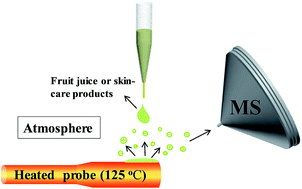
The schematic diagram of TBI setup is shown in Scheme 1 (refer to Fig. S1). It simply consists of a heated metal probe. When a liquid sample is added onto the heated metal probe, solvent evaporates dramatically accompanying with the transfer of analyte from liquid phase to gas phase for mass spectrometric detection. It is noteworthy that the name of “paper-assisted thermal ionization” was used in our previous work, since filter paper was used for organic reaction monitoring. However, the liquid sample is loaded onto the metal probe directly in general application. Therefore, we named the ionization source “thermal bursting ionization” in this work.


image file: c5ra22626k-s1.tif
Scheme 1 Schematic diagram of the TBI setup.

The TBI source was observed to enable the detection of compounds with molecular weight from 180–1100 tested in this work. As shown in Fig. 1, for polar compounds, such as tyrosine and angiotensin II (Ang II), the protonated ([M + H]+) and deprotonated ([M − H]) molecules were observed in positive and negative mode respectively, implying that bipolar charged droplets were produced during the bursting process. For PEG 400, TBI produces a spectrum with the correct average mass of ∼400 and the proper oligomeric distribution with the mass difference of 44 (corresponding to CH2CH2O). For sucrose (weakly polar compound) analysis, sodium adducts were observed to be the base peak of the mass spectrum instead of the protonated molecules, similar to the signal obtained by ESI (the corresponding ESI mass spectra of these compounds are shown in Fig. S2).21 Hardly any signal was obtained for acetone (very weakly polar compound) (Fig. S3), indicating that TBI is more appropriate for preformed ions in solution. This may depend on the ionization mechanism of TBI. When solution sample is loaded onto the heated metal probe, solvent boils intensively accompanying with the transfer of analyte from liquid phase to gas phase, during which process both positively and negatively charged droplets are produced based on the statistical distribution upon sampling a neutral fluid containing discrete positive and negative charges.22 Then the charged droplets form ions via desolvation under the high temperature and local electrical fields generated by the charge on the droplet. The ionization mechanism is similar to that proposed by REIMS and thermospray ionization.9,23 Since the ionization process relies on the separation of anions and cations, preformed ions are more readily detected by TBI MS.


image file: c5ra22626k-f1.tif
Fig. 1 Mass spectra of (a–d) tyrosine and Ang II in positive and negative mode, and (e and f) PEG 400 and sucrose in positive mode detected by TBI MS. Note that the spectrum obtained in (d) is from the reaction mixture of Ang II, H2O2 and NaNO2. Conditions: Ctyrosine = 4 μg mL−1, CAng II = 2.5 μg mL−1, CAng II + CAng II–NO2 = 2.5 μg mL−1, CPEG 400 = 5 μg mL−1, Csucrose = 1 μg mL−1, solvent: CH3OH/H2O (v/v, 1[thin space (1/6-em)]:[thin space (1/6-em)]1), Tprobe = 125 °C. The MS2 spectra of tyrosine and sucrose are shown in the insets.

For thermal-based ambient ionization sources, heat is generally used to desorb analytes, whereas additional ionization means such as DART, ESI or photoionization are still obligatory. However, TBI integrates desorption with ionization process, which greatly simplifies the experimental apparatus. Moreover, despite of the high temperature, the analyte molecules are still prevented from pyrolyzation in TBI. This may be attributed to three reasons: (1) the heat energy is transferred to analyte molecules indirectly via solvent molecules, in analogy to energy transfer via matrix molecules in matrix-assisted laser desorption ionization (MALDI);24 (2) rapid heating by the high temperature makes molecular evaporation rate comparable to the decomposition rate;23 (3) collisional cooling of nascent ions at atmosphere is expected to further suppress thermal decomposition.23

The critical factor that effects the performance of TBI is probe temperature. The test results of reserpine in CH2Cl2, CH3OH/H2O (v/v, 1[thin space (1/6-em)]:[thin space (1/6-em)]1) and H2O are shown in Fig. 2. As can be seen, regardless of which solvent, too low probe temperature will result in low signal intensity and serious background interference. This is because solvent evaporates nonviolently under such conditions, and most of the analyte molecules are retained on the probe surface. If the temperature is too high, sample loading would be difficult for Leidenfrost effect,25 and it will result in bad repeatability and decreased signal intensity. With reserpine in CH2Cl2 as an example, the relative standard deviation (RSD) based on five measurements and signal intensity are (7.05 × 10², 215%), (5.02 × 10³, 49%), (6.86 × 10⁴, 52%) and (3.48 × 10⁴, 120%) at 60 °C, 75 °C, 90 °C, and 110 °C respectively. Therefore, 90 °C was chosen as the optimal temperature for solvent of CH2Cl2. Since boiling point varies with solvent species, the optimal temperatures are different for various solvents. After optimization, the optimal temperatures for solvents of CH3OH/H2O (v/v, 1[thin space (1/6-em)]:[thin space (1/6-em)]1) and H2O are 125 °C and 150 °C respectively.


image file: c5ra22626k-f2.tif
Fig. 2 Effect of the probe temperature on reserpine (0.5 μg mL−1) signal in different solvents with TBI MS. (a) CH2Cl2, (b) CH3OH/H2O (v/v, 1[thin space (1/6-em)]:[thin space (1/6-em)]1), and (c) H2O. The values in the spectra represent probe temperature, signal intensity (m/z 609), and RSD based on five measurements.

Under the optimal experimental conditions, analytical performances of TBI, including repeatability, linearity, and LOD, were characterized. With reserpine in CH3OH/H2O (v/v, 1[thin space (1/6-em)]:[thin space (1/6-em)]1) as an example, the RSD is 30% based on the peak areas of eight measurements. When 75 ng mL−1 of tioconazole was added as internal standard (IS), the RSD decreased to 11%, indicating improved repeatability (Fig. 3a). The linearity curve for reserpine detection is shown in Fig. 3b. The LOD is 6.8 pg (calculated with loading volume of 2 μL), and the correlation coefficients (R2) is 0.9977 with dynamic range from 5 ng mL−1 to 600 ng mL−1.


image file: c5ra22626k-f3.tif
Fig. 3 (a) Representative analysis sequence of reserpine (0.2 μg mL−1) used for determining the repeatability of TBI source. The ordinates represents the normalized integral area of selected ion chromatogram of m/z 609 (blue column), and the ratio of the integral areas of selected ion chromatogram of m/z 609 to m/z 389 (IS, tioconazole) (red column). (b) The linearity curve for reserpine analysis. The error bars represent standard deviation of three repetitive measurements.

Further on, TBI is shown to be suitable for the analysis of real samples without or with minimum sample pretreatment. The mass spectrum of fruit juice is shown in Fig. 4a. Abundant signals of [glucose + Na]+ (m/z 202.9), [glucose + K]+ (m/z 218.9), [sucrose + Na]+ (m/z 365.0), and [sucrose + K]+ (m/z 380.9) were observed. Though [glucose + K]+ and [sucrose + K]+ dominated the mass spectrum of muskmelon detected with API,26 the results of both of these methods accord with the fact that fruit are rich in saccharides.


image file: c5ra22626k-f4.tif
Fig. 4 Mass spectra of (a) orange fruit purchased from a local supermarket, and (b) skin-care products of Proya and Chando brands.

As is known, counterfeit beauty products generally contain plenty harmful ingredients that are unconducive to health. To pursue maximum interests, some profiteers adulterate the products to deceive consumers. Therefore, rapid identification of different brands of beauty products is essentially important. Fig. 4b shows the mass spectra of two brands (Proya and Chando) of skin-care products analyzed by TBI MS. For Proya brand, some common peaks, including m/z 118, 140, 235, 257, 352, 469, and 491, were observed for both lotion and cream. However, additional cluster peaks in the 600–1000 m/z range were observed for lotion. On the other hand, the mass distribution of the cream of Chando brand was quite different. The most abundant peaks were observed in the 400–900 m/z range while few signals were observed in the low mass range. Though the accurate identification of these ion peaks is unavailable currently, it is indubitable that TBI MS provides a rapid pathway to fingerprint various brands of beauty products.

Overall, these results show that TBI MS copes with analysis of complex samples. Other than skin-care products, it could be readily used for identification of other samples as well, such as perfume and beer.

Conclusions

In summary, a low-cost, easy-to-operate, and high sensitivity ionization source has been developed for ambient mass spectrometry, which is based on the thermal bursting techniques. Since bipolar charge droplets are produced during the bursting process, both positive and negative ions could be detected without alteration of ionization source polar. Moreover, TBI is illustrated to be applicable to complex matrixes, such as fruit juice and skin-care products. According to the fingerprinting peaks of the mass spectra, different brands of beauty products could be distinguished.

For the simplicity and no requirement for external gas or voltage supply, TBI may be applied to portable mass spectrometers in future application. Also, TBI could be tried for heterogeneous catalytic reaction monitoring, which provides new insight into reaction mechanisms.

Acknowledgements

This work was supported by the National Key Basic Research Program of China (No. 2013CB956102), the Guangxi Natural Science Fund Project (No. 2013GXNSFEA053001), the BaGui Scholars Program Foundation (2014) and the NSFC (41473118, 41273139).

References

  1. R. J. Cotter, Anal. Chem., 1981, 53, 1306 CrossRef CAS.
  2. J. B. Fenn, M. Mann, C. K. Meng, S. F. Wong and C. M. Whitehouse, Science, 1989, 246, 64 CAS.
  3. G. Y. Li, Y. Yin and G. M. Huang, RSC Adv., 2014, 4, 59650 RSC.
  4. V. V. Laiko, M. A. Baldwin and A. L. Burlingame, Anal. Chem., 2000, 72, 652 CrossRef CAS PubMed.
  5. P. S. Addy, A. Bhattacharya, S. M. Mandal and A. Basak, RSC Adv., 2014, 4, 46555 RSC.
  6. A. Hirabayashi, M. Sakairi and H. Koizumi, Anal. Chem., 1994, 66, 4557 CrossRef CAS.
  7. V. G. Santos, T. Regiani, F. F. Dias, W. Romão, J. L. P. Jara, C. F. Klitzke, F. Coelho and M. N. Eberlin, Anal. Chem., 2011, 83, 1375 CrossRef CAS PubMed.
  8. R. J. Cotter, Anal. Chem., 1980, 52, 1589A CrossRef CAS.
  9. C. R. Blakley and M. L. Vestal, Anal. Chem., 1983, 55, 750 CrossRef CAS.
  10. Z. Takáts, J. M. Wiseman, B. Gologan and R. G. Cooks, Science, 2004, 306, 471 CrossRef PubMed.
  11. M. Li, B. Hu, J. Q. Li, R. Chen, X. Zhang and H. W. Chen, Anal. Chem., 2009, 81, 7724 CrossRef CAS PubMed.
  12. H. Chen, Z. Ouyang and R. G. Cooks, Angew. Chem., Int. Ed., 2006, 45, 3656 CrossRef CAS PubMed.
  13. V. S. Pagnotti, N. D. Chubatyi and C. N. McEwen, Anal. Chem., 2011, 83, 3981 CrossRef CAS PubMed.
  14. M. Haapala, T. Suominen and R. Kostiainen, Anal. Chem., 2013, 85, 5715 CrossRef CAS PubMed.
  15. P. Dwivedi, D. B. Gazda, J. D. Keelor, T. F. Limero, W. T. Wallace, A. V. Macatangay and F. M. Fernández, Anal. Chem., 2013, 85, 9898 CrossRef CAS PubMed.
  16. M. Z. Huang, C. C. Zhou, D. L. Liu, S. S. Jhang, S. C. Cheng and J. Shiea, Anal. Chem., 2013, 85, 8956 CrossRef CAS PubMed.
  17. N. A. Devenport, L. C. Sealey, F. H. Alruways, D. J. Weston, J. C. Reynolds and C. S. Creaser, Anal. Chem., 2013, 85, 6224 CrossRef CAS PubMed.
  18. J. Balog, L. Sasi-Szabo, J. Kinross, M. R. Lewis, L. J. Muirhead, K. Veselkov, R. Mirnezami, B. Dezső, L. Damjanovich, A. Darzi, J. K. Nicholson and Z. Takáts, Sci. Transl. Med., 2013, 5, 194 Search PubMed.
  19. P. Y. Liu, A. Forni and H. Chen, Anal. Chem., 2014, 86, 4024 CrossRef CAS PubMed.
  20. J. Y. Pei, Y. B. Kang and G. M. Huang, Analyst, 2014, 139, 5354 RSC.
  21. C. H. Stephens, B. Shrestha, H. R. Morris, M. E. Bier, P. M. Whitmore and A. Vertes, Analyst, 2010, 135, 2434 RSC.
  22. E. E. Dodd, J. Appl. Phys., 1953, 24, 73 CrossRef CAS.
  23. K. C. Schäfer, J. Dénes, K. Albrecht, T. Szaniszló, J. Balog, R. Skoumal, M. Katona, M. Tóth, L. Balogh and Z. Takáts, Angew. Chem., Int. Ed., 2009, 48, 8240 CrossRef PubMed.
  24. E. Schulz, M. Karas, F. Rosu and V. Gabelica, J. Am. Soc. Mass Spectrom., 2006, 17, 1005 CrossRef CAS PubMed.
  25. A. B. Wang, C. H. Lin and C. C. Chen, Phys. Fluids, 2000, 12, 1622 CrossRef CAS.
  26. C. H. Hsieh, C. H. Chang, P. L. Urban and Y. C. Chen, Anal. Chem., 2011, 83, 2866 CrossRef CAS PubMed.

Footnote

Electronic supplementary information (ESI) available: Experimental procedures, mass spectra. See DOI: 10.1039/c5ra22626k

This journal is © The Royal Society of Chemistry 2016
Click here to see how this site uses Cookies. View our privacy policy here.