Anilkumar Satapathyab,
Sandip T. Gadgea,
Takehiko Sasaki
c and
Bhalchandra M. Bhanage*a
aDepartment of Chemistry, Institute of Chemical Technology, N. Parekh Marg, Matunga, Mumbai-400019, India. E-mail: bm.bhanage@gmail.com; bm.bhanage@ictmumbai.edu.in; Fax: +91 22 22692102; Tel: +91 22 33612601
bReliance Industries limited, Patalganga, Rasayani, Raigad, Maharashtra 410 220, India
cDepartment of Complexity Science and Engineering, Graduate School of Frontier Sciences, The University of Tokyo, 5-1-5, Kashiwanoha, Kashiwa, Chiba 277-8561, Japan
First published on 27th October 2015
This work reports the synthesis of polyamides using an efficient, ligand free and Pd/C-catalyzed protocol. Various polyamides can be synthesized by carbonylation polycondensation reaction of aromatic diiodides, diamines and carbon monoxide using Pd/C as a heterogeneous and recyclable catalyst. Variation in inherent viscosities observed with the structure of diamine component. Notably this synthetic route does not require any ligand and give high yield of the polyamides. Catalyst Pd/C can be recovered easily and was characterized using XPS analysis. The catalyst was recycled five times without substantial loss in activity.
![]() | ||
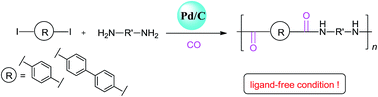
| Scheme 1 Comparison of previous traditional, industrial and carbonylation methods with the present work.1a,4,6 | ||
Various homogeneous catalytic systems along with phosphine ligands are reported for the synthesis of polyamide using aromatic di-halides with diamine compounds under carbonylation method (Scheme 1).6 Phosphine ligands are very much costly and air sensitive, require tedious work-up procedures to separate it from product and high workup costs which place significant limits on their synthetic applications. In our previous work we have successfully synthesized polyesteramide by using immobilized palladium metal containing ionic liquid on SBA-15 as a phosphine free catalytic system in heterogeneous medium.7 It is well known that Pd/C as heterogeneous and ligand-free catalyst and well explored for various carbonylation, cross-coupling reactions.8
To extend our continued interest in this ligand-free carbonylation9 polymerization process we have developed an efficient, ligand free protocol for the synthesis of polyamides from carbon monoxide, aromatic diiodides and diamines in the presence of Pd/C catalyst (Scheme 1).
During the course of our investigation on carbonylation–polycondensation we observed the change in inherent viscosities with different structure of diamines. Advantageously this method, avoids use of the air sensitive phosphine ligand, lower reaction time and easy recovery of Pd/C from the reaction mixture by simple filtration, providing excellent yield of desired polyamides.
| Entry | Catalyst | Catalyst loading (mol%) | Yieldb [%] | ηinh (dL g−1) |
|---|---|---|---|---|
| a Reaction conditions: 1a (5 mmol), 2a (5 mmol), CO (7 atm), DMAc (20 mL), agitation: 700 rpm, temperature 115 °C, time 70 min.b Isolated yield. | ||||
| 1 | 5% Pd/C | 10 | 59 | 0.22 |
| 2 | 10% Pd/C | 5 | 57 | 0.11 |
| 3 | 10% Pd/C | 6 | 71 | 0.17 |
| 4 | 10% Pd/C | 8 | 80 | 0.28 |
| 5 | 10% Pd/C | 10 | 86 | 0.36 |
| 6 | 10% Pd/C | 12 | 87 | 0.32 |
The 1H and 13C NMR spectrum of the product 3a carried out in DMSO solvent. The aliphatic protons appear at 1.25 (–CH2–), 3.23 (–NH–CH2–), and the aromatic protons appear at 7.83 and 7.94. The signal at 8.54 is due to the amide proton (–NH–CO). The 13C NMR spectrum also clearly indicated peaks at 165.6 corresponding to amide carbonyl (–C
O) group. TGA analysis showed that polymer 3a began to decompose around 320 °C. The DSC analysis of product 3a showed glass transition temperature at 60 °C and the melting point around 155 °C.
After confirmation of the polymer obtained was desired polyamide, we investigated the effects of different solvents such as N-methyl-2-pyrolidone (NMP), dimethyl sulphoxide (DMSO), dimethyl formamide (DMF), dimethyl acetamide (DMAc) for the present carbonylation–polycondensation reaction using the 10% Pd/C-catalyst. The results are presented in Table 2 (entries 1–4). Looking to the yield and inherent viscosity, DMAc appears to be the most suitable solvent for the present protocol (Table 2, entry 4).
| Entry | Solvent | Base | Press. (atm) | Temp °C | Yieldb [%] | ηinh (dL g−1) |
|---|---|---|---|---|---|---|
| a Reaction conditions: 1a (5 mmol), 2a (5 mmol), 10% Pd/C (10 mol%), agitation: 700 rpm, time 70 min.b Isolated yield. | ||||||
| Effect of solvent | ||||||
| 1 | NMP | DBU | 7 | 115 | 48 | 0.10 |
| 2 | DMSO | DBU | 7 | 115 | 78 | 0.30 |
| 3 | DMF | DBU | 7 | 115 | 68 | 0.22 |
| 4 | DMAc | DBU | 7 | 115 | 86 | 0.36 |
![]() |
||||||
| Effect of base | ||||||
| 5 | DMAc | DABCO | 7 | 115 | 72 | 0.15 |
| 6 | DMAc | Et3N | 7 | 115 | 26 | 0.08 |
| 7 | DMAc | Na2CO3 | 7 | 115 | 12 | 0.09 |
| 8 | DMAc | NaOH | 7 | 115 | 18 | 0.07 |
![]() |
||||||
| Effect of CO pressure | ||||||
| 9 | DMAc | DBU | 1 | 115 | 32 | 0.12 |
| 10 | DMAc | DBU | 4 | 115 | 81 | 0.23 |
| 11 | DMAc | DBU | 8 | 115 | 86 | 0.32 |
![]() |
||||||
| Effect of temperature | ||||||
| 12 | DMAc | DBU | 7 | 90 | 75 | 0.13 |
| 13 | DMAc | DBU | 7 | 110 | 78 | 0.26 |
| 14 | DMAc | DBU | 7 | 125 | 83 | 0.17 |
Base screening study showed that DBU brings out the highest yield of the product as compared to inorganic and other organic bases (Table 2, entries 5–8). It is observed that inorganic bases are found almost ineffective in these reactions. Highest yield (86%) and highest inherent viscosity (0.36 dL g−1) of polyamide 3a was obtained by using the DBU as base. The additional advantage of DBU is that it has the ability to swell the resulting polymer apart from acting as an acid acceptor.3 Next we examined the effect of different CO pressure on reaction profile (Table 2, entries 9–11).
The effect of CO pressure showed that reaction could be carried out at 1 atm pressure but gave a higher yield and inherent viscosity of polyamide 3a at 7 atm of CO pressure. It was observed that the rate of CO adsorption was very high using the 10 mol% Pd/C catalyst. Nearly three atmosphere of CO drop was observed at 115 °C temperature in 15 minute time duration. This might be due to the high surface area of the catalyst. Further increase in CO pressure has no profound effect on yield and viscosity of polyamide 3a (Table 2, entry 11).
The temperature of the reaction was also important for the effective progress of the Pd/C-catalyzed carbonylation–polycondensation reaction (Table 2, entries 12–14). The inherent viscosity was strongly influenced by temperature. At 115 °C the highest inherent viscosity and CO absorption was observed.
The low inherent viscosities of the polymers 3a at low temperature could be because of the low reaction rate (Table 2, entry 12 and 13). At higher temperature, we observed the lower inherent viscosity of polyamide 3a (Table 2, entry 14).
In order to study the potential and general applicability of developed methodology, various diamines and diiodides were investigated (Table 3). The varieties of polyamides derivatives were prepared using this approach under optimised reaction conditions. The polymers exhibited distinct and characteristic IR frequencies corresponding, amide carbonyl functional groups (around 1630 cm−1) and amide N–H stretching frequency (around 3310 cm−1).
Thermogravimetric analysis (TGA) indicated that all polymers were stable in air up to at least 320 °C (Fig. 1). The NMR spectrum indicates the absence of any amine linkages, at least in detectable amounts, (arising because of competing N-arylation reactions) and confirms the structural homogeneity of the polyamide produced by the Pd/C catalysed carbonylation route under heterogeneous and ligand-free condition.
![]() | ||
| Fig. 1 TGA curves for polyamides prepared by Pd/C catalysed carbonylation–polycondensation reaction. | ||
The reusability of Pd/C is a great advantage in decreasing environmental pollution and cost reduction in process chemistry. The effect of reused times of Pd/C on catalytic activity is shown in Table 4. We examined the reuse of Pd/C in the carbonylation–polycondensation reaction using 1a and 2a as substrates in the presence of CO at 115 °C temperature. Pd/C could be reused successfully until the five run without significant loss of yield or extension of the reaction time. We also performed the leaching study of palladium metal after first and fifth recycle runs. Pd metal was not detected within the limits of the assay (<1 ppm) by analysis with inductively coupled plasma atomic emission spectrometry (ICP-AES).
The XPS spectrum and content of each element are shown in Fig. 2a, which proves that the catalyst used in this experiment is composed of elements Pd, C and O. High resolution spectra of element Pd (Fig. 2b) show that 336 eV and 341 eV represent Pd2+ in fresh Pd/C catalyst and the two peaks are resulted from spin splitting of Pd(II). It suggests that Pd(II) does exist in the fresh Pd/C catalyst which can promote the carbonylation–polycondensation of diiodides and diamines. For the 1st and 5th recycle catalysts, both peaks tend to shift to lower binding energies (334.3 eV and 339.4 eV), which are assigned as 3d5/2 and 3d3/2 for Pd0 species suggesting that the catalysts are reduced but the activity of the Pd species remains constant for the reaction. Fig. 2c and d showed the presence of the carbon and oxygen species in fresh and reused catalyst. For the 1st recycle and the 5th recycle catalysts, in the I 3d region, two intensive peaks appear at 617.8 eV (I 3d5/2) and 629.2 eV (I 3d3/2), indicating that adsorption of iodide atoms takes place on the surface of carbon (Fig. 2e).
![]() | ||
| Fig. 2 XPS spectra of the fresh and reused Pd/C catalyst; [a] wide scan; [b] Pd 3d; [c] C 1s; [d] O 1s; [e] I 3d. | ||
O), 141.5, 133.9, 127.8, 126.6, 29.1, 26.1; anal. calcd (%): theoretical: C (73.46), H (6.12), N (9.52) experimental: C (73.25), H (5.92), N (9.63).
[3b] IR (KBr): 3313, 1629 cm−1; 1H NMR (300 MHz, DMSO) δ 8.59 (br. NH), 7.98 (ArH), 7.84 (ArH), 3.28 (CH), 1.52 (CH), 1.32 (CH); 13C NMR (75 MHz, DMSO) δ 165.7 (C
O), 141.5, 134.0, 127.9, 126.7, 29.1, 26.2, 26.1; anal. calcd (%): theoretical: C (74.53), H (6.83), N (8.69) experimental: C (74.41), H (6.97), N (8.45).
[3c] IR (KBr): 3294, 1647 cm−1; 1H NMR (300 MHz, DMSO) δ 8.69 (br. NH), 7.95 (ArH), 7.86 (ArH), 3.30 (CH); 13C NMR (75 MHz, DMSO) δ 166.1 (C
O), 141.6, 133.8, 127.9, 126.7, 29.2; anal. calcd (%): theoretical: C (72.18), H (5.26), N (10.52) experimental: C (71.74), H (5.34), N (10.15).
[3d] IR (KBr): 3296, 1647 cm−1; 1H NMR (300 MHz, DMSO) δ 9.12 (br. NH), 8.04 (ArH), 7.85 (ArH), 7.31 (ArH), 4.48 (CH); 13C NMR (75 MHz, DMSO) δ 164.7 (C
O), 141.7, 138.1, 133.8, 130.0, 128.0, 127.2, 42.4; anal. calcd (%): theoretical: C (77.19), H (5.26), N (8.18) experimental: C (76.55), H (5.88), N (7.76).
[3e] IR (KBr): 3309, 1644 cm−1; 1H NMR (300 MHz, DMSO) δ 10.30 (br. NH), 8.08 (ArH), 7.92 (ArH), 6.93 (ArH), 6.84 (ArH); 13C NMR (75 MHz, DMSO) δ 164.8 (C
O), 154.1, 148.8, 141.9, 133.9, 128.4, 126.8, 122.1, 120.1; anal. calcd (%): theoretical: C (76.84), H (4.43), N (6.89) experimental: C (76.35), H (4.92), N (7.37).
[3f] IR (KBr): 3303, 1644 cm−1; 1H NMR (300 MHz, DMSO) δ 8.56 (br. NH), 7.90 (ArH), 3.26 (CH), 1.52 (CH), 1.32 (CH); 13C NMR (75 MHz, DMSO) δ 165.5 (C
O), 136.8, 127.1, 29.1, 26.2, 26.1; anal. calcd (%): theoretical: C (69.42), H (5.78), N (11.57) experimental: C (69.01), H (5.86), N (11.13).
[3g] IR (KBr): 3307, 1630 cm−1; 1H NMR (300 MHz, DMSO) δ 8.58 (br. NH), 7.89 (ArH), 3.30 (CH), 1.56 (CH); 13C NMR (75 MHz, DMSO) δ 165.5 (C
O), 136.7, 127.1, 29.3, 26.7; anal. calcd (%): theoretical: C (67.28), H (4.76), N (13.08) experimental: C (66.53), H (5.12), N (12.46).
[3h] IR (KBr): 3306, 1613 cm−1; 1H NMR (300 MHz, DMSO) δ 10.42 (br. NH), 8.09 (ArH), 7.05 (ArH), 6.90 (ArH); 13C NMR (75 MHz, DMSO) δ 164.7 (C
O), 153.0, 144.8, 134.5, 127.6, 122.2, 120.5; anal. calcd (%) theoretical: C (72.72), H (4.42), N (8.48) experimental: C (71.51), H (5.12), N (9.06).
Footnote |
| † Electronic supplementary information (ESI) available. See DOI: 10.1039/c5ra20426g |
| This journal is © The Royal Society of Chemistry 2015 |