
Seul Ah Lee,
Jae Jun Lee,
Ga Rim You,
Ye Won Choi and
Cheal Kim*
Department of Fine Chemistry and Department of Interdisciplinary Bio IT Materials, Seoul National University of Science and Technology, Seoul 139-743, Korea. E-mail: chealkim@seoultech.ac.kr; Fax: +82-2-973-9149; Tel: +82-2-970-6693
First published on 2nd November 2015
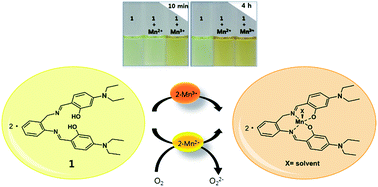
A new colorimetric chemosensor for Mn(III) and Mn(II) was developed by combination of 2-(aminomethyl)aniline and 4-(diethylamino)-2-hydroxybenzaldehyde. This sensor 1 exhibited an obvious color change from pale yellow to reddish brown in the presence of Mn3+ in aqueous solution (buffer/CH3CN = 7
:
3), which was reversible with the addition of EDTA. Moreover, 1 could be used to detect and quantify Mn3+ in water samples, and as a practical, visible colorimetric test kits for Mn3+. Moreover, 1 could detect Mn2+ via the formation of 1–Mn3+ complex with longer reaction time. The resulting different reaction time of Mn(III) and Mn(II) with 1 was used to differentiate between Mn(III) and Mn(II). Finally, the sensing ability of 1 for Mn3+ was supported by theoretical calculations.
Manganese, the 12th most common element in the earth's crust, is abundantly present in the environment and our food, including nuts, grains, tea, and legumes, which provide an average daily intake of about 5 mg kg−1.12–14 Besides, manganese is an essential trace element and has important functions, such as in catalysis and as a structural component in diverse proteins, e.g. the photosynthetic apparatus and the enzyme superoxide dismutase.15,16 However, an elevated level of manganese can result in toxic neurological effects, which cause a series of symptoms, such as adynamia/fatigability, sialorrhea, cephalalgia, sleep disturbances, muscular pain and hypertonia, masklike face, gait changes, reduced coordination, hallucinations, and mental irritability, finally leading to a Mn-induced Parkinson like disease, called manganism.17 Furthermore, manganese can exist in a wide range of oxidation states, viz. 2+, 3+, 4+, 5+, and 6+, and thus may promote redox reactions and form cytotoxic free radicals.18–20 Among them, Mn2+ and Mn3+ have differential cytotoxicity. According to Zheng's report, Mn3+ species appeared to be more cytotoxic than Mn2+ ones in their in vitro study.21 Therefore, the development of chemosensors for differentiating of Mn3+ from Mn2+ is highly significant and much needed. Nevertheless, the simultaneous detection of both Mn2+ and Mn3+ has not been reported yet, to the best of our knowledge.
In recent years, Dai and co-workers have reported a chromogenic sensor for determination of manganese ion, which was the first colorimetric chemosensor capable of detecting Mn2+ in aqueous solution.22 Our group also developed two colorimetric chemosensors for detecting Mn2+, which were successfully used to sense Mn2+ ions at a concentration below WHO guideline.23,24
To further develop a more selective and sensitive tool to identify and distinguish between Mn2+ and Mn3+ ions, herein we report a newly designed colorimetric chemosensor, which was based on Schiff base derivative containing diethylaminosalicyl moiety and have a strong chromogenic and binding properties. Specifically, chemosensor comprised of combination of 4-(diethylamino)salicylaldehyde and 2-(aminomethyl)benzenamine with high sensitivity and excellent selectivity in aqueous solution. The chemosensor 1 exhibited a color change from pale yellow to reddish brown upon binding to Mn2+ and Mn3+, respectively, while 1 reacts with Mn3+ ca. 20 times faster than Mn2+. The different reaction time of Mn(III) and Mn(II) with 1 was used to differentiate Mn(III) from Mn(II).
:
1, v/v) as eluent. Yield 0.28 g (60%); 1H NMR (400 MHz CD3CN, ppm): δ 13.54 (s, 1H), 13.45 (s, 1H), 8.46 (s, 1H), 8.22 (s, 1H), 7.33 (m, 2H), 7.20 (m, 3H), 6.98 (d, J = 8.8 Hz, 1H), 6.30 (d, J = 8.8 Hz, 1H), 6.16 (d, J = 8.8 Hz, 1H), 6.12 (s, 1H), 5.96 (s, 1H), 4.75 (s, 2H), 3.39 (q, 4H), 3.32 (q, 4H), 1.13 (t, 6H), 1.05 (t, 6H); 13C NMR (100 MHz DMSO-d6, ppm): 164.68, 164.16, 163.07, 161.90, 151.58, 150.85, 147.18, 134.32, 133.02, 132.31, 128.82, 128.59, 125.63, 118.05, 108.79, 107.92, 103.84, 102.89, 97.18, 96.79, 57.51, 43.98, 43.80, 12.56. ESI-MS m/z (M + H+): calcd, 473.29; found, 473.27. Anal. calc. for C29H36N4O2: C, 73.70; H, 7.68; N, 11.85%. Found: C, 73.43; H, 7.72; N, 12.07%.
:
3, v/v) to obtain a final concentration of 10 μM. Mn(OAc)3·2H2O (0.83 mg, 0.003 mmol) was dissolved in CH3CN (1 mL) and 1–13 μL of this Mn3+ solution (1 mM) was transferred to each sensor solution (10 μM) to give 1–1.3 equiv. After mixing them for 10 min, UV-vis spectra were taken at room temperature.
For Mn2+: sensor 1 (1.4 mg, 0.003 mmol) was dissolved in CH3CN (1 mL) and 10 μL of this solution (3 mM) was diluted with 2.99 mL of 10 mM bis-tris buffer/CH3CN (7
:
3, v/v) to make the final concentration of 10 μM. Mn(OAc)2·4H2O (0.74 mg, 0.003 mmol) was dissolved in CH3CN (1 mL) and 1–13 μL of this Mn2+ solution (1 mM) was transferred to each sensor solution (10 μM) to give 1–1.3 equiv. After mixing them for 4 h, UV-vis spectra were taken at room temperature.
:
3, v/v, 1 mL). Volumes of the Mn3+ solution were added to each of the above vials containing 1 solution: 0, 1.2, 2.4, 3.6, 4.8, 6.0, 7.2, 8.4, 9.6, 10.8 and 12 μL. Each vial was then diluted with bis-tris buffer/CH3CN (7
:
3, v/v) to obtain a total volume of 3 mL. After reacting them for 10 min, UV-vis spectra were taken at room temperature.
For Mn2+: sensor 1 (1.4 mg, 0.003 mmol) was dissolved in CH3CN (1 mL). The following aliquots of the above 1 solution were transferred to separate vials: 12, 10.8, 9.6, 8.4, 7.2, 6.0, 4.8, 3.6, 2.4, 1.2 and 0 μL. Mn(OAc)2·4H2O (0.74 mg, 0.003 mmol) was dissolved in bis-tris buffer/CH3CN (7
:
3, v/v, 1 mL). Volumes of the Mn2+ solution were added to each of the above vials containing 1 solution: 0, 1.2, 2.4, 3.6, 4.8, 6.0, 7.2, 8.4, 9.6, 10.8 and 12 μL. Each vial was further diluted with bis-tris buffer/CH3CN (7
:
3, v/v) to obtain a total volume of 3 mL. After reacting them for 4 h, UV-vis spectra were taken at room temperature.
:
3, v/v) to make the final concentration of 10 μM. MNO3 (M = Na, K, 0.003 mmol) or M(NO3)2 (M = Co, Ni, Cu, Zn, Cd, Mg, Ca, Pb, 0.003 mmol) or M(NO3)3 (M = Fe, Cr, Al, Ga, In, 0.003 mmol) was dissolved in CH3CN (1 mL), separately. Each metal solution (13 μL, 3 mM) was then added to 3 mL of the solution of sensor 1 (10 μM) to give 1.3 equiv. of the metal ions. Then, 13 μL of Mn3+ solution (3 mM) was added into the mixed solution of each metal ion and 1 to make 1.3 equiv. After mixing them for 10 min, UV-vis spectra were recorded at room temperature.
:
3, v/v) to make a final concentration of 10 μM. Mn(OAc)3·2H2O (0.83 mg, 0.003 mmol) was dissolved in bis-tris buffer (1 mL) and 13 μL of the Mn3+ solution (3 mM) was added to the solution of 1 (10 μM) prepared above. After mixing it for 10 min, UV-vis spectrum was recorded at room temperature. Ethylenediaminetetraacetic acid disodium salt dehydrate (EDTA, 0.88 mg, 0.003 mmol) was dissolved in bis-tris (1 mL) and 13 μL of the EDTA solution (3 mM) was added to the solution of 1–Mn3+ complex (10 μM) prepared above. After mixing it for 1 min, UV-vis spectrum was again recorded. For the reversibility study, another 13 μL of the Mn3+ solution (3 mM) was added to the above solution. After mixing it for 10 min, UV-vis spectrum was run at room temperature. The same experimental procedure was repeated one more time.
:
3, v/v) stock solution to 2.37 mL sample solutions. After well mixed, the solutions were allowed to stand at 25 °C for 10 min before the test. Sewage water samples were centrifuged for 20 min (2100 RCF) and only the supernatant was used for ICP spectrometry analysis.
:
3, v/v). Upon the addition of 1.3 equiv. of each cation, 1 showed little or no spectra changes in absorption peaks in the presence of Na+, K+, Mg2+, Ca2+, Cr3+, Mn2+, Fe3+, Co2+, Ni2+, Cu2+, Zn2+, Cd2+, Al3+, Ga3+, In3+ and Pb2+ (Fig. 1a). By contrast, the addition of Mn3+ to 1 caused a significant spectral change and showed a color change from pale yellow to reddish brown within 10 min (Fig. 1b). Importantly, this is the first example for the detection of Mn3+ in aqueous solution (Table 1), to the best of our knowledge.
| Sensor | Detection limit (μM) | Interference | Water% in solvent | Method of detection | Sensing metal ions | Reference |
|---|---|---|---|---|---|---|
![]() |
No data | No data | 100% | Naked eye | Mn2+ & Zn2+ | 22 |
![]() |
6.03 | Zn2+, Cr3+ | 10% | Naked eye | Mn2+, Zn2+ & Al3+ | 23 |
![]() |
7.11 | Cu2+, Co2+ | 20% | Naked eye | Mn2+ & Fe2+ | 24 |
![]() |
No data | Fe2+, Co2+, Zn2+, Cd2+, Hg2+ | 100% | Fluorescence | Mn2+, Fe2+, Zn2+ & Cd2+ | 34 |
![]() |
No data | Co2+, Cu2+, Fe2+ | 100% | Fluorescence | Mn2+ | 35 |
![]() |
1 | Pb2+ | 100% | Naked eye | Mn2+ | 36 |
![]() |
No data | No data | 50% | Fluorescence | Mn2+ | 37 |
![]() |
5.0 | Fe2+, Co2+ | 0% | Naked eye | Mn2+ | 38 |
![]() |
0.91, 0.64 | Co2+, Cu2+ | 70% | Naked eye | Mn2+ & Mn3+ | This work |
More importantly, 1 could also detect Mn2+ with longer sensing time (4 h) as shown in Fig. 2. The reaction of Mn2+ with 1 was very slow and took 4 h for the complete reaction (Fig. 2a), while its reaction with Mn3+ finished within 10 min (Fig. 2b). Consistent with UV-vis study, the solution color of 1 in the presence of Mn2+ slowly changed to reddish brown (Fig. 3a). The solution color of 1–Mn2+ complex 4 h after 1 was mixed with Mn2+ was eventually the same as that of 1 with Mn3+, indicating that the 1–Mn2+ complex might be oxidized to the 1–Mn3+ complex with the same color change from pale yellow to reddish brown. Also, UV-vis absorption spectra of 1–Mn2+ and 1–Mn3+ complexes 4 h after 1 reacted with Mn2+ and Mn3+, respectively, supported this proposal (Fig. 3b). At this stage, we do not understand why Mn2+ and Mn3+ are more selective towards the sensor 1 in comparison with other ions. Importantly, the colorimetric discrimination of Mn3+ from Mn2+ is also the first example, to the best of our knowledge (Table 1).
First of all, the binding properties of 1 with Mn3+ were studied by UV-vis titration experiments (Fig. 4). On sequential addition of Mn3+ to a solution of 1, the absorption band at 361 nm decreased and two new bands at 300 nm and 500 nm gradually reached maxima at 1.3 equiv. These peaks with molar extinction coefficients in the thousands, 1.4 × 10⁵ M−1 cm−1 (ε300 nm) and 7.0 × 10⁴ M−1 cm−1 (ε463 nm), were too large to be Mn-based d–d transitions. Thus, the peak at 500 nm might be attributed to a ligand-to-metal charge-transfer (LMCT),38–41 which is responsible for the reddish brown color of the solution. Meanwhile, an isosbestic point was observed at 341 nm, demonstrating that only one product was generated from 1 upon binding to Mn3+. These results indicated that sensor 1 could serve as a selective chromogenic sensor for Mn3+ ion.
The binding mode between 1 and Mn3+ was determined through Job plot analysis (Fig. S1†),42 which exhibited a 1
:
1 complexation stoichiometry for the 1–Mn3+ complex formation. To further confirm the binding mode between 1 and Mn3+, ESI-mass spectrometry analysis was carried out (Fig. 5). The positive-ion mass spectrum indicated that the peak at m/z = 525.33 was assignable to [1–2H+ + Mn3+]+ [calcd, 525.21] and the peak at m/z = 602.60 assignable to [1–2H+ + Mn3+ + 2H2O + CH3CN]+ [calcd, 602.25] complex. Based on Job plot and ESI-mass spectrometry analysis, we propose the structure of 1–Mn3+ complex as shown in Scheme 2.
![]() | ||
| Fig. 5 Positive-ion electrospray ionization mass spectrum of 1 (100 μM) upon addition of 1 equiv. of Mn3+. | ||
The binding constant of 1 with Mn3+ was calculated as 5.0 × 10⁴ M−1 on the basis of Benesi–Hildebrand equation (Fig. S2†).43 Based on the result of UV-vis titration, the detection limit for Mn3+ was determined to be 0.64 μM on the basis of the definition by IUPAC (CDL = 3Sb/m, Fig. S3†). Importantly, the value (0.64 μM) for Mn3+ is much below the World Health Organization (WHO) guideline (7.28 μM) in the drinking water and the lowest among those previously reported for Mn2+/3+-binding chemosensors in aqueous solution, to the best of our knowledge.44 This result indicated that 1 could be a powerful tool for the detection of Mn3+ in the drinking water.
To check further the practical applicability of receptor 1 as a Mn3+-selective receptor, we carried out competition experiment (Fig. 6). A background of most coexistent metal ions such as Na+, K+, Mg2+, Ca2+, Cr3+, Fe3+, Co2+, Ni2+, Cu2+, Zn2+, Cd2+, Al3+, Ga3+, In3+ and Pb2+ did not interfere with the detection of Mn3+ by 1 in bis-tris buffer/CH3CN (7
:
3, v/v). However, Co2+ and Cu2+ quenched about 46% and 92% of the absorbance obtained with Mn3+ alone, respectively, suggesting that Co2+ and Cu2+ have a comparable or stronger binding ability to 1 compared to Mn3+. These results indicated that 1 could be an excellent chromogenic sensor for Mn3+ over most competing relevant metal ions, in spite of interfering with Co2+ and Cu2+, in aqueous solution. To overcome the interference of Co2+ and Cu2+, cyanide was used as binding agent for Co2+ and Cu2+ (Fig. S4†). The detection of Mn3+ with 1 was not interfered by both Co2+ and Cu2+ in presence of the CN− ion.
For environmental applications, the pH dependence of the 1–Mn3+ complex was further investigated, as shown in Fig. 7. Over the pH range tested, the absorbance intensity of the complex displayed a strong pH dependence. As the nitrogen atoms of imine groups of 1 could be protonated below pH 6.0, 1 might not chelate with Mn3+. At pH higher than 11.0, 1–Mn3+ complex may decompose by demetallation. Therefore, an intense and stable absorption intensity of 1–Mn3+ complex was observed in the pH range of 7.0–11.0, which warrants its application in monitoring Mn3+ by naked-eye without having it affected by changes in physiological pH values.
To examine the reversibility of sensor 1 toward Mn3+ in bis-tris buffer/CH3CN (7
:
3, v/v), ethylenediaminetetraacetic acid (EDTA, 1.3 equiv.) was added to the solution of sensor 1 and Mn3+ complex. As shown in Fig. 8, the addition of EDTA to a mixture of 1 and Mn3+ resulted in a return of the absorbance from reddish brown to pale yellow at 450 nm, which indicated the regeneration of the free 1. Upon re-addition of Mn3+ into the solution, the color and the absorbance again changed to reddish brown. The absorbance and color changes were almost reversible even after several cycles with the sequential alternate addition of Mn3+ and EDTA. These results indicated that sensor 1 could be recyclable simply through treatment with a proper reagent such as EDTA. Such reversibility and regeneration could be important for the fabrication of chemosensors to sense Mn3+.
For the practical application of sensor 1, test strips were prepared by immersing filter papers in the solution of 1 and then dried in air. These test strips were used to sense Mn3+ among different cations. As shown in Fig. 9, when the test strips coated with 1 were added to different cation solutions, a clear color change was observed only with Mn3+ in bis-tris buffer. Therefore, the test strips coated with the receptor 1 solution would be convenient for detecting Mn3+. These results showed that receptor 1 could have a practical application for detecting Mn3+ in environmental samples. Moreover, this is the first example that the test strips were used to sense Mn3+ among different cations, to the best of our knowledge.
In order to examine the applicability of the chemosensor 1 in environmental samples, we constructed a calibration curve for the determination of Mn3+ by 1 (Fig. S5†), which exhibited a good linear relationship between the absorbance of 1 and Mn3+ concentration (0.00–10.00 μM) with a correlation coefficient of R2 = 0.9971 (n = 3). Then, the chemosensor was applied to the determination of Mn3+ in water samples. First, tap water samples were chosen. As shown in Table 2, one can see that satisfactory recovery and R.S.D. values of water samples were exhibited. Second, artificial polluted water samples were prepared by adding various metal ions that are known to be involved in industrial processes into deionized water. The results have also been summarized in Table 2, which exhibited satisfactory recovery and R.S.D. values for all the water samples. In order to prove the validation of 1 as an analytical method for quantification, sewage water samples were chosen. 1 presented the comparable results with those of ICP-spectrometry analysis (Table 2), indicating that 1 could be used as an analytical method for detecting Mn3+ in real water samples.
| Sample | Mn(III) added (μmol L−1) | Mn(III) found (μmol L−1) | Recoveryf (%) | R.S.D.g (n = 3) (%) |
|---|---|---|---|---|
a Tap water (10 mM bis-tris solution) : CH3CN = 7 : 3, v/v.b Prepared by deionized water, 5.00 μmol L−1 Mn(III), 5 μmol L−1 Cd(II), Pb(II), Na(I), K(I), Ca(II), Mg(II), Zn(II). Conditions: [1] = 30 μmol L−1 in 10 mM bis-tris buffer–CH3CN solution (7 : 3, pH 7.0).c Sewage water was obtained from the pigsty in Seoul, Korea.d Our method.e Inductively Coupled Plasma (ICP) spectrometry analysis.f [(Mn(III) found)/(Mn(III) added)] × 100.g Relative standard deviations. |
||||
| Tap watera | 0.00 | 0.00 | — | — |
| 6.00 | 5.78 | 96.6 | 3.0 | |
| Water sampleb | 0.00 | 5.10 | 102 | 2.1 |
| 2.00 | 7.41 | 115 | 2.2 | |
| Sewage water samplec | 0.00 | 3.63d | — | 3.5 |
| 0.00 | 3.51e | — | 2.6 | |
The binding mode between 1 and Mn2+ was determined through Job plot analysis (Fig. S6†).42 The Job plot exhibited a 1
:
1 complexation stoichiometry for the 1–Mn2+ complex formation. To further confirm the binding mode between 1 and Mn2+, ESI-mass spectrometry analysis was carried out (Fig. S7†). The positive-ion mass spectrum of 1–Mn2+ complex was nearly identical to that of 1–Mn3+ complex, although Mn2+ was used as standard metal ion. These results led us to propose two possibilities: one is that 1–Mn2+ complex might be oxidized to the 1–Mn3+ complex under ESI-mass experimental conditions, and the other is that after its formation from the reaction of Mn2+ with 1, the 1–Mn2+ complex is oxidized to the 1–Mn3+ complex.
To investigate the correct reason, we first carried out the sensing test of 1–Mn2+ and 1–Mn3+ complexes under degassed conditions. If there is no color change for the complexation of the Mn2+ ion with 1 under the degassed conditions, it would mean that 1 detects Mn3+, not Mn2+, because 1–Mn2+ complex is oxidized to 1–Mn3+ complex only by O2 molecules without any oxidants. Finally, we observed no color change for 1–Mn2+ complex under the degassed conditions as shown in Fig. 11, while the solution of 1–Mn3+ complex showed the color change from pale yellow to reddish brown. These results strongly demonstrate that 1 does not detect Mn2+, but Mn3+ through color change from pale yellow to reddish brown.
![]() | ||
Fig. 11 Color changes of 1 (10 μM) 4 h after 1.3 equiv. of Mn2+ and Mn3+ ions were added into 1, respectively, in 10 mM bis-tris buffer/CH3CN (7 : 3, v/v) under the degassed conditions. | ||
To more clearly confirm our proof of the oxidation of Mn2+ to Mn3+ in the 1–Mn2+ complex, we used electron paramagnetic resonance (EPR) spectroscopy (Fig. 12). As expected, 1–Mn3+ samples prepared under aerobic conditions showed typical silent signals suggestive to Mn3+ regardless of the reaction time (10 m through 4 h, Fig. 12a). 1–Mn2+ samples prepared under aerobic conditions showed typical signals at g = 2.03 and 2.04 suggestive to Mn2+. However, the EPR signals of the 1–Mn2+ samples gradually decreased and disappeared after 4 h (Fig. 12b). These results confirm that 1–Mn2+ complexes formed from the reaction of 1 with Mn2+ ions were gradually oxidized to 1–Mn3+ complexes by oxygen molecules over 4 h. Based on Job plot, the degassed experiment, EPR study, and ESI-mass spectrometry analysis, we propose the reaction mechanism for the formation of 1–Mn3+ complex produced from the reaction of 1 with Mn2+ ion as shown in Scheme 3. We assume that 1–Mn2+ complex exists in a small ratio by an easy rotation of the benzyl carbon of 1 at equilibrium (the first step in Scheme 3), because Mn2+ ion with lower oxidation state may not strongly bind to two oxygen atoms of 1. In contrast, Mn3+ ion with higher oxidation state may form 1–Mn3+ complex easily. Therefore, the small portion of 1–Mn2+ complex under aerobic condition would be oxidized slowly to 1–Mn3+ complex by O2. In comparison, a similar type of chemosensor (L, 9th row in Table 1), which do not contain a benzyl carbon,38 seems to react quickly with Mn2+ to form L–Mn2+ complex, thus resulting in quick sensing of Mn2+.
The binding constant of 1 with Mn2+ was calculated as 2.0 × 10⁴ M−1 on the basis of Benesi–Hildebrand equation (Fig. S8†),43 which was nearly identical to that of the 1–Mn3+ complex. This values is within those (103 to 1012) previously reported for Mn2+-binding chemosensors.4,11,35,36,45 Based on the result of UV-vis titration, the detection limit for 1–Mn2+ was determined to be 0.91 μM on the basis of the definition by IUPAC (CDL = 3Sb/m, Fig. S9†), which is also nearly identical to that of the 1–Mn3+ complex. Importantly, the value (0.91 μM) of 1 for Mn2+ is far below the World Health Organization (WHO) guideline (7.28 μM) of the drinking water,46–48 suggesting that 1 could be an influential chemosensor for the detection of manganese in the drinking water.
:
1 stoichiometric ratio, the theoretical calculations were performed with 1
:
1 stoichiometry. The exact coordination of 1 with Mn3+ could not be established since single crystal growth was not successful. However, the reported similar single crystal structures46–48 and ESI-mass spectrometry analysis led us to propose that the 1–Mn3+ complex might have square pyramidal coordination geometry with one solvent molecule (acetonitrile, see Scheme 2). Also, based on the EPR spectroscopy, 1–Mn3+ complex was optimized with a paramagnetic complex (S = 3, DFT/uB3LYP/main group atom: 6-311+G** and Mn: Lanl2DZ/ECP). The significant structural properties of the energy-minimized structures are shown in Fig. S10.†
We also investigated the absorption to the singlet excited states of 1 and 1–Mn3+ complex via TDDFT calculations. In case of 1, the main molecular orbital (MO) contribution of the first lowest excited state was determined for HOMO → LUMO transition (362.50 nm, Table S1 and Fig. S11†), which indicated an intramolecular charge transfer (ICT) band. In case of 1–Mn3+ complex, the excited states of 10th, 22nd and 30th (552.33, 410.69 and 378.60 nm) were found to be relevant for the observed color change (yellow to reddish brown) showing the predominance of LMCT and ICT (Table S2 and Fig. S12 and S13†). These results were well consistent with the experimental absorption wavelengths. Thus, the chelation of Mn3+ with 1 mainly showed the LMCT and ICT, which induced the color change of 1 in the presence of Mn3+.
Footnote |
| † Electronic supplementary information (ESI) available. See DOI: 10.1039/c5ra20396a |
| This journal is © The Royal Society of Chemistry 2015 |