DOI:
10.1039/C5RA20104G
(Paper)
RSC Adv., 2015,
5, 92685-92689
Microbial production of phenol via salicylate decarboxylation
Received
29th September 2015
, Accepted 22nd October 2015
First published on 23rd October 2015
Abstract
Phenol, as an important bulk chemical, is the synthetic precursor to polycarbonates, epoxide resins and phenolic resins. Currently, phenol production relies on chemical processes using benzene as the starting material, which are environmentally incompatible and nonrenewable. Here we designed a novel phenol biosynthetic pathway and achieved phenol production from renewable carbon sources in Escherichia coli. A decarboxylase from Klebsiella pneumoniae was over-expressed and purified. In vitro assay was conducted to determine the kinetic parameters toward salicylate. In the bioconversion study, 1154.5 ± 12.0 mg L−1 of phenol was produced from supplemented salicylate. Connecting salicylate decarboxylation with its biosynthesis led to microbial phenol production. Phenol production was improved by enhancing upstream shikimate pathway and modulating gene expression levels. E. coli strain QH4 was a better strain than BW25113 for phenol production. In shake flask experiment the best strain produced 405.6 ± 13.7 mg L−1 of phenol with only trace amount of salicylate left in the culture. Optimization of cultivation conditions further increase phenol titer by 16.4% to 472.1 ± 19.8 mg L−1. This study provides a promising alternative for sustainable production of phenol.
1. Introduction
Phenol is an important commodity chemical with many applications. It mainly serves as the precursor to polycarbonates, epoxide resins and phenolic resins. In addition, it can also be used to synthesize herbicides and pharmaceutical drugs. In 2008, over 8 million tons of phenol was produced globally.1 Currently, the dominant route for phenol production is the cumene process using benzene as the starting material, which is non-renewable and environmentally unfriendly.2 With the concerns on oil crisis and environment pollution, increasing attention has been attracted to develop new sustainable processes for the production of phenol and other fossil-derived chemicals. Metabolic engineering represents a promising alternative and the biological production of a variety of chemicals has been achieved from renewable biomass.3–12
Biological production of phenol has been reported by several research groups. A phenol biosynthetic pathway was constructed in a solvent-tolerant Pseudomonas putida S12 strain.13 Tyrosine was converted to phenol by introducing a foreign tyrosine phenol-lyase (TPL). To increase precursor supply, shikimate pathway was enhanced by over-expressing 3-deoxy-D-arabino-heptolosonate-7-phosphate (DAHP) synthase. The final strain produced 142 mg L−1 of phenol in shake flask culture. Phenol titer was further improved to 868 mg L−1 in biphasic fed-batch cultivation using octanol as the extractant. This pathway was also reconstituted in E. coli.1 To improve tyrosine supply, csrA and tyrR were down-regulated using synthetic regulatory small RNA. The engineered strain produced 419 mg L−1 of phenol from glucose by flask culture. Phenol titer was increased to 3.8 g L−1 by biphasic fermentation with tributyrin as an extractant. Recently, a novel phenol production pathway was established in E. coli by recruiting 4-hydroxybenzoate decarboxylase.14 4-Hydroxybenzoate is a native metabolite in E. coli and is synthesized from chorismate by the catalysis of chorismate pyruvate lyase (UbiC). DAHP synthase and UbiC were shown to be rate-limiting, and over-expression of their encoding genes resulted in 7- and 69-fold increase of phenol titer, respectively. The pathway genes were integrated into the chromosome to obtain genetically stable strains. By modulating gene expression levels, phenol titer reached 250 mg L−1 in shake flask culture. Five different solvents were tested for biphasic extractive fermentation and dibutyl phthalate and tributyrin were the best two solvents for improving phenol production. By two-phase fed-batch fermentation, the best strain produced 9.5 g L−1 phenol in a 7 L fermentor.14
In this study, we designed a novel phenol biosynthetic pathway by connecting salicylate synthesis and its decarboxylation. After pathway and strain optimization, the final titer reached 472.1 mg L−1 in shake flask experiment.
2. Materials and methods
2.1 Media, strains and plasmids
Luria–Bertani (LB) medium was used for cell propagation and protein expression. Modified M9 medium was used for microbial production of phenol. LB medium contains 10 g tryptone, 5 g yeast extract and 10 g NaCl per liter. The modified M9 (M9Y) medium contains 10 g L−1 glycerol, 2.5 g L−1 glucose, 6 g L−1 Na2HPO4, 0.5 g L−1 NaCl, 3 g L−1 KH2PO4, 1 g L−1 NH4Cl, 1 mM MgSO4, 0.1 mM CaCl2, 2 g L−1 yeast extract and 2 g L−1 MOPS. When needed, ampicillin and kanamycin were added to the medium to the final concentration of 100 mg L−1 and 50 mg L−1, respectively. E. coli strain XL1-Blue was used for plasmid construction and propagation. E. coli BL21 (DE3) Star was used for protein expression and purification. E. coli BW25113 and QH4 were used for phenol production. Plasmid pETDuet-1 was employed for protein expression and purification. Plasmids pZE12-luc (high-copy) and pCS27 (medium-copy) were used for pathway assembly. The details of the strains and plasmids used in this study are depicted in Table 1.
Table 1 Plasmids and strains used in this study
| Plasmids and strains |
Description |
Source |
| Plasmids |
| pZE12-luc |
PLlacO1, colE ori, luc, Ampr |
Ref. 16 |
| pCS27 |
PLlacO1, P15A ori, Kanr |
Ref. 16 |
| pETDuet-1 |
pT7, PBR322 ori, Ampr |
Ref. 16 |
| pET-kpBDC |
pETDuet-1, salicylate decarboxylase gene from K. pneumoniae |
Ref. 15 |
| pZE-EP |
pZE12-luc, entC from E. coli and pchB from Pseudomonas fluorescens |
Ref. 16 |
| pCS-APTA |
pCS27, aroL, ppsA, tktA, aroGfbr from E. coli |
Ref. 16 |
| pZE-kpBDC |
pZE12-luc, salicylate decarboxylase gene from K. pneumoniae |
This study |
| pZE-kpBDC-EP |
pZE12-luc, salicylate decarboxylase gene, entC, pchB, two operons |
This study |
| pCS-APTA-EP |
pCS27, aroL, ppsA, tktA, aroGfbr, entC, pchB, two operons |
This study |
| pCS-APTA-kpBDC |
pCS27, aroL, ppsA, tktA, aroGfbr, salicylate decarboxylase gene, two operons |
This study |
![[thin space (1/6-em)]](https://www.rsc.org/images/entities/char_2009.gif) |
| Strains |
| XL1-Blue |
recA1 endA1 gyrA96 thi-1 hsdR17 supE44 relA1 lac [F′ proAB lacIqZΔM15Tn10 (Tetr)] |
Stratagene |
| BW25113 |
rrnBT14 ΔlacZWJ16 hsdR514 ΔaraBADAH33 ΔrhaBADLD78 |
Coli genome stock center |
| QH4 |
E. coli ATCC 31884 with pheA and tyrA disrupted |
Ref. 20 |
| BP1 |
BW25113 with pZE-kpBDC-EP |
This study |
| BP2 |
BW25113 with pZE-kpBDC-EP and pCS-APTA |
This study |
| BP3 |
BW25113 with pZE-kpBDC and pCS-APTA-EP |
This study |
| BP4 |
BW25113 with pZE-kpBDC-EP and pCS-APTA-kpBDC |
This study |
| QP1 |
QH4 with pZE-kpBDC-EP |
This study |
| QP2 |
QH4 with pZE-kpBDC-EP and pCS-APTA |
This study |
| QP3 |
QH4 with pZE-kpBDC and pCS-APTA-EP |
This study |
| QP4 |
QH4 with pZE-kpBDC-EP and pCS-APTA-kpBDC |
This study |
2.2 DNA manipulation
Plasmids pET-kpBDC, pZE-EP and pCS-APTA were constructed in our previous studies.15,16 Plasmid pZE-kpBDC was constructed by inserting BDC encoding gene into Kpn I/Xba I sites of plasmid pZE12-luc. Plasmids pZE-kpBDC-EP and pCS-APTA-EP were constructed by inserting the expressing cassette PLlacO1-EP into Spe I/Sac I sites of pZE-kpBDC and pCS-APTA, respectively. Plasmid pCS-APTA-kpBDC was constructed by inserting the expressing cassette PLlacO1-kpBDC into Spe I/Sac I sites of pCS-APTA.
2.3 Salicylate decarboxylase assay
E. coli strain BL21 (DE3) Star was transformed with plasmid pET-kpBDC. Overnight cultures were inoculated into 50 mL of LB medium and incubated at 37 °C with shaking. When OD600 reached 0.4, cultures were induced with 0.25 mM IPTG and grown for 5 h at 30 °C. Cell pellets were harvested by centrifugation. After re-suspended in 800 μL of His-binding buffer, the cells were disrupted with 0.1 mm glass beads. The protein was purified using His-Spin protein miniprep kit (ZYMO Research). Protein concentration was estimated using BCA kit (Pierce Chemicals). For measurement of decarboxylase activity, the following reaction conditions were used: the mixture contained 20 μL of purified protein, salicylate as substrate in 66.7 mM Na2HPO4–KH2PO4 buffer (pH 5.0) with a final volume of 1 mL in a 1.5 mL micro-centrifuge tube and incubated at 30 °C for 4 h. The substrate concentrations varied from 0 to 2.5 mM. The enzyme activity was monitored by measuring the formation of phenol by HPLC. The kinetic parameters of decarboxylase were calculated through non-linear regression of the Michaelis–Menten equation.
2.4 Feeding experiments
Feeding experiments were carried out to examine phenol production from salicylate. E. coli strain BW25113 was transformed with plasmid pZE-kpBDC. Single colonies were inoculated into 3 mL LB medium containing 100 μg mL−1 of ampicillin and grown overnight at 37 °C. Overnight cultures were inoculated into 50 mL of M9Y medium containing ampicillin. The cultures were left to grow at 37 °C till OD600 reached 0.6 and then induced with 0.25 mM IPTG. Salicylate (final concentration 400 mg L−1) was fed into the culture at 8 h, 16 h, 24 h and 36 h after induction. Samples were taken at four different time points and the product concentrations were measured by HPLC.
2.5 De novo production of phenol
Overnight cultures of phenol-producing strains were inoculated into the M9Y medium containing appropriated antibiotics with a ratio of 1% or 2% and cultivated at 37 °C with shaking for 3 h. Then, the cultures were induced with 0.25 mM IPTG and continued to be cultivated at 30 °C or 37 °C for 48 h. Samples were taken every 12 hours. OD600 values were measured and the concentrations of phenol and salicylate were analyzed by HPLC.
2.6 HPLC analysis
Salicylate (from Sigma Aldrich) and phenol (from Alfa Aesar) were used as the standards. Both the standards and samples were analyzed and quantified by HPLC (Hitachi Chromaster) equipped with a reverse-phase Diamonsil C18 column and a Hitachi 5420 UV-Vis detector. Solvent A was water with 0.1% formic acid and solvent B was methanol. The column temperature was set to 30 °C. For salicylate and phenol detection, the following gradient was used at a flow rate of 1 mL min−1: 50 to 80% solvent B for 22 min, 80 to 50% solvent B for 3 min, and 50% solvent B for an additional 5 min. Quantification of salicylate and phenol was based on the peak areas at specific wavelengths (300 nm for salicylate, 274 nm for phenol).
3. Results and disussion
3.1 Design of a novel phenol biosynthetic pathway
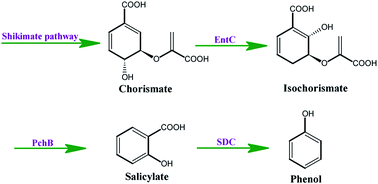
Salicylate is an important naturally-occurring compound that has various physiological functions and wide commercial applications. In our previous study, a salicylate biosynthetic pathway was designed and verified in E. coli, in which chorismate was converted to salicylate by the action of two enzymes isochorismate synthase (encoded by entC) and isochorismate pyruvate lyase (endoded by pchB).16 After systematic pathway and strain optimization, 1.2 g L−1 of salicylate was produced in shake flasks.17 This pathway was further extended for 4-hydroxycoumarin and muconic acid production.16,17 In nature, salicylate decarboxylase (SDC) catalyzes the decarboxylation of salicylate to form phenol and CO2. Although the reaction is reversible, the escape of CO2 from the reaction system makes it prefer phenol production. Based on this, we designed a new phenol biosynthetic pathway by connecting salicylate synthesis and its decarboxylation (Fig. 1).
 |
| | Fig. 1 A novel biosynthetic pathway for phenol production. EntC, isochorismate synthase; pchB, isochorismate pyruvate lyase; SDC, salicylate decarboxylase. | |
3.2 SDC characterization and bioconversion of salicylate to phenol
So far, only one SDC, which is from Trichosporon moniliiforme, is recorded in BRENDA enzyme database. Formerly, our group characterized a decarboxylase, which showed activity toward several hydroxybenzoic acids.15 To further investigate the kinetic parameters, we purified the enzyme and did in vitro assay using salicylate as the substrate. The Km, Vmax, and kcat under optimal conditions were determined to be 1.03 mM, 1.85 μm min−1, and 3.93 min−1, respectively.
To evaluate its application potential for phenol production, feeding experiment was carried out. The result showed that 1154.5 ± 12.0 mg L−1 of phenol was produced from 1580 mg L−1 of salicylate (Fig. 2). The conversion continued even when cell growth entered stationary phase, which indicates that this enzyme can keep active for a long time and requires no cofactors from cell metabolism.
 |
| | Fig. 2 Bioconversion of salicylate to phenol using recombinant E. coli strain BW25113 harboring pZE-kpBDC. Salicylate (400 mg L−1) was supplemented to the cell culture at 8 h, 16 h, 24 h and 36 h after induction. Experiments were carried out in triplicate. | |
3.3 Microbial production of phenol in E. coli strain BW25113
After achieving phenol production from salicylate, we then moved forward to de novo phenol production. First, E. coli BW25113 was transformed with plasmid pZE-kpBDC-EP, yielding strain BP1. In 48 h, this strain only produced 67.7 ± 1.7 mg L−1 of phenol with 209.8 ± 1.4 mg L−1 of salicylate remained unconverted in the cell culture (Fig. 3A). Sufficient supply of precursors is vital to achieve high production of target compounds. To this end, strain BP1 was transformed with plasmid pCS-APTA, yielding strain BP2. Plasmid pCS-APTA was constructed previously, containing four key genes (aroL, ppsA, tktA and aroGfbr) in the shikimate pathway. Expression of these genes had been shown to be effective to increase carbon flux through shikimate pathway, resulting in increased titer and yield of final products.18,19 As expected, phenol titer was doubled to 132.8 ± 1.3 mg L−1 (Fig. 3A). However, we observed that higher amount of salicylate was accumulated. To solve this problem, we tried to modulate the expression level of pathway genes. In the first strategy, to decrease salicylate supply, EP module was moved to medium-copy number plasmid (pCS-APTA-EP) while BDC remained on high copy number plasmid (pZE-kpBDC). Compared to strain BP2, E. coli strain BP3 containing these two new plasmids produced even less amount of phenol (8.6 ± 0.4 mg L−1) although salicylate accumulation was alleviated (359.6 ± 2.4 mg L−1). In the second strategy, an extra copy of BDC encoding gene was cloned into plasmid pCS-APTA, yielding plasmid pCS-APTA-kpBDC. E. coli strain BP4 co-transformed with pZE-kpBDC-EP and pCS-APTA-kpBDC produced 220.6 ± 9.0 mg L−1 of phenol with only 40.1 ± 0.1 mg L−1 of salicylate left in the culture, which indicated that increasing BDC expressing level did promote salicylate conversion (Fig. 3A).
 |
| | Fig. 3 Pathway optimization for phenol production in E. coli strains BW25113(A) and QH4(B). Detailed information for strains used was shown in Table 1. Data were generated from samples collected 48 h after induction. Experiments were carried out in triplicate. | |
3.4 Microbial production of phenol in E. coli strain QH4
Using E. coli BW25113 as the host, we achieved de novo phenol production. However, the titer is not satisfactory. We then tested the production capacity of another E. coli strain QH4, which is a derivative of a phenylalanine overproducing strain ATCC 31884. Strain QH4 has been successfully used for the production of several valuable compounds derived from shikimate pathway, such as caffeic acid and muconic acid.17,20 Strain QH4 was transformed with the same sets of plasmids, generating strains QP1 to QP4. Compared with BP1, QP1 performed much better and phenol titer reached 296.3 ± 32.2 mg L−1 with only trace amount of salicylate accumulated. QP2 with enhanced upstream pathway produced 405.6 ± 13.7 mg L−1 of phenol, which is the best among all the constructed strains (Fig. 3B). Compared with their counterparts (BP3 and BP4), strains QP3 and QP4 performed slightly better or similar in phenol production (Fig. 3).
3.5 Optimization of cultivating conditions to further improve phenol production
As mentioned above, the best strain QP2 produced 405.6 ± 13.7 mg L−1 of phenol in shake flasks. Originally, 8 h-old inoculum was used with a inoculation ratio of 1% and the induction temperature was 30 °C. Changing inoculum cultivation time from 8 h to 12 h improved phenol titer to 424.5 ± 6.6 mg L−1. Increasing inoculation ratio from 1% to 2% led to further improvement of phenol titer to 472.1 ± 19.8 mg L−1 in 48 h. Shifting the induction temperature from 30 °C to 37 °C resulted in decreased phenol production although cell growth was improved (Fig. 4).
 |
| | Fig. 4 Optimization of cultivation conditions to further improve phenol titer. Inoculum age, inoculation ratio and induction temperature were three variables investigated. Condition A, 8 h, 1% and 30 °C; condition B, 12 h, 1% and 30 °C; condition C, 12 h, 2% and 30 °C; condition D, 12 h, 2% and 37 °C. Data were generated from samples collected 48 h after induction. Experiments were carried out in triplicate. | |
Time course of phenol production showed that salicylate production was cell growth dependent. Salicylate titer experienced an increasing phase and then began to decline due to the continued conversion to phenol. Phenol production is independent on cell growth and its titer kept increasing untill trace amount of salicylate was left in the culture (Fig. 5).
 |
| | Fig. 5 Time courses of phenol production using strain QP2 under optimized conditions. | |
4. Conclusion
In this study, a novel phenol biosynthetic pathway was established. Modulating gene expression levels is an effective way to balance metabolic pathway, reduce intermediate accumulation and realize significant improvement of product titer. Strain QH4 is superior to strain BW25113 for phenol production. Through systematic optimization of pathway, host strain and cultivation conditions, 472.1 ± 19.8 mg L−1 was produced, which is, to the best of our knowledge, the highest reported titer obtained in flask culture. To meet the standards for industrial application, future work will include improving genetic stability by chromosome integration, increasing strain tolerance to toxic products by direct evolution, and maximizing titer and productivity by process engineering.
References
- B. Kim, H. Park, D. Na and S. Y. Lee, Biotechnol. J., 2014, 9, 621–629 CrossRef CAS PubMed.
- R. J. Schmidt, Appl. Catal., A, 2005, 280, 89–103 CrossRef CAS.
- P. Ma, J. Liu, A. Osbourn, J. Dong and Z. Liang, RSC Adv., 2015, 5, 18137–18144 RSC.
- T. Jojima, M. Inui and H. Yukawa, Appl. Microbiol. Biotechnol., 2008, 77, 1219–1224 CrossRef CAS PubMed.
- S. Atsumi, T. Hanai and J. C. Liao, Nature, 2008, 451, 86–89 CrossRef CAS PubMed.
- D. Niu, K. Tian, B. A. Prior, M. Wang, Z. Wang and F. Lu, et al., Microb. Cell Fact., 2014, 13, 78 CrossRef PubMed.
- M. Xiong, D. K. Schneiderman, F. S. Bates, M. A. Hillmyer and K. Zhang, Proc. Natl. Acad. Sci. U. S. A., 2014, 111, 8357–8362 CrossRef CAS PubMed.
- J. Blazeck, A. Hill, L. Liu, R. Knight, J. Miller and A. Pan, et al., Nat. Commun., 2014, 5, 3131 Search PubMed.
- Y. Tashiro, S. H. Desai and S. Atsumi, Nat. Commun., 2015, 6, 7488 CrossRef CAS PubMed.
- P. K. Ajikumar, W. H. Xiao, K. E. Tyo, Y. Wang, F. Simeon, E. Leonard, O. Mucha, T. H. Phon, B. Pfeifer and G. Stephanopoulos, Science, 2010, 330, 70–74 CrossRef CAS PubMed.
- C. J. Paddon, P. J. Westfall, D. J. Pitera, K. Benjamin, K. Fisher and D. McPhee, et al., Nature, 2013, 496, 528–532 CrossRef CAS PubMed.
- P. Xu, Q. Gu, W. Wang, L. Wong, A. G. W. Bower and C. H. Collins, et al., Nat. Commun., 2013, 4, 1409 CrossRef PubMed.
- N. J. Wierckx, H. Ballerstedt, J. A. de Bont and J. Wery, Appl. Environ. Microbiol., 2005, 71, 8221–8227 CrossRef CAS PubMed.
- L. Miao, Q. Li, A. Diao, X. Zhang and Y. Ma, Appl. Microbiol. Biotechnol., 2015, 99, 5163–5173 CrossRef CAS PubMed.
- X. Sun, Y. Lin, Q. Yuan and Y. Yan, ChemSusChem, 2014, 7, 2478–2481 CrossRef CAS PubMed.
- Y. Lin, X. Shen, Q. Yuan and Y. Yan, Nat. Commun., 2013, 4, 2603 Search PubMed.
- Y. Lin, X. Sun, Q. Yuan and Y. Yan, Metab. Eng., 2014, 23, 62–69 CrossRef CAS PubMed.
- D. Juminaga, E. E. Baidoo, A. M. Redding-Johanson, T. S. Batth, H. Burd and A. Mukhopadhyay, et al., Appl. Environ. Microbiol., 2012, 78, 89–98 CrossRef CAS PubMed.
- X. Sun, Y. Lin, Q. Huang, Q. Yuan and Y. Yan, Appl. Environ. Microbiol., 2013, 79, 4024–4030 CrossRef CAS PubMed.
- Q. Huang, Y. Lin and Y. Yan, Biotechnol. Bioeng., 2013, 110, 3188–3196 CrossRef CAS PubMed.
Footnote |
| † These two authors contributed equally to this work. |
|
| This journal is © The Royal Society of Chemistry 2015 |
Click here to see how this site uses Cookies. View our privacy policy here.