Weijin Qian*,
Mengjie Li,
Lihong Chen,
Jianghui Zhang and
Changkun Dong*
Institute of Micro-nano Structure & Optoelectronics, Wenzhou University, Wenzhou 325035, P. R. China. E-mail: weijinqian@wzu.edu.cn; dck@wzu.edu.cn; Fax: +86 57786689011; Tel: +86 57786689067
First published on 30th October 2015
The application of carbon nanotubes (CNTs) as a thermo-electrochemical cell (TEC) electrode is still difficult due to their weak contact with the substrate during the electrophoretic deposition (EPD) method. In this study, by doping the suspension of the CNTs with Mg2+ and Ag powder, Ag–MgO–CNT nanocomposites were successfully prepared on a stainless steel (SS) substrate using the EPD method. The products were confirmed using characterization by scanning electron microscopy, X-ray diffraction, energy-dispersive X-ray and X-ray photoelectron spectroscopy. The TEC performance of the Ag–MgO–CNTs nanocomposite electrodes was significantly improved due to their higher conductivity, thermal conductivity and improved adhesion between the composite film and the SS substrate, depending on the concentrations of the Ag powder. The results suggest that constructing Ag–MgO–CNTs nanocomposite electrodes can effectively enhance the performance of CNTs-based TECs, which might be a promising way for energy harvesting using CNTs-based TECs prepared via the EPD technique.
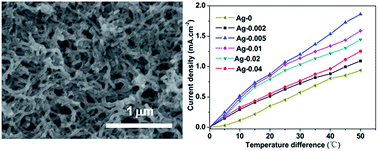
Upon comparison with other solid thermal energy harvesting devices,3–6 TECs become a promising alternatives for harnessing waste heat due to their ease of design, sustained operation, and low cost.1 To make TECs more practical, the electrode materials need to be selected with low cost and relatively high conversation efficiency.1,7 Traditional catalytic materials, such as platinum and palladium, have been used as TEC electrodes because of their high surface catalytic activity in oxidation and reduction reactions.8 However, the high cost and low conversion efficiency have hindered their development. In recent years, carbon nanomaterials have been considered as ideal candidates for TEC electrodes because of their fast electron transfer ability with the potassium ferri/ferrocyanide redox couple.1,2,9–16 However, it is difficult to obtain a high output power and conversation efficiency for carbon nanomaterials composed of a single-component. Nanocomposites can exhibit intriguing properties due to the synergetic effect of their different components, which are beneficial for the practical applications of TECs.7,16 For example, Romano et al. reported that carbon nanotube–reduced graphene oxide composites can achieve a significantly higher conversation efficiency when compared with pristine CNTs due to their faster kinetics and larger electroactive surface area.7 In addition, the composite electrodes have a higher conductivity and specific surface area, which can also result in better properties for the TECs constructed using the composite electrodes.7,16
The electrophoretic deposition (EPD) technique has been widely used to synthesize CNTs-based composites due to its low requirement for the substrate's shape, less time-consuming, large-scale production and low cost.17 Usually, the charging agent, such as Mg(NO3)2, is added into the electrophoretic suspension to improve the adhesion between the CNTs film and the substrate, which is very significant for its practical application.18,19 In addition, the charged ions can bring the CNTs to the anode to form the homogeneous film on the substrate.19,20 However, the existence of Mg2+ decreases the conductivity of the CNTs due to the formation of MgO after the heat treatment step.18,19 Ag–CNTs composites can improve the conductivity and thermal conductivity when compared with pristine CNTs21–23 and CNTs coated with Ag particles have also improved the electrochemical properties of CNTs.24–26
Therefore, doping CNTs with Mg2+ and Ag is expected to provide superior TEC performance in the nanocomposites. In this study, we have attempted to improve the TEC performance of CNTs by doping the electrophoretic suspension of CNTs with Mg2+ and Ag powder. The Ag–MgO–CNTs nanocomposite electrodes were constructed using the EPD method and the nanocomposite electrodes present significantly improved TEC performance when compared with their undoped counterparts, suggesting a promising way for the energy harvesting using CNTs-based TECs prepared via the EPD technique.
Tensile tests were conducted using an Instron 3343 instrument to evaluate the adhesion between the films (including the pristine CNTs and the Ag–MgO–CNTs nanocomposites) and the SS substrates. First, the sample was fixed with a clamp and subsequently wrapped with the tape. During the test, the tape grabbing film was pulled away until the film peeled off from the SS substrate.
Four tungsten needles (about 50 μm in diameter) were fixed in line at equal distance. The sample was first scraped in part to expose the bare SS substrate for the electrical contact test, then it was placed on the platform in contact with the top four needles, and its position could be adjusted to leave the composites film or the CNTs part between the middle two needles. Current was supplied through the outside two needles, and the voltage can be obtained using the two middle needles.
XRD and EDS characterizations were applied to confirm the species and compositions of the products. XRD (Fig. 2a) showed the typical reflection peaks at 26.4°, 38.2° and 64.5°, corresponding to the (002) crystallographic planes of the CNTs27,28 and (111), (220) planes of Ag.22,29 The other four crystallographic planes correspond to SS(110), SS(200), SS(200) and SS(211).30 It is worth mentioning that the reflection peaks of MgO were not observed by XRD, which might be due to the existence of amorphous MgO.31 The EDS result (Fig. 2b) showed the signals for Fe, Cr, C, O, Mg and Ag, as expected. The signals of Fe and Cr are from the stainless steel substrate. The O signal was mainly from MgO due to the heat treatment and MgO can improve the adhesiveness between the composite film and the SS substrate. The Ag signal was from the Ag powder. The results indicate that the products include CNTs and Ag species.
Further characterization by XPS showed the expected signals from C, O, Mg and Ag for the nanocomposites, as shown in Fig. 3 (also see the ESI, Fig. S2 and Table S1†). For the C 1s spectrum (Fig. 3a), a major peak from the C–C/C
C bonds was observed at 284.6 eV. In addition, minor peaks from the C–O and C
O bonds were observed at 286.2 and 289.2 eV, respectively.32 As shown in Fig. 3b, the peak from Mg–O bonds was detected at 1303.9 eV for Mg 1s, which was higher than the peak of metallic Mg (Mg 1s at ∼1303 eV).33 For the O 1s spectrum (Fig. 3c), three peaks at 530.1, 531.7 and 533.3 eV were assigned as the O–Mg, O–C and O
C bonds, respectively.32,34,35 As shown in Fig. 3d, the binding energies (BE) of the Ag 3d3/2 and 3d5/2 appear at 374.2 eV and 368.2 eV, respectively, corresponding to the BE of the metallic silver.36,37 XPS characterization confirmed the existence of MgO and Ag species in the product.
![]() | ||
| Fig. 3 XPS spectra of the Ag–MgO–CNTs-0.01 sample prepared via EPD. (a) C 1s; (b) Mg 1s; (c) O 1s; and (d) Ag 3d. Note: the peak for C 1s at 284.6 eV was used for calibration. | ||
Tensile tests were conducted to investigate the function of the CNTs-based films on the adhesion between the films and the SS substrate. We performed the tensile tests to measure this adhesion by mechanically pulling away the CNT-based films from the SS substrate (see Experimental section). As shown in Fig. 4a, the stress curve for the pristine CNTs shows a maximum stress of 0.26 MPa, when doped with Ag powder, the maximum stress of the nanocomposites increased up to 0.32, 0.97, 0.67, 0.62 and 0.48 MPa, corresponding to Ag contents of 0.002, 0.005, 0.01, 0.02 and 0.04 g L−1, respectively, showing clearly the adhesion enhancement with the existence of Ag. Usually, CNTs prepared by EPD have high electrical resistance due to the weak contact between the CNTs film and SS substrate.38 In our experiment, the Mg2+ and Ag powder were added in the CNTs suspension to decrease the electrical resistance of the CNTs electrode. A four-probe device (see Experimental section) was applied to study the electrical resistance of the pristine CNTs and the Ag–MgO–CNTs nanocomposites. As shown in Fig. 4b, the resistance of the pristine CNTs electrode was measured to be 80.2 Ω, whereas the resistance of Ag–MgO–CNTs nanocomposite electrodes was measured to be 57.9, 10.0, 19.9, 29.8 and 39.2 Ω, corresponding to Ag concentrations of 0.002, 0.005, 0.01, 0.02 and 0.04 g L−1. The results indicate that the surface resistance of the CNTs electrode can be enhanced with the existence of Ag, in agreement with the results of the tensile tests. The resistance of Ag-0.005 was smaller than Ag-0.01, Ag-0.02 and Ag-0.04, mainly due to two reasons as follows. First, the adhesion of the Ag-0.005 sample shows the largest value when compared with the other samples (see Fig. 4a), indicating the good surface contact between the Ag-0.005 sample and the SS substrate. Second, the existence of excessive Ag leads to the agglomeration of the Ag particles in the samples (see Fig. 1d–f), which may not be beneficial for the improvement of the conductivity due to the weak synergetic effect of the CNTs-based nanocomposites.
![]() | ||
| Fig. 4 (a) Tensile tests and (b) four-probe current–voltage measurements of the pristine CNTs and the Ag–MgO–CNTs nanocomposites. | ||
If TECs are continuously operated in an open environment for a long time, the concentration of the electrolyte would be changed due to evaporation of the solution, resulting in the instability of the TEC performance. However, TECs in a closed system can operate with long-term stability.1 In this study, the U-shaped TECs (Fig. 5a) in a closed system were applied to investigate the TEC performance. As shown in Fig. 5b, the open circuit voltage (voc) and the temperature difference (ΔT) show a linear relationship.
The Seebeck coefficient of the redox couple was usually employed using 0.4 M potassium ferro/ferricyanide due to its high Seebeck coefficient and large exchange current.1,7 By linear fitting the data, the Seebeck coefficient was obtained as ∼1.42 mV K−1, in agreement with the literature.1,15 Fig. 5c shows that the current densities (Jsc) improved upon increasing the temperature difference for the pristine CNTs and the nanocomposites, and the Jsc of the Ag–MgO–CNTs composite electrodes were much higher than that found for the pristine CNTs electrode at the same temperature difference, which contributed to the better conductivity, thermal conductivity, and adhesion between the composite films and the substrate. As for the Ag–MgO–CNTs nanocomposite electrodes, the Ag–MgO–CNT-0.005 nanocomposite shows the best TEC performance, which might be due to the better conductivity, adhesion between the film and the SS substrate, and the higher specific surface area. When the temperature difference climbed to 50 °C, the Jsc and Jsc/ΔT reached 9.4 A m−2 and 0.19 A m−2 K−1 for the CNTs electrode, as well as 18.6 A m−2 and 0.37 A m−2 K−1 for Ag–MgO–CNTs-0.005 composite electrode, respectively.
To evaluate the performance of the TECs, the maximum output power (Pmax) and the relative power conversion efficiency (ηr) are two important parameters. Pmax can be described as 0.25voc × Isc. ηr can be expressed as ηr = η/(ΔT/Th).1,13
Footnote |
| † Electronic supplementary information (ESI) available. See DOI: 10.1039/c5ra19182c |
| This journal is © The Royal Society of Chemistry 2015 |