Hierarchical crystalline morphologies induced by a distinctly different melt penetrating process

Rui-Yan Zhanga, Wei Yanga, Quan-Ping Zhangb, Xiao-Chao Xiaa, Chun-Xia Zhua, Shan Hea, Yan-Hao Huanga, Zheng-Ying Liua and Ming-Bo Yang*a
aCollege of Polymer Science & Engineering, The State Key Laboratory of Polymer Materials Engineering, Sichuan University, Chengdu 610065, P. R. China. E-mail: yangmb@scu.edu.cn
bState Key Laboratory Cultivation Base for Nonmetal Composites and Functional Materials, Southwest University of Science and Technology, Mianyang 621010, P. R. China

Received 14th September 2015 , Accepted 21st October 2015

First published on 28th October 2015


Abstract

Recently, a melt penetrating process which allows one kind of polymer melt to penetrate another polymer melt has been achieved on our home-made multi-melt multi-injection molding (MMMIM) instrument. It is the first time that hierarchically crystalline morphologies induced by melt penetration of the melt with different interactions are reported. In this work, high density polyethylene (HDPE) melt was penetrated by a distinctly different polypropylene (PP) melt and also by the same HDPE melt for comparison. The crystalline morphologies were observed using SEM and PLM, and the lamellar structures were characterized using a synchrotron 2D-SAXS/WAXD. The results showed that β-form transcrystallization occurred along the interface of the PP penetrating sample, and only α-iPP spherulites were observed in the core layer. Interestingly, shish–kebabs with flat lamellae were found in the subskin layer of the PP penetrating sample, while spherulites and cylindrites consisting of a banded-structure were observed in the sample at the penetration of the HDPE melt.

Introduction

During processing, polymer materials are subjected to intense shear and/or elongation flow in most cases,1–3 resulting in various supermolecular structures, such as spherulites,4 cylindrites,5 shish–kebabs,6 and so on. Among them, shish–kebab structures contain two stable conformations and are widely studied morphologies. Shish–kebab structures are composed of parallel extended long chains as the shish, which serves as the nucleation site for the epitaxial growth of crystals, as the kebab. Such a crystalline morphology can increase the stiffness and modulus of an industrial sample substantially. In order to control the final crystalline morphologies and structures and to improve the properties of the molded samples, advanced injection molding technologies such as, dynamic packing injection molding (DPIM),7 shear-controlled orientation in injection molding (SCORIM),8 and rotational injection molding (RTM),9 have been created. It is found that anisotropic crystalline morphologies (like shish–kebabs and cylindritic structures) are formed in the samples that are molded by these advanced injection molding technologies due to the introduction of an intense shear field; these are distinctly different from the crystalline structures that are observed under quiescent conditions.10–13 For pure polymer, polyethylene samples prepared by dynamic packing injection molding and shear-controlled orientation injection molding technologies experienced an intense shear field, leading to the orientation of macromolecular chains and anisotropic morphologies,14–19 while spherulites were mainly observed in samples molded by conventional injection molding (CIM). The fantastic interlocking shish–kebabs20 were observed by Kalay in the oriented parts of polybutene molded by “melt manipulation” methods. When introducing shear in the packing stage of the injection molding of HDPE/inorganic whisker composites, hybrid shish–kebabs16 where the inorganic whiskers served as the shish and HDPE as the kebab, were found in the DPIM samples.

Recently, the concept of multi-fluid multi-injection molding (MFMIM) was proposed by our group.21 In the typical molding process, the mold cavity is partially filled with the first polymer melt, and then the melt is penetrated by a high-speed fluid and dragged to fill in the whole cavity, finally the cavity is cooled down gradually. The universally known gas-assisted injection molding (GAIM) is one representative of MFMIM technology where an inert gas acts as a second penetration fluid. Some fascinating microstructures have been observed in GAIM samples,22,23 resulting from the strong shear field after the second flow of polymer melt is induced by gas penetration. Banded-spherulites22 were formed in lower molecular weight HDPE by gas-assisted injection molding (GAIM) specimens, however only normal spherulites were observed in the CIM sample. With a slightly elevated molecular weight of HDPE, shish–kebab structures can be obtained in GAIM samples.23 Typical and hybrid shish–kebab superstructures were gained across the thickness direction of the GAIM parts by introducing the microfibril polycarbonate (PC) into the HDPE matrix.24

Among the MFMIM technologies, a peculiar molding method has been constructed in our laboratory,21,25 called the multi-melt multi-injection molding (MMMIM) process, in which a polymer melt instead of a gas can serve as the second fluid which is used for penetration, allowing us to clarify the influence of the melt penetration on the crystalline morphologies of both the penetrated and the penetrating layers. Attractive crystalline morphologies have been observed in the MMMIM parts due to an intense shear field induced by the higher friction coefficient between the two polymer melts than that between a melt and gas or water.25 In our previous papers, both the penetrated and penetrating layers displayed a skin–core morphology distribution with an anisotropic skin and an isotropic core, which is reported as the so-called double skin–core structure21,26,27 in the melt-penetrating sample molded by MMMIM. Cylindritic structures composed of banded-spherulites were formed in both the subskin and transition layers in the melt-penetrating sample, while only normal spherulites were formed in the non-melt-penetrating parts.21 We observed an oriented PS dispersed phase skin and a nonoriented spherical PS dispersed phase core both in penetrated and penetrating regions, and the distribution of the calculated shear rate is bimodal and stronger than the shear field in the CIM samples.27 The double skin–core oriented crystalline morphologies were formed with the introduction of 20 wt% UHMWPE in the melt-penetrating parts.26 However, the penetrating melt we used is the same kind of polymer as the penetrated melt in our previous studies. So a question arose spontaneously: how about the evolution of crystalline morphologies during the MMMIM process with the introduction of a different penetrating polymer melt and will a peculiar crystalline morphology be formed in such a different melt penetrating process?

As is universally known, polypropylene (PP) and polyethylene (PE) are completely different polymers even though they have similar structural units, they can form highly immiscible blends,28,29 and they form distinctly different crystals.30–32 Isotactic polypropylene (iPP) has pronounced polymorphic crystalline modifications, such as a monoclinic α phase,30 a trigonal (or frequently hexagonal) β phase31 and an orthorhombic γ phase.32 PE possesses less kinds of crystals but has various crystalline morphologies especially when under flow.33,34 In this work, a high density polyethylene (HDPE) melt was selected to be injected into the cavity first as the penetrated melt, then the melt of polypropylene (PP) was selected to penetrate the injected HDPE melt to accomplish the melt penetration process. We focus on the crystalline morphologies formed by melt penetrating of distinctly different polymer melts during the MMMIM process. For comparison, the crystalline morphology of the melt penetrating sample by an identical HDPE melt was also investigated.

Experimental

Materials

High-density polyethylene resin (HDPE, Model: 2911) was obtained from Fushun Petroleum Chemical Co. Ltd, P. R. China, with a melt flow rate (MFR) of 20 g/10 min (190 °C/2.16 kg, ASTM D1238). The weight-average molecular weight (Mw) was 1.42 × 10⁵ g mol−1 and the polydispersity was 3.3.

Isotactic polypropylene (iPP, Model: T30S) was purchased from Lanzhou Chemical Industry Factory, with a MFR of 2.6 g/10 min (190 °C/2.16 kg, ASTM D1238). The weight average molecular weight (Mw) was 5.87 × 10⁵ g mol−1 and the polydispersity was 5.2.

Sample preparation

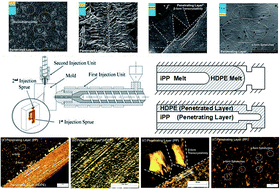
The melt penetration process was performed on the MMMIM instrument constructed in our laboratory. In this process, the first polymer melt HDPE was plasticized and injected into the cavity by an SM60HC injection molding machine, then the penetrating melt, HDPE or PP, was injected to penetrate the first HDPE melt using an SHJ20 micro-pneumatic injection molding machine (the injection pressure was supplied by an air compressor). The two injection units were controlled independently so that the delay time between the onsets of the movements of the two units could be controlled. The samples with HDPE acting as the penetrating melt were marked as the “PE penetrating sample”, and the samples with PP acting as the penetrating melt were marked as the “PP penetrating sample”, as shown in Fig. 1. The processing parameters of the MMMIM process are listed in Table 1.
image file: c5ra18885g-f1.tif
Fig. 1 Schematic representation of the MMMIM instrument utilized and the PE and PP penetrating samples molded by the MMMIM process.
Table 1 Processing parameters applied in this study for both of the MMMIM processes
Parameters MMMIM
Injection unit 1 Injection unit 2
Injection pressure (MPa) 24 ∼40
Melt temperature (°C) 220 220
Mold temperature (°C) 100 100
Delay time (s) 15 15
Cool time (s) 150 150
Injection volume (%) 50 50


The specimens for scanning electron microscopy (SEM) and polarized light microscopy (PLM) observations were cut along the direction parallel to the flow direction (FD), as shown in Fig. 2. First, the melt penetrating sample with a thickness of 5 mm was cut at the position 30 mm away from the gate; then slices of 20 μm thickness were prepared for PLM and of 50 μm thickness for SEM observation. The slices were cut by microtome from the central part of the sample along the flow direction. The samples used for synchrotron 2D-SAXS/WAXD characterization were obtained from 30 mm away from the gate and cut from the 70 mm wide and 5 mm thick specimen into 20 mm × 1 mm (width-thickness) pieces. The locations a, b, c and d, along the thickness of the parts, were selected and characterized by SEM, PLM and synchrotron 2D-SAXS/WAXD technologies.


image file: c5ra18885g-f2.tif
Fig. 2 Schematic representation of sample preparation for SEM, PLM and 2D-SAXS characterizations.

Morphological observations

The obtained slices were sandwiched by the penetrated layers, and the slices with a thickness of about 50 μm were etched by an etching method. After the surfaces were washed, dried and coated with a thin layer of gold, the crystalline morphologies were observed using a scanning electron microscope (SEM, FEI INSPECT-F) with an accelerating voltage of 20 kV. The slices with a thickness of 20 μm were observed using polarized light microscopy (PLM, Olympus BX-51) equipped with a digital camera (DC), Micropublisher RTV 5.0.

Synchrotron 2D-SAXS and WAXD measurements

Synchrotron two-dimensional small-angle X-ray scattering (2D-SAXS) and wide-angle X-ray diffraction (2D-WAXD) tests were conducted at the beamline BL16B1 of the Shanghai Synchrotron Radiation Facility (SSRF, shanghai, China). The sample-to-detector distance was 5180 mm for 2D-SAXS and 350 mm for 2D-WAXD. The wavelength of the X-ray was 0.124 nm, a beam size of 0.4 × 1.0 mm was used, and the signals were collected by an X-ray CCD detector (Model Mar165, 2048 × 2048 pixels of 80.56 × 80.56 μm). The X-ray beam was normal to the FD-ND plane, and the electrical machine was used to control the test location. All data were corrected for subtracting contributions from air scattering. Fit2D software was used to analyze the SAXS and WAXD data. The 1D-WAXD curves were gained from integrated 2D-WAXD patterns along the equatorial direction and the curves of intensity dependent on the diffraction angle were obtained. When the 2D-WAXD patterns were integrated with azimuthal scanning, the intensity distribution as a function of the azimuthal angle was gained.

The scattering vector is shown as q (q = 4π(sin[thin space (1/6-em)]θ)/λ, where 2θ is the scattering angle and λ is the wavelength). The integrating method was used to collect the SAXS pattern from the meridian direction with the subtraction of background. For the isotropic samples, 360° integration of intensity was performed, where for the oriented samples, ±20° along the flow direction, the intensity has been integrated. Based on the one dimensional intensity curves obtained by integrating the meridian signal from the two dimensional patterns, the technique of electron density correlation function analysis was used to give detailed structural and lamellar stacking information for each position. The electron density correlation function K(z) can be gained from the inverse Fourier transformation of the intensity distribution I(q) as follows:35,36

 
image file: c5ra18885g-t1.tif(1)
where z represents the location normal to the lamellar surface, and the correlation function shows features of the long period, which is defined as the distance combined average thickness of a lamella and one interlamellar amorphous layer, for the system with lamellar stacking.

Results and discussion

Crystalline morphologies

The crystalline morphologies of the PE and PP penetrating samples observed by PLM are shown in Fig. 3. One can see a large number of cylindritic structures in the penetrating layer and some small and imperfect cylindritic structures were formed in the penetrated layer of the PE penetrating sample (Fig. 3a). From the magnified micrograph Fig. 3b, it is seen that the cylindritic structures consisted of small and imperfect banded-spherulites aligned tightly along the flow direction, which are similar to the morphologies in PA66,37 PPS38 and iPP,39,40 and are distinctly different from the cylindritic structures with non-banded spherulites, as reported in our previous work.21 At the transition region, as shown in Fig. 3c, cylindritic structures composed of bigger and more perfect banded-spherulites are clearly observed. The banded-spherulites stacked along the equatorial profile are responsible for this morphology. Many banded-spherulites with twisted lamellae are displayed in the core layer (see Fig. 3d).
image file: c5ra18885g-f3.tif
Fig. 3 PLM micrographs of the crystalline morphologies molded by MMMIM with different melt penetrating samples: (a) PE penetrating sample; (b–d) magnified micrographs of the circles in (a); (a′) PP penetrating sample and (b′–d′) magnified micrographs of the circles in (a′).

A distinct two-layer structure, when the PP acted as the penetrating layer and the PE acted as the penetrated layer, was formed in the PP penetrating sample due to the different birefringence characteristics of PP and PE, as shown in Fig. 3a′. Magnified pictures of the given locations were used to observe the morphology clearly. Unfortunately, the crystalline morphologies were too fuzzy to be seen clearly in the subskin layer, as shown in Fig. 3b′, which illustrated that the crystal size seemed to be too small to be observed by PLM or oriented crystals were formed at this layer. The fine structures were further investigated at a larger magnification by SEM observation. Fig. 3c′ shows the crystalline morphology at the interfacial location between the penetrating and the penetrated layers in the PP penetrating sample. Some fan-shaped β-iPP column structures were observed, due to the β-form iPP being brighter than the α-form in the same PLM micrograph, as Varga et al. reported previously.41 These crystals were colorful even without the λ plate and they showed a negative birefringence, which vanished at temperatures above 158 °C.42 This morphology is very similar to observations from the fiber-pulling process,43–47 which should be a well-known transcrystallization induced by the effect of shear flow or heterogeneous nucleation and spatially confined crystal growth subsequently. At the core layer of the PP penetrating sample, only isotropic α-iPP spherulites were formed (see Fig. 3d′). The in situ PLM pictures of the PP penetrating sample molded by MMMIM at different temperatures are shown in Fig. 4. When the temperature reached 134 °C, the originally bright area became black due to the melting of the HDPE crystals. Then when the temperature reached 158 °C, the fan-shaped β transcrystallinity became black and disappeared. Through selective melting of the β-iPP crystals at temperatures above the melting point of the β-form but below that of α-form, we can distinguish these two forms of crystal. We also found two crystalline forms in the transcrystallinity, namely, a thin α layer directly connected to the penetrated melt, PE and away from the penetrated melt, β-iPP crystals were grown.


image file: c5ra18885g-f4.tif
Fig. 4 The in situ PLM pictures of the PP penetrating sample molded by MMMIM at different temperatures, (a) 20 °C, (b) 134 °C, (c) 158 °C, (d) 164 °C.

In order to better characterize the fine crystalline structures of the PE and PP penetrating samples, SEM micrographs were used and are shown in Fig. 5. All of the crystalline structures were observed after chemical etching. Both the penetrated and penetrating layers display a skin–core morphology with an isotropic core and an anisotropic skin just consisting of banded structures in the PE penetrating sample. Banded-spherulites were observed with diameters of 10 μm in the skin layer (see Fig. 5a) and about 200 μm in the core layer (see Fig. 5d). The cylindritic structures consisting of imperfect banded-structures are clearly seen in the subskin layer along the flow direction and the diameters of the cylindritic structures are about 15 μm, meanwhile cylindritic structures with more perfect and bigger banded-spherulites were formed in the transition layer (see Fig. 5c). Moreover, the growth of the banded spherulites was restricted in the flow direction and they could only grow perpendicular to the flow direction, leading to the formation of the cylindritic structures (Fig. 5b and c), which is consistent with the PLM observation. The lamellae of the cylindritic crystals or spherulites in all of these banded-structures had S- or C-shaped profiles which were primly consistent with the previous reports.48,49 Due to different etching effects between edge-on and flat-on lamellae, the edge-on lamellae can be shown in the bright region while the flat-on lamellae were hardly seen in the valley region of the bands.50,51


image file: c5ra18885g-f5.tif
Fig. 5 SEM micrographs of the crystalline morphologies of different melt penetrating samples: letters a, b, c, d represent the four layers in the PE penetrating sample: a, skin, b, subskin, c, transition and d core layer. Letters a′, b′, c′, d′ represent the four layers in the PP penetrating sample: a′, skin, b′, subskin, c′, transition or interface and d′ core layer. The main magnifications are 5000 except for positions c, d, b′, c′, where the magnifications are 3000, 600, 80[thin space (1/6-em)]000, 3000 times, respectively, due to different crystal sizes.

However, abundant crystalline morphologies appeared across the thickness direction of the PP penetrating sample and also formed a double skin–core morphology. There were also some banded-spherulites observed in the skin layer of the PP penetrating sample, whose diameter was about 10 μm, as large as those in the PE penetrating sample. Interestingly, the fuzzy crystalline morphology observed by PLM observation turned out to be oriented lamellae stacked normal to the flow direction in the subskin layer of the PP penetrating sample, as shown in Fig. 5b′. The shishes were clearly aligned along the flow direction from which the oriented lamellae (kebabs) grew epitaxially, and such a crystalline morphology was well in line with the so-called shish–kebab in Pennings observation.52 The formation of the shish–kebab can be ascribed to the shear effect during the PP melt penetration, which surpasses the critical shear rate for the formation of oriented lamellae at a given molecular weight.53,54 As seen in Fig. 5c′, the β-iPP transcrystallization dominated along the interface as indicated by the white arrow, which exhibited a distinct contrast from the α-iPP formed in the core layer (see Fig. 5d′). β-iPP column structures, grown from the interface between the penetrated PE and the penetrating PP layers, were observed clearly, as shown in Fig. 5c′, which indicated that the β-iPP column structures were from the well-known transcrystallization. The β-iPP column structures might be induced by the complex influence of strong surface-induced heterogeneous nucleation of the penetrated polymer55,56 or the shear-induced β-iPP crystallization as put forward by Karger-Kocsis.11,57 More specific work is needed to understand the formation and mechanism of the β-iPP transcrystallizations in the future.

Crystalline structure

Fig. 6 shows the 2D-WAXD patterns obtained from various locations of the different melt penetrating samples. Two Debye rings where (110) (inner circle) and (200) lattice planes (outer circle) were shown indicate α orthorhombic PE crystals and four isotropic diffraction rings represent PP crystals (see Fig. 6c′ and d′). In order to recognize unambiguously the crystalline modification of the diffraction rings at different locations, the 1D-WAXD curves were gained from integrating the 2D-WAXD patterns along the equatorial direction, as shown in Fig. 7.
image file: c5ra18885g-f6.tif
Fig. 6 2D-WAXD images of different melt penetrating samples. The letters represent the same position as mentioned in the SEM observations.

image file: c5ra18885g-f7.tif
Fig. 7 1D-WAXD curves at different locations of different melt penetrating samples. The letters represent the same meaning as mentioned above.

To elucidate the signal of 1D-WAXD curves clearly, some basic information was sorted out. The reflection peaks at 2θ of 14.1°, 16.2°, 16.8°, 18.6° and 21.8° correspond to the α(110), β(300), α(040), α(130) and α(041) lattice planes of the iPP crystals, meanwhile, the reflection peaks at 2θ of 21.6° and 24° correspond to the α(110) and α(200) lattice planes in PE, respectively, as shown in the 1D-WAXD curves. The diffraction reflections for all of the PE layers (all of the layers in the PE penetrating sample and the penetrated layer in the PP penetrating sample) show only two diffraction peaks at 2θ = 21.6° and 24° corresponding to the (110) and (200) lattice planes of the α orthorhombic crystals of PE. Interestingly, six reflection peaks were shown in the interface layer of the PP penetrating sample indicating that both signals of PE and PP were collected at this position, resulting from all of the PE and PP diffraction peaks mentioned above being observed in 1D-WAXD curves. The diffraction peak of the PE α(110) overlapped with that of PP α(041) due to their close reflection angle. So there are six instead of seven reflection peaks shown in the curves. The reflection peak β(300) at 16.2° revealed the existence of a β phase in the interface layer, consistent with the SEM/PLM observation. The absence of the diffraction peak at 16.2° in the core layer of the PP penetrating sample revealed that only a monoclinic α phase was formed in this regime.

The intensity distribution of the α(110) of the PE crystal and the β(300), α(040) of the PP crystal as a function of the azimuthal angle were shown in Fig. 8. The orientation of the lattice plane can be obtained more specifically. Two-arc (110) reflections were seen clearly on the neighbor of the equator, which is in accordance with the off-axis (110) observations in Keller’s work.34 Generally, off-axis (110) is termed as the ‘Keller/Machin I’ mode with twisted lamellae induced by a weak flow. At the lamellar growth stage, the fold surface stress accumulated in the incipient lamellae due to the weak flow, therefore, the lamellae were inclined to release the fold surface stress by the twisting of lamellae, leading to rotations of the crystallographic α-axis.34 Such patterns are consistent with the formation of the banded-structure that we observed in these regions with SEM and PLM. The (110) maximum intensity appeared in the equator instead of the off-axis, indicating that lamellae were parallel with the molecular orientation along the flow direction, in which the lamellae were flat leading to ‘c-axis orientation’.33 Moreover, the β(300) maximum intensities were also observed in the equatorial direction, however, the intensity distributions of α(040) were independent of the azimuthal angle. Herein, it should be noted that the β crystals were anisotropic and oriented along the flow direction in accordance with our observations from PLM and SEM, while the α crystals were isotropic along the interface and in the core layers of the PP penetrating samples.


image file: c5ra18885g-f8.tif
Fig. 8 Intensity distribution of the α(110) of the PE crystal and the β(300), α(040) of the PP crystal along the azimuthal angle at different regions. The letters represented the same meaning as mentioned above.

Fig. 9 shows the 2D-SAXS patterns obtained at various locations of the different melt penetrating samples. Almost all of the scattering signals appeared as nearly isotropic circles except for the distinctly anisotropic patterns shown in the subskin layer of the PP penetrating sample (see Fig. 9b′). On the whole, the SAXS patterns showed an isotropic signal compared with that of a typically oriented pattern in Fig. 9b′, where two scattering maxima can be clearly seen in the meridional direction, and two equatorial streaks were also seen at the same time. It can be seen clearly that two scattering maxima were concentrated in the meridional direction, indicating that oriented lamellar stacks were packed periodically normal to the flow direction. Two equatorial streaks were also observed at the same time suggesting the existence of a shish structure, which may be formed from bundles of molecular chains.58


image file: c5ra18885g-f9.tif
Fig. 9 2D-SAXS patterns of different melt penetrating samples. The letters represent the same positions as mentioned in the SEM observations.

The resultant correlation functions are shown in Fig. 10. The inset shows how the average thickness of the amorphous layer da and the long period dac were gained from the correlation function, and the results obtained are listed in Table 2.


image file: c5ra18885g-f10.tif
Fig. 10 The correlation function obtained by inverse Fourier transformation at various locations. The letters represent the same positions as mentioned in the SEM observations.
Table 2 Long period (dac), amorphous thickness (da) and calculated lamellar thickness (dc) obtained at various locations of different melt penetrating samples
  PE penetrating sample PP penetrating sample
a b c d a′ b′ c′ d′
dac (nm) 21.5 21.4 21.9 22.0 21.4 23.1 14 13.6
da (nm) 10.7 10.8 10.8 10.8 10.7 11.7 7.1 7.0
dc (nm) 10.8 10.6 11.1 11.2 10.7 11.4 6.9 6.6


As shown in Table 2, both the average thickness of lamellae and the long spacing slightly increased (or were almost identical due to the accuracy of fitting) from the mold wall to the center in the PE penetrating sample due to the higher temperature at the mold center in the cavity,59 leading to a more perfect and thicker lamellar structure. Apparently, the parameters of lamellae in the subskin layer of the PP penetrating sample were considerably larger than those in the same layer of the PE penetrating sample. According to previous characterization, shish–kebab structures were formed in the subskin region of the PP penetrating sample, which can have a larger distance between two lamellar stacks under shear flow.60 In addition, one can see that the long spacing in the interface layer was higher than that in the core layer, which can be ascribed to the formation of β-iPP in the interface layer which possessed a longer lamellar distance compared with that of the α modification.61

Mechanism discussion

It is well known that the final hierarchical crystalline morphologies of polymer articles are dependent on the external fields. In our melt penetration process, the effect of external fields is a coupling effect of the temperature field and the shear field. The shear field provided by melt penetration brings about a second flow of the penetrated melt and causes a great deformation. The great deformation is beneficial for the formation of oriented crystalline structures. However, the polymer melt is in a higher temperature field compared with the cases of gas or water penetration. In this case, polymer chains were prone to be relaxed. In our work, only banded-structures, such as banded-spherulites, cylindritic structures with banded-spherulites, were formed across the thickness of the PE penetrating sample, however, shish–kebabs can be seen in the subskin layer of the PP penetrating sample. Some questions arise here: what is the formation mechanism of these crystalline morphologies? How can they form during the melt penetrating process? According to our previous work and current results, the formation of banded-spherulites, cylindritic structures consisting of banded-structures and shish–kebab structures in the melt penetrating process are discussed as below.

In the PE penetrating sample, the penetrated HDPE melt was in a random coil state which was the same as the blank melt at first. Then the melt was injected into the mold cavity in the short shot stage, and the melt in the skin region cooled down very fast due to the low temperature at the mold wall and the higher efficiency of heat transfer. When the PE or PP penetrating melt was injected after a delay time, the melt in the skin layer could not be dragged intensively. So the melt experienced a weak flow in which the molecular alignments could not be stretched away from the random coil state, and such a flow almost had no effect on the nucleation stage. Hence, point nuclei were formed and distributed randomly in the initial matrix.62 At the lamellar growth stage, the fold surface stress accumulated in the incipient lamellae due to the weak flow, therefore, the lamellae were inclined to release the fold surface stress by the twisting of lamellae, leading to rotations of the crystallographic α-axis.34 Thus, the randomly banded-spherulites were generated in the skin layer due to the twisting growth of the lamellae, as shown in Fig. 11a.


image file: c5ra18885g-f11.tif
Fig. 11 Schematic representation of the evolution of crystalline morphologies induced by different polymer melt penetration: the formation of (a) banded-spherulites, (b) cylindritic structures composed of a banded-structure and (c) shish–kebabs.

The molecular chains in the penetrated HDPE melt were in a random coil state, the same as the blank melt mentioned above. However, the melt in the subskin layer experienced shear and elongational flow due to the melt penetration, which caused a larger shear rate than that in the skin region,23,25 the macromolecular network could be stretched to some extent along the flow direction but hardly any stretched chains form the fibrillar nuclei.63 The strong flow caused by the second flow led to high density fluctuations in the local alignments similar to the process of liquid–liquid phase separation in the initial crystalline stage.64,65 These precursors can be quasi-ordered clusters or metastable,66 noncrystalline phase,67 or smectic domains. So the nucleation stage is influenced and the point-like row nuclei are formed. Certainly, even the row of nuclei can be formed during the molding stage, however, these oriented precursors can still be relaxed before crystallization, and so only isotropic spherulites were formed as shown in Fig. 11a. The surrounding molecular chains were absorbed by these nuclei and grew normal to the flow direction to subsequently form crystals. The crystal growth can only take place normal to the flow direction due to the lamellae impinging on each other along the flow direction. Actually, the lamellae were also inclined to release the accumulated surface stress provided by the flow stress by twisting the lamellae, leading to the formation of cylindrite structures composed of banded-spherulites, as shown in Fig. 11b.

According to previous research,68,69 the penetrating melts with higher viscosity will drag and push the penetrated melts, however, the melts with lower viscosity will lead to breaking through instead of driving the penetrated melt. Even for a melt penetration process, the higher viscosity of a penetrating melt leads to a lower shear rate at a given pressure. In other words, the penetrated HDPE melts were under a much higher shear rate caused by the penetration of the PP melt with a higher viscosity than that caused by the PE penetration. In the PP penetrating sample, the penetrated HDPE melt was in the random coil state as mentioned above. During the PP melt penetration, the HDPE melt in the subskin layer experienced an intensive flow in which the shear rate surpassed the critical value for HDPE with a given molecular weight.12 The molecules were stretched and aligned to form fibrillary nuclei and shish, then the rest of the surrounding macromolecular chains were adsorbed and aligned on the shish where the lamellae can grow epitaxially normal to the flow direction to form the kebab, then shish–kebabs were observed in the subskin layer of the PP penetrating sample (see Fig. 11c).

Conclusion

It is the first time that hierarchically crystalline morphologies were observed by different melt penetration. β-form transcrystallizations dominated along the interface in the PP penetrating sample, which possessed some extent of orientation as characterized by 2D-WAXD. Shish–kebabs with highly oriented flat lamellae were formed in the penetrated layer of the PP penetrating sample, while cylindritic structures consisting of banded-spherulites emerged in the penetrated layer of the PE penetrating sample due to distinctly different polymer melt penetrating.

Acknowledgements

The authors would like to express their sincere gratitude to the National Natural Science Foundation of China (21174092, 51473105 and 51421061) and the Major State Basic Research Development Program of China (973 program) (Grant No. 2012CB025902). And we also gratefully thank Mr Chao-liang Zhang for his assistance in SEM observations. The 2D-SAXS characterizations were performed at the beamline BL16B1 of Shanghai Synchrotron Radiation Facility (SSRF, Shanghai, China).

References

  1. D. Lellinger, G. Floudas and I. Alig, Polymer, 2003, 44, 5759–5769 CrossRef CAS.
  2. K. Watanabe, T. Suzuki, Y. Masubuchi, T. Taniguchi, J.-i. Takimoto and K. Koyama, Polymer, 2003, 44, 5843–5849 CrossRef CAS.
  3. S. F. Ran, Z. G. Wang, C. Burger, B. Chu and B. S. Hsiao, Macromolecules, 2002, 35, 10102–10107 CrossRef CAS.
  4. R. Pantani, I. Coccorullo, V. Speranza and G. Titomanlio, Prog. Polym. Sci., 2005, 30, 1185–1222 CrossRef CAS.
  5. A. Keller, J. Polym. Sci., 1956, 21, 363–379 CrossRef CAS.
  6. H. Fukushima, Y. Ogino, G. Matsuba, K. Nishida and T. Kanaya, Polymer, 2005, 46, 1878–1885 CrossRef CAS.
  7. C. Geng, J. Su, S. Han, K. Wang and Q. Fu, Polymer, 2013, 54, 3392–3401 CrossRef CAS.
  8. J. Lei and Z. M. Li, in Synthetic Polymer–Polymer Composites, ed. D. B. Fakirov, Hanser, 2012, pp. 739–767 Search PubMed.
  9. J. Dolinska, M. Jonsson-Niedziolka, V. Sashuk and M. Opallo, Electrochem. Commun., 2013, 37, 100–103 CrossRef CAS.
  10. G. Kumaraswamy, A. M. Issaian and J. A. Kornfield, Macromolecules, 1999, 32, 7537–7547 CrossRef CAS.
  11. C.-M. Wu, M. Chen and J. Karger-Kocsis, Polymer, 1999, 40, 4195–4203 CrossRef CAS.
  12. R. H. Somani, L. Yang, B. S. Hsiao, T. Sun, N. V. Pogodina and A. Lustiger, Macromolecules, 2005, 38, 1244–1255 CrossRef CAS.
  13. B. S. Hsiao, L. Yang, R. H. Somani, C. A. Avila-Orta and L. Zhu, Phys. Rev. Lett., 2005, 94, 117802 CrossRef PubMed.
  14. W. Cao, K. Wang, Q. Zhang, R. Du and Q. Fu, Polymer, 2006, 47, 6857–6867 CrossRef CAS.
  15. S. Liang, K. Wang, D. Chen, Q. Zhang, R. Du and Q. Fu, Polymer, 2008, 49, 4925–4929 CrossRef CAS.
  16. N. Ning, F. Luo, B. Pan, Q. Zhang, K. Wang and Q. Fu, Macromolecules, 2007, 40, 8533–8536 CrossRef CAS.
  17. G. Kalay and M. J. Bevis, J. Polym. Sci., Part B: Polym. Phys., 1997, 35, 241–263 CrossRef CAS.
  18. G. Kalay and M. J. Bevis, J. Polym. Sci., Part B: Polym. Phys., 1997, 35, 265–291 CrossRef CAS.
  19. G. Kalay, R. A. Sousa, R. L. Reis, A. M. Cunha and M. J. Bevis, J. Appl. Polym. Sci., 1999, 73, 2473–2483 CrossRef CAS.
  20. G. Kalay and C. R. Kalay, J. Polym. Sci., Part B: Polym. Phys., 2002, 40, 1828–1834 CrossRef CAS.
  21. K. Zhang, Z. Liu, B. Yang, W. Yang, Y. Lu, L. Wang, N. Sun and M. Yang, Polymer, 2011, 52, 3871–3878 CrossRef CAS.
  22. L. Huang, W. Yang, B. Yang, M. Yang, G. Zheng and H. An, Polymer, 2008, 49, 4051–4056 CrossRef CAS.
  23. G.-Q. Zheng, L. Huang, W. Yang, B. Yang, M.-B. Yang, Q. Li and C.-Y. Shen, Polymer, 2007, 48, 5486–5492 CrossRef CAS.
  24. X.-C. Xia, W. Yang, Q.-P. Zhang, L. Wang, S. He and M.-B. Yang, Polymer, 2014, 55, 6399–6408 CrossRef CAS.
  25. R.-Y. Zhang, W. Yang, J.-J. Wu, J. Feng, J.-M. Feng, B.-H. Xie and M.-B. Yang, RSC Adv., 2014, 4, 31960–31968 RSC.
  26. J. Feng, L. Wang, R.-Y. Zhang, J.-J. Wu, C.-Y. Wang, M.-B. Yang and X.-R. Fu, J. Polym. Res., 2014, 21, 1–14 CAS.
  27. J.-J. Wu, W. Yang, K. Zhang, R.-Y. Zhang, J. Feng, Z.-Y. Liu, B.-H. Xie, C.-L. Zhang and M.-B. Yang, Polym. Eng. Sci., 2014, 54, 2345–2353 CAS.
  28. A. M. C. Souza and N. R. Demarquette, Polymer, 2002, 43, 3959–3967 CrossRef CAS.
  29. J. Li, R. A. Shanks, R. H. Olley and G. R. Greenway, Polymer, 2001, 42, 7685–7694 CrossRef CAS.
  30. E. Lezak, Z. Bartczak and A. Galeski, Polymer, 2006, 47, 8562–8574 CrossRef CAS.
  31. R.-Y. Bao, Z.-T. Ding, Z.-Y. Liu, W. Yang, B.-H. Xie and M.-B. Yang, Polymer, 2013, 54, 1259–1268 CrossRef CAS.
  32. B. Lotz, J. C. Wittmann and A. J. Lovinger, Polymer, 1996, 37, 4979–4992 CrossRef CAS.
  33. J. K. Keum, C. Burger, F. Zuo and B. S. Hsiao, Polymer, 2007, 48, 4511–4519 CrossRef CAS.
  34. P. H. Lindenmeyer and S. Lustig, J. Appl. Polym. Sci., 1965, 9, 227–240 CrossRef CAS.
  35. G. R. Strobl and M. Schneider, J. Polym. Sci., Polym. Phys. Ed., 1980, 18, 1343–1359 CrossRef CAS.
  36. G. R. Strobl, M. J. Schneider and I. G. Voigt-Martin, J. Polym. Sci., Polym. Phys. Ed., 1980, 18, 1361–1381 CrossRef CAS.
  37. C. A. Silva, J. C. Viana and A. M. Cunha, Macromol. Mater. Eng., 2007, 292, 655–665 CrossRef CAS.
  38. R.-C. Zhang, Y. Xu, A. Lu, K. Cheng, Y. Huang and Z.-M. Li, Polymer, 2008, 49, 2604–2613 CrossRef CAS.
  39. C. Zhang, H. Hu, X. Wang, Y. Yao, X. Dong, D. Wang, Z. Wang and C. C. Han, Polymer, 2007, 48, 1105–1115 CrossRef CAS.
  40. Y. Wang, K. Meng, S. Hong, X. Xie, C. Zhang and C. C. Han, Polymer, 2009, 50, 636–644 CrossRef CAS.
  41. J. Varga and J. Karger-Kocsis, Polym. Bull., 1993, 30, 105–110 CrossRef CAS.
  42. B. Zhang, J. Chen, F. Ji, X. Zhang, G. Zheng and C. Shen, Polymer, 2012, 53, 1791–1800 CrossRef CAS.
  43. H. Li, X. Zhang, X. Kuang, J. Wang, D. Wang, L. Li and S. Yan, Macromolecules, 2004, 37, 2847–2853 CrossRef CAS.
  44. X. Sun, H. Li, X. Zhang, D. Wang, J. M. Schultz and S. Yan, Macromolecules, 2010, 43, 561–564 CrossRef CAS.
  45. X. Sun, H. Li, I. Lieberwirth and S. Yan, Macromolecules, 2007, 40, 8244–8249 CrossRef CAS.
  46. X. Sun, H. Li, J. Wang and S. Yan, Macromolecules, 2006, 39, 8720–8726 CrossRef CAS.
  47. H. Li, X. Sun, S. Yan and J. M. Schultz, Macromolecules, 2008, 41, 5062–5064 CrossRef CAS.
  48. U. Göschel, F. H. M. Swartjes, G. W. M. Peters and H. E. H. Meijer, Polymer, 2000, 41, 1541–1550 CrossRef.
  49. H. D. Keith, Polymer, 2001, 42, 09987–09993 CrossRef CAS.
  50. J. J. Janimak, L. Markey and G. C. Stevens, Polymer, 2001, 42, 4675–4685 CrossRef CAS.
  51. L. Markey, J. J. Janimak and G. C. Stevens, Polymer, 2001, 42, 6221–6230 CrossRef CAS.
  52. A. J. Pennings and A. M. Kiel, Kolloid Z. Z. Polym., 1965, 205, 160–162 CAS.
  53. J. Moitzi and P. Skalicky, Polymer, 1993, 34, 3168–3172 CrossRef CAS.
  54. C. Duplay, B. Monasse, J. M. Haudin and J. L. Costa, J. Mater. Sci., 2000, 35, 6093–6103 CrossRef CAS.
  55. J. H. Kim and S. C. Kim, Macromolecules, 2003, 36, 2867–2872 CrossRef CAS.
  56. M. L. Ruegg, B. J. Reynolds, M. Y. Lin, D. J. Lohse and N. P. Balsara, Macromolecules, 2006, 39, 1125–1134 CrossRef CAS.
  57. J. Varga and J. Karger-Kocsis, J. Polym. Sci., Part B: Polym. Phys., 1996, 34, 657–670 CrossRef CAS.
  58. P. P. Matloka, Z. Kean and K. B. Wagener, J. Polym. Sci., Part A: Polym. Chem., 2010, 48, 1866–1877 CrossRef CAS.
  59. L. Wang, M.-B. Yang, Q.-P. Zhang, R.-Y. Zhang, J.-J. Wu and J.-M. Feng, Polym. Adv. Technol., 2013, 24, 541–550 CrossRef CAS.
  60. R. H. Somani, B. S. Hsiao, A. Nogales, S. Srinivas, A. H. Tsou, I. Sics, F. J. Balta-Calleja and T. A. Ezquerra, Macromolecules, 2000, 33, 9385–9394 CrossRef CAS.
  61. Y.-H. Chen, Y.-M. Mao, Z.-M. Li and B. S. Hsiao, Macromolecules, 2010, 43, 6760–6771 CrossRef CAS.
  62. A. Keller and H. W. H. Kolnaar, in Materials Science and Technology, Wiley-VCH Verlag GmbH & Co. KGaA, 2006 Search PubMed.
  63. T. Hashimoto, H. Murase and Y. Ohta, Macromolecules, 2010, 43, 6542–6548 CrossRef CAS.
  64. N. J. Terrill, P. A. Fairclough, E. Towns-Andrews, B. U. Komanschek, R. J. Young and A. J. Ryan, Polymer, 1998, 39, 2381–2385 CrossRef CAS.
  65. M. Imai, K. Kaji and T. Kanaya, Phys. Rev. Lett., 1993, 71, 4162–4165 CrossRef CAS PubMed.
  66. B. Monasse, J. Mater. Sci., 1992, 27, 6047–6052 CrossRef CAS.
  67. R. Androsch, M. L. Di Lorenzo, C. Schick and B. Wunderlich, Polymer, 2010, 51, 4639–4662 CrossRef CAS.
  68. M. Kadota, M. Cakmaka and H. Hamada, Polymer, 1999, 40, 3119–3145 CrossRef CAS.
  69. K. Oda, J. L. White and E. S. Clark, Polym. Eng. Sci., 1978, 18, 25–28 CAS.

This journal is © The Royal Society of Chemistry 2015
Click here to see how this site uses Cookies. View our privacy policy here.