Controllable dye adsorption behavior on amorphous tungsten oxide nanosheet surfaces

Jian Yi Luo*, Yu Rong Lin, Bao Wen Liang, Yu Dong Li, Xi Wei Mo and Qing Guang Zeng
School of Applied Physics and Materials, Wuyi University, Jiangmen, Guangdong 529020, P. R. China. E-mail: luojiany@mail3.sysu.edu.cn

Received 11th September 2015 , Accepted 11th November 2015

First published on 13th November 2015


Abstract

In this study, the surface interactions between different dyes and amorphous WO3 nanosheets in water were investigated. The amorphous WO3 nanosheets had a strong adsorption for cationic dyes and could be self-precipitated from water after enough dye molecules were absorbed into their micro-structures. The absorbed cationic dyes eventually formed H-aggregates or J-aggregates on the surface of WO3. In contrast, the amorphous WO3 nanosheets had a weak or no adsorption capacity for anionic dyes. This selective adsorption property of WO3 nanosheets could be applied to separate cationic dyes from a mixed solution. The possibilities of pH-induced desorption for cationic dyes on the WO3 nanosheet surfaces have also been demonstrated in this study, and its mechanism has been discussed in detail. The findings leaded to a better understanding of the dye adsorption behavior on amorphous tungsten oxide surfaces.

1. Introduction

Adsorption of organic dyes onto the surfaces of materials became a research topic due to the aim of dye removal from wastewater, and the typical adsorbent materials included rice husks, clay, powdered activated sludge, and activated carbon.1–5 Recently, aggregations of dye molecules have been intensively investigated due to their applications in forward-looking technologies such as solid-state dye lasers, light-energy conversion systems, chemical sensors, high-resolution optical imaging, drug delivery and photodynamic therapy.6,7 There has been considerable research interest focused on the study of organic dye monolayers adsorbed chemically on metal oxide semiconductors, especially organic dye onto TiO2, for enhancing visible-light absorption in dye-sensitized solar cells.8–11

Tungsten oxide has been intensively investigated as an interesting photoelectron material due to its potential applications in electrochromic and photochromic devices, gas sensors devices, and field emission devices.12–16 More recently, the surface interactions between organic dyes and tungsten oxide nanomaterials have also attracted increasing attention. The photochromic WO3 nanocolloid particles exhibited colorimetric sensing properties for α-amino acid compounds in an aqueous solution, which can be applied for continuous in vivo monitoring.17 The novel dye adsorption property of amorphous WO3 nanostructures has been of interest to Xiao et al.18 and our group.19 Recently, the pH-responsive switchable aggregation phenomena of xanthene dyes adsorbed on tungsten oxide colloidal surfaces has been reported by K. Adachi and coworkers.20 However, the abovementioned research work was focused on dye adsorption behaviors on metal oxide surfaces, but less attention is paid to its controlled switching between dye adsorption and desorption, which is a crucial technology for controlled dye adsorption on the surface of metal oxide semiconductors.

In this study, we focus our interest on the controllable dye adsorption onto amorphous tungsten oxide (a-WO3) nanosheet surfaces. Our results clearly revealed that the a-WO3 nanosheets only had a strong adsorption for cationic dyes in water, and this selective adsorption property could be applied to separate the cationic dyes from mixed solutions. The possibility of pH-induced desorption for cationic dyes on the a-WO3 nanosheet surfaces has also been demonstrated in this study.

2. Experimental section

Material synthesis and characterization

Amorphous WO3 nanosheets were synthesized on a normal glass substrate by thermal evaporation deposition as described below: pure WO3 powder (99.95%) was placed in a tungsten boat and was heated under high vacuum (4.0 × 10⁻³ Pa) by increasing the electric current of the tungsten boat to 130 A and maintaining it at 130 A for 30 minutes. The WO3 vapor would deposit on the glass substrate (which had been placed above the tungsten boat) to form the a-WO3 nanosheets. The temperature of the substrate was maintained at 250 °C during the deposition process by another heater. The as-grown WO3 nanosheets could be separated from the substrate in deionized water by ultrasonic cleaning for one hour and then dried to obtain the adsorbent powder. The morphologies, chemical compositions, and crystal structures of the prepared products were characterized by field emission scanning electron microscopy (SEM, Nova Nano SEM 432), X-ray diffraction spectroscopy (XRD, X'pert Pro with Cu Kα radiation), and high-resolution transmission electron microscopy (TEM, FEI Tecnai GZ F30 at 300 kV), respectively. The size distribution and zeta potential tests of WO3 nanosheets in the solution were analyzed by a laser particle analyzer (Malvern Zetasizer Nano ZS90).

Dye adsorption tests

Seven typical types of dye molecules in industrial wastewater were used to test the adsorption property of a-WO3 nanosheets. These dyes included methylene blue (MB), rhodamine B (RhB), magenta red (MR), methyl violet (MV), methyl orange (MO), chrome black T (CBT) and acid chrome blue (ACB), in which the first four dyes belonged to the cationic dye category and the other three dyes belonged to the anionic dye category. The test experiment for a-WO3 nanosheet powders could be described as follows: N mg adsorbent was added into 100 mL deionized water and was suspended for 10 min by ultrasonic concussion. The suspension was divided into ten portions of 10 mL test solutions with the same adsorbent of N/10 mg. Then, 20 mL dye solution with the initial concentration of C0 was added and stirred into the 10 mL test solution. The resulting dye concentration CT in the test solution was calculated by 2C0/3. As a comparison, a blank solution containing the mixed solution of 10 mL deionized water without adsorbent and 20 mL dye solution with an initial concentration of C0 was prepared simultaneously. In this study, we assume that N/10 mg adsorbent powder was added into a dye solution (30 mL, 2C0/3) for simplicity. Herein, it should be noted that we assumed the suspended solution was totally uniform, but in actuality, some larger-sized suspended WO3 nanosheets may have precipitated to the bottom of the solution, resulting in a difference in the amount of WO3 nanosheets in different solutions. In order to test the uniformity of the suspended solution, a laser particle analyzer (Malvern Zetasizer Nano ZS90) was applied to probe the dynamic light scattering (DLS) spectra from different detecting positions (see the ESI). The DLS result as shown in Fig. S1 showed that the particle size distribution spectra from the upper to lower sections of the suspended solution almost completely overlapped, indicating the suspended solution was uniform. Thus, the abovementioned assumption is reasonable.

In addition, in order to test the dye adsorption property of the as-grown thin WO3 film on the substrate, the WO3 film with an area of 1.5 cm × 2 cm was injected into the dye solution and was allowed to stand for 4 hours in the solution. The changes in the absorption spectra of the test solutions during the dye adsorption onto the a-WO3 nanosheets were recorded by a UV-Vis spectrophotometer (Shimadzu UV2550).

Dyes separation experiment

A cationic dye solution (e.g., MB solution) was added into an anionic dye solution (e.g., MO solution) to form a mixed dye solution. Then, the a-WO3 nanosheet powder was used to adsorb the cationic dye molecules in the mixed solution. The change of the mixed dye solutions during the adsorption was recorded by an absorption spectrophotometer.

pH-induced dye desorption experiment

3.4 mg a-WO3 nanosheet powder was added into a MO solution (20 mg L−1, 30 mL) and then after the adsorption finished (e.g., the absorption spectra of the test solutions did not change over time), H2O2 (25%) or NH3·H2O (30%) was added drop by drop to decrease or increase the pH value of the solution under magnetic stirring. The corresponding change in the absorption spectrum was also recorded by the absorption spectrophotometer.

3. Results and discussion

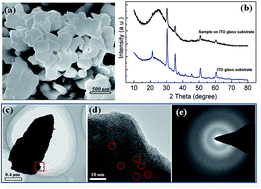
As shown in Fig. 1(a), the products have a sheet-sharp structure, which could be more easily recognized in the SEM image of the as-prepared product on the substrate, as shown in Fig. S2 (see the ESI). The sizes of the nanosheets were in the range of 200–2000 nm, and their crystalline structures were analyzed by XRD tests. The XRD results, as shown in Fig. 1(b), showed that only a broad peak centered at 24 degrees came from the sample, and all sharp diffraction came from the ITO glass substrate. This broad peak at 24 degrees could be indexed to the superposition of the three strongest characterized peaks (002), (020), and (200) of monoclinic WO3 (JCPDs cards: 43-1035). This indicated the amorphous characteristic of the nanosheets. This amorphous characteristic had also been proved by TEM test results, as shown in Fig. 1(c)–(e). As shown in Fig. 1(d), some small white regions, denoted by small red-dashed circles, were observed in the internal structure of the nanosheet. Since the contrast in TEM image represents the intensity of transmission electrons, the white region indicates that the transmission electron intensity is stronger than the other regions, and it means that the thickness of this region should be thinner than the other regions. Thus, in our TEM test, the white spots in the enlarged TEM image could be attributed to the appearance of pore microstructures in the WO3 nanosheets. In addition, no periodic structure could be seen from the high-resolution TEM image. Selected-area electron diffraction (SAED) pattern, as shown in Fig. 1(e), showed that there were only amorphous diffraction rings without any crystal diffraction spots, further confirming the amorphous characteristics of the products.
image file: c5ra18601c-f1.tif
Fig. 1 (a) SEM image of the WO3 nanosheets separated from the substrate. (b) XRD spectra of the WO3 nanosheets on the ITO glass substrate (blank ITO glass substrate has also been given). (c) Typical low-resolution TEM image of a WO3 nanosheet. (d) Enlarged TEM image and (e) SAED pattern of the red-dashed-square region in (c). The positions of pore microstructures are denoted by small red-dashed circles in (d).

The dye adsorption property of the a-WO3 nanosheets was investigated by the removal typical dye molecules from water. A typical result is shown in Fig. 2. The WO3 nanosheets had a high adsorption property for MB dyes in an aqueous solution, and the saturated MB adsorbed amount can reach up to 600 mg g−1, which had been reported in our previous study.19 Furthermore, a self-precipitation phenomenon of the adsorbent would occur when the MB concentration in water increased to be higher that a certain threshold (e.g., 20 mg L−1 in Fig. 2. This value could change with the mass of adsorbent used, and its corresponding threshold adsorbed amount was at about 420 mg g−1), in the case of the same solution volume and the same mass of adsorbent used. This has been proved to be attributed to the density increase of a-WO3 nanosheets after their porous micro-structures were adsorbed with enough MB molecules.19 This may be useful for the separation of nanoscale adsorbents from water. In addition, the as-grown nanosheets on the substrate without separation into water also had high performance on cationic dyes adsorption. As shown in Fig. 3, a WO3 film with an area of 1.5 cm × 2.0 cm on the glass substrate was injected into a RhB dye solution (8 mg L−1, 20 mL) and was allowed to stand for one hour in the solution. As in the result shown in Fig. 3(b), the color of the solution turned transparent and the RhB molecules originally in water totally adsorbed onto the surface of the WO3 nanosheets film. The change of RhB solution was simultaneously recorded by the absorption spectrum, as shown in Fig. 3(c). The strongest absorption peak centered at 550 nm was attributed to light absorption of RhB molecules, and it almost disappeared after adsorption by the WO3 thin film, indicating that most of the RhB molecules in water had been removed by the thin film.


image file: c5ra18601c-f2.tif
Fig. 2 Self-precipitation phenomenon when WO3 nanosheets absorbed enough MB molecules: images at left and right side are the MB solutions before and after the introduction of the WO3 nanosheets with the same mass of 1.4 mg into the solutions in each concentration, respectively.

image file: c5ra18601c-f3.tif
Fig. 3 Images of RhB solutions with a concentration of 8.0 mg L−1 before (a) and after (b) the introduction of a piece of glass coated with amorphous WO3 film. (c) The corresponding absorption spectra of the RhB solutions before and after adsorption by the a-WO3 film.

Another feature in cationic dye adsorption of the a-WO3 nanosheets was its aggregation phenomena for cationic dyes on the adsorbent surfaces. Typical results are shown in Fig. 4(a) and (b), in which a blue-shift absorption and a red-shift absorption compared to the monomer band could be assigned to the formation of two types of aggregate geometries, namely, H- and J-aggregates on the WO3 surfaces, respectively.21 In the MB adsorption, only H-aggregates occurred, while both H- and J-aggregates could occur in the case of RhB adsorption. This result for RhB adsorption agreed with the recent report from K. Adachi and coworkers.20 However, this aggregation adsorption did not happen for anionic dyes. As shown in Fig. 4(c) and (d), the characteristic peaks for MO and CBT dyes in the absorption spectra were almost unchanged compared to the ones before adsorption. Only change was an enhanced absorption intensity in the ultraviolet region, which could be attributed to the band-edge absorption of WO3 nanosheets in water, (WO3 is a wide gap n-type semiconductor with a band gap at 2.6–3.0 eV) in agreement with our previous study.22


image file: c5ra18601c-f4.tif
Fig. 4 Absorption spectra for four typical dye solutions before and after adsorption by the amorphous WO3 nanosheets with the same mass of 3.5 mg in the dye solutions (30 mL): (a) MB solution at 25 mg L−1, (b) RhB solution at 20 mg L−1, (c) MO solution at 25 mg L−1, (d) CBT solution at 20 mg L−1.

Seven typical types of dye adsorption have been tested with our nanosheets. These dyes included methylene blue (MB), rhodamine B (RhB), magenta red (MR), methyl violet (MV), methyl orange (MO), chrome black T (CBT) and acid chrome blue (ACB), in which the first four dyes belonged to the cationic dye category and the other three dyes belonged to the anionic dye category. The test results as shown in Fig. 5 clearly indicated that WO3 nanosheets only had strong adsorption for cationic dyes and weak to no adsorption for anionic dyes. The adsorbed amount Qe (mg g−1), i.e., the amount of dye adsorbed into unit weight of the adsorbent, which is usually used to evaluate the dye adsorption ability of an adsorbent, can be expressed by

 
Qe = γC0V/m (1a)
 
γ = (1 − Ce/C0) × 100% (1b)
where γ is defined as the decolor rate. C0 and Ce are the dye concentration before and after adsorption, respectively. V is the volume of dye solution used (L), and m is the mass of adsorbent used (g) (here, m equals 0.0035 g). The decolor rate and adsorbed amount for the abovementioned seven types of dye have been listed in Table 1. For all cationic dyes, the adsorbed amount exceeded 70 mg g−1, while it was lower than 12 mg g−1 for anionic dyes. This selective adsorption property of the nanosheets was remarkable.


image file: c5ra18601c-f5.tif
Fig. 5 The changes in the concentration of seven types of test dye solutions before and after adsorption by 3.5 mg amorphous WO3 nanosheets in 30 mL solution (MB: methylene blue, RhB: rhodamine B, MR: magenta red, MV: methyl violet, MO: methyl orange, CBT: chrome black T, ACB: acid chrome blue).
Table 1 List of decolor rate and adsorbed amount of WO3 nanosheets for different kinds of dyes
Dyes C0V (mg) γ (%) Qe (mg g−1)
MB 0.75 61 130.7
RhB 0.60 51.5 88.3
MR 0.75 41.7 89.4
MV 0.75 32.8 70.3
MO 0.75 1.0 2.1
CBT 0.75 5.5 11.8
ACB 0.75 0 0


This selective adsorption property implied that the surface charges of WO3 nanosheets may be negative, and the selective adsorptions resulted from electrostatic attractive/repulsive interactions between the WO3 nanosheets and dye molecules. In order to distinguish the type of surface charges of WO3 nanosheets, a zeta potential test for WO3 nanosheets was carried out in deionized water. The test result as shown in Fig. 6 clearly indicated the zeta potential of WO3 nanosheets was negative, and the average value was in the range from −21 to −15 mV, proving our abovementioned analysis about the surface charges of WO3 nanosheets.


image file: c5ra18601c-f6.tif
Fig. 6 (a) Schematic illustrating the detection position of zeta potential tests for WO3 nanosheets in deionized water: upper, middle and bottom sections of the suspended solution are numbered as 1, 2, and 3, respectively; (b) the corresponding zeta potential curves and their average zeta potentials are (1) −17.3, (2) −15.4, and (3) −20.7 mV.

The selective adsorption property of WO3 nanosheets can be applied to separate cationic dyes from a mixed solution. As an example, 10 mL MB dye solution (cationic dye solution, 15 mg L−1) was added into 10 mL MO solution (anionic dye solution, 15 mg L−1) to form a mixed dye solution, and 3.5 mg WO3 nanosheet powder was used to adsorb the cationic dye molecules in the mixed solution. The results were shown in Fig. 7. Before adsorption, the mixed solution was deep green, and after the introduction of WO3 nanosheets into the solution, the mixed solution gradually turned yellow from deep green. This change process was also recorded by an absorption spectrophotometer, and the corresponding absorption spectra of the solutions are shown in Fig. 7(a)–(d). Both the characteristic absorption peaks from methylene blue (MB) molecules and methyl orange (MO) molecules could be observed in the absorption spectrum of the mixed solution before adsorption, but after adsorption, the signals from MB molecules disappeared and only the signals from MO molecules could be observed. This means that the MB molecules were almost totally removed from water by adsorption onto the WO3 nanosheets, and only MO molecules were left in the water, achieving the separation of cationic dyes from the solution. Herein, it should be pointed out that the absorbance intensity of mixed solution in Fig. 7(g) decreased to half of the ones in MB solution in Fig. 7(e) or MO solution in Fig. 7(f) before mixing, which was due to the increase of solvent (water here) volume to 30 mL from 15 mL, resulting the concentrations of MB and MO molecules in solution to drop.


image file: c5ra18601c-f7.tif
Fig. 7 Dye-separation experiment: images of (a) 10 mL MB solution with a concentration of 15 mg L−1, (b) 10 mL MO solution with a concentration of 15 mg L−1, and their mixed solution (c) before and (d) after adsorption by 3.5 mg amorphous WO3 nanosheets in a solution. (e–h) are the corresponding absorption spectra of the solutions in (a–d). Small black squares and white circles indicate the characteristic absorption peaks from MB molecules and MO molecules in water, respectively.

The question rises as to how to separate the adsorbed cationic dyes from the a-WO3 nanosheets. To study the dye desorption processes on the surfaces of amorphous WO3 nanosheets, we altered the pH values of the solutions by the introduction of a little hydrogen peroxide or aqueous ammonia into the test solutions. Hydrogen peroxide and aqueous ammonia create hydrogen ions (H+) and hydroxyl ions (OH) in the solution, respectively, through the following reaction equations (eqn (2a)–(3b)).

 
H2O2 ↔ H+ + HO2 (2a)
 
HO2 ↔ H+ + O2 (2b)
 
NH3 + H2O ↔ NH3·H2O (3a)
 
NH3·H2O ↔ NH4+ + OH (3b)

The result as shown in Fig. 8(a) clearly indicated that the MB desorption processes from the surfaces of WO3 nanosheets strongly depended on the pH value of the solution. In the neutral (pH 7.7, the value of the pure MB solution) solution, two absorption peaks centered at 665 and 610 nm, which could be assigned to the MB monomers and dimers in water, had shifted to the peak at 560 nm after adsorption, and this blue-shift effect was barely influenced by the pH value decreasing from 7.7 to 2.0. This peak at 560 nm had been proved to be attributed to aggregate formation, namely, H-dimers of MB molecules on the surfaces of the a-WO3 nanosheets according to previous reports.23–26 Thus, most MB molecules in water had adsorbed onto the surfaces of the WO3 nanosheets in the neutral solution, and they were hard to desorbed from the WO3 nanosheets by an acidic treatment. On the other hand, when the pH value increased to more than 8.0, the new appearing peak at 560 nm after adsorption shifted back to 665 and 610 nm, indicating the adsorbed MB molecules could be desorbed from WO3 nanosheets into water by an alkaline treatment. Thus, we demonstrated the dye adsorption and desorption on the surfaces of WO3 nanomaterials could be controlled by pH. However, it should be noted that the WO3 nanosheets with cleaned surfaces after desorption were still suspended in the solution. Thus, another question rises as to how to recycle these nanomaterials in a solution. We still do not have a solution this question so far. The reusability of the WO3 nanomaterials should be considered as a crucial question in our further study.


image file: c5ra18601c-f8.tif
Fig. 8 (a) pH-induced desorption of MB molecules on the surfaces of WO3 nanosheets. (b) Schematic illustrating the cationic dye desorption processes in acidic and alkaline treatments, respectively.

The dye desorption processes involving acidic and alkaline treatments were proposed as illustrated in Fig. 8(b). First, in the neutral solution, the cationic dyes adsorb onto the negatively surface-charged WO3 nanosheets due to electrostatic attraction. Then, when H2O2 was introduced into the solution, newly produced hydrogen ions (H+) may occupy some surface positions of the WO3 nanosheets, resulting in a slight decline in the adsorption amount, but most of the newly produced hydrogen ions could not reach the surface of the WO3 nanosheets due to the repulsive forces from the adsorbed dye molecules. Thus, acidic treatment could not induce the adsorbed cationic dyes to be removed from the WO3 nanosheets. In contrast, in an alkaline treatment, once hydroxyl ions (OH) were introduced into the solution, they would be attracted by the adsorbed dye molecules on the surfaces of WO3 nanosheets, and the charged dye molecules would be neutralized, leading the dyes to escape from the negatively surface-charged WO3 nanosheets.

4. Conclusions

In summary, amorphous WO3 nanosheets were fabricated by a one-step thermal evaporation process without any catalyst, and their dye adsorption properties were studied in depth. The dye adsorption test showed that the WO3 nanosheets had a strong adsorption for cationic dyes in water, and they could be self-precipitated from water after they absorbed enough dye molecules in their porous micro-structures. The evidence from experiments in this study proved that cationic dyes were adsorbed onto the surface of WO3 nanosheets by an electrostatic attractive interaction between the negatively charged surfaces of WO3 nanosheets and the cationic dye molecules, and these adsorbed dye molecules had an aggregation phenomenon on the surfaces of WO3 nanosheets. Seven types of dye adsorption was tested and the results clearly indicate that the WO3 nanosheets had a selective adsorption property for cationic dyes, and this property could be applied to separate cationic dyes from a mixed dye solution. Thus, these findings not only prove the outstanding dye adsorption capacity of amorphous WO3 nanomaterials in water, but also demonstrated their potential application in dye separation technologies.

Acknowledgements

The authors gratefully acknowledge the financial support of the projects from the National Natural Science Foundation of China (No. 51402218), the Guangdong Natural Science foundation (No. 2014A030313622, and 2015A030306031), and the Science Foundation for Young Teachers of Wuyi University (No. 2013zk05, and 2014td01).

Notes and references

  1. J. J. Li, J. T. Feng and W. Yan, Appl. Surf. Sci., 2013, 279, 400–408 CrossRef CAS.
  2. E. Forgacs, T. Cserháti and G. Oros, Environ. Int., 2004, 30, 953–971 CrossRef CAS PubMed.
  3. T. G. Chuah, A. Jumasiah, I. Azni, S. Katayon and S. Y. Thomas Choong, Desalination, 2005, 175, 305–316 CrossRef CAS.
  4. G. Crini, Bioresour. Technol., 2006, 97, 1061–1085 CrossRef CAS PubMed.
  5. R. Malik, D. S. Ramteke and S. R. Wate, Waste Manage., 2007, 27, 1129–1138 CrossRef CAS PubMed.
  6. B. L. Feringa, and W. R. Browne, Molecular Switches, Wiley-VCH, Germany, 2011 Search PubMed.
  7. J. L. Atwood, and J. W. Steed, Encyclopedia of Supramolecular Chemistry, Marcel Dekker, New York, USA, 2004 Search PubMed.
  8. K. G. Reddy, T. G. Deepak, G. S. Anjusree, S. Thomas, S. Vadukumpully, K. R. V. Subramanian, S. V. Nair and A. S. Nair, Phys. Chem. Chem. Phys., 2004, 16, 6838–6858 RSC.
  9. J. Gong, J. Liang and K. Sumathy, Renewable Sustainable Energy Rev., 2012, 16, 5848–5860 CrossRef CAS.
  10. H. Kim and J. S. Suh, RSC Adv., 2015, 5, 74107–74114 RSC.
  11. D. Qi, L. Wang and J. Zhang, RSC Adv., 2015, 5, 74557–74561 RSC.
  12. C. G. Granqvist, Sol. Energy Mater. Sol. Cells, 2000, 60, 201–262 CrossRef CAS.
  13. J. Y. Luo, X. X. Chen, W. D. Li, W. Y. Deng, W. Li, H. Y. Wu, L. F. Zhu and Q. G. Zeng, Appl. Phys. Lett., 2013, 102, 113104 CrossRef.
  14. H. Zheng, J. Z. Ou, M. S. Strano, R. B. Kaner, A. Mitchell and K. Kalantar-zadeh, Adv. Funct. Mater., 2011, 21, 2175–2196 CrossRef CAS.
  15. J. W. Liu, J. Zheng, J. L. Wang, J. Xu, H. H. Li and S. H. Yu, Nano Lett., 2013, 13, 3589–3593 CrossRef PubMed.
  16. C. X. Zhao, S. Z. Deng, N. S. Xu and J. Chen, RSC Adv., 2015, 5, 70059–70063 RSC.
  17. S. Tanaka, K. Adachi and S. Yamazaki, Analyst, 2013, 138, 2536–2539 RSC.
  18. W. Xiao, W. T. Liu, X. H. Mao, H. Zhu and D. H. Wang, J. Mater. Chem. A, 2013, 1, 1261–1269 CAS.
  19. J. Y. Luo, Z. Cao, F. Chen, L. Li, Y. R. Lin, B. W. Liang, Q. G. Zeng, M. Zhang, X. He and C. Li, Appl. Surf. Sci., 2013, 287, 270–275 CrossRef CAS.
  20. K. Adachi, K. Watanabe and S. Yamazaki, Ind. Eng. Chem. Res., 2014, 53, 13046–13057 CrossRef CAS.
  21. M. Kasha, H. R. Rawls and M. A. El-Bayoumi, Pure Appl. Chem., 1965, 11, 371–392 CrossRef CAS.
  22. J. Y. Luo, S. Z. Deng, Y. T. Tao, F. L. Zhao, L. F. Zhu, L. Gong, J. Chen and N. S. Xu, J. Phys. Chem. C, 2009, 113, 15877–15881 CAS.
  23. W. Spencer and J. R. Sutter, J. Phys. Chem., 1979, 83, 573–1576 CrossRef.
  24. K. Bergmann and C. T. Ơkonski, J. Phys. Chem., 1963, 67, 2169–2177 CrossRef CAS.
  25. S. M. Ohline, S. Lee, S. Williams and C. Change, Chem. Phys. Lett., 2001, 346, 9–15 CrossRef CAS.
  26. A. A. Attia, W. E. Rashwan and S. A. Khedr, Dyes s., 2006, 69, 128–136 CrossRef CAS.

Footnote

Electronic supplementary information (ESI) available. See DOI: 10.1039/c5ra18601c

This journal is © The Royal Society of Chemistry 2015
Click here to see how this site uses Cookies. View our privacy policy here.