
A. M. S. Salema,
F. A. Harraz*a,
S. M. El-Sheikha,
H. S. Hafezb,
I. A. Ibrahima and
M. S. A. Abdel-Mottalebc
aNanostructured Materials and Nanotechnology Division, Central Metallurgical Research and Development Institute (CMRDI), P.O. Box: 87 Helwan, Cairo 11421, Egypt. E-mail: fharraz68@yahoo.com; Fax: +20-27142451; Tel: +20-27142452
bEnvironmental Studies and Research Institute, Sadat University, Sadat City, Egypt
cNano-Photochemistry and Solar Chemistry Labs., Department of Chemistry, Faculty of Science, Ain Shams University, Abbassia, Cairo, Egypt
First published on 16th November 2015
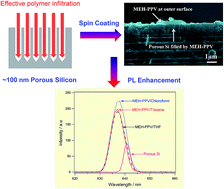
The electrochemical anodization of a single crystalline silicon in hydrofluoric acid-based solution leads to the formation of porous silicon (PSi) with tunable pore sizes and morphology for a wide range of technological applications. By infiltrating the as-anodized PSi layer with a conducting polymer, new functionalities can be achieved. Herein, we report on the enhancement of the electrical and luminescent properties of a nanohybrid composed of ∼100 nm PSi infiltrated by poly(2-methoxy-5-(2-ethylhexyloxy)-p-phenylenevinylene) (MEH-PPV) via a repeated spin coating technique. Morphological and structural investigations using FE-SEM and XRD on the hybrid nanostructure revealed a successful deposition of MEH-PPV inside the entire porous channels with a low degree of crystallinity. A partial silicon oxide formation was confirmed by FT-IR and XPS measurements. Furthermore, a remarkable increase in the electrical properties was detected by measuring the I–V curves and the electrochemical impedance spectroscopy (EIS). Moreover, a noticeable photoluminescence (PL) spectral enhancement after the MEH-PPV deposition into the PSi was detected. The spectral analyses for the current system indicate the possibility of exciton transfer from PSi to the MEH-PPV polymer. This simple synthetic approach can open new opportunities for the development of hybrid nanostructures of PSi and conducting polymers with potential for optical device applications.
The discovery of the room temperature visible photoluminescence (PL) and electroluminescence (EL) of porous silicon (PSi) has stimulated an enormous interest owning to its potential application in solar cells, light emitting diodes, chemical and bio-sensors, interference filters, waveguide, silicon-on-insulator (SOI) structures, and biomedical applications, etc.15 Specially, this luminescence property has not been observed in bulk silicon.16 Therefore, several research groups have investigated the properties of hybrid composite materials of PSi layer with conducting polymers,17–19 including poly[2-methoxy-5-(2-ethylhexyloxy)-1,4-phenylenevinylene] (MEH-PPV).20
Spin casting has become one of the most commonly used techniques for obtaining uniform thin films.11 Baltchford et al.21 have observed that the polymeric films that are cast with different solvents exhibited different PL spectral responses. This observation implies that the morphology or the aggregation of polymer chains has a remarkable effect on final emission spectra. In continuation of our previous works,22–25 herein we report the infiltration of MEH-PPV conducting polymer into the pores of PSi via a simple spin coating technique. MEH-PPV is dissolved in different organic solvents, followed by infiltration into the pores of PSi. The detailed of the experimental approach, along with the electrical and optical properties of the prepared nanohybrids are thoroughly addressed and discussed.
000–70
000), chloroform, THF and toluene were purchased from Sigma-Aldrich (St. Louis, MO, USA), and used as received without further treatment.
Fig. 2 shows the XRD spectra of MEH-PPV films spin coated into PSi using THF, toluene and chloroform as organic solvents, along with the pattern measured for bare PSi. The hybrid structures exhibit broad diffraction peaks at 2θ = 21.1° and large background indicating inhomogeneity of a short-range MEH-PPV chain arrangement. In a recent report, Urbánek et al.27 have investigated the structural ordering as a function of MEH-PPV film thickness using XRD. Their results revealed that the development of a more ordered phase could be observed above a polymer thickness of 150 nm. Our observation indicates again that the crystallinity degree for the polymeric films prepared in all solvents is low and is hardily evaluated. The MEH-PPV polymeric chain is likely confined inside the porous template, which in turn alters its molecular structure to behave as an elongated and aligned chain segment. Another possibility for the appearance of such broad diffraction peaks after the polymer infiltration is the formation of Si oxide layer. This broad peak was not detected for the as-formed PSi, indicating the absence of native oxide layer in bare PSi. To confirm the formation of Si oxide after polymer deposition, further surface analysis using FTIR and XPS is conducted in the following sections.
![]() | ||
| Fig. 2 X-ray diffraction patterns of bare porous silicon and MEH-PPV spin coated into porous silicon in different organic solvents. | ||
Fig. 3 represents the FT-IR spectra measured between 400–4000 cm−1 for the MEH-PPV in toluene solution and spin coated MEH-PPV film into PSi. The spectrum of as-formed PSi before polymer infiltration is also shown. The assignments of the absorption bands were done according to earlier work.28 The characteristic peaks of the MEH-PPV conducting polymer as well as the complete assignments of the bands are listed in Table 1. It can be observed from the data listed in Table 1 that the bands position and type recorded from the toluene containing polymer are almost retained in the deposited MEH-PPV film. It is worth to note that the characteristic band of (RO)–CH2 asymmetric vibration are observed at 1450 and 1457 cm−1 for the polymeric film and solution, respectively. The as-deposited MEH-PPV film reveals a band at 1736 cm−1 due to the formation of aromatic aldehyde (C–O stretch), which was also observed at 1732 cm−1 in the toluene solution. Moreover, the strong band appearing at 1108 cm−1 is assigned to Si–O–Si stretching mode appeared for PSi deposited polymeric film. In contrast to the as-formed polymeric film, the peaks at 3030 and 3432 cm−1 correspond, respectively to the –CH stretching vinyl and O–H stretching of the polymer solution. The absence of Si–O–Si stretching peak in bare PSi indicated the absence of native Si oxide layer in the freshly prepared sample. For more details, the FTIR spectra recorded for all polymeric solutions and for the deposited films into the PSi template using the three tested solvents (toluene, chloroform, THF) are presented as ESI (Fig. S1†), along with a complete peak assignment collected in Table S1.†
| Peak position (cm−1), solution | Peak position (cm−1) for deposited film | Peak assignments |
|---|---|---|
| 3432 | — | O–H stretching |
| 3030 | — | CH– stretching vinyl |
| — | 2950 | CH3 antisymmetric stretching |
| 2924 | 2924 | CH– stretching |
| 2865 | 2863 | CH2 stretching |
| 1732 | 1736 | Formation of aromatic aldehyde |
| 1607 | — | Aromatic stretching |
| 1494 | — | Phenyl stretch (C–C aromatic) |
| 1457 | 1450 | Antisymmetric phenyl stretch |
| — | 1108 | Si–O–Si stretching |
| 1033 | — | Alkyl oxygen stretch |
| — | 965 | Trans-double bond CH-wag (vinyl group) |
| 882 | 882 | Out of plane phenyl CH-wag |
| 727 | 736 | Out of plane ring bend of phenyl ring |
The XPS spectra of the MEH-PPV spin coated into PSi are shown in Fig. 4. The C 1s and O 1s photoelectron signals are investigated in both low resolution (survey) and high resolution indicating the presence of MEH-PPV polymer. The Si 2p signal is also detected from the PSi template. The main Si 2p, C 1s, and O 1s peaks are centered at ∼99, 285, and 532 eV, respectively. However, it is noticed that the surface is partially oxidized in consistent with the above FT-IR observation (Fig. 3). The Si 2p spectrum exhibits two components: elemental Si (with oxidation state; Si (0) ∼99 eV) and silicon oxide SiO2 (with oxidation state; Si (4) ∼103 eV).29 It can be accordingly concluded from the FT-IR and XPS measurements that a partial oxidation of PSi takes place during the spin coating process and substrate drying, and thus a ternary system of PSi/SiO2/MEH-PPV is likely obtained.
![]() | ||
| Fig. 4 XPS analysis of MEH-PPV spin coated into porous silicon from toluene solution; low resolution (top spectrum) and high resolution (bottom spectra). | ||
The conductivity of hybrid structures of PSi/MEH-PPV is also evaluated by measuring the electrochemical impedance spectroscopy. The frequency dependence of the electrochemical impedance was measured in a wide range of 100 mHz to 100 kHz in the dark at 0.0 V for as-prepared PSi and PSi after MEH-PPV deposition. The result obtained for the Bode plot of EIS is depicted in Fig. 6. After polymer deposition (solid triangle: red curve) the electronic resistance and charge transfer resistance are found to increase compared to the PSi sample with no polymer deposition (empty triangle: blue curve). Similar behavior was observed using different applied potential mainly, 0.0, 0.2, 0.4, 0.6, and 0.8 V with respect to the open circuit potential (OCP) (data not shown). The enhancement of the electrical properties of the PSi template after polymer deposition is an indication that the MEH-PPV conducting polymer is successfully spin coated into the porous channels, with a small fraction of silicon being transformed to the insulating silicon dioxide as confirmed by FTIR and XPS measurements.
![]() | ||
| Fig. 7 Room temperature photoluminescence spectra of 0.25 mg ml−1 of MEH-PPV conducing polymer dissolved in toluene, chloroform and THF. | ||
Luminescence spectra of different concentrations of MEH-PPV in toluene solution (0.25, 0.50 and 1 mg ml−1) are measured and the recorded spectra are depicted in Fig. 8. The PL spectrum obtained in 0.50 mg ml−1 concentrated solution (peak at 606 nm) is slightly red-shifted (11 nm) compared with the spectrum of sample with lower concentration (0.25 mg ml−1). Further red-shift of ∼16 nm was obtained upon increasing the concentration to 1 mg ml−1. The results of Fig. 7 and 8 indicate that the PL spectral profile of MEH-PPV directly depends on solvent nature as well as the polymer concentration. Due to the difference in solvation ability of toluene, chloroform and THF, the solvents undergo different interactions with the polymer leading to different conformations with different energy levels in solutions that are reflected in the final PL properties.
![]() | ||
| Fig. 8 Room temperature photoluminescence spectra of MEH-PPV measured in different concentrations of polymer in toluene: concentrations: 0.25, 0.50 and 1 mg ml−1. | ||
According to the chemical structure of MEH-PPV, the structure consists of an aromatic polymer backbone and many ethyl–hexylyoxy side chains, and hence it is likely that aromatic solvents can solvate the polymer backbone better than the alkyl side chains. This is actually in agreement with what has been reported earlier that the toluene as an aromatic solvent undergoes a preferential solvation of the conjugated polymer backbone (vinylene–phenylene groups) inducing a more planer structure, whereas chloroform and THF likely undergo a preferential interaction with the lateral groups which led to a more flexible backbone.31 The polymeric chains are accordingly solvated differently in toluene in one side compared to chloroform and THF on the other side. Upon preferential solvation of the backbone in toluene, good overlapping for the π-electrons with neighboring polymeric chains is expected. Increasing the polymer concentration led to much more segments that are available for interaction which resulted in an increase in the aggregation. The aggregation is promoted in toluene solution and hindered in chloroform and THF. The red-shift of the PL spectra could accordingly be related to: (i) the conformational changes of the polymer chain that modify the conjugation,32 (ii) the formation of aggregates that increases the relative intensity of the red-edge 0–1 vibronic band that has been reported to locate at 598 nm,31,33 very close to our PL emission peak observed in the current work.
Fig. 9 shows the recorded PL spectra of MEH-PPV polymer films prepared by the spin coating into the PSi template in the previous mentioned solvents using a 0.25 mg ml−1 polymer concentration. Two important findings are observed, (i) the PL peak intensity of the structures after polymer coating are remarkably enhanced and slightly blue-shifted compared to the emission peak observed for bare PSi (with no polymer), and (ii) reference to the PL spectra of MEH-PPV measured in different solvents (Fig. 7) one can see a red-shift of the spectral profile for the spin-coated films with sharper peaks. In other words, the PL spectra of all nanohybrid structures of PSi and MEH-PPV (Fig. 9) are red-shifted and sharper compared with the spectra obtained in different solvents (Fig. 7). However, there is no great difference in the PL peak intensities for the three nanohybrids due to the polymer concentration used is very low where the polymeric chains have better conjugation in dilute solutions than in higher concentrations.34
To better understand the PL spectral enhancement after the MEH-PPV deposition into the PSi and to test the possibility of excitation transfer from PSi to the polymer, we measured the UV-vis absorbance of the MEH-PPV film and compare the profile with the PL spectra of unmodified PSi layer. Fig. 10 shows the UV-vis absorbance spectra of MEH-PPV (a) and the PL spectra of PSi (b). It is evident that MEH-PPV polymer had a significant absorption in the main PSi excited wavelength regime, due to the good overlapping with the luminescence energy band of PSi. As a result, the energy transfer from the PSi to MEH-PPV film is possible resulting in PL enhancement observed. The PL enhancement is consistent with the recent published work of electrochemically deposited a group of conducting polymers into meso-PSi templates.35 Additionally, the polymer chains are confined inside the pores and being separated by the pore walls and hence their movement is restricted. This led to increase the polymer conjugation as the degree of collisions between polymer molecules is retarded,36 which in turn could enhance the emission of MEH-PPV conducting polymer.
![]() | ||
| Fig. 10 UV-vis absorbance of MEH-PPV film (a) and photoluminescence spectrum of porous silicon (b). Adapted from our work.35 | ||
Footnote |
| † Electronic supplementary information (ESI) available. See DOI: 10.1039/c5ra18407j |
| This journal is © The Royal Society of Chemistry 2015 |