
Marcus V. M. Silvaa,
Jonathan F. Bassuta,
Ivaldo I. Juniorb,
Stefania P. de Souzaa,
Melissa L. G. Estradabc,
Leandro S. M. Mirandaa and
Rodrigo O. M. A. de Souza*a
aBiocatalysis and Organic Synthesis Group, Federal University of Rio de Janeiro, Chemistry Institute, Rio de Janeiro, Brazil. E-mail: rodrigosouza@iq.ufrj.br
bSchool of Chemistry, Federal University of Rio de Janeiro, Rio de Janeiro, Brazil
cCampus Xerém, Federal University of Rio de Janeiro, Rio de Janeiro, Brazil
First published on 10th November 2015
Development of asymmetric transformations for the synthesis of chiral molecules has achieved great results in the last decade. Besides the great evolution achieved during recent years in the biotechnology and biocatalysis fields, industrial processes using enzymatic approaches are few and a more broad application of such technology towards the synthesis of chiral molecules is still under development. Herein we report our results on the immobilization of lipase B from Candida antarctica on five different commercial supports for the development of a continuous-flow kinetic resolution of alcohol. Immobilization on Accurel MP1000 gave the best results arriving at productivities of around 140 g per h per g of protein and the immobilized biocatalyst could be recycled 5 times without significant loss of activity.
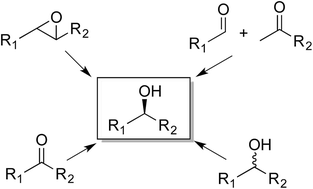
Development of asymmetric transformations for the synthesis of chiral molecules has achieved great results in the last decade. Among the different transformations developed so far, successful strategies towards the synthesis of chiral alcohols are very important for organic chemistry. The synthesis of chiral alcohols can be done by different asymmetric strategies, being the most important, the aldol reaction,4–7 epoxide opening,7–10 ketone hydrogenation,11–14 kinetic/dynamic resolution,15–17 among others (Fig. 1). It is important to note that most of the asymmetric chemical catalysts used to afford the desired chiral alcohol can find an equivalent on enzyme catalysis.
Besides the great evolution achieved during the recent years into the biotechnology and biocatalysis field, industrial process using enzymatic approach are few and a more broad application of such technology towards the synthesis of chiral molecules is still under development. Besides the benefits of working with biocatalysts the cost associate with such technology are still high, making recyclability and productivity important issues on the development of a biocatalytic process.
In order to improve recyclability, immobilization of enzymes is mandatory and different techniques can be found over literature being adsorption, when the protein is linked to the support by hydrophobic interactions, the easiest, cheapest and most common way of producing an immobilized lipase.18–23 To improve productivity, one of the technologies that have gained attention recently is continuous-flow process24,25 by the use of packed bed reactors. Mass transfer can be enhanced by continuous-flow protocols leading to an increase on productivity of biocatalyzed continuous-flow processes.4,14,22,26–29
During the recent years our group has focus attention on the development of continuous-flow protocols for biocatalyzed reactions aiming to improve recyclability and productivity of different process. Here we report our results on the immobilization of lipase B from Candida antarctica in five different hydrophobic commercial supports for the development of a continuous-flow kinetic resolution process. The developed process was compared to the traditional batch reactors in terms of productivity and also with a commercial immobilized enzyme in order to verify the efficiency of the new biocatalyst.
| a * ethyl acetate, isopropenyl acetate and vinyl acetate. ** 1-phenylethanol. | |||
|---|---|---|---|
| Variables | −1 | 0 | +1 |
| Temperature (°C) | 50 | 60 | 70 |
| [E] (%) | 5 | 10 | 15 |
| Acylating agent* proportion/alcohol** (mol mol−1) | 1/1 | 2/1 | 3/1 |
:
1–100 mM in n-heptane) at different temperatures. The reactions were performed in cryotubes under 200 rpm of agitation on a shaker. Samples (10 μL) were collected after 30, 60 and 120 min. All quantifications were done by GC-MS analysis.
:
1 to 1
:
3) under batch conditions for the immobilized commercial enzymes Novozyme 435, Amano Lipase AK, Lipase PS-C Amano I, which will be used as a positive standard for our immobilized enzymes (Scheme 1). The optimization mentioned above was performed for three different acyl donors: ethyl acetate, isopropenyl acetate and vinyl acetate.
Results obtained from this reaction optimization have shown that ethyl acetate leads to good conversion but very low enantiomeric ratios (E), even when Novozyme 435 was used. Changing the acyl donor to isopropenyl acetate (IsoAc) or vinyl acetate (VyAc), better results of conversion and enantiomeric ratio, can be obtained for all immobilized enzymes as shown on Table 2.
| Entry | Enzyme | Acyl donor | Temp. (°C) | [E] (%) | Ratio acyl donor/alcohol | Conversion (%) | E |
|---|---|---|---|---|---|---|---|
| a Reaction conditions: rac-1-phenylethanol (122 mg, 0.12 mL), acyl donor acetate (1–3 mol eq.), and 5–15% w/w of the corresponding immobilized enzyme were reacted in cyclohexane (3 mL) for 2 h at 50–70 °C. | |||||||
| 1 | PSC | IsoAc | 70(+1) | 5(−1) | 1/1(−1) | 52 | 46 |
| 2 | PSC | VyAc | 70(+1) | 15(+1) | 3/1(+1) | 64 | 25 |
| 3 | N435 | IsoAc | 50(−1) | 15(+1) | 1/1(−1) | 50 | 175 |
| 4 | N435 | VyAc | 50(−1) | 15(+1) | 1/1(−1) | 51 | 194 |
| 5 | AK | IsoAc | 70(+1) | 15(+1) | 3/1(+1) | 25 | 2 |
| 6 | AK | VyAc | 50(−1) | 15(+1) | 1/1(−1) | 33 | 62 |
Initial screening shown on Table 2 revel that both Amano Lipase AK and Lipase PS-C Amano I do not present satisfactory results arriving at very poor conversions and enantiomeric ratios (E) while Novozyme 435 can lead to the formation of the desired product in high yields and selectivity. The best reaction condition were similar to vinyl and isopropenyl acetate where 50 °C, 15% immobilized enzyme (w/w) and 1
:
1 proportion between substrate (1) and acylating agent (2) gave the best results.
With these results in hands we decided to start the immobilization of Lipase B from Candida antarctica (Cal-B) into 5 different commercial supports (Accurel MP1000, IB-EC1, IB-S861, ECR1091F and ECR8806F) by hydrophobic interaction (see ESI† for further details).
Immobilization procedure was followed by 30 hours in order to define the reaction time needed for maximum protein incorporation into the support. The behavior of each enzyme during the immobilization procedure is given in Fig. 2.
From the data presented on Fig. 2 is possible to observe that macroporous styrene (ECR1091F), polystyrene (IB-EC1) and octadecyl methacrylate (ECR8806F) have the highest amount of protein incorporation, around 80% after 26 hours. For both ECR1091F and ECR8806F the explanation for this high efficiency can be related to the hydrophobicity and also to the support porous diameter of each material that can be on the range of 950–1220 and 500–700 (Å), respectively. Unfortunately, Accurel MP1000 and IB-S861 did not lead to a high immobilization efficiency reaching 32 and 42% of protein incorporation respectively. All immobilized biocatalysts were characterized by infrared spectroscopy, thermogravimetric analysis (TG) and scanning electron microscopy (SEM). Table 3 presents an additional data for the immobilization procedure showing the amount of protein loaded into each support.
| Support | Immobilization efficiency (%) | mg of protein per g of support |
|---|---|---|
| a Immobilization conditions: 20 mg of protein per gram of support in phosphate buffer, pH 7.0, 20 mM for 26 hours at room temperature. | ||
| Accurel MP1000 | 32 | 6.4 |
| IB-EC1 | 80 | 16.1 |
| IB-S861 | 42 | 8.5 |
| ECR1091F | 88 | 17.6 |
| ECR8806F | 83 | 16.7 |
Characterization of the immobilized biocatalysts was performed in order to enable reproducibility of the immobilization procedure. Infrared (IR) analysis shows the presence of protein on the support but thermogravimetric (TG) results do not show significant changes between samples before and after immobilization, probably due to small amount of protein loaded into the support (see ESI† for further details). On the other hand, scanning electron microscopy (SEM) revels some differences between the immobilized enzyme and the parent support (Fig. 3). For example, IB-EC1 (1a and 1b) and ECR1091F (2a and 2b), clearly shows changes on the surface after immobilization, as well as, Accurel MP1000 (5a and 5b) where the macroporous structure is changed after the immobilization procedure.
![]() | ||
| Fig. 3 Scanning electron microscopy images of supports used in this work before (a) and after (b) immobilization (1-IB-EC1, 2-IB-S861, 3-ECR1091F, 4-ECR8806F and 5-Accurel MP1000). | ||
Before starting to use this immobilized biocatalysts on the kinetic resolution of 1-phenylethanol, we have performed some experiments in order to identify the stability of the biocatalysts at different temperatures such as: 50 °C, 60 °C and 70 °C. For this purpose we have used, as a standard experiment, the esterification reaction between oleic acid and ethanol in cyclohexane at different reaction temperatures, as shown in Table 4.
| Biocatalyst | Time (min) | Conversion (%) | ||
|---|---|---|---|---|
| 50 °C | 60 °C | 70 °C | ||
a Reaction conditions: 10 mg of biocatalyst in 1 mL solution of oleic acid/ethanol 1 : 1, 100 mM in n-heptane at different temperatures for 60 minutes. |
||||
| Accurel MP1000 | 30 | 74 | 70 | 60 |
| IB-EC1 | 34 | 60 | 47 | |
| IB-S861 | 76 | 73 | 58 | |
| ECR1091F | 60 | 76 | 60 | |
| ECR8806F | 71 | 74 | 60 | |
| Accurel MP1000 | 60 | 75 | 77 | 62 |
| IB-EC1 | 46 | 67 | 54 | |
| IB-S861 | 74 | 71 | 57 | |
| ECR1091F | 69 | 75 | 59 | |
| ECR8806F | 73 | 70 | 59 | |
| Accurel MP1000 | 120 | 75 | 75 | 62 |
| IB-EC1 | 55 | 68 | 54 | |
| IB-S861 | 72 | 70 | 57 | |
| ECR1091F | 68 | 71 | 57 | |
| ECR8806F | 74 | 70 | 58 | |
As shown in Table 4, the immobilized biocatalysts present good behavior at different temperatures being 50 and 60 °C the best temperatures for these biocatalysts. Even at higher temperatures (70 °C), the immobilized biocatalysts prepared in this work could lead to moderate conversion towards the desired product.
Moving forward to the use of the prepared immobilized biocatalysts on the kinetic resolution of 1-phenylethanol (1) we decided to use the reaction conditions already optimized to commercial immobilized biocatalysts in order to have them as a reference to our work, in combination with the results obtained about temperature behavior presented on Table 4. The comparative results between the commercial immobilized enzyme (Novozyme 435 – N435) and the prepared immobilized biocatalysts are shown in Table 5. It is important to note that in order to have a true comparison between all immobilized biocatalysts, productivity should be used in place of conversion because it takes into account the amount of protein presented in each biocatalyst.
| Entry | Enzyme | mg Cal-B per g support | Conv. (%) | E | Productivity (g product per h per g ptn) |
|---|---|---|---|---|---|
| a Reaction conditions: 0.33 M 1-phenylethanol, vinyl acetate 0.33 M in 3 mL of cyclohexane with 15% of biocatalyst for 2 hours at 50 °C.30 | |||||
| 1 | N435 | 30 | 49 | >200 | 7.4 |
| 2 | Accurel MP1000 | 6.4 | 24 | >200 | 17.0 |
| 3 | IB-EC1 | 16.1 | 48 | >200 | 13.5 |
| 4 | IB-S861 | 8.5 | 50 | >200 | 26.9 |
| 5 | ECR1091F | 17.6 | 20 | >200 | 5.1 |
| 6 | ECR8806F | 16.7 | 20 | >200 | 1.9 |
As presented on Table 5, all immobilized biocatalysts could lead to the desired product with very high enantiomeric ratios (E) but the conversions were slightly different between them. A first look at conversion we will say that Novozyme 435, IB-EC1 and IB-S861 were the best biocatalysts for this transformation. But besides the good conversion of Novozyme 435 the productivity is very low when compared to IB-EC1 and IB-S861 since these immobilized biocatalysts have respectively 46 and 71% less protein then the commercial one. Accurel MP1000 was also effective on performing the kinetic resolution with high productivities, comparable to those obtained by IB-EC1 and IB-S861, but conversions were low which can difficult downstream process with more laborious purification steps.
In order to increase the productivity of the immobilized biocatalysts we decided to evaluate the kinetic resolution of 1-phenylethanol under continuous-flow conditions, by the use of packed bed reactors. The packed bed reactors were packed with the same amount of immobilized biocatalyst and the reaction screened at different residence times. The results are presented on Table 6.
| Entry | Enzyme | mg Cal-B per g support | Res. time (min) | Conv. (%) | E | Productivity (g product per h per g ptn) |
|---|---|---|---|---|---|---|
| a Reaction conditions: 0.33 M 1-phenylethanol and 0.33 M vinyl acetate in cyclohexane. | ||||||
| 1 | N435 | 30 | 7 | 31 | >200 | 13.9 |
| 15 | 46 | >200 | 9.7 | |||
| 20 | 50 | >200 | 7.8 | |||
| 2 | Accurel MP1000 | 6.4 | 7 | 15 | >200 | 90.2 |
| 15 | 50 | >200 | 141.1 | |||
| 20 | 50 | >200 | 104.8 | |||
| 3 | IB-EC1 | 16.1 | 7 | 21 | >200 | 13.9 |
| 15 | 30 | >200 | 9.3 | |||
| 20 | 37 | >200 | 8.5 | |||
| 4 | IB-S861 | 8.5 | 7 | 14 | >200 | 20.4 |
| 15 | 26 | >200 | 17.8 | |||
| 20 | 34 | >200 | 17.2 | |||
| 5 | ECR1091F | 17.6 | 7 | 15 | >200 | 7.6 |
| 15 | 21 | >200 | 5.0 | |||
| 20 | 24 | >200 | 4.2 | |||
| 6 | ECR8806F | 16.7 | 7 | 8 | >200 | 3.2 |
| 15 | 14 | >200 | 2.6 | |||
| 20 | 42 | >200 | 4.8 | |||
Results presented on Table 6 shows that in general continuous-flow protocol can reduce reaction time from hours to a few minutes without loosing productivity towards the desired product. Novozyme 435 can improve by 2× the productivity under continuous flow conditions while IB-EC1 and IB-S861 did not show great improvements on productivity but could reduce reaction time by more then 1 hour and 30 minutes. ECR1091F and ECR8806F presented a slightly improvement on both conversion and productivity under such conditions.
Accurel MP1000 was the one to have a huge enhancement on conversion and productivity arriving on the desired product after 15 minutes with 50% of conversion (E > 200) and productivity around 140 g of product per h per g ptn. This great productivity is observed because under continuous-flow conditions this immobilized lipase can be very efficient with a small amount of protein, probably due to the enhanced mass transfer obtained under such conditions.
Another important feature of this immobilized biocatalyst is the fact that recyclability was better under continuous-flow conditions compared to the batch reactors probably due to mechanical damage of the support, which can lead to protein leakage. The results obtained for recycling are shown in Fig. 4.
![]() | ||
| Fig. 4 Recyclability of lipase B from Candida antarctica immobilized on Accurel MP1000 resin: Continuous-flow × batch reactors. | ||
Footnote |
| † Electronic supplementary information (ESI) available. See DOI: 10.1039/c5ra17961k |
| This journal is © The Royal Society of Chemistry 2015 |