Highly π-extended tetrathiafulvalene analogues derived from pentacene-5,7,12,14-tetraone

Eyad A. Younes and Yuming Zhao*
Department of Chemistry, Memorial University, St. John's, NL A1B 3X7, Canada. E-mail: yuming@mun.ca; Fax: +1 709 864 3702; Tel: +1 709 864 8747

Received 2nd September 2015 , Accepted 12th October 2015

First published on 12th October 2015


Abstract

A new class of π-extended tetrathiafulvalene analogue, which is capable of reversibly revealing and concealing a central pentacene segment under redox control, was synthesized by stepwise olefination reactions on pentacene-5,7,12,14-tetraone. The structural, electronic, and redox properties were investigated by NMR, UV-Vis absorption, electrochemical analyses in conjunction with density functional theory (DFT) calculations.
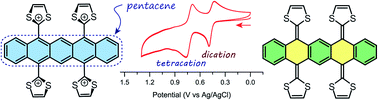

Small-molecule semiconductors have been actively pursued in recent years, owing to their promising application in advanced molecular optoelectronic devices.1–3 Of many organic semiconductors developed so far, fused acenes constitute a very appealing class of p-type semiconducting organic molecules; especially, pentacene-based molecules have been developed into a benchmark material for organic field effect transistors (OFETs) in light of their very high hole mobilities.4–7 Electron-deficient acenes, on the other hand, also attract considerable attention as n-type semiconductors.4,8 Attachment of electron-withdrawing groups, such as halogen,9,10 cyano,11,12 or imide groups12–15 onto the backbone of pentacene lowers the HOMO and LUMO energies, favouring electron transport in device application. It also renders the pentacene unit to be more resistant to oxygen-caused decomposition.

Linking redox-active functional groups to various molecular/macromolecular structures is a popular design approach for generating novel functional materials with wide-ranging applications, since in this way the properties of materials can be readily modulated or tuned by straightforward redox controls.16,17 In theory, the electronic nature of a redox-active unit can be switched between electron-donating and electron-withdrawing in different oxidation states. It is hence reasonable to assume that functionalization of pentacene with redox-active substituents would give rise to redox-switchable structural and electronic characteristics. Tetrathiafulvalene (TTF) and related π-extended analogues (i.e., exTTFs) are excellent organic electron donors, many of which can undergo facile reversible redox processes induced by electrochemical and/or chemical means.7,18–20 A well known representative of exTTFs is the anthraquinone-derived system 1 (Scheme 1), generally referred to as TTFAQ.7,19,21–23 In the neutral state, TTFAQ 1 adopts a non-planar saddle-like conformation.24–27 Under moderate oxidative conditions, TTFAQ can release two π-electrons simultaneously to form a stable dication.28–30 As depicted in Scheme 1, the two-electron oxidation transforms the central anthraquinoidal unit of TTFAQ 1 into a planar anthracene structure, while the two dithiolium rings rotate to an orientation perpendicular to the central anthracene so as to minimize disfavoured charge repulsion.7,21


image file: c5ra17855j-s1.tif
Scheme 1 Unmasking anthracene and pentacene moieties via oxidation reactions on the dithiole units in TTFAQ 1 and exTTF 2a.

In a sense, TTFAQ can be deemed as concealing an anthracene moiety that can be fully revealed after oxidizing its two dithiole groups. The dication of TTFAQ, as a matter of fact, is an electron-deficient anthracene, given the electron-withdrawing nature of the dithiolium rings attached. Along this line, an unprecedented fused TTFAQ dimer 2a (Scheme 1) recently caught our attention. Conceptually, compound 2a not only represents an intriguing type of exTTFs with increased electron-donating ability compared with TTFAQ, but also exhibits an electron-deficient pentacene structure in its tetracationic state. As this type of exTTFs has not yet been known in the current literature, it is of great fundamental importance to conduct pertinent synthetic and characterization studies.

In this work, pentacene-5,7,12,14-tetraone (3)31 was chosen as the starting material for synthesis. Initially, a fourfold P(OMe)3-promoted olefination reaction32 with thione 4 at elevated temperature (Scheme 2) was expected to directly lead to the target exTTF. However, this reaction only yielded tri-substituted compound 5 as the major product in 41% yield. Worth noting is that there were no significant amounts of mono- and di-substituted products formed in this reaction. The inertness of 5 toward olefination with thione 4 can be ascribed to the strong electron-donating effects of the three dithiole groups which significantly reduce the electrophilicity of the last keto group. To accomplish the synthesis, a more reactive Horner–Wittig olefination approach was adopted, where a phosphonate ylide in situ generated by deprotonation of 6 (ref. 28 and 30) with n-BuLi was reacted with compound 5 to furnish the target exTTF 2b in 65% yield.


image file: c5ra17855j-s2.tif
Scheme 2 Synthesis of exTTF 2b via olefination reactions.

The electronic absorption properties of exTTFs 2b and 5 were investigated by UV-Vis spectroscopy (Fig. 1). Compound 2b is a stable yellow coloured semisolid, and in chloroform its UV-Vis absorption spectrum exhibits four well-resolved relatively sharp peaks at 478, 401, 356, and 250 nm. In addition, two shoulder bands are discernible at 449 and 294 nm. The finely structured spectral profile is indicative of a rigid π-backbone for compound 2b. Compound 5 is a dark-red semisolid, which shows absorption bands at 512, 418, 310 (shoulder) and 255 nm in its UV-Vis absorption spectrum. The lowest-energy absorption band of 5 is considerably redshifted compared with that of exTTF 2b, which can be attributed to the electron push-and-pull effects33 between electron-donating dithiole groups and the electron-withdrawing ketone group in the molecular structure of 5. This result indicates that 5 has a more narrowed HOMO–LUMO gap than 2b does.


image file: c5ra17855j-f1.tif
Fig. 1 Normalized UV-Vis spectra of compounds 2b and 5 measured in CHCl3 at room temperature.

The redox activity of compounds 2b and 5 were probed by cyclic voltammetric (CV) and differential pulse voltammetric (DPV) analyses (see Fig. 2). The CV profile of exTTF 2b clearly shows two reversible redox wave pairs which are consistent with the two oxidation peaks observed at +0.46 and +0.72 V in its DPV. The results indicate that exTTF 2b undergoes two distinctive steps of oxidation, with each step involving the transfer of two electrons given the nearly equal intensities of the two current peaks. Also worth noting is that the first oxidation potential of exTTF 2b is significantly lower than that of a typical TTFAQ7,28–30 by ca. 0.1 V, indicating that 2b is a better electron donor than TTFAQ 1. The DPV data of compound 5 shows three major oxidation peaks at +0.59, +0.96, and +1.21 V respectively. Together with the observation of three quasi-reversible redox wave pairs in the CV profile of 5, the electrochemical oxidation of 5 can be attributed to three sequential single-electron transfer steps. Interestingly, there is a weak current peak observed at +0.77 V in the DPV of 5. The origin of this peak is not quite clear at this moment and awaits further investigations to understand.


image file: c5ra17855j-f2.tif
Fig. 2 Electrochemical analysis of compounds 2b and 5 measured in CH2Cl2. (A) DPV of 2b, (B) CV of 2b, (C) DPV of 5, and (D) CV of 5. The arrows indicate the scan direction. Supporting electrolyte: Bu4NBF4 (0.1 M), working electrode: glassy carbon, counter electrode: Pt wire, reference electrode: Ag/AgCl (3 M NaCl). CV: scan rate = 100 mV s−1; DPV: step = 4 mV, pulse amplitude = 50 mV, pulse width = 50 ms, pulse period = 200 ms.

Apart from electrochemical analysis, the oxidation properties of compounds 2b and 5 were also studied by oxidative UV-Vis titration experiments in which a mixture of PhI(OAc)2/CF3SO3H (1[thin space (1/6-em)]:[thin space (1/6-em)]4 molar ratio) was utilized as the oxidant.34 The titration results of exTTF 2b as shown in Fig. 3 manifest two stages of spectral changes upon chemical oxidation. In the first stage (Fig. 3A), four isobestic points can be clearly seen and the lowest-energy absorption band of 2b at 478 nm decreases substantially. A long-wavelength absorption tail ranging from 500 to 800 nm emerges and grows steadily, and this absorption feature can be ascribed to the formation of dithiolium cations during the oxidation of 2b.27,28,30 The second stage of spectral changes (Fig. 3B) exhibits three isobestic points, while the overall variations of spectral profiles do not appear to be as dramatic as those in the first stage. Of note is that the long-wavelength absorption tail shows a significant degree of redshift. The two-stage spectral changes observed in the oxidative UV-Vis titration of 2b coincide with the two steps of electron transfer disclosed by electrochemical analysis. It is therefore reasonable to correlate the two stages in Fig. 3 with the formation of the dication and tetracation of 2b in a sequential manner.


image file: c5ra17855j-f3.tif
Fig. 3 UV-Vis spectra monitoring the titration of compound 2b with PhI(OAc)2/CF3SO3H in THF at different stages. Addition of PhI(OAc)2: (A) 0 to 6.5 molecular equivalents, and (B) 7 to 14 molecular equivalents. The arrows indicate the trend of increasing oxidation.

The oxidative UV-Vis titration results of compound 5 can be divided into three stages of spectral changes as depicted in Fig. 4. In the first stage, the UV-Vis absorption profile of 5 changes considerably with four isobestic points clearly seen (Fig. 4A). Unlike the case of 2b, the characteristic long-wavelength tail of dithiolium cation is rather weak in the oxidative titration of 5. This phenomenon is likely associated with the electron-withdrawing keto group present in the π-framework of compound 5. In the second and third stages, the spectral profiles change only to a small extent in comparison with the first stage. In view of the stepwise single-electron transfers observed in electrochemical experiments, the three stages shown in Fig. 4 are assigned to the formation of the radical cation, dication, and trication of 5 respectively.


image file: c5ra17855j-f4.tif
Fig. 4 UV-Vis spectra monitoring the titration of compound 5 with PhI(OAc)2/CF2SO3H in THF at different stages. Addition of PhI(OAc)2: (A) 0 to 10 molecular equivalents, (B) 11 to 18 molecular equivalents, and (C) 19 to 36 molecular equivalents. The arrows indicate the trend of increasing oxidation.

To further understand the structural properties of exTTF 2b in neural and oxidized states, its unsubstituted parent structure 2a was subjected to theoretical modeling studies by the density functional theory (DTF) approach. In the neutral state, two stable conformers (denoted as cis and trans, see Fig. 5A and B) were obtained from the DFT calculations. In each of the structures, the TTFAQ segments take a saddle-like shape similar to those reported in the literature.24–27 The two conformers differ in the positions of the dithiole rings relative to the central polyaromatic unit. Energetically, the trans conformer is more stable than cis by 0.56 kcal mol−1 in the gas phase. DFT calculations also indicate that the two conformers of 2a possess very similar frontier molecular orbital properties (see ESI for details); however, the cis conformer has a slightly smaller HOMO–LUMO gap (4.45 eV) than trans (4.40 eV), as a result of its relatively higher HOMO energy. The optimized geometry of the singlet tetracation of 2a exhibits a dramatically changed conformation in comparison with the neutral state. As expected, the central π-unit turns into a planar, fully conjugated pentacene structure, to which the four dithiolium rings are in a perpendicular orientation (Fig. 5C). The HOMO–LUMO gap of [2a]4+ is significantly reduced to 1.99 eV (in the gas phase), which accounts for the rise of a long-wavelength absorption tail in the oxidative UV-Vis titration of 2b.


image file: c5ra17855j-f5.tif
Fig. 5 Front (top) and side (bottom) views of (A) and (B) the optimized molecular geometries of exTTF 2a and (C) its singlet tetracation calculated at the B3LYP/6-31G(d) level of theory.35

The interchange of the conformers of 2b does not undergo a very large energy barrier, as manifested by the variable temperature (VT) NMR study. In Fig. 6, the two SCH3 groups of 2b clearly give a set of two singlets (2.42 and 2.43 ppm) at room temperature (298 K), suggesting that the conformers of 2b are in rapid equilibria at kinetic rates much faster than the time scale of NMR. As the temperature decreases from 298 K to 218 K, the two SCH3 singlets gradually merge into one broad peak. In the meantime, the range of the CH2 proton peaks become significantly widened. This phenomenon may be related to enhanced intermolecular aggregation at lowered temperature. When the temperature is further lowered to 198 K, the broad SCH3 peak splits into several different peaks, signifying considerably slowed down interconversion between different conformers at this temperature.


image file: c5ra17855j-f6.tif
Fig. 6 Partial variable temperature (VT) 1H NMR spectra (CD2Cl2, 500 MHz) of exTTF 2b showing the regions of SCH2 and SCH3 protons.

In summary, stepwise olefination reactions on pentacen-5,7,12,14-tetraone have successfully led to a new class of highly π-extended TTF analogues 2b and 5. The redox chemistry of these compounds features multi-stage electron transfers accompanied by dramatic conformational changes. Of great fundamental interest is that the central moiety of exTTF 2b can be transformed into a full pentacene structure after exhaustive oxidation. It is anticipated that this type of exTTFs can be developed into useful redox-switchable building blocks for advanced molecular materials and devices.

Acknowledgements

This work is financially supported by the Natural Sciences and Engineering Research Council of Canada (NSERC). Mr Mohammadreza Khadem of Memorial University is acknowledged for assistance in VT-NMR studies.

References

  1. Y. Lin, Y. Li and X. Zhan, Chem. Soc. Rev., 2012, 41, 4245–4272 RSC.
  2. A. Mishra and P. Bäuerle, Angew. Chem., Int. Ed., 2012, 51, 2020–2067 CrossRef CAS PubMed.
  3. A. R. Murphy and J. M. J. Fréchet, Chem. Rev., 2007, 107, 1066–1096 CrossRef CAS PubMed.
  4. Q. Ye and C. Chi, Chem. Mater., 2014, 26, 4046–4056 CrossRef CAS.
  5. J. E. Anthony, Angew. Chem., Int. Ed., 2008, 47, 452–483 CrossRef CAS PubMed.
  6. J. E. Anthony, Chem. Rev., 2006, 106, 5028–5048 CrossRef CAS PubMed.
  7. M. Bendikov, F. Wudl and D. F. Perepichka, Chem. Rev., 2004, 104, 4891–4945 CrossRef CAS PubMed.
  8. H. Qu and C. Chi, Curr. Org. Chem., 2010, 14, 2070–2108 CrossRef CAS.
  9. Y. Shu, Y.-F. Lim, Z. Li, B. Purushothaman, R. Hallani, J. E. Kim, S. R. Parkin, G. G. Malliaras and J. E. Anthony, Chem. Sci., 2011, 2, 363–368 RSC.
  10. H. Qu and C. Chi, Org. Lett., 2010, 12, 3360–3363 CrossRef CAS PubMed.
  11. S. Katsuta, D. Miyagi, H. Yamada, T. Okujima, S. Mori, K.-i. Nakayama and H. Uno, Org. Lett., 2011, 13, 1454–1457 CrossRef CAS PubMed.
  12. Y.-C. Lin, C.-H. Lin, C.-Y. Chen, S.-S. Sun and B. Pal, Org. Biomol. Chem., 2011, 9, 4507–4517 CAS.
  13. H. Qu, W. Cui, J. Li, J. Shao and C. Chi, Org. Lett., 2011, 13, 924–927 CrossRef CAS PubMed.
  14. Q. Ye, J. Chang, K.-W. Huang and C. Chi, Org. Lett., 2011, 13, 5960–5963 CrossRef CAS PubMed.
  15. J. Yin, K. Zhang, C. Jiao, J. Li, C. Chi and J. Wu, Tetrahedron Lett., 2010, 51, 6313–6315 CrossRef CAS PubMed.
  16. G. Inzelt, Conducting Polymers: A New Era in Electrochemistry, Springer, Berlin, 2nd edn, 2012 Search PubMed.
  17. Functional Organic Materials: Syntheses, Strategies and Applications, ed. T. J. J. Müller and U. H. F. Bunz, Wiley-VCH, Weinheim, Germany, 2006 Search PubMed.
  18. D. Canevet, M. Salle, G. Zhang, D. Zhang and D. Zhu, Chem. Commun., 2009, 2245–2269 RSC.
  19. J. L. Segura and N. Martín, Angew. Chem., Int. Ed., 2001, 40, 1372–1409 CrossRef CAS.
  20. TTF Chemistry: Fundamentals and Applications of Tetrathiafulvalene, ed. J.-i. Yamada and T. Sugimoto, Springer, Berlin, 2004 Search PubMed.
  21. F. G. Brunetti, J. L. López, C. Atienza and N. Martín, J. Mater. Chem., 2012, 22, 4188–4205 RSC.
  22. E. M. Pérez and N. Martín, Chem. Soc. Rev., 2008, 37, 1512–1519 RSC.
  23. M. R. Bryce and A. J. Moore, Synth. Met., 1988, 25, 203–205 CrossRef CAS.
  24. R. García, M. A. Herranz, M. R. Torres, P.-A. Bouit, J. L. Delgado, J. Calbo, P. M. Viruela, E. Ortí and N. Martín, J. Org. Chem., 2012, 77, 10707–10717 CrossRef PubMed.
  25. M. Shao, P. Dongare, L. N. Dawe, D. W. Thompson and Y. Zhao, Org. Lett., 2010, 12, 3050–3053 CrossRef CAS PubMed.
  26. C. A. Christensen, A. S. Batsanov and M. R. Bryce, J. Am. Chem. Soc., 2006, 128, 10484–10490 CrossRef CAS PubMed.
  27. C. A. Christensen, M. R. Bryce, A. S. Batsanov and J. Becher, Org. Biomol. Chem., 2003, 1, 511–522 CAS.
  28. M. Shao, G. Chen and Y. Zhao, Synlett, 2008, 371–376 CAS.
  29. N. E. Gruhn, N. A. Macías-Ruvalcaba and D. H. Evans, Langmuir, 2006, 22, 10683–10688 CrossRef CAS PubMed.
  30. G. Chen and Y. Zhao, Tetrahedron Lett., 2006, 47, 5069–5073 CrossRef CAS PubMed.
  31. N. Vets, H. Diliën, S. Toppet and W. Dehaen, Synlett, 2006, 1359–1362 CAS.
  32. C. A. Christensen, A. S. Batsanov and M. R. Bryce, J. Org. Chem., 2007, 27, 1301–1308 CrossRef PubMed.
  33. H. Meier, Angew. Chem., Int. Ed., 2005, 44, 2482–2506 CrossRef CAS PubMed.
  34. M. Shao and Y. Zhao, Tetrahedron Lett., 2010, 51, 2892–2895 CrossRef CAS PubMed.
  35. A. D. Becke, J. Chem. Phys., 1993, 98, 5648–5652 CrossRef CAS PubMed.

Footnote

Electronic supplementary information (ESI) available: Detailed synthetic procedures and characterization data for new compounds. See DOI: 10.1039/c5ra17855j

This journal is © The Royal Society of Chemistry 2015
Click here to see how this site uses Cookies. View our privacy policy here.