Muyang Zhang,
Yuming Zhou*,
Man He,
Tao Zhang and
Xiaohai Bu
School of Chemistry and Chemical Engineering, Southeast University, Jiangsu Optoelectronic Functional Materials and Engineering Laboratory, Nanjing 211189, People's Republic of China. E-mail: ymzhou@seu.edu.cn
First published on 12th October 2015
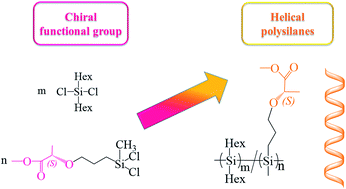
The novel single-handed helical polysilanes (HPS), poly[di-n-hexylsilane-co-(methoxycarbonyl ethyl propyl ether)methylsilane] were synthesized by the Wurtz-type coupling of the chiral functional monomer, dichloro(methoxycarbonyl ethyl propyl ether)methylsilane (DCMMS). The monomer was prepared by the hydrosilylation reaction of methyl (S)-2-(allyloxy)propanoate. The chemical structure of HPS was confirmed by 1H, 13C and 29Si nuclear magnetic resonance (NMR), Fourier transform infrared spectroscopy (FT-IR), ultraviolet-visible spectroscopy (UV-Vis) and circular dichroism (CD). The weight distributions and crystallinity of the polysilanes were demonstrated by gel permeation chromatography (GPC), differential scanning calorimetry (DSC) and polarized light microscopy (POM), respectively. The single-handed helical characterization and polymerization degree of the new-typed polysilanes could be controlled by the co-monomers of DCMMS and di-n-hexyldichlorosilane (DCDHS), respectively. Furthermore, the infrared emissivity values (0.598 at 8–14 μm) of HPS were investigated by an Infrared Emissometer.
O and N–H and polymers' intramolecular hydrogen. Moreover, the intramolecular hydrogen bond improves the generation of orderly secondary structure and hydrogen deficiency simultaneously. Whereas, the orderliness and helicity would dramatically weaken when the temperature rises above 100 °C. The limit of temperature restricts their high temperature application such as military stealth. To solve this problem, HPS are devised to improve the infrared emissivity performance at high temperature. Besides the high temperature stability, polysilanes with particular substituents adopt helical conformation.5 The helical conformation of backbone doesn't merely rely on the intramolecular hydrogen bond induced by side chain functional groups.
Helical polysilanes have been synthesized and applied in various fields like molecular recognition and information storage.6 Typically, most of the optical active polysilanes are modified by alkyl or aromatic side groups.7,8 To be more specific, poly(di-n-hexylsilane) (PDHS) with hexyl functional groups possesses a typical 7/3 helix backbone which consists of both P- and M-screw senses.9,10 Polysilane with randomly distributed coiled segment doesn't show conformational orderliness. Hence, the preparation of helical polysilanes with enantiomerically pure conformations is reasonable.11,12 Optically active polysilanes with enantiopure chiral functional groups can be obtained by introducing chlorosilane chiral monomer.13 Since the reactivity of silicon–chlorine group, polysilanes with organo-functional groups are rarely reported.14 Polar polysilanes containing randomly distributed –OH groups haven't been prepared until multihydroxy functional polysilanes are synthesized by Reuss and his co-workers.15 The acetal protecting strategy offers a novel pathway to entirely new class of functional polysilanes. Thus, functional groups like methoxycarbonyl and ether can be employed in preparing functional polysilanes as well.16–20 The addition of unsaturated group C
O makes the synthesis of HPS meaningful. Moreover, due to the chiral structure of functional group, lactic acid-based polymers exhibit excellent optical and physical properties.21
In this work, we present the synthesis and characterization of helical polysilane copolymers consisting of randomly distributed methoxycarbonyl and ether groups (Scheme 1). Methyl-(S)-2-(allyloxy)propanoate, applies as one of the raw materials, is originated from methyl-(S)-(−)-lactate. The other reactant dichloromethylsilane and the corresponding monomer demand low temperature and inert gas environment for preservation. Tetrahydrofuran (THF) offers the mild condition of copolymerization in which monomer can be preserved. The crystallinity and polymerization degree of helical polysilanes can be controlled by the copolymerization ratio of DCMMS and DCDHS. Additionally, the influences of helical conformation and unsaturation are investigated. The incorporation of chirality in the resulting polymers provides a promising prospect in low infrared emissivity application. Poly[di-n-hexylsilane-co-(methoxycarbonyl ethyl propyl ether)methylsilane] with copolymerization ratio of 10%, 30%, 50% MMS content are abbreviated as HPS-1, HPS-2, HPS-3 for the reason of conciseness.
DCMMS: yield: 54%, colorless oil. 1H NMR (300 MHz, CDCl3): δ [ppm] = 3.96 (q, 1H, 3J = 6.8 Hz, CH), 3.72 (s, 3H, CH3–O), 3.55 (dd, 1H, JAB = 15.2 Hz, 3J = 6.4 Hz, O–CH′H′′–CH), 3.40 (dd, 1H, JAB = 15.2 Hz, 3J = 6.4 Hz, O–CH′H′′–CH), 1.85–1.73 (m, 2H, CH2–CH2–CH2), 1.38 (d, 3H, CH–CH3), 1.19 (m, 2H, Si–CH2–CH2), 0.77 (s, 1H, Si–CH3). 13C NMR (75 MHz, CDCl3): δ [ppm] = 173.53 (s, CH–COO–CH3), 74.80 (s, CH3–CH–O), 71.14 (s, CH2–CH2–O), 51.71 (s, CH3–O), 22.80 (s, Si–CH2–CH2), 18.51 (s, CH2–CH2–CH2), 17.96 (s, CH–CH3), 5.07 (s, Si–CH3). 29Si NMR (99.35 MHz, CDCl3): δ [ppm] = 32.97 (s, Si–CH3).
HPS: yield: 10–55%. 1H NMR (300 MHz, CDCl3): δ [ppm] = 4.01–3.88 (CH), 3.79–3.65 (CH3–O), 3.57–3.41 (O–CH′H′′–CH), 3.35–3.23 (O–CH′H′′–CH), 1.80–1.55 (CH2–CH2–CH2), 1.43–1.35 (CH–CH3), 0.91–0.78 (Si–CH3), 1.78–0.91 (C(CH3)2, Si–(CH2)5–CH3, and CH3–Si–CH2). 13C NMR (75 MHz, CDCl3): δ [ppm] = 104.67 (CH–COO–CH3), 59.44 (CH3–CH–O), 45.80 (CH3–O), 45.94 (Si–CH2–CH2), 33.05 (Si–(CH2)2–CH2–Pr), 31.55 (Si–(CH2)3–CH2–Et), 22.57 (Si–CH2–CH2–Bu), 31.62 (CH2–CH2–CH2), 29.64 (CH–CH3), 16.61 (Si–(CH2)4–CH2–Me), 16.17 (Si–CH2–(CH2)2–O), 16.11 (Si–(CH2)5–CH3), 14.04 (Si–CH2–CH2–Bu), −0.08 (Si–CH3). 29Si NMR (99.35 MHz, CDCl3): δ [ppm] = −21.6 to −23.34 (MeSiR), −24.0 to −27.0 (Hex2Si), FT-IR (cm−1, KBr): 2957 (asymmetrical C–H stretching), 2920 (symmetrical C–H stretching), 2856 (C–H stretching), 1750 (asymmetrical C
O stretching), 1740 (symmetrical C
O stretching), 1570 (C
C stretching), 1464 (CH2 scissoring), 1405 (asymmetrical C–H bending), 1378 (symmetrical C–H bending), 1340 (symmetrical C–H bending), 1258 (C–O–C stretching), 1186 (CH3 rocking), 1075 (C–O–C stretching), 1015 (Si–O–C stretching), 962 (Si–OH stretching), 841 (Si–CH3 rocking), 770 (asymmetrical Si–C stretching), 722 (CH2 rocking), 688 (symmetrical Si–C stretching).
Methyl-(S)-2-(allyloxy)propanoate was prepared by reacting methyl lactate with allyl bromide in the presence of Ag2O. Then the product was hydrosilylated with dichloromethylsilane after the addition of Karstedt's catalyst, platinum(0)-1,3-divinyltetramethyldisiloxane, resulted in the predicted chiral silane monomer with a yield of 54% after optimization of reactions. The structure of DCMMS was characterized by 1H, 13C and 29Si NMR spectroscopy. Fig. 1 illustrates the 1H NMR spectra of methyl-(S)-2-(allyloxy)propanoate and the corresponding hydrosilylated product in CDCl3. Raw material and DCMMS showed similar peaks at 3.96, 3.72 and 1.38 ppm which were assigned to the chiral functional group. The signals assignable to the protons of vinyl (–CH
CH2) around 5.43 and 6.07 ppm disappeared after reacting with dichloromethylsilane, which demonstrating the formation of the carbon silicon bond. Due to the hydrosilylation reaction, the signal of CH2 shifted from 3.95 to 3.45 ppm. Fig. S2† displays characteristic peak assignable to the methyl silicon group at 33 ppm of the DCMMS. The 13C NMR spectrum also supports the structure of the monomer.
Due to the formation of by-product at elevated temperature (≥155 °C), the hydrosilylated product is hard to be purified, fractional distillation is accompanied with a color change to black or brown and decreasing the yield as well as purity of prepared monomer. This phenomenon is widely reported among dichlorodiorganosilanes and had already been studied among dichlorosilane monomers containing ether linkages.22 This detrimental behavior is caused by inter and intramolecular reactions of the polar Si–Cl bonds with the oxygen atoms in the substituents, leading to thermodynamically favored Si–O bonds as well as C–Cl compounds. The minor peak around 32 ppm in 29Si NMR spectrum results from degradation between synthesis and recording of spectra. The peak position corresponds to that expected from degradation, as reported in the research work of Reuss.15 Since the limited preservation time, distilled DCMMS has to be utilized in all further reactions and characterization immediately. After 3 days of storage under argon at 0 °C, color change of the product from orange to black was observed.
O group appeared around 1750 cm−1. Moreover, the characteristic band at 1258 cm−1 demonstrated the existence of ester group. The 1H NMR spectra of HPS-1 and PDHS are shown in Fig. 2(B) and the peak assignment of HPS-1 is presented in ESI Fig. S3.† The newly emerged signals of HPS-1 from 3.2 to 4.0 ppm are assignable to the protons of chiral functional group which are similar to the chiral center peaks of DCMMS in Fig. 1, confirming the formation of copolymerized polysilane. Compared to DCMMS, CH2 signal of HPS-1 was more close to 0 ppm. These results indicated that the reaction had taken place as expected. Fig. 2(C) shows the 29Si NMR spectrum of HPS-3. The broad signal between −24.0 to −27.0 ppm was generated by longer runs of directly connected di-n-hexylsilane repeating units. The broad resonance around −22 ppm can be assigned to the MMS units. The 13C NMR spectrum of the HPS-1 is presented in ESI Fig. S4.†
![]() | ||
| Fig. 2 (A) IR spectra of PDHS and HPS-1, (B) 1H NMR spectra (CDCl3, 300 MHz) of PDHS and HPS-1, (C) inverse gated 29Si NMR spectrum (CDCl3, 99.35 MHz) of HPS-3 and peak assignment. | ||
![]() | ||
| Fig. 3 (A) CD spectra of HPS-3 measured in THF; (B) UV-Vis spectra of HPS-3 measured in THF. The concentration of measured sample is about 0.01 g dL−1. | ||
The intermolecular weak C
O⋯H interaction influenced the C
O stretching vibration. IR spectrum of HPS-1 demonstrates the splitting band at 1750 and 1740 cm−1. The former and later characteristic bands could be respectively assigned to the free C
O band and C
O interacting with alkyl group. The intermolecular interaction like hydrogen bonding causes the blue-shift effect. Besides, the peak of ether group also emerged at a lower frequency band 1075 cm−1, which could be attributed to the weak interaction between C–O–C and alkyl as well.
The 29Si NMR spectroscopy is an efficient instrument for the detection of HPS copolymers' microstructure and noncovalent interaction. The helical conformation of backbone induced by weak interaction could be proved by 29Si NMR spectrum as well. The linewidth is related to the rigidity of polysilane, the broader linewidth reflects the enhanced rigidity of HPS-3. The splitting resonance of di-n-hexylsilane repeating units might results from the electron withdrawing effect of O atoms. Hence, the minor and higher signal around −26.2 ppm is attributed to the upfield chemical shift of di-n-hexylsilane repeating units. From the analyses of IR and 29Si NMR, the cooperative interaction affects the functional groups of HPS, thus leading to the helical conformation and other improved properties.
000 g mol−1. As the addition of DCMMS fraction, the copolymers' molecular weights decreased at the same time. This phenomenon could be attributed to the solution equilibrium alteration at the sodium surface caused by the polar substituents.27 The addition of glyme or diglyme to the heterogeneous chemical synthesis of polysilane will result in a great reduction of molecular weight.
| Polymer | Contenta/% | Mwb/g mol−1 | PDIb | Yieldc/% |
|---|---|---|---|---|
| a The content denotes the DCMMS fraction in the monomer feed, the value in parentheses determined via 1H NMR spectroscopy after separation of the cyclic fraction by fractionating precipitation.b Determined by GPC in THF, polystyrene standards, RI detection.c After separation of the cyclic fraction by fractionating precipitation. | ||||
| PDHS | 0 | 146 100 |
36 | |
| HPS-1 | 10(9) | 47 800 |
2.10 | 55 |
| HPS-2 | 30(28) | 12 100 |
1.27 | 21 |
| HPS-3 | 50(47) | 6100 | 1.20 | 33 |
| PMMS | 100 | 1300 | 0.99 | 10 |
Symmetrical alkyl substituted polysilanes usually exhibit special mesomorphic behavior, PDHS is a kind of conformationally disordered liquid crystalline with hexagonal columnar phase. Thus, HPS with MMS content from 0 to 100% are characterized by DSC to investigate the thermal properties. The characteristic appearance can be seen in the Fig. S1,† the PDHS turned to be colorless crystalline powder. As the addition of DCMMS in copolymerization increases, the products gradually lead to a yellow, visquous material. The respective DSC curves of HPS with varying MMS content are depicted in Fig. 6, the corresponding calorimetric data are summarized in Table 2. Around 45 °C, PDHS powder displayed the distinctive thermochromic order–disorder transition from crystalline to a hexagonal columnar mesophase.28 As the Fig. 6 describes, the melt point and intensity of HPS decreased with broader linewidth, which result from comonomer-induced irregularities and crystalline order disturbance compared to PDHS. The gradual rising transition temperatures with increasing MMS content reflects the existence of the HPS copolymers. In order to eliminate the interference aroused by PDHS homopolymer fraction, PDHS mixed with HPS-1 and HPS-3 at the weight ratio of 1
:
1 were measured additionally. In line with literature, the DSC curves showed the combined thermal property of both proportions and immiscibility induced by crystallization,17 disclosing the absence of PDHS homopolymer.
| Polymer | MMS contenta/% | Tg/°C | Tpb/°C | ΔHc/J g−1 |
|---|---|---|---|---|
| a DCMMS fraction determined via 1H NMR spectroscopy after separation of the cyclic fraction by fractional precipitation.b Peak temperature of the endothermic transition observed in the second heating run of the DSC measurements.c Enthalpy of the endothermic transition determined via DSC (second heating run). The determination of the exact enthalpy is impeded by the broadness of the phase transition. | ||||
| PDHS | 0 | 45 | 79 | |
| HPS-1 | 10 | −40 | 26 | 36 |
| HPS-2 | 30 | −41 | 1 | 18 |
| HPS-3 | 50 | −42 | ||
| PMMS | 100 | −41 | ||
The detection of anisotropic character of HPS was conducted on polarized light microscopy with crossed polarizers. PDHS and HPS-1 are able to form mesophases above their respective transition temperatures and demonstrate birefringence above their disordering temperatures. Kinetically controllable nucleation causes the hysteresis of the transition temperatures and the phase transition procedure could be reversed completely. The amorphous fraction increased with the increase addition of DCCMS comonomer. Meanwhile, a glass transition temperature was observed around −41 °C. HPS with more than 30% MMS content were unable to form a mesophase and showed amorphous isotropic property above the glass transition temperature. The microscopy images of HPS-3 observed by polarized microscopy are presented in ESI Fig. S5.†
O provides the lone pair electrons, thus improves the unsaturated degree of the helical polysilane. In addition, the stretch of C–O–C alter the original vibration mode of molecules, hence the infrared low emissivity could be attributed to the addition of ether group as well. To be more specific, infrared emissivity values of polysilanes at wavelength of 8–14 μm were investigated at room temperature and shown in Fig. 7 and Table 3. PDHS and PMMS homopolymers demonstrated the infrared emissivity values of 0.972 and 0.816 respectively, meanwhile the HPS-3 displayed the lowest value of 0.612 at 20 °C. HPS-3 with 50% MMS content optimized the weak interaction between functional groups and showed the superior infrared emissivity property.
| Polymer | MMS content/% | Infrared emissivity (8–14 μm) |
|---|---|---|
| PDHS | 0 | 0.972 |
| HPS-1 | 10 | 0.826 |
| HPS-2 | 30 | 0.681 |
| HPS-3 | 50 | 0.598 |
| PMMS | 100 | 0.782 |
To further evaluate the relationship between temperature and infrared emissivity, the infrared emissivity of HPS-3 was measured from 0 to 200 °C and presented in Fig. 8. The infrared emissivity value of HPS-3 increased slowly from 20 to 135 °C, then rose sharply above 140 °C and became smoothly as high as 190 °C. These data indicating the interaction between chiral functional group and main chain, and noncovalent forces gradually weaken with the rising temperature. Vice versa, the lower temperature makes randomly distributed backbone orderly which leads to the improvement of low infrared emissivity. According to this phenomenon, we further evaluated the performance of HPS in low temperature condition. At 5 °C, the value of infrared emissivity reached a minimum number of 0.598. For comparison, the infrared emissivity values of PMMS were also measured, similar pattern of value curve is shown on the Fig. 8.
TG curve of HPS-3 is presented in Fig. 8 and observed dramatically thermal decomposition above 300 °C. HPS-3 based on chiral monomer possesses more regular secondary structure which favors the transmission of heat. Therefore, the molecule's thermal restraining and vibrational state modification would facilitate the reduction of infrared emissivity.1 The infrared emissivity is clearly relevant to the addition of methoxycarbonyl and ether group according to above analyses.
Footnote |
| † Electronic supplementary information (ESI) available. See DOI: 10.1039/c5ra17239j |
| This journal is © The Royal Society of Chemistry 2015 |