
Amjed Javidab,
Manish Kumar
a and
Jeon Geon Han*ac
aCenter for Advanced Plasma Surface Technology (CAPST), NU-SKKU Joint Institute for Plasma Nano-Materials (IPNM), Advanced Materials Science and Engineering, Sungkyunkwan University, Suwon, 440-746, Korea. E-mail: hanjg@skku.edu
bDepartment of Textile Processing, National Textile University, Faisalabad-37610, Pakistan
cDepartment of Industrial Engineering, Faculty of Engineering, Chiang Mai University, Chiang Mai-50200, Thailand
First published on 5th November 2015
Understanding of surface conductivity at the nanoscale is very important for surface activities e.g. bio-activity and electronic transportations. In this work, the co-relation of surface properties to surface conductivity has been investigated in carbon films prepared by plasma sputtering. A Field Emission Scanning Electron Microscopy (FE-SEM) study provided evidence of film growth in the form of the nano-domains (NDs). Conductive atomic force microscopy (C-AFM) was used to explore the influence of growth conditions on the local current flow in carbon thin films through the induced current variation across the NDs. It is found that the growth regime of the NDs has a close relation to the power density and the working pressure. The flow of current across the internal area of the ND surface is lower than the boundaries due to the difference of conjugation in sp2 hybridized carbon atoms. The mean current flow through the films as measured by C-AFM is in accordance with the resistivity of the films observed by the van der Pauw method.
Atomic force microscopy (AFM) is a non-destructive technique to characterize surface topography, adhesion, grain size and some other properties on a scale from nanometers to few micrometers.16,17 Y. F. Dufrêne reported the use of AFM in multi-parametric analysis of microbial cell surfaces, giving deep insight into structure–function relationships.18 The C-AFM is very promising technique to investigate structural characteristics and conductivity of materials.19–21 Jiang et al. reported the failure analysis on nanometer scale on integrated circuits using C-AFM.22 In the semiconductor industry, the use of C-AFM is very helpful to explore the electrical and structural characteristics of ErAs nanoparticles incorporated in GaAs.19 Dai et al. explored the structural imperfections and their effect on the conductivity of individual carbon nanotubes via C-AFM.23 The high spatial resolution measurements, achieved by C-AFM, over other electrical characterizations, is the main reason for motivation and initiation of this research work.
In the present research work, deposition of carbon films is carried out by varying process conditions (power density and pressure) to elucidate their effect on the surface structure and surface conductivity. FE-SEM provides the information about morphological features of the film. The C-AFM provided the deep insight into electrical properties on nanoscale of the carbon film surface. The resistivity was also measured to investigate the overall electrical behavior of films.
The films thickness was analyzed through surface profiler (KLA-Tencor, Alpha-Step IQ). The surface conductivity and topography were measured using AFM (NX-10, Park Systems) in contact mode. The silicon probe tip, coated with Cr/Pt conductive coatings, was used to investigate the nanoscale conductivity variation on the surface of deposited films. A positive bias (5 V) was applied across the film and tip of the cantilever. Both the topography and current images were recorded by moving the cantilever across an area of 1 μm × 1 μm with 256 × 256 data points. An electric current amplifier was used to measure the current flow on the surface of the film.
The electrical resistivity of films was measured by van der Pauw method (4-point probe). The surface morphological observations were carried out through FE-SEM technique (JEOL JSM-6500F).
The height images are obtained, without applying bias voltage to AFM cantilever, to investigate the surface physical features. In Fig. 2, the (a)–(c) corresponds to films prepared at 10 W cm−2, 15 W cm−2 and 20 W cm−2 power density (at fixed 4.5 mTorr pressure) respectively while the (d)–(f) represent the films deposited at 2.5 mTorr, 6.5 mTorr and 8.5 mTorr pressure (at fixed 20 W cm−2 power density). Uniform and smooth films are observed with little variation in surface roughness. The RMS roughness changes in the narrow range of 1.52 nm to 1.82 nm, for all values of power density (5 to 20 W cm−2) and working pressure (2.5 to 8.5 mTorr). The variation is not significant which depicts that the film surface is smooth and uniform.
The histograms of height distribution have been plotted as a function of power density and pressure and are shown as (a) and (b) respectively in Fig. 2. The 0 nm represents the mean position about which the pixels are distributed. The scanning is carried out on an area of 1 μm × 1 μm having 256 × 256 pixels. Interestingly, the data points for pixel counts are concentrated about the mean position with little variation in distribution range for all values of power density and pressure. Very few pixels are in the wider range which represent the external points of peaks and valleys. Due to this small variation in distribution range, the span of RMS roughness is narrow (1.56 to 1.80 nm). Furthermore, the sharpness of pixel distribution curves increases on increasing the power density and decreasing the pressure. This can be correlated to the accumulation behaviour of surface NDs. Both at higher power density and lower pressure, the NDs are packed relatively in compact manner and showing the more pixels about 0 nm.
The film growth phenomenon is closely related to the plasma process parameters and can be controlled by controlling the plasma conditions. The plasma process conditions are varied by changing the power density and working pressure. On increasing the power density, the gaps between the NDs become narrower, making a structure in which these are tightly packed. At elevated power, the energetic ions, approaching the growing films, directly influence the film growth phenomenon and produce a structure with more compact and tightly packed NDs with minimal spacing. However, the increase in working pressure gives the structures of lower compactness with relatively wider gaps between NDs. At high pressure, the electron temperature decreases and the impact of bombardment of the excited species on the growing film is less effective and the resulting films are grown with the structures of lower compactness. So, the film growth can be well controlled by controlling the plasma conditions to tailor a structure of desired properties. These results are supported by the FE-SEM cross-sectional images where the openings between columnar structures illustrate the film growth behaviour.
The electrical resistivity of the carbon film is observed as function of power density and pressure. The results are shown in Fig. 3. The observations depict that there is significant effect of power density and pressure on resistivity of carbon films. A reduction in resistivity of the order of 103 is observed on increasing the power density from 5 to 20 W cm−2. However, an increasing trend in resistivity, with the order of 102, is observed on changing pressure from 2.5 to 8.5 mTorr. The resistivity of carbon films mainly depends upon the amount of sp2 hybridized carbon atoms which are responsible to generate conjugation due to delocalization of π electrons. The increase in power density enhances the electron temperature9 which gives rise to the formation of more graphitic nano-clusters of sp2 phase. This phenomenon leads to increase the number of π states causing reduction in resistivity of the films. Similarly, in case of increasing pressure the electron temperature decreases24 and an increase in resistivity is observed due to reduction of sp2 phases.
![]() | ||
| Fig. 3 Electrical resistivity of carbon films as a function of power density at fixed pressure (4.5 mTorr) and as a function of pressure at fixed power density (20 W cm−2). | ||
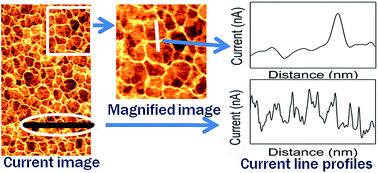
The current images of carbon films are obtained by scanning over 1 μm × 1 μm through conductive tip of AFM. In Fig. 4, the images of carbon films, prepared as function of power density, are shown as (a)–(d), corresponding to 5 W cm−2, 10 W cm−2, 15 W cm−2 and 20 W cm−2 (at fixed 4.5 mTorr pressure) respectively. Similarly, the images of the films, deposited as function of pressure, are shown as (e)–(g), representing the 2.5 mTorr, 6.5 mTorr and 8.5 mTorr pressure (at fixed 20 W cm−2 power density) respectively in Fig. 4. The film growth process is carried out, in such a way to generate two types of contrast regions in nanometer scale. These regions, having dissimilar reflections, can be seen clearly in the Fig. 4. The dark regions represent the areas where the carbon species are joined together to form NDs. The dark areas have relatively lower current flow as compared to the bright channels. The bright areas represent the ND boundaries and exhibit the relatively higher current flow zones. The difference of conductivity between the internal areas and boundaries of NDs is attributed to difference of π electron density. This concept is explained by drawing a schematic diagram, representing the variation of π electron density on film surface and is shown as (h) in Fig. 4. The grey spheres illustrate the NDs and blue dots represent the π electrons (responsible for conductivity). The difference in conductivity is further explained by selecting the two adjacent NDs (white dotted squares), and plotting the current flow against the distance for 2.5 and 8.5 mTorr pressure at fixed power density (20 W cm−2), and are shows as (i) and (j) respectively. Both the graphs show wavy lines, each having single large peak corresponding to higher current flow across the area between NDs (bright region). The wavy lines (without large peaks) represent the internal area of ND surface (dark region).
The line profile of current on the surface of the film is observed as function of pressure and shown, as (a) and (b) referring to 2.5 mTorr and 8.5 mTorr (at fixed 20 W cm−2 power density) respectively, in Fig. 5. A variation in current is observed as the tip of C-AFM passes across the surface of carbon film (1 μm length). This variation is centered about a mean value and can be divided into lower and higher current values, corresponding to the contrast regions (dark and bright) as mentioned earlier. The lower peaks correspond to the centers of the NDs surface areas. These peaks are less sharp, which is due to the less variation in conductivity at central areas. As the tip moves towards the boundaries, then near the edges of these NDs, the variation in conductivity starts increasing and sharp peaks appear. The sharp peaks, above the mean line, show the rapid change in conductivity and also exhibit the smaller areas between NDs.
The mean current flow across the film surface as measured by C-AFM varies between the nA to μA. A directly proportional relationship exists between the amount of current flow and power density. However, the current flow decreases upon increasing pressure (Fig. 6). The maximum current flow value (0.426 μA) is observed for 20 W cm−2 and 2.5 mTorr (the highest power density and the lowest pressure in this study). The dependence of surface conductivity of carbons films, upon power density and pressure, is attributed to the number of sp2 hybridized carbon atoms and is in accordance with the 4-point probe observations.
![]() | ||
| Fig. 6 Mean current variation probed through conductive tip of AFM as a function of, power density (at fixed 4.5 mTorr pressure) and pressure (at fixed 20 W cm−2 power density). | ||
The diamond like carbon films are mixtures of sp2 and sp3 hybridized carbon atoms. The electrical conductivity of carbon films as reported by many researchers9,25,26 depends upon the amount of sp2 bonds. The sp2 hybridization process, in materials fabrication, is originated from the combination of 1s and two p (px and py) orbitals. The pz orbital does not take part in hybridization and is perpendicular to the plane of hybrid sp2 orbitals. The additional pz orbitals of adjacent carbon atoms share their electron to make π bonds. The electrons of these bonds are known as π electrons.27 The π electrons are not tightly bound and have some freedom to move across the participating atoms and give rise to phenomenon of delocalization. The delocalized π electrons cannot exist independently. They are influenced by the adjacent π bonds to form benzene like conjugated system. So, each π bond has contributions due to adjacent π bonds and this provides long-range polarizabilities due to long-range forces.28 Here, it should be noted that all the samples were kept in identical conditions (in isolated vacuum boxes) between the sample preparation and surface conductivity testing duration. The reproducibility of C-AFM measurements were checked in back and forth mode and found satisfactory to distinguish the noise (as background) and signal (as information) level. The effect of atmospheric exposure in properties of carbon films e.g. surface energy, wettability, resistivity, and sp2 bonding, is extensively investigated and submitted elsewhere.
The sp2 hybridized carbon atoms, forming π bonds, are distributed on the surface of carbon films. The distribution of the sp2 hybridized carbon atoms, on the surface of the NDs, occurs in a narrow range of variation. This is evidenced by the mean current flow data. A little variation in current flow is observed upon moving the conductive tip on the ND surface. A higher current flow, observed at the boundaries as compared to the internal areas of the NDs, exhibits that an enhancement in density of charge transport species occurs at the boundaries. The higher current flow at the boundaries is attributed to the difference of conjugation due to π electrons of sp2 hybridized carbon atoms at the internal areas and boundaries of NDs. At the boundaries, the conjugation is higher due to higher electron density and additional conjugations are contributed from the sp2 hybridized carbon atoms of the neighbouring NDs. So, there is relatively higher density of π electrons at the boundaries to enhance the conductivity. At the ND boundaries, a nano-interface exists where a rapid change in current flow gives the evidences about the existence of enhanced conjugation.
| This journal is © The Royal Society of Chemistry 2015 |