
Amines functionalized C60 as solid base catalysts for Knoevenagel condensation with high activity and stability

Yongbin Sun, Changyan Cao*, Peipei Huang, Shuliang Yang and Weiguo Song*
CAS Key Laboratory of Molecular Nanostructures and Nanotechnology, Institute of Chemistry, Chinese Academy of Sciences, Beijing 100190, China. E-mail: cycao@iccas.ac.cn; wsong@iccas.ac.cn; Fax: +86-10-62557908; Tel: +86-10-62557908

Received 10th August 2015 , Accepted 5th October 2015

First published on 6th October 2015


Abstract

Four kinds of amines functionalized C60 were prepared through an amination reaction of C60 with organic amines. Their surface structures and basic properties were studied by Fourier transform infrared spectrometry (FTIR), X-ray photoelectron spectroscopy (XPS) and temperature-programmed desorption (TPD) with CO2 as the probe molecule. When used as solid base catalysts, N-aminoethylpiperazine functionalized C60 (C60-AEP) showed the best catalytic activity in the Knoevenagel condensation reaction due to the highest basic strength. In addition, the C60-AEP catalyst also showed impressive catalytic stability. All these features endowed C60-AEP with characteristics of both homogeneous and heterogeneous catalysts. More interestingly, chiral L-lysine functionalized C60 (C60-L-L) can be used for asymmetric intermolecular aldol reactions.

1. Introduction

Basic-type catalysts play a decisive role in a large number of chemical processes.1 Various solid base catalytic systems have been developed in the literature, such as layered double hydroxides,2 zeolites,3 oxides,4 porous metal–carboxylates,5 graphene based materials,6 carbon nitride,7 and so on. Typically, organic bases immobilized on different supports, for example, amino-grafting onto silica (NH2-SiO2)8 and amino-grafting onto metal–organic frameworks (NH2-MOF),9 have been actively investigated due to their unique textural and physicochemical properties. However, most of these solid base catalysts suffer from deactivation due to the instability of the supports, or their preparation methods are complicated.10 It is very desirable to develop a convenient and effective route to prepare highly active and stable heterogeneous base catalysts.

Compared to silica, zeolite and MOF, carbon-based materials are more suitable as supports for amino grafting due to their chemical stability. The most common carbon supports are carbon nanotubes and graphene. Fullerenes are also one kind of carbon materials, which are aromatic molecules containing double bonds, so they can undergo a wide variety of reactions characteristic of alkenes.11 Over the last two decades, a great diversity of reactions had been developed to functionalize C60 or C70 for organic reactions.12 Recently, our group reported that C60 fullerenol, a simple derivative of C60, was an outstanding catalyst for Henry reaction, aldol reaction and the cycloaddition between CO2 and epoxides.13 We envision that the amines functionalized C60 may also be used as effective heterogeneous base catalysts.

In this manuscript, we report four kinds of amines functionalized C60 through simple amination reaction of C60 with organic amines. Fourier transform infrared spectrometer (FTIR), X-ray photoelectron spectroscopy (XPS) and elemental analysis indicated the presence of abundant amine groups. When used as solid base catalysts, they showed excellent catalytic activity and stability in Knoevenagel condensation reaction. More interesting, chiral L-lysine functionalized C60 can be used for asymmetric intermolecular aldol reactions.

2. Experimental section

2.1 Materials

All solvents were purchased from Sinopharm Chemical Reagent Beijing Co., Ltd. Organic amines were purchased from Adama's Reagent Co., Ltd. C60 was purchased from Suzhou Dade Carbon Nanotechnology Co., Ltd. All the reagents used for Knoevenagel Condensation reaction were purchased from Alfa Aesar. All the reagents were used without further purification.

2.2 Catalyst preparation

The ethanediamine (EDA) functionalized C60 were synthesized by following the reported procedure.14 200 mg of C60 (2.8 mmol) was added into a round bottom flask which contained 6 mL of ethanediamine, the mixture was stirred at 50 °C for 24 h, then 20 mL of toluene was added, the solid was collected by centrifugation, and washed three times with tetrahydrofuran. The product was dried at 60 °C for 12 h. The N-aminoethylpiperazine (AEP) functionalized C60 and diethylenetriamine (DETA) functionalized C60 were prepared in the same way except that the N-aminoethylpiperazine or diethylenetriamine was used instead of ethanediamine. The synthesis of L-lysine (L-L) functionalized C60 was different as L-lysine was not liquid and there was acid site in it. The preparation method was as follows. 108 mg of C60 (0.15 mmol) was dissolved in 50 mL of toluene, 500 mg of L-lysine (25 equiv.) and 150 mg of NaOH (25 equiv.) was added, the mixture was stirred at 110 °C for 6 h, and the toluene became colorless. After that, the toluene was removed, and the residue solid was dissolved with water, and precipitated by adding 5 times volume ethanol. This process repeated 5 times. The product was dried at 60 °C for 12 h. The N-aminoethylpiperazine functionalized carbon nanotube was prepared in the similar method with that of C60. 100 mg of multi-wall carbon nanotube or few-wall carbon nanotube was added into a round bottom flask which contained 6 mL of N-aminoethylpiperazine. The mixture was stirred at 50 °C for 72 h, after that 20 mL of toluene was added. The solid was collected by centrifugation, and washed three times with tetrahydrofuran. The product was dried at 60 °C for 12 h.

2.3 Catalyst characterizations

X-ray diffraction (XRD) pattern was recorded on a Rigaku model D/MAX-2500V system (Cu Kα radiation) at 40 kV and 200 mA. Fourier transform infrared spectrum was performed on a TENSOR-27 type infrared spectrometer. X-ray photoelectron spectroscopy data were obtained with an ESCALab220i-XL electron spectrometer from VG Scientific using 300 W Al Kα radiation. Elemental analysis was carried out on a Flash EA 1112 type elemental analyzer. Thermogravimetric (TG) analysis was conducted on a SHIMADZU DTG-60 thermogravimetric analyzer. Temperature-programmed desorption (TPD) experiments were carried out on a Micromeritics Auto Chem II 2920 type instrument. Circular dichroism (CD) spectrophotometry was collected on a J815 type spectropolarimeter.

2.4 Catalytic activity test

2.4.1 Knoevenagel condensation reaction. Benzaldehyde (1.0 mmol), ethyl isocyanoacetate (1.2 mmol), para-xylene (1 mmol, as internal standard), ethanol (3 mL) and catalyst (30 mg) were added into a glass reactor. The temperature was kept at 60 °C. The products were analyzed by GC (SHIMADZU, GC-2010 Plus) and GC-MS (SHIMADZU, GCMS-QP2010s). To study the reusability of the catalyst, the catalyst was washed one time with ethanol before next cycle.
2.4.2 Asymmetric aldol reaction. 4-Nitrobenzaldehyde (0.5 mmol), cyclohexanone (3.0 mmol) and catalyst (100 mg of C60-L-L) were added into a glass reactor which contained 1 mL of water. The mixture was stirred at room temperature for stated time. Ethyl acetate was then added, and the organic solvent was evaporated under vacuum. The crude aldol product was purified by silica-gel column chromatography. The ee value of the aldol product was determined by chiral-phase HPLC (SHIMADZU, LC-15C) analysis.

3. Results and discussion

As shown in Scheme 1, four kinds of amines functionalized C60 were prepared through amination reaction of C60 with N-aminoethylpiperazine (AEP), diethylenetriamine (DETA), ethanediamine (EDA) and L-lysine (L-L). The corresponding products were denoted as C60-AEP, C60-DETA, C60-EDA and C60-L-L, respectively. During the amination reaction, organic amines acted as nucleophilic reagents reacted with C60 to obtain the respective amine functionalized C60 according to the literatures.14 The amines functionalized C60 were multi-addition products, and elemental analysis was difficult to reconcile with rational formulae.14 The average number of organic amines attached to one C60 molecule was determined by the mass ratio of carbon and nitrogen, and the results were listed in Table S1 (ESI).
image file: c5ra16011a-s1.tif
Scheme 1 Preparation of amines functionalized C60.

X-ray diffraction analyses showed that C60 was crystalline, but amines functionalized C60 were amorphous (Fig. S1). It meant that the crystal structure of C60 was destroyed after nucleophilic addition, and the products were not physical mixture of C60 and organic amines. In order to confirm that organic amines were attached onto C60, Fourier transform infrared spectrometer (FTIR) analyses were conducted (Fig. 1). The bands at around 3400 cm−1 and 1630 cm−1, 2920 cm−1 and 1460 cm−1, 1110 cm−1 and 1040 cm−1 can be assigned to amine groups (–NH–),15 alkyl groups (–CH2–)16 and C–N groups,14 respectively. The spectrum of C60-L-L showed a COO peak at 1580 cm−1, suggesting the existence of L-lysine.16 These peaks cannot be found in the spectrum of C60 (Fig. S2), it indicates the presence of organic amines.


image file: c5ra16011a-f1.tif
Fig. 1 FTIR spectra of amines functionalized C60.

X-ray photoelectron spectroscopy was further used to characterize the nitrogen forms in amines functionalized C60. The spectra (Fig. 2) showed a small difference among these samples, indicating the chemical environments of nitrogen in these samples were different. The peak with a binding energy at around 398.8 eV could be assigned to amine.17 C60-EDA exhibited the lowest binding energy (398.6 eV), C60-AEP and C60-DETA showed a slightly higher value (398.8 eV), which could be attributed to the influence of alkyl groups. C60-L-L showed the highest value among these samples (398.9 eV), which may be due to the electron withdrawing effect of carboxyl group. All these results indicated that organic amines were successfully attached to C60. The C1s spectra of C60 before and after the functionalization were nearly the same, which meant the electron structure of C was not changed greatly (Fig. S3). C60 might act as a carrier for organic amines.


image file: c5ra16011a-f2.tif
Fig. 2 XPS spectra of the N1s of amines functionalized C60.

The thermal stability of amines functionalized C60 was analysed by thermogravimetric analysis. As shown in Fig. 3a, the weight loss profiles of C60-AEP, C60-DETA and C60-EDA were similar. They all displayed a rapid weight loss at around 175 °C, which can be attributed to the decomposition of amines functionalized C60. This result also indicated that amines functionalized C60 were thermally stable at below 170 °C, ensuing their applications in a variety of catalytic reactions.


image file: c5ra16011a-f3.tif
Fig. 3 (a) TG curves and (b) carbon dioxide TPD spectra of amines functionalized C60.

In order to test the basicity of amines functionalized C60 catalysts, temperature-programmed desorption with CO2 as probe molecule was conducted. As shown in Fig. 3b, CO2 desorption bands were observed between 100 °C and 250 °C for all amines functionalized C60 catalysts. C60-AEP displayed two bands concentrated at 147 °C and 206 °C, corresponding to secondary amines and tertiary amines, respectively. While the maximum desorption temperature for C60-DETA, C60-EDA and C60-L-L were 140 °C, 157 °C and 167 °C, respectively. Typically, the desorption temperature is an indication of the basic site strength.18 Higher desorption temperature suggests stronger basicity. Therefore, C60-AEP exhibited the highest basicity among these four kinds of amines functionalized C60 catalysts, which was in agreement with the total amounts of adsorbed CO2 (Table S2).

Organic amines as non-ionic bases can be the catalysts for many reactions, such as esterification reaction,19 Baylis–Hillman reaction,20 aldol reaction,21 Knoevenagel condensation, and Henry reaction.22 The amines functionalized C60 have amine groups, which are similar to organic amines. We expect that they would be advantageous for catalysis. Knoevenagel condensation of benzaldehyde and ethyl cyanoacetate was then chosen as model reaction for testing their catalytic activities. As shown in Table 1, high yields were obtained when DMF and ethanol were used as solvents (Table 1, entries 1–6). Polar solvent was favorable for the reaction, so ethanol was used as solvent in the following reactions. Four kinds of amines functionalized C60 showed different catalytic activity under the same condition. C60-AEP and C60-EDA exhibited the highest catalytic activity (Table 1, entries 6 and 8), while C60-L-L showed the lowest activity (Table 1, entry 9). The catalytic activity results were consistent with their basic density.

Table 1 Catalytic activity of amines functionalized C60 for Knoevenagel condensation in different solventsa

image file: c5ra16011a-u1.tif

Entry Solvent Catalyst Yield (%)
a Reaction conditions: amines functionalized C60 (30 mg), benzaldehyde (1.0 mmol), ethyl cyanoacetate (1.2 mmol), solvent (3 mL), 60 °C, 1 h.
1 THF C60-AEP 11
2 DMF C60-AEP 97
3 Toluene C60-AEP 13
4 Acetonitrile C60-AEP 27
5 Isopropanol C60-AEP 79
6 Ethanol C60-AEP 99
7 Ethanol C60-DETA 95
8 Ethanol C60-EDA 99
9 Ethanol C60-L-L 78


Knoevenagel condensation between various aldehyde derivatives and ethyl cyanoacetates were tested. As shown in Table 2, excellent yields were obtained with C60-AEP as catalyst when benzaldehyde derivatives reacted with ethyl cyanoacetate (Table 2, entries 1–4). For cyclohexanone derivatives (Table 2, entries 5–6), alkyl aldehyde (Table 2, entry 7) and alkenyl aldehyde (Table 2, entry 8), C60-AEP also showed high activity. In addition, other kinds of substrates such as dimethyl malonate and 2,4-pentanedione could be activated as well (Table 2, entries 9–10).

Table 2 Knoevenagel condensation with C60-AEP as the catalysta
Entry Reagent Reagent Product Time (h) Yield (%)
a Reaction conditions: C60-AEP (30 mg), aldehyde (1.0 mmol), ethyl cyanoacetate (1.2 mmol, entries 1–8), dimethyl malonate (2.0 mmol, entry 9), diacetone (2.0 mmol, entry 10), ethanol (3.0 mL), 60 °C.
1 image file: c5ra16011a-u2.tif image file: c5ra16011a-u3.tif image file: c5ra16011a-u4.tif 1 98
2 image file: c5ra16011a-u5.tif image file: c5ra16011a-u6.tif image file: c5ra16011a-u7.tif 1 99
3 image file: c5ra16011a-u8.tif image file: c5ra16011a-u9.tif image file: c5ra16011a-u10.tif 2 99
4 image file: c5ra16011a-u11.tif image file: c5ra16011a-u12.tif image file: c5ra16011a-u13.tif 1 98
5 image file: c5ra16011a-u14.tif image file: c5ra16011a-u15.tif image file: c5ra16011a-u16.tif 1 93
6 image file: c5ra16011a-u17.tif image file: c5ra16011a-u18.tif image file: c5ra16011a-u19.tif 1 94
7 image file: c5ra16011a-u20.tif image file: c5ra16011a-u21.tif image file: c5ra16011a-u22.tif 1 97
8 image file: c5ra16011a-u23.tif image file: c5ra16011a-u24.tif image file: c5ra16011a-u25.tif 1 99
9 image file: c5ra16011a-u26.tif image file: c5ra16011a-u27.tif image file: c5ra16011a-u28.tif 10 87
10 image file: c5ra16011a-u29.tif image file: c5ra16011a-u30.tif image file: c5ra16011a-u31.tif 10 85


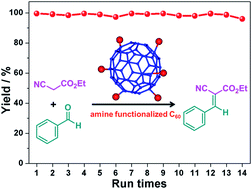
The impressive tolerance of functional groups and the excellent catalytic activity shown in Table 2 confirmed that C60-AEP was a highly active and effective catalyst for Knoevenagel condensation. In addition, due to the insolubility of C60-AEP in ethanol, C60-AEP can be separated easily from the reaction solution through centrifugation. As shown in Fig. 4, no obvious decrease of yield was observed after 14 cycles, indicating the catalyst was very stable. FTIR spectrum of C60-AEP after being used for 14 times was nearly the same as that of the fresh one (Fig. S4).


image file: c5ra16011a-f4.tif
Fig. 4 Cycle performance of the prepared C60-AEP catalyst.

With abundant amine groups, C60-AEP was dispersed well in reaction system and it showed high activity like homogeneous catalyst. At the same time, due to the insolubility of C60-AEP in ethanol, it can be recycled as heterogeneous catalyst. These two features enabled C60-AEP with characteristics of both homogeneous and heterogeneous catalyst.

The amines functionalized C60 fullerene can be advantageous for catalysis, we think that carbon nanotube may also work. The catalytic activity of N-aminoethylpiperazine functionalized few-wall carbon nanotube was higher than that of multi-wall carbon nanotube, however, all the yields were low. Elemental analysis showed that the nitrogen content in N-aminoethylpiperazine functionalized carbon nanotube was far lower than that of C60-AEP (Table S3). We supposed that carbon nanotube was more difficult to be functionalized by amines compared to C60 fullerene.

Amino acids have been used as catalysts for asymmetric intermolecular aldol reactions.23 L-Lysine is a chiral amino acid, we envision that L-lysine functionalized C60 (C60-L-L) may also be a chiral catalyst for asymmetric aldol reaction. In order to confirm this, circular dichroism spectrum was first conducted. The result showed C60-L-L possessed CD peaks (Fig. S5). When it was used as catalyst for asymmetric aldol reaction between cyclohexanone and 4-nitrobenzaldehyde (Scheme 2), 98% yield with ee value of 13% was obtained. Although the observed ee value was low at present, this chiral amino acid functionalized C60 may provide an effective way for preparation of heterogeneous chiral catalysts.


image file: c5ra16011a-s2.tif
Scheme 2 Asymmetric aldol reaction with C60-L-L as catalysts.

4. Conclusions

In summary, four kinds of amines functionalized C60 were prepared through an amination reaction of C60 with organic amines. When used as solid base catalysts, N-aminoethylpiperazine functionalized C60 (C60-AEP) showed best catalytic activity in Knoevenagel condensation reaction due to the highest basic strength. In addition, no obvious decrease of yield was observed after 14 times, indicating the impressive catalytic stability of C60-AEP catalyst. All these features enabled C60-AEP with characteristics of both homogeneous and heterogeneous catalyst. More interesting, chiral L-lysine functionalized C60 (C60-L-L) can be used for asymmetric intermolecular aldol reaction.

Acknowledgements

We thank the National Natural Science Foundation of China (NSFC 21273244, 21333009, and 21121063) and the Chinese Academy of Sciences (KJCX2-YW-N41) for financial support.

Notes and references

  1. (a) R. A. Sheldon, Pure Appl. Chem., 2000, 72, 1233–1246 CrossRef CAS; (b) J. Gascon, U. Aktay, M. D. Hernandez-Alonso, G. P. M. van Klink and F. Kapteijn, J. Catal., 2009, 261, 75–87 CrossRef CAS PubMed; (c) J. M. Fraile, J. I. Garcia and J. A. Mayoral, Catal. Today, 2000, 57, 3–16 CrossRef CAS; (d) Y. Ono, J. Catal., 2003, 216, 406–415 CrossRef CAS.
  2. V. R. L. Constantino and T. J. Pinnavaia, Catal. Lett., 1994, 23, 361–367 CrossRef CAS.
  3. (a) U. Meyer and W. F. Hoelderich, J. Mol. Catal. A: Chem., 1999, 142, 213–222 CrossRef CAS; (b) K. Sugino, N. Oya, N. Yoshie and M. Ogura, J. Am. Chem. Soc., 2011, 133, 20030–20032 CrossRef CAS PubMed; (c) M. N. Timofeeva, V. N. Panchenko, J. W. Jun, Z. Hasan, O. V. Kikhtyanin, I. P. Prosvirin and S. H. Jhung, Microporous Mesoporous Mater., 2013, 165, 84–91 CrossRef CAS PubMed.
  4. S.-W. Bian, Z. Ma, Z.-M. Cui, L.-S. Zhang, F. Niu and W.-G. Song, J. Phys. Chem. C, 2008, 112, 15602 CAS.
  5. V. N. Panchenko, M. M. Matrosova, J. Jeon, J. W. Jun, M. N. Timofeeva and S. H. Jhung, J. Catal., 2014, 316, 251–259 CrossRef CAS PubMed.
  6. (a) Y. Zhang, C. Chen, G. Wu, N. Guan, L. Li and J. Zhang, Chem. Commun., 2014, 50, 4305–4308 RSC; (b) S. M. Islam, A. S. Roy, R. C. Dey and S. Paul, J. Mol. Catal. A: Chem., 2014, 394, 66–73 CrossRef CAS PubMed.
  7. X. Jin, V. V. Balasubramanian, S. T. Selvan, D. P. Sawant, M. A. Chari, G. Q. Lu and A. Vinu, Angew. Chem., Int. Ed., 2009, 48, 7884–7887 CrossRef CAS PubMed.
  8. (a) D. J. Macquarrie and D. B. Jackson, Chem. Commun., 1997, 1781–1782 RSC; (b) Y. Xia and R. Mokaya, Angew. Chem., Int. Ed., 2003, 42, 2639–2644 CrossRef CAS PubMed; (c) X. F. Zhang, E. S. M. Lai, R. Martin-Aranda and K. L. Yeung, Appl. Catal., A, 2004, 261, 109–118 CrossRef CAS PubMed.
  9. (a) S. Hasegawa, S. Horike, R. Matsuda, S. Furukawa, K. Mochizuki, Y. Kinoshita and S. Kitagawa, J. Am. Chem. Soc., 2007, 129, 2607–2614 CrossRef CAS PubMed; (b) Q. Fang, S. Gu, J. Zheng, Z. Zhuang, S. Qiu and Y. Yan, Angew. Chem., Int. Ed., 2014, 53, 2878–2882 CrossRef CAS PubMed.
  10. (a) S. van Dommele, K. P. de Jong and J. H. Bitter, Chem. Commun., 2006, 4859–4861 RSC; (b) J.-P. Tessonnier, A. Villa, O. Majoulet, D. S. Su and R. Schloegl, Angew. Chem., Int. Ed., 2009, 48, 6543–6546 CrossRef CAS PubMed; (c) C. Yuan, W. Chen and L. Yan, J. Mater. Chem., 2012, 22, 7456–7460 RSC.
  11. R. Taylor and D. R. M. Walton, Nature, 1993, 363, 685–693 CrossRef CAS PubMed.
  12. (a) J. F. Nierengarten, New J. Chem., 2004, 28, 1177–1191 RSC; (b) J. L. Segura, N. Martin and D. M. Guldi, Chem. Soc. Rev., 2005, 34, 31–47 RSC; (c) M. D. Tzirakis and M. Orfanopoulos, Chem. Rev., 2013, 113, 5262–5321 CrossRef CAS PubMed.
  13. (a) F. Niu, J. Wu, L. Zhang, P. Li, J. Zhu, Z. Wu, C. Wang and W. Song, ACS Catal., 2011, 1, 1158–1161 CrossRef CAS; (b) Y.-B. Sun, C.-Y. Cao, S.-L. Yang, P.-P. Huang, C.-R. Wang and W.-G. Song, Chem. Commun., 2014, 50, 10307–10310 RSC.
  14. F. Wudl, A. Hirsch, K. C. Khemani, T. Suzuki, P. M. Allemand, A. Koch, H. Eckert, G. Srdanov and H. M. Webb, ACS Symp. Ser., 1992, 481, 161–175 CrossRef CAS PubMed.
  15. A. Pielesz and A. Wlochowicz, Spectrochim. Acta, Part A, 2001, 57, 2637–2646 CrossRef CAS.
  16. R. M. F. Lima, P. R. G. Brandao and A. E. C. Peres, Miner. Eng., 2005, 18, 267–273 CrossRef CAS PubMed.
  17. (a) S. R. Kelemen, M. Afeworki, M. L. Gorbaty, P. J. Kwiatek, M. S. Solum, J. Z. Hu and R. J. Pugmire, Energy Fuels, 2002, 16, 1507–1515 CrossRef CAS; (b) P. Nowicki, R. Pietrzak and H. Wachowska, Energy Fuels, 2010, 24, 1197–1206 CrossRef CAS.
  18. (a) S. K. Bej, C. A. Bennett and L. T. Thompson, Appl. Catal., A, 2003, 250, 197–208 CrossRef CAS; (b) H. Y. Huang, R. T. Yang, D. Chinn and C. L. Munson, Ind. Eng. Chem. Res., 2003, 42, 2427–2433 CrossRef CAS; (c) M. C. G. Albuquerque, I. Jimenez-Urbistondo, J. Santamaria-Gonzalez, J. M. Merida-Robles, R. Moreno-Tost, E. Rodriguez-Castellon, A. Jimenez-Lopez, D. C. S. Azevedo, C. L. Cavalcante Jr and P. Maireles-Torres, Appl. Catal., A, 2008, 334, 35–43 CrossRef CAS PubMed.
  19. F. Jerome, G. Kharchafi, I. Adam and J. Barrault, Green Chem., 2004, 6, 72–74 RSC.
  20. (a) L. J. Brzezinski, S. Rafel and J. W. Leahy, J. Am. Chem. Soc., 1997, 119, 4317–4318 CrossRef CAS; (b) V. K. Aggarwal and A. Mereu, Chem. Commun., 1999, 2311–2312 RSC.
  21. Y. Hayashi, T. Sumiya, J. Takahashi, H. Gotoh, T. Urushima and M. Shoji, Angew. Chem., Int. Ed., 2006, 45, 958–961 CrossRef CAS PubMed.
  22. J. Han, Y. Xu, Y. Su, X. She and X. Pan, Catal. Commun., 2008, 9, 2077–2079 CrossRef CAS PubMed.
  23. (a) B. List, R. A. Lerner and C. F. Barbas, J. Am. Chem. Soc., 2000, 122, 2395–2396 CrossRef CAS; (b) A. Cordova, W. B. Zou, I. Ibrahem, E. Reyes, M. Engqvist and W. W. Liao, Chem. Commun., 2005, 3586–3588 RSC.

Footnote

Electronic supplementary information (ESI) available: Experimental details, XRD analysis, elemental analysis, FT-IR spectra of C60-AEP after being reused 14 times, CD spectrum of C60-L-L and CO2 TPD analysis. See DOI: 10.1039/c5ra16011a

This journal is © The Royal Society of Chemistry 2015
Click here to see how this site uses Cookies. View our privacy policy here.