Weiwei Ding,
Yinghong Chen*,
Zhuo Liu and
Sen Yang
State Key Laboratory of Polymer Materials Engineering, Polymer Research Institute, Sichuan University, Chengdu 610065, China. E-mail: johnchen@scu.edu.cn; Fax: +86 28 85402465; Tel: +86 28 85405136
First published on 26th October 2015
In this paper, the microinjection molding (μIM) of poly(lactic acid) (PLA)/poly(ε-caprolactone) (PCL) blend as well as a full comparison with the conventional injection molding (CIM) was carried out. The prepared PLA/PCL blend micropart and macropart were characterized by using various measurements. The results showed that μIM and CIM have a significantly different influence on the structure and performance of the PLA/PCL blend. μIM leads to a remarkable reduction in the domain size of PCL dispersed phase to the nanometer range, improvement in interfacial compatibility and narrower domain size distribution. Very interestingly, there are PCL nano fibrils in situ formed and oriented along the melt flow direction in the μIM micropart, i.e. the occurrence of an in situ PCL nano-fibrillation phenomenon. Comparatively, only PCL micro fibrils are formed in the CIM macropart, i.e. the occurrence of PCL micro-fibrillation. For both micropart and macropart, the shear layer shows much higher degrees of PCL nano/micro-fibrillation and orientation than the core layer. Compared with the macropart, the micropart exhibits increased PCL crystallinity and remarkably enhanced PLA crystallization capability. μIM also leads to a higher PLA degradation degree than CIM. In addition, the PLA/PCL blend micropart shows much higher mechanical performance and much more obvious double yielding phenomenon than the macropart.
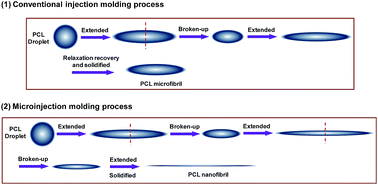
The current study on microinjection molding technology in literatures was mainly focused on mold structure optimization,7–9 melt flowing and filling behavior in the micro-flow channel,10–13 process parameters,14 apparent quality and microstructure of micropart,15–19 etc. However, the investigations of the properties (especially mechanical performance) of microinjection molding products are relatively less involved, which is possibly related to the too small dimension of the microparts. Below are several examples.20–22 Huang et al.20 prepared polypropylene (PP) products with thickness of 0.7 mm (μ-PP) and 3.5 mm (m-PP) through microinjection molding and conventional injection molding, respectively. The results showed that compared with m-PP products, tensile strength and storage modulus (40 °C) of μ-PP increases by 67% and 48% respectively. Pan et al.21 compared the structure distribution and tensile property of microinjection molded and conventional injection molded isotactic polypropylene. The results showed that microparts have higher orientation degree and crystallinity as compared to macroparts, resulting in the remarkably enhanced tensile strength and modulus (e.g. increasing from 35.8 and 240 MPa for macroparts to 46.5 and 1540 MPa for microparts, respectively). Lin et al.22 analyzed the yield strength and elongation at break of the microinjection molded HDPE samples and found that increasing the injection rate, elevating mold temperature and prolonging cooling time can increase the yield strength of HDPE.
Relative to conventional injection molding (CIM), the melt in microinjection molding (μIM) shows larger shear rate, temperature gradient and quicker cooling rate, which could make the μIM products exhibit unique morphology different from the CIM products. This would necessarily affect the mechanical properties of the microparts.17,23,24 This paper will deal with the microinjection molding problem of PLA/PCL blend system and make a comparison with conventional injection molding. As is well known, poly(lactic acid) (PLA) is a biodegradable aliphatic polyester and is derived from the natural material such as potato, corn, etc. As one of the environmental friendly biodegradable polymers, PLA exhibits excellent mechanical properties (can be comparable to PS, PC, etc.), good formability, fast degradation rates and good biocompatibility,25 which promote its applications in drug delivery system, absorbable surgical suture, tissue engineering scaffold and biomedical microdevice.26–28 However, the characteristics of low crystallinity and rigid structural skeleton29 and the existence of tertiary carbon atoms would result in brittleness, poor heat resistance and easy decomposition of PLA during processing,30,31 which greatly limits its more broad application. As a result, copolymerization or blend of PLA with a tough polymer is an effective approach to improve its toughness.32 As we know, poly(ε-caprolactone) (PCL) is also a biodegradable and biocompatible polyester with excellent flexibility and formability, but its insufficient strength and high cost are still the factors hindering its wider applications.33 So, melt blending of PLA with flexible PCL to achieve the performance complementarity is one of the most cost-effective approaches to expand their application fields. Because of this, in recent years, there is much work on PLA/PCL blend carried out.34–39 For example, Jen-Taut Yeh et al.35 found that PCL promoted the crystallization of PLA as a nucleating agent and also played a toughening role for PLA. Semba et al.36 conducted cross-linking of PLA/PCL blends and found strong interfacial interactions formed between the PLA and PCL phase, resulting in the increase of elongation at break. Bai et al.38 utilized a nucleating agent to tailor the crystallization of PLLA in the blend of PLLA/PCL (80/20) and got a wide range of matrix crystallinity (10–50%) by altering the nucleating agent concentrations and mold temperatures. However, in the publications related to PLA/PCL blend, there is no research conducted on microinjection molding of PLA/PCL blend. So, it would be of great interest to investigate the microinjection molded PLA/PCL blend system.
In this paper, PLA/PCL blends were accordingly prepared and are used for the microinjection molding processing. In general, the morphology and thermal behavior of semicrystalline materials strongly affect their mechanical properties. As a result, the variations in phase morphology, crystallization and tensile property of PLA/PCL blends under microinjection molding conditions were investigated. In addition, the comparisons of the morphology and structure evolution between μIM micropart and CIM macropart were also carried out by means of SEM, DSC and WAXD characterizations. Very interestingly, there are nano PCL fibrils in situ formed during microinjection molding process, which is for the first time reported by us. The formation of PCL nanofibrils is beneficial to the high performance of PLA/PCL blend.
000) with the melting temperature of about 60 °C and glass transition temperature of about −60 °C was supplied by Shenzhen Brightchina Industrial Co. (China). The used 1 wt% sodium hydroxide (NaOH) solution was self-formulated.
In order to avoid the hydrolysis of raw material induced by water absorption during processing, the PLA and PCL pellets were dried under vacuum at 40 °C for 24 hours. The dried PLA and PCL pellets with a weight ratio of 80/20 were first mixed in a high-speed mixer and then extruded in a TSSJ-25/33 twin-screw extruder (ϕ = 25 mm, L/D = 33, Chenguang Research Institute of Chemical Industry, China) with a screw rotation speed of 80 rpm at 175 °C. The cooled extrudates were cut into pellets and then dried under vacuum at 40 °C for 24 hours. Finally, the dried PLA/PCL blend pellets were injection-molded into microparts and macroparts at melt temperature of 180 °C and mold temperature of 40 °C by using a MicroPower5 microinjection molding machine (Wittmann Battenfeld GmbH, Austria)15 and K-TEC 40 conventional injection molding machine (Terromatik Milacron Corporation, USA), respectively. Fig. 1(a–c) show the dimension and geometry of the micropart and macropart, respectively. To evaluate the tensile property of PLA/PCL microparts, the dumbbell-shaped microparts were used and the corresponding dimension and geometry are shown in Fig. 1(d).
![]() | (1) |
![]() | (2) |
Fig. 2 shows the SEM photos of the core layer at the fractured surface (along perpendicular to the melt flow direction) of PLA/PCL blend samples prepared by conventional injection molding (a) and microinjection molding (b). The schematic diagrams show the distribution of PCL dispersed phases in PLA matrix. Fig. 3 compares the domain size distribution of PCL dispersed phase in macropart (a) and micropart (b) of PLA/PCL blends. It is interestingly found that there are substantial differences in the PCL dispersed phase morphology between conventional injection molded macropart and microinjection molded micropart. For macropart, almost all of the PCL dispersed phase exist in ellipsoid or sphere state in the cross-section direction. There are the obvious interfacial gaps between PCL particles and PLA matrix, indicating the poor interfacial compatibility. The domain size of PCL dispersed phase is in the range of 0.35–2.0 μm (averaged 0.76 μm). In addition, these PCL dispersed phases are unevenly distributed in PLA matrix. Comparatively, for micropart, the domain size of PCL dispersed phase is remarkably decreased and the size distribution becomes much narrower (most PCL dispersed phases are in the range of 50–250 nm and the averaged size is about 110 nm, where ∼42% is in the nanometer range and ∼53% is close to nanometer range), showing the great improvement in both the interfacial compatibility and the PCL dispersed phase dispersion. According to the subsequent SEM results of PCL dispersed phase along the melt flow direction, the PCL domain size is actually the diameter of the in situ formed PCL fibrils.
![]() | ||
| Fig. 2 SEM micrographs and schematic diagrams of the core layer at the fractured surface of PLA/PCL (80/20) blend macropart (a and a′) and micropart (b and b′) along cross-section direction. | ||
![]() | ||
| Fig. 3 The size distribution of PCL dispersed phase in PLA/PCL (80/20) blend macropart (a) and micropart (b). | ||
Fig. 4 shows the SEM micrographs of the fractured surface (along the melt flow direction) of PLA/PCL (80/20) blend macropart and micropart, where Fig. 4(a) and (b) show the morphology images of shear layer and core layer of macropart, respectively; Fig. 4(c)–(e) show the morphology images of shear layer, core layer and the half fractured surface of micropart, respectively. As can be seen, in both macropart and micropart samples, at the fractured surface along the melt flow direction, there are skin–core structures appearing as skin layer, shear layer and core layer accordingly. In the shear and core layer regions of both samples, there are equally the orientation structures formed along the melt flow direction. For macropart, the spherical and elongated ellipse shape structures appear in the core layer, while the fibrillar structures oriented along the flow direction emerge in the shear layer. After measurement, the diameter of the fibrils in shear layer is in the range of 0.32–1.8 μm, which is consistent with the previous domain size result in cross-section direction (Fig. 2(a)). What is different from the macropart is that in micropart the PCL in situ nano-fibrillation phenomenon occurs in the almost whole micropart fractured surface (many PCL nanofibril structures appear in the shear layer and core layer except for skin layer) along the melt flow direction. After measurement, the diameter of the fibrils in shear layer is in the range of 48–220 nm, which is also in agreement with the previous domain size result (Fig. 2(b)). Comparatively, the in situ nano-fibrillation phenomenon in the shear layer is more remarkable and almost all the PCL dispersed phase particles are elongated into fibrils due to presence of the strongest shear force field there. This is because the shear layer of micropart is close to the mold cavity wall, which receives the greater shear force field. Accordingly, the low viscosity PCL (the viscosity of PCL at the processing temperature is much lower than that of PLA, indicating a high viscosity ratio) dispersed phase under the enhanced shear force field is more easily elongated into fibrils due to the interfacial tension.43
In order to further confirm above results and more clearly observe the morphology evolution of the PCL phase, we applied the NaOH solution to remove part of the PLA phase. Fig. 5 shows the SEM micrographs and schematic diagrams of the etched fractured surface of PLA/PCL (80/20) macropart and micropart samples along the melt flow direction. Comparing Fig. 5(a) and (b), it is seen that in macropart sample the PCL dispersed phases exhibit the oriented fibrillar structures in shear layer and the less oriented spherical and ellipse shape structures in core layer. However, in micropart sample, it is very clear that there are the fibrils occurring in both shear layer and core layer. Relative to core layer, the formation and orientation of nanofibrils in shear layer is more significant. In shear layer, there are much more number of well-defined nanofibrils highly oriented along the melt flow direction. Comparatively, in the core layer, there are the relatively less number of well-defined nanofibrils oriented along the melt flow direction and the orientation degree is obviously reduced. The reason for the less orientation in core layer can be explained by the rheology existing in the polymer microinjection molding. As we know, for a polymer injection molding process, when the polymer melt is injected into a mold cavity, there is a shear rate distribution generated across the cross-section of the whole mold cavity, where the shear rate located at mold cavity wall tends to be maximum and the shear rate located at mold cavity center zone tends to be minimum. As a consequence, the polymer melt near the cavity wall would receive a much higher shear stress and the polymer melt near the cavity center zone would receive a much smaller shear stress. This means that the shear stress field near the cavity wall is much stronger than the one near the cavity center zone. This would make the polymer melt near the cavity wall be extended along the melt flow direction much more easily than the one near the cavity center. On the other hand, the temperature gradient in the mold cavity also influences the orientation of polymer molecular chains. The melt temperature near the cavity center zone is much higher than the one near the cavity wall. Consequently, the stretched polymer melt near the cavity wall could be quickly solidified. However, the stretched polymer melt with viscoelasticity near the cavity center would recover to a certain degree through relaxation of molecular chains before solidification because of the still high melt temperature there, leading to the reduction in the orientation degree of polymer molecular chains. The schematic diagrams shown in Fig. 5 also demonstrate the morphology distribution of the macroparts and microparts. The results are in agreement with the findings previously obtained.
![]() | ||
| Fig. 5 The SEM micrographs and schematic diagrams of PLA/PCL (80/20) samples fractured surface etched with NaOH solution along the flow direction: macropart (a) and micropart (b). | ||
![]() | ||
| Fig. 6 The morphology evolution mechanism of PCL dispersed phase in PLA/PCL blends in microinjection molding and conventional injection molding process. | ||
To demonstrate how rapid the cooling rate is under microinjection molding and convention injection molding conditions, the temperature change in the two injection molding process during the cooling process was calculated according to the following equation:21,44
![]() | (3) |
Actually, the reasons for the PCL dispersed phase dimension of micropart being much smaller than that of macropart can also be illustrated by the research results of Guo-Hua Hu's group.45 Hu et al. found that in order to obtain a fine morphology for the blending of two immiscible polymers, the most favorable conditions should be: pellets melting/plasticization rate ≪ dispersion rate (deformation + breakup) of the polymer melt to small particles ≪ stabilization rate. Comparing conventional injection molding and microinjection molding, both have the similar pellets melting/plasticization rate. However, the latter has the much higher dispersion rate and stabilization rate than the former, because relative to conventional injection molding, microinjection molding has the much higher shear rate (much stronger dispersion effect on polymer melt droplets) and much higher cooling temperature gradient (this is helpful to the rapid solidification and stabilization of the polymer particles with reduced size due to the breakup of droplets).
| Sample | Tcc (°C) | ΔHcc (J g−1) | Tm (°C) | ΔHm (J g−1) | Xc,PLA (%) | Xc,PCL (%) | |||
|---|---|---|---|---|---|---|---|---|---|
| PLA | PLA | PLA | PCL | PLA | PCL | ||||
| Macropart | Whole part | 86.8 | 17.47 | 165.1 | 56.9 | 29.47 | 12.36 | 16.13 | 44.36 |
| Shear layer | 84.9 | 14.90 | 165.7 | 59.7 | 31.68 | 17.84 | 22.55 | 64.03 | |
| Core layer | 85.6 | 16.77 | 166.4 | 59.3 | 30.24 | 17.18 | 18.10 | 61.66 | |
| Whole micropart | 82.5 | 16.19 | 166.5 | 56.9 | 36.29 | 14.76 | 27.02 | 52.97 | |
As can be seen, in the DSC curves of all samples, there are three peaks occurring. They are PCL melting endothermic peak (57 °C), PLA cold crystallization exothermal peak (83 °C) and PLA crystallization melting endothermic peak (166 °C), respectively. Since the glass transition of PLA occurs in the temperature range of 56–63 °C, the PLA glass transition is overlapped with the PCL melting peak and the Tg of PLA cannot be identified. Comparing macropart with micropart, both have the similar PCL melting temperature, but the latter has the obviously higher crystallinity than the former (53.0% versus 44.4%). The reason for this may be that under microinjection molding conditions a relatively larger number of the formed PCL highly oriented fibrillar structures are arrayed into the crystal lattice, leading to increase in crystallinity. The cold crystallization is caused by a reorganization of macromolecular chains in the amorphous domains during the DSC heating process and the corresponding peak could reflect the crystallization capability of macromolecular chain segments to a certain degree. It is noted that, compared with macropart, micropart has the obviously lower cold crystallization peak temperature (82.5 °C versus 86.8 °C) and cold crystallization enthalpy. This indicates that the microinjection molding, on one hand, could hold back the cold crystallization of PLA in PLA/PCL blend system to a certain degree and, on the other hand, could promote the melt crystallization of PLA macromolecular chains. About results could be further verified by the significantly increased PLA crystallinity (from 16.1% to 27.0%, increased by ∼70%) and the increased PLA melting temperature (from 165.1 °C to 166.5 °C) for micropart (compared with macropart). This is possibly because under microinjection molding conditions, the much stronger shear force field is more advantageous to the formation of PLA orientation structures which can enter the crystal lattice (the flow induced crystallization or shear induced crystallization49). For macropart, the different layer shows the different crystallization and melting behavior. It is noted that both shear layer and core layer show the obviously higher PCL melting temperature than the whole part and relative to core layer, shear layer also shows the slightly higher one. This is related to the different PCL orientation degree in different layer of macropart. Since there is the stronger shear force field in shear layer than in core layer, the PCL orientation degree in shear layer would be necessarily higher than in core layer (confirmed by the previous SEM results), leading to increase in the PCL melting temperature of shear layer. On the other hand, the whole macropart contains the amorphous skin layer and this would obviously decrease the averaged PCL melting temperature, even lower than that of core layer. The order of the cold crystallization temperature for different layer of macropart is found to be whole part > core layer > shear layer. This is related to formation of the oriented PCL fibrillar structures in shear layer and the existence of amorphous structures in skin layer of the whole part. From Fig. 8 and Table 1, it is also seen that like PCL, basically the PLAs in the shear layer and core layer of blend macropart also show the higher melting temperature than the whole part. In addition, particularly for PLA in the blend, the whole micropart even exhibits a lower cold crystallization temperature and an obviously higher melting temperature and crystallinity than the oriented shear layer of macropart. Above results verify that the shear force field generated under microinjection molding conditions is really much stronger than that generated under conventional injection molding conditions and is more beneficial to formation of oriented structures.
![]() | ||
| Fig. 9 The 2D-WAXD patterns and the corresponding schematic diagrams of PLA/PCL (80/20) blends: macropart shear layer (a), micropart with rib (b) and dumbbell shaped micropart (c), of which the dimension corresponds to Fig. 1(a), (c) and (d), respectively. | ||
Fig. 10 shows the FT-IR spectra of pure PLA, pure PCL, extruded PLA/PCL blend, conventional injection molded PLA/PCL blend (macropart) and microinjection molded PLA/PCL blend (micropart). As can be seen, for pure PLA, the strong peak at 1754 cm−1 and the bands in the range of 1050–1250 cm−1 can be attributed to the stretching vibration absorption of C
O and C–O–C in the ester group, respectively. In addition, the peaks at 1360 cm−1 and 1455 cm−1 can be ascribed to the stretching vibration absorption of –CH– and –CH3 groups, respectively. For pure PCL, the peak at 1725 cm−1 is caused by the stretching vibration absorption of C
O group. The peaks at 1188 cm−1 and 1242 cm−1 are caused by the stretching vibration absorption of –C(
O)–O– group. The absorptions at 1472 cm−1 and 1295 cm−1 can be attributed to the vibration of –(CH2)5– group. The absorptions at 1367 cm−1 and 1242 cm−1 can be ascribed to the vibration of –OH group. For the extruded and injection molded PLA/PCL blend (Fig. 10(c)–(e)), due to the low PCL content, most of absorptions of PCL functional groups are hidden by the absorptions of PLA functional groups. Only the featured absorption of C
O group of PCL at 1725 cm−1 appears as a shoulder in FT-IR spectra of PLA/PCL blend. There are no obvious differences in the main absorption peaks of PLA between the three PLA/PCL blend samples prepared by different processing method. This illustrates that there is possibly no transesterification occurring between PLA and PCL during processing, which is interesting and remains the further investigation later. In addition, it is noticed that in the FT-IR spectrum of micropart, there is a new weak peak appearing at 1213 cm−1, which can be ascribed to the vibration absorption of C–O in carboxyl group. This indicates that during microinjection molding process part of PLA polymers possibly degrade to a certain degree under the shear stress field, which was confirmed by the further GPC characterization.
![]() | ||
| Fig. 10 FT-IR spectra of pure PLA (a), pure PCL (b), extruded PLA/PCL blend (c), conventional injection molded PLA/PCL blend (d) and microinjection molded PLA/PCL blend (e). | ||
Fig. 11 shows the GPC results of pure PLA, pure PCL, extruded PLA/PCL blend, PLA/PCL macropart and PLA/PCL micropart. As can be seen, PLA shows a much higher molecular weight than PCL (the latter has an obviously longer elution time). This is consistent with the material information given by the experimental part. The GPC profile of PLA/PCL blend prepared by three different processing methods is more like that of pure PLA than the simple superposition of the elution curves of PLA and PCL. This indicates that there is possibly some interaction between PLA and PCL in PLA/PCL blend, which influences the elution of PCL. In addition, it is also noticed that from pure PLA, extruded PLA/PCL blend, macropart to micropart sample, the peak of the elution curve shifts toward longer time direction, indicating a decreasing tendency in molecular weight. This means that PLA degradation occurs during processing due to the co-effects of heat and shear stress field. Because there is the different intensity in the shear stress field of different processing method, the degradation degree of PLA is also different. The intensity of the shear stress field decreases in the order of microinjection molding ≫ conventional injection molding > extrusion. So, the decreasing degree of PLA molecular weight under microinjection molding condition would be at the maximum. This is in agreement with the FT-IR result. Compared with microinjection molding, the PLA degradation occurring under the other two processing conditions would become much less and hence it is difficult for the degradation products to be detected by the IR spectrometer. This is the reason why the weak peak at 1213 cm−1 does not appear in the FT-IR spectra of extruded blend (Fig. 10(c)) and macropart sample (Fig. 10(d)).
![]() | ||
| Fig. 11 The GPC curves of pure PLA (a), pure PCL (b), extruded PLA/PCL blend (c), conventional injection molded PLA/PCL blend (d) and microinjection molded PLA/PCL blend (e). | ||
![]() | ||
| Fig. 12 The tensile strength, elongation at break and Young's modulus of conventional injection molded macropart and microinjection molded dumbbell-shaped micropart. | ||
Fig. 13 shows the tensile stress–strain curves of micropart and macropart. It can be seen that during the whole strain development process, the stress–strain curve of the dumbbell-shaped micropart is always located a lot above that of the macropart. It is very clear that the microinjection molded dumbbell-shaped micropart has the obviously higher tensile yield strength and elongation at break (toughness) than the conventional injection molded macropart. From Fig. 13, it can be also seen that the tensile stress–strain curves of both micropart and macropart show two platforms, which means a double yielding phenomenon.52,53 Meanwhile, it is noted that for pure PLA micropart, there is no such double yielding phenomenon occurring. Above results indicate that the occurrence of the double yielding phenomenon for PLA/PCL blend micropart and macropart in tensile test should be related to presence of PCL in blend. From Fig. 13, it is also seen that the double yielding of the blend micropart is much remarkable than that of the blend macropart. According to the previous SEM results shown in Fig. 4, the difference in structure between blend micropart and macropart lies in such a fact that the number and the dimension of PCL fibrillar structures in situ formed in micropart is much more and smaller than that of macropart, respectively, which can hence explain the much remarkable double yielding in micropart. As a result, it can be concluded that the double yielding phenomenon above mentioned is related to the PCL nano/micro-fibrillation occurring in blend micropart and macropart. In order to further investigate the double yielding phenomenon, the SEM observation was conducted on the fractured surface of PLA/PCL blend micropart after tensile test. The result is shown in Fig. 14. As can be seen, the tensile fractured surface of micropart is very rough and in the shear layer region, there are a lot of matrix resins drawn out. Particularly, it is noticed that a large sheet consisting of a great number of PCL fibrils is pulled out from the shear layer region upon tensile test. This can well explain the double yielding phenomenon for PLA/PCL blend micropart in tensile test.
![]() | ||
| Fig. 13 The tensile stress–strain curves of conventional injection molded macropart and microinjection molded dumbbell-shaped micropart. | ||
![]() | ||
| Fig. 14 SEM photos of the fracture surface of microinjection molded dumbbell-shaped micropart after tensile test. | ||
| This journal is © The Royal Society of Chemistry 2015 |