CFD simulations of catalytic hydrodeoxygenation of bio-oil using Pt/Al2O3 in a fixed bed reactor

Malladi D. Subramanyam, Anjani R. K. Gollakota and Nanda Kishore*
Department of Chemical Engineering, Indian Institute of Technology Guwahati, Assam – 781039, India. E-mail: nkishore@iitg.ernet.in; mail2nkishore@gmail.com

Received 28th July 2015 , Accepted 1st October 2015

First published on 1st October 2015


Abstract

The upgradation of pyrolysis bio-oil by a hydrodeoxygenation (HDO) process using a Pt/Al2O3 catalyst is numerically investigated using a computational fluid dynamics (CFD) based commercial solver, ANSYS Fluent 14.5. In the simulations, a fixed bed reactor with concurrent upflow of unprocessed bio-oil and H2 gas is introduced. The dimensions of the reactor and the thermo-physical properties of all three phases are adopted from experimental data available in the literature. The size of the catalyst particles is 10 μm and a loading of 60 g is used in the present simulations. The main aim of this work is to numerically investigate the effects of weight hourly space velocity (WHSV), temperature (T) and pressure (P) on the upgradation of bio-oil using catalytic hydrodeoxygenation and to delineate the effects of pertinent parameters on the distribution of the various products of the upgraded biofuel. For this purpose, the following ranges of parameters are considered in this work: weight hourly space velocity, WHSV = 2–4 h−1, temperature, T = 623–673 K, and pressure, P = 6996–10[thin space (1/6-em)]443 kPa. Briefly, the results indicate that a lower WHSV and higher pressure are favourable for the yield of aromatics and the conversion of high non-volatile components, however the effect of temperature is negligible. Finally, a comparison is made between the conversion of high non-volatiles and phenols and the yield of alkanes and aromatics obtained in fixed bed and fluidized reactors for identical values of WHSV, temperature and pressure. It is found that the performance of the HDO of bio-oil using a Pt/Al2O3 catalyst in a fixed bed reactor is superior in all aspects in comparison to fluid bed reactors in the present range of pertinent parameters.

Introduction

Biomass is a very attractive and productive resource for energy production in the form of transportation fuels amongst all the sustainable and renewable resources. It can be treated by different methods such as physical, biochemical and thermal conversion.1 Amongst the many biomass to bio-oil conversion processes, fast pyrolysis is a very propitious route and it has gained great interest from researchers for the conversion of lignocellulosic biomass to liquid bio-oil. The pyrolysis process produces a liquid bio-oil product with yields of up to 80 wt% based on the dry biomass. The bio-oil obtained from the pyrolysis process contains acids, alkenes, esters, alcohols, ketones, furans, phenols, aldehydes, etc. However, such unprocessed bio-oils are not directly used as transportation fuel because of the presence of oxygenated compounds and the highly acidic and non-volatile nature of unprocessed bio-oils. Furthermore, such unprocessed bio-oils have adverse properties such as high viscosity, water content which may cause corrosion in the combustion chamber, low heating values and low stability.2 A high oxygen content (≈30–40 wt%) prevents usage of bio-oil because it gives the unprocessed bio-oil a low content of high non-volatiles (HNV), a high ignition delay and thermal instability. Thus the bio-oils must be processed so that they can be used as transportation fuels, and the available upgradation methods are classified as physical, catalytic and chemical upgrading.3 Many of the upgrading processes such as catalytic hydroprocessing,4 esterification,5,6 catalytic pyrolysis,7,8 hydrodeoxygenation (HDO),4,9–11 and steam reforming12 are focused on the removal of oxygen from the bio-oil. Catalytic hydro-processing has the advantage of upgrading the bio-oil to a selected range of hydrocarbons at high temperature and high hydrogen pressure but it has limited deoxygenation feasibility. During the hydrotreatment processes of bio-oil several reactions occur simultaneously such as hydrogenation, hydrogenolysis, hydrodeoxygenation, decarboxylation, decarbonylation, cracking/hydrocracking, and polymerization. In HDO processes, hydrogen is used to remove the oxygen content in the presence of a catalyst to produce transportation fuels, similar to the conventional hydro-desulfurization (HDS) process which removes sulphur, although the degree of deoxygenation is dependent on the type of pyrolysis oil used. In the initial period of research on the HDO process, it was performed by a similar method to the conventional petroleum HDS process, but a significant disparity has been observed between the two mechanisms.13 Elliott and Baker14 performed HDO in a bench scale continuous reactor at 350–450 °C and 138 bar using Ni–Mo/Al2O3 and Co–Mo/Al2O3 catalysts, and the yield of upgraded oil was 80 wt% with 90% oxygen removal. Gagnon and Kaliaguine performed the HDO of vacuum pyrolysis oil with ruthenium, nickel oxide and copper chromite catalysts supported on alumina15 in a batch slurry reactor where the catalysts led to excessive char and coke formation. Sheu et al.16 conducted the HDO of pine pyrolytic oil using a platinum supported on alumina catalyst along with other conventional HDS catalysts such as Ni–Mo/Al2O3 and Co–Mo/Al2O3 at operating conditions ranging from 350–400 °C, 6996–10[thin space (1/6-em)]443 kPa, and 0.5–3 h−1 of WHSV in a trickle bed reactor. They adopted lumped kinetic parameters in order to obtain the mass fractions obtained in the upgradation processes as groups of high non-volatiles (HNV), low non-volatiles (LNV), aromatics, phenols, etc. Elliott17 developed a two stage up-flow packed bed HDO reactor maintaining different operating conditions for various pyrolysis oils to reduce coke formation using HDS catalysts, i.e., Ni–Mo/Al2O3 and Co–Mo/Al2O3. The first stage, known as the hydrotreating stage, is for the reduction of reactive species like ethers, methoxy phenols, aldehydes, and ketones, and the second stage, known as the hydrocracking stage, is for the removal of the remaining oxygen compounds.

It is known that many studies on the HDO of bio-oil are conducted in continuous reactors, and only a few in batch reactors.15,18 Oasmaa18 carried out HDO in a batch reactor using a cobalt oxide supported on Al2O3 catalyst and achieved 86% deoxygenation. Baldauf19 achieved 99.9 wt% deoxygenation by the HDO of pyrolysis oils in packed bed up-flow and downflow modes using sulphided Co–Mo and Ni–Mo catalysts, and operational problems such as catalyst deactivation, plugging and coking were encountered during the process. Furthermore, the major yield is of water rather than oil, and the obtained upgraded bio-oil is not suitable for direct usage. Many experiments were carried out between 1995 and 2004 on the HDO of various unprocessed bio-oil feedstocks in a two stage packed bed reactor by Conti,20 in slurry reactors by Samolada21 and Suping22, and in a two stage trickle bed reactor using a ruthenium based catalyst by Elliott.23 The experiments on HDO have been progressed further by using noble metal catalysts, bimetallic catalysts supported on carbon, zirconium oxide, sulphided compounds, and titanium oxide.24 Parapati et al.25 worked on a single-stage catalytic hydrotreatment in a continuous packed-bed reactor using various catalysts, and reported that catalyst deactivation and low yields are the main barriers to the upgradation of bio-oil. Thus, on the basis of the aforementioned literature review, it can be concluded that extensive research has to be carried out on the HDO of various pyrolysis oil feedstocks, including catalyst functions, reactor specifications for minimizing coke, optimizing the process economy, and maximizing the yields. In the present study, numerical results are presented on the upgradation of bio-oil in a concurrent upflow fixed bed reactor using catalytic HDO to convert unprocessed bio-oil into lighter hydrocarbons such as gasoline and diesel. The conversion of HNV and phenols, the yield of alkanes and aromatics obtained in fixed bed and fluid bed reactors with identical operating conditions are compared, which justifies the superiority of the upflow fixed bed reactor for the HDO of pyrolytic oil using a Pt/Al2O3 catalyst.

Problem statement and mathematical formulation

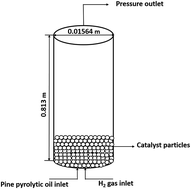
A cylindrical reactor with dimensions of 0.813 m height and 0.0156 m diameter is considered in the present study (Fig. 1). The dimensions used in the present simulation study are the same as those in the experimental work by Sheu et al.16 though the mode of operation is different. Sheu et al.16 used a trickle bed reactor wherein the bio-oil enters the reactor from the top and H2 gas enters from the bottom of the reactor in which a catalyst bed along with some inert packing material is present. However in the present work, the reactor is operated in a concurrent upflow fixed bed reactor mode where both the bio-oil and H2 gas concurrently enter from the bottom of the reactor where a 60 g Pt/Al2O3 catalyst bed is present. To be specific, a Pt/Al2O3 catalyst of 10 μm size with a density of 21[thin space (1/6-em)]450 kg m−3 is packed up to the maximum packing height (0.508 m) of the reactor. The 60 g of catalyst loaded into the reactor corresponds to a volume fraction of 0.0286.
image file: c5ra14985a-f1.tif
Fig. 1 Schematic representation of the upflow fixed bed reactor for bio-oil upgradation.

Pine pyrolytic oil consisting of various lumped groups such as heavy nonvolatiles (HNV), light nonvolatiles (LNV), phenols, alkanes and aromatics along with hydrogen (H2) gas is introduced from the bottom of the reactor to pass through the catalyst bed. The thermo-physical properties of all three phases used in the present simulations are adopted from ref. 34–37, 39 and 40 and a summary of these properties is given in Table 1. The reaction pathway (adopted from Sheu et al.16) is shown in Fig. 2 and the corresponding details of the rate expressions are highlighted in Table 2. In this table, ρ1, ρ2, ρ3, and ρ4 are the densities of the HNV, LNV, phenols and alkanes/aromatics, respectively. The initial compositions of all the components are given in Table 3. The oil feed rate and its velocity are controlled on the basis of weight hourly space velocity (WHSV) values, which is defined as grams of pine pyrolytic oil input per hour per gram of catalyst loaded into the reactor. For different values of WHSV, the corresponding flow rates/velocities of the bio-oil and H2 gas are presented in Table 4.

Table 1 Properties of the three phases used in the present simulations adopted from the literature
Phase Compound Density (kg m−3) Viscosity (kg m−1 s−1) Specific heat (J kg−1 K−1) Thermal conductivity (W m−1 K−1)
Pine pyrolytic oil HNV-(limonene)34 841.15 0.00092 1833.817 0.127
LNV-(heptane)35 679.5 0.00040 2223.19 0.140
Phenols-(cresol-o)39 1030 0.18423 1430.00 0.190
Aromatics-(xylene)40 880 0.00081 1699.84 0.131
Alkane-(methane)37 0.669 0.000018 2222 0.033
H2 gas phase H2 (gas)37 0.8189 0.000008 14[thin space (1/6-em)]283 0.167
Water vapour37 0.5542 0.000013 2014 0.0261
Catalyst Pt/Al2O3 (ref. 36) 21[thin space (1/6-em)]450 0.000017 130 71.6
Coke + ash37 375 1.206 850 0.2


image file: c5ra14985a-f2.tif
Fig. 2 Reaction pathway of the hydroprocessing of pine pyrolytic oil.16
Table 2 Reaction pathway and kinetic parameters adopted from Sheu et al.16
Reaction pathway Rate expression Activation energy, Ea (J kmol−1) Arrhenius constant, A (min−1)
image file: c5ra14985a-t3.tif r1 = −k1ρ1 7.40 × 10⁷ 3860
image file: c5ra14985a-t4.tif r2 = k1ρ1k2ρ2k3ρ2 9.18 × 10⁷ 75[thin space (1/6-em)]400
image file: c5ra14985a-t5.tif r3 = k3ρ2k4ρ3 8.06 × 10⁷ 8300
image file: c5ra14985a-t6.tif r4 = k2ρ2 + k4ρ3k5ρ4 6.23 × 10⁷ 950
image file: c5ra14985a-t7.tif r5 = k5ρ4 6.96 × 10⁷ 4000


Table 3 Initial mass fractions of all components used in the simulation studies
Component Mass fraction
HNV 0.4932
LNV 0.369
Phenols 0.1232
Alkane + aromatics 0.0146
Gases + coke 0


Table 4 Velocity values used in the simulations for different values of WHSV in both fixed and fluidized bed reactors
  Fixed bed Fluid bed
WHSV (h−1) 2
Oil flow rate (g min−1) 120 120
Oil velocity (m s−1) 1.752 × 10⁻⁴ 1.752 × 10⁻⁴
Gas velocity (m s−1) 0.01752 0.047

  Fixed bed Fluid bed
WHSV (h−1) 3
Oil flow rate (g min−1) 180 180
Oil velocity (m s−1) 2.604 × 10⁻⁴ 2.604 × 10⁻⁴
Gas velocity (m s−1) 0.026 0.047

  Fixed bed Fluid bed
WHSV (h−1) 4
Oil flow rate (g min−1) 240 240
Oil velocity (m s−1) 3.437 × 10⁻⁴ 3.437 × 10⁻⁴
Gas velocity (m s−1) 0.0346 0.047


The modeling of this bio-oil upgradation process is governed by the hydrodynamics and reactions amongst the various phases involved in the process. The simulation was performed by solving the governing equations of mass, momentum and energy conservation using the CFD software ANSYS Fluent 14.5. An Eulerian multiphase turbulence model is used to simulate the hydrodynamics, heat transfer, and kinetics of bio-oil in the fixed bed reactor. All three phases are treated with an interpenetrating continuum approach. The governing equations for the hydrodynamics and kinetic details of the reactions which are adopted in the present simulations are presented below.

Hydrodynamics

The mass conservation equations of both the primary (q) and secondary phases (p) can be written as:
 
image file: c5ra14985a-t1.tif(1)
where ρrq is the phase reference density, or the volume averaged density of the qth phase, image file: c5ra14985a-t2.tif is the velocity of phase q, mpq characterizes the mass transfer from the pth to the qth phases, and similarly mqp characterizes the mass transfer from phase q to phase p.

The effective density of phase q is given as:

 
[small rho, Greek, circumflex]q = αqρq (2)
where αq is the volume fraction of phase q, and ρq is the physical density of phase q.

The conservation of momentum equation for a fluid phase (primary phase ‘q’ = liquid & gas) is

 
image file: c5ra14985a-t14.tif(3)

The momentum exchange coefficients from the Schiller–Naumann26 drag correlation for a fluid phase are given in Table 5.

Table 5 Momentum exchange coefficient (Schiller–Naumann26 drag functions) for a fluid phase
image file: c5ra14985a-t8.tif
image file: c5ra14985a-t9.tif
image file: c5ra14985a-t10.tif
image file: c5ra14985a-t11.tif
image file: c5ra14985a-t12.tif
CD = 0.44, for Re > 1000
image file: c5ra14985a-t13.tif


The conservation of momentum for the sth solid phase is

 
image file: c5ra14985a-t15.tif(4)

The kinetic theory of granular flow, which considers the conservation of solid fluctuation energy, was used for closure of the solids stress terms. The transport equation from the kinetic theory of Gidaspow and Ding27 is

 
image file: c5ra14985a-t16.tif(5)

Table 6 presents the Gidaspow model,28 which is a combination of the Wen and Yu29 and Ergun30 drag model equations for a solid phase, whereas Table 7 represents the granular temperature and solids pressure for a solid phase from Lun.31

Table 6 Momentum exchange coefficient (Wen and Yu,29 Ergun30 drag functions) for a solid phase
image file: c5ra14985a-t17.tif
image file: c5ra14985a-t18.tif
image file: c5ra14985a-t19.tif
image file: c5ra14985a-t20.tif


Table 7 Granular temperature and solids pressure (Lun31) for a solid phase
image file: c5ra14985a-t21.tif
image file: c5ra14985a-t22.tif


The solid shear viscosity, μs is expressed as

 
image file: c5ra14985a-t24.tif(6)

The solid bulk viscosity, λs is given as

 
image file: c5ra14985a-t25.tif(7)

Generally the multiphase flow system operates under highly turbulent flow conditions. It is thus important to use the appropriate turbulence model to describe the effect of fluctuations of velocities and scalar variables for basic conservative equations. In this study, a kε turbulence model is used to describe the turbulence motion in the liquid phase. The turbulence kinetic energy, k, and its rate of dissipation, ε, are obtained from the following transport equations:

 
image file: c5ra14985a-t26.tif(8)
 
image file: c5ra14985a-t27.tif(9)
where YM represents the contribution of the fluctuating dilation, Gb represents the generation of turbulent kinetic energy due to buoyancy, Gk represents the generation of turbulent kinetic energy due to mean velocity gradients, C1ε, C2ε, and C3ε are constants with values of 1.44, 1.92, 0.09, respectively, σε and σk are the turbulent Prandtl numbers for k and ε with values of 1.0 and 1.3, respectively, and Sk and Sε are the user defined source terms.

Heat transfer model

The conservation of energy in Eulerian multiphase flows is written as
 
image file: c5ra14985a-t28.tif(10)
where hq is the specific enthalpy of the qth phase, image file: c5ra14985a-t29.tif is the heat flux, Sq is the source term that includes the sources of enthalpy (e.g., due to chemical reaction or radiation), Qpq is the intensity of heat exchange between the pth and qth phases and hpq is the interphase enthalpy. Table 8 gives the energy equations for the respective phases from the Ranz–Marshall32 and Gunn33 models.
Table 8 Interaction energy equations for fluid–fluid (Ranz and Marshall32) and fluid–solid (Gunn33) interactions
Qpq = hpq(TpTq)
image file: c5ra14985a-t23.tif
Nup = 2.0 + 0.6Rep1/2Pr1/3
Nus = (7 − 10αf + 5αf2)(1 + 0.7Res0.2Pr1/3) + (1.33 − 2.4αf + 1.2αf2)Res0.7Pr1/3


Kinetics model

The finite rate/eddy dissipation model is used to study the reaction kinetics of the HDO of pyrolysis bio-oil. This model helps in computing both the Arrhenius rate and the mixing rate.

The ith species transport equation is

 
image file: c5ra14985a-t30.tif(11)
where Yi is the mass fraction of chemical species i, Di is the diffusion coefficient, Ri is the net rate of the production of species i by chemical reaction, and Si is a source term. Since there are many species present in both pine pyrolytic oil and its hydrotreated products, the lumping of their constituents together in terms of similar functional groups is a useful approach for studying the reaction kinetics. Also, lumped kinetic models give a useful insight and clear understanding in order to quantify the effects of process variables on product yields. Therefore in this work, lumping kinetic models of the hydrodeoxygenation of pyrolytic bio-oil proposed through experimental means by Sheu et al.16 are used and their reaction mechanism of the lumped parameter model is adopted in the present simulation work. A schematic representation of their reaction pathway for the hydro-processing of bio-oil is shown in Fig. 2.

Numerical methodology

The aforementioned governing equations along with other supporting models are solved in a two dimensional computational domain using the commercial CFD based software ANSYS Fluent.37 The dimensions of the reactor used in the simulation are the same as in the experimental setup of Sheu et al.16 Grids inside the reactor domain are generated using Gambit 2.2.30 and exported to the Fluent 14.5 software. The 2D computational structured hexahedral grid was discretized by 6000 quadrilateral cells with 12[thin space (1/6-em)]170 faces with 7000 node points. The bottom inlet of the reactor is designated as the “velocity inlet” boundary in the Fluent software.37 At the inlet, the velocities, mass fractions, volume fractions, and temperatures of the three phases along with the temperature and pressure are specified according to the desired operating conditions. The outlet at the top of the reactor is set as the “pressure outlet” boundary. The other boundary conditions are specified as “wall” boundaries which are defined as no-slip boundaries for all phases. In Fluent, the phase coupled semi-implicit method for pressure linked equations (PC-SIMPLE) algorithm which is an extension of the SIMPLE algorithm is adopted. In order to solve a vector equation of the velocity components of the three phases simultaneously, a block algebraic multigrid scheme is adopted. A second order upwind scheme is used for spatial discretization whereas a QUICK scheme is used for the volume fractions. Finally, simulations are run with a time step of 0.001 s with 20 iterations per time step achieving convergence. A convergence criterion of 10−3 is chosen for the residual components. Once the steady state for the volume fractions, bed height, and conversions is achieved, then these are further utilized to analyse the effects of pertinent parameters on the volume and mass fractions of all components. However, before presenting new results it is necessary to establish the reliability of the solver by comparing the simulation results with existing experimental results. Thus the methodology used in the present study is validated with the existing experimental literature values for the mass fractions of the five lumped species16 for hydrodeoxygenation in a fixed bed mode presented elsewhere.38 In this comparison, it was observed that the mass fractions of the components obtained by this simulation study are in good agreement with the experimental mass fractions of all components except the amount of coke formed. The coke formation due to secondary reactions, i.e. the enhanced polymerization of oxy-organic compounds of bio oil species in the experiments of Sheu et al.16 is 0.1587 when T = 673 K, P = 8720 kPa and WHSV = 2 h−1. However, the present simulations show lower mass fractions of coke formation i.e., 0.000169 at these values of independent variables under a fixed bed mode of operation. The obtained aromatic content from the present CFD simulated data is close to the literature value of aromatic content.16 This inspires sufficient confidence in the reliability and accuracy of the present numerical methodology to extend this solution method to a wider range of operating conditions for the HDO of pyrolytic oil using a Pt/Al2O3 catalyst.

Results and discussion

Volume fraction of three phases

The variations in the volume fractions of the catalyst, bio-oil and H2 gas with respect to time are presented in Fig. 3–5, respectively, for conditions of WHSV = 2 h−1, T = 673 K and P = 6996 kPa. In the present simulation study, the oil phase and H2 gas are upflowing through the catalyst bed and the flow conditions are maintained such that the catalyst bed should not undergo fluidization. Because in the numerical simulations it is not possible to fix the catalyst bed, as is possible in experiments, the bed in the present simulations is slightly expanded as the simulation time progresses from 10 s to 80 s because of the upflow of the bio-oil phase and the H2 gas phase. The bio-oil phase almost completely occupies the interstitial spaces available inside the catalyst bed (Fig. 3). This bio-oil phase is also slightly expanding with the increase of the simulation time; however, no portion of the bio-oil occupies the free board space available in the reactor. This indicates that throughout the reaction time (until the steady state is established) the bio-oil phase is in excellent contact with the catalyst bed and it also interacts with the upflowing H2 gas so that an efficient HDO process takes place inside the bed. As can be seen in Fig. 5, the H2 gas mostly occupies the interstitial spaces available between the catalyst particles along with the bio-oil phase up to a simulation time of t = 30 s. However, as the time progresses further it gradually enters the free board space along with other gaseous and vapor products formed during the HDO process. Therefore it is judicious to select the WHSV values (oil flow rate and catalyst loading) and H2 gas flow velocity such that close contact between the three phases exists for a longer time, so that the conversion of unprocessed bio-oil to bio-fuel can effectively take place.
image file: c5ra14985a-f3.tif
Fig. 3 Volume fraction of the Pt/Al2O3 catalyst phase at T = 673 K, P = 6996 kPa and WHSV = 2 h−1 in a fixed bed reactor.

The volume fraction images of the three phases with respect to the simulation time for other combinations of WHSV, T and P are qualitatively similar to those shown in Fig. 3–5, hence they are not repeated herein. However, their final steady state values against various combinations of these pertinent parameters such as WHSV, T and P are presented in Fig. 6. The values of the volume fractions of the three phases presented in Fig. 6 are obtained after the steady state process is established, i.e., after changes in the compositions of the lumped components of bio-oil cease. From this figure, it can be see that the slight expansion of the catalyst bed occurred only at WHSV = 2 h−1 and T = 623 K as the pressure increases; however, at WHSV = 2 h−1 and T = 648 K, the bed is unaffected by the pressure whereas at WHSV = 2 h−1 and T = 678 K, the bed is found to fluctuate with the pressure. On the other hand, at WHSV = 3 h−1 and WHSV = 4 h−1, the catalyst bed volume fraction is unaffected by the variations in temperature and pressure because of the decreasing residence time with increasing WHSV; however, for a fixed combination of temperature and pressure, the volume fraction of the catalyst phase decreases with increasing WHSV. In the case of the bio-oil volume fraction, at WHSV = 2 h−1 and for a low value of pressure, i.e., at P = 6996 kPa, the effect of temperature is negligible; however, as the pressure increases to P = 8720 kPa and P = 10[thin space (1/6-em)]443 kPa, the volume fraction of the bio-oil increases with temperature. By increasing the WHSV to 3 h−1, the volume fraction of the bio-oil increases with pressure for temperatures of T = 648 K and T = 673 K but is unaffected by pressure if T = 623 K. Interestingly however, at WHSV = 4 h−1 (i.e., a small residence time compared to the other two values of WHSV), mixed trends in the volume fraction of the bio-oil are observed with respect to temperature for all values of pressure. The reason ascribed to the mixed trend with rising temperatures is the enhanced polymerization of oxy-organics which are precursors for coke formation, which rises with the rise in temperature. As the temperature rises, aromatic condensation followed by the hydrogenation reaction takes place, leading to the asymmetric behaviour. In the case of H2 gas, its volume fraction increases with increasing WHSV values irrespective of the combination of temperature and pressure; however, for a fixed value of WHSV, the H2 volume fraction shows a mixed behaviour with the variation of both temperature and pressure except for the case of WHSV = 4 h−1 and P = 10[thin space (1/6-em)]444 kPa, when it is unaffected by variations in temperature.


image file: c5ra14985a-f4.tif
Fig. 4 Volume fraction of the pine-oil phase at T = 673 K, P = 6996 kPa and WHSV = 2 h−1 in a fixed bed reactor.

image file: c5ra14985a-f5.tif
Fig. 5 Volume fraction of the H2 gas phase at T = 673 K, P = 6996 kPa and WHSV = 2 h−1 in a fixed bed reactor.

image file: c5ra14985a-f6.tif
Fig. 6 Steady state volume fraction values of the pine oil, H2 gas and Pt/Al2O3 catalyst at different temperatures, pressures and WHSV values.

Steady state mass fractions of lumped components

Fig. 7 presents the mass fractions of the HNV component in the final bio-fuel after the HDO process ceases because of the establishment of a steady state, for different combinations of WHSV, T and P. For all values of WHSV and T, it can be seen from this figure that the mass fraction of HNV decreases with increasing pressure. For fixed combinations of pressure and temperature, it decreases with increasing WHSV; however, mixed trends against temperature are observed for fixed values of WHSV and P. The fluctuations/mixed trends are ascribed to the formation of low boiling fractions through carbon bond breakage, along with the hydrodeoxygenation process. Fig. 8 presents the steady state mass fractions of LNV for different operating values of WHSV, T and P. Qualitatively similar functionalities of the LNV against WHSV, T and P are seen as in the case of the HNV mass fractions, i.e., the mass fraction of LNV decreases with increasing pressure and decreasing WHSV values while mixed trends are observed with respect to temperature. Since non-volatile components are undesirable components in the fuel, it is suggested that the HDO process should run at higher pressure and lower WHSV values. Fig. 9 shows the mass fractions of phenol in the final pyrolytic bio-fuel present in the reactor after steady state for various values of WHSV, T and P. For WHSV = 2 h−1 and 3 h−1, the phenol mass fractions increase with pressure and mixed trends are seen against the temperature values. This may be due to the fact that phenols are very much resistant to hydrodeoxygenation because the bond strength of oxygen atoms is high. Further increasing the WHSV leads to the slow conversion of phenols to alkane and aromatic species but with small conversion rates. For WHSV = 4 h−1, the phenols mass fraction decreases with pressure for T = 623 K and 648 K; however, for T = 673 K, the mass fraction of phenols is maximum at P = 8720 kPa and higher than at P = 6996 kPa and P = 10[thin space (1/6-em)]444 kPa. In such HDO processes, the phenols are intermediate components which are produced from HNV and are often deoxygenated into aromatics which are favourable components in fuels. Fig. 10 shows the effects of WHSV, T and P on the mass fraction of aromatics present in the final pyrolytic bio-fuel in the reactor at steady state. It can be seen from this figure that the mass fraction of aromatics substantially increases with increasing pressure and slightly increases with increasing WHSV values. However, the effect of temperature is insignificant for all values of WHSV and pressure. Thus in order to increase the desirable aromatics in the final bio-fuel, it would be beneficial to operate the HDO at higher pressures.
image file: c5ra14985a-f7.tif
Fig. 7 Final steady state mass fractions of HNV in the upgraded pine-oil obtained in a fixed bed reactor in the presence of a Pt/Al2O3 catalyst.

image file: c5ra14985a-f8.tif
Fig. 8 Final steady state mass fractions of LNV in the upgraded pine-oil obtained in a fixed bed reactor in the presence of a Pt/Al2O3 catalyst.

image file: c5ra14985a-f9.tif
Fig. 9 Final steady state mass fractions of phenols in the upgraded pine-oil obtained in a fixed bed reactor in the presence of a Pt/Al2O3 catalyst.

image file: c5ra14985a-f10.tif
Fig. 10 Final steady state mass fractions of alkanes and aromatics in the upgraded pine-oil obtained in a fixed bed reactor in the presence of a Pt/Al2O3 catalyst.

Comparison of conversion and yield in fixed bed and fluid bed reactors

During the hydrodeoxygenation process heavy non volatiles (HNV) are converted into small fractions such as LNV and phenols, and to required aromatics; thus it is necessary to analyse the effects of operating conditions on the conversion and yield of certain components. The conversion of HNV and yield of alkanes and aromatics are obtained using the following definitions:
image file: c5ra14985a-t31.tif

image file: c5ra14985a-t32.tif

The details of simulations of HDO in a fluid bed reactor are available elsewhere38 and some of those results are adopted here in Fig. 10–12 for comparison purposes. Fig. 11 shows the conversion of HNV at different values of WHSV, T and P in fixed bed and fluid bed reactors. It can be seen from this figure that the conversion of HNV is lower in a fluid bed reactor in comparison with a fixed bed reactor and is unaffected by the operating conditions. However, in the case of a fixed bed reactor, the conversion of HNV substantially increases with increasing pressure and slightly increases with the temperature, but it slightly decreases with increasing WHSV for all values of temperature and pressure. Fig. 12 presents the effects of WHSV, T and P on the conversion of phenols in fixed bed and fluid bed reactors; here too the conversions are lower in a fluid bed reactor and are unaffected by the operating conditions. But in the case of a fixed bed reactor, the phenol conversion increases with pressure for fixed values of WHSV and temperature. However, for a fixed temperature and pressure, it decreases with increasing WHSV, whereas mixed trends are seen against temperature for fixed values of WHSV and pressure. Fig. 13 presents the effects of operating conditions on the yield of alkanes and aromatics in fixed bed and fluid bed reactors. Here too the yield is very poor in the case of a fluid bed reactor which is least affected by the operating conditions. In the case of a fixed bed reactor, the yield of alkanes and aromatics significantly increases with increasing pressure and is unaffected by the values of WHSV and temperature. Finally, Table 9 presents the mass fractions of all components after upgradation for all combinations of temperature, pressure and WHSV values. While the mass fractions of HNV, LNV, phenols and alkanes and aromatics are presented in Fig. 7–10, respectively, the remaining fractions of coke + H2O + gases are presented in Table 9. It can be seen from this table that for a given value of WHSV, this remaining fraction increases with increasing temperature and pressure, whereas for a fixed combination of temperature and pressure, as the value of WHSV increases, the remaining fraction decreases. In summary, it is understood from the simulation study that the hydrodeoxygenation of pine pyrolytic using Pt/Al2O3 in an upflow fixed bed reactor favours higher yields of alkanes and aromatics at the pertinent operating conditions. The fluidized bed perhaps fails to achieve higher solid conversion due to high back mixing of the solid catalyst particles.


image file: c5ra14985a-f11.tif
Fig. 11 Comparison of the conversion of HNV in fixed and fluid bed reactors at different T, P and WHSV values.

image file: c5ra14985a-f12.tif
Fig. 12 Comparison of the conversion of phenols in fixed and fluid bed reactors at different T, P and WHSV values.

image file: c5ra14985a-f13.tif
Fig. 13 Comparison of the yield of alkanes and aromatics in fixed and fluid bed reactors as a function of T, P and WHSV.
Table 9 Mass fractions of product species with respect to different operating conditions using a Pt/Al2O3 catalyst in a fixed bed reactor
Species WHSV = 2 h−1 WHSV = 3 h−1 WHSV = 4 h−1
  T = 623 K T = 648 K T = 673 K T = 623 K T = 648 K T = 673 K T = 623 K T = 648 K T = 673 K
P = 6996 kPa
HNV 0.2822 0.2736 0.2825 0.2935 0.2996 0.3006 0.3031 0.3036 0.3061
LNV 0.4210 0.4261 0.425 0.4303 0.4367 0.4357 0.4275 0.4355 0.4265
Phenol 0.1481 0.1448 0.1368 0.1406 0.1461 0.1373 0.1387 0.1452 0.1379
Alkane + aromatic 0.1267 0.1254 0.1225 0.1354 0.1475 0.1365 0.1305 0.1455 0.1378
Coke + H2O + gases 0.0220 0.0301 0.0332 0.0002 −0.0299 −0.0101 0.0002 −0.0297 −0.0083
[thin space (1/6-em)]
P = 8720 kPa
HNV 0.2251 0.2214 0.2102 0.2349 0.2396 0.2315 0.2505 0.2546 0.2501
LNV 0.4089 0.4063 0.4083 0.4125 0.4112 0.4194 0.4309 0.4319 0.4398
Phenol 0.1486 0.1456 0.1552 0.1426 0.1415 0.1559 0.1414 0.1416 0.1562
Alkane + aromatic 0.1938 0.1965 0.1962 0.1998 0.1975 0.1984 0.1971 0.1908 0.1991
Coke + H2O + gases 0.0236 0.0329 0.0301 0.0102 0.0102 −0.0052 −0.0199 −0.0189 −0.0452
[thin space (1/6-em)]
P = 10[thin space (1/6-em)]443 kPa
HNV 0.1912 0.1982 0.1884 0.2059 0.2001 0.2047 0.2104 0.2115 0.2189
LNV 0.3692 0.3712 0.3784 0.3781 0.3792 0.3801 0.3902 0.3968 0.4011
Phenol 0.1792 0.1739 0.1751 0.1485 0.1467 0.1458 0.1381 0.1376 0.1354
Alkane + aromatic 0.2202 0.2214 0.2234 0.2329 0.2357 0.2316 0.2398 0.2402 0.2409
Coke + H2O + gases 0.0402 0.0353 0.0347 0.0346 0.0383 0.0378 0.0215 0.0139 0.0037


Conclusions

The upgradation of pyrolytic oil by the HDO process in the presence of Pt/Al2O3 is numerically studied and some of the key conclusions are as follows. The bed experiences slight expansion at WHSV = 2 h−1, however no expansion of the bed is observed when WHSV = 3 h−1 and WHSV = 4 h−1. The mass fractions of undesirable HNV and LNV in the final pyrolytic bio-oil at steady state are found to substantially decrease with pressure and slightly increase with WHSV while the effect of temperature is very small. On the other hand, the mass fraction of desirable aromatics significantly increases with pressure but slightly increases with WHSV whereas the temperature effect is negligible. Finally, the conversion of HNV and phenols and the yield of alkanes and aromatics in the fluid bed reactor are very small and are unaffected by operating conditions, whereas in the fixed bed reactor, these conversions and yield are significantly larger and further increase with pressure. Overall, it is suggested that the HDO of pyrolytic oil in the presence of Pt/Al2O3 is more favourable at high pressures in upflow fixed bed reactors than in fluid bed reactors.

Acknowledgements

Authors gratefully acknowledge the support received from Prof. Sai Gu (Centre for Biofuel, School of Energy, Environmental and Agrifood, Cranfield University, UK) in the beginning stages of this project.

References

  1. H. B. Goyal, D. Seal and R. C. Saxena, Renewable Sustainable Energy Rev., 2008, 12, 504–517 CrossRef CAS PubMed.
  2. Q. Zhang, J. Chang, T. Wang and Y. Xu, Energy Convers. Manage., 2007, 48, 87–92 CrossRef CAS PubMed.
  3. A. V. Bridgwater, Biomass Bioenergy, 2012, 38, 68–94 CrossRef CAS PubMed.
  4. D. C. Elliott, Energy Fuels, 2007, 21, 1792–1815 CrossRef CAS.
  5. X. Hu, C. Lievens, A. Larcher and C. Z. Li, Bioresour. Technol., 2011, 102, 10104–10113 CrossRef CAS PubMed.
  6. X. Hu, R. Gunawan, D. Mourant, Y. Wang, C. Lievens, W. Chaiwat, L. Wu and C. Z. Li, Bioresour. Technol., 2012, 123, 249–255 CrossRef CAS PubMed.
  7. R. French and S. Czernik, Fuel Process. Technol., 2010, 91, 25–32 CrossRef CAS PubMed.
  8. A. Aho, N. Kumar, K. Eränen, T. Salmi, M. Hupa and D. Y. Murzin, Fuel, 2008, 87, 2493–2501 CrossRef CAS PubMed.
  9. J. Wildschut, F. H. Mahfud, R. H. Venderbosch and H. J. Heeres, Ind. Eng. Chem. Res., 2009, 48, 10324–10334 CrossRef CAS.
  10. O. Şenol, T. R. Viljava and A. O. I. Krause, Catal. Today, 2005, 100, 331–335 CrossRef PubMed.
  11. E. Furimsky, Appl. Catal., A, 2000, 199, 147–190 CrossRef CAS.
  12. J. R. Galdámez, L. Garcia and R. Bilbao, Energy Fuels, 2005, 19, 1133–1142 CrossRef.
  13. E. Furimsky, AIChE J., 1979, 25, 306–311 CrossRef CAS PubMed.
  14. D. C. Elliott and E. G. Baker, Biotechnol. Bioeng. Symp., 1984, 14, 159–174 CAS.
  15. J. Gagnon and S. Kaliaguine, Ind. Eng. Chem. Res., 1988, 27, 1783–1788 CrossRef CAS.
  16. Y. E. Sheu, R. G. Anthony and E. J. Soltes, Fuel Process. Technol., 1988, 19, 31–50 CrossRef CAS.
  17. D. C. Elliott and G. F. Schiefelbein, Prepr. Pap. - Am. Chem. Soc., Div. Fuel Chem., 1989, 34, 1160–1166 CAS.
  18. A. Oasmaa and D. Boocock, Can. J. Chem. Eng., 1992, 70, 294–300 CrossRef CAS PubMed.
  19. W. Baldauf, U. Balfanz and M. Rupp, Biomass Bioenergy, 1994, 7, 237–244 CrossRef CAS.
  20. L. Conti, G. Scano, J. Boufala and S. Mascia, Bio-Oil Prod. Util., 1996, p. 198 Search PubMed.
  21. M. C. Samolada, W. Baldauf and I. A. Vasalos, Fuel, 1998, 77, 1667–1675 CrossRef CAS.
  22. Z. Su-Ping, Y. Yong-Jie, R. Zhengwei and L. Tingchen, Energy Sources, 2003, 25, 57–65 CrossRef PubMed.
  23. D. C. Elliott and T. R. Hart, Energy Fuels, 2009, 23, 631–637 CrossRef CAS.
  24. M. Saidi, F. Samimi, D. Karimipourfard, T. Nimmanwudipong, B. C. Gates and M. R. Rahimpour, Energy Environ. Sci., 2014, 7, 103–129 CAS.
  25. R. P. Divya, K. G. Vamshi, K. P. Venkata, H. S. Philip and S. K. Tanneru, Environ. Prog. Sustainable Energy, 2014, 33, 726–731 CrossRef PubMed.
  26. L. Schiller and Z. Naumann, VDI Z., 1935, 77S, 318–325 Search PubMed.
  27. D. Jianmin and D. Gidaspow, AIChE J., 1990, 36, 523–538 CrossRef PubMed.
  28. D. Gidaspow, R. Bezburuah and J. Ding, Hydrodynamics of circulating fluidized beds, kinetic theory approach, in Fluidization VII: 7th Engineering Foundation, ed. O. E. Potter and D. J. Nicklin, McGill University, Montreal, 1992, pp. 75–82 Search PubMed.
  29. C. Y. Wen and Y. H. Yu, Chem. Eng. Prog., Symp. Ser., 1966, 62, 100–111 CAS.
  30. S. Ergun, Chem. Eng. Prog., 1952, 48, 89–94 CAS.
  31. C. K. K. Lun, S. B. Savage, D. J. Jeffrey and N. Chepurniy, J. Fluid Mech., 1984, 140, 223–256 CrossRef.
  32. W. E. Ranz and W. R. Marshall, Chem. Eng. Prog., 1952, 48, 141–146 CAS.
  33. D. J. Gunn, Int. J. Heat Mass Transfer, 1978, 21, 467–476 CrossRef.
  34. L. R. Stowe, Method of conversion of heavy hydrocarbon feedstocks, US Pat., US5547563 A, 1996.
  35. D. J. Raal and A. Muhlbauer, Phase Equilibria: Measurement & Computation, Taylor & Francis, Washington, USA, 1997 Search PubMed.
  36. S. C. Lin, Hydrocarbons via catalytic hydrogen treatment of a wood pyrolytic Oil, PhD Thesis, A & M University, Texas, 1981.
  37. Ansys Fluent, Fluent User’s Guide, in Fluent Inc, 2006 Search PubMed.
  38. A. R. K. Gollakota, M. D. Subramanyam, N. Kishore and S. Gu, RSC Adv., 2015, 5, 41855–41866 RSC.
  39. Y. Wang, T. He, K. Liu, J. Wu and Y. Fang, Bioresour. Technol., 2012, 108, 280–284 CrossRef CAS PubMed.
  40. J. F. Zhu, J. C. Wang and Q. X. Li, Chin. J. Chem. Phys., 2013, 26, 477–483 CrossRef CAS.

This journal is © The Royal Society of Chemistry 2015
Click here to see how this site uses Cookies. View our privacy policy here.