Rencheng Jin*,
Dongmei Liu,
Chunping Liu and
Gang Liu
School of Chemistry & Materials Science, Ludong University, Yantai 264025, P. R. China. E-mail: jinrc427@126.com; Fax: +86 535 6696162; Tel: +86 535 6696162
First published on 29th September 2015
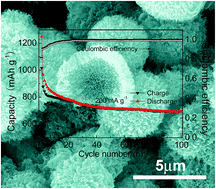
Hierarchical NiCo2S4 hollow spheres are successfully fabricated by a facile hydrothermal method accompanied by a high-temperature annealing and anion exchange process. By using NiCo2S4 hollow spheres as an anode material for lithium ion batteries, a high specific capacity of 696 mA h g−1 can be obtained after 100 cycles at a current density of 200 mA g−1. Even at a current density of 2000 mA g−1, the specific capacity still remains at 411 mA h g−1 after 50 cycles. The good electrochemical performance can be attributed to the unique porous features and void spaces within the surface of the hollow spheres, which provide large contact areas between the electrolyte and active materials for electrolyte diffusion and alleviate the volume change during the lithium-ion insertion/extraction process.
Recently, CoSx (ref. 23 and 27) and NiS (ref. 28 and 29) with different morphologies have been fabricated and their lithium storage capacities have been evaluated. However, the poor cycling performance and the low conductivity will limit their practical application. It has been reported that ternary Ni–Co sulfides have much higher electrical conductivity than nickel sulfides and cobalt sulfides. The higher electronic conductivity is benefit for the rapid transfer of electrons in an electrode, enhancing the electrochemical properties. Up to now, various nanostructured Ni–Co sulfides including nanosheets,30 nanoplates,31 nanotubes,32,33 ball-in-ball hollow spheres34 and urchin like structures35,36 were prepared and their electrochemical properties for supercapacitors were investigated. To the best of our knowledge, no report has been devoted to investigate the electrochemical properties of Ni–Co sulfides as the anode material for rechargeable lithium ion batteries. Although different morphologies of Ni–Co sulfides have been fabricated, less report has been focused on the fabrication of NiCo2S4 hollow structures. In this work, NiCo2S4 hollow spheres with high surface area were successfully synthesized by a simple hydrothermal method accompanied by high-temperature calcination and anion exchange. Based on the experimental results, a CO2 bubble template mechanism is proposed for interpreting the formation of the hollow spheres. Electrochemical measurements indicate that NiCo2S4 hollow spheres exhibit high specific capacity, good cycling stability and rate capability.
:
1
:
1. Cyclic voltammetry (CV) and electrochemical impedance spectra (EIS) were carried out on CHI660E electrochemical workstation (Shanghai Chenhua Co., Ltd., China).
![]() | ||
| Fig. 1 (a) XRD pattern and FESEM images of the NiCo2O4: (b) low magnification, (b) middle magnification, (d) high magnification. | ||
To understand the formation mechanism of the hollow sphere, different reaction parameters were performed. When the solvothermal reaction temperature was decreased to 150 °C, urchin-like NiCo2O4 precursor can be obtained. Unfortunately, no broken spheres can be observed after 30 min ultrasonic treatment (Fig. S2a and b†). Further decreasing the reaction temperature to 120 °C, the obtained samples were composed of urchin-like structure, microspheres as well as nanoparticles (Fig. S2c†). From the above experimental results, one can conclude that the reaction temperature has much effect on the final morphology of the sample. In this work, urea was used as mineralizer. In the reaction system, the CO2 bubbles with different size formed by decomposing the urea with increased reaction temperature. Because of the surface tension and the pressure caused by CO2 atmosphere, CO2 bubbles are aggregated into big spheres of micrometer size. Then the NiCo2O4 precursor nanocrystals start to nucleate homogeneously around the gas–liquid interface between bubble and solvent. As the result, the hollow spheres formed. With the reaction temperature increasing, the pressure inside the hollow spheres increases, leading to the broken hollow spheres, which can be seen in Fig. 1. According to the above discussion, the NiCo2O4 precursor hollow spheres can be explained by a bubble template mechanism,37–40 as illustrated in Scheme S1.† When less amount of urea (0.6 g) was introduced into the reaction system, less CO2 bubbles generated. As indicated, microspheres, irregular nanoparticles combined with hollow spheres can be obtained (Fig. S2d†). In addition, the reaction time is another important factor that affected the final morphology. After hydrothermal treatment for 2 h, less pink product is obtained. As presented in Fig. S3a,† numerous microspheres constructed by tiny nanorods and some nanoparticles can be obtained. The broken microspheres indicate that the obtained microspheres possess the hollow structure. When the reaction time is prolonged to 4 h, the microspheres become more uniform and the irregular nanoparticles decrease (Fig. S3b†). After hydrothermal reaction time proceeded (8 h), the obtained product is composed of uniform hollow spheres (Fig. S3c and d†). Closer inspection of these hollow spheres demonstrates that the nanorods grow longer and wider, which can be further ascertained in Fig. 1b–d. In the initial stage, the Ni–Co precursor nuclei were generated in the solution and then grew around the CO2 bubbles. Thus the hollow spheres come into being. With increasing the reaction time, the Ni–Co precursor nuclei continued generating and then nucleated onto the big nanorods forming the regular hollow spheres through the process known as Ostwald ripening. The results further proved that appropriate CO2 bubbles promoted the formation of NiCo2O4 precursor hollow spheres.
Using Na2S as the sulfur source, the free sulfide anions can react with NiCo2O4 to form NiCo2S4. Fig. 2a displays the XRD pattern of the sample after 12 h sulfidation. The obtained diffraction peaks are agreed well with the standard patterns of the cubic NiCo2S4 (JCPDS No. 20-0782). And no other impurities such as NiCo2O4, NiS and CoS can be observed, indicating that this strategy can be successfully applied to fabricate NiCo2S4 through anion exchange. In addition, the diffraction peaks are weak and broad, indicating low crystallinity of the sample. The panoramic FESEM image shows that hollow spheres are obtained without apparent deformation in appearance. Such hollow spheres (shell thickness is ∼1 μm) are still constructed by some small nanorods. The composition of the sample is further determined by energy dispersive spectroscopy (EDS), three elements of Ni, Co, S with the atomic ratio of 13.01
:
30.20
:
55.71 are observed in Fig. S4,† which is consistent with the stoichiometric ratio of NiCo2S4.
![]() | ||
| Fig. 2 (a) XRD pattern and FESEM images of the NiCo2S4: (b) low magnification, (b) middle magnification, (d) high magnification. | ||
The microstructure of as-prepared NiCo2S4 was further determined by transmission electron microscopy (TEM), high resolution TEM (HRTEM) and selected area electron diffraction (SAED) pattern. Fig. 3a further confirms that the hollow sphere is composed of numerous nanorods. As shown in Fig. 3b, the nanorods were porous and constructed by many small nanoparticles. The HRTEM image (Fig. 3c) presents the clear lattice fringes with spacings of 0.286 nm and 0.234 nm, which correspond to the (311) and (400) planes of cubic NiCo2S4, respectively. And the ring pattern of the selected area electron diffraction (SAED) in Fig. 3d displays the polycrystalline nature of the NiCo2S4.
![]() | ||
| Fig. 3 (a and b) TEM images, (c) HRTEM image, and (d) corresponding SAED pattern of the NiCo2S4 hollow sphere. | ||
X-ray photoelectron spectrum (XPS) was applied to detect the chemical composition of NiCo2S4 hollow sphere and the results were presented in Fig. 4. The full XPS spectrum demonstrates three elements Ni, Co and S are detected except the adventitious C and O (Fig. 4a). The XPS spectrum of Ni 2p shows two peaks at 853.1 eV and 870.4 eV, attributed to Ni 2p3/2 and Ni 2p1/2, respectively (Fig. 4b).41,42 The peaks at 778.8 eV and 793.9 eV can be assigned to the Co 2p3/2 and Co 2p1/2 of NiCo2S4 phase (Fig. 4c).42 And the two peaks with binding energy values at 161.8 and 162.8 eV in Fig. 4d, corresponding to S 2p3/2 and S 2p1/2, respectively.43
![]() | ||
| Fig. 4 (a) XPS survey spectra, (b) Ni 2p, (c) Co 2p, and (d) S 2p spectra of the NiCo2S4 hollow sphere. | ||
The porous nature of the NiCo2S4 hollow sphere was determined by nitrogen gas adsorption–desorption isotherm. It can be seen that the NiCo2S4 hollow sphere displays a type IV isotherm with a type H3 hysteresis loop in the relative pressure range of 0.6–1.0 P/P0, implying the presence of mesopores structure (Fig. 5a). The corresponding pore size distribution in Fig. 5b presents the narrow pore size distribution in the range of 2–15 nm. The pores correspond to the interstitial spaces between the small nanoparticles in the shell, which is in agreement with that observed in SEM and TEM images. The specific surface area of the hollow sphere calculated by the Brunauer–Emmett–Teller (BET) method is 59.37 m2 g−1. The porous structure with a high surface area is expected to provide numerous electrochemical reaction sites for intercalation and deintercalation of the lithium ions.
![]() | ||
| Fig. 5 (a) Nitrogen gas adsorption–desorption isotherm and (b) pore size distribution of the NiCo2S4 hollow sphere. | ||
In the previous reports, the NiCo2S4 can be used as supercapacitors.32,34,35 In this work, the NiCo2S4 hollow sphere is applied as a potential anode for Li-ion battery. Cyclic voltammetry (CV) is initially used to evaluate the lithium storage properties. In the first cycle of NiCo2S4 hollow spheres electrode, as shown in Fig. 6a, the cathodic peak centered at 1.06 V is attributed to the reduction of Co3+ and Ni2+ to metallic Co and Ni, respectively.3,44 In the subsequent cycles, the peak shifts to the higher voltage range. The weak peak at 0.56 V originates from the formation of a solid electrolyte interface (SEI) layer. Meanwhile, the anodic peaks at 2.04 V and 2.37 V can be observed, resulting from the sulfuration of metallic Ni and Co to nickel sulfides and cobalt sulfides. On the above analysis and previous reports,28,45,46 the redox reactions can be described as follows:
| NiCo2S4 + 8Li+ + 8e− → Ni + 2Co + 4Li2S | (1) |
| Ni + Li2S ↔ NiS + 2Li | (2) |
| Co + Li2S ↔CoS + 2Li | (3) |
To further investigate the Li-ion insertion and extraction properties, CR2025 coin cell was tested by galvanostatic cycling at room temperature at various current rates in the voltage ranging from 0.01 V to 3.0 V versus Li/Li+. Fig. 6b demonstrates the voltage–capacity profiles of the as-prepared NiCo2S4 hollow sphere electrode for the first, second, and fifth charge/discharge cycles at a current rate of 200 mA g−1, respectively. The NiCo2S4 electrode delivers a first discharge capacity of 1251 mA h g−1 and charge capacity of 1016 mA h g−1, respectively, which leads to a coulombic efficiency of 81%. The large irreversible capacity and the low initial coulombic efficiency may be attributed to the formation of a solid–electrolyte interface (SEI) layer on the surface of the electrode.8,11 For the second and fifth cycles, the discharge capacities are 966 mA h g−1 and 874 mA h g−1. While the charge capacities are 879 mA h g−1 and 811 mA h g−1, respectively. And the coulombic efficiency increased to 91% and 92.8%, respectively. During the cycling process, the porous structure can cushion the volume change of the electrode and effectively alleviate the pulverization problem, resulting in the enhanced cycle stability. As shown Fig. 6c, the coulombic efficiency is closed to 100% after 15 times cycles. The cycling performance of the NiCo2S4 electrode is presented in Fig. 6b. The specific discharge capacity decreased gradually to 764 mA h g−1 at the 25th cycle, then the capacity was stabilized and retained at 696 mA h g−1 after 100 cycles. The capacity retention after the second cycle is ∼72%. In addition, the electrochemical properties of NiCo2O4 hollow spheres are also investigated. As can be seen in Fig. S4a,† the NiCo2O4 hollow spheres present the initial discharge and charge capacities of 1486 and 1018 mA h g−1, respectively (current density: 200 mA g−1). Fig. S4b† shows the cycling performance of the NiCo2O4 hollow spheres at the current rate of 200 mA g−1. The discharge capacity remains at 867 mA h g−1 after 100 cycles, and the corresponding capacity retention after the second cycle is 73.5%, which is comparable to the previous NiCo2O4 hollow spheres with a core-in-double shell interior structure,47 mesoporous NiCo2O4 nanosheets,48 porous NiCo2O4 nanoflakes and nanobelts.44 The results indicate that both NiCo2O4 and NiCo2S4 demonstrate the good cycle performance. The relatively high discharge capacity and good cycle performance is mainly due to the unique porous structures. The high capacity and stability are ascribed to the synergistic effect of the porous structure and the small nanoparticles that assembled the hollow spheres. The small nanoparticles provide an increased contact area between NiCo2S4 or NiCo2O4 electrode and electrolyte, which shortens the diffusion length of charge carriers and accommodates the volume change during the Li-ion insertion/extraction process, resulting in the high specific capacity and high rate capability. Meanwhile, the hollow structure of NiCo2S4 or NiCo2O4 spheres can promote the penetration of electrolyte into the electrode, which mitigates the volume change during charge–discharge process, leading to the good cycling performance. The enhanced electrochemical properties can be observed in other transition metal oxides and chalcogenides mesoporous and hollow structures.11,24,44,47,49 From another point of view, the stability of the hollow spheres has much effect on the electrochemical properties. Even after 100 cycles, the overall morphology of hollow spheres is still maintained and no obvious aggregation is observed (Fig. S6a and b†). The result further presents that elastic mesoporous structure can effectively suppress the large volume change during cycling. The good volume stability is helpful to achieve high capacity retention and excellent cycling performance. The rate capability of the NiCo2S4 hollow spheres is also evaluated at different current densities and the results are shown in Fig. 6d. The reversible capacity decreases gradually with increasing the current density. But cycle specific capacity still remains at 411 mA h g−1 even at higher current density of 2000 mA g−1. The NiCo2S4 hollow spheres display better stability and rate capacity compared to the previously reported Li storage performance for Ni3S4 nanoparticles,29 NiS hierarchical hollow microspheres28 and CoSx with shapes of nanosheets46 and hollow spheres.27 For instance, the Ni3S4 nanoparticles electrode displays poor cycle stability with the specific capacity decreased from 1402 to 494 mA h g−1 (100th cycle) at the current density of 140.9 mA g−1. The NiS hierarchical hollow spheres show a capacity retention of 14.2% after only 20 cycles at the current density of 50 mA g−1.28 The ultrathin CoS nanosheets demonstrate a specific capacity of 359 mA h g−1 after 80 cycles at the current density of 58.9 mA g−1.46 For the Co9S8 hollow spheres, the specific capacity decreased from 1008 to 634 after 100 cycles at the current density of 1103.9 mA h g−1 to 254.9 mA h g−1 at 100 mA g−1.27
To further understand the electrochemical performance of NiCo2S4 hollow spheres as anode material, the electrochemical impedance spectra (EIS) are preformed. Fig. 7 shows the Nyquist plots for the fresh cell and the cell after 100 cycles. Both the Nyquist plots depict the similar shape with depressed semicircles in the high and medium-frequency range and a straight line in the low-frequency. The inclined line in the low-frequency range corresponds the Warburg impedance (Zw), implying solid-state diffusion of Li+ in the electrode materials.50 While the semicircle in the middle frequency represents the charge-transfer resistance (Rct), which may be attributed to the charge transfer through the electrode/electrolyte interface. As can be seen in Fig. 7, the charge-transfer resistance increases after 100 times cycling. The lower charge-transfer resistance (Rct) of the electrode indicates that the lithium ions and electrons can transfer more freely in the electrode/electrolyte interface. The electrochemical impedance result is in agreement with the cycle performance of the electrode first decreasing from the initial discharge capacity of 1251 mA h g−1 to 696 mA h g−1 after 100 cycles.
![]() | ||
| Fig. 7 Electrochemical impedance spectra (EIS) of (a) the fresh cell and (b) the cell after 100 cycles at a current density of 100 mA g−1. | ||
Footnote |
| † Electronic supplementary information (ESI) available. See DOI: 10.1039/c5ra14412d |
| This journal is © The Royal Society of Chemistry 2015 |