PhI(OAc)2-promoted metal-free oxidation of 2-oxoaldehydes: a facile one-pot synthesis of cyanoformamides

Zhen Zhan, Xu Cheng, Yang Zheng, Xiaojun Ma, Xiaoyu Wang, Li Hai* and Yong Wu*
Key Laboratory of Drug Targeting and Drug Delivery System of Education Ministry, Department of Medicinal Chemistry, West China School of Pharmacy, Sichuan University, Chengdu 610041, P. R. China. E-mail: smile@scu.edu.cn; wyong@scu.edu.cn

Received 21st July 2015 , Accepted 23rd September 2015

First published on 23rd September 2015


Abstract

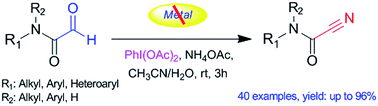
A novel, efficient and environmental method for the conversion of 2-oxoaldehydes into cyanoformamides with iodosobenzene diacetate as oxidant has been developed. The reactions proceeded smoothly at room temperature under metal-free conditions and generated the corresponding products in good to excellent yields.

Cyanoformamides have attracted worldwide attention because of their wide use in the synthesis of symmetrical/unsymmetrical substituted ureas,1 acrylonitriles,2 and some aza-heterocycles, such as tetrazoles3 and lactams.4 They also act as stable sources of isocyanates and hydrogen cyanide in reactions requiring neutral or thermal conditions.5 The first natural product with this functionality in its structure, ceratinamine (Fig. 1), was isolated in 1996 by Fusetani and co-workers from the marine sponge Pseudoceratina purpurea5a and was synthesized later by Ganem and Schoenfeld.5b A related compound, 7-hydroxyceratinamine (Fig. 1), was isolated three years later from the marine sponge Aplysinella sp. by Schmitz.6 In addition, N,N-dimethyl cyanoformamide has been isolated from several vegetables and fruits, such as tomatoes, oranges, and apples, as a degradation metabolite of pesticides.7
image file: c5ra14409d-f1.tif
Fig. 1 Nature products contain a cyanoformamide functional group.

In past decades, there have been only a few reports concerning the preparation of cyanoformamides. Traditionally, they were synthesized from the reactions of amines with reagents like carbonyl cyanide or triphosgene followed by treatment with the cyanide ion.8 Other methods used more sophisticated reagents like 4-chloro-5H-1,2,3-dithiazol-5-one,9 isonitroso Meldrum's acid10 or its tosyl derivative 5-[(tosyloxy)imino]-2,2-dimethyl-1,3-dioxane-4,6-dione.11 Later on, García-Egido et al. reported the preparation of cyanoformamides through the reaction of primary amines and carbon dioxide at atmospheric pressure with a cyanophosphonate.12 Recently, Yang et al. developed the synthesis of cyanoformamides from 1-acyl-1-carbamoyl oximes in the presence of phosphorus oxychloride in dichloroethane.13 However, the above methods suffer from various drawbacks such as multiple steps, harsh reaction conditions, poor functional group tolerance, or the use of expensive and toxic reagents. Therefore, the development of more milder, convenient, and environmentally benign processes to access cyanoformamides is still highly necessary. In 2014, Ahmed and co-workers reported the synthesis of α-ketoamides via the oxidative amidation of 2-oxoaldehydes.14 Inspired by this work, we were very interested in the synthesis of cyanoformamides from 2-oxoaldehydes and NH3 (g) in the presence of suitable oxidant.

On the other hand, hypervalent iodine reagents are extensively used for various transformations in organic synthesis because of their low toxicity, ease of handling, and high reactivity. They are environmentally benign and are also known for their selective, efficient and mild properties as oxidizing agents.15 For example, widely used hypervalent iodine reagents such as Dess–Martin periodinane (DMP) and its precursor 2-iodoxybenzoic acid (IBX) are widely known as mild and highly selective reagents for the oxidation of alcohols. However, these iodine(V) reagents are potentially explosive and the regenerated iodine(III) species from the oxidations are usually not utilized. Thus, readily available and stable iodine(III) oxidants such as iodosobenzene diacetate (IBD) are attracting much attention. IBD is commercially available as a white crystalline solid and can be kept without refrigeration for a long time. Recently, it has been reported for the synthesis of symmetrical biaryls,16 α-acetoxy ketones,17 C–H acetoxylation of arenes,18 benzylic-acetoxylation of alkylbenzenes,19 diacetoxylation of olefins,20 and decarboxylative methylation of aromatic carboxylic acids.21

In this paper, we describe the preparation of cyanoformamides under very mild conditions through the reaction of 2-oxoaldehydes and ammonium acetate in the presence of iodosobenzene diacetate. To the best of our knowledge, the usage of iodosobenzene diacetate in this transformation hasn't been reported before.

At the beginning of our investigation, experiments were carried out using N-methyl-2-oxo-N-phenylacetamide (1a) as a model substrate. First, a range of hypervalent iodine reagents, such as: PhIO, PhIO2, PhICl2, PhI(OCOCF3)2, PhI(OAc)2, IBX or DMP were used as oxidants in the reaction at 25 °C, however, all of them were unsatisfactory except for PhI(OAc)2 (Table 1, entries 1–7). Among various ammonium salts examined, NH4OAc turned out to be the best choice, while others such as NH4HCO3, (NH4)2CO3, HCOONH4, NH4NO3, NH4Cl, NH4I, TBAI, NH3·H2O and Ce(NH4)2(NO3)6 were less effective (Table 1, entries 8–16). For the optimization of the amount of IBD used in the model reaction, less than two equivalent of IBD led to the incompletion of the reaction (Table 1, entry 7). Meanwhile, up to three equiv. of IBD did not increase the yield of 2a significantly (Table 1, entry 18). Further investigation indicated that temperature was important for this transformation. A good yield has been obtained when the reaction carries out at 25 °C (Table 1, entry 17). However, with the temperature increasing to 40 °C, the yield of the desired product dropped to 65% (Table 1, entry 19). And no product formation was observed when the reaction was conducted at 0 °C (Table 1, entry 20). With respect to the amount of NH4OAc, three equivalents was found to be adequate, as neither bigger nor smaller amount showed better yields (Table 1, entries 21–22). When the reaction was allowed to proceed in different solvents, an optimal yield of 93% was obtained in CH3CN/H2O (Table 1, entries 23–26). Notably, the yield decreased to 49% when the reaction was conducted in an open system (Table 1, entry 27). Finally, as observed in this study, the optimized reaction conditions tends to be: 2-oxoaldehyde (1.0 mmol), PhI(OAc)2 (2.0 mmol), NH4OAc (3.0 mmol) and CH3CN/H2O (2 mL, v[thin space (1/6-em)]:[thin space (1/6-em)]v = 4[thin space (1/6-em)]:[thin space (1/6-em)]1) in a sealed tube at 25 °C.

Table 1 Optimization studies for the synthesis of cyanoformamidesa

image file: c5ra14409d-u1.tif

Entry Oxidant NH3 source Solvent Yieldb (%)
a Reaction conditions: 2-oxoaldehydes (1.0 mmol), oxidant (1.0 mmol), NH4OAc (3.0 mmol) and EtOH/H2O (2 mL, v[thin space (1/6-em)]:[thin space (1/6-em)]v = 4[thin space (1/6-em)]:[thin space (1/6-em)]1) in a sealed tube, rt, 3 h.b Isolated yield.c PhI(OAc)2 (2.0 mmol).d PhI(OAc)2 (3.0 mmol).e Reaction temperature: 40 °C.f Reaction temperature: 0 °C.g NH4OAc (1.0 mmol).h NH4OAc (6.0 mmol).i NH4OAc (6.0 mmol), unsealed tube, 12 h.
1 PhIO NH4OAc EtOH/H2O 23
2 PhIO2 NH4OAc EtOH/H2O 60
3 PhICl2 NH4OAc EtOH/H2O 0
4 PhI(OCOCF3)2 NH4OAc EtOH/H2O 56
5 PhI(OAc)2 NH4OAc EtOH/H2O 71
6 IBX NH4OAc EtOH/H2O 31
7 DMP NH4OAc EtOH/H2O 42
8 PhI(OAc)2 NH4HCO3 EtOH/H2O 62
9 PhI(OAc)2 (NH4)2CO3 EtOH/H2O 55
10 PhI(OAc)2 HCOONH4 EtOH/H2O 67
11 PhI(OAc)2 NH4NO3 EtOH/H2O 50
12 PhI(OAc)2 NH4Cl EtOH/H2O 0
13 PhI(OAc)2 NH4I EtOH/H2O 0
14 PhI(OAc)2 TBAI EtOH/H2O 0
15 PhI(OAc)2 NH3·H2O EtOH/H2O 37
16 PhI(OAc)2 Ce(NH4)2(NO3)6 EtOH/H2O 23
17c PhI(OAc)2 NH4OAc EtOH/H2O 89
18d PhI(OAc)2 NH4OAc EtOH/H2O 90
19e PhI(OAc)2c NH4OAc EtOH/H2O 65
20f PhI(OAc)2c NH4OAc EtOH/H2O 0
21g PhI(OAc)2c NH4OAc EtOH/H2O 63
22h PhI(OAc)2c NH4OAc EtOH/H2O 77
23 PhI(OAc)2c NH4OAc THF/H2O 79
24 PhI(OAc)2c NH4OAc CH3COCH3/H2O 76
25 PhI(OAc)2c NH4OAc CH3CN/H2O 93
26 PhI(OAc)2c NH4OAc 1,4-Dioxane/H2O 71
27i PhI(OAc)2c NH4OAc CH3CN/H2O 49


In order to evaluate the versatility of this novel method, we applied the procedure to the oxidation of a wide range of 2-oxoaldehydes. The results are summarized in Scheme 1. A host of 2-oxo-N-phenylacetamides bearing either the electron-donating groups such as methyl, methoxy, or electron-withdrawing groups such as nitro, cyanogroup and halogen, are well tolerated during the course of the reaction providing the desired compounds in good to excellent yields. This illustrate that the reaction is not sensitive to the electronic effects of oxoaldehydes. Besides, synthetically useful biphenyl, thienyl, benzyl and vinyl are tolerated in this transformation, giving 2o–2w and 2zd in good yields. Notably, in addition to the aromatic systems, the aliphatic cyanoformamides 2x, y and 2za, zb could also be obtained in moderate to good yields. Although we failed to prepare 2z through the optimized reaction condition, it could be synthesized from 2n via the deprotection of p-methoxybenzyl in high yield (Scheme 2). What's more, a variety of functional groups such as ether, nitryl, halogen and cyanogroup and vinyl are well-suited for this reaction.


image file: c5ra14409d-s1.tif
Scheme 1 Transformation of 2-oxoaldehydes (1) to cyanoformamides (2). Reaction conditions: 2-oxoaldehydes (1, 1.0 mmol), PhI(OAc)2 (2.0 mmol), NH4OAc (3.0 mmol) and CH3CN/H2O (2 mL, v[thin space (1/6-em)]:[thin space (1/6-em)]v = 4[thin space (1/6-em)]:[thin space (1/6-em)]1) in a sealed tube at 25 °C for 3 h.

image file: c5ra14409d-s2.tif
Scheme 2 Synthesis of 2z from 2n.

Finally, considering the general application of this transformation, we demonstrated the gram-scale progress, and an example of large-scale reaction with excellent yield of the product is shown in Scheme 3.


image file: c5ra14409d-s3.tif
Scheme 3 Large-scale reaction.

A plausible mechanism for this reaction is depicted in Scheme 4. The reaction of 2-oxoaldehyde with NH4OAc results in the formation of aldimine, which then undergoes oxidation by IBD to afford the final product cyanoformamide. The driving force for this transformation could be the reduction of iodine(III) to the more stable iodine(I) in the reaction mixture leading to the formation of nitrile which is more stable than N–I(OAc)Ph aldimine.


image file: c5ra14409d-s4.tif
Scheme 4 Proposed reaction mechanism.

Conclusions

In summary, a novel and efficient method for the oxidation of 2-oxoaldehydes to cyanoformamides in the presence of PhI(OAc)2 has been developed. This method features operational simplicity, good functional group tolerance and mild and environmental-friendly reaction conditions. Further studies for the utilization of these products are ongoing in our laboratory. This reaction will provide a straightforward, practically useful way to prepare various cyanoformamide derivatives.

Experimental section

General reaction procedure for the synthesis of cyanoformamides

A 5 mL sealed tube was charged with NH4OAc (3.0 mmol) and 2.0 mL of CH3CN/H2O (v[thin space (1/6-em)]:[thin space (1/6-em)]v = 4[thin space (1/6-em)]:[thin space (1/6-em)]1). The mixture was stirred at room temperature until the solid was completely dissolved. Then 2-oxoaldehyde (1.0 mmol) was added. After stirring for 5 min, PhI(OAc)2 (2.0 mmol) was added. The reaction was carried out at room temperature in the sealed tube for 3 h. The mixture was diluted with ethyl acetate, washed with water and brine. The combined organic phase was dried over anhydrous Na2SO4. Removal of the organic solvent in a vacuum followed by flash silica gel column chromatographic purification (petroleum/ethyl acetate) afforded the corresponding product.

Acknowledgements

We are grateful for financial support from the National Natural Science Foundation of China (NSFC) (grant number 81373259 & 81573286).

Notes and references

  1. (a) Y. Chang, H. Lee and K. Kim, Tetrahedron Lett., 2001, 42, 8197 CrossRef CAS; (b) J. Paz, C. Perez-Balado and B. Iglesias, J. Org. Chem., 2010, 75, 8039 CrossRef CAS PubMed.
  2. Y. Hirata, A. Yada, E. Morita, Y. Nakao, T. Hiyama, M. Ohashi and S. Ogoshi, J. Am. Chem. Soc., 2010, 132, 10070 CrossRef CAS PubMed.
  3. R. Ford, P. Knowles, E. Lunt, S. Marshall, A. Penrose, C. Ramsden, A. Summers, J. Walker and D. Wright, J. Med. Chem., 1986, 29, 538 CrossRef CAS.
  4. (a) Y. Kobayashi, H. Kamisaki, R. Yanada and Y. Takemoto, Org. Lett., 2006, 8, 2711 CrossRef CAS PubMed; (b) Y. Kobayashi, H. Kamisaki, H. Takeda, Y. Yasui, R. Yanada and Y. Takemoto, Tetrahedron, 2007, 63, 2978 CrossRef CAS PubMed; (c) Y. Yasui, H. Kamisaki and Y. Takemoto, Org. Lett., 2008, 10, 3303 CrossRef CAS PubMed.
  5. (a) S. Tsukamoto, H. Kato, H. Hirota and N. Fusetani, J. Org. Chem., 1996, 61, 2936 CrossRef CAS; (b) R. Schoenfeld and B. Ganem, Tetrahedron Lett., 1998, 39, 4147 CrossRef CAS.
  6. X. Fu and F. J. Schmitz, J. Nat. Prod., 1999, 62, 1072 CrossRef CAS PubMed.
  7. J. J. Harvey, J. C.-Y. Han and R. W. Reiser, J. Agric. Food Chem., 1978, 26, 529 CrossRef CAS.
  8. (a) W. J. Linn, O. W. Webster and R. E. Benson, J. Am. Chem. Soc., 1965, 87, 3651 CrossRef CAS; (b) E. L. Martin, Org. Synth., 1988, 6, 268 Search PubMed; (c) Y. Kobayashi, H. Kamisaki, H. Takeda, Y. Yasui, R. Yanada and Y. Takemoto, Tetrahedron, 2007, 63, 2978 CrossRef CAS PubMed.
  9. Y.-G. Chang, H.-S. Lee and K. Kim, Tetrahedron Lett., 2001, 42, 8197 CrossRef CAS.
  10. N. Katagiri, Y. Morishita and C. Kaneko, Heterocycles, 1997, 46, 503 CrossRef CAS.
  11. N. Katagiri, M. Ishikura, Y. Morishita and M. Yamaguchi, Heterocycles, 2000, 52, 283 CrossRef CAS.
  12. G.-E. Eduardo, P. Jairo, I. Beatriz and M. Luis, Org. Biomol. Chem., 2009, 7, 3991 Search PubMed.
  13. J. M. Yang, D. X. Xiang, R. Zhang, N. Zhang, Y. J. Liang and D. Dong, Org. Lett., 2015, 17, 809 CrossRef CAS PubMed.
  14. N. Mupparapu, S. Khan, S. Battula, M. Kushwaha, A. P. Gupta, Q. N. Ahmed and R. A. Vishwakarma, Org. Lett., 2014, 16, 1152 CrossRef CAS PubMed.
  15. (a) A. Varvoglis, Hypervalent Iodine in Organic Synthesis, Academic Press, London, 1997 Search PubMed; (b) T. Wirth and U. H. Hirt, Synthesis, 1999, 1271 CrossRef CAS; (c) U. Ladziata and V. V. Zhdankin, ARKIVOC, 2006, ix, 26 Search PubMed; (d) V. V. Zhdankin, ARKIVOC, 2009, i, 1 Search PubMed.
  16. Q. Xiong, Z. J. Fu, Z. J. Li and H. Cai, Synlett, 2015, 26, 975 CrossRef CAS.
  17. G. S. Deng and J. Luo, Tetrahedron, 2013, 69, 5937 CrossRef CAS PubMed.
  18. (a) A. K. Cook and M. S. Sanford, J. Am. Chem. Soc., 2015, 137, 3109 CrossRef CAS PubMed; (b) F. Tato, A. Garcia-Dominguez and D. J. Cardenas, Organometallics, 2013, 32, 7487 CrossRef CAS; (c) M. H. Emmert, A. K. Cook, Y. J. Xie and M. S. Sanford, Angew. Chem., Int. Ed., 2011, 50, 9409 CrossRef CAS PubMed.
  19. H. Baba, K. Moriyama and H. Togo, Tetrahedron Lett., 2011, 52, 4303 CrossRef CAS PubMed.
  20. J. Seayad, A. M. Seayad and C. L. L. Chai, Org. Lett., 2010, 12, 1412 CrossRef CAS PubMed.
  21. Y. Jiang, S. Pan, Y. Zhang, J. Yu and H. Q. Liu, Eur. J. Org. Chem., 2014, 2014, 2027 CrossRef CAS PubMed.

Footnote

Electronic supplementary information (ESI) available: General reaction procedure for the synthesis of cyanoformamides 2 and the spectroscopic characterization data of new compounds. See DOI: 10.1039/c5ra14409d

This journal is © The Royal Society of Chemistry 2015
Click here to see how this site uses Cookies. View our privacy policy here.