
Jun Suab and
Jun Zhang*a
aDepartment of Polymer Science and Engineering, College of Materials Science and Engineering, Nanjing Tech University, Nanjing 210009, People's Republic of China. E-mail: zhangjun@njtech.edu.cn
bCollege of Mechanics Engineering, Nanjing Institute of Industry Technology, Nanjing 210023, People's Republic of China
First published on 8th September 2015
In this study, three types of coupling agent, titanium tris(dodecylbenzenesulfonate) isopropoxide (NDZ 109), γ-methacryloxypropyltrimethoxysilane (KH570) and vinyltrim + ethoxysiloxane homopolymer (SG-Si6490), were utilized to reduce the polar surface energy of barium titanate (BaTiO3) particles from 37.53 mJ m−2 to 0.77 mJ m−2, 16.52 mJ m−2 and 5.46 mJ m−2, respectively. At 30 vol% filler loading, NDZ 109 treated BaTiO3 with the lowest polar surface tension exhibited a remarkable compatibility with ethylene propylene diene monomer (EPDM) gum shown by the bound rubber content. It is found that just 1% (by weight of BaTiO3 amount) coupling agents SG-Si6490 can raise the tensile strength of EPDM with untreated BaTiO3 composite from 1.94 MPa to 9.00 MPa, due to the C
C bonds from vinyl groups. In terms of electrical properties, when untreated BaTiO3 loading was 30 vol%, the dielectric constant of EPDM control can increase from about 2 to 7. Moreover, the SG-Si6490 treated BaTiO3 further improved the dielectric constant of EPDM with untreated BaTiO3 composite from 7 to around 8. EPDM with NDZ109 treated BaTiO3 composite exhibited the lowest volume resistivity among EPDM composites.
Another promising class of dielectric polymer/ceramic composites are dielectric elastomers with high actuated strain, which are capable of transforming under electric field over a wide range of frequency. Therefore, researchers are interested in developing artificial muscles and sensors by the use of dielectric elastomers.5,6
One of the commonly used ceramic particles is barium titanate (BaTiO3), which is ferroelectric material with perovskite structure and has both high dielectric constant and loss.7 The disadvantage of BaTiO3 is brittleness and high dielectric loss.8
In literature, polyurethanes have been studied as dielectric elastomers.9,10 Compared to them, ethylene propylene diene monomer (EPDM), with saturated and nonpolar backbone, not only has low dielectric constant and loss, but also has excellent resistance to heat, oxidation and solvent.11 However, EPDM is non-self reinforced rubber. It was often incorporated with fillers, semi-crystallized resins or fibers to improve tensile strength.12,13
Thus, it is interested to find whether the incorporation of EPDM and BaTiO3 can overcome their individual drawbacks and obtain dielectric elastomers with high dielectric constant, low dielectric loss, enhanced tensile strength and retained flexibility.
Due to different polar surface energy between EPDM matrix and BaTiO3 particles, the filler tends to aggregate and will influence the overall properties of EPDM composites. It is reported that the application of coupling agents improves the adhesion between rubber and fillers, and reduces agglomeration among fillers at the meantime.14,15
In this work, BaTiO3 particles were treated by three types of coupling agents with different functional groups to reduce the surface energy and then improve the interactions between EPDM and BaTiO3 particles. The aim is to select a coupling agent to produce a flexible EPDM/BaTiO3 elastomer with high tensile strength, high dielectric constant and low dielectric loss. Other properties include polar surface tension, cure characteristics, bound rubber content, crosslink density, mechanical and dielectric properties.
Apart from FT-IR measurement, other experiments used the modified BaTiO3 without further extraction. So, the content of coupling agents on BaTiO3 surface in EPDM composites is 1 wt% of BaTiO3 mass.
| EPDM | Control | Untreated BaTiO3 | NDZ109 treated BaTiO3 | KH570 treated BaTiO3 | SG-Si 6490 treated BaTiO3 | ZnO | SA | DCP | MB |
|---|---|---|---|---|---|---|---|---|---|
| 100 | 5 | 1 | 4 | 1 | |||||
| 100 | 260 | 5 | 1 | 4 | 1 | ||||
| 100 | 260 | 5 | 1 | 4 | 1 | ||||
| 100 | 260 | 5 | 1 | 4 | 1 | ||||
| 100 | 260 | 5 | 1 | 4 | 1 |
Fourier Transform Infrared (FT-IR) spectra of such extracted BaTiO3 were gained in Nicolet spectrometer (model NEXUS 670) by using KBr powder. The transmittance spectra of BaTiO3 were recorded from 4000 to 400 cm−1, at the resolution of 2 cm−1.
![]() | (1) |
The bound rubber content was calculated following eqn (2):
| Rb (%) = 100 × [Wfg − Wt[mf/(mf + mr)]]/Wt[mr/(mf + mr)] | (2) |
Additionally, the coupling agent NDZ109 has characteristic peak at 1601 cm−1, assigned to skeletal vibration of phenyl group.18 As for KH570, a characteristic absorption peak appeared at 1637 cm−1 and is assigned to C
C stretching vibration. In terms of SG-Si6490, the band characteristically absorbs at 1076 cm−1, assigned to Si–O–C rocking vibration.19–21
Fig. 2 shows spectra of treated BaTiO3 after extraction. Although some of the characteristic peaks mentioned above are not obvious, the peaks at 2925 cm−1 and 2854 cm−1 can prove the adherence of coupling agents to the surface of BaTiO3 particles.
Moreover, there is a peak appearing at 3525 cm−1, which is the stretching vibration of the –OH group.6,10 In literature,22 alkoxy groups can alcoholize with hydroxyl groups on particle surface and generate strong interaction between particles and coupling agents. Thus, it can confirm the adherence of coupling agents (NDZ109, KH570 and SG-Si6490) to BaTiO3 surface, respectively.
| Sample | Surface tension (mJ m−2) | ||
|---|---|---|---|
| γs | γds | γps | |
| a γs: solid surface tension; γds: dispersive solid surface tension; γps: polar solid surface tension. | |||
| Untreated BaTiO3 | 75.37 | 37.84 | 37.53 |
| 109-Treated BaTiO3 | 37.19 | 36.42 | 0.77 |
| 570-Treated BaTiO3 | 77.51 | 60.99 | 16.52 |
| 6490-Treated BaTiO3 | 36.48 | 31.02 | 5.46 |
Scheme 1 illustrate the interaction of treated BaTiO3 with EPDM matrix. The reason for polarity differences is that the dodecylbenzenesulfonate group in NDZ109 has non-polar dodecyl and benzene groups, which can cover the surface of BaTiO3 particles to the most degree, changing the surface of BaTiO3 particles from hydrophilic to hydrophobic.2,11 By comparison, oligomer SG-Si6490 possesses non-polar long carbon chains and polar vinyl groups rather than non-polar benzene groups, making the polar surface tension a little higher than NDZ109 treated BaTiO3. In terms of methacryloxypropyl groups in KH570, due to the lack of long molecular chains and presence of polar acryloxy group, the polar surface tension of KH570 treated BaTiO3 is further increased.
![]() | ||
| Scheme 1 Interaction of treated BaTiO3 with EPDM matrix: (A) NDZ109 treated BaTiO3; (B) KH570 treated BaTiO3; (C) SG-Si6490 treated BaTiO3. | ||
| Sample | Bound rubber content (%) |
|---|---|
| EPDM with untreated BaTiO3 | 26 |
| EPDM with NDZ109 treated BaTiO3 | 35 |
| EPDM with KH570 treated BaTiO3 | 29 |
| EPDM with SG-Si6490 treated BaTiO3 | 32 |
It is observed in Scheme 1 that NDZ109 possesses non-polar dodecyl and benzene groups, so the bound rubber of EPDM with NDZ109 treated BaTiO3 is the highest.8 Although oligomer SG-Si6490 has polar vinyl groups, it also long hydrocarbon chains. Like dodecyl groups, such polar and long hydrocarbon chains can physically entangle with EPDM matrix to increase the compatibility with EPDM, leading to the relatively higher bound rubber content.5,9 Because of the lack of long molecular chains, the polar acryloxy group mainly reduce the compatibility of KH570 treated BaTiO3 with EPDM matrix. In this way, the bound rubber content of EPDM with NDZ109 treated BaTiO3 further decreases.
| Sample | ML | tML | MH | tMH | ts2 | t90 | Cure rate |
|---|---|---|---|---|---|---|---|
| N m | min | N m | min | min | min | N m min−1 | |
| a ML: minimum torque; tML: time to minimum torque; MH: maximum torque; tMH: time to maximum torque; ts2: scorch time; t90: optimum cure time; cure rate: (MH − ML)/(t90 − ts2). | |||||||
| EPDM control | 0.097 | 0.68 | 1.11 | 14.90 | 1.40 | 7.90 | 0.0713 |
| EPDM with untreated BaTiO3 | 0.13 | 0.17 | 1.93 | 14.98 | 0.90 | 7.22 | 0.1215 |
| EPDM with NDZ109 treated BaTiO3 | 0.16 | 0.47 | 2.52 | 14.82 | 0.93 | 7.13 | 0.1643 |
| EPDM with KH570 treated BaTiO3 | 0.16 | 0.18 | 2.80 | 14.53 | 0.97 | 7.27 | 0.1843 |
| EPDM with SG-Si6490 treated BaTiO3 | 0.21 | 0.23 | 2.49 | 15.00 | 0.91 | 9.73 | 0.1572 |
It is observed that ultimate cure state of mixes indicated by maximum torque (MH) and cure rate, obeys the sequence: EPDM with KH570 treated BaTiO3 > EPDM with SG-Si6490 treated BaTiO3 > EPDM with NDZ109 treated BaTiO3 > EPDM with untreated BaTiO3 > EPDM control.
Generally, the rise of MH and cure rate can be ascribed to two possible reasons: increased physical entanglement of particles with rubber gums and increased chemical bonds formed.3 The incorporation of untreated BaTiO3 particles can increase the MH and cure rate of EPDM composites. This is because that untreated BaTiO3 can partially and physically adhere to the EPDM matrix. As for NDZ109 treated BaTiO3, the physical adherence of particles to EPDM matrix is much stronger than untreated BaTiO3, proved by bound rubber content measurement.7 So the MH and cure rate of EPDM with NDZ109 treated BaTiO3 are higher than those of EPDM with NDZ109 treated BaTiO3.
It has been proved that surface modification of BaTiO3 can endow particle surface with certain functional groups from coupling agents.22 In terms of SG-Si6490, the C
C of vinyl groups can cleave and generate active carbon radicals to form extra chemical crosslink bonds, making the MH and cure rate of EPDM with SG-Si6490 treated BaTiO3 higher than those of EPDM with NDZ109 BaTiO3 particles.12
Similarly, KH570 introduces methoxy groups that can dehydrate with hydroxyl on the surface of BaTiO3, introducing C
C groups at the same time. The C
C groups from KH570 can participate into cure process and react with unsaturated groups in EPDM, leading to the rise of MH and cure rate.15
Although both KH570 and SG-Si6490 have the C
C groups, the differences between MH and cure rate of them are greater. SG-Si6490 is oligomer, so there is lower concentration of C
C groups in SG-Si6490 than that in KH570. Therefore, there are less C
C groups in SG-Si6490 to generate chemical cross-linking points, making the MH and cure rate of EPDM with SG-Si6490 treated BaTiO3 lower than those of EPDM with KH570 treated BaTiO3.13
Scorch time indicates the premature vulcanization of EPDM matrix. It is observed from the Table 5 that the addition of untreated and treated BaTiO3 can all shorten scorch time, meaning the reduced scorch safety of EPDM composites.23,24
| Sample | Crosslink density (mol cm−3) |
|---|---|
| EPDM control | 0.000155 |
| EPDM with untreated BaTiO3 | 0.000147 |
| EPDM with NDZ109 treated BaTiO3 | 0.000185 |
| EPDM with KH570 treated BaTiO3 | 0.000530 |
| EPDM with SG-Si6490 treated BaTiO3 | 0.000493 |
Although EPDM with untreated BaTiO3 has higher MH value than EPDM control, the crosslink density of EPDM with untreated BaTiO3 is almost the same as that of EPDM control. The reason is that the MH value is not only correlated with the variation of chemical crosslink density but also affected by the physical entanglement of BaTiO3 particles with EPDM gums. It seems that the incorporation of untreated BaTiO3 can partially enhance the physical entanglement with EPDM gums and then boost the MH, without affecting the chemical crosslink density of EPDM composites.25
In terms of NDZ109, the dodecyl can physically entangle with EPDM matrix, making BaTiO3 particles physically adhere to the EPDM matrix. In this way, such physical entanglement slightly increases crosslink density of EPDM with NDZ109 treated BaTiO3.13
When the surface of BaTiO3 has been modified by KH570 and SG-Si6490, the functional groups adhered to the surface of filler particles can participate into the vulcanization process and form chemical bonds between BaTiO3 particles and EPDM matrix, raising both MH value and chemical crosslink points.25,26
| Sample | Hardness | Modulus at 100% | Tensile strength | Elongation at break | Tear strength |
|---|---|---|---|---|---|
| Shore A | MPa | MPa | % | kN m−1 | |
| EPDM control | 51 | 1.34 ± 0.06 | 1.45 ± 0.18 | 119 ± 30 | 8.73 ± 1.58 |
| EPDM with untreated BaTiO3 | 65 | 1.53 ± 0.11 | 1.94 ± 0.48 | 252 ± 32 | 9.53 ± 0.79 |
| EPDM with NDZ109 treated BaTiO3 | 68 | 1.59 ± 0.06 | 3.23 ± 0.44 | 251 ± 17 | 9.26 ± 1.15 |
| EPDM with KH570 treated BaTiO3 | 74 | 4.88 ± 0.14 | 8.29 ± 0.89 | 182 ± 7 | 19.87 ± 2.15 |
| EPDM with SG-Si6490 treated BaTiO3 | 74 | 4.21 ± 0.08 | 9.00 ± 0.52 | 196 ± 9 | 21.06 ± 2.48 |
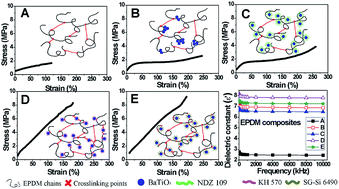
Fig. 7 illustrates the strain–stress curves of EPDM composites as well as the dispersion models of BaTiO3 particles in EPDM matrix. The addition of untreated BaTiO3 can not increase the 100% modulus and tensile strength of EPDM composites because of the agglomeration of BaTiO3 particles in EPDM matrix. It is also observed that the weak and physical adherence of untreated BaTiO3 particles to EPDM matrix can increase the elongation at break from 119% to 252%.
The treatment of coupling agent NDZ109 brings slight increase on mechanical properties of EPDM composites, because the crosslink density of EPDM with NDZ109 treated BaTiO3 is slightly higher than that of EPDM with untreated BaTiO3. The dodecyl on BaTiO3 particles can not only prevent BaTiO3 from agglomerating, but also can physically entangle with EPDM matrix. In this way, the elongation at break and tensile strength of EPDM with NDZ109 treated BaTiO3 have a little increase compared with EPDM with untreated BaTiO3.9,29
In addition, EPDM with KH570 and SG-Si6490 treated BaTiO3 all show higher tensile and tear strength than EPDM with untreated and NDZ109 treated BaTiO3. This is because both KH570 and SG-Si6490 have C
C bonds, which can generate chemical cross-linking points between BaTiO3 particles and EPDM matrix. Thereby, crosslink density, modulus at 100% and tensile strength of EPDM composites all increase. In addition, the functional groups of SG-Si6490 on BaTiO3 has long hydrocarbon chains, which have more physical entanglement with EPDM matrix than KH570 treated BaTiO3. In this way, although EPDM with SG-Si6490 treated BaTiO3 has lower crosslink density than EPDM with KH570 treated BaTiO3, the tensile strength of the former is a little higher than the latter.
Compared to EPDM with untreated BaTiO3, surface treatment of BaTiO3 with KH570 and SG-Si6490 can lower the elongation at break. This can be explained by the fact that the extra formed C–C linkage are much rigid.12 Thus, EPDM with KH570 and SG-Si6490 treated BaTiO3 exhibit lower value of elongation at break than EPDM with untreated BaTiO3.
Due to the presence of BaTiO3 particles, there is interfacial polarization at the interface between BaTiO3 and EPDM matrix. Generally, the relative dielectric constant is mainly correlated with the ability to polarize. The relative dielectric constant can change with the variation of polarizability. Thus, the results of surface tension of functional groups on the surface of BaTiO3 can support the results of relative dielectric constant of EPDM composites.20,21
The surface modification of BaTiO3 can increase the dielectric loss of EPDM composites. The dielectric loss values of EPDM composites follow the order: EPDM with KH570 treated BaTiO3 > EPDM with SG-Si6490 treated BaTiO3 > EPDM with NDZ109 treated BaTiO3 ≈ EPDM with untreated BaTiO3 ≈ EPDM control. The dielectric loss tangent is ascribed to the viscous drag of BaTiO3 particles which correlates with polar surface tension of particles. The higher the polarity on surface of BaTiO3 particles can cause higher value of dielectric loss tangent.
In addition, the relative dielectric constant of EPDM with various coupling agents remain almost unchanged in the frequency range of 20 kHz–10 MHz, while dielectric loss decline in that range.
Fig. 10 shows the dielectric loss factor (defined as tan
δ = ε′′/ε′) of EPDM composites. It is shown that the dielectric loss factors of EPDM composites are close to each other, and that EPDM with KH570 treated BaTiO3 has the highest dielectric loss factor among all EPDM composites.
In literatures, Cole–Cole model and Debye relaxation are often used to evaluate the dielectric properties of compostes.32–36 Cole–Cole semicycles are often shown by the plot of dielectric constant versus dielectric loss.29 Fig. 11 illustrates the curves of dielectric loss versus dielectric constant of EPDM samples. There are Cole–Cole semicycles found for EPDM with untreated BaTiO3, EPDM with KH570 treated BaTiO3 and EPDM with SG-Si6490 treated BaTiO3 composites. Every semicycle can be correlated to one Debye relaxation, due to the interfacial polarization. NDZ109 treated BaTiO3 possesses the lowest polar surface energy, so there is not obvious semicycle found in curves of EPDM with NDZ109 treated BaTiO3 composites, meaning the interfacial polarization between NDZ109 treated BaTiO3 and EPDM matrix is the lowest.
| Sample | EPDM Control | EPDM with untreated BaTiO3 | EPDM with NDZ109 treated BaTiO3 | EPDM with KH570 treated BaTiO3 | EPDM with SG-Si6490 treated BaTiO3 |
|---|---|---|---|---|---|
| Volume resistivity (Ω m) | 1.57 × 10¹⁵ | 1.49 × 10¹³ | 2.87 × 10¹² | 3.38 × 10¹³ | 1.42 × 10¹³ |
| Surface resistivity (Ω) | 5.01 × 10¹² | 1.46 × 10¹² | 3.85 × 10¹¹ | 3.47 × 10¹¹ | 1.93 × 10¹¹ |
C bonds from vinyl groups in SG-Si6490 can participate into cure process and generate chemical bonds between BaTiO3 particles and EPDM matrix, greatly enhancing crosslink density of EPDM composites.
When the filler loading of untreated BaTiO3 is at 30 vol%, the dielectric constant of EPDM control can increase from around 2 to 7 at 10 MHz. Moreover, KH570 and SG-Si6490 treated BaTiO3 particles can further increase the dielectric constant from 7 to around 8. However, compared to untreated BaTiO3, NDZ109 treated BaTiO3 particles can decrease the dielectric constant and loss of EPDM composites. As for some EPDM composites, there are Cole–Cole semicycles shown in curves of dielectric constant versus dielectric loss, due to strong interfacial polarization.
The surface treatment of BaTiO3 with coupling agents can introduce functional groups to particle surface and reduce the polar surface tension of BaTiO3 particles, shown by the contact angle results. The non-polar dodecyl and benzene groups in NDZ109 can lower the polar surface energy of BaTiO3 from 37.53 mJ m−2 to 0.77 mJ m−2. The decreased polar surface tension can increase the bound rubber content of EPDM gum and decrease the volume resistivity of EPDM to the greatest extent. The dispersion properties show that treated BaTiO3 change from hydrophilic to oleophilic. The SEM results show that the interaction between filler and EPDM has been improved.
| This journal is © The Royal Society of Chemistry 2015 |