Zhijian Zhang,
Guorong Hu,
Yanbing Cao*,
Jianguo Duan,
Ke Du and
Zhongdong Peng
School of Metallurgy and Environment, Central South University, Changsha 410083, China. E-mail: cybcsu@csu.edu.cn; Fax: +86-0731-88830474; Tel: +86-1387-5868540
First published on 21st September 2015
A series of LiMnPO4 nanoparticles with different morphologies have been successfully synthesized via a solvothermal method. The samples have been characterized by X-ray diffraction (XRD), scanning electron microscopy (SEM), transmission electron microscopy (TEM). The results show that the morphology, particle size and crystal orientation are controllably synthesized by various precursor composite tailoring with various Li
:
Mn
:
P molar ratios. At 3
:
1
:
1, a Li+-containing precursor Li3PO4 is obtained while at 2
:
1
:
1, only a Mn2+-containing precursor involving Mn5(PO4)2[(PO3)OH]2·4H2O and MnHPO4·2.25H2O is detected. Especially, at 2.5
:
1
:
1, the precursor consists predominantly of a Mn2+-containing precursor with a minor amount of Li3PO4. From 2
:
1
:
1 to 3
:
1
:
1, the particle morphology evolves from sheet to spherical texture accompanied with the particle size reducing. In the presence of urea, highly uniform LiMnPO4 with a hierarchical micro-nanostructure is obtained, which is composed of nanosheets with a thickness of several tens of nanometers. Thus, these unique hierarchical nanoparticles with an open porous structure play an important role in the LiMnPO4 cathode material. At a concentration of 0.16 mol L−1 for urea, the hierarchical LiMnPO4/C sample assembled from nanosheets with the (010) facet exposed shows the best electrochemical performance, delivering higher reversible capacity of 150.4, 142.1, 138.5, 125.5, 118.6 mA h g−1 at 0.1, 0.2, 0.5, 1.0, 2.0C, respectively. Moreover, the composites show long cycle stability at high rate, displaying a capacity retention up to 92.4% with no apparent voltage fading after 600 cycles at 2.0C.
:
Mn
:
P molar ratio of 3
:
1
:
1 or even more.12,13 Up to now, EG based solvent has been successfully used to prepare micro- and nano-structure LiMPO4 (M = Fe, Mn, Ni) for lithium ion-batteries, and the morphology could be easily tuned by altering the synthesis condition or selecting different raw materials, such as the concentration, solvent, temperature and time, pH valve, feeding sequence and the surfactant.6,8,14–18 However, It is rarely reported the effect of the phase composition in the precursor solution or Li
:
Mn
:
P molar ratio on the morphology and structure of LiMnPO4. Thus, it deserves further research to reveal the role that phase composition or Li
:
Mn
:
P molar ratio play in the preparation of LiMnPO4. With this perspective, we report the morphology controllable synthesis of LiMnPO4 tailoring with the molar ratio of Li
:
Mn
:
P by solvothermal method, using ethanol as green solvent, LiH2PO4, LiOH·H2O and MnSO4·H2O as the starting material, as illustrated in Scheme 1.
![]() | ||
Scheme 1 The morphology controllable solvothermal process by tailoring with the Li : Mn : P molar ratio. | ||
On the other hand, it is hard to control the morphology, especially for highly uniform particles with nanostructure. Generally, the nanoparticles prefer to agglomerate together, which in turn constantly limits the demonstration of its intrinsic performance. In this regard, LiMnPO4 nanoparticles with a novel hierarchical micro-nanostructure are expected as a new prototype to minimize the self-agglomeration and re-stacking and also facilitate physical properties at macroscale.
Herein, a urea assisted solvothermal method was proposed for the growth of hierarchical micro-nanostructured LiMnPO4 by controlling the molar ratio of Li
:
Mn
:
P at 2
:
1
:
1. To fully demonstrate the effect of urea, the concentration of urea was optimized. With the morphology and composition advantages, the as-prepared LiMnPO4/C is expected to manifest superior electrochemical performance, especially, the high rate capacity and long cycle stability.
:
1) as follows: various amount of LiOH aqueous solution was added drop-wise into the LiH2PO4–EG–H2O solution under vigorous stirring, and then CTAB (hexadecyl trimethyl ammonium bromide, 0.015 mol L−1) was dissolved in the above white suspension followed by MnSO4 aqueous solution introduced into the mixture. The final mixture was transferred to a 300 mL stainless steel autoclave. The concentration of Mn2+ in the precursor solution was controlled to be 0.1 mol L−1. The solvothermal reaction was carried out at 220 °C for 4 h to form a white precipitation. After that, white particles were collected via centrifugation, washed with distilled water three times, absolute ethanol twice. After dried in a vacuum oven at 60 °C for 12 h, the as-prepared LiMnPO4 was mixed and ground with PVA (20 wt%), and then annealed at 670 °C for 4 h (3 °C min−1) under an Ar atmosphere to carbonize glucose and increase the crystallinity of the LiMnPO4 material. The mass percentage of carbon was determined by carbon sulfur analyzer to be about 3.4 wt%. The molar ratio of Li
:
Mn
:
P was controlled at 2
:
1
:
1, 2.5
:
1
:
1 and 3
:
1
:
1 by adjusting the added amount of LiOH, and the product was named s-1, s-2 and s-3. During the series experiments in the presence of urea, the molar ratio of Li
:
Mn
:
P was 2
:
1
:
1, while the concentration of urea was controlled at 0.08, 0.12, 0.16, 0.2 mol L−1, namely s-4, s-5, s-6, and s-7, respectively.
:
15
:
10 was pasted on an Al foil, which works as a current collector. A Celgard 2340 microporous membrane was used as the separator and lithium foil was used as the counter electrode. The non-aqueous electrolyte was 1 M LiPF6 solution in ethylene carbonate, dimethyl carbonate, and methyl-ethyl carbonate with a volume ratio of 1
:
1
:
1 (LIB 315, Guotai Huarong Chem. Co., Ltd, Zhangjiagang, China). The electrochemical tests were carried out at room temperature on a Land Test System (CT2001A, Wuhan Jinnuo Eletronic Co., Ltd, Wuhan, China) setting the cut off voltages of 2.50–4.50 V versus Li+/Li (1C = 160 mA g−1).
:
Mn
:
P molar ratio
:
Mn
:
P molar ratio. The XRD pattern of the product obtained from various molar ratio are presented in Fig. 1. It can be clearly seen that all samples are single phase which can be indexed to the orthorhombic olivine structure with a Pmnb space group (JCPDS card no. 74-0375). Upon closer observation, the relative peak intensities change with the molar ratio variation of Li
:
Mn
:
P. The diffraction intensity from the (020) facet is strongest at 2
:
1
:
1, while the highest intensity at 3
:
1
:
1 comes from the (311) facet. This may indicate that the as-obtained sample at 2
:
1
:
1 has a preferential crystal orientation along the [010] direction, which is favorable to the Li+ diffusion due to the fact that LiMnPO4 has a one-dimension migration path along the b axis.9,19 Fig. 2 shows the SEM images of the samples tailoring with different Li
:
Mn
:
P molar ratio. At 2
:
1
:
1, a novel morphology was obtained. As shown in Fig. 2a, the sample consists of sheet-like crystals with the thickness of several tens of nanometers, a mean length of ∼450 nm, an average width of ∼300 nm, in which the small crystals attach together irregularly to assemble into hierarchical structure with open porousness. But unfortunately, the hierarchical structure is not open enough, thus we carried out the urea assisted solvothermal method to effectively take advantage of those novel morphology which will be discussed later in detail. When the molar ratio is prolonged to 2.5
:
1
:
1, LiMnPO4 composed of sheet-like crystals similar to 2
:
1
:
1 is obtained. It is clearly seen that the obtained sample was randomly dispersed with well-defined shape, in which the sheet-like crystals have a uniform particle size distribution. For instance, the length is varied from 250 nm to 500 nm, while the width from 150 nm to 450 nm. When the molar ratio increased to 3
:
1
:
1, the particles are near-spherical with an average diameter of several tens of nanometers. Obviously, the particles are seriously agglomerated, which will bring negative effects on the electrochemical performance. It is worth noting that, when increasing the molar ratio of Li
:
Mn
:
P, a smaller particle size is achieved, indicating that excess Li was favorable for attaining small particle size for LiMnPO4, in well agreement with the previous study.20,21
![]() | ||
Fig. 1 The XRD pattern of the sample tailoring with different Li : Mn : P molar ratio: (a) 2 : 1 : 1; (b) 2.5 : 1 : 1; (c) 3 : 1 : 1. | ||
![]() | ||
Fig. 2 The SEM images of samples tailoring with different Li : Mn : P molar ratio: (a) 2 : 1 : 1; (b) 2.5 : 1 : 1; (c) 3 : 1 : 1. | ||
To further understand the evolution of morphology and the diversity of particle size. The structure and morphology of the precursors from the mother solution before solvothermal treatment were characterized. The XRD patterns of the dried precursors synthesized at room temperature are presented in Fig. 3. The phase composition of the precursor is strongly affected by the molar ratio of Li
:
Mn
:
P. From the XRD patterns, obviously, Mn2+-containing precursor involving Mn5(PO4)2[(PO3)OH]2·4H2O (JCPDS card no. 34-0146) and MnHPO4·2.25H2O (JCPDS card no. 47-0199) is stable at the off-stoichiometry, leaving Li+ freely existing in the mother solution, as the molar ratio of Li
:
Mn
:
P increased, Li3PO4 phase (JCPDS card no. 25-1030) is detected. When increased to 3
:
1
:
1, no other phase but Li+-containing precursor Li3PO4 is identified, while the manganese salt phases cannot be detected. Fig. S1† shows the SEM images of the dried precursors, clearly, at 3
:
1
:
1, the particles exhibit spherical texture similar to that of the resultant product LiMnPO4, indicating that LiMnPO4 is most likely formed by an in situ evolution from the precursor Li3PO4 in the solvothermal method, in agreement with previous research.22 In the EG based solvothermal condition in which water is almost highly deficient is not likely able to dissolve the starting material Li3PO4 to form the intermediate phases such as Mn3(PO4)2, MnHPO4, which are known as the dissolution–reprecipitation process in the hydrothermal method similar to LiFePO4.23,24 Thus, the Li3PO4 may plays as an hard template to form LiMnPO4 directly. At 2
:
1
:
1, the precursor also presents the spherical texture different with the subsequent product, which may due to the multi-phases in the precursor solution, in which case the crystal units may contain more than one nucleus with different orientation and growth rates. In addition, such remarkable divergence in precursor solution results in different released ions from the precursor with various types or priority orders, leading to the different nucleation or growth rates. In this regard, the distinction in morphology is caused by the different solution composition generated by adjusting the molar ratio of Li
:
Mn
:
P.
![]() | ||
Fig. 3 The XRD pattern of the precursors tailoring with different Li : Mn : P molar ratio: (a) 2 : 1 : 1; (b) 2.5 : 1 : 1; (c) 3 : 1 : 1. | ||
Based on the above results, it can be reasonably understood that the molar ratio of Li
:
Mn
:
P has a great effect on the phase composition of the precursor, which will control the morphology and particle size of the LiMnPO4 crystals in the solvothermal process. To further confirm the roles of molar ratio of Li
:
Mn
:
P, also, taking advantage of the sheet-like crystals with preferred orientation of [010] direction, a set of independent experiments were carried out where urea was mainly used as the alkaline reagent.
According to the SEM images in Fig. 5, the morphologies are not obviously changed by varying the concentration of urea, and all the samples are composed of sheet-like crystals, which indicates that urea can act as an alkaline reagent for the formation of LiMnPO4 phase and has no obvious role in changing the shape of the LiMnPO4 crystals. Therefore, it is believed that the phase composition of the precursor has a great effect on the morphology of LiMnPO4 instead of the pH when tailoring with the molar ratio of Li
:
Mn
:
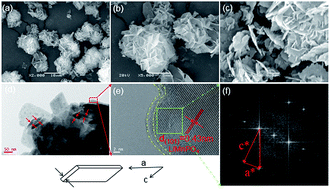
P. In addition, the LiMnPO4 crystals assemble regularly to form the flower-like structure with more open porousness gradually, as increasing the concentration of urea. For the closed observation in Fig. 5, we can see that the particle size become smaller with the increasing amount of urea, as well as less agglomeration, indicating that urea is useful to reduce agglomeration and inhibit particles from growing. Importantly, when the concentration of urea is increased to 0.16 mol L−1, the sample consists of nanosheets with flower-like texture. As shown in Fig. 6a–c, the flower-like sample is uniformly dispersed with well-defined micro-nanostructure. Obviously, the nanosheets crosslink together forming an open porous structure with an average thickness of several tens of nanometers, which further demonstrates their loose-packed flowery architecture. From the Fig. 6d, it is clear that the hierarchical structure can be maintained after the thermal treatment, which may be due to the fact that the relative low calcination temperature and short calcination time was employed during the thermal treatment, also the decomposed carbon can hinder agglomeration. Thus, those highly hierarchical structure constructed from the attached sheet-like crystals is beneficial to reduce the transport lengths for both electron and ion for the large surface areas readily accessible to electrolyte compared with the bulk material. Furthermore, the micro-nanostructure enables easy operation in terms of electrode fabrication and high tap density, compared with the nanoparticles. In addition, from the HRTEM image in Fig. 6e, the sample exhibits a set of lattice fringe with the d spacing value of 0.43 nm, which is indexed to the (101) facet of LiMnPO4. Importantly, the sample has a uniform and perfect carbon coating on the surface of LiMnPO4 with a thickness of around 2 nm, which is beneficial to the electron transfer. It also reveals that the flower-like sample is a single crystal from the clear lattice fringe, which is further confirmed by the FFT pattern with regular spots. A more detailed analysis of FFT pattern reveals that the sample exhibits an exposed (010) as shown in Fig. 6f. Combination the XRD, TEM, HRTEM and FFT pattern, we could further confirm that the b axis of the sheet-like crystals are parallel to the electron beam direction [010], indicating that the product of the flower-like sample exposes a large (010) facet and the [010] direction is the thinnest direction of the particle, which is an optimal situation for LiMPO4 (M = Mn, Fe) cathode material with favorable lithium ion migration owing to the known fact that lithium (de)insertion in LiMPO4 (M = Mn, Fe) is along the b axis.28,29
![]() | ||
| Fig. 5 The SEM images of the samples with various concentration of urea: (a) 0 mol L−1; (b) 0.08 mol L−1; (c) 0.12 mol L−1; (d) 0.16 mol L−1; (e) 0.2 mol L−1. | ||
:
Mn
:
P molar ratio increased further, the sample s-3 exhibits the spherical nanoparticles with smaller particle size. However, it exhibits agglomeration to some degree, which is adverse to the effective contact between electrolyte and active material, as well as additive Super P carbon between nanoparticles during the fabrication of the composite electrodes. In addition, the mainly exposed facet is different with the (010). In a word, the electrochemical performance of LiMnPO4 is significantly affected by the morphology and structure.
![]() | ||
| Fig. 7 The electrochemical performance of the typical LiMnPO4/C samples: (a) the initial discharge curve at 0.1C; (b) the rate capacity from 0.1C to 2.0C. | ||
Long cycle performance is one of the significant electrochemical aspects of lithium-ion batteries for high power applications. The cycle performance of the flower-like LiMnPO4/C is shown in Fig. 8a. The cells were cycled at 2.0C in the voltage range of 2.5–4.5 V. As shown in Fig. 8b, the initial discharge capacities of LiMnPO4 sample is 109.6 mA g−1 with a potential plateau of about 4.0 V. As usual, upon increasing the cycle number, the samples exhibit slight polarization, which is reflected in the term of potential difference between the charge–discharge plateaus, thereby declining the storage capacity of the electrode. However, the flower-like sample displays excellent cycle stability with a negligible voltage fading after 600 cycles at 2.0C, showing a capacity retention up to 92.4%, which indicates that those novel morphology can obviously improve the cycle behaviour, especially at high rate.
![]() | ||
| Fig. 8 The cycle performance of the flower-like LiMnPO4/C: (a) the cycle curve at 2.0C for 600th; (b) the charge–discharge profile after 1st and 600th. | ||
:
Mn
:
P. From 2
:
1
:
1 to 3
:
1
:
1, the particle morphology evolves from sheet-like to spherical texture while the particle size reduced, accompanied with the phase composition from Mn2+-containing precursor to Li+-containing precursor. In addition, the urea is used to further confirm the conclusions, in which the urea has no obvious effect on the morphology, but prevent crystals from growing and reduce the agglomeration. At the concentration of 0.16 mol L−1, the sample consists of small sheet-like crystals with flower-like texture, delivering excellent reversible capacity of 150.4, 125.5, 118.6 mA h g−1 at 0.1, 1.0, 2.0C, respectively. The composites show long cycle stability at high rate, displaying a capacity retention up to 92.4% with no apparent voltage fading after 600 cycles at 2.0C. The attracting electrochemical performance of the flower-like LiMnPO4/C composites suggests that the unique 3D hierarchical structure with (010) facet exposed and well carbon decorated is a promising way for high power Li-ion batteries electrode materials. Combination of the simple and facile synthesis method, it may also be applicable for the other olive type cathode materials such as LiFePO4, LiCoPO4 that require electrodes with high electronic and ionic conductivity.
Footnote |
| † Electronic supplementary information (ESI) available. See DOI: 10.1039/c5ra14040d |
| This journal is © The Royal Society of Chemistry 2015 |