Using the Taguchi method to investigate the effect of different parameters on mean diameter and variation in PA-6 nanofibres produced by needleless electrospinning

A. Nazir*ab, N. Khenoussib, L. Schacherb, T. Hussaina, D. Adolpheb and A. H. Hekmatibc
aDepartment of Textile Processing, National Textile University, Sheikhupura Road, Faisalabad (37610), Pakistan. E-mail: ahsan.nazir@uha.fr; ahsan@ntu.edu.pk
bUniversité de Haute-Alsace – ENSISA – Laboratoire de Physique et Mécanique Textiles, 11 rue Alfred Werner, 68093 MULHOUSE CEDEX, France. Fax: +33 (0)3 89 33 63 39; Tel: +33 (0)3 89 33 63 20
cDepartment of Textile Engineering, Faculty of engineering, South Tehran Branch, Islamic Azad University, Tehran, Iran

Received 12th July 2015 , Accepted 4th September 2015

First published on 4th September 2015


Abstract

Employing different types of fibre generators, needleless electrospinning gives much higher fibre production rates as compared to needle-based techniques. In the present study, the effect of various process parameters on the mean diameter and variation in PA-6 nanofibers produced by the needleless electrospinning method, was investigated. Based on the Taguchi design and analysis of experiments, it was concluded that polymer concentration is the most influential factor affecting the mean fibre diameter, followed by distance between the electrodes, air flow, substrate speed, polymer carrier speed and the voltage difference. Mean fibre diameter and standard deviation were found to increase with increase in polymer concentration, polymer carrier speed and the collector substrate speed. With the help of the Taguchi method, it was not only possible to rank different factors in the order of their magnitude of effect on mean fibre diameter but also to find the optimum factor levels for minimum fibre diameter with minimum standard deviation.

Introduction

Needleless electrospinning has been developed to increase the productivity of the electrospinning process by generating multiple fibre forming jets from a polymer solution supported on a suitable support. This technique has been found to produce very encouraging results for bulk scale production of nanowebs. As with needled electrospinning setups, the needleless technique also utilizes a high voltage to draw the polymer jets into nanofibres but in needle-based electrospinning, the polymer solution is not guided through a nozzle or needle but it is present as a controlled free surface solution on a suitable support that could be in the form of a cylinder, a wire or a liquid surface.1

Different needleless electrospinning setups have been developed in last decade.2 Yarin and Zussman, one of the pioneers of needleless electrospinning, developed a system by supporting a polymer solution on a ferromagnetic liquid which produced vertical spikes due to perturbation under a magnetic field. The spikes, when subjected to an electric field, turned to source of polymer jets for nanofibres.3 Another needleless system was developed by Jirsak and co-workers and has now been commercialized. In this system, the polymer jets are produced from solution coated on a cylinder from a bath below it.4 Similarly, many other techniques have been employed for fibre jet generation in electrospinning, including conical wire coil,5 rotating cone electrode,6 metal roller spinneret7 and some other novel setups.1 Some of these systems have been shown schematically in Fig. 1.


image file: c5ra13649k-f1.tif
Fig. 1 Schematic representation of some needleless electrospinning setups with emphasis on fibre generators. Where (a) uses a cylinder, whose lower end is dipped in polymer solution, as a fibre generator; (b) uses a disk as fibre generator; (c) uses a rotating spiral coil as fibre generator; (d) employs a rotating ball as fibre generator.

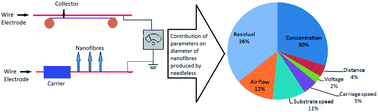
Another important type of needleless electrospinning (which is also the focus of current study) has been commercialized by Elmarco under its brand name “Nanospider”. This system is based on “free surface technology” that generates nanofibres by electrostatic force between two wire electrodes, one of which is coated with polymer solution using a solution carriage that coats an even layer of solution on electrode as it moves in a to and fro fashion on it. A substrate is allowed to move between the electrodes in order to collect the electrospun fibres. A continuous air flow is maintained inside the chamber in order to facilitate the evaporation of solvent as the fibres move between the electrodes. A schematic diagram of this system is shown in Fig. 2.


image file: c5ra13649k-f2.tif
Fig. 2 Schematic representation needleless electrospinning system producing nanofibres with wire electrode as fibre generator.

Each electrospinning setup allows controlling the properties of fibres using some basic parameters. Most common amongst them are solution concentration and viscosity, applied voltage, distance between electrodes and the environment inside spinning chamber including air flow. Normally, within the spinable viscosity range the fibre diameter increases with increasing viscosity (and polymer solution concentration).8,9 A high voltage, generally, reduces the fibre diameter by applying higher stretching force;10,11 however, it may also increase the diameter due to lower stretching time.12 Similarly, increasing the distance between fibre generator (for example, needle for needled electrospinning) and collector, on one hand, decreases the fibre diameter due to higher flight time;13,14 but on the other hand it increases the diameter due to decreased electric field intensity at higher distances.10 So, within a certain range of distance the diameter decreases and beyond that range it starts to increase because of leading role of decreased electric field intensity. In the same way, the environment within the electrospinning chamber also plays an important role in determining the fibre diameter by affecting the rate of solvent evaporation.15

Although effects of most of the electrospinning parameters on fibre properties have been investigated by different researchers for needle-based electrospinning, there have been a limited number of studies on needleless electrospinning, based on the statistical design of experiments (DOE) for investigating the effect of these parameters on output properties such as fibre diameter. Different DOE approaches have, successfully, been employed for optimization and improvement of industrial processes since Sir R. Fisher highlighted the significance of these approaches.16 One of the commonly used types of statistical DOE is full factorial design. However, the number of experimental runs in such a design is quite high for large number of factors and their levels. The Taguchi methodology, developed by Dr Genichi Taguchi, is a statistical tool that aims at optimization of a manufacturing process by reducing variations in it at design phase.17,18 Taguchi designs of experiments offer a powerful and efficient method for investigating effect of different process parameters as well as for determining optimum process conditions for consistent output at the desired level.19 This approach focuses on elimination of deficiencies in a product before the actual process is started and is based on three design stages i.e. system design, parameter design and tolerance design.20 For system design basic scientific/engineering knowledge is used to design a system by identifying the factors affecting it as well as the best value of each factor. In parameter design stage, magnitudes of important factors are adjusted and significance of their impact on process and product are identified and best parameter values are determined. The basic goal of a parameter design is to minimize the variation in process and keep it close to the ideal by identifying the best values of parameters. The tolerance design identifies the limits of parameters of a process, thus reducing the variation in it.

Taguchi methodology uses standard tables, termed as orthogonal arrays, to arrange the combination parameter values in experimental design. It employs three different options for target design; i.e. “bigger is the better”, “smaller is the better” and “nominal is the better”. The choice of these targets depends on the type of process and product. For our case, we have chosen “smaller is the better” to get best designs with minimum fiber diameters.

The number of experiments in Taguchi designs is far lower than full factorial designs which make them an attractive alternative to the factorial designs. For example, for five factors each at three levels, total number of experiments in a full factorial design would be 35 = 243. However, using Taguchi design of experiment, the effect of five factors at three levels can be investigated with only 27 experiments. The aim of the present study is to investigate the effect of different process parameters on the mean fibber diameter and variation in the diameter of PA-6 nanofibres produced by needleless electrospinning method using Taguchi approach.

Experimental

Electrospinning solution was prepared by dissolving Nylon 6 (obtained from Acros Organics, USA; Mw = 10[thin space (1/6-em)]000) in formic acid 90% (obtained from Fisher Scientific, France) at three different concentrations i.e., 18, 19 and 20 w/w%. The solution was stirred for 24 h on a magnetic stirrer at room temperature. It was electrospun on a spunbond nonwoven collector (100% polypropylene, 35 g per sq. m) using Elmarco's Nanospider (NS 1WS500U series), a wire-electrode needleless electrospinning system. The parameters and their levels studied in this work are given in Table 1. Experimental design was developed according to Taguchi approach using Minitab 16 statistical software. The samples were gold-coated using a basic sputter coater working at 2.0 kV at 20 mA for 2 minutes The fibres obtained were analysed using a scanning electron microscope (FEI Quanta 250) and mean diameter from100fibres (randomly selected from 3 replicates of a sample) was measured using image analysis software (Image J). Statistical analysis of the data was performed using Minitab 16 software, by performing analysis of variance and depiction of main effects mean and standard deviation of the nanofibre diameter. The standard deviation of fibre diameter was particularly investigated to study the effect of inputs on variation in fibre diameter. The Taguchi model was validated by predicting diameter of four new combinations of experimental variables (not included in the original experimental design), and by comparing the predicted results of these combinations with the experimental results.
Table 1 Experimental parameters and their levels
No. Process parameter Abbreviation Units Level 1 Level 2 Level 3
1 Solution concentration C % (w/w) 18 19 20
2 Distance between electrodes D Mm 260 275 290
3 Voltage difference V kV 35 45 55
4 Speed of polymer carrier Cs mm s−1 290 340 390
5 Substrate speed Ss mm s−1 15 20 25
6 Air flow Af m3 h−1 120 130 140


Results and discussion

The design of experiments and the output diameter achieved at each of the set of inputs is mentioned in Table 2.
Table 2 Experimental design with mean fibre diameter (nm) and standard deviation (SD)
Exp. no. Process parameters Fibre diameter
C D V Cs Ss Af Mean (nm) SD
1 18 260 35 290 15 120 139 26
2 18 260 35 290 20 130 132 26
3 18 260 35 290 25 140 200 68
4 18 275 45 340 15 120 197 77
5 18 275 45 340 20 130 183 52
6 18 275 45 340 25 140 167 48
7 18 290 55 390 15 120 159 40
8 18 290 55 390 20 130 146 24
9 18 290 55 390 25 140 184 38
10 19 260 45 390 15 130 138 24
11 19 260 45 390 20 140 237 54
12 19 260 45 390 25 120 273 85
13 19 275 55 290 15 130 138 32
14 19 275 55 290 20 140 207 37
15 19 275 55 290 25 120 195 67
16 19 290 35 340 15 130 160 37
17 19 290 35 340 20 140 178 34
18 19 290 35 340 25 120 184 39
19 20 260 55 340 15 140 233 59
20 20 260 55 340 20 120 185 35
21 20 260 55 340 25 130 258 112
22 20 275 35 390 15 140 245 79
23 20 275 35 390 20 120 274 111
24 20 275 35 390 25 130 180 48
25 20 290 45 290 15 140 167 31
26 20 290 45 290 20 120 237 90
27 20 290 45 290 25 130 220 41


Effect of solution concentration on fibre diameter

From analysis of variance (Table 3), it could be inferred that concentration of polymer (C) in spinning solution plays a significant role in determining the diameter of nanofibres. Its percentage contribution (30%) strongly supports the fact that it is the major factor influencing the fibre diameter. The same could be observed from response table for means (Table 4) that ranks the effect of inputs on outputs. The tables include ranks based on delta statistics, which compare the relative magnitude of effects. The delta statistic is the highest minus the lowest average for each factor.
Table 3 Analysis of variance (ANOVA) for means of diametera
Source P % contribution
a Where “P” represents the significance of an input parameter and ranges between 0–1. A lower P-value suggests the effect of an input parameter on output is more significant.
C 0.014 30
D 0.485 4
V 0.635 2
Cs 0.414 5
Ss 0.164 11
Af 0.123 12
Residual 36
Total 100


Table 4 Response table for means and standard deviation
Level Diameter Standard deviation
1 2 3 Delta Rank 1 2 3 Delta Rank
C 168 190 223 54.6 1 44 46 67 22.8 1
D 200 200 182 17.7 5 54 61 42 19.7 2
V 189 203 190 14.1 6 52 56 49 6.6 6
Cs 182 194 204 22 4 46 55 56 9.5 5
Ss 176 198 207 31.8 3 45 51 61 15.5 4
Af 205 173 203 32.1 2 63 44 50 19.4 3


The ranks are assigned based on delta values; rank 1 to the highest delta value, rank 2 to the second highest, and so on. The concentration has rank 1, which indicates that it is the most highly influential factor both for the mean and standard deviation of fibre diameter. The highest value of delta for concentration also indicates that the highest magnitude of change in fibre diameter results due to change in the polymer solution concentration.

As shown in Fig. 3, increasing concentration increases the fibre diameter linearly. This is in line with some previous studies on needled electrospinning setups which suggest that increasing the polymer concentration and hence the solution viscosity increases the diameter of fibres.9


image file: c5ra13649k-f3.tif
Fig. 3 Effect of input parameters on mean fibre diameter.

Similarly, solution concentration also affects the diameter distribution (indicated by standard deviation) more than any other parameter as confirmed by its highest rank in response surface table (Table 4). From Fig. 4, it could be observed that increasing the concentration increases diameter distribution within a sample. Particularly, the trend becomes sharper at higher solution concentrations, which suggests that concentrations beyond an optimum range produce nanofibres with large variation in their diameters.


image file: c5ra13649k-f4.tif
Fig. 4 Main effects plot for standard deviation.

Effect of distance between electrodes on fibre diameter

Although distance between the electrodes also affects the fibre diameter, as shown in Fig. 3, it was observed that its contribution towards affecting the diameter is only about 4% (Table 3). This fact is also evident in response table for means (Table 4), where it is ranked at 5th position.

This fact is also evident in response table for means, where it is ranked at 5th position. From Fig. 3, it could be observed that increase in the distance between the electrodes results in decrease in the fibre diameter. According to Reneker and co-workers,13 this could be due to higher flight times for bending instabilities to operate longer and hence produce thinner fibres. Bending instability occurs during the flight of polymer when the jet starts to whip after a straight path motion, normally when most of the solvent evaporates. During bending instability the fibre faces very high stretching that leads to decrease in its diameter.21 It could also be observed from Fig. 3 that a higher decrease in diameter has been observed as the distance between electrodes is increased beyond a certain level.

This could be attributed to the fact that after evaporation of the solvent, the fibres thinning increases tremendously due to initiation of bending instabilities thus causing a much larger decrease in fibre diameter after a critical flight time.

Distance between the electrodes is ranked as the second most important factor affecting the variation in diameter, as shown in Table 4.

From Fig. 4, it could be observed that variation in diameter is lower for the highest distance between electrodes. This could be due to the larger distance allowing the fibres more uniform mass distribution.

However, it could be noticed that there is an increase in standard deviation at intermediate distances. This trend needs to be investigated further in detail in some focused studies.

Effect of distance between electrodes on fibre diameter

Although distance between the electrodes also affects the fibre diameter, as shown in Fig. 3, it was observed that its contribution towards affecting the diameter is only about 3% From Fig. 3, it could be observed that increase in the distance between the electrodes results in decrease in the fibre diameter. According to Reneker and co-workers,13 this could be due to higher flight times for bending instabilities to operate longer and hence produce thinner fibres. Bending instability occurs during the flight of polymer when the jet starts to whip after a straight path motion, normally when most of the solvent evaporates. During bending instability the fibre faces very high stretching that leads to decrease in its diameter.21 It could also be observed from Fig. 3 that a higher decrease in diameter has been observed as the distance between electrodes is increased beyond a certain level.

This could be attributed to the fact that after evaporation of the solvent, the fibres thinning increases tremendously due to initiation of bending instabilities thus causing a much larger decrease in fibre diameter after a critical flight time.

Distance between the electrodes is ranked as the second most important factor affecting the variation in diameter, as shown in Table 4. From Fig. 4, it could be observed that variation in diameter is lower for the highest distance between electrodes.

This could be due to the larger distance allowing the fibres more uniform mass distribution. However, it could be noticed that there is an increase in standard deviation at intermediate distances. This trend needs to be investigated further in detail in some focused studies.

Effect of voltage difference on fibre diameter

It can be observed form Fig. 2 and 3 that increasing voltage difference first increases and then decreases the fibre diameter as well as fibre variation. The effect of increasing the voltage on fibre diameter is multidimensional. It increases the amount of polymer taken away by electrostatic forces from the wire electrode and decreases the time of flight of polymer jets; both these factors can reduce the fibre fineness.12 At the same time it also increases elongation of fibres as they travel between the electrode and collector due to higher force applied at higher voltages. This reduces the fibre diameter.10,22 From trend in Fig. 3 it could be observed that the first impact is dominant at the voltage below 45 kV while at higher voltage the second impact takes the lead. This behaviour may be explained due to production of higher perturbation on polymer surface, producing more fibre jets as the voltage is increased above 45 kV thus reducing the diameter of initial jet ejected from wire electrode due to reduced availability of polymer on wire electrode.3 Nevertheless, it can be noticed from the delta and ranks given in Table 4, which the effect of voltage is the least significant on fibre mean diameter and standard deviation, among the parameters investigated in this study.

Effect of carriage speed on fibre diameter

Carriage speed has been found to increase the fibre diameter with a directly proportional relationship (Fig. 3). Higher carriage speeds can be considered to produce similar effect as produced by higher feed rates in needled electrospinning.23 At higher carriage speeds more frequent replenishment of polymer coating on wire electrode takes place, resulting in a thicker layer and thus larger polymer take up by electrostatic forces. But, its contribution in determining the fibre diameter is quite low in rank (given in Table 4). Also, the variation in diameter increases with increase in fibre mean diameter, which is a general observation in present study.

Effect of substrate speed on fibre diameter

To the best of our knowledge, no significant work has been reported on the effect non-conductive substrate speed on the diameter of electrospun fibres. In the present work, the substrate speed was found to have a strong linear impact on fibre diameter such that by increasing the speed of substrate, the fibres turned coarser. From Tables 3 and 4, it could be observed that speed of substrate is the third most influential parameter to affect the fibre diameter. This shows that there must be some factors, defined by substrate speed, that have a strong impact on fibre diameter. In some previous works it has been observed that higher charge density as a result of lower charge drainage on non-conductive substrate decreases the number of fibres or their density on such collectors due to repulsive forces and decrease in potential difference between the emitter and collector.24,25 For certain polymers, the fibres collected on a substrate are known to carry a charge as high as 1 kV even after 20 h.26 Moreover, it has been found that growing deposition of charged fibres increases the overall charge of deposited fibres.27 Thus moving substrate out of the field reduces the growth of charge on it by reducing the growth of nanofibres at a single location. At higher substrate speed the rate of charge growth decreases that means a lower potential difference drop and a lower repulsion to on-flight fibres from charges on collected fibres thus decreasing the flight time and hence the drawing during shorter time for bending instability to operate. For lower substrate speeds the larger amount of charge accumulation on substrate and collected fibres takes place thus repelling the incoming fibres and causing them to “fly” for longer time and getting stretched. However, more work in area is required to confirm these observations and authors intend to carry out these studies in near future.

Effect of air flow on fibre diameter

Air flow has second highest contribution in controlling the fibre diameter as confirmed by its percentage contribution value and rank in Table 3 and 4. The high contribution of air flow could be due to the effect it produces on achieving the bending instability of fibrous jets.

The effect of air flow is quite complex. Increasing air flow enhances evaporation of solvent thus allowing the bending instabilities to operate earlier and result in thinner fibres. On the other hand, it also increases the viscosity of solution present on wire electrode thus increasing the fibre diameter. Both these effects can be observed in Fig. 3, where the diameter of fibres decreases below air flow of 130 m3 h−1 beyond which it starts to increase.

Conclusions

Taguchi technique was successfully employed for statistical analysis of different factors affecting the mean diameter and variation in PA-6 nanofibres. Polymer solution concentration was found to be the most significant input factor affecting the fibre mean diameter, followed by air flow, substrate speed, carriage speed, distance between the electrodes and the voltage difference. Variation in terms of standard deviation of the fibre diameter was also most significantly affected by the polymer solution, followed by distance between the electrodes, air flow, substrate speed, carriage speed and the voltage difference. High impact of residual factors (almost 35%) was found to influence mean fibre diameter. One of these factors could be the replenishment time in coating cycle of different areas of wire. Another could be the possible evaporation of solvent from the coater and the wire, resulting in increased viscosity. Still another factor is the residual charge density, which may vary with time of electrospinning. Many other factors may also be identified with focussed studies in the field. The authors of current work intend to carry out such studied to identify the residual factor and their impact on the wire-electrode needleless electrospinning.

For minimum mean fibre diameter and minimum standard deviation in the diameter, the optimum levels of parameters were found to be: polymer concentration 18%, distance between the electrodes 290 mm, carriage speed 290 mm s−1, substrate speed 15 mm s−1 and air flow 130 m3 h−1. The optimum voltage for minimum mean diameter was 35 kV and that for minimum standard deviation was 55 kV. Since, there is no significant difference in mean fibre diameter at 35 kV and 55 kV; the recommended voltage may be kept at 55 kV for low variation in the fibre diameter.

In future modelling studies more accurate techniques, such as Helium ion microscopy (He-IM),28 need to be considered for modelling of nanofibre diameter. This is because of lower accuracy of electron microscopy limits the accuracy of model. Techniques such as He-IM could highly increase the accuracy of model.

References

  1. H. Niu and T. Lin, J. Nanomater., 2012, 1–13 Search PubMed .
  2. H. Niu, T. Lin and X. Wang, in Nanofibers – Production, Properties and Functional Applications, INTECH Open Access Publisher, 2011, pp. 17–36 Search PubMed .
  3. A. Yarin and E. Zussman, Polymer, 2004, 45, 2977–2980 CrossRef CAS PubMed .
  4. O. Jirsak, F. Sanetrnik, D. Lukas, V. Kotek, L. Martinova and J. Chaloupek, US Pat., US7585437 B2, 2009 .
  5. X. Wang, H. Niu, T. Lin and X. Wang, Polym. Eng. Sci., 2009, 49, 1582–1586 CAS .
  6. B. Lu, Y. Wang, Y. Liu, H. Duan, J. Zhou, Z. Zhang, Y. Wang, X. Li, W. Wang and W. Lan, Small, 2010, 6, 1612–1616 CrossRef CAS PubMed .
  7. S. Tang, Y. Zeng and X. Wang, Polym. Eng. Sci., 2010, 50, 2252–2257 CAS .
  8. T. Jarusuwannapoom, W. Hongrojjanawiwat, S. Jitjaicham, L. Wannatong, M. Nithitanakul, C. Pattamaprom, P. Koombhongse, R. Rangkupan and P. Supaphol, Eur. Polym. J., 2005, 41, 409–421 CrossRef CAS PubMed .
  9. M. M. Demir, I. Yilgor, E. Yilgor and B. Erman, Polymer, 2002, 43, 3303–3309 CrossRef CAS .
  10. J. S. Lee, K. H. Choi, H. D. Ghim, S. S. Kim, D. H. Chun, H. Y. Kim and W. S. Lyoo, J. Appl. Polym. Sci., 2004, 93, 1638–1646 CrossRef CAS PubMed .
  11. S. Megelski, J. S. Stephens, D. B. Chase and J. F. Rabolt, Macromolecules, 2002, 35, 8456–8466 CrossRef CAS .
  12. S. Zhao, X. Wu, L. Wang and Y. Huang, J. Appl. Polym. Sci., 2004, 91, 242–246 CrossRef CAS PubMed .
  13. D. H. Reneker, A. L. Yarin, H. Fong and S. Koombhongse, J. Appl. Phys., 2000, 87, 4531–4547 CrossRef CAS PubMed .
  14. J. Ayutsede, M. Gandhi, S. Sukigara, M. Micklus, H.-E. Chen and F. Ko, Polymer, 2005, 46, 1625–1634 CrossRef CAS PubMed .
  15. P. K. Baumgarten, J. Colloid Interface Sci., 1971, 36, 71–79 CrossRef CAS .
  16. T. Taner and J. Antony, Leader. Health Serv., 2006, 19, 26–35 CrossRef .
  17. L.-I. Tong, C.-T. Su and C.-H. Wang, Int. J. Qual. Reliab. Manag., 1997, 14, 367–380 CrossRef .
  18. G. Taguchi, System of experimental design; engineering methods to optimize quality and minimize costs, 1987 Search PubMed .
  19. M. Adèr, H. J. Adèr and G. Mellenbergh, Advising on research methods: A consultant's companion, Johannes van Kessel Publishing, 2008 Search PubMed .
  20. H. Marouni, Qual. Progr., 2001, 34, 111 Search PubMed .
  21. K. Garg and G. L. Bowlin, Biomicrofluidics, 2011, 5, 013403 CrossRef PubMed .
  22. S. Megelski, J. S. Stephens, D. B. Chase and J. F. Rabolt, Macromolecules, 2002, 35, 8456–8466 CrossRef CAS .
  23. X. Zong, K. Kim, D. Fang, S. Ran, B. S. Hsiao and B. Chu, Polymer, 2002, 43, 4403–4412 CrossRef CAS .
  24. P. Tsai, H. L. Schreuder-Gibson and N. S. Center, presented in part at the American Filtration and Separations Society Meeting, 2003 Search PubMed .
  25. L. Liu and Y. A. Dzenis, Nanotechnology, 2008, 19, 355307 CrossRef PubMed .
  26. H. L. Schreuder-Gibson, P. Gibson, P. Tsai, P. Gupta and G. Wilkes, Cooperative charging effects of fibers from electrospinning of electrically dissimilar polymers, DTIC Document, 2005 Search PubMed .
  27. G. Collins, J. Federici, Y. Imura and L. H. Catalani, J. Appl. Phys., 2012, 111, 044701 CrossRef PubMed .
  28. E. M. Campo, E. Larios, C. Huynh and M. Ananth, J. Mater. Res., 2015, 30, 130–140 CrossRef CAS .

This journal is © The Royal Society of Chemistry 2015
Click here to see how this site uses Cookies. View our privacy policy here.