
Jian-Xin Ma,
Honglei Yang,
Shuwen Li,
Ren Ren,
Jing Li,
Xueyao Zhang and
Jiantai Ma*
State Key Laboratory of Applied Organic Chemistry, Gansu Provincial Engineering Laboratory for Chemical Catalysis, College of Chemistry and Chemical Engineering, Lanzhou University, Lanzhou 730000, PR China. E-mail: majiantai@lzu.edu.cn; Fax: +86-931-8912582; Tel: +86-931-8912577
First published on 20th October 2015
Inspired by the discovery of adhesive proteins in mussels, we prepared a graphene-polydopamine (GPDA) hybrid, in which the commonly used graphene oxide was replaced by graphene synthesized through physical routes. Then, the hybrid was decorated with ultrafine Pd nanoparticles to obtain a catalyst that was stable and well-dispersed in polar solvents. The Pd nanoparticles on graphene-polydopamine (GPDAP) were 2.0 nm on average and showed good monodispersibility on the polydopamine-modified graphene, whereas the Pd particles on unmodified graphene (GP) were larger than 4.5 nm and were obviously aggregated. The catalytic activity of the catalyst was investigated in the reduction of 4-nitrophenol (4-NP), K3[Fe(CN)6], methylene blue (MB) and rhodamine B (RhB), which are common industrial pollutants. A comparison between Pd/C (CP), GP and GPDA showed that the prepared catalyst, GPDAP, showed superior activity even when just a tiny amount of catalyst was added.
Due to the toxicity and stability of dyes, many efficient catalysts such as noble metals are frequently used in their disposal.2 Currently, a cheaper noble metal, Pd, showed much higher activity with respect to catalytic oxidation, catalytic hydrogenation, cross-coupling reactions,3–5 and reduction of 4-NP, compared to other commonly studied noble metals.6 For example, Zhang et al. reported the development of a new type of bifunctional nanocatalyst based on three-dimensional macroscopic carbon nanotube-graphene hydrogel-supported Pd nanoparticles and explored its practical application in the catalytic reduction of p-nitrophenol.7 In 2013, ultrafine Pd nanoparticles were prepared, which were encapsulated by double-shelled hollow carbon spheres with reduced graphene oxide as an inner shell and a carbon layer as an outer shell and they exhibited a superior performance in the reduction of p-nitrophenol.8 Moreover, improving the surface area and the quantity of steps and kinks on the surface can enhance the catalytic activity of the metallic nanoparticles. Based on the abovementioned properties, a smaller size of metal particle is beneficial for the activities of the catalysts. However, extensive aggregation makes it hard to prepare small and monodispersed particles. To avoid the aggregation, different types of supports, such as Al2O3, MOF and graphene, have been used to minimize the total surface energy and stabilize the nanoparticles.9–13
Graphene, in the form of two-dimensional carbon nanosheets, with a honeycomb structure, has attracted great attention because of its high strength and excellent conductivity to both heat and electricity. Since being discovered by Novoselov et al. in 2004,14 graphene has been applied in many fields such as transistors,15 biosensors,16 fuel cells,17 catalysts,18,19 hydrogen storage,20 and drug delivery.21 As a support for a catalyst, it can stabilize nanoparticles through static interaction, as well as improving the catalytic performance through synergistic interaction between nanoparticles and graphene.22 Though the excessive charge makes pure graphene a good support for stabilizing nanoparticles, the static interaction is not strong enough to effectively prevent aggregation.23 To solve this problem, the functionalization of graphene via a covalent or noncovalent method is thoroughly investigated. The covalent functionalization shows strong bond intensity. However, the extended aromatic structure of graphene is perturbed, because of binding to or generating defects on graphene.24–26 Compared to covalent functionalization, noncovalent functionalization can attach functional groups to graphene without disturbing the aromatic structure.27,28 In most cases, the strength of this type of decoration is not as intense as that of covalent decoration. Therefore, it is crucial to find an approach that combines the advantages of both covalent and noncovalent functionalization.
Recently, polymers with aromatic structures have been employed to functionalize graphene.29,30 The discovery of adhesive proteins in mussels, which are rich in 3,4-dihydroxy-L-phenylalanine as the main compound to interact with substrates,31 propelled a new strategy of modification of surfaces. Inspired by this versatile adhesiveness of invertebrate mussels, in 2007, Lee et al.32 reported a method of functionally modifying material surfaces with polydopamine (PDA), a structure similar to DOPA, which interacts with surfaces by intensive covalent and noncovalent binding.33 For this reason, PDA is a promising alternative to functionalized graphene that combines the advantages of both covalent and noncovalent functionalization. Xu et al. reduced GO with dopamine to obtain polydopamine functionalized reduced graphene oxide (rGO).34 Ye et al. designed a route to synthesize a polydopamine (PDA)–Ag–reduced graphene oxide (RGO) hybrid and the hybrid was applied to the oxidation of hydroquinone to benzoquinone in the presence of H2O2.35 Furthermore, they synthesized flowerlike Pt nanocrystals on poly-dopamine (PDA)-functionalized reduced graphene oxide (RGO).36 The Pt(F)-PDA/RGO catalyst showed improved catalytic activity and stability toward methanol electrooxidation. Zhao et al. immobilized Cu2+ on magnetic graphene@polydopamine (magG@PDA@Cu2+) composites and applied the novel nanocomposites to the enrichment and identification of low-concentration standard peptides.37 However, a strong oxidizer and concentrated acid are needed to prepare GO, which consumes a large quantity of dangerous reagents and produces environmental pollutants. Paton et al.38 exfoliated graphite in solution to prepare graphene directly on a large-scale, which means that graphene prepared via this physical route could be more widely available and cheaper than traditional GO in the near future. However, this compound contained fewer –OH and –COOH than GO, which made it hard to disperse in polar solvents without the aid of surfactants. To mimic the directly exfoliated graphene, we chose commercialized graphene prepared through a physical route, which is also short of –OH and –COOH, to proceed the experiment.
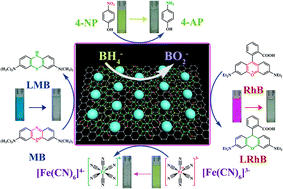
Based on the reasons mentioned above, we functionalized graphene synthesized through physical routes, instead of traditional GO, with polydopamine through direct self-polymerization of dopamine, which is facile and will be more useful for large scale preparation in the future. Furthermore, ultrafine Pd nanoparticles were used to decorate a graphene-polydopamine (GPDA) hybrid using a simple method that did not involve adding surfactant. To evaluate the catalytic activity of our catalyst, it was used in the reduction of 4-NP and K3[Fe(CN)6] by borohydride ions and its performance was compared with those of commercial grade palladium on carbon (CP) and graphene-Pd (GP) prepared using a similar process to that of graphene-PDA-Pd (GPDAP).39 The degradation of two famous dyes (MB and RhB) for was studied. The processes were recorded in situ using UV-vis spectrophotometry.
Fig. 2 shows Raman spectra of graphene, polydopamine and graphene-PDA (GPDA) hybrids. In the spectrum of graphene, there were two strongly-featured bands, the vibrational D band at 1350 cm−1 and the G band at 1580 cm−1. The D band arose from the defects at the edges of graphene and interaction with the substrate.42 Polydopamine also showed two broad bands at 1350 cm−1 and 1580 cm−1, coming from the vibration of aromatic rings and aliphatic C–C and C–O stretching.43 The sum of two constituents was observed in GPDA. The ratios of the intensity of peaks (ID/IG) before and after modification were calculated; these changed from 1.46 to 1.18 after modification with PDA, inferring the existence of fewer defects after decoration with PDA. This is because the defects on graphene were covered by polydopamine, which also possesses aromatic structures.44
TEM images of GPDAP compared with Graphene Pd are given in Fig. 3. A fabulous feature was that the Pd particles on GPDA were monodispersed and well-distributed, whereas the size of Pd in the absence of PDA not was as uniform as in the former. High resolution TEM (HRTEM) clearly visualized the aggregation of Pd in the absence of PDA and showed good monodispersity when PDA was added. By statistical analysis of the particle size distribution, as observed in the insets of Fig. 3(A) and (B), the mean particle size of Pd in GPDAP was found to be 2.0 nm and the particles possessed better monodispersibility, most of them being distributed in a narrow range from 1 to 3 nm. However, the diameter of Pd nanoparticles in GP was as large as 4.5 nm on average and ranged from 1 to 9 nm. This could be ascribed to catechol and amino groups stabilizing the particles and lowering the energy.41 In the HRTEM image, the interplanar spacing of the Pd lattice was clearly shown to be 0.226 nm, which matched well with the (111) plane of Pd (0.225 nm).45 Based on the TEM results, GPDAP had a larger surface area and more Pd atoms were exposed.
![]() | ||
| Fig. 3 TEM images of GP (A and C) and GPDAP (B and D). Inset: particle size distribution graphs of Pd nanoparticles in GP (A) and GPDAP (B) and HRTEM of GP (C) and GPDAP (D). | ||
XRD was used to study the structure of our catalysts. With regard to GP, the peaks in Fig. 4 demonstrated the existence of both graphite-like crystalline and Pd particles. The broad diffraction peak at 26.3° came from the (002) crystal plane of graphene. The other four peaks at 40.4°, 46.8°, 68.4° and 82.4° corresponded to the (111), (200), (220) and (311) crystalline planes of Pd particles.46 For GPDAP, similar features were presented. The average particle size of Pd in GPDAP calculated from the Pd (111) peak, according to Scherrer's formula, was 2.1 nm, which agreed well with the TEM result. The XRD result confirmed that the Pd particle was successfully immobilized on the graphene-polydopamine hybrid.
Typical XPS spectra of GP and GPDAP are depicted in Fig. 5. The existence of N 1s (400.8 eV) further confirmed that the graphene was decorated by PDA through π–π interaction. Peaks at 335.4 eV, which were assigned to 3d5/2 of Pd nanoparticles, indicated the existence of Pd in our catalysts.41,47 Comparing the high resolution XPS spectra of Pd in GPDAP with that of GP, the peak of Pd 3d5/2 for GP is 335.51 eV and that for GPDAP is 337.95 eV. An obvious shift of 2.44 eV was recognized after the decoration of PDA, which may be due to the strong interaction between the amino group or the catechol structure with Pd nanoparticles.
![]() | ||
| Fig. 5 (A) XPS wide-scan spectra of GPDAP and GP. (B) N 1s core level spectra of GPDAP and GP. (C) Pd 3d core level spectra of GPDAP and GP. | ||
For heterogeneous catalysts, the dispersibility in solution plays a key role in the catalytic activity. Based on the properties of hydroxyl groups on the surface, our catalyst showed fabulous dispersibility. Catalysts with and without added polydopamine were compared. As shown in Fig. 6, images were taken after 0 h (A), 2 h (B), 5 h (C) and 7 h (D). The concentrations of both solutions are 0.5 mg mL−1 and the solution started to precipitate after 7 days. Obviously, the dispersibility of GPDAP was significantly improved by polydopamine.
Therefore, to accurately demonstrate the catalytic ability of our catalysts, our catalysts (GPDAP, GP and CP) were used in two widely-used catalytic model reactions,39,48 viz., the reduction of 4-NP by sodium borohydride and the reduction of ferrocyanate(III),49 as shown in Fig. 6(E).
When studying the former model reaction, the extent of the reactions was monitored in situ by obtaining the UV-vis absorption spectra of the reactant mixture to ensure precise surveillance, because the reaction was so fast that to separate the products in such a short time was infeasible. A peak of the reactant 4-NP was shown at 400 nm and that of the product 4-aminophenol (4-AP) at 315 nm.50
Initially, a blank experiment was tried, during which no catalyst was added. The 4-NP solution was yellowish in colour, whereas it turned dark yellow after NaBH4 was added. Furthermore, the peak of 4-NP at 400 nm remained unchanged. This indicated that it cannot react in the absence of catalysts. Then, with catalysts (GPDAP, GP and CP) added in other experiments, the intensity of the peak of 4-NP at 400 nm decreased as the reaction extended and a new peak assigned to 4-AP appeared gradually at 315 nm. An interesting phenomenon was observed that the peak at 315 nm did not always increase as 4-NP was reduced. The inconsistency might be attributed to the absorption of products on graphene51,52 or the accumulation of intermediates.53
When 10 μL GPDAP was added, the intensity of absorption at 400 nm decreased sharply and the system turned transparent within 600 s, as shown in Fig. 7(A). However, the system catalyzed with GP became yellowish after 1000 s (Fig. S2†). We also tried an experiment with CP, the colour of which remained almost unchanged owing to low quantities of catalysts. Only in the spectra can we distinguish a decrease in the peak at 400 nm.
The concentration of BH4− was more than 100 times greater than that of 4-NP and the catalysts, therefore we could ignore the degradation of BH4− ions and treat the concentration of BH4− as a constant. Furthermore, because the concentration of NaBH4 was so high, we could treat the reduction as pseudo-first-order with respect to the concentration of 4-NP,54,55 that is, ln(A/A0) and time show a good linear relationship, therefore we can write the kinetic equation for the reaction as follows
Another famous reaction we used was the reduction of hexacyanoferrate(III) by borohydride. What is interesting about this reaction is that both states of the ions are stable and possess the same chemical composition. Because of these particularities, no induction period, which was often observed in reductions of organic dyes such as the 4-NP reduction had been observed in this reaction, as shown in Fig. 7(C). Like the former reaction, the reduction of hexacyanoferrate(III) was carried out on condition that BH4− was more in excess than [Fe(CN)6]3− to minimize the influence of the concentration of BH4− and to inhibit the hydrolysis of BH4−. The rate of reaction was monitored in situ by spectrophotometry with a decrease in the absorption at 420 nm. Interestingly, the presence of the catalysts changed the order of the reaction, as reported, from zero-order kinetics to first-order kinetics.49 To compare the rates before and after the addition of the catalysts and to simplify the experiment, we treated the reaction with no catalyst added as a first-order reaction, which did not affect the result of the experiment.
The rate constants for the reductions were k(GPDAP) = 2.330 × 10⁻² s−1, k(GP) = 4.260 × 10⁻³ s−1 and k(CP) = 2.650 × 10⁻³ s−1, as shown in Fig. 7(C and D) and the calculated values of factor k* (k*(GPDAP) = 4.660 × 10³ s−1 g−1, k*(GP) = 8.520 × 10² s−1 g−1 and k*(CP) = 5.300 × 10² s−1 g−1) indicated that the catalyst GPDAP showed higher catalytic activity than GP or CP. The remarkably high activity may originate from the high accessible surface area of the ultrafine Pd nanoparticles.
For further application of the catalyst, we applied our catalyst GPDAP to the reductive degradation of two major toxic chemicals produced by many industries, MB and RhB, as shown in Fig. 7(E–H); this reaction was compared with corresponding reactions with GP, CP and no added catalyst.
First, the reductive degradation of MB was studied. The absorption band that appeared at 665 nm corresponded to the n–π* transition of MB and the MB was reduced to leuco methylene blue (LMB).55–57 Due to the excess BH4−, these reactions were also treated as first-order reactions and the ratios of ln(At/A0) to time were calculated, as shown in Fig. 7(F). The ratio for the reaction without catalysts is k(blank) = 7.066 × 10⁻⁵ s−1. The reaction proceeded faster after adding GP and CP. To our surprise, after adding GPDAP, the reduction was greatly enhanced (k(GPDAP) = 2.040 × 10⁻² s−1). The degradation of MB to LMB was accomplished in less than 300 s in the presence of the ultrafine Pd catalyst, GPDAP. An induction time of about 150 s was observed during the reduction, owing to surface restructuring of the catalyst.58,59
The reduction degradation of another organic toxic chemical, RhB to leuco RhB (LRhB), which had often been used as a fluorescent dye, was then studied.60,61 The ratios of ln(At/A0) to time were calculated and the result was similar to that of MB. The activity of the catalyst GPDAP was much higher than that of GP or CP with an induction time of about 180 s. This was shown in Fig. 7(H) (k(GPDAP) = 2.146 × 10⁻² s−1, k(GP) = 1.550 × 10⁻⁴ s−1, k(CP) = 6.553 × 10⁻⁵ s−1 and k(blank) = 2.926 × 10⁻⁵ s−1). A summary of the constants for the catalytic reactions in this study is presented in Table 1. Compared with the results reported in other studies, shown in Table S1,† our catalysts showed higher catalytic activity.
| Catalyst | Substance | k (s−1) | Catalyst dosing | k* (s−1 g−1) |
|---|---|---|---|---|
| GPDAP | 4-NP | 4.7098 × 10⁻³ | 10 μg | 4.7098 × 10² |
| GP | 4-NP | 1.8349 × 10⁻³ | 10 μg | 1.8349 × 10² |
| CP | 4-NP | 1.2937 × 10⁻⁴ | 10 μg | 12.937 |
| None | 4-NP | 1.0153 × 10⁻⁵ | — | — |
| GPDAP | K3[Fe(CN)6] | 2.330 × 10⁻² | 5 μg | 4.660 × 10³ |
| GP | K3[Fe(CN)6] | 4.260 × 10⁻³ | 5 μg | 8.520 × 10² |
| CP | K3[Fe(CN)6] | 2.650 × 10⁻³ | 5 μg | 5.300 × 10² |
| None | K3[Fe(CN)6] | 4.310 × 10⁻⁴ | — | — |
| GPDAP | MB | 2.146 × 10⁻² | 1 μg | 2.146 × 10⁴ |
| GP | MB | 1.550 × 10⁻⁴ | 1 μg | 1.550 × 10² |
| CP | MB | 6.553 × 10⁻⁵ | 1 μg | 65.53 |
| None | MB | 2.926 × 10⁻⁵ | — | — |
| GPDAP | RhB | 2.040 × 10⁻² | 5 μg | 4.080 × 10³ |
| GP | RhB | 2.146 × 10⁻⁴ | 5 μg | 42.92 |
| CP | RhB | 1.452 × 10⁻⁴ | 5 μg | 29.04 |
| None | RhB | 7.066 × 10⁻⁵ | — | — |
It can been observed from Fig. 8 that the recovered catalysts still retained good catalytic activity with respect to the reduction of 4-NP, even after five cycles of 9 min, with a small decrease in conversion from 99% to 93%, which might be due to the loss of Pd. This result indicated that the catalyst had good stability, which was attributed to the strong interaction between PDA and Pd.
Footnote |
| † Electronic supplementary information (ESI) available. See DOI: 10.1039/c5ra13361k |
| This journal is © The Royal Society of Chemistry 2015 |