Krishna Gavvala,
Sagar Satpathi and
Partha Hazra*
Department of Chemistry, Indian Institute of Science Education and Research (IISER), Pune 411008, Maharashtra, India. E-mail: p.hazra@iiserpune.ac.in; Fax: +91-20-2589-9790; Tel: +91-20-2590-8077
First published on 11th August 2015
Molecular rotors have become indispensable tools in monitoring several important processes in chemistry and biology owing to their sensitivity towards viscosity. Despite their importance, less attention has been paid to understanding the excited state properties of molecular rotors. Recently, Maroncelli and coworkers unraveled the excited state photochemistry of a julolidine based molecular rotor, 9-(2-carboxy-2-cyano)vinyl julolidine (CCVJ), and claimed that CCVJ is not a simple rotor probe. Unlike other molecular rotors, photoisomerization is believed to be the main non-radiative decay pathway for this molecule. Inspired by their report, herein, we tried to understand how the excited state dynamics of CCVJ is affected inside the nano-cavities of cyclodextrins (CDs) and human serum albumin (HSA) protein using steady-state and femtosecond fluorescence up-conversion techniques. We observed a pronounced enhancement in fluorescence quantum yield when CCVJ is encapsulated in CDs (β- and γ-CD) and HSA. Femtosecond up-conversion studies reveal that the ultrafast dynamics of CCVJ are drastically retarded inside the nano-cavities of CDs and protein. All these results suggest that photoisomerization, which is believed to be the major non-radiative decay pathway of CCVJ, is severely restricted inside the abovementioned bio-mimetic and biological nano-cavities. The molecular images of orientations of CCVJ inside the nano-cavities of CDs and protein have been discussed by theoretical and molecular modeling studies. We believe the present results might be helpful in exploiting this molecule more in biological and viscosity sensing applications.
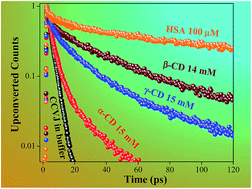
Herein, for the first time, we explored the ultrafast dynamics of CCVJ in an aqueous solution, CDs and HSA using the femtosecond fluorescence up-conversion technique. The excited state dynamics of CCVJ are found to be strongly dependent on the surrounding confinement effect of the medium. Importantly, the fluorescence quantum yield of CCVJ is enhanced many times in CDs and protein due to the retardation of non-radiative processes inside the nano-cavities of the hosts and HSA. Fluorescence lifetime of CCVJ becomes several times slower inside the nano-cavities of CDs and HSA, confirming the restriction of rotational motions of CCVJ inside the abovementioned constrained media. Finally, the possible orientations of CCVJ inside the nano-cavities of CDs and protein have been predicted by molecular modeling and theoretical studies.
Absorption measurements were performed on a Perkin-Elmer UV-visible spectrophotometer (Lambda-45) and steady-state fluorescence spectra were obtained with a Fluoromax-4 spectrofluorometer (Horiba Jobin Yvon). Time-resolved fluorescence measurements were initially collected on a time correlated single photon counting (TCSPC) spectrometer (Horiba Jobin Yvon IBH, U.K.). The detailed description of the instrument is described elsewhere.22 Briefly, in the present study, a 440 nm diode laser (∼100 ps, 1 MHz repetition rate) was used as the excitation source and a MCP-PMT detector was used for collecting the fluorescence signal. The analysis of the lifetime was done by the IBH DAS6 analysis software.
Ultrafast fluorescence decay transients were measured using a femtosecond fluorescence up-conversion setup (FOG 100, CDP) with a description given elsewhere.23 Briefly, the sample was excited at 420 nm using the second harmonic of a mode-locked Ti-sapphire laser (Mai-Tai, Spectra Physics). The fluorescence emitted from the sample was up-converted in another nonlinear crystal using a gate pulse (840 nm) of the fundamental beam. The sum frequency of the fluorescence and gate pulse was detected as a function of the time delay between excitation and gate pulses. The angle between the polarization of the pump and gate pulses was maintained at the magic angle to eliminate effects from rotational diffusion. The up-converted signal was dispersed in a monochromator and detected using photon counting electronics. A cross-correlation function obtained using the Raman scattering from ethanol provided a full-width at half-maximum (fwhm) of ∼350 fs. Estimated uncertainties in the up-conversion measurements are ∼15–20%.
Molecular docking was carried out by the standard protocol and the details are described elsewhere.24 CD was taken as the receptor and the anion form of CCVJ, i.e., the E isomer was used as the ligand in the docking protocol. During docking, the receptor was kept rigid and the ligand was flexible. For all docking, we used Gasteiger charges for both the CDs and the ligand. The grid was generated on a whole receptor with grid points of 60 on each of the orthogonal directions with a spacing of 0.16 Å. The search was performed using a genetic algorithm. Finally, all the docked complexes were fully optimized by PM3 semi-empirical methods using Gaussian software.25
![]() | ||
| Fig. 1 Absorption spectra of CCVJ (10 μM) in the presence of (a) α-CD (0 to 10 mM), (b) β-CD (0 to 10 mM) and (c) γ-CD (0 to 10 mM). Arrows indicate the direction of increasing concentration of CD. | ||
To gain insight into the excited state properties, emission profiles of CCVJ are monitored in the absence and presence of various cavity sized CDs. CCVJ exhibits weak fluorescence (Φf = 0.0016)11 with an emission maximum situated at 500 nm in a neutral buffer solution (Fig. 2). It is pertinent to mention that CCVJ exists mainly in the carboxylate form (E isomer) in buffer or water. However, when E isomers are excited, they convert to non-fluorescent Z isomers. Hence, the observed fluorescence spectrum with a peak of ∼500 nm is originated from the S1 state of the E isomers of CCVJ. In the presence of α-CD, a slight increase in fluorescence quantum yield is found (∼1.3 times) without showing any hypsochromic shift (Fig. 2a, Table 1). However, a significant alteration in emission profiles is observed in the presence of β-CD. Herein, a ∼10 fold enhancement in fluorescence quantum yield is noticed (Fig. 2b, Table 1) at the highest concentration of β-CD. Besides the increase in quantum yield, a hypsochromic shift from 500 nm to 475 nm is observed. The abovementioned findings infer a strong interaction between CCVJ and β-CD, whereas a weak interaction may prevail with α-CD. The observed hypsochromic peak shift suggests that E isomers are in a less polar environment in the presence of β-CD and it has been reported that the E isomer is sensitive to the polarity of the surrounding environment.21 This confirms that E isomers are displaced from the water environment, and subsequently, they are encapsulated inside the less polar nano-cavity of β-CD. The increase in fluorescence quantum yield can be ascribed to the inhibition of the photoisomerization process, which is believed to be the main non-radiative decay pathway of CCVJ.21 As there is no hypsochromic shift observed in the case of α-CD, the possibility of inclusion complex formation between α-CD and CCVJ can be ruled out. This is further justified considering the cavity size of CD (the internal cavity diameter of α-CD is 5.7 Å) and size of a CCVJ molecule (according to the geometry optimized structure, the width of a CCVJ molecule is ∼7 Å along the julolidine group and the length of a CCVJ molecule is ∼9.2 Å). However, partial inclusion complexes (incorporation of cyano, carboxy-vinyl group of CCVJ) as well as hydrogen bond interaction between the carboxyl group and –OH groups of α-CD cannot be ruled out. To confirm the latter possibility, we performed a control experiment with glucose. However, no significant enhancement in fluorescence intensity is observed (Fig. S1†), confirming that the hydrogen bond interaction between the carboxyl/cyano group of CCVJ and –OH groups is not responsible for the observed change in the presence of α-CD. Similar to β-CD, the fluorescence quantum yield of CCVJ increases continuously with gradual addition of γ-CD (Fig. 2c, Table 1), and at maximum γ-CD concentration, a ∼4.5 fold increase in fluorescence quantum yield along with a 10 nm hypsochromic shift is observed. Certainly, this increase as well as the shift is less compared to β-CD. The dissimilar extent of the rise in quantum yield in CDs is due to the different extent of rigidity felt by E isomers of CCVJ in various CDs. Therefore, the cavity size of the host has a major role in the observed changes in fluorescence quantum yield of CCVJ in different CDs. Among all three CDs, the increase in fluorescence quantum yield of CCVJ is more in the case of β-CD, and it is attributed to the more restricted environment inside the β-CD nano-cavity. Since the internal cavity diameter of β-CD is ∼7 Å and the depth of the cavity is ∼8 Å, a CCVJ molecule can perfectly fit inside the nano-cavity of β-CD, thereby, restricting its rotational motion along the vinyl bond as well as the twisting motion along the aryl–alkenyl single bond. On the other hand, the internal cavity diameter of γ-CD (∼9 Å) is large enough compared to the size of the E isomer. As a result, the incorporation of a CCVJ molecule into the γ-CD cavity cannot fully restrict the photo-isomerisation process, which is believed to be the main non-radiative decay pathway of the CCVJ molecule.21 The large hypsochromic shift inside the β-CD cavity is attributed to the less polar nano-cavity experienced by the E isomer of CCVJ compared to the γ-CD nano-cavity. To gain more insight into the inclusion complex formation, stoichiometry and association constants are calculated using the Benesi–Hildebrand (BH) equation.26
![]() | (1) |
:
1 stoichiometry for both β- and γ-CD. The association constants for β- and γ-CD are calculated to be ∼1300 (±100) M−1 and 450 (±20) M−1, respectively. The three times higher binding constant for β-CD is in good agreement with our conjecture that CCVJ forms a more stable inclusion complex with β-CD than γ-CD.
| Sample | a1a | τ1 (ps) | a2b | τ2 (ps) | Φfc | kr (ns)−1 | ∑knr (ns)−1 |
|---|---|---|---|---|---|---|---|
| a Relative amplitude for τ1.b Relative amplitude for τ2.c ∼10% error in measurement. | |||||||
| CCVJ in buffer | 1.00 | 2.87 | — | — | 0.0016 | 0.56 | 347.87 |
| α-CD 15 mM | 0.90 | 2.90 | 0.10 | 16.00 | 0.0024 | 0.15 | 62.35 |
| β-CD 14 mM | 0.35 | 2.90 | 0.65 | 35.00 | 0.02 | 0.57 | 28.00 |
| γ-CD 15 mM | 0.56 | 3.00 | 0.44 | 24.00 | 0.0087 | 0.36 | 41.30 |
| HSA 100 μM | 0.25 | 3.00 | 0.75 | 84.00 | 0.0895 | 1.07 | 10.84 |
For the further understanding of radiative and non-radiative decay pathways, we calculated radiative (kr) and non-radiative (knr) decay rate constants using the following equations:
![]() | (2) |
![]() | (3) |
The calculated decay rate constants (considering the lifetime component of bound CCVJ) are summarized in Table 1. Herein, it is pertinent to mention that the long lifetime components, which reflect the lifetime of bound CCVJ, are considered for calculating kr and knr. The very low kr and high knr values are in good agreement with the very low fluorescence quantum yield as well as the faster lifetime component of CCVJ in water. In the presence of α-CD, the kr value increases ∼3.5 times; however, the knr value decreases almost 5.5 times. Considering the steady state and lifetime results, the increase in kr and decrease in knr values may be attributed to the formation of a partial inclusion complex between CCVJ and α-CD. In the presence of β-CD, an almost 14 times reduction in knr confirms that the non-radiative internal rotations are drastically reduced inside the nano-cavity of the supramolecular host. For γ-CD, similar observations are found. However, in this case, the suppression of knr is less (∼8.75 times) when compared to β-CD. The lower knr value inside the β-CD nano-cavity can be attributed to the formation of a more rigid inclusion complex with the E isomer, hence the restriction of internal molecular rotations (includes photoisomerization process21) is increased. In summary, lifetime results and decay rate constants are in good agreement with steady state findings.
![]() | ||
| Fig. 4 Absorption (a) and emission (b) spectra of CCVJ (10 μM) in the presence of HSA (0 to 100 μM). Excitation wavelength is 430 nm. Arrows indicate the direction of increasing concentration of HSA. | ||
To gain deeper insight into the underlying photo-physical behaviour of the rotor upon interaction with the protein, fluorescence lifetime measurements were performed for CCVJ in the presence of a protein environment. The fluorescence up-converted decay profile of CCVJ in the presence of HSA exhibits a comparably slow lifetime (∼84 ps) component (Fig. 3). This time constant is certainly higher than for the CCVJ:β-CD complex, wherein a ∼35 ps lifetime component is observed. Moreover, a 30 times decrease in the knr value compared to uncomplexed CCVJ is observed. Lower knr and longer lifetime values compared to CDs confirm that the inhibitions of non-radiative internal molecular rotations are more inside the protein nano-cavity. As the E to Z conversion is one of the major non-radiative decay pathways,21 we believe that this conversion process is restricted more inside the protein nano-cavity compared to cyclodextrin nano-cavities.
![]() | ||
| Fig. 5 Geometry optimized structures of inclusion complexes of CCVJ with (a) α-CD, (b) β-CD and (c) γ-CD. | ||
To locate the dye in a protein nano-cavity, CCVJ is docked with HSA. The negatively charged E isomer of CCVJ is taken as the ligand because it exists as an anion in solutions. Fig. 6 shows the CCVJ docked protein complex with minimum energy in the cluster analysis. The most stable or least energetic structure clearly depicts that CCVJ resides at the domain II (IIA) binding pocket of the protein. This binding site is well-known to have higher binding affinities for negatively charged ligands,27–30 and therefore the location of CCVJ in this binding pocket is justified. The less polarity at this binding site27–30 is believed to be responsible for observed blue shift in steady state emission spectrum. Moreover, the negatively charged E isomer of CCVJ is surrounded by positively charged basic amino acid residues, Lys286, Arg257, Lys289 and His242. These basic amino acids may be the main driving force for attracting CCVJ towards the binding pocket IIA of the protein. In particular, carboxy and cyano groups of CCVJ are involved in hydrogen bond interactions with two basic amino acids (Lys199 and Arg222). Therefore, the E isomer of CCVJ is believed to be stabilized by positively charged amino acids located at this binding site through both electrostatic and hydrogen bonding interactions (Fig. 6b).
![]() | ||
| Fig. 6 (a) Docked structure of CCVJ complex with HSA. (b) Interaction of CCVJ with amino acids at the binding pocket. | ||
Footnote |
| † Electronic supplementary information (ESI) available. See DOI: 10.1039/c5ra13298c |
| This journal is © The Royal Society of Chemistry 2015 |