
Thermal deoxygenation causes photoluminescence shift from UV to blue region in lyophilized graphene oxide

Veeresh Kumar*ab, Vivek Kumar a, G. B. Reddya and Renu Pasricha§ *b
aDepartment of Physics, Indian Institute of Technology, New Delhi-110016, India
bCSIR-National Physical Laboratory, New Delhi-110012, India. E-mail: renup@ncbs.res.in; phz098586@physics.iitd.ernet.in

Received 1st July 2015 , Accepted 17th August 2015

First published on 18th August 2015


Abstract

Lyophilized graphene oxide (GO) was thermally exfoliated in stages at predefined temperatures up to 400 °C, and photoluminescence (PL) study of GO and thermally reduced GO (TGO) was carried out at each step. A significant red shift in the PL emission peak (412 nm) was found on annealing GO at 400 °C in comparison to as-synthesized GO (365 nm). In addition, the PL emission at 457 nm in case of as synthesized GO, which is related to topological defects was quenched conspicuously. Samples were characterized using X-ray photoelectron spectroscopy (XPS), UV-visible spectroscopy, Fourier-transform infrared (FTIR) spectroscopy and Raman spectroscopy. Morphological characterization was performed using scanning electron microscopy (SEM) and atomic force microscopy (AFM). The detailed analysis presented might help in highlighting and understanding the structural changes related to deoxygenation and the PL emission mechanism of graphene derivatives synthesized at lower temperatures. The study can also be used a tool for comprehending tunable PL emissions for future optoelectronic applications.

1. Introduction

Graphene has attracted enormous interest in the field of applied as well as fundamental research because of its unique and extraordinary electrical, mechanical and thermal properties.1,2 Tight-binding calculations show that in graphene the conduction and valence bands touch each other at a point and thus graphene is termed as a zero-gap semiconductor.3,4 This zero band gap of graphene limits its application in photonic and optoelectronic devices. Theoretically predicted and experimentally observed results prove the possibility of the creation of a band gap in oxidized graphene5 by a systematic process of cutting and functionalization of graphene sheets.6 In this context, graphene oxide (GO) provides a perfect platform for synthesizing fluorescent graphene.7 GO is an insulator8 and can be described as graphene with oxygen-containing functional groups,7 which is dominated by the epoxy and hydroxyl functional groups on the basal plane and the carboxyl groups at the sheet edges.

GO displays interesting steady-state photoluminescence behaviour, which is very promising for novel optoelectronic applications.8,9 A blue shift10,11 and red shift12 in the fluorescence have been observed from as-synthesized GO to reduced GO. It has been shown by Xin et al. and Khai et al. that PL of GO can be tuned by varying the concentration of the reducing agent13 or increasing the time of thermal treatment.11 However, the origin of the PL mechanism is still a debatable subject. There are many earlier reports on PL emission and its origin in GO and reduced GO synthesized by different methods, such as chemical reduction,13,14 hydrothermal reduction,15 photochemical reduction16 and thermal reduction, at high temperature and very low pressure.11,17 In these reports, the origin of PL is attributed to disorder-induced states and newly formed graphitic domains of sp2 clusters during reduction,11,18 bond distortions, which may contribute to the fluorescence of GO and reduced GO12 and or C[double bond, length as m-dash]O related localized electronic states of oxidation sites.19 In spite of all the above mentioned reports, the exact mechanism of the origin of PL in the reduction of GO is still not clearly understood. It is believed that a better understanding of the reduction mechanism will help open up an opportunity for tailoring the band gap of GO.

Herein, we demonstrate a mild thermal annealing procedure with no chemical treatments involved to control the PL emission. To the best of our knowledge, there are no reports available on PL emission and its tunability by thermal reduction at a relatively low temperature in the literature. This is the first detailed study on a shift in PL emission from the UV region to the blue region aided by a thermal reduction process. A PL mechanism has been proposed on the basis of XPS, FTIR and Raman spectroscopy results. Our results also demonstrate the advantages of the thermal reduction process over other reduction processes and provide a profound understanding of the origin of PL.

2. Experimental details

GO in an aqueous solution (given in ESI, Fig. S1) was prepared from natural graphite powder by the Hummers' method in the same way as reported in our earlier study.20 The as-obtained GO was dried by a lyophilization process and the recovered powder was collected and stored at room temperature in a desiccator. This process gives loosely stacked GO, which facilitates the full exposure of an individual sheet to a reduction procedure. GO was annealed for a very short duration (25 seconds) in the presence of nitrogen, starting from 100 °C and proceeding in steps of 100 °C to reach 500 °C. We selected GO annealed at 200 °C (GO-200) and 400 °C (GO-400) for our study because we found similar characterization results for the products that were obtained after annealing at 400 °C and 500 °C.

Scanning electron micrographs of all samples were obtained using a Zeiss EVO MF10 scanning electron microscope. Fourier-transform infrared (FTIR) spectra were obtained using a Nicolet 5700 FTIR spectrometer in the frequency range of 400–3800 cm−1. XPS studies were carried out by SPECS with a Mg/Al anode 25 kV X-ray source and a PHOIBOS HAS3500 150 R6 [HW Type 30[thin space (1/6-em)]:[thin space (1/6-em)]14] MCD-9 hemispherical analyzer. Raman spectra were obtained by an EVA Raman spectrometer. An Edinburgh luminescence spectrometer (model F900) equipped with a xenon lamp was used to obtain PL spectra.

3. Results and discussions

Fig. 1 shows the SEM images of GO, GO-200 and GO-400 samples as obtained (i.e. in the dried form; images of GO and annealed GO are given in the ESI, Fig. S2). The morphology of as-prepared GO illustrated in Fig. 1(a) shows wrinkled and stacked GO sheets. When GO was treated at 200 °C, the stacking and wrinkling of GO sheets were disturbed and significantly reduced, as seen in Fig. 1(b). This may be due to the pressure created by the release of CO2.21 The formation of CO2 is due to the decomposition of carboxylic and ketone groups in GO.22 At this temperature, the release of carbon atoms from the layers also gives rise to defects in the sheets during exfoliation. At 400 °C, complete exfoliation of GO was observed and the increased lateral dimensions of sheets indicate the formation of good-quality graphene. In Fig. 1(c), the underlying sheets (as pointed by red arrows) can also be observed in the SEM images due to the increased transparency of the graphene sheets after the thermal treatment, this is an important parameter indicating the formation of graphene. Furthermore, we carried out AFM measurements to confirm the presence of single layers in annealed GO. The micrographs and details of GO and GO-400 are given in ESI, Fig. ​S3.
image file: c5ra12793a-f1.tif
Fig. 1 SEM images of (a) as-prepared GO, (b) GO-200 and (c) GO-400. The large size and transparency of sheets in (c) clearly indicate the full exfoliation of GO and formation of graphene sheets. The arrows show the transparent sheets.

This stepwise reduction of GO has been confirmed by FTIR results. Fig. 2 shows the FTIR spectra of GO and reduced GO samples. The 3400 cm−1 band seen in Fig. 2(a) is attributed to the vibrations related to the hydroxyl groups, which arise due to the presence of water molecules and carboxyl groups. Carbonyl groups (1723 cm−1),23 epoxy (C–O–C ∼ 1222 cm−1) and alkoxy groups (C–O ∼ 1050 cm−1)24 were all observed in GO (Fig. 2(a)). Quenching of the 3400 cm−1 band and shifting of the 620 cm−1 band (observed in GO) to 1580 cm−1 (C[double bond, length as m-dash]C vibrations) along with C–O–C stretching vibrations (1230 cm−1) were observed in the GO-200 sample (Fig. 2(b)). The different carbonyl compounds, in which oxygen forms bonds in the rings and at the edges, have all been removed in the GO-200 sample.25 The increase in the intensity of C[double bond, length as m-dash]C vibrations and reduction in carbonyl groups in the GO-400 sample (curve c) clearly demonstrate the enhanced quality of the graphene sheets. UV-vis spectra of GO and GO-400 were also obtained, details of which are given in the ESI, Fig. ​S4.


image file: c5ra12793a-f2.tif
Fig. 2 FTIR spectra of (a) as-prepared GO, (b) GO-200 and (c) GO-400.

Fig. 3 shows the Raman spectra of GO and reduced GO samples obtained at different annealing temperatures. Both GO and TGOs display two prominent peaks (D band and G band). The peak at 1380 cm−1, which is labelled as the D band, corresponds to the breathing modes of rings or K-point phonons of A1g symmetry, whereas the G band at 1580 cm−1 corresponds to an E2g mode of graphite and is related to the vibration of sp2-bonded carbon atoms in a two-dimensional hexagonal lattice. The ratio of the intensity of the G band to that of the D band is related to the in-plane crystallite size, La. The in-plane crystallite sizes of GO, GO-200 and GO-400, which were calculated using the relationship La (nm) = 4.4/(ID/IG),26 were about 4.3 nm, 4.7 nm and 5.6 nm, respectively, for which the corresponding ID/IG ratios were 1.01, 0.99 and 0.79, respectively. The reduction process enables the restoration of sp2 domains, which results in a decrease in the defect density. The low ID/IG ratio observed in Raman spectra with an increase in the annealing temperature agrees well with this fact. We also compared the Raman spectra of chemically reduced GO (CRGO) and GO-400 and found that GO-400 was of better quality than CRGO (ESI Fig. ​S5).


image file: c5ra12793a-f3.tif
Fig. 3 Raman spectra of (a) as-prepared GO, (b) GO-200 and (c) GO-400.

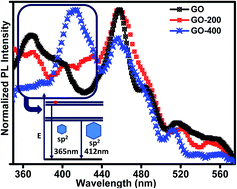
Fig. 4 presents comparison curves of PL spectra collected for GO, GO-200 and GO-400 under 300 nm excitation. It can be observed from Fig. S2(a) and (b) that all samples were in the dried form, not in any dispersion, because the dispersibility of GO decreases with reduction, which might affect the results. For the GO sample (curve a), five peaks of different emission intensity were observed centred at 365 nm, 457 nm, 484 nm, 515 nm and 557 nm. PL emission in the case of GO at 367 nm under 250 nm excitation has also been reported earlier.27 The calculated 4.3 nm size of an sp2 domain for GO alone may not be responsible for the 365 nm emission as this will contain more than 200 atomic rings, resulting in a very narrow band gap. Eda et al. reported that the origin of emission in the near UV region is due to the localization of sp2 domains into the sp3 matrix2 and therefore the 365 nm emission can originate from the sp2/sp3 matrix.


image file: c5ra12793a-f4.tif
Fig. 4 Photoluminescence spectra of (a) as-prepared GO, (b) GO-200 and (c) GO-400.

The presence of 512 nm emission is due to the oxygen-related groups.14 From first-principles calculations as reported by Gan et al., the emission in the blue region (457 nm in our case) originates from topological defects, specifically 5-7-7-5 defects and 5-5-5-7-7-7 defects. They also emphasized that this blue emission is due to local vacancy-dimer defects and can never be shifted by varying the size of sheets. Therefore, to remove blue emissions, these defects should be removed. The higher transition probability and shorter lifetime of blue emissions in comparison to green emissions is the reason for the intense blue emission.14

As can be seen in the PL spectrum for the GO-200 sample, a low-intensity peak was observed at 368 nm (red-shifted in comparison to 365 nm), which confirmed the reduced localization. The presence of a blue emission with no shift in emission is in agreement with the presence of topological defects. In the GO-400 sample, the PL spectrum displayed only three emissions, which were centred at 412 nm, 456 nm and 512 nm. The emissions at 365 nm and 557 nm, as observed in the GO sample, were absent in the GO-400 sample. The sp2 domain size (∼5.6 nm), which was calculated from Raman data (ID/IG ratio) and most intense absorbance of the C[double bond, length as m-dash]C band in FTIR spectra (Fig. 2(c)) were in good agreement with the fact that sp2 localization in the sp3 matrix had decreased. Therefore, no emission was observed at 365 nm in GO-400. The 457 nm emission was minimized in the GO-400 sample, which displayed nearly the same intensity as in the cases of GO and GO-200.

To understand the structural changes during thermal reduction, XPS spectra of as-synthesized GO, GO-200 and GO- 400 were obtained and then correlated with PL emissions. Fig. 5(a) shows the XPS scan of GO. We found four components after Gaussian fitting of the experimentally observed data. Theoretical predictions for the C 1s component and functional groups that were attached to carbon atoms matched our observations. As reported in the literature,28–30 a peak for the sp2 hybridized carbon was observed at 284.6 ± 0.1 eV. When oxygen in the hydroxyl form forms a bond with a carbon atom, a higher shift of 1–1.5 eV in binding energy was observed in comparison to the sp2 component.30 The component at 286.1 eV is assigned to C–OH and matches well with the expected shift. Two other components at 287.3 eV and 288.6 eV can be assigned to carbonyl (C[double bond, length as m-dash]O) and carboxyl (O[double bond, length as m-dash]C–OH), respectively. XPS data show a mixture of a C6 ring network along with sp3 hybridized carbon that is formed by the presence of oxygen-containing functional groups.28,29 This mixture is responsible for the PL emission at 357 nm.


image file: c5ra12793a-f5.tif
Fig. 5 Typical C 1s XPS spectra of (a) as-prepared GO, (b) GO-200 and (c) GO-400. (d) shows the content of the sp2 fraction as a function of the annealing temperature.

When the sample was heated at 200 °C for a very short duration, the carboxyl component disappeared, as can be seen in Fig. 5(b). The intensity of the C–OH and C[double bond, length as m-dash]O components decreased in comparison to the sp2 component, which indicates the restoration of the sp2 network. Herein, the C[double bond, length as m-dash]O component was found to decrease in intensity with an increased full width at half maximum (FWHM). The reason for the increase in FWHM can be understood by the fact that there is a large uncertainty in the position and intensity of the C 1s peak (at ∼288 eV), because of the difficulty in distinguishing it from π–π* transitions.29

In the XPS spectra of GO-400, which are given in Fig. 5(c), the intensity of the C[double bond, length as m-dash]O component again decreased to the minimum value. Some groups (mostly in C–O form) remained bonded to graphene sheets; however, it is difficult to remove these groups by the thermal treatment.31 We calculated the percentage of the sp2 fraction and found that for the GO-400 sample it was the maximum. The percentage of the sp2 fraction was calculated by the following formula:

 
image file: c5ra12793a-t1.tif(1)
where A is the area under the peaks marked in the XPS spectra. Fig. 5(d) presents the percentage of the sp2 fraction as a function of the reducing temperature.

The increase in the fraction of sp2 carbon due to the thermal treatment confirms that deoxygenated carbon atoms form bonds with other carbon atoms to complete a ring. Therefore, localization of sp2 domains in an sp3 matrix decreases, which in turn results in a shift in PL emission from 365 nm in GO to 412 nm in GO-400. The intensity of PL emission at 457 nm decreased but no shift was observed in this emission. It can be concluded from PL that the number of defects like 5-7-7-5 defects and 5-5-5-7-7-7 defects decreased at 400 °C and good quality of graphene sheets was achieved.

Fig. 6 depicts the proposed PL mechanism for reduced GO. The structural changes in GO and GO-400 are shown in Fig. 6(a). In GO, smaller sp2 domains surrounded by an sp3 structure create a larger band gap due to the confinement phenomenon. These structures are responsible for emission at 365 nm. The presence of defect structures is responsible for emission at different wavelengths. Thermal reduction of lyophilized GO (GO-400 sample) increases the domain size and also reduces the amount of topological defects, as proved by Raman and FTIR spectra. The value of the energy gap due to topological defects does not decrease with an increase in domain size. Only the transition rate from these defect states changes; therefore, a remarkable reduction in PL intensity was found in the GO-400 sample. The energy gap due to the sp2/sp3 structure shifts towards lower energy due to reduced confinement (Fig. 6(b)). Most of the earlier reports indicate an increase in the ID/IG ratio after a reduction process but in our case there was a decrease in this ratio, which indicates an enlargement of sp2 domains, as shown in Fig. 6(a). Therefore, taking the PL study into account, it can be concluded that the GO-400 sample is nearly defect-free. Herein, it can be noted that no chemical treatment has been used for the reduction of GO, and this reduces the probability of the presence of chemical contaminants, which might hamper the reproducibility of results.


image file: c5ra12793a-f6.tif
Fig. 6 Schematics of observed PL mechanism, (a) shows the increased size of an sp2 domain after reduction, (b) shows a band diagram with emissions from different states.

4. Conclusions

In conclusion, the shift in the PL emission from the near UV to the blue region has been systematically discussed in GO and TGO along with the structural changes during thermal reduction. The reduced intensity of PL emission at 457 nm in GO-400 is correlated with the minimization of topological defects. On the basis of a decrease in defects at temperatures as low as 400 °C, thermal reduction of lyophilized GO can be considered superior to other reduction processes for producing good-quality graphene. FTIR and Raman analyses revealed that labile oxygen functionalities are progressively eliminated, thereby restoring a π-conjugated network. This was further corroborated by XPS studies based on quantitative analysis of each carbon component associated with different chemical functionalities. A systematic study of the shift in PL emission from the UV to the blue region helped us to propose that an increase in the fraction of sp2 domains over that of sp3 domains was responsible for this phenomenon. This will allow the tailoring of the optical and electrical properties of GO sheets and also help the in-depth understanding of PL emission in graphene derivatives.

Acknowledgements

Veeresh Kumar thanks the University Grant Commission (UGC), Govt. of India for the research fellowship. The authors sincerely thank the Director, National Physical Laboratory-CSIR, New Delhi for allowing us to carry out research in this field.

References

  1. A. K. Geim and K. S. Novoselov, Nat. Mater., 2007, 6, 183 CrossRef CAS PubMed.
  2. G. Eda, Y. Y. Lin, C. Mattevi, H. Yamaguchi, H. A. Chen, I. Chen and M. Chhowalla, Adv. Mater., 2010, 22, 505 CrossRef CAS PubMed.
  3. P. R. Wallace, Phys. Rev., 1947, 71, 622 CrossRef CAS.
  4. F. Bonaccorso, Z. Sun, T. Hasan and A. C. Ferrari, Nat. Photonics, 2010, 4, 611 CrossRef CAS PubMed.
  5. M. Acik and Y. J. Chabal, J. Mater. Sci. Res., 2013, 2, 101 CAS.
  6. C. Galande, A. D. Mohite, A. V. Naumov, W. Gao, L. Ci, A. Ajayan, H. Gao, A. Srivastava, R. B. Weisman and P. M. Ajayan, Sci. Rep., 2011, 1, 85 Search PubMed.
  7. V. Kumar, N. Bahadur, D. Sachdev, S. Gupta, G. B. Reddy and R. Pasricha, Carbon, 2014, 80, 290 CrossRef CAS PubMed.
  8. M. Acik, G. Lee, C. Mattevi, M. Chhowalla, K. Cho and Y. J. Chabal, Nat. Mater., 2010, 9, 840 CrossRef CAS PubMed.
  9. J. Shang, L. Ma, J. Li, W. Ai, T. Yu and G. G. Gurzadyan, Sci. Rep., 2012, 2, 792 Search PubMed.
  10. G. Eda, Y. Y. Lin, C. Mattevi, H. Yamaguchi, H. A. Chen, I.-S. Chen, C. W. Chen and M. Chhowalla, Adv. Mater., 2010, 22, 505 CrossRef CAS PubMed.
  11. T. V. Khai, H. G. Na, D. S. Kwak, Y. J. Kwon, H. Ham, K. B. Shim and H. W. Kim, J. Mater. Chem., 2012, 22, 17992 RSC.
  12. Z. Luo, P. M. Vora, E. J. Mele, A. T. Charlie Johnson and J. M. Kikkawa, Appl. Phys. Lett., 2009, 94, 111909 CrossRef PubMed.
  13. G. Xin, Y. Meng, Y. Ma, D. Ho, N. Kim, S. M. Cho and H. Chae, Mater. Lett., 2012, 74, 71 CrossRef CAS PubMed.
  14. Z. Gan, S. Xiong, X. Wu, T. Xu, X. Zhu, X. Gan, J. Guo, J. Shen, L. Sun and P. K. Chu, Adv. Opt. Mater., 2013, 1, 926 CrossRef PubMed.
  15. C. H. Chuang, Y. F. Wang, Y. C. Shao, Y. C. Yeh, D. Y. Wang, C. W. Chen, J. W. Chiou, S. C. Ray, W. F. Pong, L. Zhang, J. F. Zhu and J. H. Guo, Sci. Rep., 2014, 4, 4525 Search PubMed.
  16. D. Kozawa, Y. Miyauchi, S. Mouri and K. Matsuda, J. Phys. Chem. Lett., 2013, 4, 2035 CrossRef CAS PubMed.
  17. T. V. Cuong, V. H. Pham, E. W. Shin, J. S. Chung, S. H. Hur, E. J. Kim, Q. T. Tran, H. H. Nguyen and P. A. Kohl, Appl. Phys. Lett., 2011, 99, 041905 CrossRef PubMed.
  18. C. T. Chien, S. S. Li, W. J. Lai, Y. C. Yeh, H. A. Chen, I. S. Chen, L. C. Chen, K. H. Chen, T. Nemoto, S. Isoda, M. Chen, T. Fujita, G. Eda, H. Yamaguchi, M. Chhowalla and C. W. Chen, Angew. Chem., Int. Ed., 2012, 51, 6662 CrossRef CAS PubMed.
  19. T. Gokus, R. R. Nair, A. Bonetti, M. Bo hmler, A. Lombardo, K. S. Novoselov, A. K. Geim, A. C. Ferrari and A. Hartschuh, ACS Nano, 2009, 3, 3963 CrossRef CAS PubMed.
  20. V. Kumar, A. Kumar, A. M. Biradar, G. B. Reddy, D. Sachdev and R. Pasricha, Liq. Cryst., 2014, 41, 1719 CrossRef CAS PubMed.
  21. M. J. McAllister, J. L. Li, D. H. Adamson, H. C. Schniepp, A. A. Abdala, J. Liu, M. H. Alonso, D. L. Milius, R. Car, R. K. Prud’homme and I. A. Aksay, Chem. Mater., 2007, 19, 4396 CrossRef CAS.
  22. Z. Lin, Y. Yao, Z. Li, Y. Liu, Z. Li and C. P. Wong, J. Phys. Chem. C, 2010, 114, 14819 CAS.
  23. M. Acik, G. Lee, C. Mattevi, A. Pirkle, R. M. Wallace, M. Chhowalla and Y. Chabal, J. Phys. Chem. C, 2011, 115, 19761 CAS.
  24. Z. Lin, Y. Yao, Z. Li, Y. Liu, Z. Li and C. P. Wong, J. Phys. Chem. C, 2010, 114, 14819 CAS.
  25. M. Acik, C. Mattevi, C. Gong, G. Lee, K. Cho, M. Chhowalla and Y. J. Chaba, ACS Nano, 2010, 4, 5861 CrossRef CAS PubMed.
  26. K. S. Subrahmanyam, S. R. C. Vivekchand, A. Govindaraj and C. N. R. Rao, J. Mater. Chem., 2008, 18, 1517 RSC.
  27. S. Shukla and S. Saxena, Appl. Phys. Lett., 2011, 98, 073104 CrossRef PubMed.
  28. D. Joung and S. I. Khondaker, Phys. Rev. B: Condens. Matter Mater. Phys., 2012, 86, 235423 CrossRef.
  29. A. V. Ellis, A. Al-deen, H. Dalal and G. G. Andersson, J. Phys. Chem. C, 2013, 117, 21312 CAS.
  30. A. Ganguly, S. Sharma, P. Papakonstantinou and J. Hamilton, J. Phys. Chem. C, 2011, 115, 17009 CAS.
  31. D. X. Yang, A. Velamakanni, G. Bozoklu, S. Park, M. Stoller, R. D. Piner, S. Stankovich, I. Jung, D. A. Field, C. A. Ventrice Jr and R. S. Ruoff, Carbon, 2009, 47, 145 CrossRef CAS PubMed.

Footnotes

Electronic supplementary information (ESI) available. See DOI: 10.1039/c5ra12793a
Present address: Department of physics, National Institute of Technology Meghalaya, Laitumkhrah, Shillong – 793003, Meghalaya, India.
§ Present address: National Centre for Biological Sciences-TIFR, Bangalore, India.

This journal is © The Royal Society of Chemistry 2015
Click here to see how this site uses Cookies. View our privacy policy here.