Base induced synthesis of 4H-1,4-benzothiazines and their computational studies

Simer Preet and Damanjt Singh Cannoo*
Department of Chemistry, Sant Longowal Institute of Engineering and Technology, Sangrur, PB, Longowal - 148106, India. E-mail: djs6311@gmail.com; Fax: +91-1672-280072; Tel: +91-1672-253200

Received 27th June 2015 , Accepted 7th September 2015

First published on 7th September 2015


Abstract

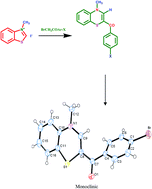
A one pot synthesis of 1,4-benzothiazines from 1,3-benzothiazolium cations and α-haloketones through ring expansion under ultrasonication was carried out by employing optimal 5% sodium hydroxide and characterization was done with the help of various spectroscopic techniques viz. NMR, IR and mass spectrometry. Single crystal X-ray diffraction and computational studies of (4-bromophenyl)(4-methyl-4H-benzo[b][1,4]thiazin-2-yl)methanone (3c) were also performed. Different concentrations of different bases (NaOH, Na2CO3, NaHCO3 solutions etc.) were used to obtain 1,4-benzothiazine derivatives. But, the best results were obtained with 5% NaOH solution (3.7 equivalents) for the synthesis of single product 1,4-benzothiazine derivatives while, with other concentrations, the reaction did not proceed to a single product. Quantum chemical calculations were done to find the optimized geometry and to correlate the experimental and calculated values of the bond parametres and 13C NMR chemical shifts of the synthesized compound. The optimized geometry was obtained using density functional theory (DFT) with the basis set 6-31G(d). The theoretical values of the 1H NMR chemical shifts were in agreement with the experimental values. The photophysical properties of some of the synthesized compounds were studied with the help of ultraviolet-visible and fluorescence spectroscopy.

1. Introduction

Heterocycles having more than one heteroatom have been a focus due to their multifarious biological activities.1 Amongst these, six membered heterocycles especially 1,4-benzothiazines, owing to the presence of nitrogen, carbon and sulfur linkages, have attained importance due to their wide range of applications in different fields like the pharmaceutical, medicinal, therapeutic and agricultural fields etc.2 1,4-Benzothiazine derivatives possess numerous biological activities viz. antibiotic, anticancer, antiviral, antifungal, antimicrobial, antiparkinson, anti-inflammatory, antihypertensive, antitumor, anti-aldose reductase, anti-rheumatic, anti-arrhythmic, anti-HIV and anti-allergy activity etc.3–7 Some of these moieties have even been known to be better antipyretics and analgesics in comparison with aspirin.8 A well known anti-psychotic drug, phenothiazine comprises of a benzothiazine core nucleus.9 It has been reported that a slight change in the substituents of 1,4-benzothiazine derivatives can cause a significant change in their activities.9

In view of the above, various synthetic methodologies have been developed to synthesize 1,4-benzothiazines and their derivatives viz. cyclocondensations and, to a lesser extent, ring transformations.4,5,10 The most general ones involve cyclocondensation of 2-aminobenzothiazole with α,β-unsaturated acids or esters, or electron deficient alkynes; cyclocondensation of 2-aminobenzothiaoles with α-haloketones; condensation and oxidative cyclization of N-unsubstituted and N,N-dialkyldithioanilines with 1,3-dicarbonyls or esters; ring expansions of benzothiazolines using different oxidants like iodine and sulfuryl chloride to synthesize 1,4-benzothiazine and its derivatives.4,10 Even ring contractions of benzothiazepinones have been also reported in the literature for the synthesis of the above said moieties.4 The present finding belongs to the ring expansion category using a greener method i.e. ultrasonication. Ultrasonication has been an advantageous finding for synthetic chemistry especially in the case of reactions which require harsh reaction conditions and prolonged reaction times. Ultrasonication has been an enabling key advantage over conventional procedures and has taken organic synthesis to a reliable and sophisticated level with reductions in temperature and reaction times, and higher yields, selectivity and reproducibility. Ultrasonication enables optimization, avoids toxicity, reduces multistep reactions to a single step, and forms less byproducts.2–6,9,11–15

The present paper discusses the synthesis of 1,4-benzothiazine derivatives using a greener synthetic pathway, i.e. an ultrasonication method, and their characterization using NMR, IR, UV-vis and fluorescence spectroscopy and mass spectrometry. Also, single crystal X-ray diffraction and computational studies were done. 1H and 13C NMR are basic tools for the structural elucidation of any organic molecule. So, the experimental and calculated chemical shifts obtained are correlated to confirm the structure of the compound 3(c).

2. Computational study

The optimized molecular geometry, 1H NMR and 13C NMR calculations were performed using Gaussian 09W16 by DFT methods with the B3LYP (Beck three parameter Lee–Yang–Parr) exchange correlation functional, which combines the hybrid exchange functional of Becke,17 with the gradient–correlation functional of Lee et al.18 The 6-31G(d) basis set was used for calculations in the gas phase of the structure 3(c). The optimized geometry using the 6-31G(d) basis set was used in the 1H and 13C NMR calculations using DFT to characterize all stationary points as minima. The calculated geometrical parameters viz. bond lengths and bond angles were compared with the experimental geometrical parameters obtained from the single crystal X-ray data of compound 3(c). The optimized structural parameters using B3LYP/6-31G(d) are listed in Table 1 along with an optimized structure with atom numbers in Fig. 1. Table 1 shows that the optimized parameters were in good agreement with the X-ray crystal structure. The optimized bond length of C (11)–S and C (9)–N is 1.796 Å and 1.368 Å respectively. However, the actual bond lengths of C (11)–S and C (9)–N are 1.773 Å and 1.361 Å. The optimized bond angles for C (9)–N (1)–C (10) and C (7)–C (8)–S (1) are 123.1° and 118.2° respectively. Whereas the actual bond angles are 123.1° and 114.4°. The largest differences between the calculated and experimental bond lengths and bond angles are about −0.04 Å for S (1)–C (8) and −3.8° for C (7)–C (8)–S (1) respectively. The slight deviations in the single crystal X-ray data and the computed geometrical data are due to the fact that crystal packing interactions in the solid state are dominant in comparison with the optimized geometry of a molecule in the gas phase.
Table 1 Selected experimental and calculated bond parameters of compound 3(c)
Parameters Compound 3(c)
Experimental Calculated
Bond lengths (Å)
Br–C (1) 1.901 1.881
S (1)–C (8) 1.770 1.729
S (1)–C (11) 1.773 1.795
O (1)–C (7) 1.243 1.208
N (1)–C (9) 1.361 1.367
N (1)–C (10) 1.429 1.405
N (1)–C (12) 1.464 1.470
C (2)–C (3) 1.378 1.394
C (11)–C (16) 1.389 1.394
C (5)–C (6) 1.370 1.394
[thin space (1/6-em)]
Bond angles (°)
C (8)–S (1)–C (11) 99.9 101.4
C (9)–N (1)–C (10) 122.4 123.1
C (9)–N (1)–C (12) 118.3 118.4
C (10)–N (1)–C (12) 118.8 118.4
C (9)–C (8)–S (1) 122.0 123.4
C (7)–C (8)–S (1) 114.4 118.2
C (11)–C (10)–N (1) 120.9 121.7
C (13)–C (10)–N (1) 121.1 119.2
C (8)–C (9)–N (1) 127.2 123.1


image file: c5ra12442e-f1.tif
Fig. 1 Optimized structure of compound 3(c).

Shielding tensors for the structure of compound 3(c) were computed within the GIAO approach,19–22 by applying similar methods and the 6-31G(d) basis set as used for the geometrical optimization. It is pertinent to optimize the geometry of TMS and chloroform molecules in order to express the chemical shift in ppm. 1H and 13C NMR spectra were calculated using the 6-31G(d) basis set for the structure of compound 3(c). The equation, δi = σTMSσi was used to convert the calculated isotropic shielding constants σi to chemical shifts relative to TMS. The experimental and calculated 1H and 13C NMR chemical shifts (ppm) of compound 3(c) are listed in Table 2. Only a single value for the hydrogen atoms of CH3 groups is available in experimental 1H NMR, so the average of the calculated 1H NMR chemical shift values was used.

Table 2 Experimental and calculated 1H NMR and 13C chemical shifts for compound 3(c)a
  Experimental NMR Calculated NMR
a The first three rows refer to 1H NMR chemical shift and the last three represent 13C NMR chemical shifts.
–N–CH3 3.07 3.58
[double bond, length as m-dash]C–H 6.73 13.15
Ar–H 7.08 7.32
–N–C 36.2 52.6
–C[double bond, length as m-dash]O 187.5 165.9
Ar–C 128.7 128.7


For the 1H NMR of compound 3(c), the calculated singlet of [double bond, length as m-dash]C–H comes at δ = 13.1556 in comparison to the experimental value which is δ = 6.5332. The average calculated chemical shift of the N–CH3 protons comes at 3.5888 ppm whereas the experimental chemical shift was 3.07 ppm. The calculated C[double bond, length as m-dash]O chemical shift in the 13C NMR spectrum comes at 165.9 whereas in the experimental spectrum the peak is at 187.5 ppm. The carbon attached to the nitrogen atom in the experimental and calculated 13C NMR gives peaks at 36.2 ppm and 52.6 ppm respectively. The correlation value for the calculated and experimental 13C NMR chemical shifts was found to be 0.995 (Fig. 2). The experimental 13C NMR chemical shifts show good correlation which confirms the structure of compound 3(c). The optimized structure of compound 3(c) didn’t show any negative frequencies in the frequency optimized calculation which automatically confirms that the global minimum or equilibrium geometry has been found. The calculated energy of the optimized structure of compound 3(c) is −3716.03 a.u. and the dipole moment is 5.63 debye with the point group C1.


image file: c5ra12442e-f2.tif
Fig. 2 Plot of calculated vs. experimental 13C NMR chemical shifts (ppm) of compound 3(c).

3. Results and discussion

Numerous cyclocondensations have been reported for the synthesis of 4H-1,4-benzothiazines using multistep procedures and rigorous reaction conditions. The present study involves a one pot synthesis of 4H-1,4-benzothiazines from ionic liquid based N-methyl-1,3-benzothiazolium iodide or N-methyl-6-nitro-1,3-benzothiazolium iodide [prepared from 1,3-benzothiazole or 6-nitro-1,3-benzothiazole and methyl iodide (scheme is in the ESI)] and derivatives of phenacyl bromide in basic medium (Scheme 1). The structures of the synthesized 4H-1,4-benzothiazines were established through spectral data (1H NMR, 13C NMR, mass spectra, IR). The singlet in the 1H NMR of the products at δ 6.53 confirms the hydrolytic cleavage of C–S and alternate cyclization to a 1,4-benzothiazine ring. The singlet due to three protons within δ 3–4 shows the N–CH3 in the species (additional singlets at δ 3.8 (3H), δ 2.3 (3H) and δ 2.51 (3H) in 3(d), 3(e) and 3(h) are due to methoxy and methyl groups, respectively), whereas the multiplet within δ 6–8 confirms the presence of two phenyl rings in the product. The peak in the 13C NMR between δ 180–190 ppm [3(b), 3(d), 3(g)] shows the presence of C[double bond, length as m-dash]O in the compounds. Besides the above peaks in 1H and 13C NMR, the M+ values obtained from mass spectrometry correspond to the molecular weight of the compounds, however 3(b) and 3(c) show M+, m/z peaks at 302.1 and 304.1 (3[thin space (1/6-em)]:[thin space (1/6-em)]1) and 346.1 and 348.1 (1[thin space (1/6-em)]:[thin space (1/6-em)]1) which indicates the presence of chlorine and bromine in the said compounds. Similarly, M+, m/z peaks at 313 and 327 confirm compounds 3(f) and 3(h), respectively. Lastly, the structure of 3(c) was confirmed on the basis of single X-ray diffraction and DFT studies (discussed above). To validate the structure, analytical and calculated results were correlated and the values were in good accordance with each other which confirms the structure of compound 3(c).
image file: c5ra12442e-s1.tif
Scheme 1 Synthesis of 1,4-benzothiazine derivatives (3).

The reaction of N-methyl benzothiazolium iodide or N-methyl-6-nitro-1,3-benzothiazolium iodide with the α-haloketone was carried out with different concentrations of base (sodium hydroxide, sodium carbonate etc.). The optimum concentration of NaOH was 5% (3.7 equivalents), which provided the 1,4-benzothiazines. It has been observed that at higher concentrations of the base the product decomposed whereas, at lower concentration the reaction did not proceed to completion. The reaction was carried out by both conventional and greener routes (comparison table in the ESI). Employing the latter, i.e. through ultrasonication, the yield of the product was enhanced and a substantial reduction in the reaction time was observed. The use of N,N-dimethylformamide as a solvent along with a prolonged reaction time and lesser yield was noted in the conventional method in comparison to ultrasonication.

The reaction could be envisaged to proceed through initial nucleophilic attack of the hydroxide ion at C (2) of the N-methyl benzothiazolium iodide or N-methyl-6-nitro-1,3-benzothiazolium iodide to form a pseudobase 2(a) which could undergo hydrolytic C (2)–S cleavage to give 2(b) which further reacts with phenacyl bromide to form 2(c). The latter, under the reaction conditions is envisaged to generate α-thiocarbanion 2(d) which finally undergoes intramolecular cyclisation along with removal of H2O to give the target molecule 3 (Scheme 2).


image file: c5ra12442e-s2.tif
Scheme 2 Mechanism for the synthesis of 1,4-benzothiazine derivatives.

2.1. Single crystal X-ray diffraction study and the structural description

An X-ray diffraction study was done using an X Calibur EOS OXFORD Diffractometer at 293 (2) K. The structure was solved using a SHELX-97 software package.23 The non-hydrogen atoms were refined with anisotropic parameters. Compound 3(c) crystallizes in a monoclinic system with a refinement of 0.0587. The crystal has the space group P21/n and the cell formula unit was 4. The cell lengths of the crystal a, b and c are 11.7172 (19), 9.2242 (17) and 13.153 (2) respectively, and the angles are α = 90, β = 93.150 (16) and γ = 90. Graphite monochromator radiation of type MoKα with a wavelength of 0.71073 was used for the diffraction study. The bond angle of O1–C7–C8 is 118.7 (4)° which shows that C7 is sp2 hybridized and the bond length of O1–C7 of 1.243 (7) Å depicts its double bond character. Similarly that the bond length of C9–C8 is 1.345 (6) Å also reveals that C9 and C8 have a double bond between them. The ORTEP diagram of compound 3(c) [(4-bromophenyl)(4-methyl-4H-benzo[b][1,4]thiazin-2-yl)methanone] is shown in Fig. 3, the crystal close packing along the a, b, c coordinates is shown in the ESI and the structural data is given in Table 3.
image file: c5ra12442e-f3.tif
Fig. 3 ORTEP diagram of structure 3(c).
Table 3 Crystal data and structural refinement of compound 3(c). (4-Bromophenyl)(4-methyl-4H-benzo[b][1,4]thiazin-2-yl)methanone
CCDC no. 1050855
Empirical formula C16H12BrNOS
Formula mass 346.24
Temperature (K) 293
Crystal system Monoclinic
Space group P21/n
a, b, c (Å) 11.7172 (19), 9.2242 (17), 13.153 (2)
α, β, γ (°) 90, 93.150 (16), 90
Volume (Å3) 1419.5 (4)
Z 4
Density (calc)/g cm−3 1.620
Mu (MoKα) [mm−1] 3.0
Crystal size [mm] 0.13 × 0.18 × 0.24
Radiation [Angstrom] MoKα 0.71073
Theta Min, Max [degree] 3.3, 29.0
Refinement (R, wR, S) 0.0587, 0.1384, 1.00
Final R indices [I > 2σ(I) ] R1 = 0.0587, wR2 = 0.1130
R indices (all data) R1 = 0.1214, wR2 = 0.1387
R (int) 0.041
Reflection collected 3220
Independent reflections 1872
Goodness-of-fit on F2 0.999


2.2. Absorption spectra

The absorption spectra of compounds 3(c), 3(d), 3(g) and 3(i) were recorded in chloroform and DMSO and the spectra are shown in Fig. 4 and 5. The spectra reveal that the maximum absorptions for the above said compounds appear within the ranges of 180–200 and 290–300 owing to the presence of C[double bond, length as m-dash]O in the compounds. These absorptions are attributed to the π–π* and n–π* transitions respectively. Another absorption peak occurs in the range of 390–460 due to the benzothiazine chromophore. Similar absorption peaks in the spectra indicate that all the compounds have similar structures. The shift in absorption spectra of compounds 3(g) and 3(h) towards higher wavelength i.e. red shift is due to the presence of nitro group in these compounds.
image file: c5ra12442e-f4.tif
Fig. 4 UV-vis absorption spectra of compounds 3(c), 3(d), 3(g) and 3(i) in chloroform.

image file: c5ra12442e-f5.tif
Fig. 5 UV-vis absorption spectra of compounds 3(c), 3(d), 3(g) and 3(i) in DMSO.

2.3. Fluorescence

The emission spectra of compounds 3(c), 3(d), 3(g) and 3(i) are shown in Fig. 6, and the emission and excitation wavelengths are given in Table 4. The emission spectra of compounds 3(c), 3(d), 3(g) and 3(i) show peaks at 373 nm, 577 nm, 421 nm and 321 nm respectively. So, these compounds present a single fluorescence emission band which makes these compounds fluorescence active. The spectra in Fig. 6 show that compounds 3(c) and 3(d) are more fluorescence active in comparison to compounds 3(g) and 3(i).
image file: c5ra12442e-f6.tif
Fig. 6 Emission spectra of compounds 3(c), 3(d), 3(g) and 3(i) in chloroform.
Table 4 Maximum excitation and emission wavelengths of compounds 3(c), 3(d), 3(g) and 3(i) in CHCl3 solvent
Compound CHCl3
λex λem
3(c) 268 373
3(d) 457 577
3(g) 291 421
3(i) 296 321


3. Experimental

All the chemicals and solvents were purchased from Sigma Aldrich and were used without further purification. The melting points of the compounds were determined using melting point apparatus. An ultrasonic bath (LINCO, Ambala) was used to provide ultrasound waves with a frequency of 40 MHz. Thin layer chromatography (TLC) was performed with glass plates coated with silica gel G, which were exposed to iodine vapor to check the progress of the reaction. 1H and 13C NMR spectra were obtained in CDCl3 using a BRUKER ADVANCE II 400 NMR spectrophotometer instrument using tetramethylsilane (TMS) as an internal reference standard and the values are given in ppm (δ). Mass spectra were recorded on a Waters Q-T of Micromass (LC-MS) and a Shimadzu GCMS-QP 2010 gas chromatogram mass spectrometer. UV spectra were run on a UV-1800 (Shimadzu) and for the fluorescence spectroscopy, the spectra were recorded on a RF-5301 PC Spectrofluorophotometer (Shimadzu). The single crystal X-ray diffraction study was done using an X Calibur EOS OXFORD Diffractometer.

3.1. General procedure for the synthesis of N-methyl-1,3-benzothiazolium iodide or N-methyl-6-nitro-1,3-benzothiazolium iodide (2)

An equimolar mixture of 1,3-benzothiazole or 6-nitro-1,3-benzothiazole (1) (2.7038 g, 0.02 mol, 1 equivalent) and methyl iodide (1.245 mL, 0.02 mol, 1 equivalent) was subjected to ultrasonication under solvent free conditions for 4–5 h to obtain a light yellow colored solid. The solid thus obtained was washed with diethyl ether to remove unreacted material (yield: 95%).24

3.2. Procedure for the synthesis of the 1,4-benzothiazines (3)

3.2.1. Ultrasonication (green method). A mixture of N-methyl-1,3-benzothiazolium iodide or N-methyl-6-nitro-1,3-benzothiazolium iodide (2), the α-haloketone and 5% NaOH solution (18 mL, 3.7 equivalents) in methanol kept under ultrasonication for 25–30 minutes gives the 1,4-benzothiazines in better yield. The solid, thus separated was filtered, washed with hexane and recrystallized from chloroform.

3.3. Under phase transfer catalysis conditions

A mixture of N-methyl-1,3-benzothiazolium iodide or N-methyl-6-nitro-1,3-benzothiazolium iodide (2), the α-haloketone, 5% NaOH solution (18 mL, 3.7 equivalents) and tetrabutyl ammonium bromide (PTC as catalyst) (0.1 mol) in methanol kept under ultrasonication for 15–20 minutes gives the 1,4-benzothiazines in better yield (80–85%). The product was washed and recrystallized as in the above mentioned procedure.

3.4. Spectral data of selected compounds

3.4.1. (4-Methyl-4H-benzo[b][1,4]thiazin-2-yl)(phenyl)methanone (3a). Orange colored solid; mp: 170 °C; yield: 70%; ν = 1660 cm−1 (C[double bond, length as m-dash]O); 1H NMR (CDCl3, 400 MHz): δ = 3.06 (s, 3H, N–CH3), 6.51–6.53 (d, 1H, –C6H5 of benzothiazole ring, J = 8.0 Hz), 6.77 (s, 1H, [double bond, length as m-dash]CH), 6.83–6.88 (m, 2H, –C6H5 of benzothiazole ring), 6.92–6.96 (m, 1H, –C6H5 of benzothiazole ring), 7.39–7.43 (q, 2H, –C6H5 of benzene ring, J = 15.7 Hz, J = 6.9 Hz), 7.45–7.49 (m, 1H, –C6H5 of benzene ring), 7.52–7.54 (t, 2H, –C6H5 of benzene ring, J = 6.8 Hz); m/z 267 (M+), 224, 162, 130, 105, 77, 69, 51, 50.
3.4.2. (4-Chlorophenyl)(4-methyl-4H-benzo[b][1,4]thiazin-2-yl)methanone (3b). Orange colored solid; mp: 190 °C; yield: 72%; 1H NMR (CDCl3, 400 MHz): δ = 3.08 (s, 3H, N–CH3), 6.53–6.55 (d, 1H, –C6H5 of benzothiazole ring, J = 8.0 Hz), 6.74 (s, 1H, [double bond, length as m-dash]CH), 6.86–6.87 (d, 2H, –C6H5 of benzothiazole ring, J = 4.2 Hz), 6.93–6.97 (m, 1H, –C6H5 of benzothiazole ring), 7.38–7.40 (d, 2H, –C6H5 of benzene ring, J = 8.2 Hz), 7.47–7.50 (d, 2H, –C6H5 of benzene ring, J = 8.3 Hz); 13C NMR (100 MHz, CDCl3): δ 186.9 (C[double bond, length as m-dash]O), 149.3, 139.0, 137.0, 131.5, 129.9, 127.5, 127.2, 125.8, 125.3, 122.2, 113.3, 106.7 (C6H5), 40.4 ([double bond, length as m-dash]CH); m/z 301.1 (M + H+) (100%).
3.4.3. (4-Bromophenyl)(4-methyl-4H-benzo[b][1,4]thiazin-2-yl)methanone (3c). Orange colored solid; mp: 175 °C; yield: 75%; 1H NMR (CDCl3, 400 MHz): δ = 3.07 (s, 3H, N–CH3), 6.52–6.54 (d, 1H, –C6H5 of benzothiazole ring, J = 8.0 Hz), 6.73 (s, 1H, =CH), 6.85–6.86 (m, 2H, –C6H5 of benzothiazole ring), 6.92–6.96 (m, 1H, –C6H5 of benzothiazole ring), 7.40–7.42 (m, 2H, –C6H5 of benzene ring), 7.53–7.56 (m, 2H, –C6H5 of benzene ring); m/z 346; 348 (1[thin space (1/6-em)]:[thin space (1/6-em)]1) (M + H+) (100%).
3.4.4. (4-Methoxyphenyl)(4-methyl-4H-benzo[b][1,4]thiazin-2-yl)methanone (3d). Orange colored solid; mp: 168 °C; yield: 72%; 1H NMR (CDCl3, 400 MHz): δ = 3.07 (s, 3H, N–CH3), 3.85 (s, 3H, –OCH3), 6.51–6.53 (d, 1H, –C6H5 of benzothiazole ring, J = 7.9 Hz), 6.80 (s, 1H, [double bond, length as m-dash]CH), 6.84–6.90 (m, 2H, –C6H5 of benzene ring), 6.92–6.96 (m, 3H, –C6H5 of benzothiazole ring), 7.53–7.57 (m, 2H, –C6H5 of benzene ring); 13C NMR (100 MHz, CDCl3): δ 187.3 (C[double bond, length as m-dash]O), 161.9, 148.8, 139.6, 130.6, 130.4, 127.5, 127.1, 125.5, 122.4, 113.6, 113.0, 106.9 (C6H5), 55.4 (–C–OCH3), 40.2 ([double bond, length as m-dash]CH); m/z 297 (M+), 254, 162, 135, 107, 92, 77, 64.
3.4.5. (4-Methylphenyl)(4-methyl-4H-benzo[b][1,4]thiazin-2-yl)methanone (3e). Light orange/yellow colored solid; mp: 168 °C; yield: 78%; 1H NMR (CDCl3, 400 MHz): δ = 2.39 (s, 3H, –CH3), 3.0 (s, 3H, N–CH3), 6.51–6.53 (d, 1H, –C6H5 of benzothiazole ring, J = 8.0 Hz), 6.79 (s, 1H, [double bond, length as m-dash]CH–), 6.84–6.87 (t, 2H, –C6H5 of benzothiazole ring, J = 5.0 Hz), 6.91–6.96 (m, 1H, –C6H5 of benzothiazole ring), 7.20–7.26 (t, 2H, –C6H5 of benzene ring, J = 15.7 Hz), 7.44–7.46 (d, 2H, J = 7.9 Hz, –C6H5 of benzene ring); m/z 281 (M+), 236, 162, 119, 91, 77, 65, 39.
3.4.6. (4-Methyl-7-nitro-4H-benzo[b][1,4]thiazin-2-yl) (phenyl)methanone (3f). Dark purple colored solid; mp: 290 °C; yield: 76%; 1H NMR (CDCl3, 400 MHz): δ = 3.68 (s, 3H, N–CH3), 6.84–6.86 (d, 1H, –C6H5 of benzothiazole ring, J = 9.0 Hz), 7.01 (s, 1H, [double bond, length as m-dash]CH), 7.66–7.67 (d, 1H, –C6H5 of benzothiazole ring, J = 2.6 Hz), 7.83–7.86 (q, 1H, –C6H5 of benzothiazole ring, J = 11.6 Hz, J = 6.3 Hz), 7.56–7.61 (m, 3H, –C6H5 of benzene ring), 7.47–7.51 (m, 2H, –C6H5 of benzene ring); m/z 313 (M + H+).
3.4.7. (4-Chlorophenyl)(4-methyl-7-nitro-4H-benzo[b][1,4]thiazin-2-yl)methanone (3g). Dark purple colored solid; mp: 293 °C; yield: 78%; ν= 1781 cm−1 (C[double bond, length as m-dash]O); 1598 cm−1, 1366 cm−1 (NO2); 3068 cm−1 ([double bond, length as m-dash]C–H stretching); 743.23 cm−1 ([double bond, length as m-dash]C–H bending); 1H NMR (CDCl3, 400 MHz): δ = 3.14 (s, 3H, N–CH3), 6.84–6.86 (d, 1H, –C6H5 of benzothiazole ring, J = 9.0 Hz), 7.05 (s, 1H, [double bond, length as m-dash]CH), 7.53–7.55 (q, 2H, –C6H5 of benzothiazole ring, J = 8.5 Hz, J = 4.7 Hz), 7.61–7.66 (m, 3H, –C6H5 of benzene ring), 7.83–7.86 (q, 1H, –C6H5 of benzene ring, J = 11.6 Hz, J = 6.4 Hz); 13C NMR (100 MHz, CDCl3): δ 186.0 (C[double bond, length as m-dash]O), 149.6, 145.2, 143.9, 130.3, 128.5, 124.09, 123.57, 121.13, 113.89 (C6H5), 40.08 ([double bond, length as m-dash]CH); m/z 346 (M+), 316, 301, 177, 161, 141, 139, 113, 111.
3.4.8. (4-Bromophenyl)(4-methyl-7-nitro-4H-benzo[b][1,4]thiazin-2-yl)methanone (3h). Dark purple colored solid; mp: 295 °C; yield: 82%; 1H NMR (CDCl3, 400 MHz): δ = 3.10 (s, 3H, N–CH3), 6.50–6.52 (d, 1H, –C6H5 of benzothiazine ring, J = 8.00 Hz), 6.64 (s, 1H, [double bond, length as m-dash]CH), 7.43–7.45 (q, 2H, –C6H5 of benzene ring, J = 8.44 Hz, J = 4.84 Hz), 7.57–7.60 (q, 2H, –C6H5 of benzene ring, J = 8.44 Hz, J = 4.80 Hz), 7.65–7.66 (d, 1H, –C6H5 of benzothiazine ring, J = 2.52 Hz), 7.79–7.82 (q, 1H, –C6H5 of benzothiazine ring, J = 11.44 Hz, J = 6.32 Hz); m/z 390 (M+), 346, 222, 185, 155, 134, 104, 76.
3.4.9. (4-Methyl-7-nitro-4H-benzo[b][1,4]thiazin-2-yl)(p-tolyl)methanone (3i). Dark purple colored solid; mp: 297 °C; yield: 80%; 1H NMR (CDCl3, 400 MHz): δ = 2.51 (s, 3H, –CH3), 3.36 (s, 3H, N–CH3), 6.83–6.85 (d, 1H, –C6H5 of benzothiazole ring, J = 9.12 Hz), 7.01 (s, 1H, [double bond, length as m-dash]CH), 7.65–7.66 (d, 1H, –C6H5 of benzothiazole ring, J = 2.60 Hz), 7.83–7.86 (q, 1H, –C6H5 of benzothiazole ring, J = 11.60 Hz, J = 6.28 Hz), 7.50–7.52 (d, 2H, –C6H5 of benzene ring, J = 8.08 Hz), 7.28–7.30 (d, 2H, –C6H5 of benzene ring, J = 7.88 Hz); m/z 327 (M + H+), 226.

4. Conclusion

The synthesis of 1,4-benzothiazines through ultrasonication – a green methodology – requires less time and provides the target molecules in better yields. Furthermore, a DFT study was carried out for compound 3(c). The experimental and theoretical NMR values show good correlation which supports the structure of compound 3(c). The fluorescence spectra of compounds 3(c), 3(d), 3(g) and 3(i) reveal that these compounds exhibit excellent fluorescence activity.

Acknowledgements

The authors gratefully acknowledge the Sant Longowal Institute of Engineering and Technology (SLIET), Longowal and Punjab University (PU), Chandigarh for providing all the necessary facilities to carry out this research.

References

  1. Z. Qiao, H. Liu, X. Xiao, Y. Fu, J. Wei and Y. Li, Org. Lett., 2013, 15, 2594–2597 CrossRef CAS PubMed.
  2. A. M. A. Souza, S. T. P. Walfrido, L. F. C. Leite, M. C. A. Lima, S. L. Galdino and I. R. Pitta, Quim. Nova, 2010, 33, 562–565 CrossRef CAS.
  3. N. Kumar and A. K. Yadav, Indian J. Chem., 2008, 47B, 748–752 CAS.
  4. M. K. Parai and G. Panda, Tetrahedron Lett., 2009, 50, 4703–4705 CrossRef CAS PubMed.
  5. W. L. Li, S. B. Tian and F. Zhu, Sci. World J.,  DOI:10.1155/2013/838374 .
  6. M. Saadouni, T. Ghailane, S. Boukhris, A. Hassikou, N. Habbadi, R. Ghailane, M. Harcharras, A. Souizi and H. Amri, Org. Commun., 2014, 7, 77–84 Search PubMed.
  7. L. J. Meng, H. Zuo, Z. B. Li, G. Dupati, K. Jang, G. Moon, B. X. Zhao, J. Y. Miao and D. S. Shin, Res. Rep. Med. Chem., 2013, 3, 11–20 Search PubMed.
  8. D. Shahwar, U. Sana and N. Ahmad, Turk. J. Chem., 2013, 37, 262–270 CAS.
  9. V. V. Dabholkar and R. P. Gavande, Arabian J. Chem.,  DOI:10.1016/j.arabjc.2011.03.009.
  10. H. J. Pi, H. Liu, W. Du and W. P. Deng, Tetrahedron Lett., 2009, 50, 4529–4531 CrossRef CAS PubMed.
  11. N. Khandelwal, Abhilasha, N. Gautam and D. C. Gautam, J. Chem. Sci., 2013, 125, 85–93 CrossRef CAS.
  12. S. Aloui, I. Forsal, M. Sfaira, M. Ebn Touhami, M. Taleb, M. Filali Baba and M. Daoudi, Port. Electrochim. Acta, 2009, 27, 599–613 CrossRef CAS.
  13. R. V. Dengle, R. D. Ingle, S. P. Bondge and R. A. Mane, Indian J. Chem., 1999, 38B, 390–393 CAS.
  14. E. Mabrouk, A. Elachqar, A. Alami, A. El Hallaoui and S. El Hajji, Orient. J. Chem., 2010, 26, 1249–1255 CAS.
  15. R. N. Prasad and K. Tietje, Can. J. Chem., 1966, 44, 1247–1258 CrossRef CAS.
  16. M. J. Frisch, G. W. Trucks, H. B. Schlegel, G. E. Scuseria, M. A. Robb, J. R. Cheeseman, G. Scalmani, V. Barone, B. Mennucci, G. A. Petersson, H. Nakatsuji, M. Caricato, X. Li, H. P. Hratchian, A. F. Izmaylov, J. Bloino, G. Zheng, J. L. Sonnenberg, M. Hada, M. Ehara, K. Toyota, R. Fukuda, J. Hasegawa, M. Ishida, T. Nakajima, Y. Honda, O. Kitao, H. Nakai, T. Vreven, J. A. Montgomery Jr , J. E. Peralta, F. Ogliaro, M. Bearpark, J. J. Heyd, E. Brothers, K. N. Kudin, V. N. Staroverov, R. Kobayashi, J. Normand, K. Raghavachari, A. Rendell, J. C. Burant, S. S. Iyengar, J. Tomasi, M. Cossi, N. Rega, J. M. Millam, M. Klene, J. E. Knox, J. B. Cross, V. Bakken, C. Adamo, J. Jaramillo, R. Gomperts, R. E. Stratmann, O. Yazyev, A. J. Austin, R. Cammi, C. Pomelli, J. W. Ochterski, R. L. Martin, K. Morokuma, V. G. Zakrzewsi, G. A. Voth, P. Salvador, J. J. Dannenberg, S. Dapprich, A. D. Daniels, O. Farkas, J. B. Foresman, J. V. Ortiz, J. Cioslowski and D. J. Fox, GAUSSIAN 09, Revision, Gaussian, Inc., Wallingford CT, 2009 Search PubMed.
  17. A. D. Becke, Phys. Rev. A, 1988, 38, 3098–3100 CrossRef CAS.
  18. C. Lee, W. Yang and R. G. Parr, Phys. Rev., 1988, 37, 785–789 CAS.
  19. K. Wolinski, J. F. Hilton and P. Pulay, J. Am. Chem. Soc., 1990, 112, 8251–8260 CrossRef CAS.
  20. R. Ditchfield, Mol. Phys., 1974, 27, 789–807 CrossRef CAS PubMed.
  21. Calculation of NMR and EPR Parameters: Theory and Applications, ed. M. Kaupp, M. Bühl and V. G. Malkin, Wiley-VCH, Weinheim, 2004 Search PubMed.
  22. W. Koch and M. C. Holthausen, A Chemist’s Guide to Density Functional Theory, Wiley-VCH, Weinheim, 2001 Search PubMed.
  23. G. M. Sheldrick, SHELXTL-97, Program for Refinement of Crystal Structure, University of Gottingen, Gottingen, Germany, 1997 Search PubMed.
  24. S. Nadeem, M. A. Munawar, S. Ahmad, M. Smiglak, D. M. Drab, K. I. Malik, R. Amjad, C. M. Ashraf and R. D. Rogers, ARKIVOC, 2010, vii, 19–37 Search PubMed.

Footnote

Electronic supplementary information (ESI) available: Spectral data of the synthesised compounds along with copies of the 1H and 13C NMR, mass spectra and X-ray data. CCDC 1050855. For ESI and crystallographic data in CIF or other electronic format see DOI: 10.1039/c5ra12442e

This journal is © The Royal Society of Chemistry 2015
Click here to see how this site uses Cookies. View our privacy policy here.